Mongolia Monday: The Five Snouts, Part 3

I’ll have to be honest and say that currently I don’t know much about Mongolian sheep. I hope to learn more on the next trip.

I did find a United Nations FAO report that included the following information;
Sheep in Mongolia may be grouped into five types. The common native sheep are multipurpose and low in productivity. The other four are used more specifically for their meat (mutton), carpet wool, milk and good-quality lambskins. Grazing is on year-round pastures with no supplementary feeding, even under severe winter and spring conditions. The sheep are well adapted to the unfavourable ecological conditions of steep mountains and poor vegetation.

One distinctive feature of the native coarse wool fat-tailed sheep is noticeable when new grass grows on the pasture: at this time they grow rapidly, are easy to fatten and have a remarkable ability to store 4 to 6 kg of fat around the kidneys, mesentery and the tail bone. This fat is drawn on in winter and spring.

Sheep are reared according to the natural and economic conditions of the different regions in the country. Improvement achieved by crossing exotic, fine and semifine wool sheep breeds has been rapid in Mongolia and the results reasonably good. The average fleece weight of improved (cross-bred) fine and semi-fine wool sheep is two or three times higher than that of the native coarse wool of fat-tailed sheep. Wool quality has also improved.

There are five distinct sheep breeding zones:

· the northern mountain and grassland zone;
· the central steppe zone;
· the southern semi-arid zone;
· the southernmost, semi-desert zone of the Gobi;
· the Altay Mountains in the west.

The northern mountain grassland zone and the central steppe zone are given over to the breeding of fine and semi-fine wool sheep. In the southern semi-arid zone and the northern enclave, Mongolian fat-tailed sheep are purebred. Selection of breeding stock increases the quantity and improves the quality of the carpet wool.

In the extreme south, the semi-desert area of the Gobi has been allocated to Karakul breeding for lambskins. The production of mutton, fat and carpet wool takes place in the western part of the country and includes the Altay Mountains.

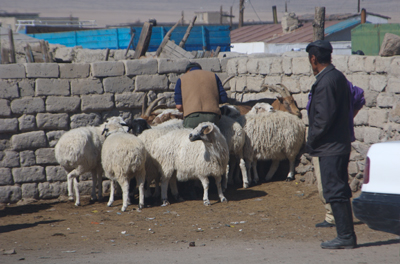
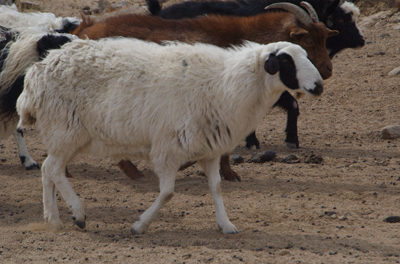
Here are some photos that I’ve taken of sheep.

A small flock at the market in Hovd, western Mongolia
“King of the Mountain” at Khar Us Nuur, also western Mongolia. Goats in the foreground, but that’s for next week.

Part of a large group of domestic livestock coming down to the stream to drink at Ikh Nartiin Chuluu Nature Reserve, south of Ulaanbaatar
Finally, for comparison, a wild argali, the world’s largest mountain sheep. This old ram with the amazing horns let me follow him around for almost 20 minutes. As you can see, he is very thin. It was late April and a lot of the animals, wild and domestic were in rough shape from the winter.

One of the main uses of the wool is to make the big pieces of felt which cover the gers. Depending on the weather, there can be one to three layers. I’ve slept in a ger in cold weather with one layer and the next night, one with two layers and the difference was quite noticeable.

One of my most useful souvenirs from Mongolia are my felt slippers. I also got a pair of felt boots. Both are amazingly warm and comfy. I would recommend them to anyone who gets cold feet!
Friday Features

BACKYARD BIRD LIST

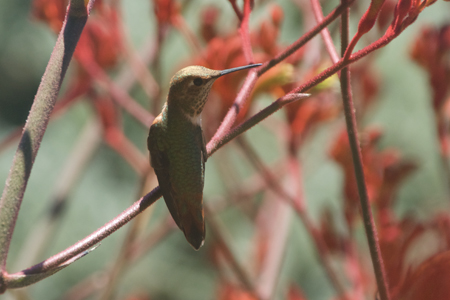
Hot hummingbird action the last few days. Two Allen’s hummers competing for control of the plants outside my studio window. I have now found an absolutely reliable way for animal artists, or anyone else for that matter, to procrastinate. Plant hummingbird-friendly plants right outside the window next to your desk. Wait for that “humming” sound, stop work and watch. Perfect.

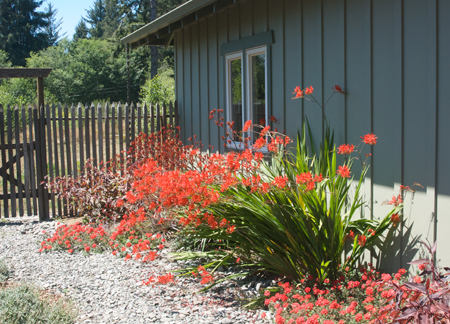
Outside my studio window is what I call “the tropical garden”. South-facing and it’s where I’m putting all the hot color combinations; red, orange, yellow, lavender, etc. Front to back is red verbena, crocosmia ‘Lucifer’, kangaroo paw and red dragon persicaria.

One of the little gladiators. I sometimes think that they are really Rottweilers in bird costumes.

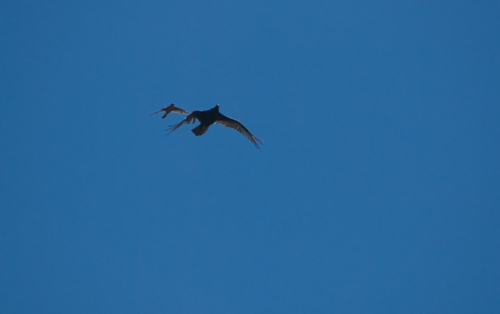
Looked up a few days ago when I was outside and saw what looks like a northern goshawk escorting a turkey vulture, probably away from the nest. I got about six photos. This one reminds me of some I’ve seen in my husband’s aviation books of comparatively tiny American fighter jets “escorting” truly huge Soviet “Bear” bombers.

ART TALK

So, to follow up on the source of the Wednesday post title “Pot of Paint”. James McNeil Whistler (of “Whistler’s Mother” fame) had utterly buffaloed the art community in London with what he called his “nocturnes”, impressionistic paintings of night scenes which he showed at a time when the eyes of the public and art critics were conditioned to seeing a high level of detail and what was called “finish”.

The leading art reviewer and taste-maker of the Victorian era was John Ruskin, the first prominent critic to champion the Pre-Raphaelites, who never let the vein of a leaf go unpainted if they could help it.

In his review of Whistler’s show at the Grosvenor Gallery, then known for showing “advanced” work, Ruskin wrote that he “he never expected to hear a coxcomb ask two hundred guineas for flinging a pot of paint in the public’s face.” So there.

Whistler sued for libel. What followed was one of the most celebrated lawsuits of the time. What makes it fascinating and relevant even today is that it turned into a monumental struggle between two very different philosophies concerning the creation of art. Ruskin represented the establishment view that art had a duty to be beautiful, uplifting and moral. Whistler adamantly insisted that Art had no duty outside itself, in other words, “Art for Art’s Sake”.

The trial lasted for eight hours. The jury deliberated for two and, in the end, returned the verdict for Whistler, but only awarded him only one farthing, approximately a quarter of a penny, in damages. Whistler mounted it on his watch fob. The good news was that the verdict saved him from having to pay Ruskin’s court costs, but it left him in debt, albeit with a moral victory.

If you would like to know all the delicious, gory details, buy, what else, A Pot of Paint- Aesthetics on Trial in Whistler vs. Ruskin, by Linda Merrill.

The debate goes on today, although without the level of consciousness that existed in the Victorian art arena. There has been more than one art show here in Humboldt County through the years that had a painting in it that someone found objectionable. The reason is usually some variation of the un-thought out idea that art is supposed to be beautiful, pretty and not make the viewer uncomfortable. Poppycock. Art has no responsibility other than to express the creativity of the maker. No one has the right to pre-censor what an artist creates or shows. No one has to buy what is produced, but they don’t have the right to demand its removal either.

ART FOR ART’S SAKE!

ART QUOTE FOR THE DAY

It is this sense of persistent life force back of things which makes the eye see and the hand move in ways that result in true masterpieces. Techniques are thus created as a need.

It is thus necessary to work very continuously and very valiantly, and never apologetically. In fact, to be ever on the job so that we may find ourselves there, brush in hand, when the great moment does arrive.

Robert Henri

A Pot of Paint

Anyone who has been to art workshops knows that there always seems to be someone who is almost obsessive about finding out what paint, brushes and supports the instructor uses. The idea seems to be that if they can use what the teacher uses, by some kind of magical osmosis they’ll be able to paint like the teacher paints.

Fortunately, it doesn’t work that way. After all, if creating good work was only a matter of using the right combination of materials, it would take all the fun out of painting- for a sufficiently broad definition of “fun”. Sometimes trying to gain mastery or even competence in an art media is an exercise in frustration, disappointment and self-doubt. And then there are those too short times when the painting seems to paint itself and you’re just along for the ride.

With all that in mind, I thought I’d blog a bit about what materials I’ve ended up using after my first twelve+ years of painting in oil. Use any or all of it at your own risk. This week, I’ll start with paint.

I began with a pretty standard palette, courtesy of my first teacher. White, black, warm/cool red, yellow, blue, green, plus three or four earth colors and then some “fancy” colors that would have had Rembrandt spinning in his grave and Gauguin breaking into my studio in the dead of night.

Then I went to Scott Christensen’s ten day plein air intensive. Four color palette (plus a couple of tube greys): titanium white, Rembrandt Permanent Red Medium, Winsor Newton (W/N) Ultramarine Blue and Winsor Newton Cadmium Yellow Pale. And my “color choices” exploded. I discovered a whole world of more muted, restrained color that I was barely aware of before. A limited palette solves the “color harmony” problem, too, since every color probably has at least a titch (the technical term) of all the others in it.

Here’s my first four color study from before I left so I could see how it worked a little, followed by two 20 minute exercises done at his workshop-

These are two studies I did after I got home. I think you can see that one isn’t really limited at all as far as color and what you can do with it. Value relationships and color temperature shifts become more important than having a particular tube color.

I pretty much stayed with that palette for over two years. For me, the main limit I bumped up against is that I’m an animal artist, not a landscape painter, and I really felt the need for a color I picked up at a Paco Young workshop, Rembrandt Transparent Oxide Red. It’s perfect for so many animals that I do. Then I found that the warmer Cadmium Yellow Medium worked better for me than the cooler Pale. Then I found myself gazing longingly at the dioxine purple, then my beloved sap green……

Presently, having realized that I’m really more of a colorist than a tonalist, I’ve added more punchy colors back so my paintings will have the emotional content I want. These days I use, from left to right on my 18″z24″ glass palette:  Rembrandt Transparent Oxide Red, Rembrandt Permanent Red Medium, W/N Cadmium Orange, W/N Yellow Oxide Pale, W/N Cadmium Yellow Medium, W/N Titanium White, W/N Ultramarine Blue, Rembrandt King’s Blue, (sometimes Rembrandt Turquoise Blue, for extra warm blues), W/N Dioxine Purple, W/N Sap Green, W/N Viridian. I very occasionally use W/N Raw Sienna, mostly to tint my canvas before starting, but otherwise I mix my own earth colors, greys and black (ultramarine blue, transparent oxide red).

I do small (6″x8″ to 8″x10″) studies to try out painting ideas and for those I use the four-color palette because I can come back to them months later and I know exactly what colors I used. Here’s three, two of which went on to become finished paintings, so far. Yes, those are Roosevelt Elk on the beach north of where I live in Redwood National Park. The finished painting is called, what else, The Beach Boys, and is in a private collection.

The most important thing is not how many or how few colors you use, but that you know why you are using them and that you use them well.

The “Pot of Paint” reference in the post title is part of another of my favorite artist stories, which will be part of Friday Features.

Friday Features

BACKYARD BIRD LIST

Six or so red crossbills are still showing up most days. There was a group of fox sparrows last weekend. Our hummingbird-friendly plants are really starting to bloom. I was sitting here at my desk and look who showed up outside my french doors? I was able to grab the camera and get some shots through the glass. Sometimes lucky is better than good. Looks like a male Allen’s hummingbird to me.

Speaking of hummer plants, here’s my 50 cent, 4″ pot white verbascum that I rescued off an end-of-season sale table the year before last. Is that a happy plant or what? I’m going to have to move the poor little heather underneath it before it’s completely smothered. Or I may move the verbascum to a more spacious location. I didn’t think it would get quite this big.

ART TALK

I finished the bighorn painting and took it to the framer only a little wet in a few areas. When it was laying on the counter, I saw a spot in the sky I missed, which I’ll fix when I get it back. But it reminded me of one of my favorite artist stories:

Every year the Royal Academy in London has its Summer Exhibition. We were lucky to be in England and able to attend some years ago. The galleries looked like in old photos you see: work stacked from the floor to the very high ceilings. Those whose paintings ended up in “nosebleed” country called it “being skied”.

William Mallord Turner (b. 1755 d. 1851) was a regular participant, although his work mystified many of his comtemporaries and the general public. “Varnishing Days” were the three to five days before the exhibition opened when the artists could come in and put on a final varnish or touch up their paintings. Turner became somewhat famous for this and is said to have deliberately brought in unfinished paintings so that he could show off his technique. Imagine any of us doing that today? It would be like Robert Bateman showing up at the opening of his current retrospective, palette, brushes and paint in hand to add a few more snowflakes to his famous snow leopard painting. Turner showed up dressed for town and S.W. Parrott was inspired to create this permanent record, which is reproduced here in black and white. How do you dress when you’re in the studio?

PLANET SAVER TIP FOR THE DAY

Speaking of Robert Bateman, besides creating a lot of the best wildlife art of this or any other century, he is a tenacious advocate for the environment. You can read what he has to say at www.batemanideas.com

ART THOUGHT FOR THE DAY

If a man does not keep pace with his companions, perhaps it is because he hears a different drummer. Let him step to the music which he hears, however measured or far away.

Thoreau

Bobcat and Bighorns

The bobcat painting is done. I’ve called it “Stepping Lightly”. It will make it’s debut at Wild Visions2, the group show with five other Humboldt County artists next month. The opening reception will be August 9 from 6-9pm. More later about the show and the other artists.

“Stepping Lightly”                   oil                               18″x24″

Now, a cautionary tale about reference and using captive animals as models.

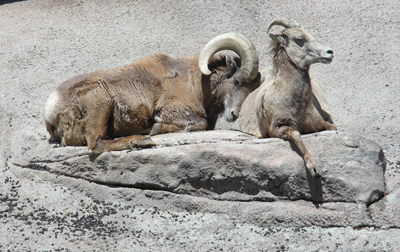
I’m doing a painting that is a first for me, three panels. Here’s the reference I’m using. The animals were photographed at the Denver Zoo and the landscape is from up on Logan Pass in Glacier National Park.

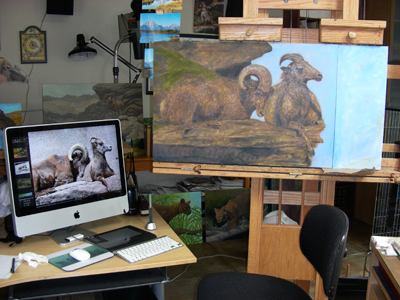
Is that a great pose or what? It was morning, warm and sunny, and the ram was getting sleepier and sleepier and finally his head gently dropped onto the ewe’s back. She never even twitched. Click. Gotta paint it. But where to put them? I chose this rocky outcropping in Glacier because I liked the shapes and knew that bighorns were often seen in the area. I did a preliminary drawing of the animals with the idea of showing them on a shelf of rocks. I wanted to communicate how comfortable bighorns are in an environment that we would find “challenging”. Here’s an in-progress shot that shows my setup with my iMac.

It’s great because Aperture lets me zoom in and out as needed very easily.

Another in-progress shot with the side panels propped on either side. At this point, I sent a jpeg to wildlife artist Laney, who has said nice things about my work the couple of times I have met her. She specializes in bighorns and I wanted her to eyeball the animals for drawing or any other problems. She replied very promptly and said that overall it looked good, but that the ewe’s hoof was in the wrong position compared to the rest of the leg and that the ram’s muzzle was too thin.

I went back to my reference and compared what I had with an absolutely wonderful book, Mountain Royalty, by famous Alaska artist Doug Lindstrand. As you can see from my photo, the ram in particular is shedding out, so it was a little hard to see the structure. Doug’s photos solved that problem and there was even a picture of a ram in a similiar position.

What I ultimately found was that while I had accurately drawn what was in my reference, it wasn’t “right”. The ewe’s hoof was at that funny angle, but that didn’t mean I should paint it that way, so I fixed it. When I compared my reference ram’s head with the ones in the book, I found that his head was really quite odd. Longer, thinner and with a roman nose that was much more exaggerated than the wild sheep. So I fixed his muzzle and re-proportioned his head as needed.

The other question I had for Laney was whether or not this behavior might be observed in the wild. She replied that the rams were only with the ewes in winter, so maybe I’d like to add some snow. Ah, well. In the zoo, of course, the animals are pretty much together all year around. In the wild when I shot my reference at the beginning of May, it was unlikely. Cue the snow reference. And, what I found was that it was the frosting on the cake since it brought the cool of the sky into the rock area and helped pull the whole thing together. Thanks Laney!

The moral of this story is that you can’t have too much reference, don’t assume that zoo or captive animals look the same as wild ones, do your fieldwork and learn about your subjects and finally, it is tremendously helpful to have a knowledgeable eye like Laney’s to look over what you’ve done and to it keep on track.

I finish the painting today and it goes in for framing tomorrow. I’ll post an image of it once it’s on the wall at the show.

ART THOUGHT FOR THE DAY

Experience enables you to recognize a mistake when you make it again.

Franklin P. Jones

Friday Features

BACK YARD BIRD LIST

Red Crossbills showed up at the sunflower seed feeder yesterday and made a serious dent in it. A group came through last fall, but moved on after a couple of days. We’ll see how long these stay.

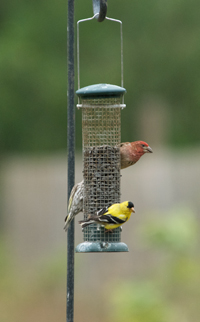
The goldfinches and sparrows are emptying out two thistle seed bags in less than 48 hours. They’re back within seconds of the refill. We live but to serve. We must have the fattest finches in the neighborhood.

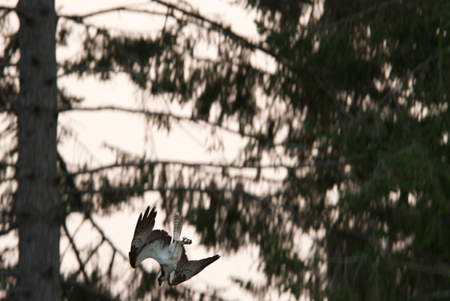
Bonus photo with my new lens- an osprey diving toward the pond, at what we’re not sure since the goldfish pretty much stay under the branches we’ve laid around part of the edge.

All photos taken with my new Nikon D80 with the equally new AF-VR-Nikkor 80-400. I’m stoked, to say the least.

PLANET SAVER TIP OF THE DAY

Anyone with even a small yard can make it bird-friendly. Food, water and shelter are the requirements. We have the big pond, feeders, food plants, trees and brush piles. But a town backyard could have a bird bath (be sure to keep it clean), bird feeders and some small shrubs. If you can stand it and feel you have room, let a corner go “wild”. And consider not obsessively cleaning up in the fall. Leave some seed heads on the flowers and grass. Then sit back and see who shows up.

ART THOUGHT FOR THE DAY

“There’ll be moments when you get a spark, a gleam of light and BOOM!, you’re gone. It seems easy. But then it goes away, and it gets so incredibly hard. It’s like having sex in a wind tunnel.”

Robin Williams (who else?)

Drawings from live animals and new painting

From the stats it looks like the post of my pet sketches was one of my most popular so far, so here’s more. These are done the way I usually work, with a fine tip gel pen. They’re done fast. Under five minutes, sometimes under two.

Niki, our tri-color rough collie

From the San Francisco Zoo. He really did hold still long enough for this head study.

These were ultra-quick, a minute or less, but I caught the gesture. Also San Francisco Zoo.

And, looking through my old sketchbooks, I came across the studies I did at Julie Chapman’s workshop in 2005. These are of Daisy, the badger, who alas, is no longer with us. Notice that I didn’t worry about eyes. I was trying to capture “badgerness”.

If you decide to try this, and I hope you do, keep in mind that every animal is an individual and look for what makes them them. If you like what I do, I think that’s a big part of it.

I’ll end with the bobcat painting, now called “Stepping Lightly”. I’m thinking of punching up the highlights on grass and maybe futzing (that’s the technical term, of course) with the logs some more, but that’s about it.

PLANET SAVER TIP OF THE DAY

This one’s easy. Start to become aware of how you use energy. You can save money and help slow down climate change by using less and using it more wisely. Just little stuff to start- turn lights off when you leave a room, don’t leave the tv on if no one is watching, turn your thermostat down a couple of degrees or up, depending on the temperature where you are.

Now, you must know that this kind of thing, while necessary and desirable, is the “low hanging fruit”. It requires simple changes of habit, not real sacrifice. If you’re already doing the above and are ready and able to take the next steps, consider updating your older appliances to new, energy-efficient models. Change your incandescent light bulbs to compact flourescents or LEDs.

For more information and actions you can take, check out www.motherearthnews.com and www.builditsolar.com

What ideas would you like to pass on to me and my readers? We’re all in this together, after all.

Friday Features

IN OUR OWN BACKYARD

Last night my husband and I were sitting in our spa at dusk and what should we see ambling along the edge of one of the flower borders but a mom skunk with one baby. Niki the collie, who got thoroughly skunked a month or so ago, immediately went to the other side of the spa and gazed with great interest toward the pond. Good dog.

The skunks went right onto the patio and then under the engawa (Japanese style veranda), at which point we called it a night.

BACKYARD BIRD LIST

Same as last week, except one of the first hummingbirds, an Allen’s I think, found the verbascum and lavender, which are starting to bloom. There was an article in the news today here about the songbird die-off. Pretty depressing. The only local bird named that we have seen here is the Rufous Hummingbird. Time to plant more hummingbird friendly plants.

ON A LIGHTER NOTE

You think you know your pets, but sometimes………..

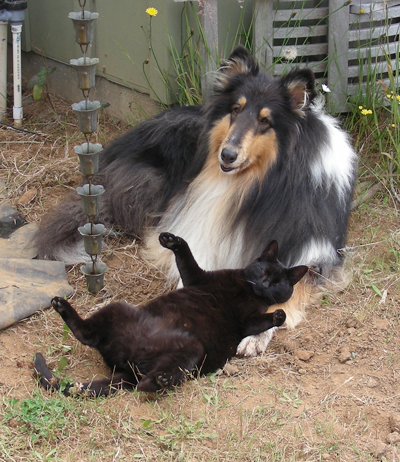
Niki and Eowyn, en flagrante something or other. Got another one that I’m going to upload to www.icanhascheezburger.com. If you haven’t been there and you have a sense of the ridiculous, highly recommended.

ART THOUGHT(S) FOR THE DAY

Two Views on Art:

Artists can color the sky red because they know it’s blue. Those of us who aren’t artists must color things the way they really are or people might think we’re stupid.

Jules Pfeiffer, famous artist

Anyone who sees and paints the sky green and pastures blue ought to be sterilized.

Adolf Hitler, failed artist

Paintings in Progress

A few of you may remember that I was posting images of an elk painting in progress. I’m sure the suspense has been killing you. As it happens, it was a bust. Too many problems with the drawing of the elk that I saw after I’d let it sit awhile. Win some, lose some.

But here are two that are well on the way-

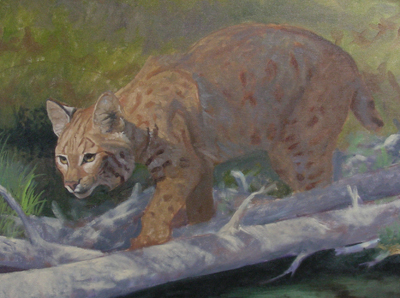
First is a bobcat I photographed at the Triple D Game Ranch and transferred to a more interesting setting that I shot on the Firehole River in Yellowstone. The trick, of course, is to make the light match when the reference is from two different locations, like Montana vs. Wyoming. However, both are morning light.

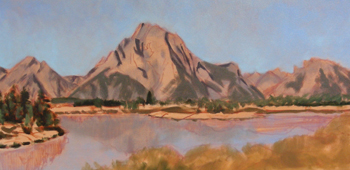
The second is Mt. Moran at Grand Tetons National Park with the famous Oxbow of the Snake River in the foreground. I’ve got three pieces of reference up for this one. One is overexposed for the mountains, but has the compositional angle I want and great reflections. The other two have rich color and show more detail of the mountain. For this subject, as I learned from a workshop I took a few years ago with Jim Wilcox, one has to introduce some atmospheric perspective in order for the painting to “read” correctly. The air is soooo clear that the Tetons look to be a few hundred yards away, but actually they are around 10-12 miles from the major vantage points along the road. So, getting the value relationships right is critical. And so is being decisive and accurate in the drawing of the mountain. It’s really a portrait in rock. Stay tuned.

ART THOUGHT FOR THE DAY

I see a flower. It gives me the sensation of the beautiful. I wish to paint it. And as soon as I wish to paint it I see the whole subject-flower-changed. It is now an art problem to resolve.

Georges Vantongerloo