Mongolia Monday- Excerpt from My 2006 Trip Journal- Ikh Nartiin Chuluu Nature Reserve

Travelers get attached to a particular place for a variety of reasons. Maybe it was stunningly beautiful or irresistibly peculiar. Maybe it was somewhere they’d wanted to go to since childhood, finally made it and it was everything they’d dreamed of and more. Maybe something special happened while they were there. Maybe they went for one reason and discovered something unanticipated but compelling. The latter probably most applies to why Ikh Nartiin Chuluu Nature Reserve has become one of my most favorite places on the planet.

This seems unlikely to me since I’ve never been a “desert” person. That would have been my mom, who found the area around Hemet, California (the landscape, not the trashy sprawl) quite to her taste. I like my landscapes green. With trees. Preferably redwoods. Like these at Prairie Creek Redwoods State Park, about 30 minutes from our house. I spent my childhood getting to camp out at places like this. Pretty darn lucky, I’d say.

prairie-creek

But Mongolia got to me. Except for the northern part of the country, which is the southern edge of the boreal forest, trees are not what Mongolia is about. It’s the ultimate wide-open-spaces destination. I went to Ikh Nartiin Chuluu for an Earthwatch project and found a place so special that I plan to go back until I can’t travel anymore. I returned in 2006 for a short visit, just a couple of days. Here’s what happened the first day.


October 6, 2006

Woke up and 6:30, out the door in less than 10 minutes to walk down the valley. Too early for good light, but saw a couple of argali dash up the hill from the stream over 100 yds. away so no photos.
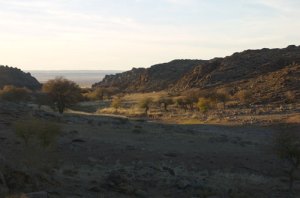
ikh-nartiin-chuluu-valley

Valley where research camp is located

ikh-nartiin-chuluu-sunrise-rocks

First sun on the rocks

Came back for 7:30 am breakfast. Baaska (my guide), driver and master’s student still asleep, so headed out on my own about 8:30 am. Found my favorite huge rock! Windy but not cold. No argali or ibex. Stopped to rest and have a snack and realized that not only was the wind getting much stronger, but that the distant rocks were getting hazy with dust, just like when I was out with Rich (Dr. Richard Reading, the Earthwatch project’s Principal Investigator, and I walked back to camp in an on-coming dust storm in 2005 after the team had walked a 4km argali survey). Decided it was time to go directly back to camp since no one knew where I was, just that I would be back at 1pm for lunch. Got out the GPS, punched “Go To” POI #1 (camp) and got back just fine.
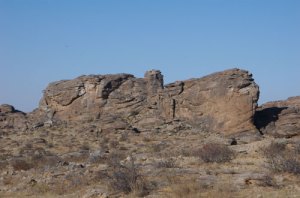
ikh-nartiin-chuluu-fav-rock

This rock turned out, from another angle, to be three formations that were overlapping, but I still like it! It’s about the size of an aircraft carrier.

ikh-nartiin-chuluu-nestCinereous vulture nest

Since I’ve never been here at this time of year and there really isn’t anyone to ask until Amgaa gets here or maybe Jed (two of the other scientists), it seemed sensible to play it safe. Maybe after lunch will be a good time to go out in the van and check out the Tibetan writings and see if we can spot any argali. The Mongolians, Baaska, student, driver, ranger are all yakking away in the kitchen ger. I’ve never known people who could sit down together, never having met before and just roll along talking like the Mongolians. It feels from the outside like the continuation of an ageless oral culture which hasn’t been undermined by tv. Yet.

ikh-nartiin-chuluu-skull2Argali skull

I hope this wind dies down. Being out in Ikh Nart again, just me and the rocks was really great.

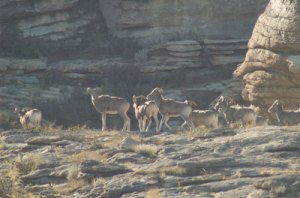
5:15 pm- Went out in our van with the ranger at 1:30. He needed to do some telemetry and was willing to find inscriptions. We found five, but no luck at all finding the one Rich took me to last time. Saw and photographed a large herd of  ewes with, it looked like, one ram and a smaller group a few minutes later. It has really stayed windy and cold. I’m in the ger with the stove going.
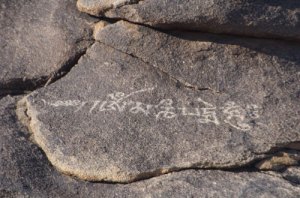
ikh-nartiin-chuluu-inscription

Tibetan inscription

ikh-nartiin-chuluu-argali

Herd of argali sheep
Mongolia Monday- Excerpt From My 2006 Trip Journal; Takhi Watching at Hustai National Park

On my first trip to Mongolia in spring of 2005, I managed to get a couple days at Hustai National Park, enough to know that I wanted to go back when the daytime high was more than 32F with howling wind (ah, early May in Mongolia!). Hustai is the most accessible place to see reintroduced takhi, or Przewalski’s horse. For 2006, I arranged to have the use of a car, driver and guide so that I wasn’t dependent on driving around with other, non-artist visitors.

I needed to be in the park at dawn and at the end of the day in order to get what I’d missed before because of cloud cover- takhi in great light. This excerpt is from my first day.

9-27 10:15 am Wed.

Just got back from the morning “game drive”. Left a little after 7:30 am and got to the valley just in time to catch the light about 8 am. Hit the jackpot, Two takhi just on the shadow side and then coming into the sun.

Takhi Mare and Stallion at sunrise, Hustai National Park

Went back up to (the) pass, seeing more takhi and the 2 eco-volunteers from France who I sat with last night. Missed a great shot of a bull marel (a species of elk) because the driver didn’t stop in time. Continued over and down around the backside of what my guide says is called “God Mountain” because all the spire-like piles of rock look like flames of fire. There were takhi at the base of a particularly picturesque part of it and the guide asked me to take her picture. She pointed out another mountain where she said lynx live.

Guide with takhi in front of "God Mountain", Hustai National Park

We continued on into what she says is called “Happy Valley” and it sure was for me. Came upon 2 groups of takhi, one waterhole. I think the issues were who got to drink first and can I steal some of the other guy’s mares. (There are 3 largish songbirds pitty-pattying around on the top of the ger as I write this entry)

Takhi harems at waterhole, Hustai National Park

We entered a part of the valley with trees along one side and it turns out they are saxaul, which I didn’t expect to see until I went south (and it turns out that I hadn’t. Something must have gotten lost in translation, because I found out this last trip that they for sure weren’t saxaul trees). There were also some domestic horses, which the driver got out to shoo away. We circled around out on the grasslands and saw 2 small and 1 large group of gazelle. Final stop was the research center, which was looking pretty sad and almost derelict last time. It’s humming now. Offices for the ec-volunteers, the managers, biologists, ecologists and a kitchen. There’s even curtains on the windows.

So, I’ve gotten my evening light and early morning light. Now it’s just seeing what kind of behavior I can record.

I liked the waterhole setting and plan to eventually do a big painting with both harems that tries to show what I saw that morning. In the meantime, I had this reference from elsewhere in the park of a mare with a beautiful gesture.

Morning Drink oil  12"x16"
Morning Drink oil 12"x16" (price on request)

Mongolia Monday- Camel Drawings

Here’s a few bactrian camel drawings I did in about an hour this morning. They were done on vellum bristol with a Wolff’s carbon pencil. The head drawing is a little more finished. The full body study was really just to capture the pose and lay in the shadow areas. You can see how I corrected one of the hind legs. The small hind leg study was to learn more about the structure. So, one subject, three different goals. As usual, do try this at home.

Bactrian camel head study
Bactrian camel studies

Marketing Our Art During the Financial Meltdown, Part 2; A Work In Progress And…. Cute Cat Alert!

CONTINUING FROM LAST FRIDAY-

Strength in Numbers! If you think about it, one could say that the ability to be alone and self-motivate are prerequisites for being a working artist. In a sense, painting is a “solitary vice”. So, it may take some conscious effort, in planning the marketing of your work, to consider the multiplier effect of joining with others. This hit me two years ago when I was offered the opportunity to have a solo show at a financial management company. (I should note that where I live there are really no commercial galleries as the term is generally understood. Most spaces, some of which are very nice, are “piggybacked” on another business. However, the community is very supportive of its artists and finding a place to show art publicly is pretty easy. Sales are uncommon, but, boy, do we get fussed over.) I’ve had a few solo shows here and have always gotten a gratifying turnout. But it occurred to me that if I invited some of my animal/nature artist friends, it would not only be more fun, but that then their “fan base” would see my art, too.

I invited four colleagues and they all said “yes”. The reception was packed, I sold two giclees, another artist sold one and a good enough time was had by all that we decided to do it again. Last year we added a couple of new artists and moved to a different venue. We also invited the local wildlife care center folks to attend with a couple of their birds as an added attraction. Once again, a great turnout, both for the reception and during the month that the show was up.

The next show, Wild Visions 3, will be in October and we will have a nationally known wildlife artist as our Special Guest (more later). While, in a sense, it’s “my” show, we all pitch in with ideas (one of the other artists came up with the name) and work the reception. We’re exploring various ideas for “growing” the show.

Should you consider finding a small group to show with whose work is complementary to yours? With the right people it really is “the more, the merrier”.

What’s Your Story? There’s a lot of artists out there. Good ones, too. How do you make your work stand out? One way is your Story. What is it that sets you apart? If you’re going to successfully get local or national editorial coverage (back to last week’s “spend no money”), you have to have a hook to get the attention of a reporter or editor. Not to mention collectors. They are buying your story along with your art.

Now, you can’t just make something up out of whole canvas, so to speak. And you don’t need to.  You’re an artist. That gives you a leg up already since people in general are really interested in what artists do and get a kick out of knowing one. Find something particular that you do and why, test drive it and see what the response is.

I like to travel and it’s a necessary part of creating my art. I happen to really like Mongolia, which has a certain cachet as a destination. So, for me, it’s kind of a no-brainer. My story is my travels to Mongolia and the paintings and drawings that are the result.

Filtering how you present yourself and your art this way can simplify your choices, too, since there’s never enough time to do everything you want/need to do.

To be continued…

NEW WORK IN PROGRESS!

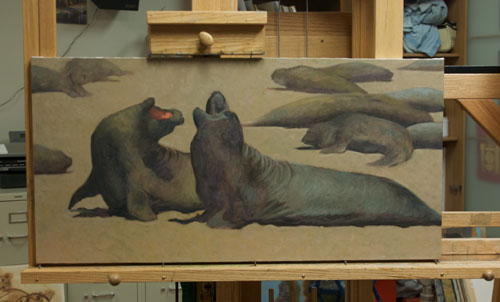
I’ve been fighting off a sinus infection for the past three weeks and haven’t gotten in much easel time, but I have made progress on this new painting from reference that I shot year before last down near Cambria, California. There is a huge elephant seal colony right on the beach next to Highway 1 and they really put on a show. Lots of male posturing.

Young male elephant seals

NEW CAT UPDATE!

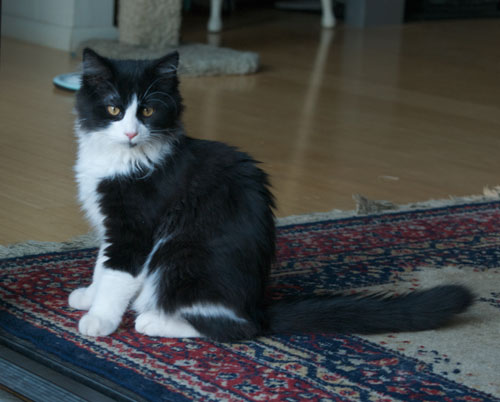
Just for fun, here’s a few photos of Alexander, who’s doing great. He’s gotten nose to nose greetings now from two of the three other cats and one is now willing to play with him.

Alexander, first day outside
Alexander, first day allowed outside
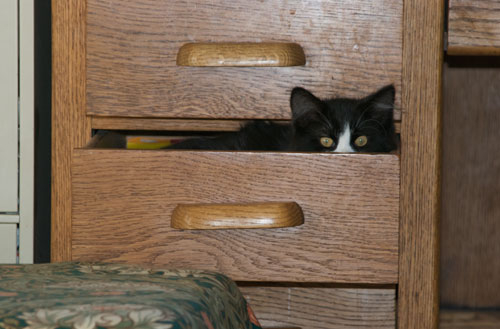
Alex in one of David's desk drawers
Alex in a new favorite place


Mongolia Monday – Argali Studies

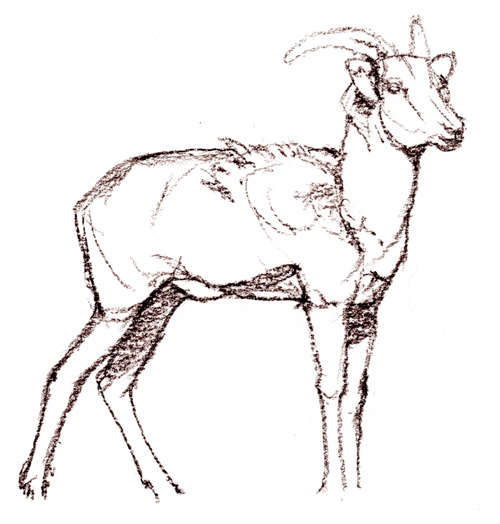
With the New Year come new painting projects. We try to take time off between Solstice and New Year’s Day because that’s when things slow down for my husband, who is the executive director of an information technology consortium, but I can’t stay out of the studio completely. I have a bunch of ideas for paintings with Mongolia subjects and this morning I thought I’d do a few drawings of argali and try different drawing media. All of these are done on 2-ply vellum bristol. None of the four took more than 15-20 minutes. The idea was to limber up after a break without worrying about doing a pretty, finished drawing. I wanted to catch the character of the animal and the rhythm of their body and movement. Please DO try this at home.

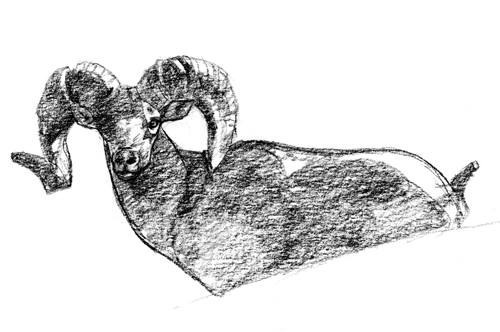
Argali Ram, Ikh Nartiin Chuluu, Sept. 2008

This is a try-out to see how he “draws” since I have a painting idea in mind. He’s a big, old ram with battered horns that will be an interesting challenge to paint.  I also like the shadow pattern on his head. Drawn with a 6B Wolff’s Carbon pencil.

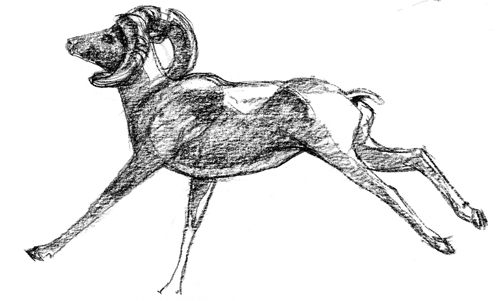
Argali Ram Running, Ikh Nartiin Chuluu, Sept. 2008

The gold standard in fieldwork for wildlife artists is the animal Doing Something. Prey animals like argali tend to be running away, so lots of butt shots. But this one took off from stage right to stage left, giving me a perfect chance to record a variety of leg positions. Also drawn with a 6B Wolff’s Carbon pencil.

Argali ewe climbing, Ikh Nartiin Chuluu, Sept. 2008
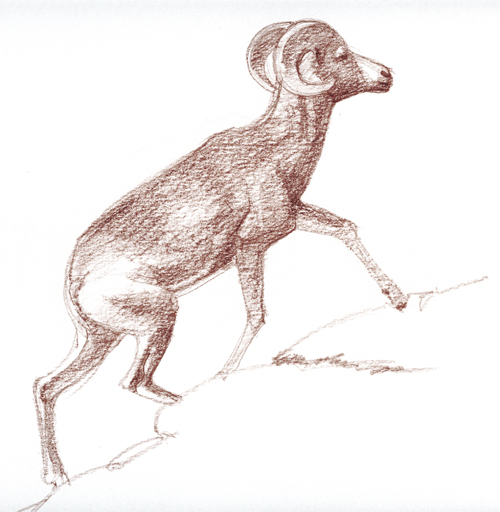
Young Argali Ram Climbing, Ikh Nartiin Chuluu, Sept. 2008

Another jackpot. He’s going up the rocks parallel to me. Drawn with a Cumberland Derwent Drawing pencil, Venetian Red. These have a fair amount of wax in them, so are more like a fancy crayon. They feel soft on the paper. I don’t think I got  very interesting line quality, but did feel that I caught the tension in the hindquarters as he is about to push off.

Argali Ewe Standing, Ikh Nartiin Chuluu, April 2005

This one is from pictures I shot on my first trip to Mongolia in April/May of 2005. The animals still had their winter coats. This ewe was part of a small herd which had come down to a stream for water one morning. I find 3/4 head views challenging, partly because I know that I have to compensate for the flattening effect of the photograph. Drawn with a 2454 Conte crayon. I hadn’t used these in awhile and found I liked the line quality and the way the Conte felt on the paper. This sketch took maybe ten minutes.

So you can see that what you draw with can really change the appearance of your drawing. The only way to know what will work best for you is to experiment with different combinations.

Why GOING THERE Makes all the Difference – Thank You, Simon

Four years ago today, internationally known wildlife artist Simon Combes was killed by a cape buffalo while walking with his wife on a mountain called Delemere’s Nose, which is part of the Delemere estate in Kenya where they lived. Just two months earlier, I and nine other incredibly fortunate wildlife artists were on the safari of a lifetime with him. Looking at dates on my images, I see that we had gotten up the morning of October 12 at the Kigio Wildlife Sanctuary and spent most of the day driving south to the Masai Mara. When we stopped for lunch in the Masai group ranch north of the reserve proper, we saw our first Mara wildlife, a male topi on top of a mound. Then, in rapid succession it was wildebeest, gazelle, hippos, a huge male giraffe right inside the entrance to the Reserve and then…lions!

My tribute page and the photos that I took of him during the safari are here. But what I want to share today is what it means as an artist to be able to travel to a place like Kenya with someone like Simon, who knew the ground and the animals and who always seemed to get us to the right place at the right time. I had realized very quickly on my first trip there in 1999 that it was  pointless to paint animals like cheetahs and lions without having seen them in their habitat. There’s really no way to get it right and those who have been there know the difference instantly. Trust me on this. So out of the 5,218 photos I shot in 2004, here are a few that I hope will illustrate this point, followed by some of the paintings that have resulted from the trip. If you want more, the whole safari is here. on my website.

Samburu encounter
Samburu encounter

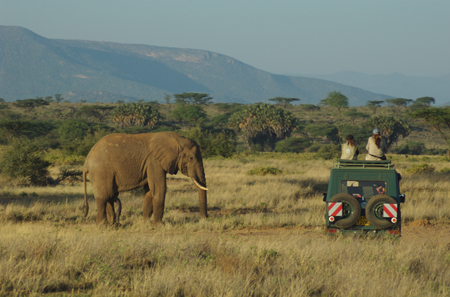
Emotion and point of view play a major role in the creation of great wildlife art. How could the two women in the front vehicle not remember  and “channel” this encounter if they paint an elephant? We’ll all remember this morning in the Samburu going from cool to warm, the beautiful light and this bull elephant who made it abundantly clear that it was time for us to move along.

Impala and baboons
Impala and baboons

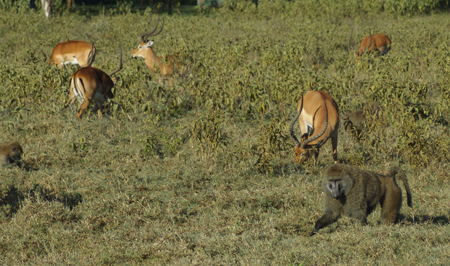
Artists get asked all the time where we get the ideas for our paintings. Well, here’s one I probably wouldn’t have thought of if I hadn’t seen it. Baboons and impala breakfasting together at Lake Nakuru. Part of the problem with zoos  and game parks is that the animals are out of context. You never see the natural groupings or interactions. Or if there are different species together, you have no idea how that would play out in the wild. To me, this kind of reference is gold. I can paint this African “Beauty and the Beast” scene because I saw it, photographed it, know it happened.

Young mara lions
Young mara lions

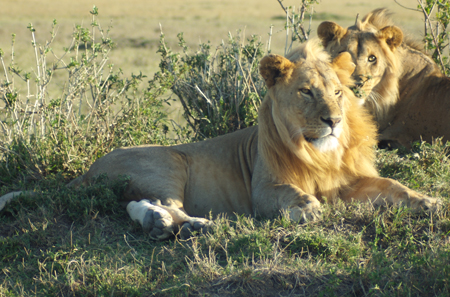
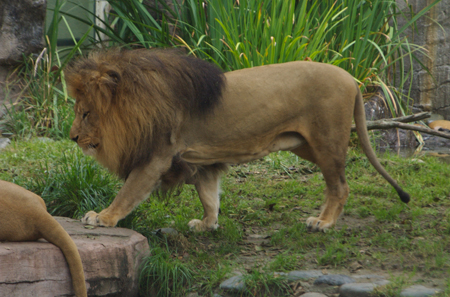
There really is something about lions. They define “presence”, even when they are still kids, like these two. Great afternoon light and you hardly notice that his face is covered with flies. For contrast, here’s a zoo lion. He’s gorgeous, with a huge mane and perfect whiskers. Dead giveaway, along with the flat light and lack of body condition. This lion don’t hunt. Which would you rather paint?

Zoo lion
Zoo lion

We went out on an evening game drive in the Samburu and as the sun was going down, it seemed to be really important to Simon to get to a particular place. We were literally along for the ride, so just waited to see what was up. Oh, yeah, this is very, very nice. It’ll do. Thank you, Simon.

Samburu sunset
Samburu sunset

Here’s a selection of the paintings that have come out of the safari so far.

Ground Hornbill
Ground Hornbill oil 18"x 24" (price on request)

Reference shot in the Mara. Simon did some interesting jogs with the vehicle to get alongside this big bird, who just wanted to walk away .

Samburu Morning
Samburu Morning oil 18"x 24" (price on request)

I loved the northern Kenya landscape with the huge, storybook doum palms.

Interrupted Nap (Spotted hyena)
Interrupted Nap (Spotted hyena) Private Collection

Reference shot in the Mara. There was a cub, too, but that’s a painting for another day.This one was snapped up by a collector who also loves vultures and gets first crack at any I do.

Thompson's Gazelle
Thompson's Gazelle oil 16" x 12" (price on request)

John Seerey-Lester was kind enough to choose this painting for inclusion in the 2008 Art and the Animal Kingdom show at the Bennington Center for the Arts.

That's Close Enough
That's Close Enough oil 12" x 9" (price on request)

Cropped in from a large herd of buffalo at Lake Nakuru. Nobody was getting anywhere near that calf. No way, no how.

Morning Break
Morning Break oil 12"x 24" (price on request)

Reference photographed in the Mara, where we got an eyeful of cheetah every day we were there. This painting was juried into the 2008 Animal Art show at the Mendocino Art Center here in California. I’ve got to be in the right mood to paint all those spots, but I do love cheetahs!

ART THOUGHT OF THE DAY

“A few days later I looked up from my work to see a new elephant, one that I had not seen before, standing quietly only yards from my easel. He had crossed the river to my side on the outer curve of the ox bow and wanted to pass through the narrow neck where I was working. To do so he would have to pass within five yards of me or go back the long way around. I held my breath as he shifted silently from foot to foot, carefully weighing the situation. Finally, he moved forward and past me, watching intently as I stood motionless. Such rare incidents of trust between man and wild animals give me a great thrill.”

Simon Combes, from An African Experience

New Paintings and My (Current) Favorite Studio Music

NEW PAINTINGS

I tend to start a number of paintings in succession and then finish them in batches. Is it that way for any of you? Or do you have a more even work flow? How do you decide what to do next?

Here’s a new one from reference that I shot in Kenya in 2004. It was after the conclusion of the Simon Combes safari and I had flown back down to the Mara for a few days at Rekero Camp, which is on the Talek River. Fabulous camp, great staff, wonderful food, terrific drivers. I’d love to go there again. It’s apparently one of the places the Big Cat Diary people stay when they are filming and I can see why. It’s a tented camp right in the bush. Buffalo wander through and you can hear the hippos grunting and roaring at night since the tents are mostly right above the river. A real storybook African place.

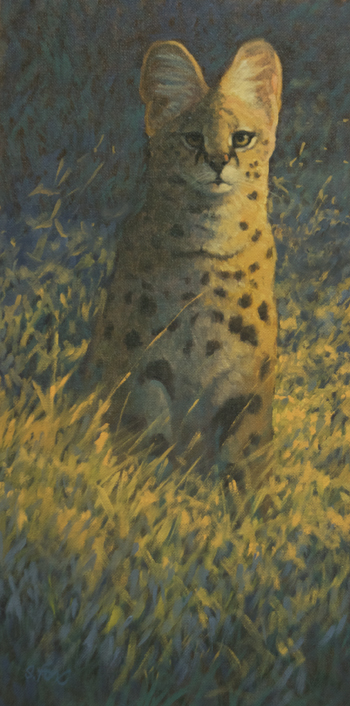
A couple from Ireland were kind enough to invite me along on their game drives. My first morning with them we saw a serval walking down the road as the sun came up. I loved the color of the first light of the day hitting his or her coat, but most of the shots weren’t particularly paintable. We were so close that my point of view was from above ( I know, I know- boo hoo) or the gesture was awkward, etc. But…..I got some great reference at the Denver Zoo this last May. Nothing special in the Light Department, but wonderful eye-level alert poses. So I put the two together and came up with this. I kept the grass loose and impressionistic so that the focus would be on the cat, who is Up At Dawn.

Up At Dawn  oil  16"x 8"
Up At Dawn oil 16"x 8" (price on request)

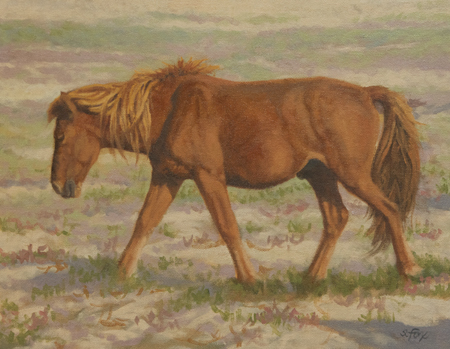
I’ve also just finished my first in a planned series of paintings of Mongolian horses, the ones the Mongolians ride, not the takhi. I got a lot really good shots in great light, but picked this one to start with because I loved the color of his coat.

Chestnut Stallion, Arburd Sands   oil  11" x14"
Mongolian Horses: Chestnut Stallion, Arburd Sands oil 11" x14" (price on request)

I’m going to be in a group show with a flower theme at my gallery, starting next week. It’s not something I’ve done a lot of, well, any, but I have some great hummingbird reference that I shot right outside my studio windows so….for something completely different…

Hummin' Along in the Leopard Lilies   oil  12"x 9" (price on request)
Hummin' Along in the Leopard Lilies oil 12"x 9" (price on request)

I went back to an Art Nouveau/Arts and Crafts inspiration from my previous incarnation as an illustrator and used a decorative approach. Flatter light with a plain background. It was fun and I’ll probably do more flower subjects in the future. This one sure got me using my reds more than usual. The bird is a male Rufous hummingbird, just another little rottweiler in a bird costume. Thank goodness they aren’t the size of ravens or none us would be able to go outdoors when they’re around.

STUDIO MUSIC

What do you listen to when you’re working? I can’t write this blog with music going, but otherwise I always have something on. I’ve acquired a taste for celtic-inspired world music and really like listening to Kila, Peatbog Fairies and Shooglenifty (No, really.). When I want to up the energy level, it’s time for some Afro Celt Sound System. I’ve been know to listen to Baka Beyond and Kenyan benga music  when working on African subjects and Mongolian music when I’m…. you get the idea. Favorite rock includes anything by John Mayer, Mark Knopfler and Sting. Also still Stuck in the Sixties with Quicksilver Messenger Service (love, love, love John Cippolina, my guitar hero), Jefferson Airplane and of course The Beatles and Rolling Stones. When I come into the studio in  the morning and need to ease in slowly, it’s Enya, Clannad or Nightnoise.

ART THOUGHT FOR THE DAY

If anyone, in the beginning of study, will set himself to study the various compositional forms, then experiment and practice with the variations of them, he will find that his instinctive taste is developed; and subjects will in time lend themselves easily to his feeling for unity, and soon he may be able to forget all about them.

It must never be forgotten and let this be most strongly emphasized – that the dominant aim of the student should be to train and equip himself to the point where he can judge unity and all of its contributing factors by “feeling”.

Edgar Payne

Mongolia Monday- Using My Takhi Reference for Paintings and Limited Edition Giclees

Since, judging from the stats, the subject seemed to be very popular, I thought I would continue today with more on the takhi, specifically how I take the reference I shoot and turn it into a painting. More and more I start with drawings to become familiar with a new species or figure out things about one I’ve painted before.

Here are three drawings from last year, the first two of which were published in the Society of Animal Artists newsletter.

Takhi scratching leg; charcoal pencil on cold-ply bristol paper
Takhi mare and foal; charcoal pencil on cold-press bristol paper

Now I’ll show you how I take an animal from one time and place and put her in a setting from another time and place, a challenge that every wildlife artist needs to meet successfully.  Here’s the setting:

Main takhi water source; Hustai National Park, Sept. 2006

What a treat! We came around the bend in the dirt track early in the morning and there, right in front of us were two harems at the same time, sorting out who gets to go first.

Watering place close-up; Hustai National Park, Sept. 2006

I always try for a variety of  shots; close-ups and the “big picture” for context. I used to come home with great close shots of something like a tree and found that I’d completely forgotten to get the surroundings, which really cut down on my options. Notice that the above photo is kinda fuzzy. But it’s still useable for reference.

Now here is the horse reference. Different part of the park, different year, different season. I’ve included two as an example of what to look for when evaluating images. These are similar, but the second, to me, is clearly superior. I love the rhythm of her gesture.

Takhi mare; Hustai National Park, May 2005
Takhi mare 2; Hustai National Park, May 2005

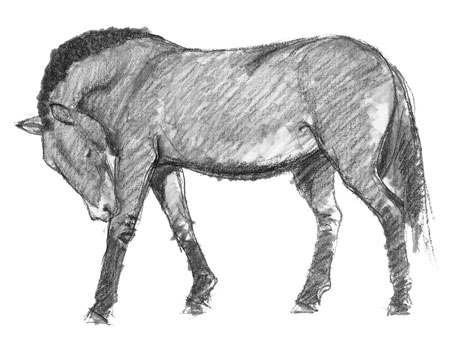
So next I did a drawing to capture that.

Takhi mare walking; charcoal pencil on cold-press bristol
Takhi mare walking; charcoal pencil on cold-press bristol paper

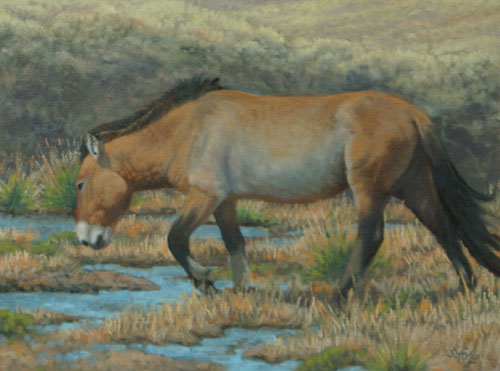
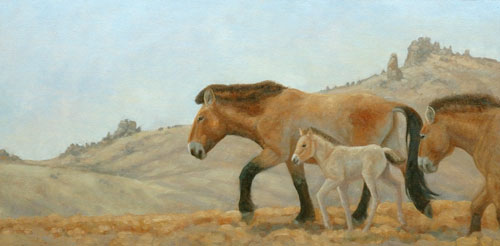
And, putting them together, here is the finished painting, completed in 2007. What I hope is that you can’t tell that I “stitched” together the reference from two sources.

Morning Drink   oil   12"x16" (price on request)
Morning Drink oil 12x 16" (price on request)

I also wanted to let you know that two of my takhi images are available as limited edition giclees, framed or unframed. The full information is on my website. Click on “Limited edition giclees” under Fox Studio in the column on the right and it will take you directly to my giclee page.

Takhi Foal; giclee on archival paper

I saw this foal on the same trip as the mare in the painting above. He or she was quite a character.

Mongolia Morning; giclee on archival paper

I posted this last week, as the original painting is still available, but have also published it as a giclee. It’s another example of how I took the mare and foal, who were against a grassy hillside and moved them to a ridge that has Hustai’s famous mountain as the background. The third horse was added as a design element.

All my giclees are available for holiday delivery.

ART THOUGHT FOR THE DAY

Let this be plain to all: design, or as it is called by another name, drawing, constitutes the fountain-head and substance of painting and sculpture and architecture and every other kind of painting, and is the root of all sciences. Let him who has attained the possession of this be assured that he possesses a great treasure…:

Michaelangelo (who ought to know)

Mongolia Monday- Talking About Takhi

Well, I certainly enjoyed the last two Mongolia Monday posts and hope you did, too. Thanks again, Simon!

Today it’s back to a subject that has become near and dear to my heart- the takhi or Przewalski’s Horse. I always liked horses, even though I was deathly allergic to them as a kid, but have never been, ahem, drawn to them as a subject until I saw takhi for the first time at the Berlin Zoo in October of 2004. I didn’t even know they were there. I just happened on them in the far nether reaches of the zoo. Seven of them, looking like they’d just stepped out of a cave painting.

Takhi group, Berlin Zoo, October 2004

I remember that I plopped down on the nearest bench, probably with an idiot smile of delight on my face, to sketch and photograph them. They were enchanting.

Takhi Stallion, Berlin Zoo, October 2004

I did some research when I got home and found out that they were being reintroduced into Mongolia. So when I signed on for an Earthwatch project there, I arranged a three day trip to the closest site, Hustai National Park. It was spring, which meant cold, windy and and occasional snow, but I saw the horses and got some decent photos. The next step was to get back to Mongolia, which I did in late September-early October of 2006. By then, I’d found out about a third, new release site in western Mongolia, Khomiin Tal, and managed to get out there. There is also a series of three articles I wrote for Horses in Art. One on Hustai National Park, one on Khomiin Tal and one on the domestic Mongolian horses. Look under “Writings” for those.
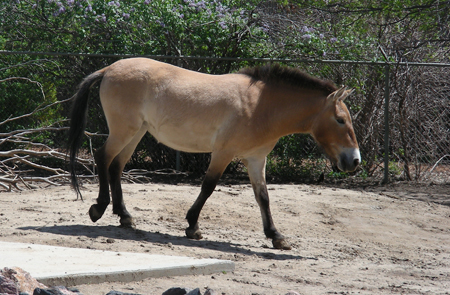
Then, this last May, I was at the Denver Zoo and saw takhi there. They looked much different from the Berlin animals, as you can see. There are a number of reasons for this that have to do with being kept in captive conditions, which can lead to much heavier bone structure and skull defects. The animals for release come from semi-reserves where they can live and eat more normally.

Takhi, Denver Zoo, May 2008

I’ve been drawing and painting them since that first trip to Hustai, but have hardly scratched the surface of the picture possibilities.

Here’s one of the first paintings, which is available as a limited edition giclee. When I showed a photo of it to a Hustai biologist on my second trip there, she immediately recognized the mare by her mane, which reinforced my desire to paint individuals of a species.

Mongolia Morning, oil  12"x 24"
Mongolia Morning       oil on canvas board          12″x 24″ (price on request)

Followers of this blog know how adamant I am about doing fieldwork. I think this next piece illustrates why. There is no way this painting  would have happened if I hadn’t been there at Khomiin Tal to photograph both the horses and the habitat. I’ve seen a few other paintings of takhi and so far none of them really looks to me like it was done from reference shot of reintroduced horses in Mongolia. They are pretty obviously captives in Europe or North America. The light’s not right, the land isn’t right and, mostly, the horses themselves aren’t right. But I sure can understand the compelling desire to paint and draw them anyway!

That's the Spot!  oil  16"x 20"
That’s the Spot!           oil on canvas board        18″x 24″ (price on request)

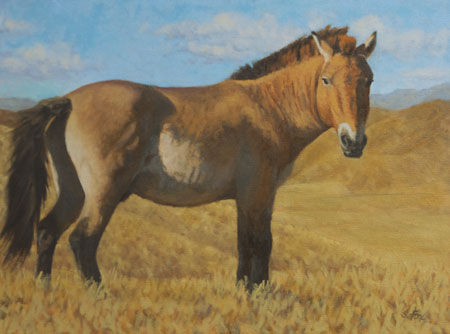
Here’s the most recent painting, a stallion at Hustai. I wanted to really show the valley that is the core habitat of the population of, now, over 200 horses in 15 harems and to try to capture the interesting shape of the shadows on him.

Master of the Valley
Master of the Valley    oil on canvas board    12″x 16″ (price on request)

This 10″x 8″ study is going to be listed for sale on EBay tomorrow or Wednesday. It was amusing to watch the foal work out the motor coordination required to scratch that itch.

Takhi Foal Scratching
Scratch that Itch!   10″x8″    oil on canvasboard

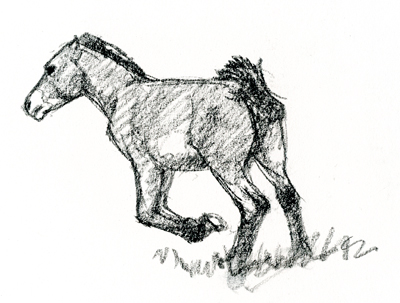
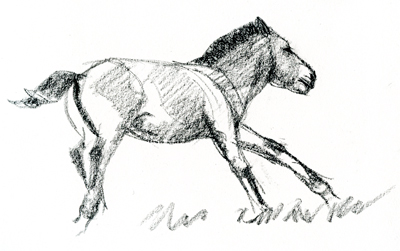
Lastly, I did a batch of drawings a couple of weeks ago and I rather liked the way these came out. The photos were taken at Hustai this past September. It was late afternoon and this one foal was having “crazy fits”. I’m always looking for animals in action and he/she certainly delivered.

takhi-foal-1takhi-foal3takhi-foal-4

takhi-foal-2