Out and About in Ulaanbaatar

Back in the room after dinner and wanted to post a few images from today. This is the first time that I have taken my laptop on one of these “adventure” trips and, with David to sort out the technical issues, I’m able to blog, check email and follow the news for the first time. Tomorrow afternoon we go out to Hustai National Park, about two hours from UB. Then we’ll have three days to watch the takhi (Przewalski’s Horse) and tour around the area. Although there will be electricity available in the gers, there is no internet connection. In fact, the park has no phone, but uses a radio to communicate.

We walked up to the Nomadic Journeys office this morning and got some trip details sorted out, then went to Le Bistro Francais for lunch. Chicken in white sauce and Mongol beer for two. Afterwards, we walked over to the Zanabazar Art Museum, which had been closed my last trip. Zanabazar was a Buddhist monk who created extremely fine bronze sculptures of Buddhist manifestations like White Tara and Manjushri. He is a national hero to the Mongolians. Unfortunately, the sculptures are under glass and I couldn’t get decent photos, but there are some on the museum website http://www.zanabazarmuseum.org/.

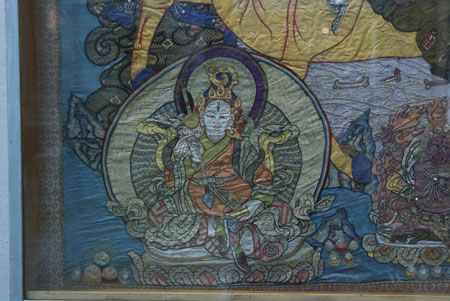
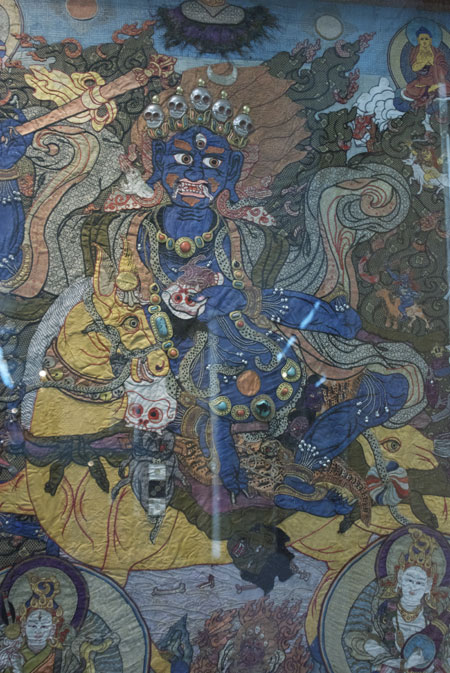
I did get some images of one of the incredible cloth applique thankas. I’ve done various kinds of embroidery for years and have never seen anything like this. The streak is a light reflection in the glass.

Applique thanka
Applique thanka

And a closeup of the figure in the lower left hand corner.

Applique closeup
Applique closeup

Downstairs at the museum is the Red Ger Art Gallery, where one can find contemporary Mongolian art for sale. We bought a couple of pieces of original calligraphy, including one that says “Chinggis Khan”. And then there were “the horse shoes”…..around $300 for the set. I did say that the Mongolians are a horse culture, didn’t I?

"Horse Shoes" from the Red Ger Gallery

Finally, some of you may have heard of “Engrish”, which is the term given for writing that closely resembles but doesn’t exactly cut it as standard English. Product directions are notorious in that regard. Then there is this notice in the elevator at the Bayangol-

Bayangol elevator sign

So, before I commit an improper purpose I’ll sign off and hope to come back with tales of Hustai takhi.

UB to Ikh Nartiin Chuluu

We left the hotel on time, a quick stop by the Nomadic Journeys office, and we were on our way. All the way to the edge of UB, where we pulled into a gas station because….a hose had split. Cell phone call went out to the driver’s son. Two attempts to epoxy it back together. Wouldn’t hold.

Can we fix it?
Can we fix it?

So we swapped cars with the son, who drove us to Ikn Nart in record time in order to get there before dark. The camp cook who was with us knew the way, which was good, since the dirt track in only had some rocks with rough arrows on them for direction. We arrived to a beautiful warm summer evening. Balmy, in fact.

At around 3:30am, David heard the camp guys outside the ger, pulling the top cover closed because of howling wind and rain. For the next 26 hours, on into the following night, it almost never let up. The toilet was around 50 yards from the ger, so we just changed back into the wet clothes when we needed to go up there. I was still feeling punk from the cold I wasn’t quite over with when we left, so a day of enforced rest wasn’t entirely a bad thing.

It wasn’t particularly cold, but as the day wore on, we saw damp areas start to appear in the cloth covering that faced the wind. Finally some water started to drip in in spots. The gers are covered with what our guide called “Russian canvas” for waterproofing and it mostly worked. Tuya, our guide, came back to the ger to chat after dinner and we could see that it was getting worse and worse. One of the camp guys came in and said that one of the other gers was dry, so we pulled together our stuff in about a minute and moved. A fire was quickly lighted in the stove (wood and dung) and we settled in for the night without any idea of how long the storm would last. For all we knew, we had driven six hours to sit in a ger for three days.

But the next morning was sunny, cold and windy and we went on our first trek after breakfast. Amazingly, we encountered the ranger who I remembered from the Earthwatch project from 2005. He had been out all night in the storm and had lost 10 sheep and 3 goats, which we calculate was about 15% of his animals.

By afternoon, it was warm, sunny and blue skies and the same the next day. Here are some photos from the rest of our stay. We came back to UB yesterday and are at the Bayangol Hotel. It’s now 10:30am Tuesday morning and we are headed out to wander around and museum hop. More this evening (my time). Also, I’ve inserted some photos in the previous posts.

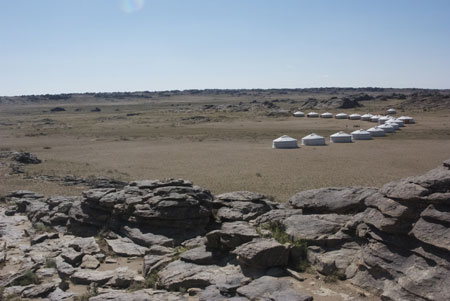
Before the storm
Before the storm
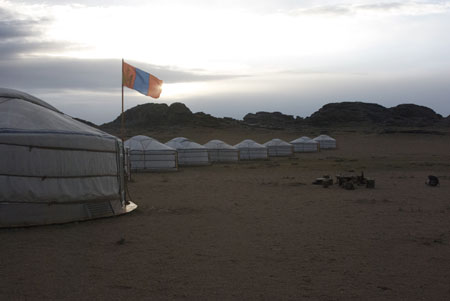
Red Rock Ger Camp
Red Rock Ger Camp
Maikhant helping sheep after storm
Horses grazing near ger camp
Argali, what I came here for mostly
David enjoying the sun in front of our ger
Me and the cook's kitten

Sain Bain Uu from Ulaanbaatar!

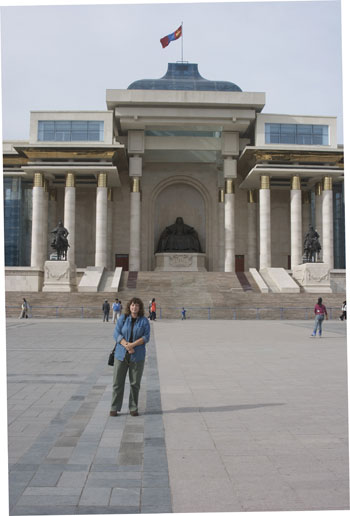
We made it! Our flight from Seoul was rescheduled to the following day due to high winds in UB. (Luggage drama story to come). So, instead of arriving Monday, we arrived Tuesday. Yesterday, Wednesday, was spent sorting out the intinerary with Jan at Nomadic Journeys for a variety of reasons I’ll go into later since I’m on battery power at the tour office right now since the internet connection was down at the hotel. We did get out in the afternoon and walked to Sukhbaatar Square and saw the new improved Government Building that now has an incredible Mongol facade with a huge statue of Chinggis Khan. I’ll post photos later if I can.

UB is looking noticeably spiffier since I was here two years ago. More prosperous, too. We are staying at a hotel called the Bishrelt Plaza. Very friendly staff, good food in the restaurant, room big, a little tatty around the edges but perfectly useable and there were renovations going on while we were there.

It is now 10:15am on Thursday, August 28. At noon, we leave for Ikn Nartiin Chuluu. Back to UB on the 2nd.

Weather yesterday was sunny and warm. Today cloudy and warm.

It’s great to be back and less than two hours from the trip really getting under way.

In front of the Chinggis Khan memorial, Sukhbaatar Square, Ulaanbaatar

Hurry Up and Wait, Part 2

To resume, we were just starting to discuss options in case of a missed connection when they called our flight. Down to San Francisco and onto the SF to Seoul leg with no muss or fuss. Snoozed for awhile, as per the anti-jet lag program that I follow, which is from the book “Overcoming Jet Lag” (available through Amazon; 5 stars based on 24 reviews). Then rediscovered crossword puzzles, thanks to the United in-flight magazine. What a great way to help a ten-plus hour flight go by. Arrived in Seoul around 4:45 Monday afternoon and the plot thickened immediately.

We went to the departure board to find our gate number for the UlaanBaatar (UB) flight and it was blank. Went to the Transit Desk, where we were told that the flight had been canceled due to high winds in UB, which surprised me because my impression was that wind was a problem only in the spring. But, the friendly staffer said, she would rebook us on the next flight…at 6:30 pm the following day. Oh, we said. There is a “transit hotel” at the airport, but next to us was someone in the same pickle and I heard him say what turned out to be the magic words “Hyatt”.

The wonderfully helpful United staff extracted our checked-through bags from the storage container down in the bowels of the airport in less than 30 minutes, which ensured that we had all our stuff, including clean clothes, which we desperately wanted and needed.

So, here we are at the extremely comfortable Hyatt near the airport and it is Tuesday morning about 11:30. Check out is noon, so we will go over to the airport and hope the UB flight goes. If not, back to the Hyatt, where the restaurant is called “Eight” because it is divided into eight different country sections as is the dinner menu. Last night, although kind of in a fog, we paged through French, Korean, Japanese, other Asian and grilled items. I had Quiche Lorraine and David had a Malaysian noodle and prawn dish.

Breakfast this morning was the buffet, where we could choose breakfast items from all the countries named above. I had an omelet, liche juice and bircher musli cereal. There was also bacon, chicken sausage, three kinds of kimchee, small slabs of smoked salmon and sliced cold cuts, a whole section of “continental” breads and pastries. It’s the kind of thing that we have always enjoyed finding at the big international business-oriented hotels.

Pack up and pull out time. With luck the next post will be from UB.

View from our room at the Hyatt, Seoul, Korea

Hurry Up and Wait- Departure Day, August 24

Sitting in the waiting area at the Eureka-Arcata Airport, which is less than ten minutes from our house. The ceiling, due to our “summer air conditioning” aka ground fog, is well under the minimum of 500′ for planes to land. Our plane is en route from San Francisco, which is good news. Our flight on it was scheduled to leave at 8:46am. Current estimate is around 10am. San Francisco to Seoul leaves around 1pm, so we should be ok.

Neighbors and friends who know about the trip have asked the last few days or so if we’re “excited”. Well, sort of. David and I have done a fair amount of international travel. We’ve both had to be focused the last week or so on trip prep. I came down with a minor cold last Monday afternoon and had to perform triage on what I could get done before departure. He had to get his business work in order to be able to leave things in decent shape. And then, especially these days, one doesn’t really know how “challenging” the “travel experience” is going to be. So here we are, starting our grand trip to Mongolia with an hour + delay. It reminds me of the scenes in Star Wars where Luke, Leia and Han anxiously anticipate the Millenium Falcon’s jump to light speed and…….nothing happens.

I’ll get excited when we’ve settled into our (thanks to frequent flier upgrades) Business Class seats and are rolling down the runway in San Francisco.

However, with free wi-fi at the local airport, life goes on. Off to get a cup of coffee.

Here’s the Gear; Reviews When I’m Back

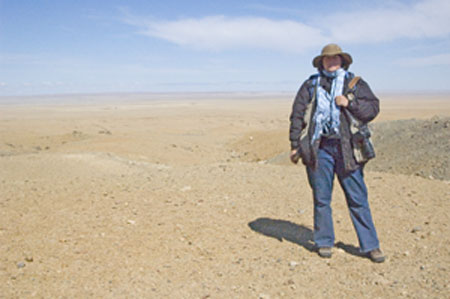
"Me in Mongolia", Ikh Nartiin Chuluu Nature Reserve

To conclude my postings about fieldwork, here’s a partial list of the gear that I’m taking to Mongolia next week. Everything has to meet certain requirements of function, weight and cost. This isn’t extreme travel (read anything by Tim Cahill for that), but we will need to be self-sufficient and ready for dramatic swings in weather since Mongolia is landlocked with no marine influence. Rain shouldn’t be an issue, but cold nights and wind are likely based on my limited past experience. Days should be nice, even hot, at least early on.

My fond hope is that this and the previous posts will de-mystify getting out into the field by providing specific information on one way to do it.

Most of the following has gone with me before, but there are a few new things, which I’ll start with:

Thermals- Icebreaker 260 100% merino wool long-sleeved top and leggings. Not cheap, but half the bulk of what I used to have.

Pants- LL Bean Pathfinder Ripstop Cotton; less bulky than jeans; my husband loves the pair we bought him so much, he’s getting two more, so I decided to try them, too.

Shoes- New Balance 644 “sneakers” (645 follow-on); for around camp and town

And, going with me again:

Boots- LL Bean Gortex Cresta Hikers; they say you can wear them out of the box and I found that to be absolutely true. These are great boots!

Socks- Thorlo Light Hikers, daytime warm; Smartwool for cold and at night as needed; they don’t itch, so I don’t have to take silk liner socks anymore

Layers- Patagonia fleece pullover, purchased used at Wilderness Experience consignment shop, Berkeley. Black, lined jacket (see photo at top) from TravelSmith; purchased for first trip to Kenya in 1999, so no longer available, but still going strong; have only had to mend torn corner of front patch pocket.

Purse-MetroSafe200; has a steel cable in the shoulder strap and all the zippers close forward so no one can slip it open; it goes into my daypack, which is one of my two carry-ons; Peace of mind in unfamiliar cities in any country.

Neck- a long blue kaffiyeh-print scarf that I picked up somewhere; more versatile than a bandana; muffler when cold; face or camera protection from dust; wet rag or washcloth; style points in photos, like above

Hat- canvas, foldable, 360 brim from The Australian Outback Collection; took a few tries to find the right one; also gets style points (see photo above); and a baseball hat to get my hair up and out of the way in camp when showers are unavailable

So, why care about “style points”? Because part of being a working artist who intends to make a living is marketing and one’s “story”. Part of mine is the trips I take, which my friends, fans and buyers get to share. Pictures of me are part of it and I don’t want to look like a dork.

the Sleeping Bag- I can’t begin to tell you how much I hate mummy bags. It affects my sleep and I never seem to really adjust since I’m a curl-up-on-my-side sleeper. Bless their hearts, LL Bean makes one of the very few rectangular down bags for my kind of field use. It’s rated to 20F.

I do have a couple of different Thermarest pads, but the tour company provides one, so mine stay home this time.

Luggage- I have a pair of LL Bean rolling duffles that have clamshell top openings. I love them, but they aren’t available anymore. My big bag, their Sportsman’s Extra-Large Drop Bottom Rolling Gear Bag, however, is. I got it because even the larger of the two clamshell duffles won’t hold the Thermarest pad. Not long enough. The smaller one is carry-on size. It gets the camera equipment and just-in-case basics. The daypack has the laptop, documents, book, food, etc. and my purse.

Last post until I manage to get on-line in Mongolia.

Cheers!

ART TIP OF THE DAY

“I don’t mind hard work. You’ve got to work hard to generate something. I don’t think there’s any secret to success if you show up in the right place, at the right time and you put in a lot of time and effort and energy – you’re going to get something out of it. It’s not brain surgery.”

Ryan Seacrest, ex-actor, now host of American Idol and Dick Clark’s heir apparent as “America’s Host”

Mongolia Monday: The Five Snouts, Part 5

At last we come to the most important “Snout” of all for Mongolians, the horse. I was told that Mongolians sing about three things: the land, their mothers and their horses. The classic Mongolian musical instrument is the “morin khuur” or horse-headed violin. Here are some that I saw at the Mongolian Artists’ Union gallery in Ulaan Baatar.

Morin Khuur
Morin Khuur

Horses have inspired Mongolian art for a very long time. I happened on this delightful modern “horse art” in the courtyard of the Museum of the Chojin Lama in Ulaanbaatar.

Rainbow Horses
Rainbow Horses

And here’s the explanation that was nearby. This was in September of 2006 and I have no idea if they are still there, but the museum is on the list for the upcoming trip, so perhaps we’ll be lucky and get to see them again.

Rainbow Horse project sign

I find that there is often confusion between the, more or less, domestic Mongolian horse and the takhi or Przewalski’s Horse, which is the only surviving species of true wild horse. They are different species. There are domestic horses who have physical traits that indicate a past cross with the takhi, which were extinct in the wild as of 1969. I’ve seen a number of Mongolian horses with some combination of upright, brushy mane, a reddish dorsal stripe, a light eye-ring or muzzle and maybe tarsal and/or carpal stripes on the legs.

As one travels about the countryside, the herder’s establishments are a blend of old and new. Motorbikes, solar panels and satellite dishes aren’t uncommon, but everywhere there was always at least one horse saddled, bridled, hobbled and ready to ride at a moment’s notice. Mongols are, after all, the original horse culture.

The Mongolian horses are beyond tough. They are left to roam at large most of the year and manage to survive weather, down to -40F in the winter, that would kill most other horses. I have read at least two accounts of western writers who traveled across Mongolia by horse and who described the morning saddle-up as “a rodeo”.

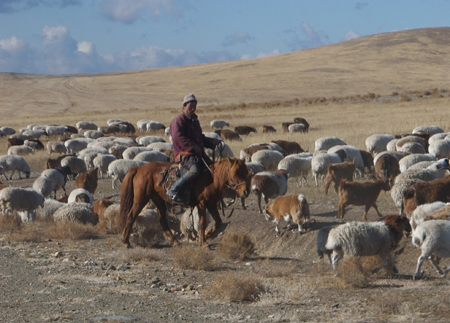
Herding sheep
Herding sheep and goats

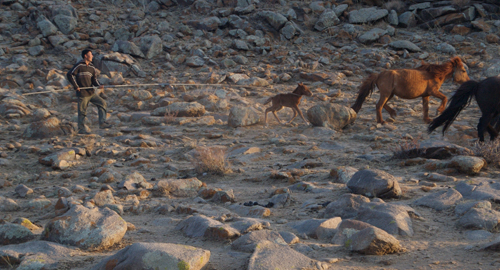
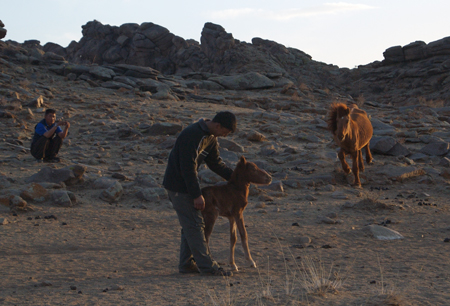
One evening at Ikh Nart, we watched a young Mongolian man capture a foal with an “urga”. Mom was not amused and kept a close eye on things.

Catching the foal
Catching the foal
Getting the foal used to human handling
Turning the foal loose and here comes the mare

One of the things that amazed me when I saw them for the first time at Ikh Nartiin Chuluu was that even though it was spring (and anyone who has been to Mongolia knows what that means weather-wise: cold, wind, dust storms) and most of the horses were terribly thin, many had long- flowing manes and tails that were gorgeous.

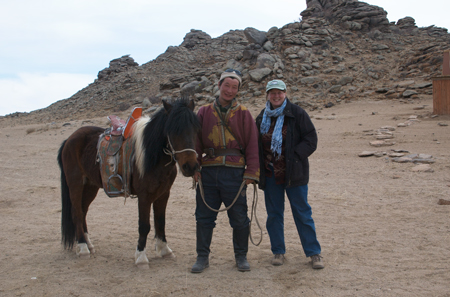
This was one of my favorite pictures from my first trip in the spring of 2005. The young herder was perfectly happy to have his picture taken with me as long as his horse was included. No problem.

Ikh Nart herder and I

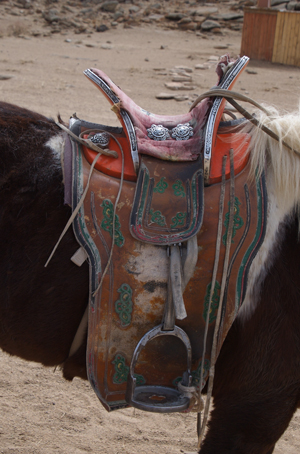
And here a close-up of the saddle. The silver bosses on the side are to “encourage” the rider to ride standing in the saddle.

Mongolian saddle
Mongolian saddle

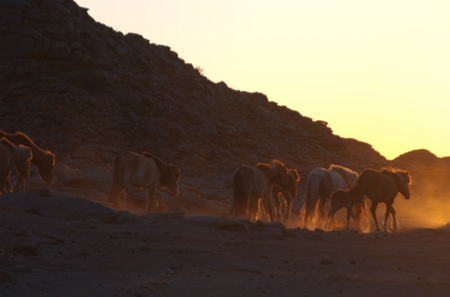
Finally, another one of my favorites; a herd of horses coming down to the stream to drink at Ikh Nartiin Chuluu.

Fieldwork for Wildlife Artists-What I Use

I’m leaving for Mongolia on August 24, coming home on September 21st. As is the case with fieldwork in any really “interesting” place, self-sufficiency is critical. As is the ability to “get the shot”, which means the camera equipment has to be reliable and ready to go at all times.

On the road in western Mongolia, Sept. 2006; some of the “endless steppe” of Central Asia

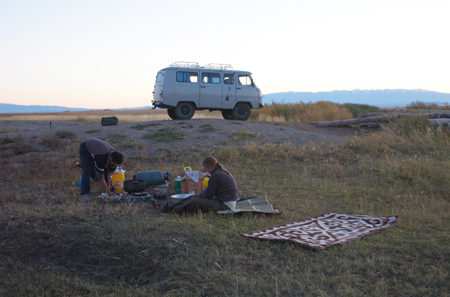
Camp kitchen at Khar Us Nuur, last night out. Trusty Russian Furgon van in the background.

Here’s a list of the gear and art stuff that I need to do my job in the field and bring home the reference that is a large part of why I’m spending the money to go to countries like Mongolia in the first place.

PHOTOGRAPHY

Bag and The Big Lens
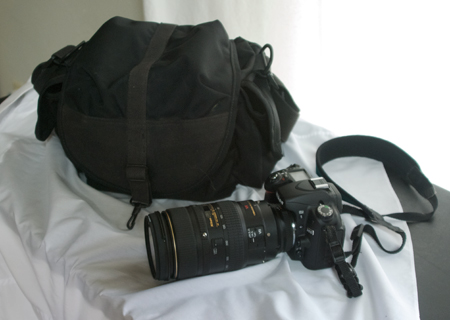
2 Nikon D80 camera bodies

1 AF-VR Nikkor 80-400mm lens (effective 600mm on a digital body)

1 Promaster (made by Tamron) 28-300mm lens

Two bodies, two lenses because, with wildlife, there’s never time to swap them, plus risk of dust, dirt, drops

4 2GB memory cards; two Promasters, purchased when I got the camera bodies from my local photography store and two SanDisk Extreme III’s, which are designed to perform in cold, heat, wind, etc.

1 40GB Firelight external hard drive

For the first time- my MacBook Pro. I’ve used Flashtrax and Wolverine external hard drives for storage and back-up till now. This time I’m going to download onto my MacBook and back-up to the Firelight. The MacBook has Photoshop Elements on it, so my hope and plan is to be able to view and create jpgs of some of my images during the trip and post them to my blog when I have internet access. I’ve been interested for awhile now in location-independent functioning for artists and this will be my first experiment in staying connected and sharing the trip in almost “real time”. My husband, an IT professional, will be along for most of the trip, so he’ll be my tech support.

Extra batteries; for a total of four

Battery charger

Inverter for recharging batteries using a vehicle cigarette lighter, critical on the road when there is no reliable access to electricity

I-Sun solar charger; Mongolia does have sun over 300 days a year, so having one of those available was a no-brainer

Probably the Nikon Coolpix for ultimate back-up or for around town

ART STUFF

Fieldwork supplies plus piece done at Hustai National Park ger camp, Sept. 2006

Plastic box with gel pens, carbon pencils, kneaded eraser, sharpener, travel watercolor brush

Some additional brushes

Pelikan gouache 24 pan kit; I like the gouache because it can be used opaquely or transparently

Aqua Tote water holder; folds flat

Aquabee Superdeluxe Sketch Book, 8″x9″- heavy paper that can take any media; I’ll use it for my journal, too.

Annigoni 100% cotton paper, acid free; a natural beige color which provides the same medium value as putting a toned wash on a canvas for oil painting; The inspiration here was Thomas Moran’s fabulous “sketches” from his travels to Yellowstone, done on toned paper, using white “body color”, i.e. gouache, for the lightest areas.

Rags from old clothes, napkins from various restaurants

TO HAUL IT ALL AROUND

My faithful photo vest; why should photographers have all the good stuff?

1 Domke Super Compact camera bag

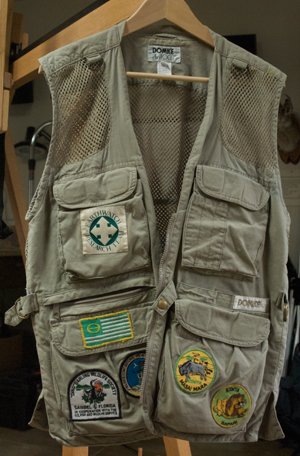
1 Domke PhotTogs vest, which I’ve had since 1999; two trips to Kenya, two to Mongolia, plus Yellowstone five or six times and wherever else and it still looks embarassingly new. It’s more or less a substitute for a day pack and has the advantage that everything is more quickly available than if it was in the pack and  it also leaves the hands free. I don’t take a sketchbook bigger than will fit in one of the lower front pockets. The patches are just for fun, but have been good conversation starters over the years. I’ve heard some great stories and gotten useful tips on where to see various species.

1 REI daypack; which gets carried on the plane and holds my laptop, book, plane tickets, hotel/rental car confirmations; folder of other trip info., steel water bottle (which is refilled once I’m through security), protein bars (because I never, ever travel without some food, just in case), and my TravelSmith purse, which has a steel cable inserted into the shoulder strap and zippers which all zip forward under my arm (and that foiled a pickpocket once, as it was designed to).

PLUS, I ALWAYS HAVE

1 Platypus water system for hiking hands-free and still being able to drink water regularly without messing with the daypack. Mongolia has VERY low humidity, so staying hydrated is important. Essentially it’s a water bag that goes in the pack and has a tube that I clip to my vest, so it’s easy to take a sip as wanted.

2-3 Protein bars

1 Pair sturdy hiking boots, ankle high for support on rough ground; a twisted ankle can be serious business in a country with not much in the way of western standard medical facilities (medical air evacuation insurance is a must, also)

1 hat with a full 360 brim and a chin cord

1 Magellen GPS, so I can go off on my own and find my way back. Very liberating!

A handful of bandaids and a compact first aid kit, a bandana, Swiss Army knife, kleenex, sunglasses, lip balm, sunscreen, passport, phrasebook

Maybe most important of all, an open mind, patience, a willingness to go with the flow and find the humor in the ridiculous things that happen when one travels.

FINALLY

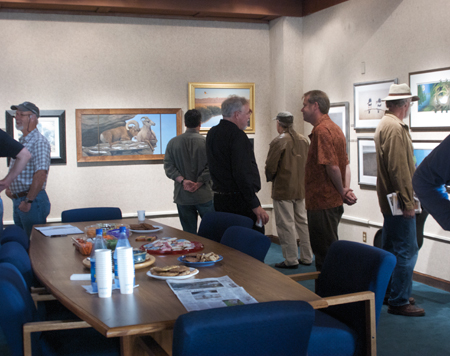
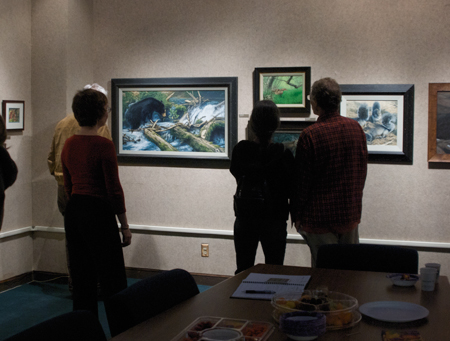
Had a great turnout for the Wild Visions 2 show reception last Friday night! Pretty much non-stop. The show was very well-received. Lots of compliments. Here’s a couple of photos:

The bighorns are my newest major work “Heavy Lies the Head”. Terrific custom frame by Mark at Southstream Art Services.

A few of Shawn Gould’s paintings
Mongolia Monday: The Five Snouts, Part 4

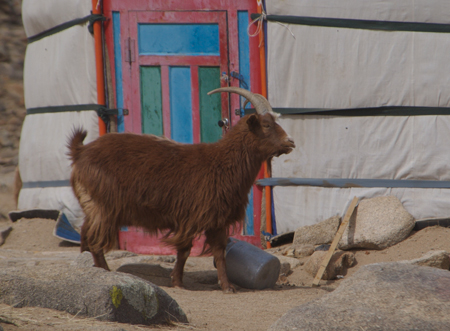
Almost everyone has heard of cashmere. It’s traditionally been associated with other high end luxury goods, like silk and gold jewelry. What isn’t widely known, and I’m hoping this will change, is that the best cashmere in the world comes from Mongolia. Cashmere is superfine angora goat wool. But the goats are pretty special, given that they can tolerate winter temperatures down to -40F.

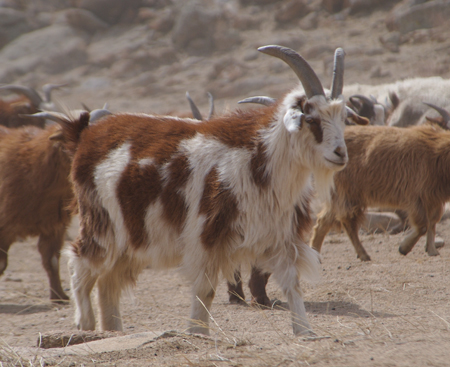
I’ve seen the goats mostly at Ikh Nartiin Chuluu Nature Reserve and found them quirky and fun to watch. As you will see, they come in all shapes, sizes, colors and horn “designs”. But the undercoat is the same on all of them, so the rest doesn’t matter.

While there are businesses in Mongolia that take the raw cashmere and turn it into a finished product, most of the wool is purchased by the Chinese and taken back to China. Our Earthwatch group got to visit Gobi Cashmere in Ulaanbaatar. I brought home a wonderful natural color cashmere neck scarf that is as soft as can be.

But here’s where it starts, with each goat being hand-combed in the spring. Other than the 30 minutes or so they are constrained for combing, they wander free in the countryside, adding a little character and humor to the landscape.

I took this photo on my first visit to a herder’s ger just outside Hustai National Park.

A “pinto” goat at Ikh Nart.

Goats and other livestock being herded through the research camp at Ikh Nart where they had been brought for watering.

There’s one in every crowd. This one just…had…to…see what was in the can.

These goats are part of a large two ger establishment near the Tuul Gol (river) just outside of Hustai National Park.

Answer to Friday’s question: Roses. Vintage Gardens in Sebastopol, California was having an end of season sale of roses that they might be discontinuing, so I’ve ordered a bunch that looked interesting to help preserve them. Most I’ve never heard of before.