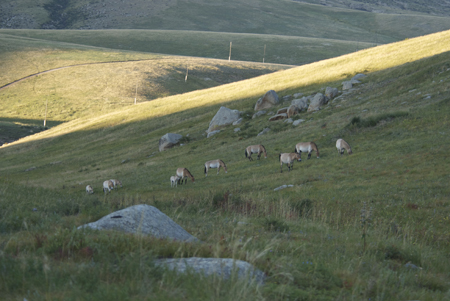
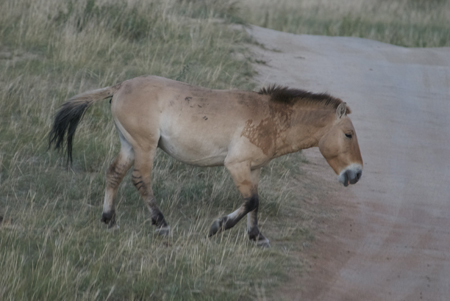
Why GOING THERE Makes all the Difference – Thank You, Simon

Four years ago today, internationally known wildlife artist Simon Combes was killed by a cape buffalo while walking with his wife on a mountain called Delemere’s Nose, which is part of the Delemere estate in Kenya where they lived. Just two months earlier, I and nine other incredibly fortunate wildlife artists were on the safari of a lifetime with him. Looking at dates on my images, I see that we had gotten up the morning of October 12 at the Kigio Wildlife Sanctuary and spent most of the day driving south to the Masai Mara. When we stopped for lunch in the Masai group ranch north of the reserve proper, we saw our first Mara wildlife, a male topi on top of a mound. Then, in rapid succession it was wildebeest, gazelle, hippos, a huge male giraffe right inside the entrance to the Reserve and then…lions!

My tribute page and the photos that I took of him during the safari are here. But what I want to share today is what it means as an artist to be able to travel to a place like Kenya with someone like Simon, who knew the ground and the animals and who always seemed to get us to the right place at the right time. I had realized very quickly on my first trip there in 1999 that it was  pointless to paint animals like cheetahs and lions without having seen them in their habitat. There’s really no way to get it right and those who have been there know the difference instantly. Trust me on this. So out of the 5,218 photos I shot in 2004, here are a few that I hope will illustrate this point, followed by some of the paintings that have resulted from the trip. If you want more, the whole safari is here. on my website.
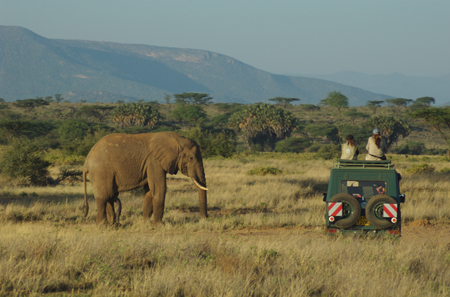
Samburu encounter
Samburu encounter

Emotion and point of view play a major role in the creation of great wildlife art. How could the two women in the front vehicle not remember  and “channel” this encounter if they paint an elephant? We’ll all remember this morning in the Samburu going from cool to warm, the beautiful light and this bull elephant who made it abundantly clear that it was time for us to move along.
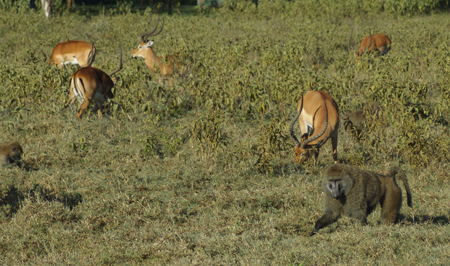
Impala and baboons
Impala and baboons

Artists get asked all the time where we get the ideas for our paintings. Well, here’s one I probably wouldn’t have thought of if I hadn’t seen it. Baboons and impala breakfasting together at Lake Nakuru. Part of the problem with zoos  and game parks is that the animals are out of context. You never see the natural groupings or interactions. Or if there are different species together, you have no idea how that would play out in the wild. To me, this kind of reference is gold. I can paint this African “Beauty and the Beast” scene because I saw it, photographed it, know it happened.
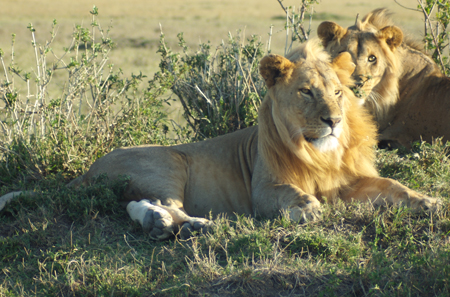
Young mara lions
Young mara lions

There really is something about lions. They define “presence”, even when they are still kids, like these two. Great afternoon light and you hardly notice that his face is covered with flies. For contrast, here’s a zoo lion. He’s gorgeous, with a huge mane and perfect whiskers. Dead giveaway, along with the flat light and lack of body condition. This lion don’t hunt. Which would you rather paint?
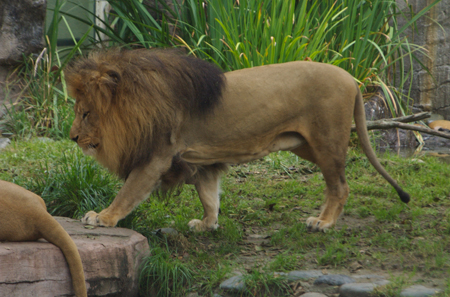
Zoo lion
Zoo lion

We went out on an evening game drive in the Samburu and as the sun was going down, it seemed to be really important to Simon to get to a particular place. We were literally along for the ride, so just waited to see what was up. Oh, yeah, this is very, very nice. It’ll do. Thank you, Simon.

Samburu sunset
Samburu sunset

Here’s a selection of the paintings that have come out of the safari so far.

Ground Hornbill
Ground Hornbill oil 18"x 24" (price on request)

Reference shot in the Mara. Simon did some interesting jogs with the vehicle to get alongside this big bird, who just wanted to walk away .

Samburu Morning
Samburu Morning oil 18"x 24" (price on request)

I loved the northern Kenya landscape with the huge, storybook doum palms.

Interrupted Nap (Spotted hyena)
Interrupted Nap (Spotted hyena) Private Collection

Reference shot in the Mara. There was a cub, too, but that’s a painting for another day.This one was snapped up by a collector who also loves vultures and gets first crack at any I do.

Thompson's Gazelle
Thompson's Gazelle oil 16" x 12" (price on request)

John Seerey-Lester was kind enough to choose this painting for inclusion in the 2008 Art and the Animal Kingdom show at the Bennington Center for the Arts.

That's Close Enough
That's Close Enough oil 12" x 9" (price on request)

Cropped in from a large herd of buffalo at Lake Nakuru. Nobody was getting anywhere near that calf. No way, no how.

Morning Break
Morning Break oil 12"x 24" (price on request)

Reference photographed in the Mara, where we got an eyeful of cheetah every day we were there. This painting was juried into the 2008 Animal Art show at the Mendocino Art Center here in California. I’ve got to be in the right mood to paint all those spots, but I do love cheetahs!

ART THOUGHT OF THE DAY

“A few days later I looked up from my work to see a new elephant, one that I had not seen before, standing quietly only yards from my easel. He had crossed the river to my side on the outer curve of the ox bow and wanted to pass through the narrow neck where I was working. To do so he would have to pass within five yards of me or go back the long way around. I held my breath as he shifted silently from foot to foot, carefully weighing the situation. Finally, he moved forward and past me, watching intently as I stood motionless. Such rare incidents of trust between man and wild animals give me a great thrill.”

Simon Combes, from An African Experience

Mongolia Monday- Talking About Takhi

Well, I certainly enjoyed the last two Mongolia Monday posts and hope you did, too. Thanks again, Simon!

Today it’s back to a subject that has become near and dear to my heart- the takhi or Przewalski’s Horse. I always liked horses, even though I was deathly allergic to them as a kid, but have never been, ahem, drawn to them as a subject until I saw takhi for the first time at the Berlin Zoo in October of 2004. I didn’t even know they were there. I just happened on them in the far nether reaches of the zoo. Seven of them, looking like they’d just stepped out of a cave painting.

Takhi group, Berlin Zoo, October 2004

I remember that I plopped down on the nearest bench, probably with an idiot smile of delight on my face, to sketch and photograph them. They were enchanting.

Takhi Stallion, Berlin Zoo, October 2004

I did some research when I got home and found out that they were being reintroduced into Mongolia. So when I signed on for an Earthwatch project there, I arranged a three day trip to the closest site, Hustai National Park. It was spring, which meant cold, windy and and occasional snow, but I saw the horses and got some decent photos. The next step was to get back to Mongolia, which I did in late September-early October of 2006. By then, I’d found out about a third, new release site in western Mongolia, Khomiin Tal, and managed to get out there. There is also a series of three articles I wrote for Horses in Art. One on Hustai National Park, one on Khomiin Tal and one on the domestic Mongolian horses. Look under “Writings” for those.

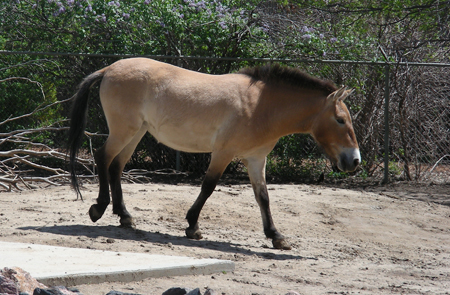
Then, this last May, I was at the Denver Zoo and saw takhi there. They looked much different from the Berlin animals, as you can see. There are a number of reasons for this that have to do with being kept in captive conditions, which can lead to much heavier bone structure and skull defects. The animals for release come from semi-reserves where they can live and eat more normally.

Takhi, Denver Zoo, May 2008

I’ve been drawing and painting them since that first trip to Hustai, but have hardly scratched the surface of the picture possibilities.

Here’s one of the first paintings, which is available as a limited edition giclee. When I showed a photo of it to a Hustai biologist on my second trip there, she immediately recognized the mare by her mane, which reinforced my desire to paint individuals of a species.

Mongolia Morning, oil  12"x 24"
Mongolia Morning       oil on canvas board          12″x 24″ (price on request)

Followers of this blog know how adamant I am about doing fieldwork. I think this next piece illustrates why. There is no way this painting  would have happened if I hadn’t been there at Khomiin Tal to photograph both the horses and the habitat. I’ve seen a few other paintings of takhi and so far none of them really looks to me like it was done from reference shot of reintroduced horses in Mongolia. They are pretty obviously captives in Europe or North America. The light’s not right, the land isn’t right and, mostly, the horses themselves aren’t right. But I sure can understand the compelling desire to paint and draw them anyway!

That's the Spot!  oil  16"x 20"
That’s the Spot!           oil on canvas board        18″x 24″ (price on request)

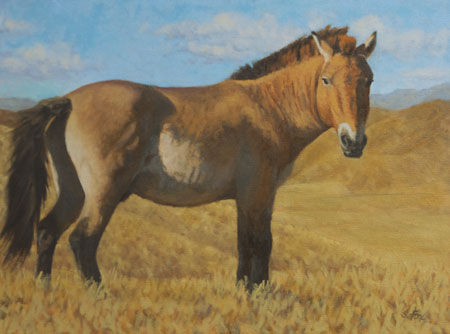
Here’s the most recent painting, a stallion at Hustai. I wanted to really show the valley that is the core habitat of the population of, now, over 200 horses in 15 harems and to try to capture the interesting shape of the shadows on him.

Master of the Valley
Master of the Valley    oil on canvas board    12″x 16″ (price on request)

This 10″x 8″ study is going to be listed for sale on EBay tomorrow or Wednesday. It was amusing to watch the foal work out the motor coordination required to scratch that itch.

Takhi Foal Scratching
Scratch that Itch!   10″x8″    oil on canvasboard

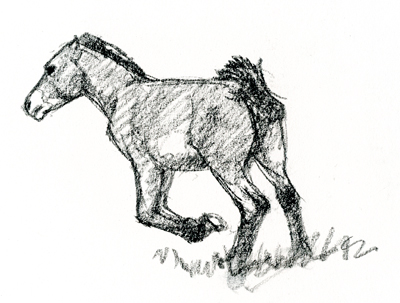
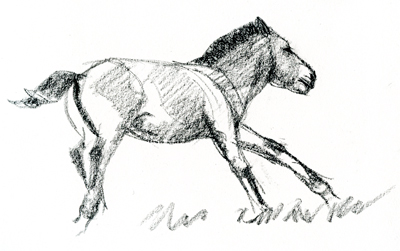
Lastly, I did a batch of drawings a couple of weeks ago and I rather liked the way these came out. The photos were taken at Hustai this past September. It was late afternoon and this one foal was having “crazy fits”. I’m always looking for animals in action and he/she certainly delivered.

takhi-foal-1takhi-foal3takhi-foal-4

takhi-foal-2

Mongolia Monday- Planes, Trains and….Camel Carts!

One of the most rewarding parts of travel is finding out how many ways there are to address the everyday challenges of life which are perfectly valid, but really, really different from how one does things at home. If the traveler is open to new experiences with an attitude of neutral curiosity, he or she might find that “difference”, in and of itself, is not threatening. Pity the impervious person who spends fair sums of money and time to travel and comes home utterly unaffected and unchanged. What an opportunity for the enrichment of one’s life wasted.

Mongolia is such a great place to get out of one’s own bubble. Customs and practices that haven’t changed in 1000 years exist happily alongside 20th/21st century technology. So, the country family holds its annual foal branding and a city relative records the occasion with her cell phone camera. Perfect.

(I would also like to note here that I have zero tolerance for those who want to deny more traditional cultures modern equipment, technology or goods because it will somehow “spoil” them. Selfish, romantic nonsense. The thought that a people like the Mongols could somehow be “spoiled” by integrating the modern world into their lives is ridiculous, IMHO. Lack of western technology does not equal stupid. Grant people the right to make up their own minds and choose what makes sense to them.)

Which brings us to today’s theme- how to get around, round, round in Mongolia. We will proceed from western high-tech to (for westerners) the picturesque.

Chinggis Khan International Airport, Ulaanbaatar
Train between Ulaanbaatar and Choir
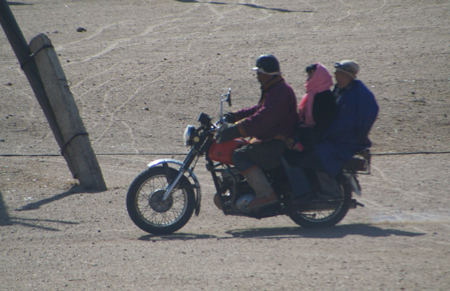
Motorcycle, western Mongolia

Love the seat cover!

A ride home from the train station
Truck with handcrank starter, Hovd, western Mongolia

The Mongolians might be the greatest mechanics in the world. Travel stories by writers who have gone there are filled with accounts of impossible repairs in the middle of nowhere. Lack of money, parts, towing services (Ha!) and the need to find a way has bred an amazing level of ingenuity, which I have personally experienced with awe and respect. But those are stories for future posts.

the fabulous Russian Fergon van

You travel in these to ensure you get there, not because they’re comfortable. Four gear shift levers and counting.

Tractor with hay, Hovd, western Mongolia
Tractor with hay, Hovd
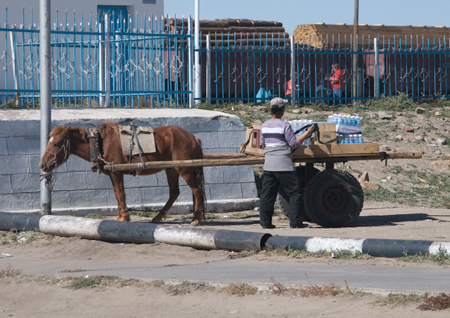
Horse cart with bottled water, Choir
Donkey carts, Hovd
Donkey carts, Hovd
Camel cart, between Ulaanbaatar and Choir
Rubber boat, Khar Us Nur National Park, western Mongolia
Rubber boat, Khar Us Nuur National Park, western Mongolia

My guide had talked about “the boat” (!?) when we were leaving Hovd for Khomiin Tal. Our last night out I found out what he was talking about. He’d purchased this inflatable boat when he was in Germany and this was his first chance to try it out.

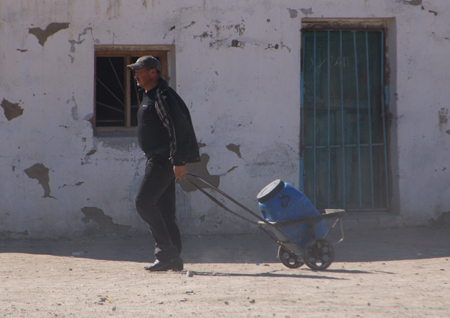
Hauling water in Hovd

There doesn’t seem to be much in the way of running water in the towns I’ve been in, so one sees it being hauled in these carts. It makes you think about your use of water and be more mindful of what it took to provide it.

Moving bricks to the kiln, western Mongolia
Home from shopping, Hovd

Lots of people have to walk to where they need to go, but, of course, the quintessential way to get around in Mongolia has always been on horseback.

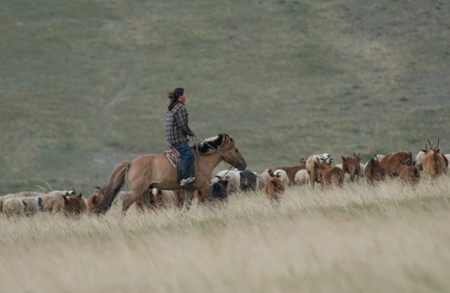
Herding goats near Hustai National Park

I like this picture because you can really see how she is riding standing up in the saddle. The stirrups are tied together under the belly of the horse to keep them in place. Ah, THAT’S the secret.

Choidog at the foal branding, Arburd Sands
Timeless
Timeless

Mongolia Monday- Cats and Dogs

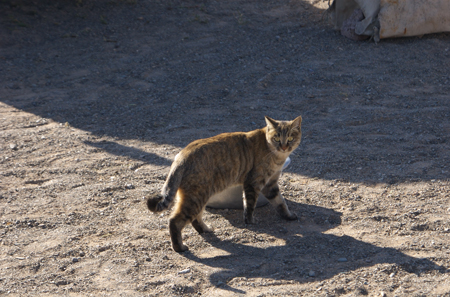
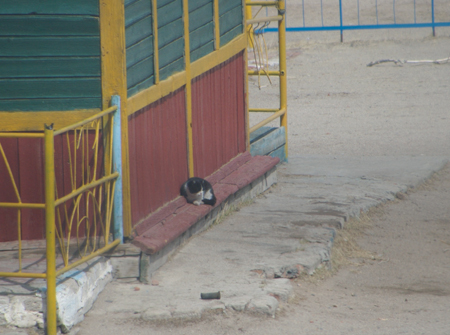
Cat seen from train, 2004

CATS

In three trips to Mongolia I’ve seen exactly….three cats, literally one per trip. In general it appears that Mongolians don’t much like cats. There are a number of beliefs about them, none particularly positive. I was told that the appearance of a cat meant that there would be a death. Two women that I’ve spoken with both said that they didn’t even like the idea of touching a cat, but one allowed as how her attitude was probably based on things older people had said when she was much younger.

On the other hand, when we stopped at a ger in the Gobi, I watched a woman shoo this cat into the ger while the dogs were clearly meant to stay outside. I remember thinking “It figures.”

Cat at ger near Bayanzag in the Gobi

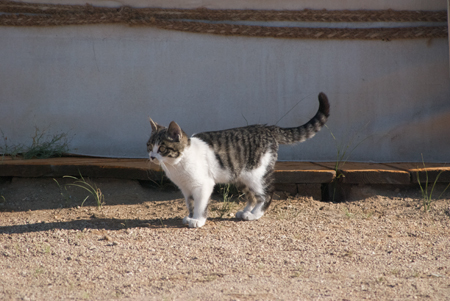
They do seem to be kept around by some families for the age-old purpose of rodent control. This little cat was at the ger camp at Ikh Nart. She was fussed over by the cook, who I was told loves animals. She was very friendly, so David and I were able to get an unexpected “cat fix”. It was apparently impossible to keep her out of the staff ger because she would climb up to the top and come in through the center opening. One night she dropped down onto our guide’s bed, one of the women who was adamant about not liking cats, and proceeded to try to snuggle up near her head. I remember thinking “It figures.”

Young cat at Red Rock Ger Camp, Ikh Nartiin Chuluu Nature Reserve

DOGS

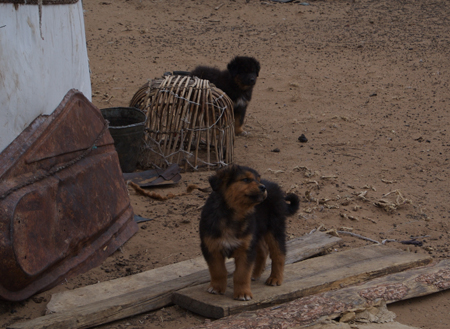
I suspect that Mongols have had dogs for as long as they have had horses and the other “Snouts”. The traditional greeting upon approaching a herder ger is “Hold the dogs!” and they aren’t kidding. The traditional herder’s dog is a Tibetan mastiff, which can take its guard duties very seriously. I was told on this last trip, however, that many herders do keep a dog as a “pet” along with the ones for guarding. I hope to learn more about all this on the next trip.

Tibetan Mastiff-type dog
Mastiff puppies near Hustai National Park

One consistant piece of advice that one runs across when looking into travel to Mongolia is do not, DO NOT, pet, pat, scritch, scratch or otherwise touch any dog. They have not been vaccinated for rabies and getting saliva on your skin, much less a bite, means air evacuation to a hospital for the (painful) series of shots. Foreigners who are working in the countryside get the rabies vaccine, but since nothing is 100%, it’s smart for them not to have contact either.

That said, I have found that most of the dogs I’ve seen don’t exhibit vicious behavior and a lot of them seem to be longing for contact with people. I finally relented once at Arburd Sands when this dog approached me while I was sketching and leaned into me. I decided that it was unlikely that the camp owners would have a dog around that was at all likely to bite the guests. I stayed alert while I gently petted his back and didn’t let his mouth near my hand. He seemed to really like it, but it was still a risk.

Friendly dog at Arburd Sands

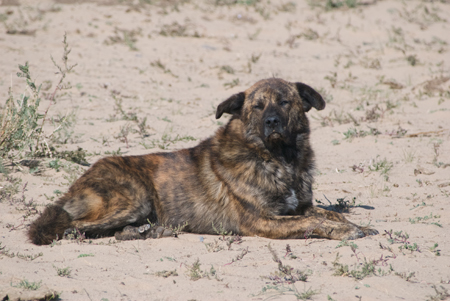
I hadn’t seen brindle dogs like this before this trip. Not sure where that coloration came from, but he has the mastiff head and body type.

I feel like I’m seeing fewer of the pure mastiffs since my first trip. When the Russians pulled out in 1991, I was told that they left their guard dogs, mostly German Shepherds, behind. And I remember seeing a couple of what looked like purebred Shepherds between the airport and UB in 2006. There has obviously been a lot of uncontrolled interbreeding. It looks to me like the dogs are gradually reverting to the basic dog form that travellers see all over the world in the streets, the countryside, at dumps, etc.

Dog seen by side of the road near Gorkhi-Terelj

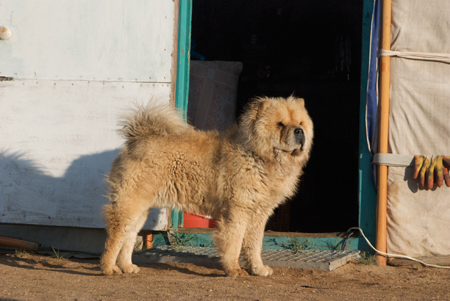
And, for something completely different, at Red Rock Ger Camp, there was this chow chow, the only one I’ve seen in Mongolia. Never found out who he belongs to, but a fairly wide area around the camp seemed to belong to him, judging by his thorough and conscientious marking routine.

Chow chow at Red Rock Ger Camp

RANDOM NOTES

From The Global Village Dept.- twice when I’ve been in the State Department Store, I’ve seen young girls with tiny “fashion accessory” dogs tucked in their arms, a la Paris Hilton. Sigh.

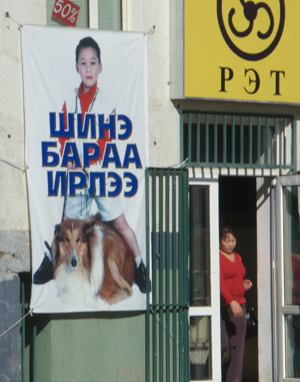
And finally, many of you know that I have a rough collie, named Niki, the same breed as Lassie. Imagine my surprise when I happened upon this banner in Ulaanbaatar:

Pet shop banner, Ulaanbaatar


New Paintings and Equipment Review

I’m just finishing a second productive week in the studio after my return and, boy, does it feel good. As did getting out yesterday afternoon and planting some new roses and spring bulbs.

HEAVY LIES THE HEAD

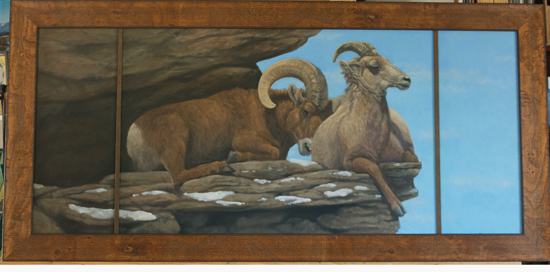
I’ve got a number of pieces in progress, but wanted to share this one that was completed before I left. It was in the Wild Visions 2 show and I hadn’t had a chance to photograph it until a couple of days ago. I’ve never done a three-panel piece and I’m thrilled with the framing. Unfortunately, the framer has gone out of business and there isn’t anyone else around here who can do this kind of custom work. Drat.

Heavy Lies the Head   oil   20"x 46"
Heavy Lies the Head oil 20"x 46"

The animals, bighorn sheep,  were photographed at the Denver Zoo. It was a warm morning and the ram couldn’t keep his eyes open. His head kept, drooping, drooping, until it sank onto the back of the ewe, who never even blinked. The pose was irresistible, but I did check with Laney, a nationally known artist who specializes in bighorns, to ensure that this behavior could have happened in the wild.

Of course they needed a more interesting setting, so I found some nice rock formations that I had shot up on Logan Pass in Glacier National Park, where bighorn sheep are often seen. Laney suggested adding the bits of snow so that the presence of the ram and ewe together would be consistent with the season.

Besides the great pose, I wanted to try to capture the feeling of the environment bighorns live in and how casual they are about heights that would make a lot of people faint with vertigo.

CHEETAH HEAD STUDY

Some animal’s heads are more challenging than others. There are subtleties to the forms that, if they are missed, leave the viewer who knows better feeling that the painting was “close, but no banana”. Cheetahs seem to be one of the difficult ones. I think I’ve seen more badly drawn and painted heads of cheetahs than maybe any other animal, so I’ll hang it out there and offer for your perusal this new head study.

Cheetah Head Study
Cheetah Head Study oil 9"x 12"

EQUIPMENT REVIEWS

All in all, everything worked as it was supposed to.

My husband was very happy with his LL Bean Katahdin 20F sleeping bag. He liked the larger size and the fact that it was rectangular. The Climashield fill kept him comfortable. The only down side was that it didn’t pack down as small as my down bag.

My Katahdin 20F down bag was great, as usual. One of the nice things about the rectangle is that it can double as a comforter. This is handy in a ger, which has regular beds with sheets and blankets. It can get cold at night though, but unzipping the bag and throwing it over the bed worked well. And if the mattress was too hard, as is sometimes the case, I used the bedding as a “pad” and just slept on top of it in the bag.

The LL Bean ripstop cotton pants were absolute winners. We wore ours day after day and they seemed to shed dirt and never felt icky. My husband likes them so much, he now wears them for his everyday pants.

Loved having the New Balance walking shoes for around town and camp as a change from the hiking boots. Hadn’t made space for that before. The LL Bean Cresta Hikers were, once again, comfortable and functional. David bought a pair of Keen hiking boots, which he really likes for their comfort and breathability. What we found, however, during the deluge at Ikh Nart, when we had to walk around 40 yards to the toilet, was that his boots wetted through pretty quickly. Now, he hadn’t waterproofed them, because we hadn’t anticipated such hard, out-of-season rain, but my boots kept my feet dry throughout. They are leather, which I probably wouldn’t buy now unless I could source them to humanely raised cattle, but they really performed.

The Smartwool socks rocked! The Thorlos tended to get sweaty. Next trip I’ll take more Smartwool for the field and a few Thorlo light hikers for around town.

Loved the Patagonia fleece for comfort, but will probably replace it to reduce bulk. It took up a lot of space in my duffle. The Travelsmith jacket was great. Too bad they don’t make it anymore. The only problem was that the patch pocket got caught on something and ripped loose.

I love, love, love my Icebreaker 100% merino wool thermals! The top and bottom together take up less space than one piece of the other brand. I didn’t need them very much, but found them very comfortable when I did wear them.

It’s interesting how things are going full-circle for some outdoor gear. All there used to be was cotton and wool. Then the new, improved synthetics came along and, overall, they were an improvement in weight, performance, etc. But I’m finding that the new cotton and wool products work as well, if not better, and are not made with petroleum by-products.

The MetroSafe 2000 purse was good, as usual. Very functional, practical and unobtrusive.

My old standby neck scarf and hat did the job, also as usual.

Camel ride at Arburd Sands

The luggage came through fine. It was nice to have the lower rigid-side compartment on the bottom of the big one for odd, ends, extras and art purchases. It’s a rolling Sportsman’s gear bag from LL Bean. The small one, which Bean doesn’t make anymore, holds the camera equipment, toiletries bag and the minimum needed to survive a day or two without the big bag.

ART THOUGHT FOR THE DAY

There is a common foundation from which all the arts rise, and that is the need for self-expression on the part of the artist,-expression of his own personal experience, whether it be by words, as with literature; by sound, as with music; by pigment or with plastic shape, as with the graphic arts. But there is a further condition attendant upon this expression of which we do not always take account, namely, that the artist’s personal experience must be emphasized by strong feelings, by enthusiasm, by emotion, or the result is not art.”

Notes on the Art of Picture-Making by C.J. Holmes, Slade Professor of Fine Art, Oxford University, 1909

Postscript-Beijing

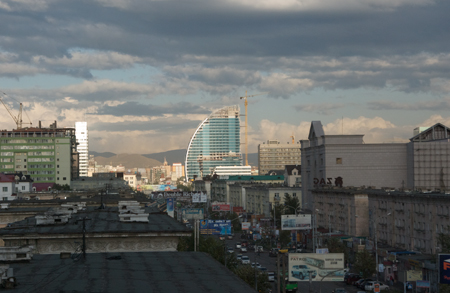
Back home safe, sound and pretty functional. I use a jet lag program from a book I found years ago at our local travel store, “Overcoming Jet Lag”. I think it’s still available on Amazon. It consists of a variety of things to do to rapidly shift one’s body clock to destination time. For me, it makes all the difference in the world on a nine time zone shift like the trip I just took. Here’s a last look, for now, of Ulaanbaatar-

Ulaanbaatar skyline along Peace Ave., with new office building under contruction

To wrap up the trip- got to the airport and gate area at the Chinggis Khan International Airport in UB around 10 am for a noon departure to Beijing, no problem. Boarded the Air China plane, no problem. Problem. Delay due to bad weather. Unclear what or where. Sat on ground. They served lunch. After two hours, we were deplaned and told that the flight would go at 4pm. At 4pm they announced a 6pm departure. Watched a sumo match on the tv (the world champ is a Mongolian, would you believe?). Read and got something to eat.

At 6pm, they started an announcement in Mongolian. All the Mongolians made happy noises and jumped to their feet. The rest of us joined them. Flight went, at last.

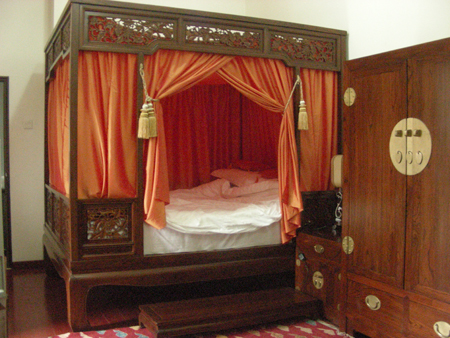
I had thought that I would have an afternoon and evening to poke around Beijing, so had booked into what the English call “character accommodation”- a converted old courtyard house, the Beijing Sihe Hotel, in a hutong neighborhood near the city center. Instead I arrived sweaty and exhausted around 9:30 pm. So I got to be there less than 12 hours, but what a wonderful place! I found them through http://www.tripadvisor.com, my go-to site for hotel/trip recommendations. They rate higher than a lot of the big, luxury hotels and the staff was great! Check this out-

Door to my room at the Beijing Sihe Hotel
View from my room
View from my room
My bed, no fooling
My bed, no fooling

Back to the Beijing Capital Airport the next morning, through the worst smog I have ever seen. So much for those blue skies we all saw during the Olympics. On the other hand, the new airport terminals for international flights are utterly mindblowing, especially compared to what one had to deal with before. Whatever else, as far as I’m concerned, if the Olympics had done nothing other than prompt construction of the new terminals, that alone justifies awarding the games to China (but don’t get me started on Tibet).

On the way to the airport

Flight from Beijing to San Francisco and from there to home were delightfully uneventful. I’ve spent the last few days catching up, unpacking, cataloging the 2300+ images I shot, etc. Next week, it’s back to the easel!

Last Day in Mongolia (for now)….and show news!


Arrived in Ulaanbaatar yesterday afternoon. Managed to get together with a couple of the Mongolian scientists that I met on the Earthwatch project in 2005 and got an update about what is happening at Ikh Nartiin Chuluu.

And….had a hoped-for email from my husband informing me that I have had two paintings accepted in the Society of Animal Artists show “Small Works, Big Impressions”! One is of two young marmots and the other is of a takhi mare and foal. The show will be at The Wildlife Experience in Parker, Colorado, which is just south of Denver. More after I get home.
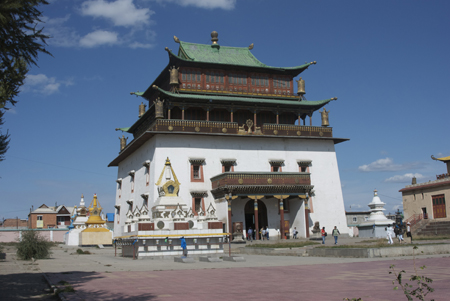
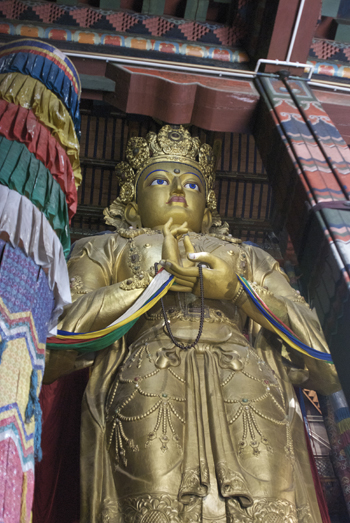
But first, the day before my husband, David, left for home, we walked up to Gandan Monastery and around the downtown. There are more monastery photos on my website but the last time the main temple building was closed. This time we were able to go in and see the gigantic statue of Buddha.

Main temple, Gandan Monastery
Buddha statue which equals the height of the building
Buddha statue, which is almost as tall as the building

David flew home on the afternoon of the 14th after I had left for Ikh Nart. Colleen, the other artist who accompanied us for part of the trip, and I spent the first day trekking around the reserve. We went out with the driver the second and third mornings. The afternoon of Day Two, two busloads of 26 Swedish tourists, who had come from Moscow via the Trans-Siberian Railway, arrived for a couple of nights, so things were very lively. Here’s a selection of images from Ikh Nart, trip 2-

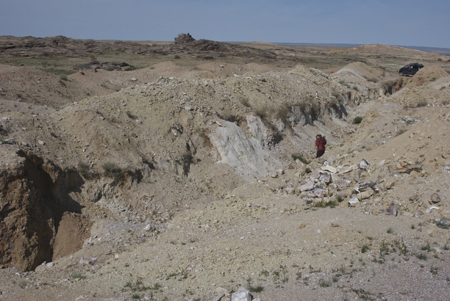
Open pit gem mine
Open pit gem mine

One of the conservation challenges the reserve faces is illegal mining for gems like amethyst. The addition of more rangers has mostly stopped this kind of thing, but the damage remains and will have to be repaired as funding allows. That’s Colleen in the trench for scale.

Rock formations
Rock formations

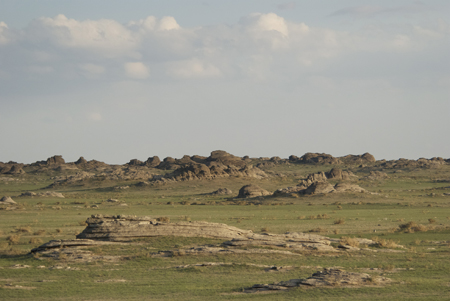
On the other hand, this is the kind of thing, besides the wildlife, that makes Ikh Nart special, the amazing rock formations.

Rock formation
Rock formation
View looking south from camp
Argali sighting
Argali sighting

Saw very few argali. They were clearly elsewhere, as were the herder families. The rains didn’t come when they were supposed to, so everybody left. Then it rained like crazy, as described in a previous post, and things greened up. It looked like some families were coming back as we left.

Horses near the ger camp

I thought that that’s what seeing these horse meant, but learned last night that the herders take their sheep, goats and camels, but leave the horses on their own. Looks like they’re doing ok to me.

The reserve faces a number of threats, including overgrazing and climate change, so the challenges exist on a micro and macro level. At one time the grass came up to the bellies of the cows. I hardly saw any grass. It is being replaced by “forbs”, perennial plants, some of which is edible by livestock and some not. I have no idea what the possibility is of reversing this, if it can be done at all. Climate change may trump everyone’s efforts. So, the work then will be to help the country people adjust to the new reality. I don’t know what the prognosis is for the wildlife. The argali seem to be holding their own, so far, which is good.

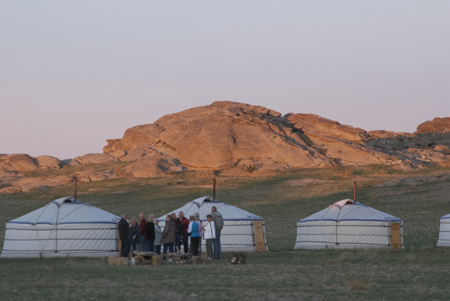
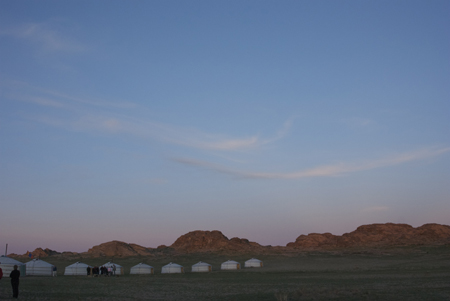
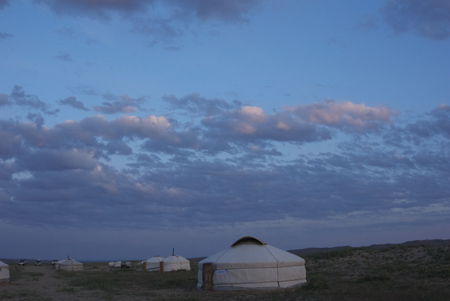
One of the things I love about Ikn Nart are the sunrises and sunsets on the rocks. So, to conclude my Mongolian trip blog, here’s a couple of final images from one of my favorite places in the world.

Sunset with Swedes
Sunset with Swedes
Sunset over the ger camp

Thanks to all of you who followed along and left comments. I had no idea whether this would work or not and I’m glad it did. It’s pretty amazing when you think about it. Not that long ago, just making an international phone call from Mongolia would have been a challenge. Now Mongolia is as connected to the rest of the world as the USA. Most Mongolians can’t afford their own computers yet, but there are lots of internet cafes to provide access

I fly to Beijing tomorrow, stay overnight and then home. Hope to be back at the easel after catching up on mail, petting the cats, kissing my sweetie, etc. Oh, and getting at least the basic cataloging done on the over 2300 images I’ve shot. I can hardly wait to get painting again!

Bayartai!

Amazing Time at Arburd Sands, Mongolia

Back at the Bayangol Hotel this afternoon. I’m sorry we didn’t get to western Mongolia, but our time at Arburd Sands was fantastic! The ger camp is owned by a local herder family and is located amongst a 20 km long stretch of sand dunes, which form a sort of northern border to the Gobi. The head of the family, Choidog, is one of the most famous and honored horse trainers in the country. His 40-something son, Batbadrach, won the national Nadaam horse race two years running when he was 8 and 9 years old. They currently have around 300 horses.

Arburd Sands ger camp at sunrise

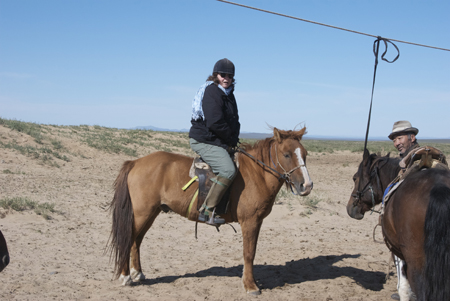
The ger camp is pretty laid back. Activity options include trekking around the dunes and surrounding countryside, horse riding and camel rides. David and I opted for a one hour horse ride the first day (and a camel ride the second). I asked about the Mongolian saddles and it turned out that they had a modified one for me to use. It didn’t have the big silver studs on the sides of the seat, but did have a thin felt pad. Otherwise it was basically the same saddle the Mongols have used since the time of Chinggis Khan. And it wasn’t uncomfortable at all for just a hour, even given that I have hardly ever ridden a horse. So, here’s David and I, ready to ride. It was great!

David on Mongolian horse
Me on Mongolian horse

My horse, who has no name except maybe “Brown Horse”, and I did quite well. He was willing to trot and was easy to “steer”. I had sat on horses while they moved a few times in the past. This was the first time I ever felt that I was really riding. I was able to stand in the saddle a few times to see what it felt like since the Mongolians ride that way from childhood. They must have thighs of steel. The stirrups are tied together under the horse’s belly, which does make standing quite a bit easier than it would be otherwise.

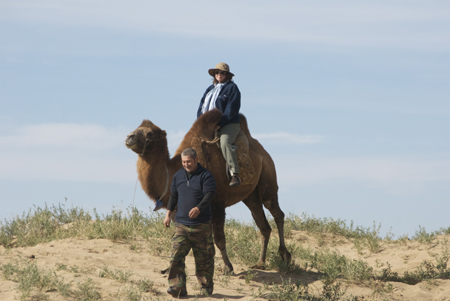
The herd of bactrian camels, which belong to other local families and our camp hosts Batbadrach and his wife Desmaa, numbers around 30. Some are trained for riding. Others pull carts loaded with camping gear. All but one of the riding camels were out on a trek with other visitors, but we got to take turns riding him. It was just as much fun as in 2006. Photo by David.

My 2008 camel ride
My 2008 camel ride

The herd tended to be around camp in the morning and late afternoon, so I got lots of pictures of them in great light. Here’s one:

Bactrian camels, Arburd Sands

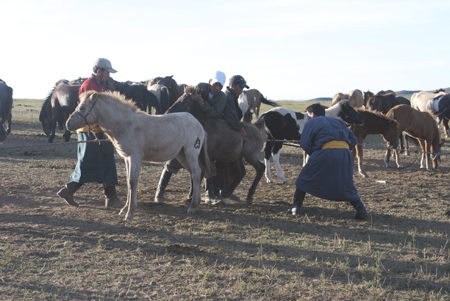
Yesterday morning, we were asked if we would like to go to an annual family event, the branding of the year’s foals. Of course we said yes, but not knowing what to expect. What we got was one of the reasons why travel is so worth the time, money and intermittent hassle- being present at something that was not a set-up for tourists, but getting to share part of a Mongolian country family’s way of life that has continued without interruption for over a thousand years. I was able to record it all and have some of the best photos I have ever taken. Here’s a few highlights:

Foals lined up for branding
Catching foal with urgaa
Batbadrach branding foal
Airag and vodka ready to imbibe
Choidog, Sodnam, Lhamsuren, Surenjav
Choidog, Lhamsuren, Sodnam, Surenjav

I had asked to take the women’s picture at the after-branding party and Choidog got up from his spot on the floor and joined them, putting on his hat, which was presented to him by the president of Mongolia and has a silver horse on the top. I looked through the viewfinder and it was a total National Geographic moment. Even now, looking at it on this post, I can hardly believe that I was so fortunate to have taken this picture. I’ll be sending copies to all of them. Sodnam is Choidog’s sister, Lhamsuren is Batbadrach’s mother and Surenjav is the mother of one of Batbadrach’s friends and also his brother’s mother-in-law. It’s a big family. Desmaa couldn’t tell us how many grandchildren Choidog has.

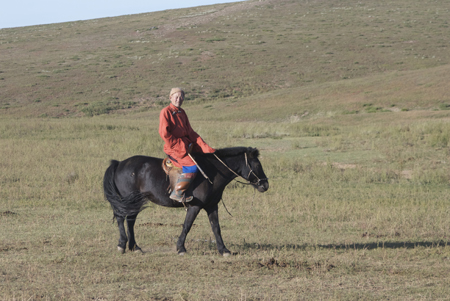
Choidog's favorite place, on his horse

To conclude- at the ger camp for the first night was a Swedish travel writer named Steven. We all sat together for dinner and had a great time exchanging stories. He had come to Mongolia by way of the Trans-Siberian Railway. The next day he was asked if he was going to come back to Mongolia. He said yes in a very strong, definite way. I asked how long he had been here. He replied “Four days”. Yup, he’s got it bad, just like me.

Back from Hustai National Park!

So we were sitting in the lobby of the Bayangol and who should walk in but Baaska, who was my guide for the Gobi and Ikh Nart legs of my trip in 2006! One of the nicest surprises I could have had. And, and to top it off, the driver was Omroo, who was my driver in the Gobi. Perfect. Off we went.

It turns out that the paving has been torn up for replacement on the regular road and it’s a dusty mess, so we went literally across country on the dirt tracks, so I got to see a part of the area that I hadn’t before.

Hustai ger camp at park headquarters

We arrived late afternoon, got settled into our ger and had a nice dinner in the dining hall. The other artist who was joining us for the rest of the trip came in and we all met for the first time. She had come over earlier to participate in the eco-volunteer program that Hustai runs. The volunteers are trained and then help with the on-going research of the takhi reintroduction. There are now well over 200 horses.

Hustai takhi harem, late afternoon

We spent the next three days driving through the park in the morning and afternoon viewing the horses and I got lots of great reference photos. There are now 24 harems in the park, up from 15 the last time I was there. The stallion with the biggest harem has been named Temujin, which was Chinggis Khan’s birth name. We got to see him and his “girls” late one afternoon. Here’s a closeup of a takhi we saw, but you’ll have to wait for the painting to see Temujin.

Hustai takhi
Hustai takhi

We were also able to tour around to see a Buddhist ruin, a Turkic grave site and a deer stone.

Bronze Age deer stone; deer help souls go to the sky after death

It turned out that there was a science conference at the same time we were there and loads of other visitors, so the park was really busy.
We came back yesterday afternoon across country again, but by a different route and had a lovely picnic lunch by a stream lined with willows. There were also some Mongolian horses nearby and I was able to get some excellent photos of them that I’m really looking forward to painting.

We’re now in UB for the day, leaving for Arburd Sands ger camp tomorrow. Internet availability is turning out to be “interesting”, so I may not be back on until the 12th. But it’s being quite a trip and these posts are only hitting the highlights.