Starting next Tuesday, I’ll be teaching “Traditional Drawing” at Westhaven Center for the Arts. Here’s the information and if you live in central or northern Humboldt County, Calilfornia, I invite you to sign up.
Westhaven Center for the Arts
501 S. Westhaven Dr.
Trinidad, CA 95570
Tuesdays 7-9pm, Oct. 11-Nov. 22 (no class Nov. 1)
6 week sessions- $55
Beginner/Intermediate
Description: A traditional approach to drawing based on the methods used at the Academy of Art University, San Francisco. The emphasis will be on learning accurate observational and motor skills, fundamentals such as line, composition and values and putting all these together to develop a personal point of view. Students will be able to experiment with a variety of drawing media and papers while they draw an interesting variety of objects from Susan’s personal collection, many from her travels to countries such as Kenya and Mongolia. Painters who would like to polish their drawing skills are encouraged to sign up.
A required materials list will be provided, but students are also encouraged to bring their own favorite drawing supplies and paper. You will need a drawing board with attached, or a separate pair of large, clamps and an easel or tabletop prop to hold it in a vertical position.
Susan Fox, BFA Illustration, Academy of Art University, is a Signature Member of the Society of Animal Artists and a member of Oil Painters of America, California Art Club, Redwood Art Association and Westhaven Center for the Arts. Her paintings have been accepted into many national and regional juried shows and are included in a number of private collections. She works full-time as a oil painter, specializing in subjects from Mongolia and has loved to draw since she was a child.
First Summer, Takhi Foal 18x24" oil hot off the easel
1. Suck it up and accept the fact that you are an entrepreneur and that you are running a business. Artists can handle business stuff. We are not, by definition, airy, fairy flakes. Get organized, get Quicken for financial recordkeeping, Evernote for keeping track of everything and make the commitment to nurture your career. No one else will do it for you or as well.
2. Create a marketing plan or you won’t have a clue about what to do. Without a context and the bigger picture, how can you know whether or not doing a particular show makes sense or if you should do prints or sign with that gallery? Not having a plan is throwing spaghetti against the wall and hoping something (like money) sticks. Find your local Small Business Development Corporation office and take advantage of their free and low-cost services. I did and it’s really paid off. Literally.
Ready for North Coast Open Studios, June 11, 2011
3. Make social media work for you. Yeah, I know “but I already spend too much time on the computer (whine)”. Like it or not, online career-building is where it’s at now and has the major advantage is that it’s often free, unlike traditional advertising and promotion. These days you must have: a website that you can update yourself (I use Go Daddy. There are others that are probably simpler to set up but don’t offer the design flexibility; google “artists websites” to see what’s out there); a blog (This is a WordPress blog. Blogger works fine also, but the backend isn’t as sophisticated); a Facebook public page (easy to set up); a Twitter account (you’ll need to experiment to see how well it works for you); a newsletter (Constant Contact is the way to go); a LinkedIn profile (lots of artists there these days) and whatever else you find out there that can help get the word out about your work. It’s the synergy between all this that is what counts. There is no “one place to be”. The question is “how many places can I be?”
4. Always do the very best work you can that reflects your passion and point of view, NOT what you think the market wants. That way lies imitative, mediocre art that is always going to be two steps behind. Be the best YOU can be and then back it up with numbers 1 and 2.
Work in progress
5. Buy Alyson Stanfield’s book“I’d Rather Be In The Studio: the artist’s no-excuse guide to self-promotion” and check out her website and blog. She’s the best resource out there for ideas, advice and encouragement for building an art career. One of the things she emphasizes over and over is how critical your mailing list is because these are the people who are interested enough in what you do to let you contact them with news of what you’re up to.
Notice all the links? That’s no accident. Part of the purpose of this post and the links is to drive traffic to this blog.
Feel free to add any further thoughts and ideas in the comments!
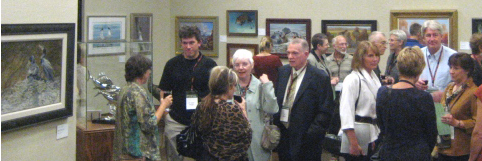
SAA members and guests at the opening weekend of the 49th Art and the Animal; Rolling Hills Wildlife Experience
This post was originally written for the Society’s Facebook public page and blog, but I wanted to share it here since I think what I have to say relates not just to what my thoughts are about applying to join the SAA, but also lays out in general some of my beliefs about what makes good animal art. It’s illustrated with images of various members of the Society, who I am proud to call my colleagues and friends.
The deadline for the next round of consideration is coming up in mid-April. I thought that, having participated in three membership juries now as a member of the Executive Board of the Society, I would offer some observations and tips that might be helpful to those of you who aspire to membership in the SAA.
A couple of notes before we start- First, I’m a painter and that’s what I know best. What I’m going to say applies to most other media, but creating a successful painting will be my main focus. Second, this article represents my personal views and is not an official statement by the SAA, any of its officers or the other board members. If you have any comments or questions, please direct them to me.
Now, to begin: I recommend that you do this exercise. Go to the Society’s website, visit the virtual museum and the individual websites of any member’s work that catches your eye. Then get out at least eight or ten of your own pieces. Line them up. Look at them objectively. This is not easy. We tend to be either too hard or too easy on ourselves. Do your best to be honest since that is when opportunities for growth happen.
The late Simon Combes giving a demonstration; Lewa Downs Wildlife Conservancy, 2004
Representational painting in general, and animal art in particular, have well-established criteria for what constitutes a “good” painting. These principles have evolved over a number of centuries. They are not “subjective”.
You are not in competition for a limited number of spots as would be true with a juried show. We usually have between two and three dozen applications to consider. We can accept all of them. Or none of them. Each applicant’s work is judged on its own merits.
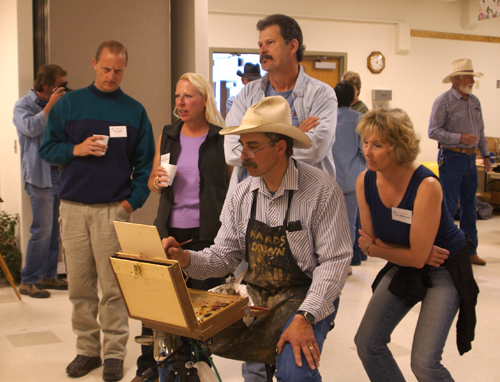
Greg Beecham at the Quick Draw; Susan K. Black Foundation art conference, 2005 (Suzie Seerey-Lester to left)
Pick one piece that you honestly believe is at or is close to the level of the work of the artists who are already members.
You now need four more at or near that level, because one of the things that will sink an application fast is one or two good pieces followed by the jury seeing the next three or four go off the cliff. You will be judged by your weakest pieces. Consistency is very important.
Kent Ullberg gets inspired at the SAA 50th Anniversary event; San Diego Safari Park, 2010
Consistent in what? Glad you asked…
1. DRAWING: Animals have a physiological and behavioral reality that a competent animal artist has to understand and demonstrate to the jury. In other words, you need to be able to draw them with accuracy and understanding if you are a traditional representational artist and clear understanding if you are going to handle them in a more personally expressive way. You are hoping to join the ranks of animal artists who have been doing this, in some cases, for decades. They know if the drawing is correct or not. Which way a leg can bend, how a wing moves in flight or what the pattern of spots are on a leopard are not really subject to debate, however open they are to informed interpretation.
Karryl sculpts on location at the 50th Anniversary event; Rolling Hills Wildlife Experience, 2010
2. CRAFT: We want to see a solid understanding of your chosen media, whatever it is. If you decide to submit work in more than one media, then all of them need to be at an equal level of competence. Don’t submit a little of this and a little of that, hoping that something will stick, like spaghetti on a wall.
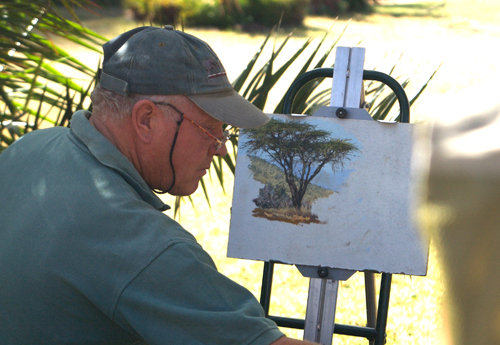
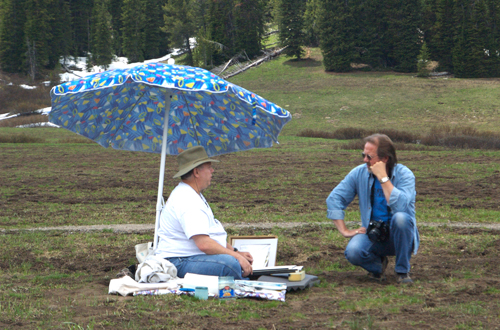
David Rankin on location, ready for anything at Torrey Lake: Susan K. Black Foundation art conference, 2005
3. DESIGN AND COMPOSITION: Do you have a solid grasp of design and composition? Have you made a conscious decision about every element of your piece? For instance, are the subjects in the majority of your submissions plopped automatically into the middle of the canvas or thoughtfully placed to carry out your central idea?
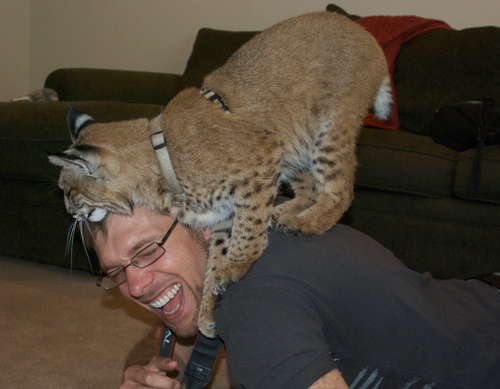
Andrew Denman gets worked over by an affectionate bobcat; he, Guy Combes and I visited the Sierra Endangered Big Cat Haven last year
4. PERSONAL VISION: Are you creating art based on a personal vision or simply copying photographs? (It is well-known that photographic images flatten and distort three-dimensional subjects like animals, so the artist must learn how to compensate for that if their goal is a realistic representation.) What do YOU have to say about lions and elk, butterflies and buzzards? Let your opinion, point of view and passion come through. HAVE an opinion, point of view and passion about your subjects.
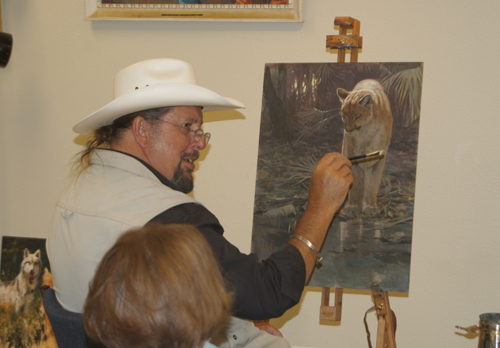
John Seerey-Lester paints a mountain lion; Susan K. Black Foundation art conference, 2005
5. KNOWLEDGE: Do you understand basic animal anatomy? Do you understand the habitat of the species you are representing? Have you learned about their behavior as an inspiration for your work? Or is everyone just standing around? If you put an animal in a realistic setting, you are now a landscape painter too. Are both your animals and any habitat shown depicted at the same level? Or does one lag behind the other?
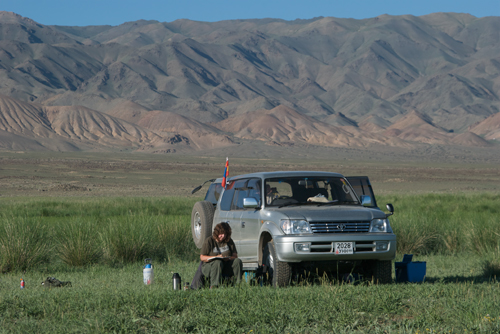
Yours truly hard at work in the Gobi, Mongolia 2010
Animals are specialized subject matter that require study and the accumulation of knowledge over time to represent successfully. There are no shortcuts.
We are looking for artists who have mastered their art and craft at a consistent level and who present us with a body of five works which all reflect that level.
I got the email telling me to go the site and check the acceptance list yesterday morning at 9am. It was in alphabetical order, so I slowly scrolled down, holding my breath. And saw my name. Twice! I entered three pieces, so two out of three.
One of my goals for many years has been to have my paintings accepted into juried shows that are outside the “wildlife art ghetto” to which the genre of animal art has been foolishly and ignorantly consigned by many in the mainstream art world, even though great artists who these same people often admire also painted animals.
Clearly, the good folks at Greenhouse Gallery don’t share that bias, bless their hearts.
I’m proud to be an animal artist and know that our genre’s best work easily stands with the best in any other field of representational art. And I also know that to paint animals successfully requires a specific depth of knowledge that is not appreciated by those outside the field.
Here are the two paintings that will soon be on their way to San Antonio, Texas:
Done for the Day 17x30" oil on canvasboardTakhi Stallion, Hustai National Park 17x30" oil on canvasboard
Safari camp on Paradise Plain, Masai Mara, Kenya, 2004
As those who get my newsletter and read this blog know, I was invited to go on what sounded like one of those trips of a lifetime that many artists dream of….traveling to India to see wild tigers. I had been scheduled to leave this past Tuesday (Jan. 17), but I canceled the trip. Why? Well, the reasons why and what you can learn from my experience are the topic of today’s post. I’ve illustrated it with images of journeys past.
I’m going to keep the identity of who invited me and was sponsoring the event private, since at no time did I feel that there was any malice or ill-intent involved. But, as I think you’ll see, it doesn’t take either to decide not go on, or actually cancel out of, what seems to be a great trip.
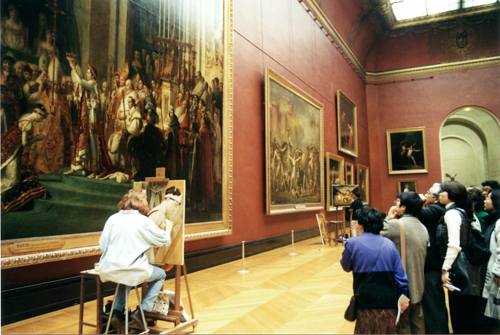
Artists copying masterworks at The Louvre, Paris, France, 1996
To make a longish saga as short as possible: an artist friend asked if I would like to see if he could get me invited to an artist’s event in India. We would be hosted at a fancy lodge adjacent to a national park which is home to tigers and other wildlife. I said “Yes!”. And, after a short time, an invitation was emailed to me by the organizer. I accepted. It seemed like a smart career move, based on what I knew at the time, with the opportunity to have my work seen by an international audience.
Plans were plotted and plane reservations were made. Then all the artists involved (from quite a few countries) got an email from the organizer with an update for the event. And that’s when it started to look iffy. As in, OMG.
What had been represented to me as an Artist’s Week that would result in a donated work being exhibited on a tour in Europe and then auctioned off to support tiger conservation had morphed into an event in India which was to include a fashion show, rock concert and some kind of children’s activities. There were no specifics about international exhibition venues and the auction was now going to be handled by a “company like Christie’s”, whatever THAT was supposed to mean. And, to top it off, the organizer said that a new sponsor had signed on and wanted our paintings at the end of February, that is, one month after our week there had ended. Red flags, flashing red lights, danger, danger, danger.
I was going to travel, literally, half way around the world for….this? I don’t think so.
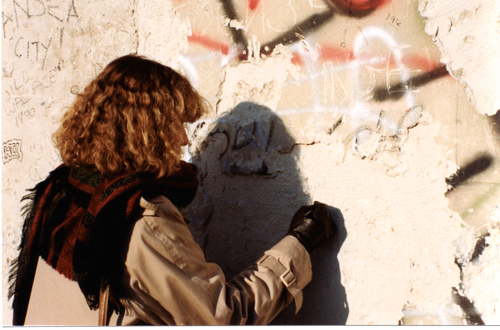
Leaving our names on a remaining section of the Berlin Wall, Germany, 1990
While there were serious problems with the changes themselves, the fact that things had changed so much so close to the event was even more worrisome. It suggested an inexperienced event organizer who was winging it and didn’t really know what they were doing. Things that should have been settled long before the artists were even invited (and remember, I got on the dance card late in the day) still seemed to be in flux. Not to mention the completely unrealistic surprise deadline and, oh by the way, can you all increase the percentage of your contribution because it’s (all together now) For The Tigers.
I (apparently along with a number of the other artists, including the friend who got me into this) replied saying, more or less, you’ve got to be kidding. I wrote to the organizer that, unfortunately, I was going to have to bow out. My previous commitments and my working methods made it impossible to meet the deadline. (I wasn’t going to get into all the other stuff.)
My friend also dropped out.
In the meantime, I had bought plane tickets to Nairobi and back and he had bought our tickets from Nairobi to Mumbai and back (I was going to hang around in Kenya for a couple of weeks after the return from India). I had, the day before, sent via FedEx my visa application to a company that handles such things.
Now I had to unwind it all. I stopped the visa application process before it had started and had them FedEx my passport back to me (total cost: around $50). I canceled my itinerary and banked the tickets (change fee when I re-book: $250. Ouch). Friend canceled the tickets he had booked (cancellation fee: $218. More ouch). So, around $500 to get out of it. Not great, but it was the right thing to do, believe me.
So, what can be learned from all of this? Remember, there are no bad guys. Everyone had good intentions.
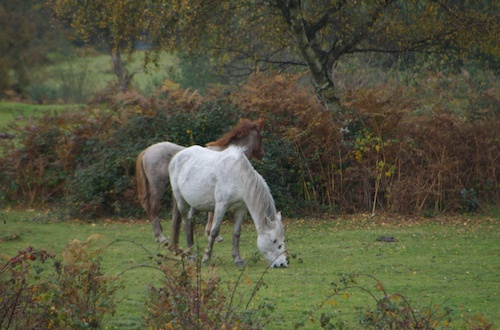
New Forest ponies, Hampshire, England, 2004
Here’s 10 tips, based on the above and other personal experiences:
1. You’ve seen an ad for a workshop or a tour in a place you’ve always dreamed of going to. Ask yourself: Is this the right trip for you or are you going because it’s there? How well does the trip fit your artistic goals?
2. Can you check out the organizer through references from previous “customers”? Make sure that their criteria for a successful or failed trip are in line with yours.
3. Before you sign up, have an exit strategy. This may mean paying more for refundable tickets (which I had not). It may mean having to leave the workshop or group. I ended up moving into a small hotel in town when I was in Portugal in 1996 because the group I was with at an old farmhouse was the very definition of “disfunctional” and I couldn’t even get a reasonable night’s sleep. Make sure you have enough money or at least a high enough limit on your credit card so you aren’t stuck in a bad situation for lack of funds.
Roman temple ruins, Evora, Portugal, 1996
4. I don’t travel with miscellaneous groups of total strangers anymore. See item 3. What’s your tolerance for rude, inconsiderate behavior? What is your tolerance for physical discomfort? Know thyself and do not try to fool yourself or talk yourself into a trip. If you need your own room, suck it up and pay the single supplement.
5. Which brings us to….Don’t force it. Trust your gut. I had to force myself to punch the “Buy” button for the India trip plane tickets. There is a book called “The Gift of Fear”, which I recommend for anyone who is planning to travel to unknown or exotic locations because it explains very clearly WHY you should trust your gut/instincts/intuition. The punch line is that the data you need is there, but, for whatever reason, only your subconscious mind is perceiving it. In hindsight, it’s often quite obvious why it was really dumb to (fill in the blank with the “What was I thinking?” of your choice).
6. Once you’ve signed on for a trip, monitor the responsiveness and helpfulness of the organizer(s). Do they communicate with the participants in a timely and professional fashion? Do they answer emails, voice messages in a timely fashion? No news is bad news and was one of the red flags for the India trip. And, by the way, two days before the event, the schedule for the week was sent out (I’m still on the mailing list, I guess). There will be only one “game drive” a day and the rest of the time will be filled with…other stuff. I would be a seriously unhappy camper at this point.
Outdoor cafe, Milan, Italy, 2000
7. If you start to wonder what’s going on, don’t make excuses for the organizers. For most of us, once we commit to something, it’s natural to want it to all be ok. See item 5.
8. Yes, it’s your dream trip, but don’t get carried away. Be hard-headed. You’re the one writing the checks. The only leverage you have is your willingness to walk away. Do not let yourself be cornered into thinking that you MUST go if it starts to feel wrong. It wasn’t easy to get to the bail-out point on the India trip, especially after announcing it in my newsletter, on my blog, on Facebook….but it was the right thing to do.
9. If you are traveling with a buddy, once again, have an exit strategy. Travel can have a strange effect on some people, who will possibly do things that they would never do at home. You are responsible for your own care and safety. If someone you’re with wants to do something you think is stupid or risky, walk away. I repeat, walk away. You’re a long way from home, may not speak the language and might not have a cell phone that works where you are. Carry the contact information for your embassy with you and register with them before you go. They can’t help you if they don’t know you’re in the country.
10. But if it all feels right and good, GO, GO, GO!!! There’s nothing like getting out there into the world and learning what a big, wonderful, fascinating place it is.
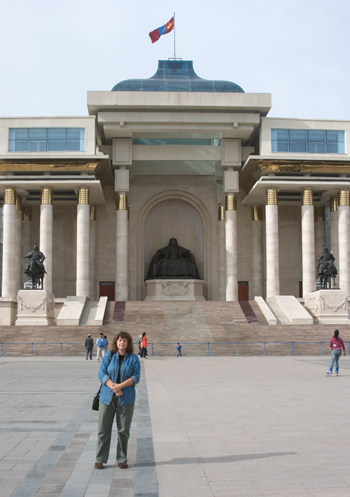
The Parliament Building with statue of Chinggis Khan, Ulaanbaatar, Mongolia, 2008
Well, I’m back in the saddle after a great vacation in Hawaii with my husband. First order of business in the studio is to finish some drawings that I have promised to do for the people at the Sierra Endangered Cat Haven to thank them for their warm welcome (and fixing my broken van). I did this study of their clouded leopard yesterday, truly one of the most beautiful of the cats.
It’s been fun to get back to this kind of finished graphite drawing. If you like good drawing and good commentary, check out Terry Miller’s blog, Pencil Shavings. Very inspirational.
I’ve admired Ron Kingswood’s work for years, since I first saw it and met him at the Southeastern Wildlife Exhibition. His work has changed since then and he has gone far beyond what is conventionally considered representational art, much less what most people think of as wildlife art. And that’s ok. Too many artists reach a certain developmental point and stop learning or they gain a satisfying level of success in the marketplace and are then trapped by the expectations of their galleries and collectors.
Now, he’s contributed an essay, “Is Animal Painting Dead?” to the online publication Wildlife Art Journal. Not too many comments there yet, but it’s buzzing on the magazine’s Facebook page. Here are links to the editor’s introduction, the essay itself and the Journal’s Facebook page.
If The Conversation About Art Isn’t Real, What Good Is It?And by the way, Wildlife Art Journal is the only source for what’s happening in the animal are world. They deserve support and currently have a special subscription offer going of $8 a year.
I did a number of art festivals in the San Francisco Bay Area for a few years, including the Marin Art Festival the year before last. What I have found as an oil painter is that the street fair style of events don’t provide a targeted market for what I do. After skipping last year because of the economy, I decided to go back to the Marin festival. It’s a well-established destination event held on a big, grassy field near the Frank Lloyd Wright designed Marin Civic Center.
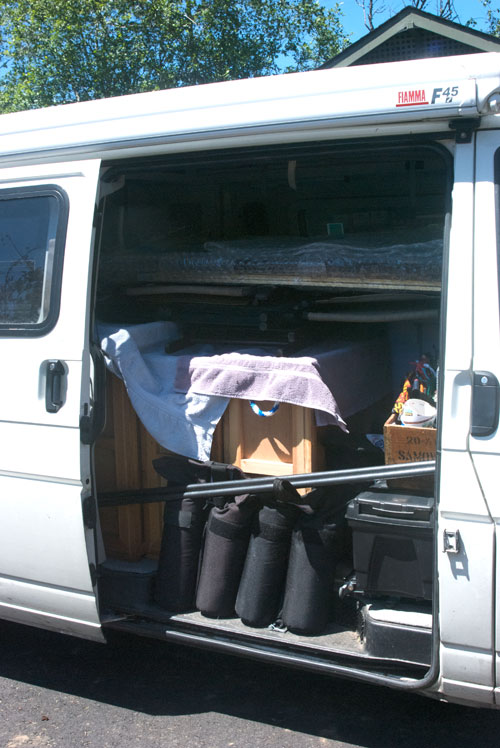
Side view of VW Eurovan packed and ready to go
I like that fact that it’s a flat rate for a space and that once you’ve been juried in, you are invited back and given a $100 discount on the entry fee. Knowing I will be able to count on participating year after year means a lot to me as far as my yearly planning. Communication from the people running the festival is excellent. They go out of their way to find ways to drive sales, especially this year. Besides postcards provided free to the artists in whatever quantity you request (each one good for a $10 free admission), they sent an email to all the artists with a free pass to print out that we could forward on to our mailing list. Other things they tried this year to drive sales were handing out “coins” that could be redeemed for a $10 discount on sales over $100 and a silent auction, which did generate sales. There is also a raffle.
Back view of VW Eurovan with propanels
Besides the artists and fine craftspeople, there is gourmet food, live music and members of a local “circus” who provide amazing stiltwalkers and costumed raffle winner announcers. Well-behaved dogs on leashes are allowed. Someone does face-painting for kids and there are special activities for them, too. There are lots of tables with umbrellas and chairs for people to plop down in for a break. It’s all calculated to encourage people to stay as long as possible.
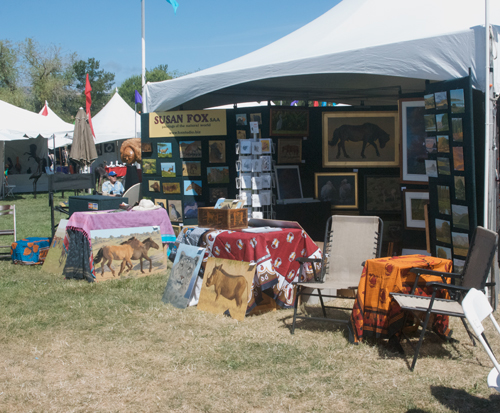
My booth at the festival; they request that you "spill out" into the walkway area
I’ve decided that the Marin festival will be my one yearly Bay Area “appearance” due to time and distance constraints. My plan is to build up a following and identity as the artist who paints Mongolian and animal subjects. I feel that I made a good start this year. I had sales, got quality sign-ups for my mailing list and was able to tell my “story” and make myself memorable.
Don’t know if I’ll have time to post anything since I hope it will be a busy weekend. It looks like it’s going to be a beautiful, weather-wise, so the crowds should be good. I’ll be in booth 105S. The festival is on the Lagoon at the Marin Civic Center. Traveling home on Monday, so stay tuned…
The Society of Animal Artists, of which I am a Signature member, has recently started a blog. On it you will find news about the Society, workshop and event listings by the members and a calendar of Society events. Check it out and let me know what you think!
We also now have a fan page on Facebook. You don’t have to join Facebook to visit us. And I invite you to visit our new website, too! It has information about our organization, exhibitions and how to become a member of the premier animal art organization.
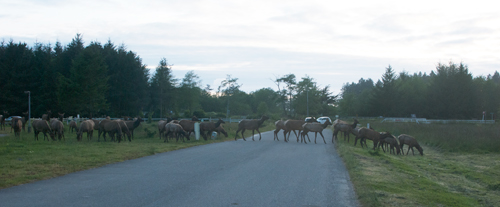
Why Did The Elk Cross The Road Dept.
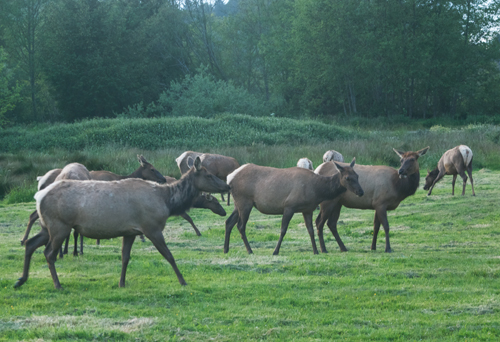
We went for a drive last weekend to find a spot from which to watch the sun set. The clouds rolled in, so that was kind of a bust, but at the Stone Lagoon Schoolhouse campground, which is right off the highway, a large herd of Roosevelt elk were working their way through the almost-empty RV section. We circled around on the campground road and ended up perfectly positioned for me to get some nice elk reference.
Over 30 elk cross the road; looking west towards the oceanFemale Roosevelt elk
This is about twenty minutes north of our house. There are often elk hanging around the campground, sometimes picturesquely situated in front of the old schoolhouse.
Oh, Honey, Look What The Cat Brought In Dept.
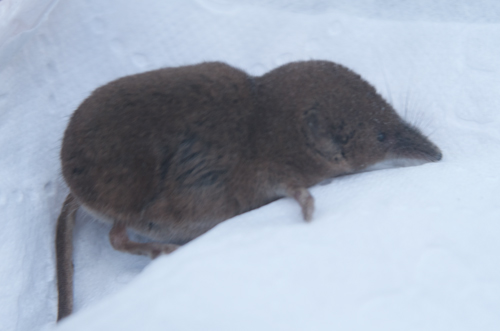
We think of it as semi-regular episodes of Animal Planet. This time, a very alive little shrew was left on an area rug in the living room where we couldn’t miss it. I picked it up in a paper towel and got a couple quick pics before turning it loose outside. Their metabolism runs really fast, so they can’t go long without food and don’t do well under stress.
 Starting next Tuesday, I’ll be teaching “Traditional Drawing” at Westhaven Center for the Arts. Here’s the information and if you live in central or northern Humboldt County, Calilfornia, I invite you to sign up.











 Susan Fox, American Artist