Here’s the Gear; Reviews When I’m Back

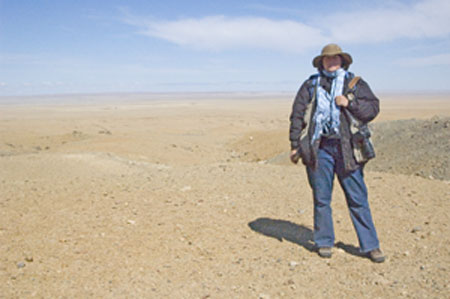
"Me in Mongolia", Ikh Nartiin Chuluu Nature Reserve

To conclude my postings about fieldwork, here’s a partial list of the gear that I’m taking to Mongolia next week. Everything has to meet certain requirements of function, weight and cost. This isn’t extreme travel (read anything by Tim Cahill for that), but we will need to be self-sufficient and ready for dramatic swings in weather since Mongolia is landlocked with no marine influence. Rain shouldn’t be an issue, but cold nights and wind are likely based on my limited past experience. Days should be nice, even hot, at least early on.

My fond hope is that this and the previous posts will de-mystify getting out into the field by providing specific information on one way to do it.

Most of the following has gone with me before, but there are a few new things, which I’ll start with:

Thermals- Icebreaker 260 100% merino wool long-sleeved top and leggings. Not cheap, but half the bulk of what I used to have.

Pants- LL Bean Pathfinder Ripstop Cotton; less bulky than jeans; my husband loves the pair we bought him so much, he’s getting two more, so I decided to try them, too.

Shoes- New Balance 644 “sneakers” (645 follow-on); for around camp and town

And, going with me again:

Boots- LL Bean Gortex Cresta Hikers; they say you can wear them out of the box and I found that to be absolutely true. These are great boots!

Socks- Thorlo Light Hikers, daytime warm; Smartwool for cold and at night as needed; they don’t itch, so I don’t have to take silk liner socks anymore

Layers- Patagonia fleece pullover, purchased used at Wilderness Experience consignment shop, Berkeley. Black, lined jacket (see photo at top) from TravelSmith; purchased for first trip to Kenya in 1999, so no longer available, but still going strong; have only had to mend torn corner of front patch pocket.

Purse-MetroSafe200; has a steel cable in the shoulder strap and all the zippers close forward so no one can slip it open; it goes into my daypack, which is one of my two carry-ons; Peace of mind in unfamiliar cities in any country.

Neck- a long blue kaffiyeh-print scarf that I picked up somewhere; more versatile than a bandana; muffler when cold; face or camera protection from dust; wet rag or washcloth; style points in photos, like above

Hat- canvas, foldable, 360 brim from The Australian Outback Collection; took a few tries to find the right one; also gets style points (see photo above); and a baseball hat to get my hair up and out of the way in camp when showers are unavailable

So, why care about “style points”? Because part of being a working artist who intends to make a living is marketing and one’s “story”. Part of mine is the trips I take, which my friends, fans and buyers get to share. Pictures of me are part of it and I don’t want to look like a dork.

the Sleeping Bag- I can’t begin to tell you how much I hate mummy bags. It affects my sleep and I never seem to really adjust since I’m a curl-up-on-my-side sleeper. Bless their hearts, LL Bean makes one of the very few rectangular down bags for my kind of field use. It’s rated to 20F.

I do have a couple of different Thermarest pads, but the tour company provides one, so mine stay home this time.

Luggage- I have a pair of LL Bean rolling duffles that have clamshell top openings. I love them, but they aren’t available anymore. My big bag, their Sportsman’s Extra-Large Drop Bottom Rolling Gear Bag, however, is. I got it because even the larger of the two clamshell duffles won’t hold the Thermarest pad. Not long enough. The smaller one is carry-on size. It gets the camera equipment and just-in-case basics. The daypack has the laptop, documents, book, food, etc. and my purse.

Last post until I manage to get on-line in Mongolia.

Cheers!

ART TIP OF THE DAY

“I don’t mind hard work. You’ve got to work hard to generate something. I don’t think there’s any secret to success if you show up in the right place, at the right time and you put in a lot of time and effort and energy – you’re going to get something out of it. It’s not brain surgery.”

Ryan Seacrest, ex-actor, now host of American Idol and Dick Clark’s heir apparent as “America’s Host”

Mongolia Monday: The Five Snouts, Part 5

At last we come to the most important “Snout” of all for Mongolians, the horse. I was told that Mongolians sing about three things: the land, their mothers and their horses. The classic Mongolian musical instrument is the “morin khuur” or horse-headed violin. Here are some that I saw at the Mongolian Artists’ Union gallery in Ulaan Baatar.
Morin Khuur
Morin Khuur

Horses have inspired Mongolian art for a very long time. I happened on this delightful modern “horse art” in the courtyard of the Museum of the Chojin Lama in Ulaanbaatar.

Rainbow Horses
Rainbow Horses

And here’s the explanation that was nearby. This was in September of 2006 and I have no idea if they are still there, but the museum is on the list for the upcoming trip, so perhaps we’ll be lucky and get to see them again.

Rainbow Horse project sign

I find that there is often confusion between the, more or less, domestic Mongolian horse and the takhi or Przewalski’s Horse, which is the only surviving species of true wild horse. They are different species. There are domestic horses who have physical traits that indicate a past cross with the takhi, which were extinct in the wild as of 1969. I’ve seen a number of Mongolian horses with some combination of upright, brushy mane, a reddish dorsal stripe, a light eye-ring or muzzle and maybe tarsal and/or carpal stripes on the legs.

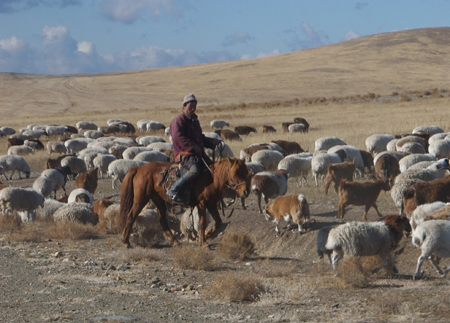
As one travels about the countryside, the herder’s establishments are a blend of old and new. Motorbikes, solar panels and satellite dishes aren’t uncommon, but everywhere there was always at least one horse saddled, bridled, hobbled and ready to ride at a moment’s notice. Mongols are, after all, the original horse culture.

The Mongolian horses are beyond tough. They are left to roam at large most of the year and manage to survive weather, down to -40F in the winter, that would kill most other horses. I have read at least two accounts of western writers who traveled across Mongolia by horse and who described the morning saddle-up as “a rodeo”.

Herding sheep
Herding sheep and goats

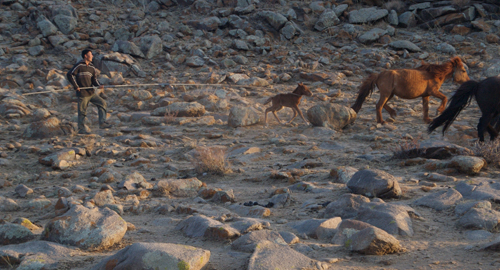
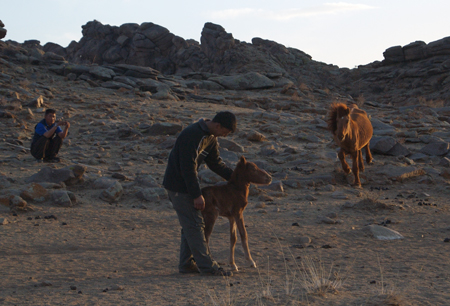
One evening at Ikh Nart, we watched a young Mongolian man capture a foal with an “urga”. Mom was not amused and kept a close eye on things.

Catching the foal
Catching the foal
Getting the foal used to human handling
Turning the foal loose and here comes the mare

One of the things that amazed me when I saw them for the first time at Ikh Nartiin Chuluu was that even though it was spring (and anyone who has been to Mongolia knows what that means weather-wise: cold, wind, dust storms) and most of the horses were terribly thin, many had long- flowing manes and tails that were gorgeous.

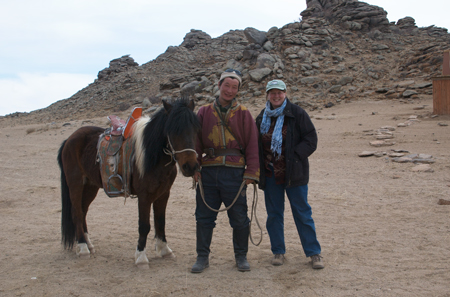
This was one of my favorite pictures from my first trip in the spring of 2005. The young herder was perfectly happy to have his picture taken with me as long as his horse was included. No problem.

Ikh Nart herder and I

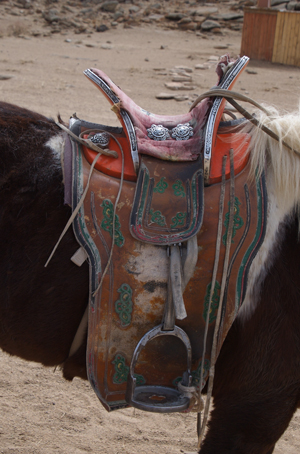
And here a close-up of the saddle. The silver bosses on the side are to “encourage” the rider to ride standing in the saddle.

Mongolian saddle
Mongolian saddle

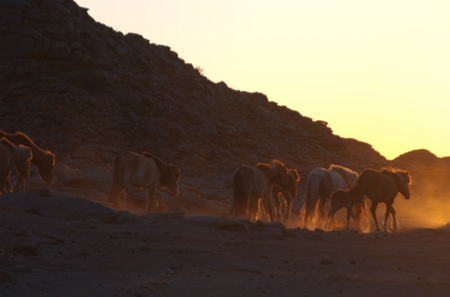
Finally, another one of my favorites; a herd of horses coming down to the stream to drink at Ikh Nartiin Chuluu.

Fieldwork for Wildlife Artists-What I Use

I’m leaving for Mongolia on August 24, coming home on September 21st. As is the case with fieldwork in any really “interesting” place, self-sufficiency is critical. As is the ability to “get the shot”, which means the camera equipment has to be reliable and ready to go at all times.

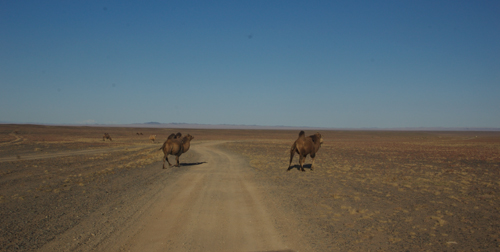
On the road in western Mongolia, Sept. 2006; some of the “endless steppe” of Central Asia

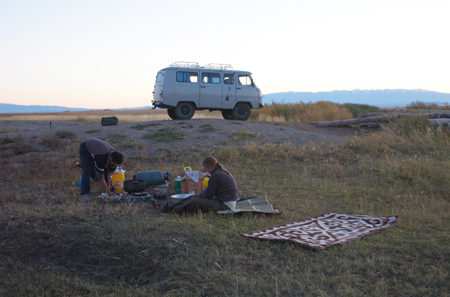
Camp kitchen at Khar Us Nuur, last night out. Trusty Russian Furgon van in the background.

Here’s a list of the gear and art stuff that I need to do my job in the field and bring home the reference that is a large part of why I’m spending the money to go to countries like Mongolia in the first place.

PHOTOGRAPHY

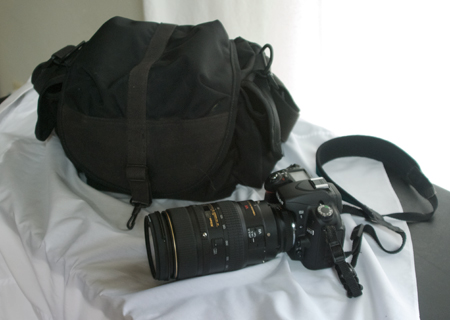
Bag and The Big Lens

2 Nikon D80 camera bodies

1 AF-VR Nikkor 80-400mm lens (effective 600mm on a digital body)

1 Promaster (made by Tamron) 28-300mm lens

Two bodies, two lenses because, with wildlife, there’s never time to swap them, plus risk of dust, dirt, drops

4 2GB memory cards; two Promasters, purchased when I got the camera bodies from my local photography store and two SanDisk Extreme III’s, which are designed to perform in cold, heat, wind, etc.

1 40GB Firelight external hard drive

For the first time- my MacBook Pro. I’ve used Flashtrax and Wolverine external hard drives for storage and back-up till now. This time I’m going to download onto my MacBook and back-up to the Firelight. The MacBook has Photoshop Elements on it, so my hope and plan is to be able to view and create jpgs of some of my images during the trip and post them to my blog when I have internet access. I’ve been interested for awhile now in location-independent functioning for artists and this will be my first experiment in staying connected and sharing the trip in almost “real time”. My husband, an IT professional, will be along for most of the trip, so he’ll be my tech support.

Extra batteries; for a total of four

Battery charger

Inverter for recharging batteries using a vehicle cigarette lighter, critical on the road when there is no reliable access to electricity

I-Sun solar charger; Mongolia does have sun over 300 days a year, so having one of those available was a no-brainer

Probably the Nikon Coolpix for ultimate back-up or for around town

ART STUFF

Fieldwork supplies plus piece done at Hustai National Park ger camp, Sept. 2006

Plastic box with gel pens, carbon pencils, kneaded eraser, sharpener, travel watercolor brush

Some additional brushes

Pelikan gouache 24 pan kit; I like the gouache because it can be used opaquely or transparently

Aqua Tote water holder; folds flat

Aquabee Superdeluxe Sketch Book, 8″x9″- heavy paper that can take any media; I’ll use it for my journal, too.

Annigoni 100% cotton paper, acid free; a natural beige color which provides the same medium value as putting a toned wash on a canvas for oil painting; The inspiration here was Thomas Moran’s fabulous “sketches” from his travels to Yellowstone, done on toned paper, using white “body color”, i.e. gouache, for the lightest areas.

Rags from old clothes, napkins from various restaurants

TO HAUL IT ALL AROUND

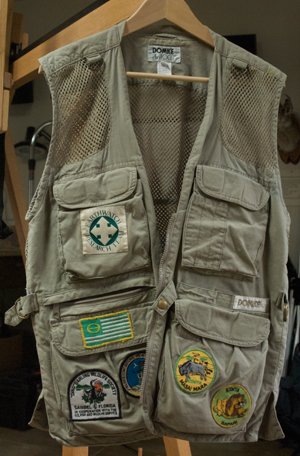
My faithful photo vest; why should photographers have all the good stuff?

1 Domke Super Compact camera bag

1 Domke PhotTogs vest, which I’ve had since 1999; two trips to Kenya, two to Mongolia, plus Yellowstone five or six times and wherever else and it still looks embarassingly new. It’s more or less a substitute for a day pack and has the advantage that everything is more quickly available than if it was in the pack and  it also leaves the hands free. I don’t take a sketchbook bigger than will fit in one of the lower front pockets. The patches are just for fun, but have been good conversation starters over the years. I’ve heard some great stories and gotten useful tips on where to see various species.

1 REI daypack; which gets carried on the plane and holds my laptop, book, plane tickets, hotel/rental car confirmations; folder of other trip info., steel water bottle (which is refilled once I’m through security), protein bars (because I never, ever travel without some food, just in case), and my TravelSmith purse, which has a steel cable inserted into the shoulder strap and zippers which all zip forward under my arm (and that foiled a pickpocket once, as it was designed to).

PLUS, I ALWAYS HAVE

1 Platypus water system for hiking hands-free and still being able to drink water regularly without messing with the daypack. Mongolia has VERY low humidity, so staying hydrated is important. Essentially it’s a water bag that goes in the pack and has a tube that I clip to my vest, so it’s easy to take a sip as wanted.

2-3 Protein bars

1 Pair sturdy hiking boots, ankle high for support on rough ground; a twisted ankle can be serious business in a country with not much in the way of western standard medical facilities (medical air evacuation insurance is a must, also)

1 hat with a full 360 brim and a chin cord

1 Magellen GPS, so I can go off on my own and find my way back. Very liberating!

A handful of bandaids and a compact first aid kit, a bandana, Swiss Army knife, kleenex, sunglasses, lip balm, sunscreen, passport, phrasebook

Maybe most important of all, an open mind, patience, a willingness to go with the flow and find the humor in the ridiculous things that happen when one travels.

FINALLY

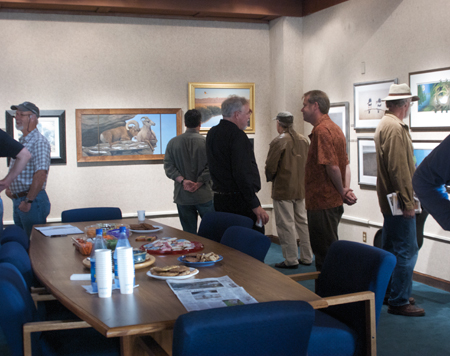
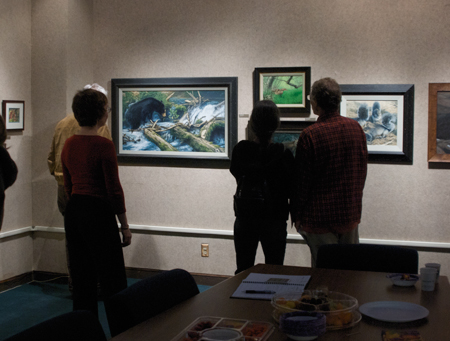
Had a great turnout for the Wild Visions 2 show reception last Friday night! Pretty much non-stop. The show was very well-received. Lots of compliments. Here’s a couple of photos:

The bighorns are my newest major work “Heavy Lies the Head”. Terrific custom frame by Mark at Southstream Art Services.

A few of Shawn Gould’s paintings

Fieldwork for Wildlife Artists

When I made the decision to specialize in animal subjects, I also took a deep breath and made a personal commitment to reach the highest level of excellence that I was capable of (still chugging away). Then I researched the approach and working methods of the best current and past wildlife artists, figuring the odds were that they knew a few things that would be useful to me.

And guess what, not a single one of them, (including Bob Kuhn, Carl Rungius, Wilhelm Kuhnert, all unfortunately deceased) like Robert Bateman, Guy Coholeach, Ken Carlson, Dino Paravano, Lindsay Scott, Julie Chapman or Laney, to name some of my favorites, rely on other people’s photos except to supplement their own for specific elements, only go to zoos or game ranches or work exclusively from photos to the exclusion of anything else. They GET OFF THEIR BUTTS, pick up their sketchbooks along with their cameras and hit the road to where the animals are.

This is not a field for the lazy. Even if your passion is the songbirds and squirrels that you can see in your own backyard, you still need to do fieldwork. Believe me, it shows in the work to those who know.

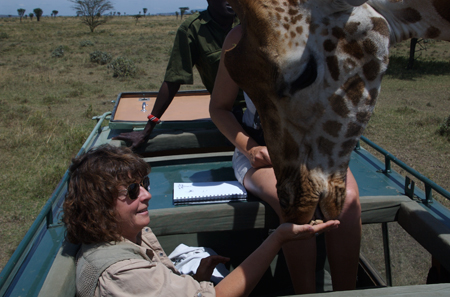
(Endangered Rothschild’s Giraffe and I at the Kigio Nature Conservancy, Kenya or Why I Like Fieldwork.)

There is no substitute for seeing an animal in its own habitat. This was brought home to me when I went to Kenya and saw lions, elephants and warthogs “in context” for the first time. The warthogs in the Masai Mara were the same color as a lot of the rocks. Thirty elephants emerged from trees lining a river bank. They had been invisible. The only evidence of their presence was that the tops of the trees were moving. We were at most 50′ away. The lions are very similar in color to the dried grass.

The prey species like wildebeest and zebra had a vibe that is totally lacking in the ones I’ve seen in zoos. In the wild they have to Pay Attention and work to survive. The zoo animals don’t have to do either and it shows in their body language.

You need:

A good digital SLR: Point and shoot won’t do it. Too slow to catch movement and you can’t change out lenses if necessary

The sketchbook of your choice: you may have to try some different ones to find a combination of paper and pen/pencil that works for you

Pens/pencils: So many possibilities. I use fine point gel pens for the most part because they don’t smear and I can’t fuzt around and erase.

Patience: In ten years, I have found that, on average, a given animal will do something at least mildly interesting or worth recording within about twenty minutes, but you have to be willing to sit and watch and watch and watch and……., even in zoos

Curiosity: Which translates into a willingness to learn about your subjects, not just settle for superficial appearance

Imagination: I’ve been in the field with other artists who seemed to be trying to capture “The Pose” that they would then faithfully reproduce on canvas. I often seemed to be the only one whose shutter was firing. Why? Because I’ve learned that you can never know in advance what you will find useful and when you’ve spent hundreds or thousands of dollars to get to a place, it’s crazy to stint on reference collection, especially with digital cameras and the ever dropping price of memory cards.

The Payoff? Great, unique reference (how many cougar paintings have you seen recently that were obviously from the same captive animal shot in the same locations? Yawn.), your memories of what it was like to be there which will somehow seep into your work, stories to accompany the paintings that will interest collectors and the possibility of seeing things very few people are privileged to.

Here’s a few examples of shots taken on the off-chance they might come in handy sometime. Not necessarily interesting to anyone but me.

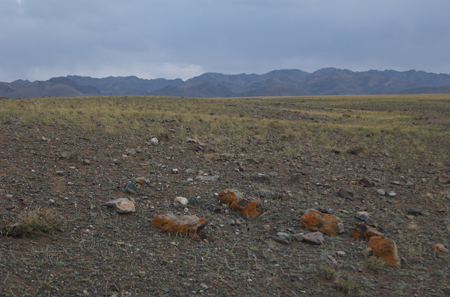
The Gobi Desert near my ger camp. Useful elements: cloudy sky, distant mountains, September grass, lay of the land, gravely surface, rocks with red lichen.

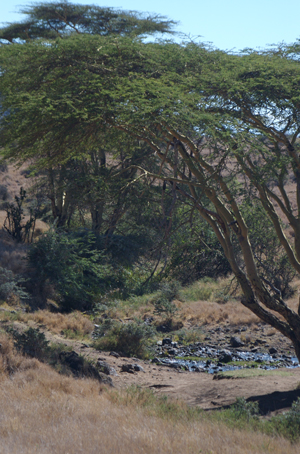
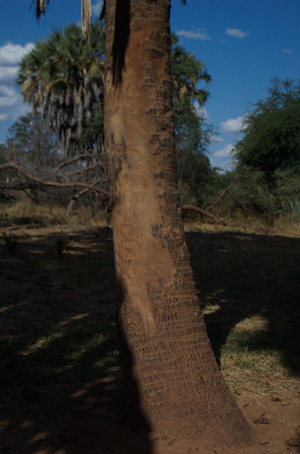
Grab shot from Lewa Downs Conservancy, Kenya. It’s a little blurry, but turns out to be the only tree that I’ve seen with that trunk color. It will be the perfect element for something, sometime.

Photographing the animals is a no-brainer, but don’t forget their habitat. I know what animals live in the Conservancy where I took this picture, so I know who could be found in this neat waterhole setting.

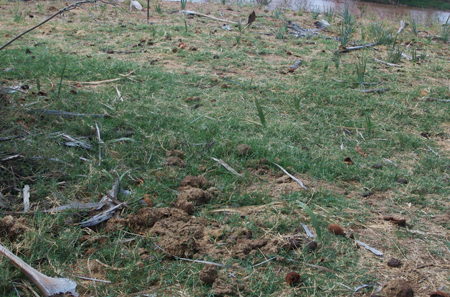
On the banks of the Ewaso Ngiro river in the Samburu, northern Kenya. We have: a little of the water for context (where did I take that picture?), grass, some kind of spiky leaved plant just coming up (needs to be identified), doum palm nuts and frond droppings and…..elephant dung. This was taken right in camp.

And, nearby, is a doum palm that has been partly rubbed smooth by elephants.

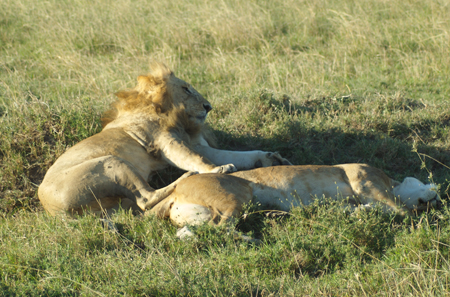
And here are some elephants. Nothing spectacular by itself (well, other than the fact that I’m seeing them in Kenya, of course!). But the preceeding photos provide context and additional elements that could be used with the photo below to create something more interesting and memorable.

I realize that these are exotic locations that many artists can’t get to or aren’t interested in, but the principle applies no matter where you are. Get out into the field and see as much as you can of everything around you. Filter that through your interests and passions as an artist and it will shine through in your work.

ART THOUGHT FOR THE DAY

“Now the light was fading fast. We had to hurry to reach the gate before 7 pm, but just as we were leaving the plains, Dave said urgently, ‘Stop! Stop!’ Thirty yards from the road, a lion and lioness stood silhouetted by the setting sun. She moved against him, rubbing her body on his great shaggy main, and twitched her tail high in the air. Then, blatantly sensual, she crouched on the ground and the big male mounted her. The coupling was brief and ended with a climax of impressive snarls before she rolled onto her back in evident satisfaction.”

Simon Combes, from Great Cats: Stories and Art from a World Traveler

Thanks, Simon. (Photo from Oct. 2004 art workshop/safari led by Simon Combes two months before he was tragically killed by a cape buffalo. More images from the safari and a memorial page to Simon on my website)

A Pot of Paint

Anyone who has been to art workshops knows that there always seems to be someone who is almost obsessive about finding out what paint, brushes and supports the instructor uses. The idea seems to be that if they can use what the teacher uses, by some kind of magical osmosis they’ll be able to paint like the teacher paints.

Fortunately, it doesn’t work that way. After all, if creating good work was only a matter of using the right combination of materials, it would take all the fun out of painting- for a sufficiently broad definition of “fun”. Sometimes trying to gain mastery or even competence in an art media is an exercise in frustration, disappointment and self-doubt. And then there are those too short times when the painting seems to paint itself and you’re just along for the ride.

With all that in mind, I thought I’d blog a bit about what materials I’ve ended up using after my first twelve+ years of painting in oil. Use any or all of it at your own risk. This week, I’ll start with paint.

I began with a pretty standard palette, courtesy of my first teacher. White, black, warm/cool red, yellow, blue, green, plus three or four earth colors and then some “fancy” colors that would have had Rembrandt spinning in his grave and Gauguin breaking into my studio in the dead of night.

Then I went to Scott Christensen’s ten day plein air intensive. Four color palette (plus a couple of tube greys): titanium white, Rembrandt Permanent Red Medium, Winsor Newton (W/N) Ultramarine Blue and Winsor Newton Cadmium Yellow Pale. And my “color choices” exploded. I discovered a whole world of more muted, restrained color that I was barely aware of before. A limited palette solves the “color harmony” problem, too, since every color probably has at least a titch (the technical term) of all the others in it.

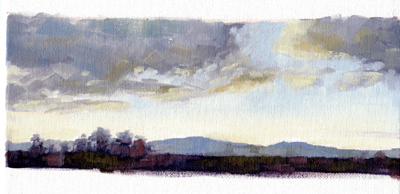
Here’s my first four color study from before I left so I could see how it worked a little, followed by two 20 minute exercises done at his workshop-

These are two studies I did after I got home. I think you can see that one isn’t really limited at all as far as color and what you can do with it. Value relationships and color temperature shifts become more important than having a particular tube color.

I pretty much stayed with that palette for over two years. For me, the main limit I bumped up against is that I’m an animal artist, not a landscape painter, and I really felt the need for a color I picked up at a Paco Young workshop, Rembrandt Transparent Oxide Red. It’s perfect for so many animals that I do. Then I found that the warmer Cadmium Yellow Medium worked better for me than the cooler Pale. Then I found myself gazing longingly at the dioxine purple, then my beloved sap green……

Presently, having realized that I’m really more of a colorist than a tonalist, I’ve added more punchy colors back so my paintings will have the emotional content I want. These days I use, from left to right on my 18″z24″ glass palette:  Rembrandt Transparent Oxide Red, Rembrandt Permanent Red Medium, W/N Cadmium Orange, W/N Yellow Oxide Pale, W/N Cadmium Yellow Medium, W/N Titanium White, W/N Ultramarine Blue, Rembrandt King’s Blue, (sometimes Rembrandt Turquoise Blue, for extra warm blues), W/N Dioxine Purple, W/N Sap Green, W/N Viridian. I very occasionally use W/N Raw Sienna, mostly to tint my canvas before starting, but otherwise I mix my own earth colors, greys and black (ultramarine blue, transparent oxide red).

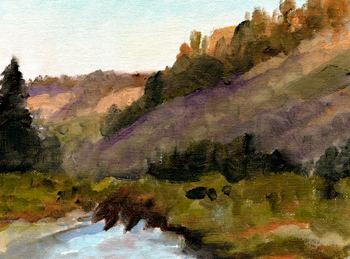
I do small (6″x8″ to 8″x10″) studies to try out painting ideas and for those I use the four-color palette because I can come back to them months later and I know exactly what colors I used. Here’s three, two of which went on to become finished paintings, so far. Yes, those are Roosevelt Elk on the beach north of where I live in Redwood National Park. The finished painting is called, what else, The Beach Boys, and is in a private collection.

The most important thing is not how many or how few colors you use, but that you know why you are using them and that you use them well.

The “Pot of Paint” reference in the post title is part of another of my favorite artist stories, which will be part of Friday Features.

Mongolia Monday

I was given a bag of aruul on my last trip to Mongolia in the fall of 2006. I’ve kept it in the freezer and have been eating a little at a time to make it last. I’m now down to the final three or so pieces, plus some bits of dried cream. So, I’ve kind of had Mongolian food on the brain, thinking about the upcoming trip.

One of my first goals upon arrival is to snag a bag of aruul for snacking on the road. Aruul is essentially dried skim milk. It’s really hard and is definitely an acquired taste. My first encounter with it was when I was out in the early morning viewing the takhi at Khomiin Tal and the ranger offered me a piece for breakfast. I hadn’t even had a cup of coffee yet, so I started to chew away at it and figured I’d better make it through most of it to be polite. By the time I was done, I liked it just fine. It has a yogurty tang.

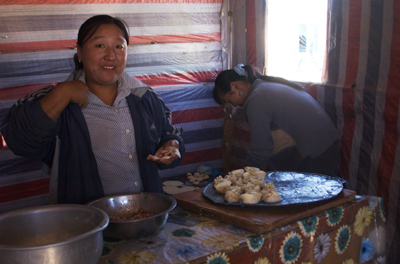
The humidity is so low in Mongolia that they can keep raw meat and dairy without refrigeration, although Westerns had better be careful what they try since we don’t have the resistance the Mongolians have built up. On the way back from Khomiin Tal, we stopped at a soum center (county seat) for lunch, which turned out to be what is almost the national dish, buuz, pronounced more like booooz, with a long “o”. Every culture, it seems, has some version of meat/veg in a dough pocket. Think Cornish pasties. So here’s the inside of the cookshop. I asked to take a picture and the reaction was along the lines of “Sure, if you want to photograph something so utterly ordinary and uninteresting it’s fine by us.”

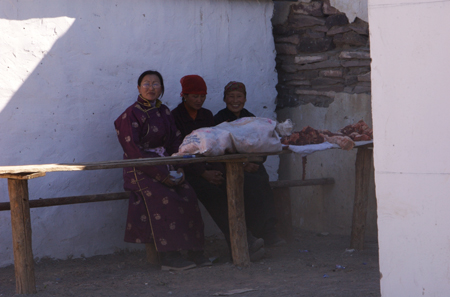
While waiting for our order to be prepared, we wandered around the busy central “plaza”. Over in the  shade were three women setting up a table with their wares, a dismembered carcass of some kind. They saw me taking the picture and we made eye contact. I went over, gestured with my camera and thanked them. Then I summoned up my very minimal Mongolian and told them that I was an artist from California. That elicited all kinds of smiles. This kind of experience is a big reason Why I Don’t Take Packaged Tours.

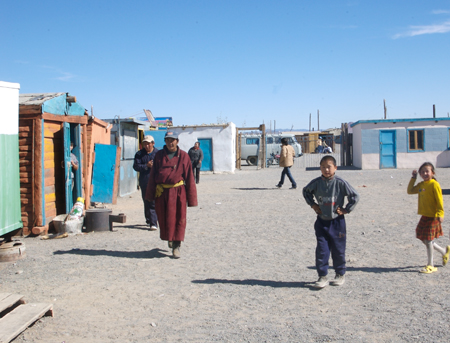
The soum center. I’m not sure of the name. It’s on the north shore of Khar Us Nur and I have maps with two different names. Someone help me out here.

News Flash!

“Autumn” has been accepted into the 16th Annual Juried Art Competition Show and Sale at the Breckenridge Fine Arts Center! It will be there from August 25 through September 28.

Back from the Marin Art Festival

Although sales weren’t what I’d hoped for, things were about as I’d expected given gas prices, the real estate implosion and the upcoming election. Made back gas and food money. I sold a lot of cards and a small original. But I got a lot more out of this event than sales. My fellow neighbor artists were equally talented and welcoming. And I feel like I laid a good groundwork for next year.

The people who came by my booth in a steady stream both days were interested and interesting, as one might expect in Marin County. There was the petite older woman who, it turns out, is an doctor of internal medicine who got her medical degree from Stanford in the 1940’s. Her father supported her, but her mother didn’t, saying that she would never go to a female doctor. Oh, well, with luck we’ve largely moved on from that sort of thing.

As always, got some great stories about other people’s world travels to places like Botswana and inner travels by a woman who does shaman work. Did I say I was in Marin County?

Many people were interested in my paintings of the takhi and most of them have seen the movie “The Story of the Weeping Camel”.

Out of around 300 artists at the festival, I was just around the corner from Jeff Morales (www.jmceramics.com), a fantastic ceramic artist who lives less than 15 minutes from me on the south end of McKinleyville. Small world #253.

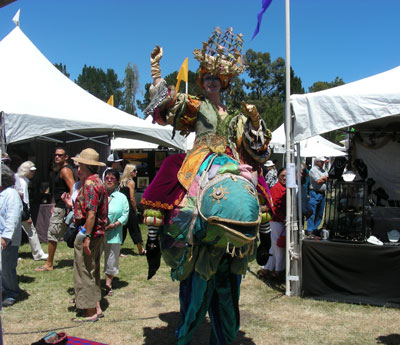
One of the great things about the festival were the stilt walkers in absolutely amazing costumes. They really took the event to another level and drew a crowd wherever they went. Here’s two of them:

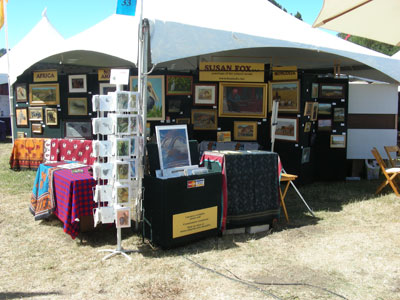
And, of course, being a wildlife artist, the universe conspired to allow me to do a little fieldwork in the comfort of my booth. Here’s the booth:

And here’s the little pocket gopher who came up for breakfast around 9am right next to the base of my easel in the middle of my space. Wildlife watching doesn’t get any easier.

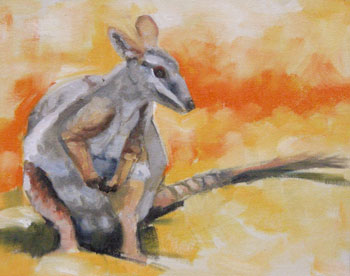
I had fun doing painting demos during the weekend. Here’s the one I did on Saturday in about two hours, counting interruptions. It’s a kangaroo I saw in a zoo. Don’t know the species:

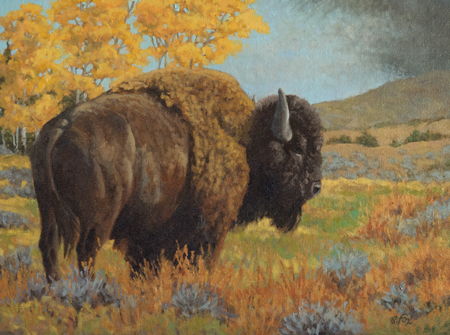
And this is the one I did on Sunday, on and off for most of the day. Considering the working conditions, I’m pretty darned please. It’s the best cape buffalo I’ve done yet. And I’m keeping him.

Great weekend and more to come!

I had a terrific time doing North Coast Open Studios this year, not the least because I sold the coyote painting shown below in my June 3 post. The title is now “Double Check”

Lots of nice people, most of whom had not been to my studio before. On Saturday afternoon, one couple stopped by who had driven all the way from Ukiah just for the event. She had researched the artists and chosen the ones they wanted to visit, since, with over 100, there wasn’t time to see them all. I was very flattered to make the cut!

I’m now in prep mode for the Marin Art Festival and will head south on Friday. Really looking forward to it. Temperatures are supposed to be in the 80’s, though. I paid an extra $25 for electricity, so the portable fan goes with me. I ain’t suffering for my art if I can help it.

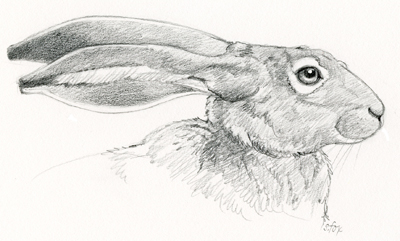
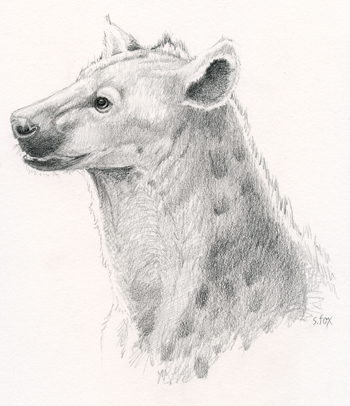
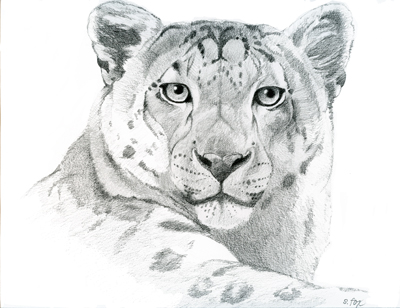
Today I’ve been scanning drawings for new notecards. Here’s three of them, a jackrabbit, spotted hyena and a snow leopard:

The next big event for me locally will be Wild Visions 2, a group show consisting of myself, Paula Golightly, John Wesa, Linda Parkinson, Shawn Gould. This time we are showing with Meridian Fine Art at the Umpqua Bank Community Gallery. There will be a reception the second Friday in August, so save the date! More as it gets closer.