Five Things Artists Can Do While Waiting For Spring

We had a heck of a series of winter storms last week here in California. And this week a large chunk of the rest of the country is getting wacked. It’s stay indoors season. Not a great time to paint outdoors, unless you’re one of those seriously hardcore plein air folk, or do fieldwork if you are an animal artist. Snow is one thing, but driving rain and hail, high winds or ice storms are something else. What to do (drums fingers on table)? Here’s some ideas:

1. Ask yourself- What are you really bad at?- Trees? Water? Fur? Eyes? Be honest. We all have our strengths and weaknesses. I remember my artist sister-in-law telling me about a classmate at art school whose use of color was, apparently, pretty awful. He made a commitment to improve and is now a nationally known artist and illustrator known for, among other things, his incredible use of color. What I learned from this story is that, with hard work and a willingness to struggle and learn, a weakness can be turned into a major strength.

There's probably at least six exercises that one could do from this photo. What are they?
Cinereous vulture, Bronx Zoo; opportunity to show depth and form in an eye study; the photo flattens the image; what do you have to do to compensate?

Exercise: Set aside some time each week to work on something that’s hard or that you feel is a weak point in your work. Do little studies that should only take a hour or two. Don’t bit off a big chunk like “water”. Break it down into smaller problems like reflections or what pebbles look like through water. Robert Bateman says that he used to sit and watch water for hours to learn what the pattern was. You could throw stones in a big mud puddle to study ripples.

2. Take a look at your old work- Creating art can be very discouraging. Sometimes it seems like we’re just spinning our wheels. Progress in gaining any skill is usually incremental. Someone who hadn’t seen my work for awhile was visiting my studio recently and commented that my work had taken a great leap since they’d last seen it. I found that very gratifying, but also interesting. I do occasionally paint something in which it all comes together and there is a big move forward, but that’s the exception.
old reference 4x6" photo (cropped) from 1996
Painting (cringe) from 1997; it looked ok to me at the time; I could write an entire post now about what's wrong with it
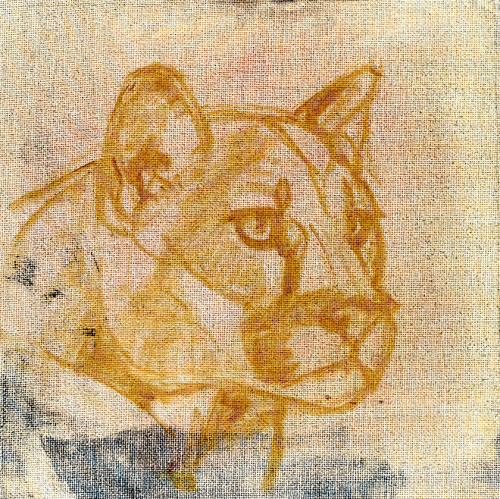
Brush drawing from a couple of weeks ago for an 8x8" painting; the difference should be obvious

Exercise: Get some of your favorite beverage, pull out your old work and set it up next to your latest pieces. What do you think? I hope you see steady improvement over time, which should give you some well-deserved encouragement. If you don’t, then see if you can figure out why. Be honest. I know some artists who seem to think that amount of years spent painting equals good work. Not true at all. Twenty-five years of doing the same subjects in the same way with the same technical problems still means mediocre paintings.

3. Evaluate your photo reference- a famous wildlife artist who I was lucky enough to study with a couple of times told us that “you’re only as good as your reference”. I have found that to be absolutely true. Every time I’ve been able to upgrade my camera equipment or how I view my reference, my paintings have shown immediate improvement. You can’t put in what’s not there unless you know the subject extremely well. Trust me on this. The biggest leap for me was going from film to digital, which let me move from prints to the equivalent of big transparencies. I’m slowly purging my photo print reference of all the kinda-sorta images that I know aren’t good enough.

Impala painting from photos shot during my 1999 trip to Kenya; flat as a piece of paper with everything in local color
my main reference photo; notice the absolute lack of any perceivable light source
Thompson's Gazelle; no hint of a background, but you know there's light because of that cast shadow on the neck

Exercise: Go through your reference, in whatever format, with a fresh eye. Ask yourself- How much work will it take to make this into something? Does it really represent what it was that caused me to take the picture in the first place? Is it blurry? (I tend to keep those because there still might be a hoof or other information that I can use, but I don’t use blurry images for primary reference. Or let’s just say that every time I’ve done it, I’ve regretted it.) Is it under- or over-exposed? How about the lighting? Is it interesting? Or is it flat?

4. Start a sketchbook- You know you “should”. One of my teachers in art school did a lot of storyboard work for major San Francisco ad agencies. High pay, super short deadlines, no time to shoot reference. He did a drawing a day besides whatever work he had. While I was in his class, we all did a drawing a day. I had fun using my favorite felt tip pens and also Berol color sticks, which were new for me. So it was a chance to try different media, too.

Table and chair; not easy to get the perspective right
But no one says it has to be literally realistic
I tend to do this kind of drawing with carbon or charcoal pencils in the studio, but still use felt pens on location

Exercise: For one week, do a drawing a day. Of anything. You can set up a still life, draw furniture, work from magazine photos. With any media. But draw. Then add a second week. See what happens. Send me a 500 pixel jpg of your favorite and I’ll post them here.

5. Dream your dreams- Blue sky time. If resources, monetary and otherwise, were not a factor, what would you be doing as an artist? Some of us want to paint full-time, which I am fortunate enough to be able to do. Others want a special place in their home where they can do their art or want to go to a workshop or travel to Italy or…..the possibilities are as endless as the ways artists express themselves.

Dream big, but don't miss the stuff that might be close by

Exercise: Set aside an evening and make a list. Try to be specific. Instead of just “workshop”, how about “I want to study plein air painting with…..”? Or not just “I want to travel”, but “I want to go to Kenya and see wild lions”. Then think about what steps you can take to achieve one or more of your dreams. Get on the internet and see what you can learn about how other artists have achieved their dreams, both for inspiration or ideas.

So, there you have it. Five ideas and look! It’s April already!

“A Republic If You Can Keep It”

This blog is primarily about my art and adventures in Mongolia. But I’m also an American and I’m very concerned about what is going on in our country. Not just economically, but the “body politic”. Who will have time for art if we lose what fundamentally ties us together as a people? I have no intention of changing the focus of my blog, but it also doesn’t exist in a vacuum. Civilization and a civil society are required for culture to flourish. Our society, thanks to a vocal few, has become anything but civil. We have lost our ability to have honest disagreements and work them out. The shrillest and most extreme voices are prevailing. And it needs to stop. Now.

“All that is required for evil to triumph is for good men to do nothing. “ Edmund Burke.

How many of us stood by for the eight years until President Obama’s election while the Constitution was dragged through the mud? I’d have to raise my hand. How many of us stood by while, at the very highest levels of government, fear was used to control people and keep them from seeing that we were engaging in a war of choice, that alleged enemies were tortured and that the civil rights upon which we all depend were deliberately, consciously and with malice aforethought eroded?

Andrew Sullivan, who blogs over at the Atlantic Monthly, posted something very important today. The title of this post is taken from his. It is a quote from John Adams. It is the best explanation yet of the situation that America now finds itself in. Whither goest our grand experiment in self-governance? Please click through and read it. Thank you.

Mongolia Monday- New Mongolian Grammar Book

I got an email a month or so ago from one Munkhbayar Barmunkh, with a link to the Amazon page which offered the above book- a new, as of Sept. 2009, Mongolian grammar textbook. He turns out to be the publisher. I ordered it immediately.

The author, Khatantuul Baatarsukh,  has a BA in International Relations and Slavic Studies from the School of Foreign Services at the National University of Mongolia. It was clearly a labor of love. She says in the Preface, “Writing this book was a daring project, for it has many critics. My motivating force was the love and fascination of the art of language. My inspiration comes from life.”

As some of you know, I’m trying to teach myself Mongolian. I’m using: a Transparent Language course ; listening to Mongolian music via both CDs I’ve purchased and TsahimRadio, an internet radio station run by a Mongolian Facebook friend; and asking Mongol friends to translate words and phrases for me. I also have the Lonely Planet phrase book, which is dated in some unfortunate ways, but still very useful; and Mongolian/English and English/Mongolian dictionaries that I brought back in July.

I just bought Bento, the Mac-based consumer datebase app. I’m going to do my own word list since I need a specialized vocabulary of art and craft terms so that I can start to communicate with the felt craft coop ladies.

There doesn’t seem to be much else available that isn’t either really expensive or doesn’t fit my needs. I haven’t diagrammed a sentence since 8th grade (am I dating myself?), but I think this book will be quite helpful.

Mongolian is structured differently than English. The word order is more like German: Subject, object, verb. Verbs are modified by endings, so while I can look up a verb’s root word in the dictionary, I’ve had no idea how to use it correctly in a sentence. One exception is “gui”, which creates a negative. So, “chadakh” means “can” and “chadakhgui” means “cannot”.

The main problem that I have in learning a language is that I have a visual memory. That is, I store and retrieve information in images, for the most part. It makes remembering things like strings of numbers interesting. So, I find it difficult to make sense out of the terms for cases and how to relate them to anything. I’m hoping this grammar will help me sort that out, one way or another. I may just have to learn it by rote, which is ok, too.

All the text is in English and Mongolian cyrillic, which is almost, but not quite, the same as the Russian alphabet. There are lots of practice exercises, with a key at the back.

This book is not for beginning language students. I know just enough to start to beat my way through some of it. It will go with me on my next trip, though.

I invite both the author and publisher to add more information or comments, along with anyone else who has the book or would like to offer ideas/comments about the Mongolian language.

New Painting Debut! “Choidog and Black”

In September of 2008, my husband and I went together to Mongolia. One of the places we stayed at was Arburds Sands ger camp. It turned into one of the most memorable experiences that I’ve had in Mongolia because we were invited to a foal branding. The post on that is here.

I got a lot of great pictures, including some of the family patriarch, Choidog. He is a famous horse trainer who won the national Naadam horse race three times in the 1960s. During socialist times, he and the other herdsmen were only allowed to have 75 horses. Twenty years after the changeover to a parliamentary democracy, he has between 300 and 400. I suspect he thinks that’s just about right, but even by horse-loving Mongol standards, it’s a lot.

I decided recently that I wanted to start painting not just the Mongol horses, but their riders, too. And where better to start than with a man who is now 80 years old, who still rides every day and whose life has been dedicated to horses?

Choidog and Black 18x24" oil on canvasboard

As much as they love their horses, Mongols do not sentimentalize them and don’t give them what we would call “real” names. Choidog is riding his current favorite horse, who is simply called “Khar” or “Black”. Black could take his master 140 km to Ulaanbaatar if necessary, probably without breaking a sweat.

In this painting, Choidog is circling and looking over the horse herd that has been gathered in. Most of the foals are already tied to a picket line, but some of the men are out lassoing the others with urga, a long pole with a loop on the end.

We were told afterward, while sitting in the ger drinking airag with the family and friends, that Choidog had made his boots himself over the previous winter. The toes are upturned, not because it looks cool, but so that when walking (which people like Choidog never do if they can ride), the wearer won’t scuff the earth and damage it. The Mongols learned over a thousand years ago that they had to live with and respect the land in order to survive. Hum….

Back In The (Figure Drawing) Saddle

A new year brings new challenges and, for me, one is to get back to drawing from a live model. As it turns out, there is a weekly drop-in figure drawing session about 15 minutes from where I live. Five bucks for two hours. Can’t beat that. It’s hosted in the studio of a well-known local figurative artist. Besides her, there were five of us and a very, very good model. I went for the first time last night.

I did a LOT of this kind of drawing when I was in art school in the late 1980s, up to nine hours a week for three years. But since then I’ve done very little, partly because I’ve been trying to get a handle on oil painting and partly because I couldn’t find a group that didn’t think that 20 minutes was a short pose. This is much more to my liking- a bunch of thirty second and one minute poses, then some fives, then a couple of tens and a few fifteens. We drew for a solid hour, took a ten minute break and then drew another fifty minutes. Heaven!

I still had my masonite clip board, some, by now, “antique” rough newsprint and lots of different types of drawing media- compressed charcoal, conte crayons, charcoal pencils, etc. One of my goals was to simply try out different sticks and pencils to see what felt right and to get used to this type of drawing again. I had no idea what to expect. Would it be like learning to ride a bike and remembering how to do it years later or would it be more like riding off a cliff and having to make a very long climb back to where I had been since I last did it?

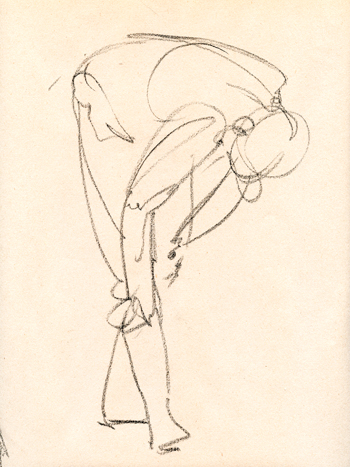
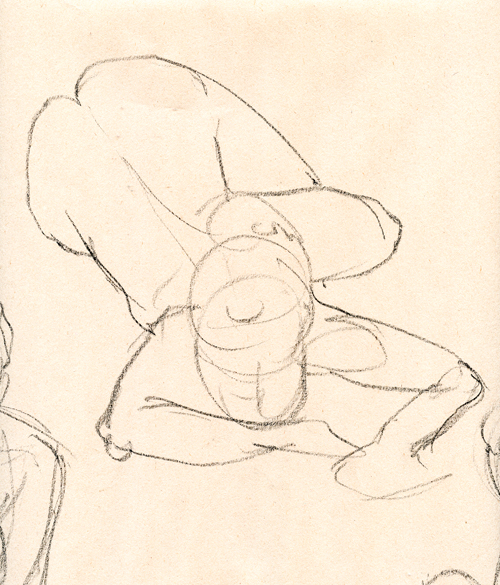
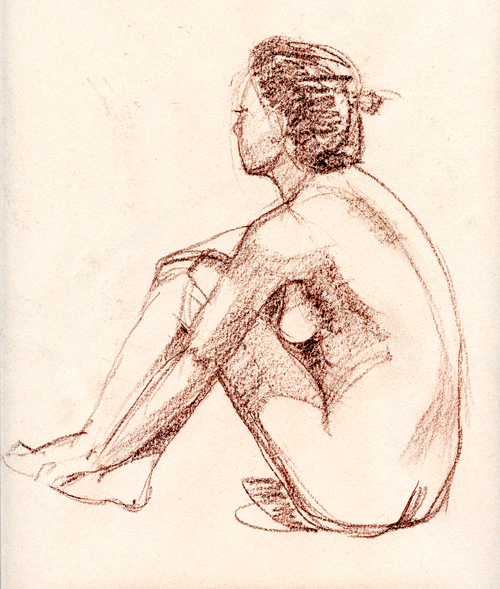
A little of each, I think. Here’s a progression of five drawings, starting with a thirty second gesture drawing and working up to the final 15 minute study. Needless to say, I highly recommend this to every representational artist, no matter what your subject matter. The human figure is endlessly challenging, but the point is less to turn out pretty drawings than to hone and train your eye.

30 second gesture drawing-compressed charcoal
one minute study-compressed charcoal
five minute head study-conte stick
final drawing of the evening, 15 minutes; conte stick

I didn’t hurt to have a model that artists like Waterhouse, Millais and Rossetti would have happily hired.

Mongolia Monday- This Week’s EBay Listing 1-4-10; A Takhi From Khomiin Tal SOLD

I thought I’d get a two-fer this week and combine my eBay listing with Mongolia Monday since the painting up for auction is a 8×6″ oil of a takhi (Przewalski’s horse). It’s from a photo that I took at Khomiin Tal, the westernmost of the three takhi reintroduction sites in Mongolia. I visited there in September of 2006. What an adventure that was for me! I flew out to Hovd, met my guide and then went by Russian Fergon van (those of you who have been to Mongolia know what that means…) east over 100 miles on what the Mongols call “earth roads” to the river valley where the horses were. I got to see them in late afternoon and morning light and got a lot of good reference. Here’s a photo of some of the horses grazing-

Takhi grazing at Khomiin Tal, western Mongolia

And here the painting that is currently available at auction here

Takhi 8x6" oil on canvasboard

Happy New Year! And Thank You To All My Readers!

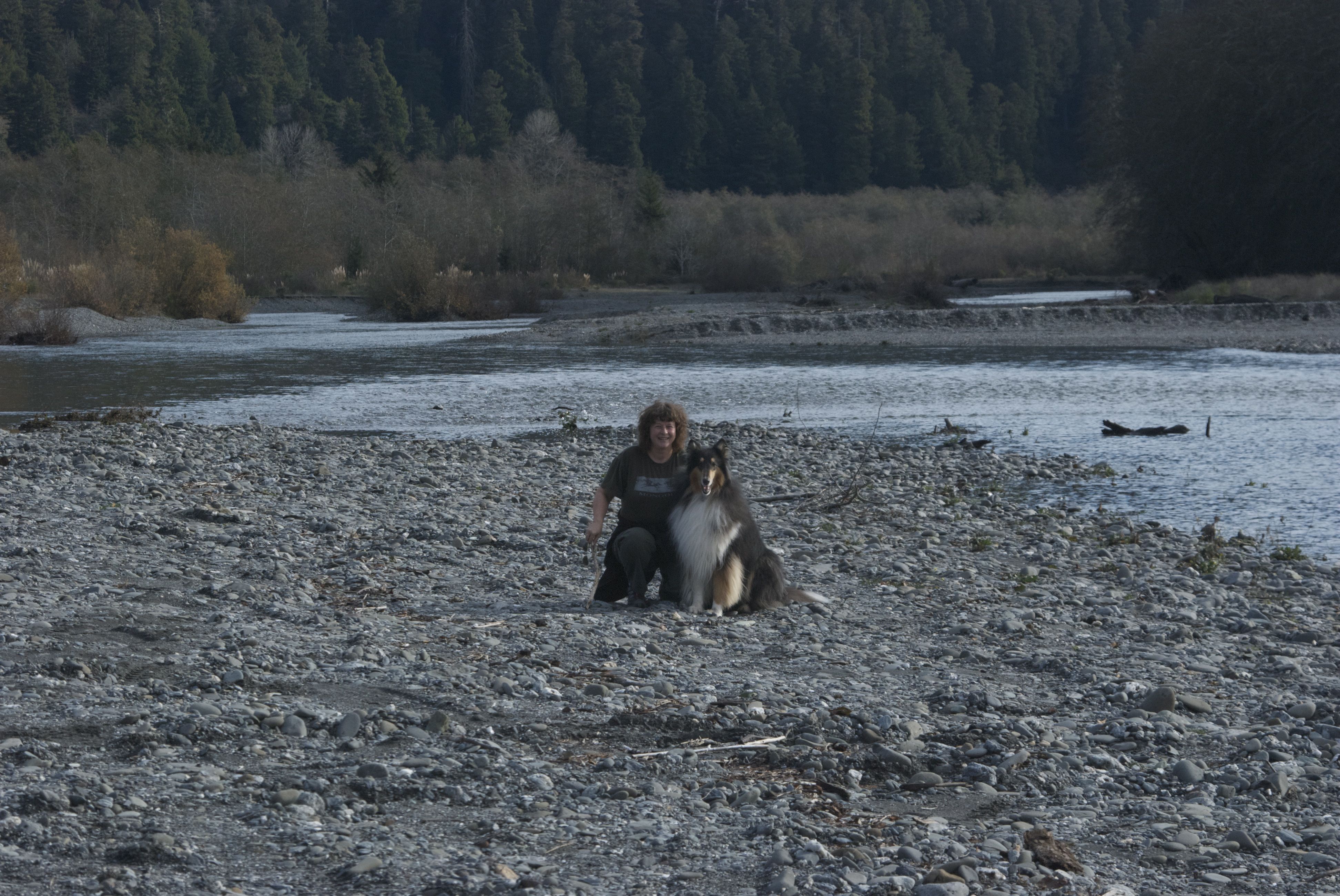
Niki and me, Redwood Creek, Dec. 19

Lots coming up in 2010…but first I’m doing some necessary career “housekeeping” like updating my marketing plan, setting up a budget spreadsheet, continuing to add info. to my Flick! painting records, planning a couple of gallery submissions and starting to think about what paintings I want to do for the jured shows I plan to enter. I even got in some drawing time earlier in the week between doing…..absolutely nothing useful.

At Trinidad State Beach, Dec. 25; photos by my husband, David

How about you other artists? What are you doing to get ready for what we all hope is a happy and (more) prosperous new year? If you feel like you need to take the next step to get your career moving, I highly recommend “I’d Rather Be In The Studio” by Alison Stanfield. She also has a great blog that you can subscribe to. Good, solid stuff every week.

That’s the business side. What are you going to do to nurture your art? Try a new media? Take a workshop? Concentrate on a particular subject? Travel to an inspiring place? Or……

(Photos taken within a half hour of our home. Yes, we are really lucky to live in northern California!)

Juried Show News!

Mongol Horse #3- Young Stallion 16x20 oil on canvasboard

“Mongol Horse #3- Young Stallion” has been juried into Art Horse Magazine’s “EX ARTE EQUINUS III!

You can see it here There will not be a physical show. Images of the art, in a variety of media, will be published in the summer issue of the magazine and a selection will included in a limited edition book, both due in March. I’ve made it into the book and greatly look forward to getting a copy.

Lesley Humphrey, who placed first in painting in Ex Arte Equinus II, was the painting juror for this year. Her juror’s statement is here and is very well-written.

And if this image looks familiar, yes, this painting was juried into an American Academy of Equine Art show earlier this year.

New Painting, New Drawings And An Interesting Call For Entries

Sort of an odds and ends Friday as the year winds down. The deep freeze is over here in coastal Humboldt County and it’s back to nice normal rainy weather with nighttime lows in the 40s. I’ve been getting in some good easel time of the past few weeks. Here’s a new argali painting from reference that I shot in July at Gun-Galuut Nature Reserve. I watched this group of rams work their way across the rocky slope for almost an hour. “Uul” is Mongolian for “mountain”.

On The Slopes of Baits Uul, Gun-Galuut 18x24" oil on canvasboard (price on request)

I’ve also decided that I want to paint not just the domestic Mongol horses, but the people who ride them. Which brings me back to wrestling with human figures, as described in an earlier post. I get a better result if I can scan the drawings rather than photograph them and also wanted to really hone in on accuracy, so these are smaller and done with a Sanford Draughting pencil, but on the same vellum bristol (which erases very nicely). The heads ended up being only 3/4″ high, which is pretty small, but it reminded me of a story from art school that I thought I might pass along.

One of my teachers was Randy Berrett, a very good illustrator who chose to work in oils. This was kind of masochistic, in a way, because it added a layer of complexity when he had to ship out a wet painting to meet a deadline. In any case, he was showing some examples of his work in class and one was a really large painting of the signers of the either the Declaration of Independence or the Constitution, I can’t remember which. Someone asked why he painted it so large. Randy’s answer really struck me at the time and has stayed with me. It’s something worth remembering when planning a painting. He said that he wanted the heads to be at least an inch high and that requirement controlled the final size of the painting. I’ve sized more than one painting on the basis of that criteria since then.

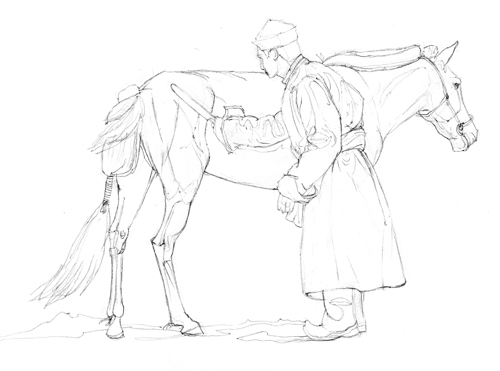
The first drawing combined two pieces of reference. One of the horse and one of the man. In the latter, he was in front of the horse’s head. In the former, I didn’t like the pose of the horse. Moving the man back works much better. The sweat from a winning horse is considered to be good luck. There are special scrapers made to remove it.

Scraping the sweat after the race, Baga Gazriin Chuluu
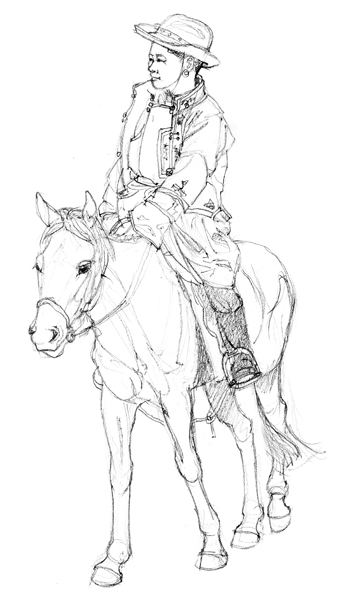
Local herder, Erdene Naadam
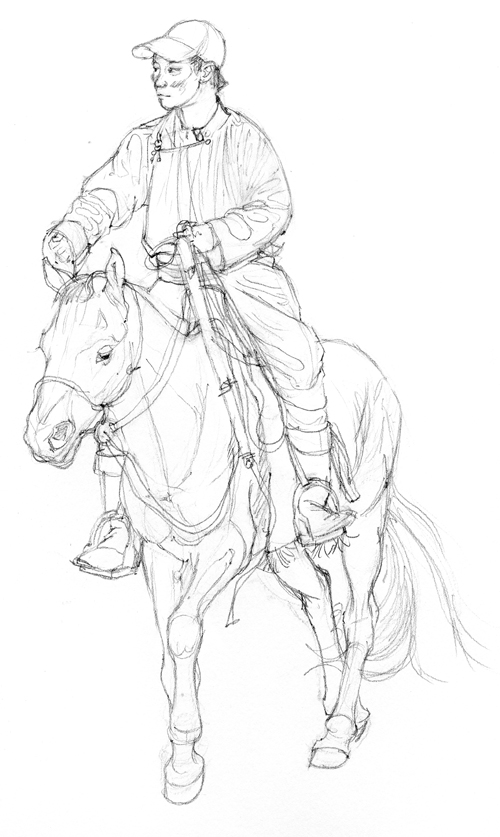
Boy on horse, Erdene Naadam

Part of the reason I did the previous two was to see if the images “drew well” and to work on horses coming forward at a 3/4 angle. The final two are head studies, in which the heads are 1 1/2″ from forehead to chin.

Local herder, Erdene Naadam

Local herder, Erdene Naadam

Finally, the folks at Eureka Books in Old Town, Eureka have decided to hold a special art show. Here’s the Call for Entries.