I’ll be bringing original paintings, drawings, location watercolors and some of my Mongolia journals, too.
I’ll be bringing original paintings, drawings, location watercolors and some of my Mongolia journals, too.

We got back last Monday night from our two week vacation on the Big Island of Hawaii. While I wanted to kick back and relax I also wanted to make art, specifically to do at least one sketch a day, and I came pretty close.
I took a variety of dry media with me, along with a 7×5″ Pentalic Nature Sketch sketchbook since it works well for what I use. Also my watercolors and I managed one, but the weather, unexpectedly hot and humid (we’ve been to Hawaii this time of year a number of times and don’t remember it being like so uncomfortable for us northern Californians) made sitting outside for any length of time very difficult. It needs a bit of work in the studio, so I haven’t posted it yet.
I used Cretacolor Monolith graphite pencils, Sakura Micron pens, Derwent watersoluble colored pencils and also their Graphitone watersoluble graphite pencils in various combinations.
The goal was to have fun, try things and have an art record of the trip, not create a finished “museum” piece. Anyone can do this while they travel and I encourage you to try. Get a spiral bound sketchbook so you can rip out and throw away (recycle) any pages you don’t like if that would take the pressure off. Any pens or pencils will do, along with a good eraser. I like the kneaded rubber ones since they don’t make a mess.
Sketching is a different way of seeing and experiencing a place because the way one observes a scene in order to draw or paint it is different than just looking at it or taking photos. With that…
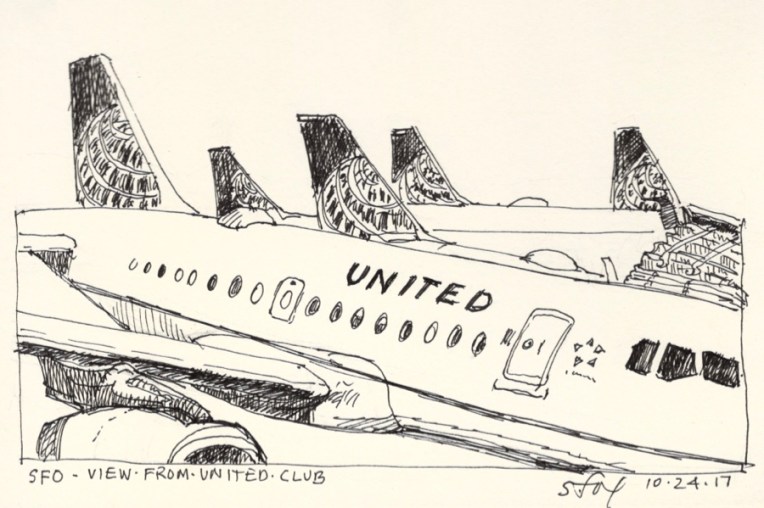
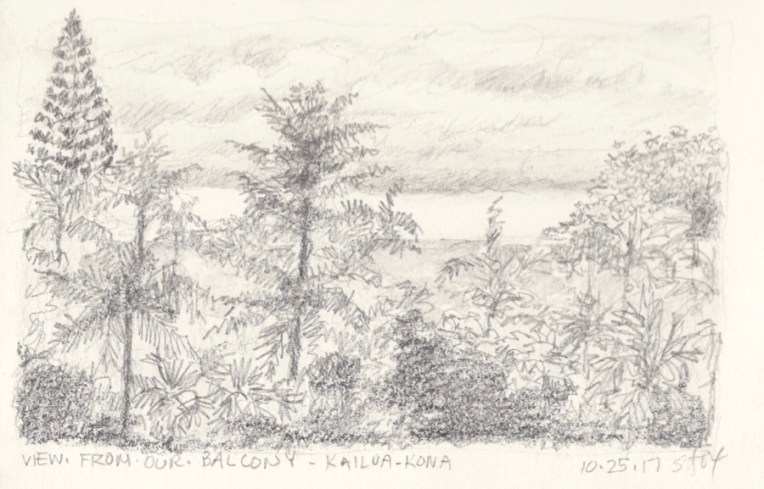


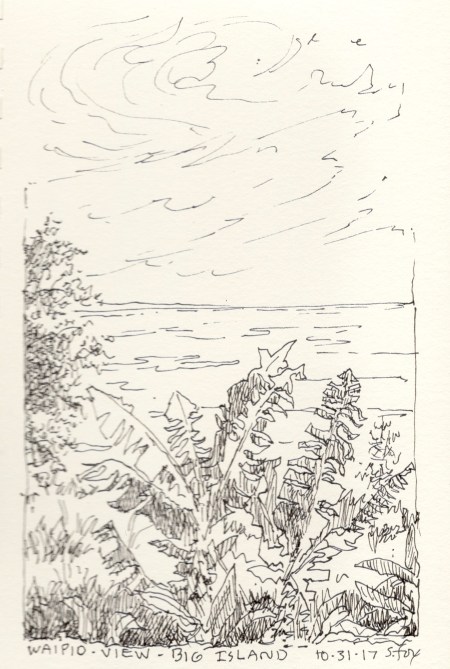

I had less than a minute to sketch each of these geckos before they vanished. Whew.

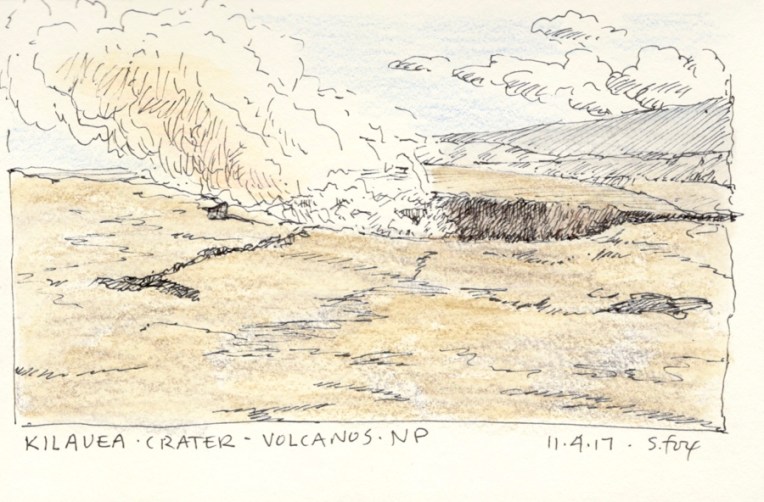
I did the above one while we were waiting for lunch at Volcano House in Volcanos National Park. The restaurants have seats that overlook the crater. Tres cool.


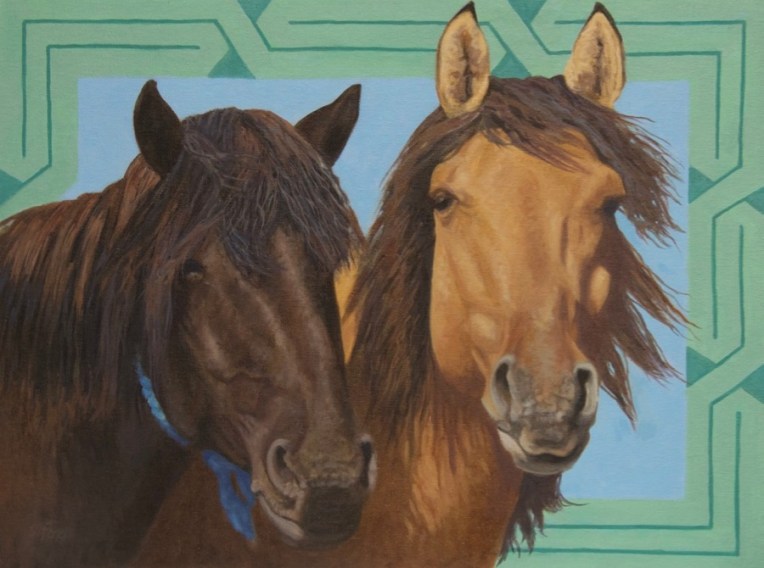
I entered my first juried competition in 1991, an Artist’s Magazine contest for wildlife/animal art. I got an Honorable Mention for a colored pen and ink drawing of a wild boar I’d photographed somewhere. Woohoo! I was out of art school, but had not started to paint in oil yet, a childhood dream. I was able to begin that with two years of private study in 1995. In 1997 I decided to focus on painting wildlife in oil. In 2003 I was accepted into my first national juried exhibition, the Art for the Parks Top 100, with a painting of a Yellowstone bison. Since then there’s rarely been a year that I haven’t had work in at least one juried show or another. But this one is really, really special. “Mongol Horses” will be in the Salmagundi Club Annual Member Exhibition, which has been held every year since the club was founded in 1871. It is open to all media and “is meant to showcase SCNY member’s finest work”. It’s the first time I’ve gotten in. Not only is it for all subjects, but I’m very proud to have one of my Mongolian subjects in this prestigious show!
This piece is part of a “new direction” my work is going. I’m drawing, so to speak, on my background in graphic design, calligraphy and love of historic decorative styles, to move away from animals in a landscape and put the focus directly on them. This makes sense for me because since I was a child I drew animals constantly.
In other news, we’re off to Hawaii next Tuesday for a two week vacation. I’ll be taking my sketching and watercolor supplies with me and will be posting here, on Instagram and on Facebook. Come follow along! Aloha!

Details to come, but I will be having a solo exhibition at the Westhaven Center for the Arts, near Trinidad, California, in November and December. It will be a retrospective to celebrate my 20th year as an oil painter. I’ll be showing work that has been accepted into juried shows and/or won awards, along with a look back at my artistic roots as a kid who loved to draw and then worked for twenty years as a sign painter, graphic designer and freelance illustrator. I studied the craft of oil painting with a local artist for two years from 1994 to 1995. In 1997 I took a wildlife painting workshop (wow, people might PAY me to paint wildlife!) and decided to make the move to painting in oil full time, focusing on what I’ve always loved most as a subject….animals.
I’ll occasionally be posting work that will be in the show between now and when it opens. In the meantime you can see that I would not be able to do the preparations without the enthusiastic assistance of Peregrin, our 18 month old rough collie boy.

I have the good fortune to work at home doing something I love. It also means “visitors” every day. Our two rough collies and three cats wander in and out, sometimes just to say “hi” or to hang out. The last few days Alexander has come in, sprawling across my desk in front of my iMac to get his tummy skritched and combed out. He was a slightly scruffy little shelter kitten who we got when he was about three months old. He’s grown into a phlegmatic 8 year old, 16 pound furball.
(And wouldn’t you know it, as I was proofing this post in he came. Pause for tummy combing….)
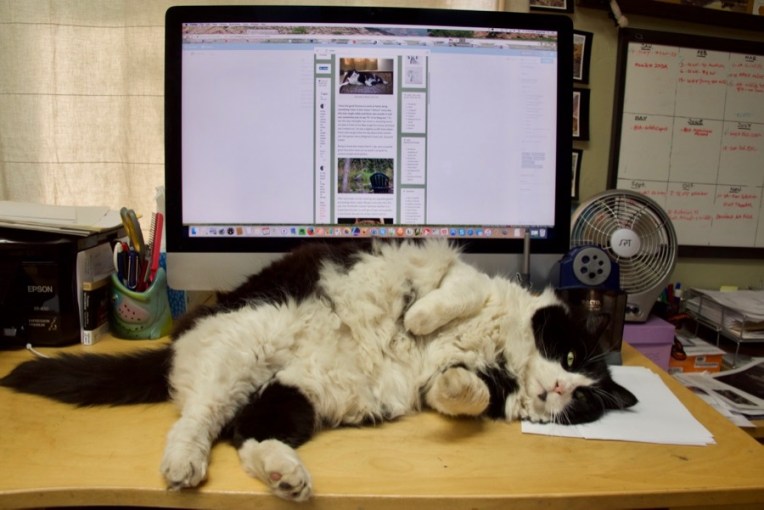
(Ok, I’m back.)
Being at home also means that if I, say, spot a juvenile great blue heron down at our pond I can grab my camera and get some photos.

After work tasks include watering the vegetable garden and picking what’s ready. We got a very late start this year, but Humboldt County’s warmest weather is in September/October so we’ll get at least some goodies in the freezer like peas for winter solstice dinner.
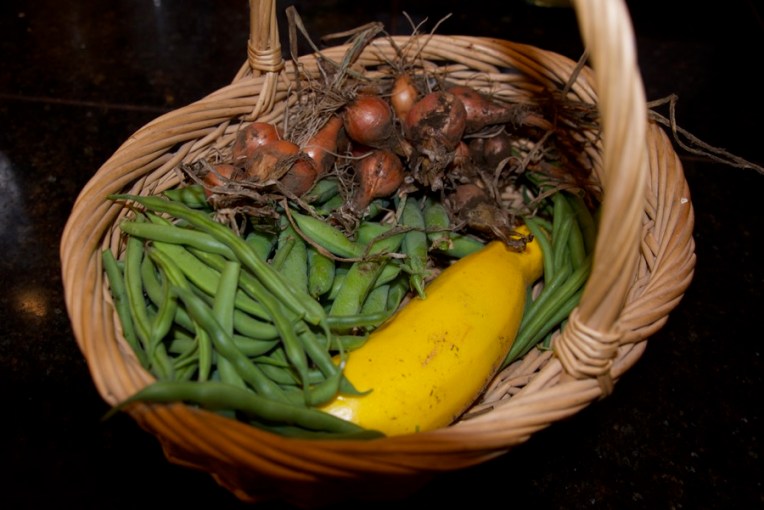
We picked our first real harvest a few days ago. Shallots, a yellow zucchini, Hurst Green Shaft peas (got the seed in England and haven’t found an American source for this awesome variety), Blue Lake green beans, and French haricot verts. Potatoes will be ready in another month or so. We’ve also planted regular green zucchini and summer squash, both of which will start to be ready for harvesting soon. I also, because I had them, threw some brussels sprout seeds from 2012 into the ground just to see if any would germinate. Thought I might get two or three. Well….I’ve now got a clump of over a dozen that are too close together. My plan is to carefully transplant them into a row once the rains come and the weather is cooler.
I think we’re going to dig a small root cellar on the north side of the garage since there are five varieties of garlic on the way, plus some heritage onions. The peas and beans will be, respectively, shelled and cut up for the freezer, where they will join the three gallon-size ziploc bags of blueberries our bushes produced this year. Did I mention that I’m reading Barbara Kingsolver’s book “Animal, Vegetable, Miracle” right now? :0).
In the meantime, last night I rummaged around for dinner wanting to use the zucchini while it was fresh and some mushrooms before they were goners. And came up with this…

I set water to boiling for the shell pasta and then sauteed the mushrooms in olive oil and butter. I added the zucchini and let it cook for a bit, then added some finely sliced leeks. It’s seasoned with a bit of salt, basil, parsley and oregano. When the pasta was done I dumped it into the vegies and stirred everything together. Dinner was served in our Portmeirion “Borders” pattern china that we got at the factory seconds shop in England twenty years ago.
As for art, as you saw last week, I’ve got some new small horse paintings under way. I also started this one, getting the brush drawing done. You can still see the pencil marks from where I projected the preliminary drawing for transfer and then made some corrections. But darn, I kinda like the way it looks now, so I might just call it done and keep it around. We’ll see.

As part of my regular routine I post to my blog on Fridays. I missed last Friday and for a very good reason….I was attending a local plein air painting workshop with nationally-known local artist Jim McVicker. I’ve known Jim for years and we own two small pieces of his work, but I’d never been able to learn from him before and this was a great chance right near home.
One thing I was very interested in was his start. He’s really a “pure” painter, having started with a brush in hand. I started out as a kid who loved to draw and didn’t take up painting in oil until 1995.
I photographed two of his demos, one from the first day at a beach that borders Trinidad Bay adjacent to the small fishing town of Trinidad, about fifteen minutes from our place, and the second in Eureka at the garden of the Ingomar Club which is located in the Carson Mansion, known as the “most photographed Victorian in the country”.
I’ll start with Trinidad. It was an overcast day, but the sun did come out in the afternoon.
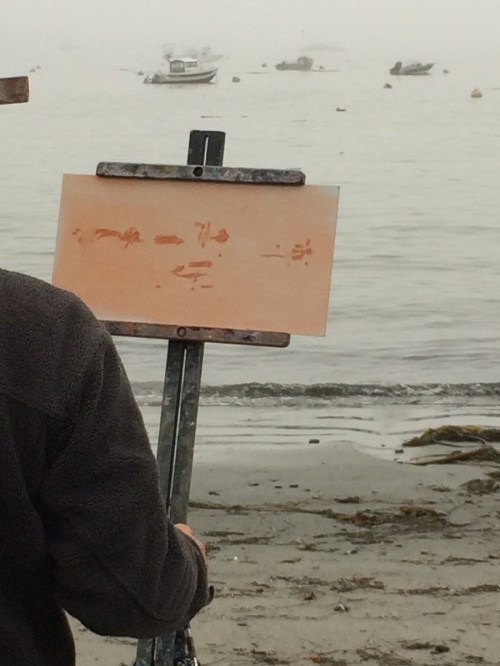
Ok, so this kind of blew me away….Jim’s first marks on the canvas. And they show the difference between someone who takes a painter’s approach and someone like me who starts their indication in line to define shapes.
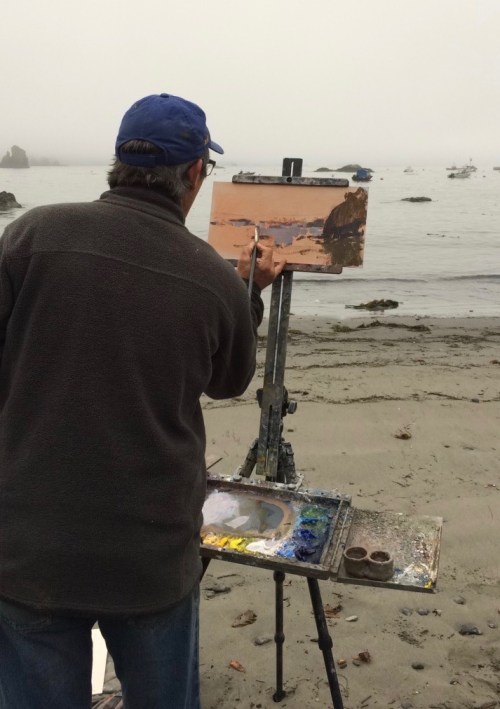
When he laid in that large area of dark for the base of the rock, my brain kind of freaked out…”OMG that’s SO DARK!” It was a LOT darker than the actual rock, even allowing for knowing that one brings lights in over darks as a general approach in oil painting. This is why it’s so valuable to get to see how other painters work and see.
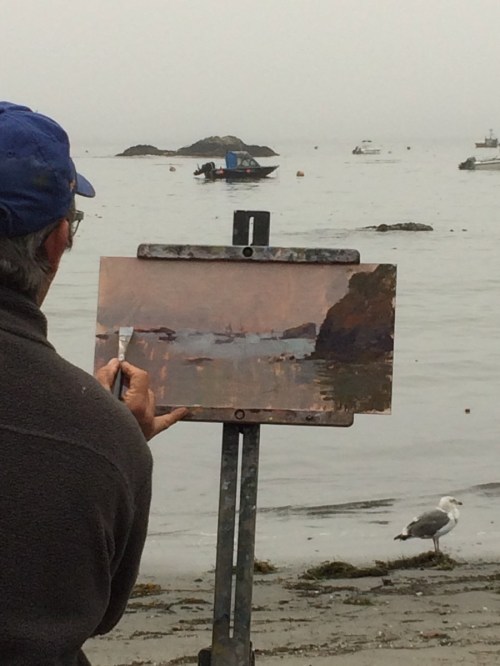
I want to thank the gull for adding a bit of additional interest…
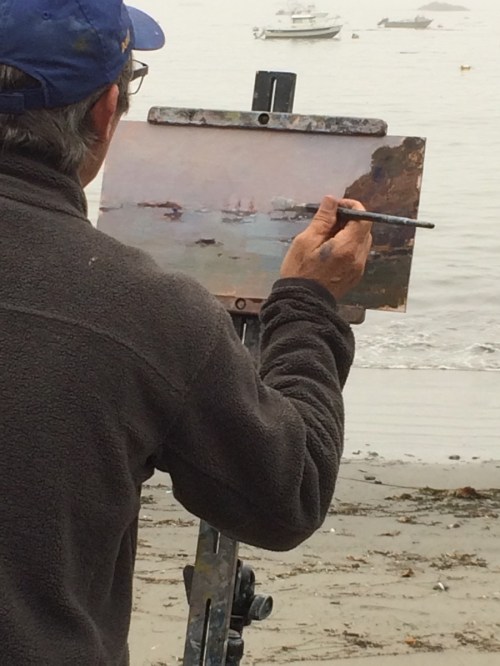
Jim talked about working all over the canvas, not going from object to object, an approach that I heartily agree with and practice myself.
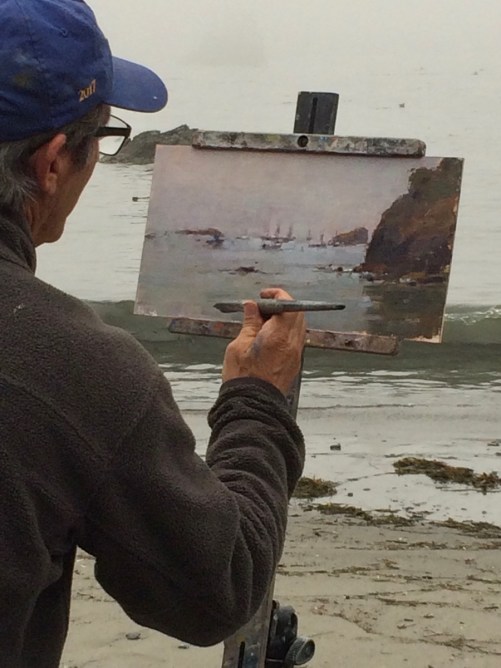
Adding tones to the water and last color notes in various spots.
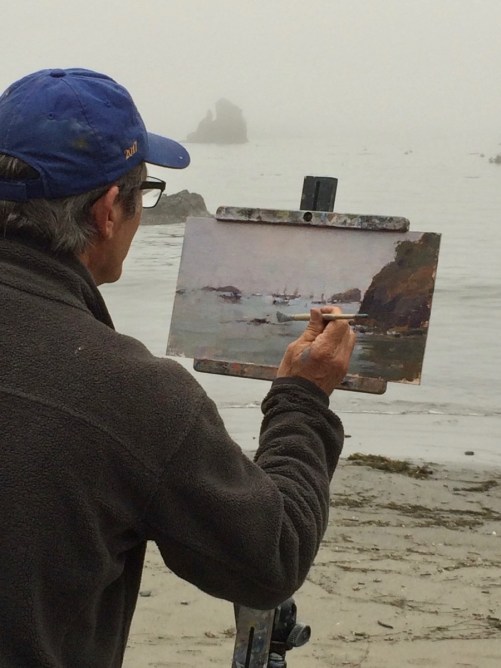
Final touches.
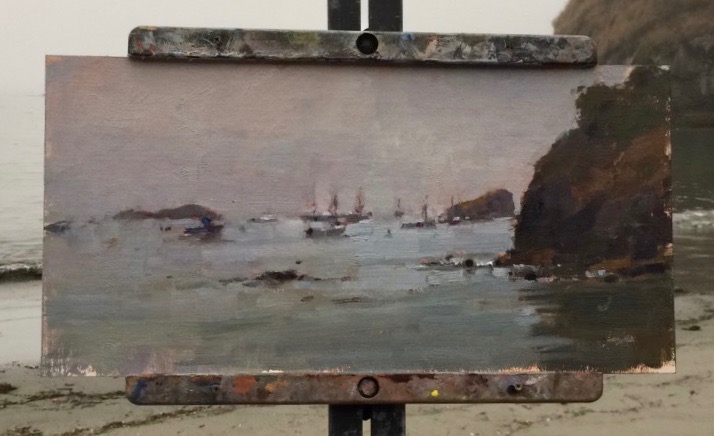
The finished painting of fishing boats in the harbor.
And then the sun came out, of course.
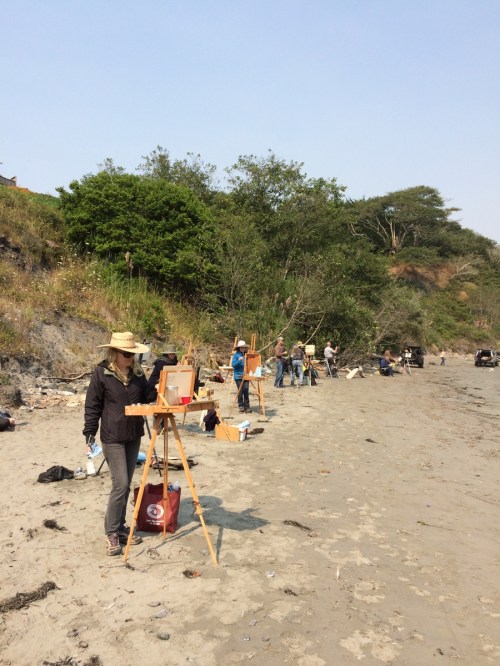
Yesterday, at the Ingomar Club in Eureka, it was overcast from the smoke of forest fires that are burning in southern Oregon, but there was still distinct light and shadow.
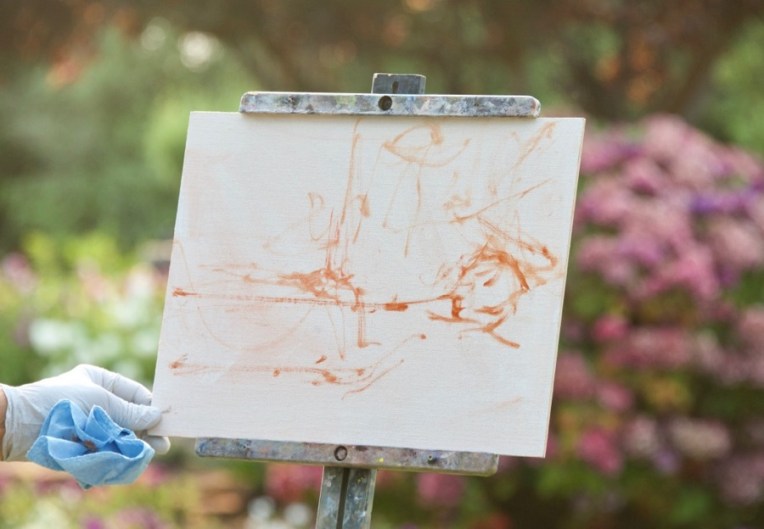
This start really shows the abstract underpinning that the painting will be built on.
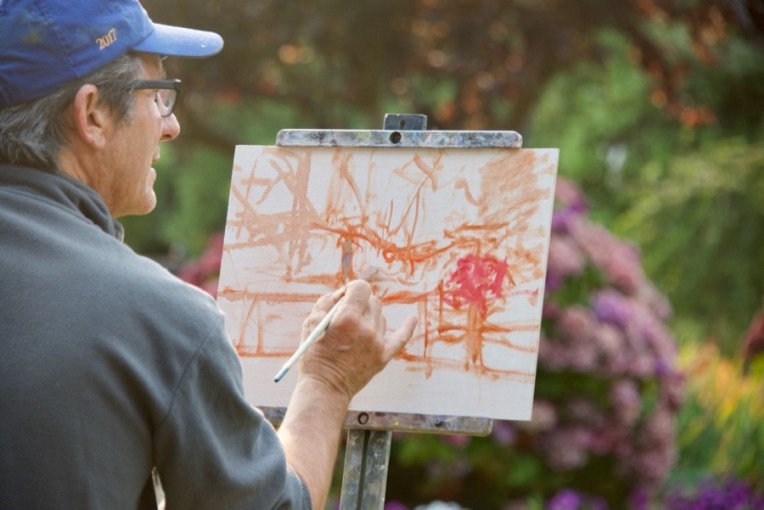
Working all over the canvas.
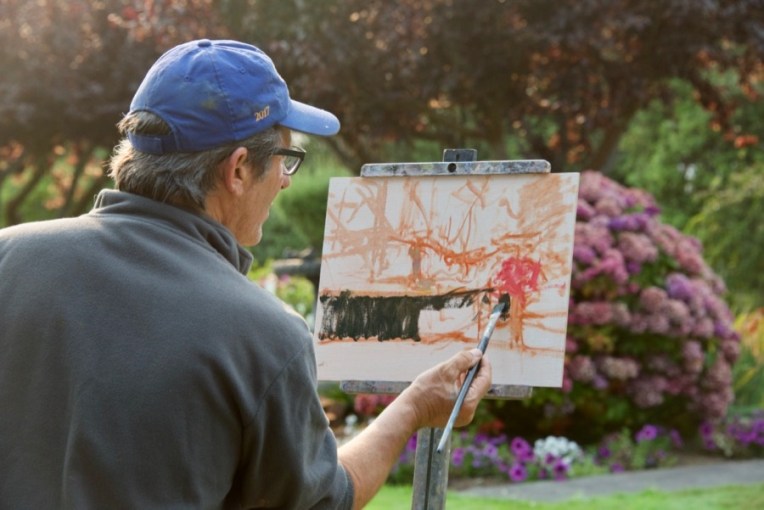
Laying in the dark of the hedge.
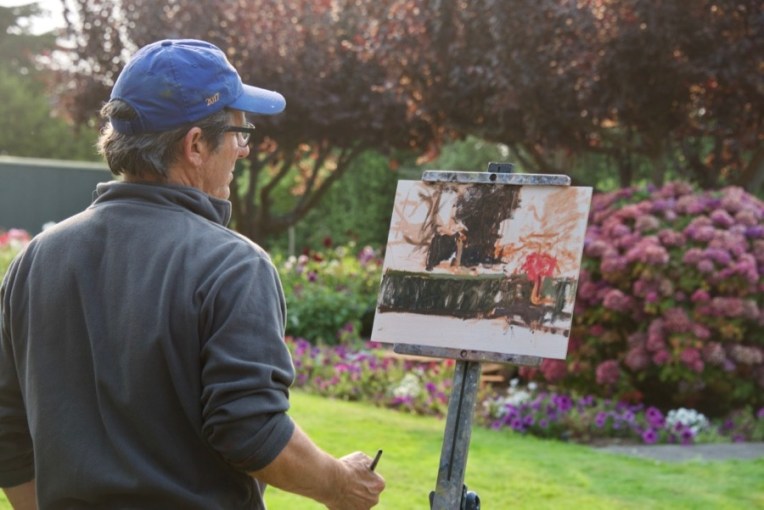
Adding the background trees. He actually did very little with them after this first step.
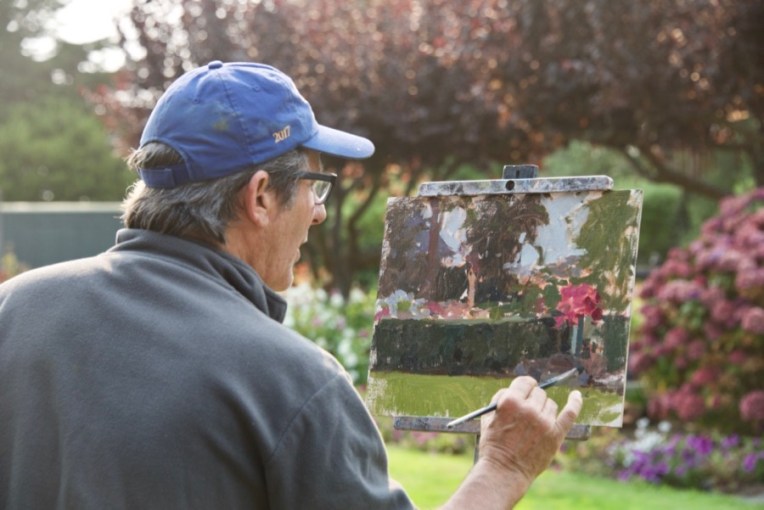
All the areas blocked in now. He can choose how far to go on any particular part or just leave it as is.
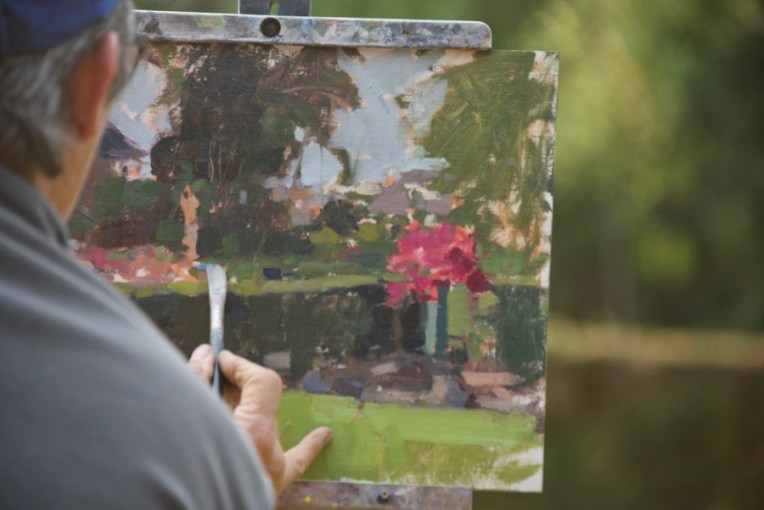
Notice that he is painting shapes, color, values and edges, not objects. There is no need to paint the individual petunia flowers in the pot on the right.
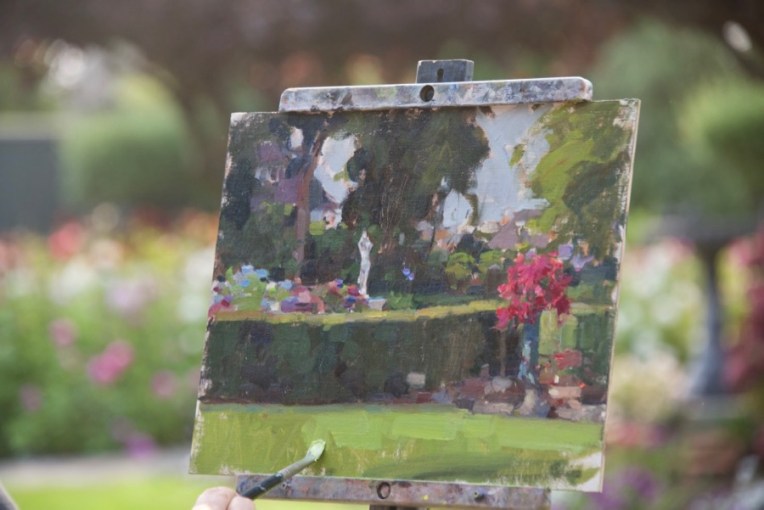
Bringing up the value of the grass, which is in sun light. It’s a warmer tone than what’s underneath, but still fairly cool. The hydrangas on the center left are pretty much as he first laid them in with the addition of some foliage around the flower shapes.
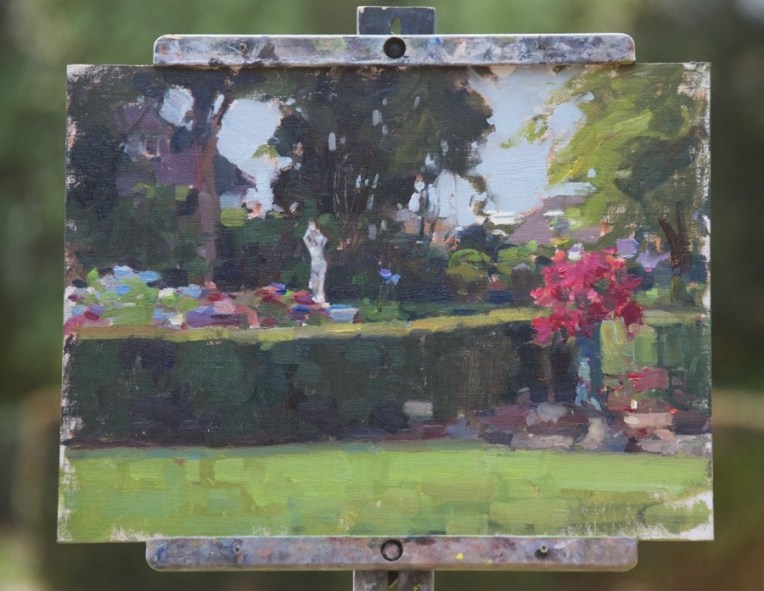
The finished painting.
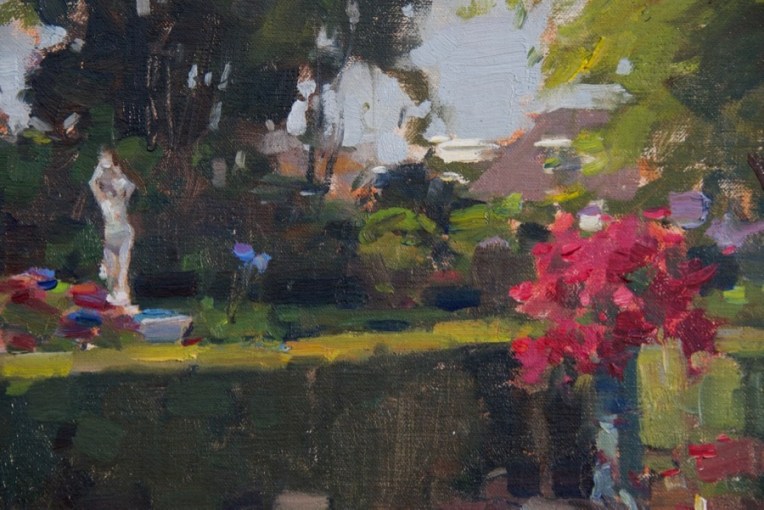
Detail of the right side. I mentioned to him afterwards that I would have skipped putting in the background buildings, but that I know he also does cityscapes. I’m not personally that interested in man-made things as subjects so it was interesting for me to see his different choice.
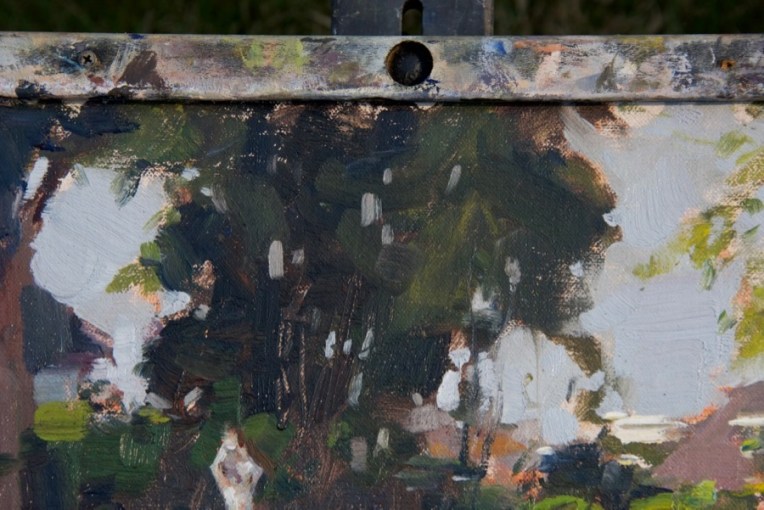
Detail of the central tree. Oh, those “sky holes” . Necessary, but tricky to pull off. They require a solid knowledge of how tree trunks, branches and foliage are related. Random spots of sky color won’t do it. Jim also pointed out that sky holes need to be a little darker in value than the rest of the sky or they’ll stand out too much. It’s the little things…
So what did I do during the workshop? Well, the Trinidad painting was a bust. I had thought the sun would come out so set it up for that, but as the time went by and that didn’t happen, I switched to adding the fog drifting past the huge rock next to the dock which was my subject (and that of many other local artists). I was also using a canvas panel that became part of the problem. Talked with Jim about it and he said that if the panel surface is wrong and is not working it becomes a real battle. That’s what happened to me and the panel won. Won’t say what the brand was because all the matters is that it didn’t work for me.
Yesterday was much better. Nice light, a panel that I knew would work and a fun subject.
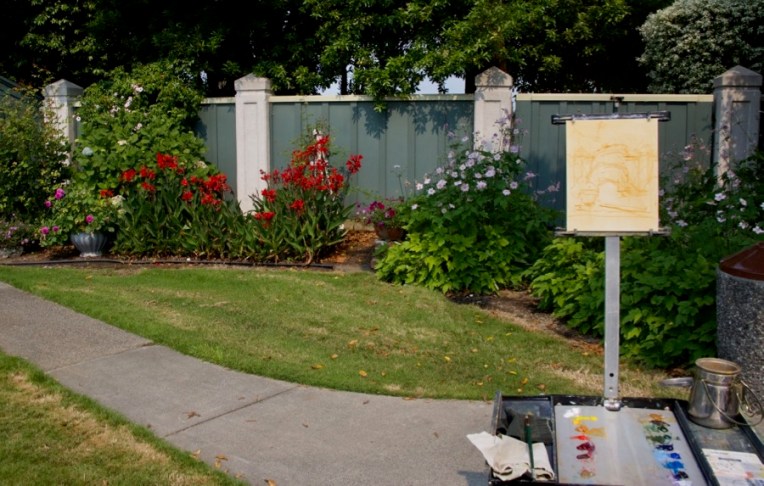
There were big free-standing beds of roses and dahlias, a gazebo, the statue and other features, but my eye was caught by the intense red cana lilies next to a pot of deep cool pink dahlias and the warm foliage greens against the cool green fence.
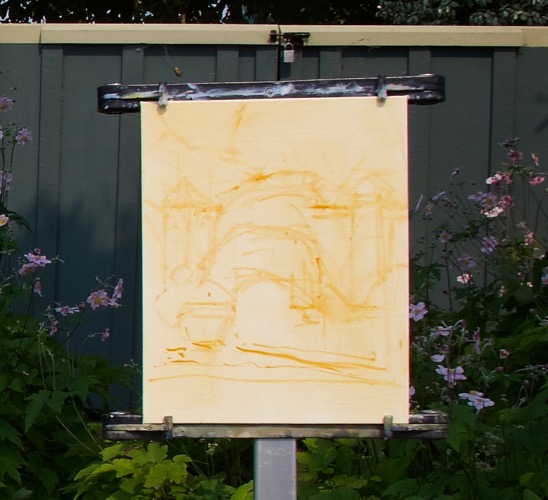
Jim likes to often use Rembrandt Transparent oxide red for a tone to knock back the white of the panel. I use it sometimes, but generally prefer Winsor-Newton raw sienna for the tone and my initial lay-in. You can see that I also do a rough lay-in with a brush.
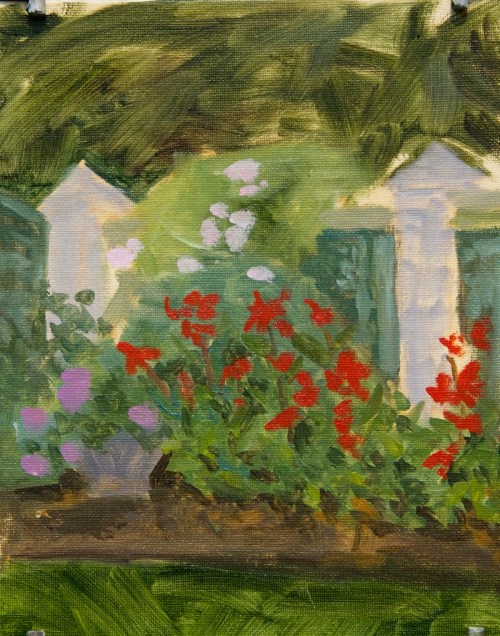
My finished first pass. I debated about when to put in the red cannas and opted to do it early on to keep the color as pure and saturated as possible and then paint the foliage around them.
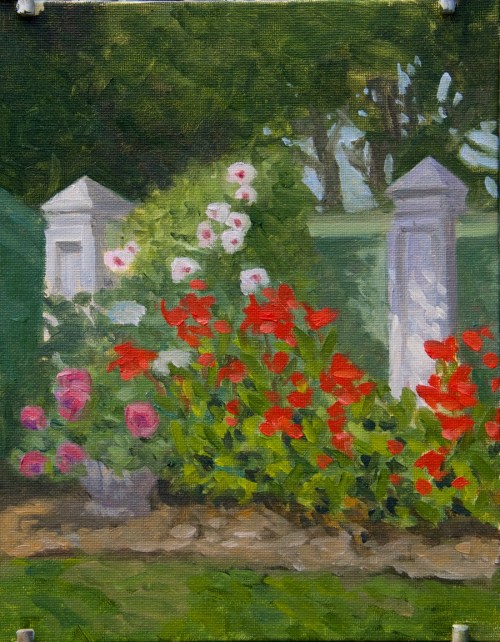
The finished piece, a 10×8″.
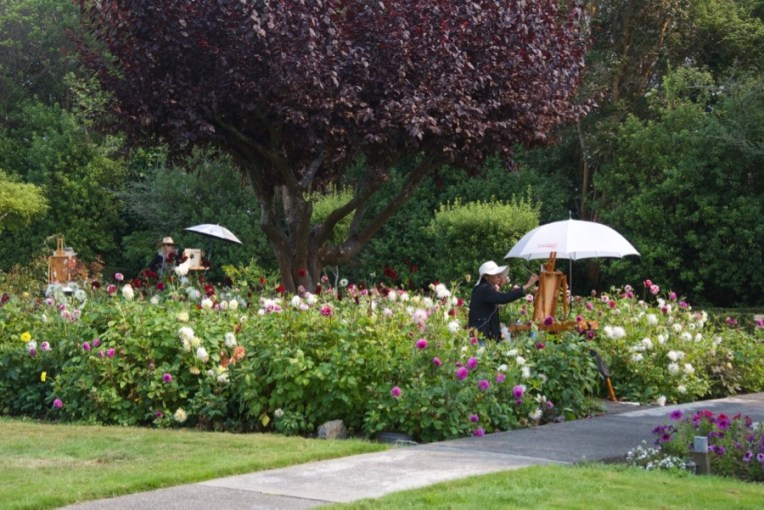
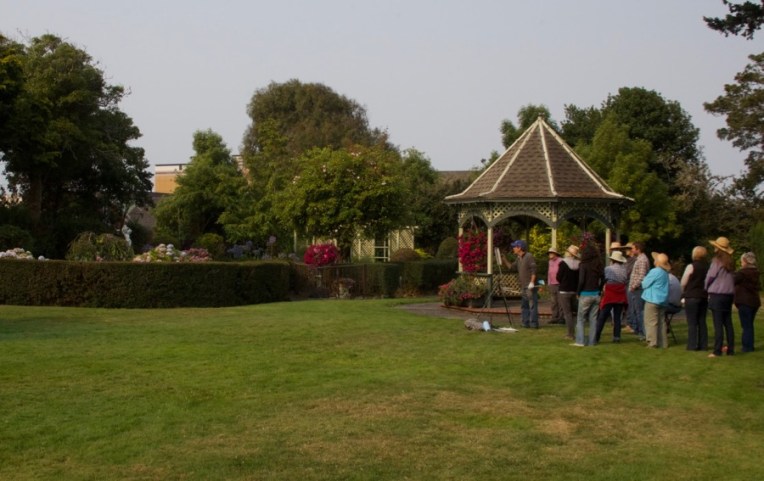
Some of the other participants in the beautiful garden.
Finally our painting time was over and we had a critique session. The man from the club was kind enough to offer beer and wine to any who were interested. Also, you can see from the warm light on the pavement the effect of the smoke from the Oregon wildfires.
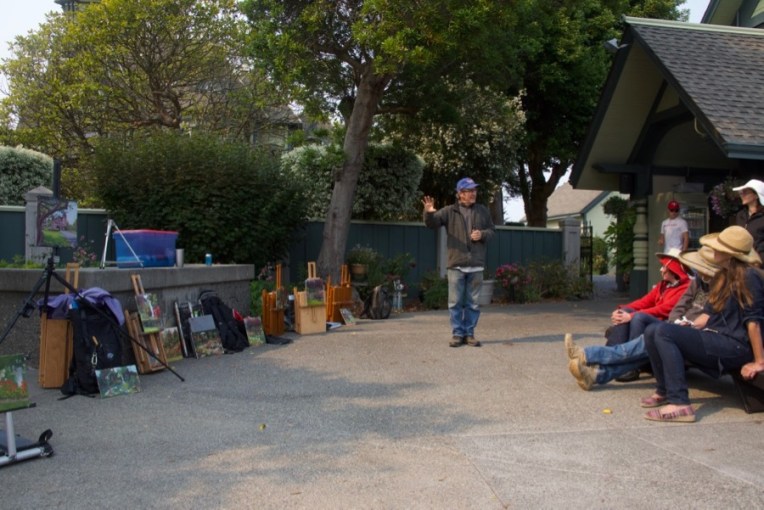
Jim was very positive about my painting, which I greatly appreciated. He pointed out two things that were spot on. One was that I’d added a lot of white to the earth tone I used for the dirt and that had given it a chalky look. Also that the grass was too dark in value for the light and sun that were on it, also quite correct.
So this morning I put the painting back on the easel in my studio and made those corrections, plus a few other little things that bugged me.
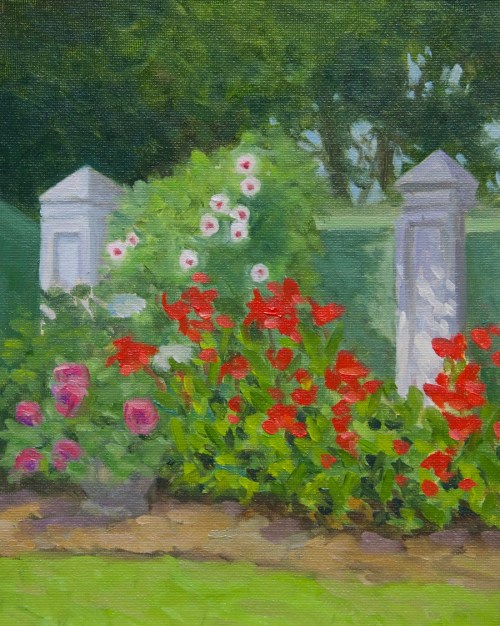
Now the ground is in tune with the rest of the piece.
I want to thank Claudia Lima, who put together the workshop and did a great job! And, of course, Jim McVicker. Thanks, Jim!
When I was working towards a degree in illustration at what was then the Academy of Art Collegs in the late 1980s, the question came up in one class about how far to go trying to make a piece work and, if it’s not, should one start over. The advice the teacher gave us and that I have followed until last year was that past a certain point, well, there was no point. Time to move on to the next piece and not repeat oneself. Made sense to me. Don’t beat the proverbial dead horse.
Fast forward to March of 2016 when I spent two wonderful days visiting and painting with superb landscape painter and friend James Coe at his home near the Hudson River Valley south of Albany, New York. We spent a few hours in his studio talking shop. He pulled out one piece after another, both plein air and studio paintings. And started to talk about how this one or that one had sat for months or years until he figured out what was needed and fixed it. Or how he’d done a small piece of a scene and was planning on doing it again larger. Some he’d painted four or five times from his plein air study. I’d never heard of such a thing! Gobsmacked I was.
Like anyone who has been at the painting game for awhile I have a lot of paintings that I either got stuck on and never finished or didn’t feel were good enough to show anyone except the cat. But now….now! Somehow Jim had given me “permission” to go back to those old pieces and see what I could do with them and it would not be wasting my time or mistreating the horse, which was now alive and well.
So there’s that. The other thing that has happened is that after toying with the idea for close to three years now, I decided to see how I could integrate my love of pure design, lettering and historic decoration back into my work with my Mongolia subjects. After painting a dozen new pieces for “Wildlife Art: Field to Studio” last year I felt that for the time being I’d had said all I had to say about depicting an animal or animals in a traditionally realistic landscape and it was time to move in what I call to myself my “new direction”. I did a couple of small pieces last fall as tryouts and have a number of larger ones under way, all new. But I’ve also gone back to paintings that just never seemed to work for one reason or another and gave them another look.
I’d also created albums in Photos for images I’ve shot that suggest possibilities for interesting designs and also some for a variety of elements, both natural ones like landscapes with warm, cool or warm and cool colors and human-made like ger or monastery decorative painting. And I found a Mongolian calligrapher who was willing to write words for me and email them as large jpgs, so I can integrate the vertical script, bichig, into my work.
What I’m finding is that adding the decorative elements is not just fun, but makes these old ones visually more interesting so they now work. I’ll be showing more of my “salvage” efforts in the future. In the meantime here’s the painting above as I originally did it in 2012, without the decorative border. I also repainted the horses, tweaking the drawing of them, and generally punching up the color.


As the great old Rolling Stones song says “You can’t always get what you want but sometimes you get what you need.” In this case, what I wanted was to leave for seven weeks in Mongolia on Monday. What I got is having to cancel the trip due to having fallen last month and sustained a concussion. The decision came this past Monday when I woke up with a recurrence of mild symptoms, plus still feeling tired and a bit out of sorts. Mongolia, and the travel required to get there, is challenging when I’m at 100% and I am definitely not. Any problems en route or out in the deep countryside or even in UB could have been serious, possibly requiring an emergency air evacuation to a country with western-standard medical care. It is not a place to test “What can possibly go wrong?”. And I was struggling and not quite getting there with mentally gearing up for packing and the attention and focus that requires. So I did the adult, responsible thing *sigh* and cancelled.

The “need” part comes in with the fact that this will my first full summer at home since 2007. And, after three exhibitions in four years and, in retrospect, a little too much travel, I find that a break with a long stretch of unstructured time and no non-discretionary deadlines (there are juried competitions I want to enter) to be very desirable. Lemonade.
So, what will I do now with all this “free” time? Well, I’ll miss having gone on my 12th trip to what has become my second home, that’s for sure. The prospect of not seeing friends, well-loved places, new places, being with the Mongols and painting and sketching on location there is kinda hard.

OTOH, I have time now to let it rip in the studio, trying out new media and ways of working, experimenting with my painting, drawing and painting “on location” in my own garden. Having time to paint with my friends in the Sunday Paintout group. Sketching at our local zoo. Taking day trips to the beach or river with my husband and our two collies. Doing training with one year old Peregrin that he needs and deserves that was going to be delayed until I got back. Spending lots of time in the garden and my propogation projects (probably will do a plant sale this fall). Getting to go to a family reunion in August on the Oregon Coast that I was going to miss. Working on marketing/career stuff that’s been beckoning for quite awhile now. Sitting on the patio in the afternoon sun with a beer in a pleasantly vegetative state. But also, retrospectively, recharging from the past four years. And, of course, planning my 2018 trip to the Land of Blue Skies…

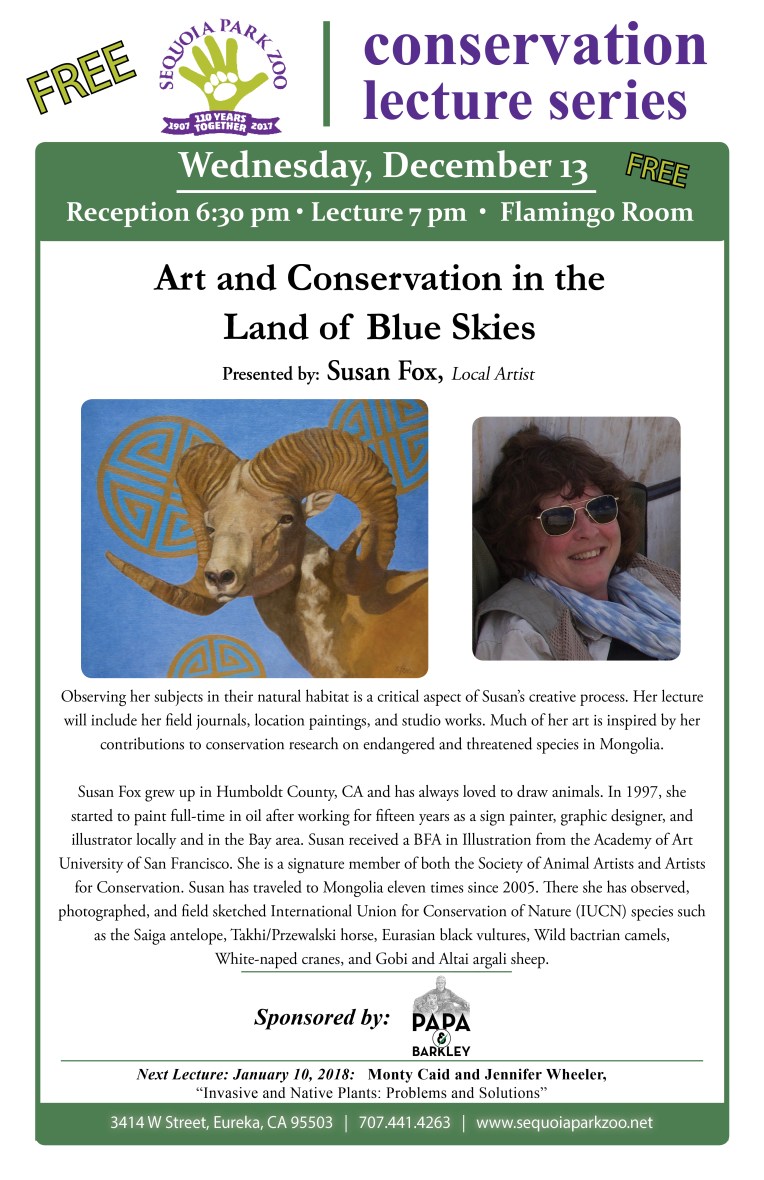
But, wait! There’s news! In either December or January (I’ll announce the date when I have it), I have been invited by the Sequoia Park Zoo Conservation Advisory Committee to be one of the speakers for their Conservation Lecture Series. The title of my talk will be “Art and Conservation in the Land of Blue Skies”.
In an interview with Wildlife Art Magazine many years ago, artist Ray Harris Ching noted that a poorly drawn bald eagle will sell better than a beautifully rendered snake. That statement is a very good example of a phenomenon with which I have long been keenly fascinated; I call it “The Primacy of Subject.” Representational art, art which portrays a recognizable subject matter (not to be confused with “realism,” which is only one type of representational art), is easier for most people to connect with than the purely abstract because, quite plainly, there is something in that artwork that the viewer can instantly recognize and relate to. Certainly, when we view abstract art, we can connect immediately with the color palette, the expressiveness of the brushwork, or shapes and quality of line, but none of these things impact us as quickly, decisively, or viscerally, as a thingwe can readily identify as belonging concretely to our own world and our own experience. Of course, how the viewer relates to the image depends largely on what the subject matter is, and therein lies the rub.
For those of us who paint wildlife, what animals one chooses to paint can dramatically impact one’s sales, as Ching’s comment suggests. We artists all like to think our decisions are never influenced by anything so crass as making a living, but in a world governed by practical realities, it’s a hard reality to ignore. My own interest in wildlife art began in my early teenage years as a vehicle for exploring exotic and lesser known creatures I read about in magazines and ogled in nature documentaries. That interest that has never left me, but as I progressed into the professional art world it was no longer appropriate to count National Wildlifeand Ranger Rick magazines as my source material, and I found myself focusing more on local flora and fauna that I could observe, sketch, and photograph myself. My first several solo shows back in my Pacific Wildlife Galleries days (the gallery where my career began) included many unusual subjects along with the more familiar ones, and a surprising number of those pieces did sell. My feeling then, as now, was that an artist’s enthusiasm for his subject shines through in the work, and that ring of truth attracts admirers (and buyers). As Hemmingway once wrote, “The truth has a certain ring to it,” and that truth, in the case of painting, must always come from an honest and enthusiastic commitment to the work, and not the kind of “punch-card” drudgery that comes from painting a wolf because “wolves sell.” I recall one time when my a very reliable collector purchased a painting of a Victoria-Crowned Pigeon, a very weird and flamboyant bird I had encountered in a friend’s aviary. The collector confided in me that she and her husband had, upon looking at the catalogue for the show, ruled that piece out from their list of potential purchases because it was such an odd bird. Upon seeing the show in person, however, they were shocked to be taken by that piece more than any other, and they bought it on the spot. I had won them over, not by catering to their interest in exotic pigeons (there was none), but by impressing them with my obvious infatuation with an exotic pigeon. Whatever it was about that painting that made it uniquely mine, it was strong enough to override The Primacy of Subject. My friend Tony Hochstetler, who creates incredible bronze sculptures of insects, reptiles, and other less commonly explored animals, says that his favorite compliment to hear is “I hate that animal, but I love how you’ve portrayed it,” and I understand why. What better endorsement can an artist receive than to know that it is his vision that is being purchased, not his choice of subject matter?
Within my own collection, there are some unusual pieces that I bought for no other reason than that I love the way the painting or sculpture was made, excluding all else. Still, as I survey what my partner Guy calls our “big collection of little art” it occurs to me that the vast majority of pieces feature subject matter that speak particularly to our own loves and interests. I had long admired the equine sculpture of Stephanie Revennaugh, but not being especially interested in horses, I never bought one of her pieces until she did an exquisite little sculpture of a whippet, the same breed as one of our beloved dogs, Enzi. Guy and I love the landscape paintings of David Grossmann, but never made a purchase until he hung a series of small paintings of the Sonoran Desert, a place to which we feel a great spiritual connection. For years I wanted to own a painting by my friend Barbara Banthien, but it was her portrayal of a Vulturine Guinea Fowl, one of my very favorite birds, that cinched the deal. Of course, none of these pieces would have made it into our very discerning collection simply because of the subject matter; they are also exceptional works of art on multiple levels. Still, it amazes me, being as aware as I am of The Primacy of Subject, and being as aware as I am that it is not always a force for good art-buying, that my own collection so obviously exhibits this bias. However anecdotal, it is proof positive to me that The Primacy of Subject is something innate and inescapable.
What concerns me is that less discriminating collectors make choices all the time based almost exclusively on the Primacy of Subject. I never want to be an elitist, but I have watched the art market closely enough and for long enough to know whereof I speak. Certainly many a thoughtful and educated collector has bought a piece of art that I wouldn’t simply because it is to their tastes and not mine. I’m not talking about differences in preference. I’m talking instead about the deep and visceral power that subject matter exerts over the viewer, oftentimes to the exclusion of all else. Every time I visit Jackson Hole, Wyoming, home to the National Museum of Wildlife Art (which houses four of my artworks) and something of a mecca for wildlife artists and wildlife art galleries, I am assaulted by an endless parade of gobsmackingly awful portrayals of elk, moose, bears, and bison. There are, to be fair, some amazing artworks featuring sensitive and original interpretations of these subjects (mine among them, I like to think) but the sheer numbers of mediocre to outright terrible forays into banality, and the accompanying “sold” stickers, drive home just how much more difference it makes what you draw, paint, or sculpt than how you draw, paint, or sculpt it. Elk, moose, bears, and bison are popular subjects, and there is no doubt in my mind that a good portion of the artwork featuring these subjects is not the result of great artistic inspiration, but rather what Robert Bateman has called (and admonished against) “painting to the market.”
Anyone who has painted wildlife for as long as I have knows that there are certain subjects that are statistically more relatable across the board. Wolves are certainly one of them. But there is also a distinct regional element to The Primacy of Subject. While bears, bison, and elk, are popular subjects across the whole of wildlife art, they are especially popular in Western markets like Jackson Hole where these animals are common visitors, and thus foremost in the personal experience of art buyers who either live in that area or visit there frequently. Friend and fellow artist Stephen Jesic lives in Australia, so naturally his work focuses on the colorful parrots and songbirds that are familiar backyard visitors in those parts, as well as charismatic endemics like Koalas, which are iconic emblems of his country. This hardly means that Australian animals won’t sell outside Australia, or that Western Wildlife won’t sell when exhibited in an East Coast gallery, but it is important to recognize that, for instance, an African Elephant is more likely to sell to someone who has traveled to Africa and loves elephants, which means that an African Elephant exhibited in Jackson Hole, WY, is probably statistically less likely to sell than the moose hanging next to it, regardless of which one is a better painting.
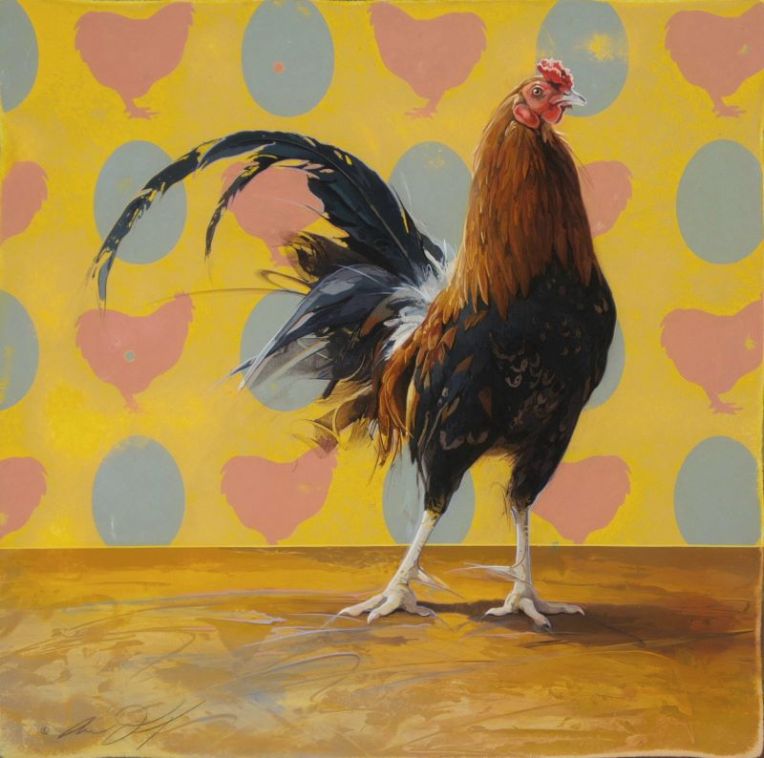
When I was painting for Contemporary Wildlife: Modern Masters at Astoria Fine Art a couple of years back, I made a very calculated decision. I had some concepts and approaches in mind that I knew would make this body of work my most modern and cutting edge to date, and I was adamant that I not blunt or soften that modernity in any way. The question was whether or not these stylistic choices might make the work harder to sell. Rather than letting those concerns soften my resolve, I simply decided to focus on the most familiar, popular, and recognizable subjects for which I had good reference material available, namely owl, elk, chickens, bison, cougars, and so on. I only selected animals I was genuinely excited about painting, but there were certainly some more questionable choices that I could have pursued but instead edited out to focus on what I deemed to be more likely saleable. Fortunately it paid off; not only was I enormously pleased with that body of work on an artistic level, but I sold every piece. It would seem that either viewers bought these very modern pieces because the subjects won them over, or they bought them because they loved how I chose to portray the subjects, regardless of what they were. I’ll never know which. What I do know is that by acknowledging The Primacy of Subject, I at least felt like I was sidestepping a visible and easily avoidable pitfall.
It is both the curse and blessing of the artist that he has more artworks in his head than he will ever be able to bring into being during his lifetime. We cannot afford to waste our time with paintings we don’t truly want to paint. Nor can we starve if the work we produce does not connect with collectors. Nor can we ever truly predict what will sell regardless of what we paint or how; that is certainly something my more than sixteen years of experience as a full-time painter has driven home. I would never recommend to any artist that he or she not take on a project simply because she is afraid that the painting might not sell. In fact, it is those occasions when I feel truly nervous about a painting that I force myself to take a gulp and dive in, because that is how an artist grows. Moreover, it is far better to put in the necessary effort to find the market for what you love to do than to shoe-horn yourself into a market that is a poor fit. Still, if I have ten potential paintings in mind for a show, and five of them are subjects I think are more likely to relate to my audience, guess which paintings I’m going to prioritize? The Primacy of Subject is something that all of us artists and art collectors would do well to acknowledge. Inspiration, whether to create a painting or to own one, is largely subconscious, deeply visceral, and always a pure reflection of one’s innermost desires and deeply imprinted memories. The feeling I get when the phrase “I have to paint that” comes into my head is almost identical to the feeling I get when “I have to buy that” asserts itself instead. We want what we want, both as creators and consumers. Certainly, as an art maker, I am indulging in my preferences every time I create a painting. The professional artist, however, as ultimately driven as he may be by the subconscious, hones his craft by becoming, through practice and hard work, as consciously aware as possible of the decisions he is making and why. With so many pitfalls before us, we art buyers can surely train ourselves to be just as aware. I often ask myself the question “Is this a good idea for a painting? Am I painting this eagle because it’s a good idea or because I like eagles?” We can all ask ourselves the same questions about why we buy what we buy, and in so doing make certain that when we buy a painting of an elk, it’s a damn good one.
 Susan Fox, American Artist