Sheltering in Place, Part 6

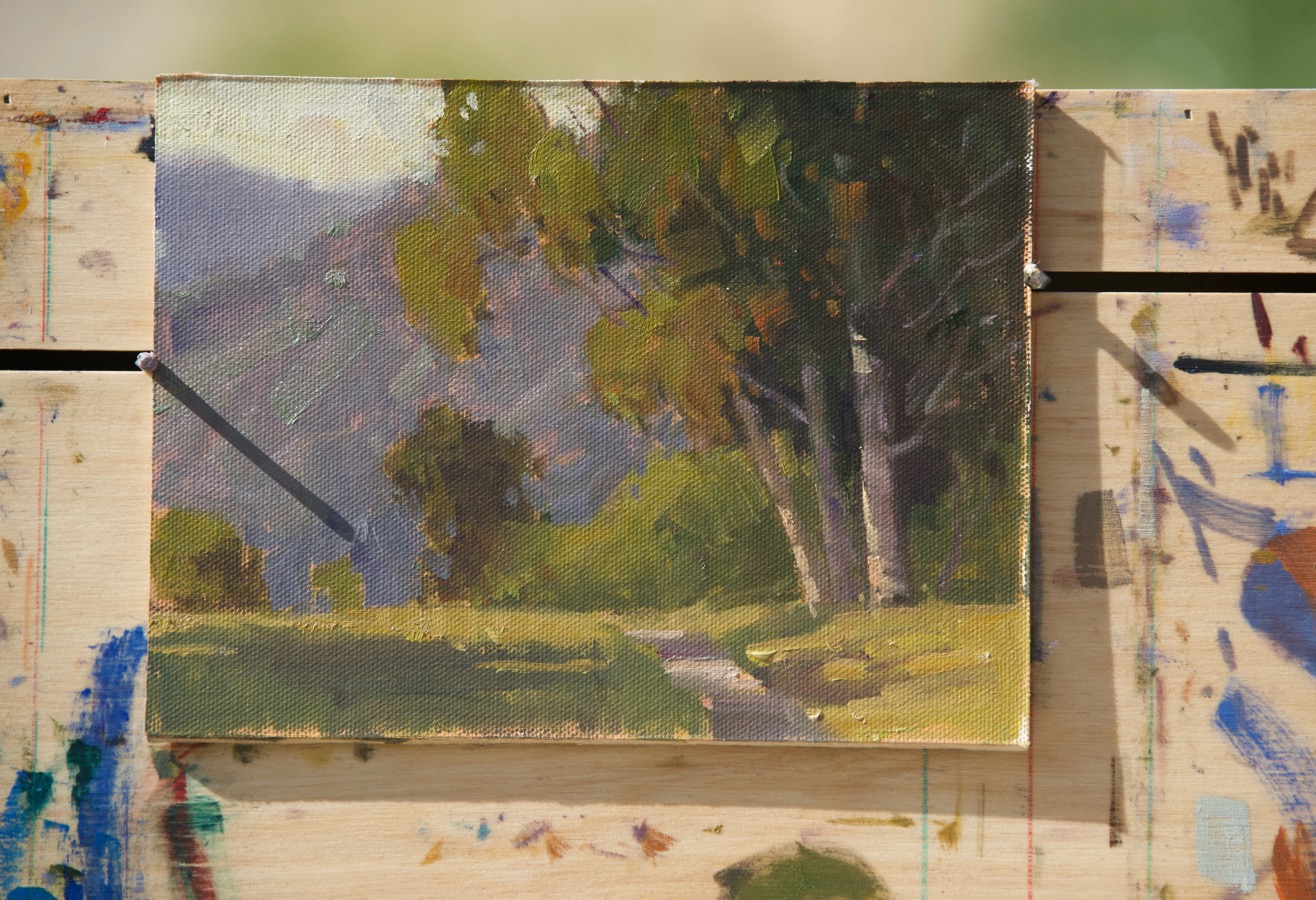
Prompt: “Green”- hope we see at least one this year

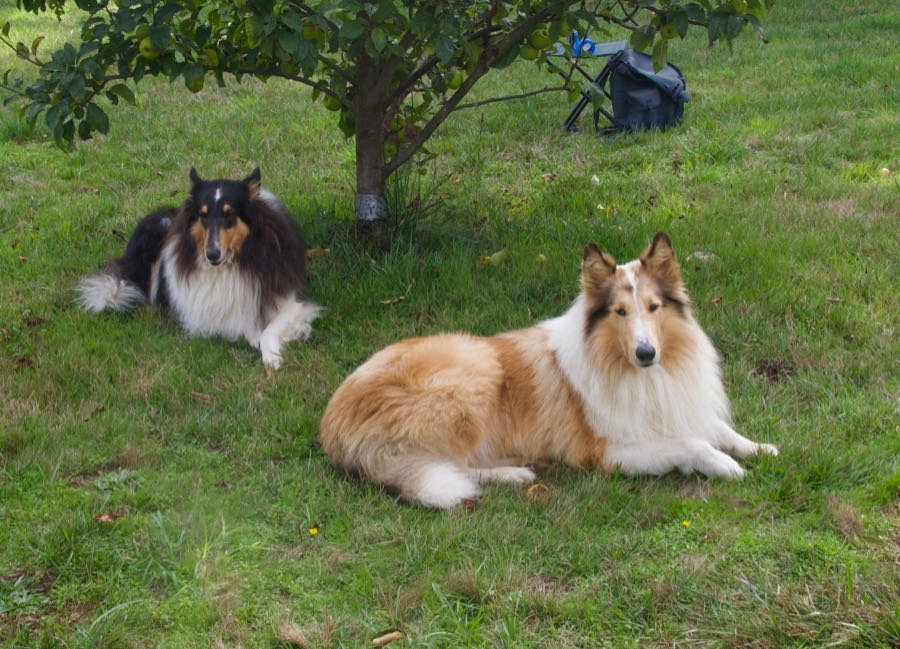
Sheltering in place continues with no drama other than Peregrin, one of our rough collies, getting skunked right in the face a few evenings ago, so his temporary nickname is Stinky. I got the deskunker on him right away but here’s still a whiff of it up if we get close.

Peregrin, age 3, aka Stinky Dog

This afternoon I’ll start making a few masks for us to wear when we go out. Did a lot of research and dug through my fabrics for tight-weave cottons. We’ve got coffee filters and some old vacuum cleaner bags for filtration. The local grocery stores seem to be doing their part to keep carts and conveyers sanitized. We’ve also got almost an entire box of disposable gloves that my husband bought for his airplane modeling. There will be a trip to the store tomorrow.

We had one last corker of a wintry storm come through over the past couple of days with good, heavy rain. Nippy this morning, but yesterday afternoon really felt like spring has sprung. Which means plenty of exercise in the garden coming up. Daffodils are almost done. Roses are leafing out nicely. Apple trees have flower buds on them. Tulips are in full bloom.

Here’s an update on the international online art event I’m participating in called Inktober52. The original event called for doing a pen and ink drawing a day for the month of….October. This time it’s one a week for the whole year. So far I’ve had no problem doing my weekly piece. My intention had been to post them in one month batches here on the blog, but that kinda got lost in all the pandemic news and prep. Things have settled down into a routine now, so in this post I’ll get caught up. You can see the first batch here. And I posted a few last time here. The one at the top is the latest, just done yesterday and posted on Instagram and elsewhere this morning. If you want to follow me on Instagram I’m here. There’s a board for them on Pinterest here.

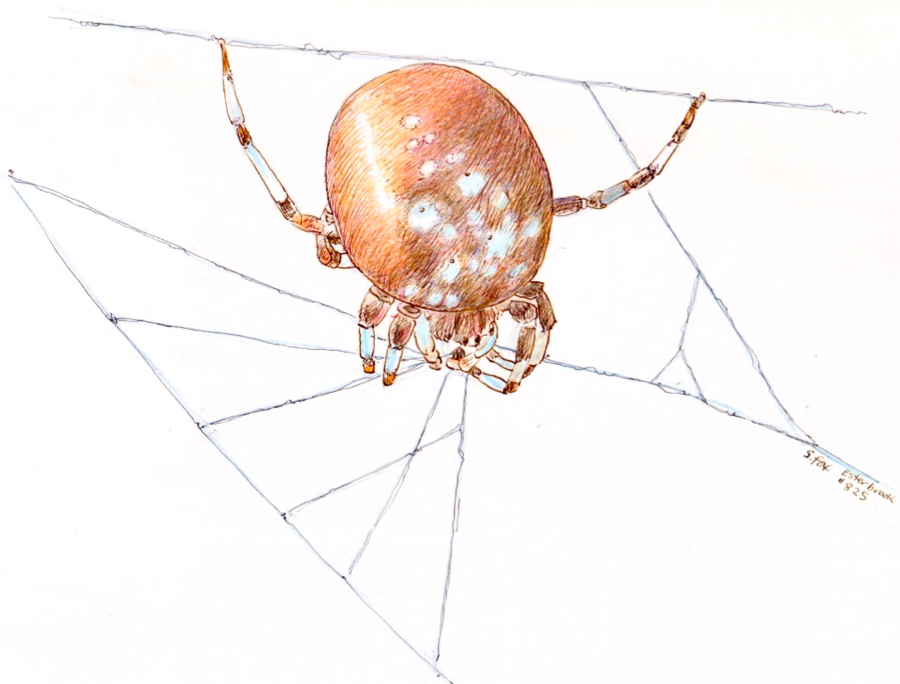
Prompt: Spider- a visitor to our backyard
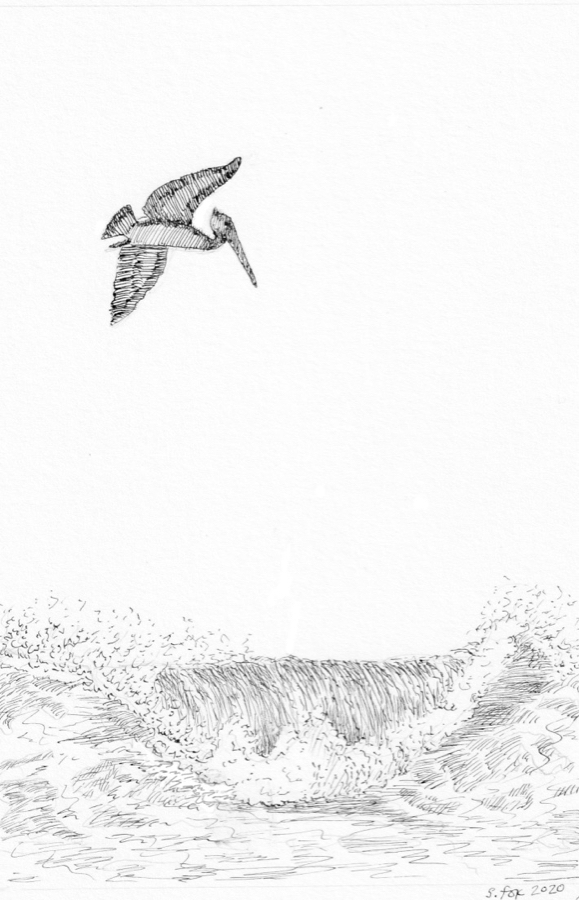
Prompt: “Wave” – reference from local beaches
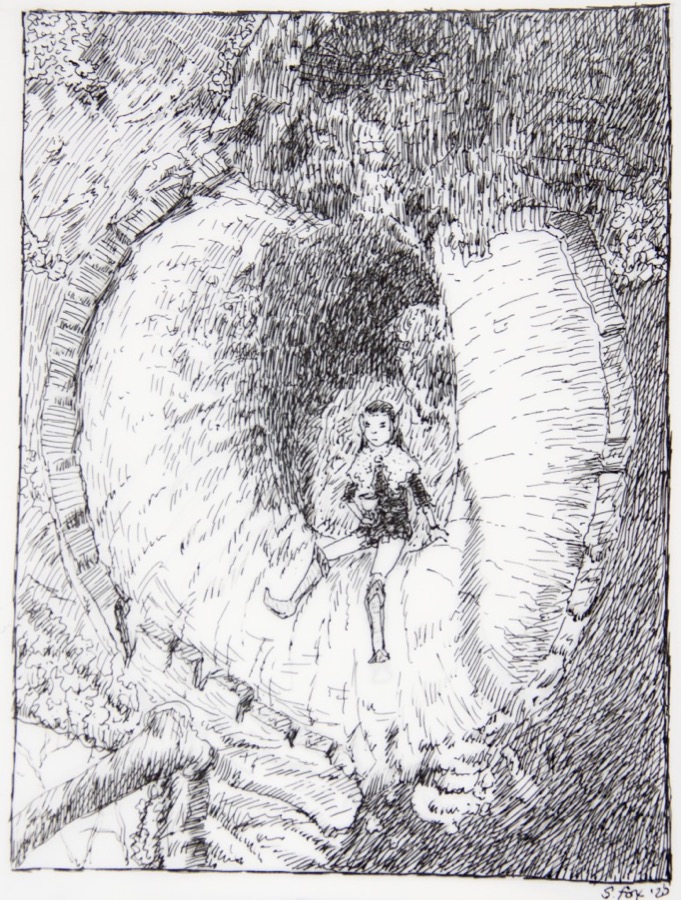
Prompt: “Elf”- the bole of a very old red alder tree on our property
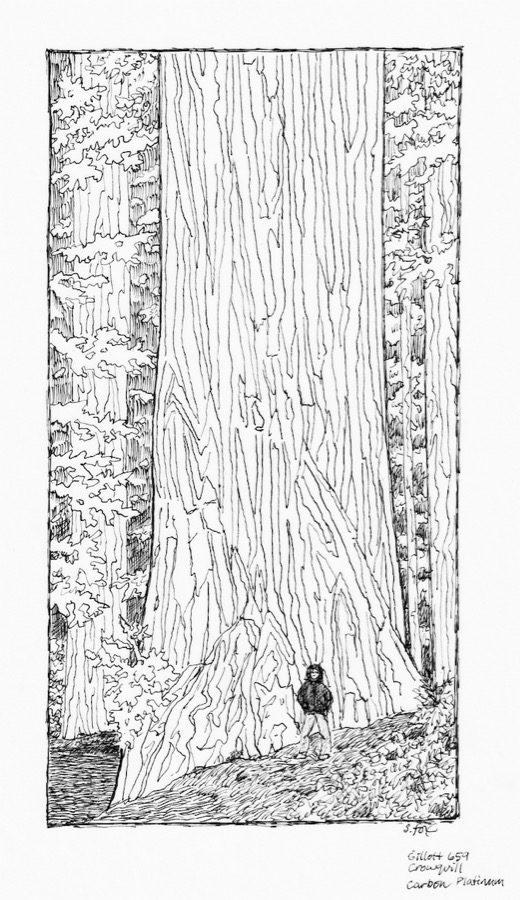
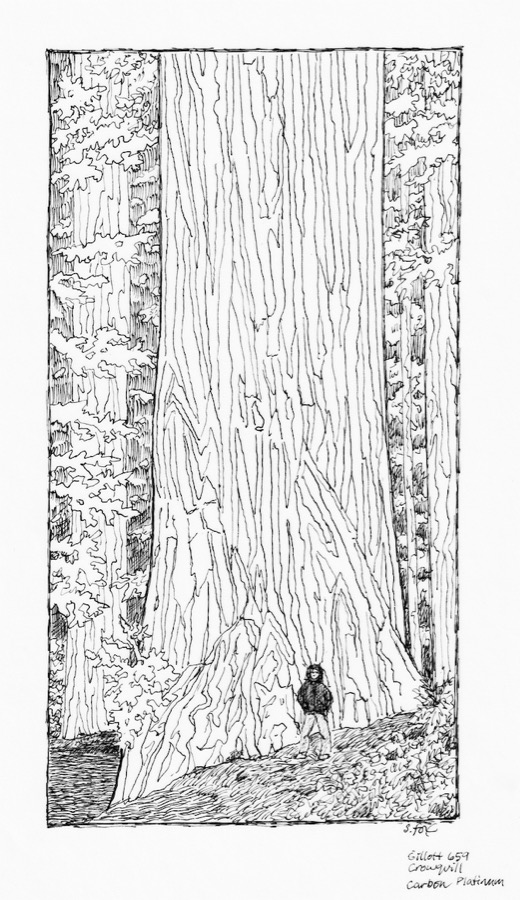
Prompt: “Tower”- me in front of a redwood tree in Prairie Creek State Park, just north of us
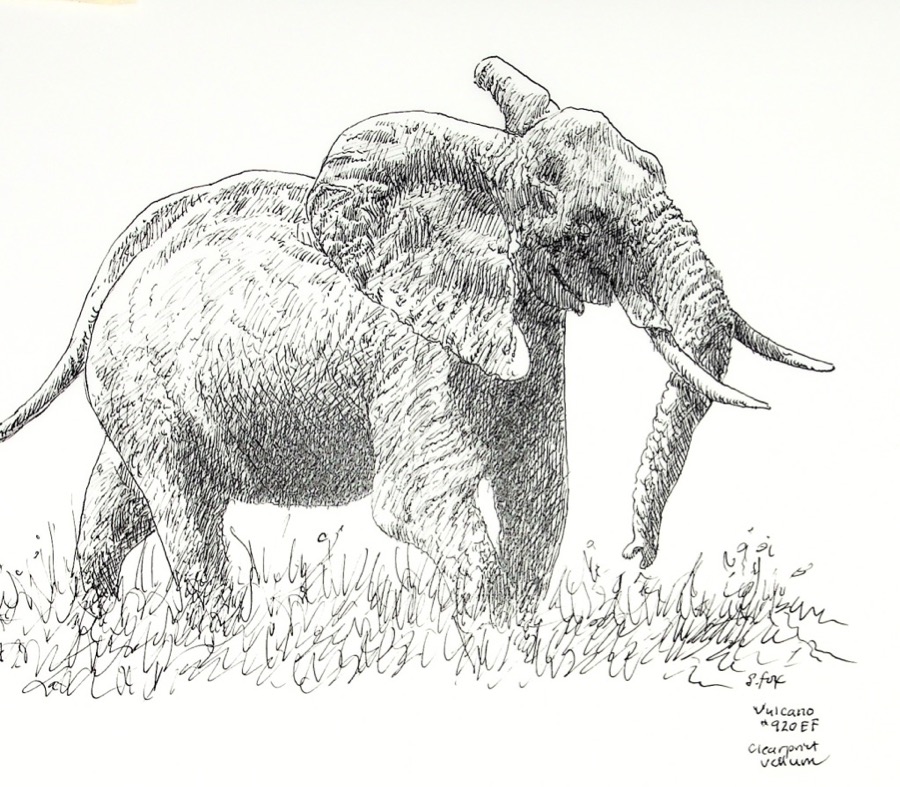
Prompt: “Elephant”- an elephant I saw in Kenya

Keeping A Record…

Yesterday, March 16, kind of feels like the first day of the rest of our lives. And, as is true for so many, we’re now sheltering in place due to the coronavirus. Fortunately, we’re in a northern California county that had one confirmed case back in January (a person who had just arrived back from an infected area of China) and none since then. But people here are preparing just the same since it’s almost sure to make another appearance.

Not sure why, but I’ve found that I want to record what it’s going to be like between now and when the “all clear” is sounded. I’ll be posting whenever I have something to say or show you. My husband and I are fortunate in that we are in good health and we work at home. He’s the Executive Director of a tech consortium with members in a variety of countries. Their April meeting has already been pushed back to June, now with the expectation that it will be pushed back again to fall at the earliest.

I’ve been an art professional of one kind or another (sign painter, graphic designer, illustrator, now fine art painter) for over forty years, so my art will be part of this record. I’m also an avid gardener and have an acre to play with. All our travel is cancelled so the garden will get my full attention, including the vegetable part of it. We also have six apple trees, three dozen blueberry bushes and a raspberry “patch”, so I’ll be posting photos through the year of all that. The blueberries are already flowering. We get between five and six gallon bags of berries from them every year.

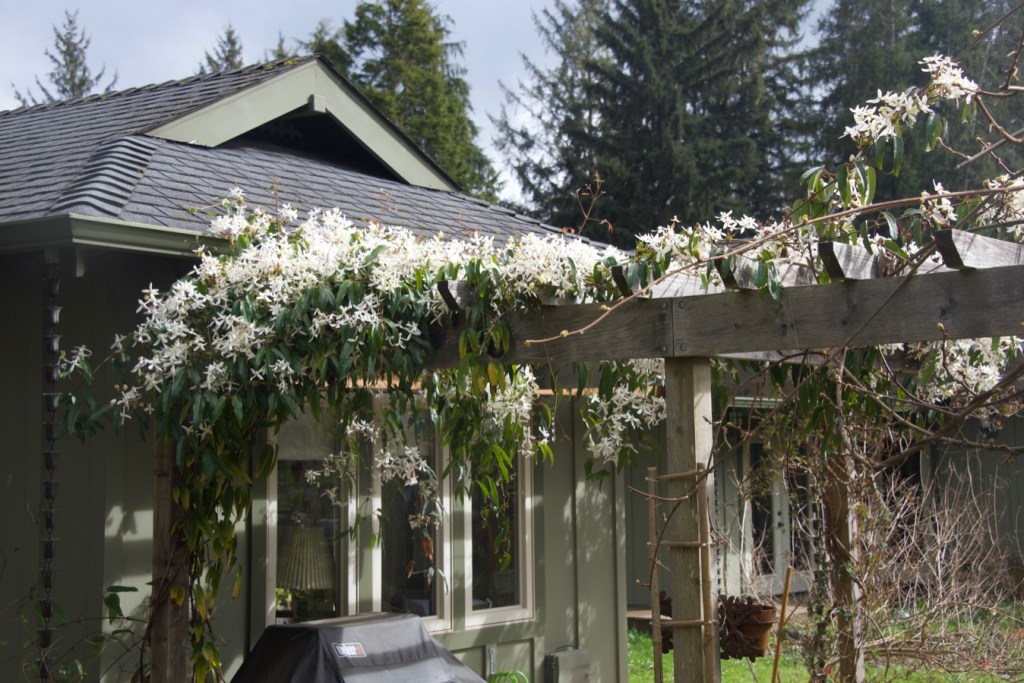
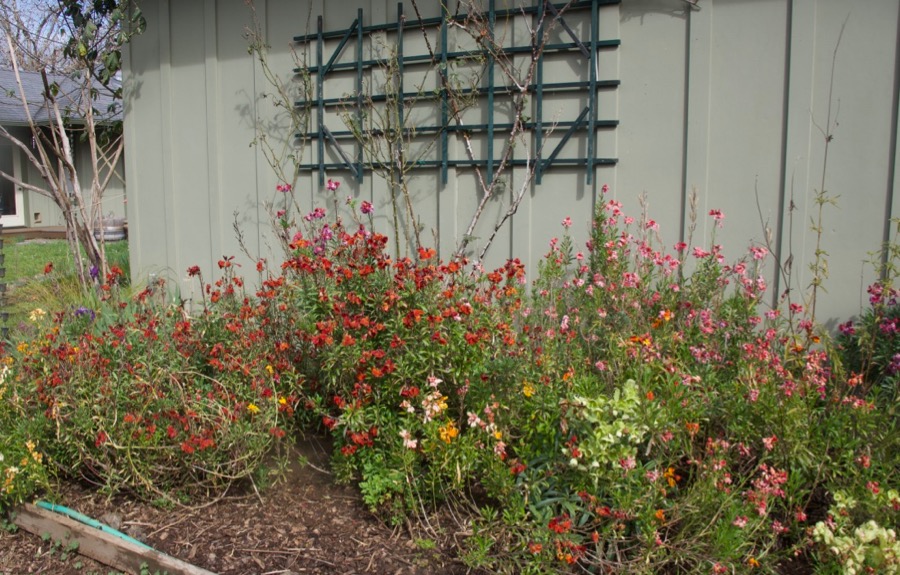
Right now the clematis armandii and wallflowers are blooming, along with crocus, grape hyacinth, daffodils and early tulips.

Clematis armandii in full bloom. The fragrance is wonderful!
English wallflowers I grew from seed
Daffodils in bloom

We share our home with two rough collies Hailey and Peregrin (“Lassie” dogs) and two cats, Michiko and Alexander A Really Great Cat.

Hailey, our seven year old tricolor and Peregrin, our 3.5 year old sable merle
Michiko in front and Alex in the back; dog toy box to the left

In other news, I’m participating in a fun art event this year called Inktober52. The original event, Inktober, calls on artists to create one black and white piece a day in the month of October. Inktober52, in its first year, is about creating one black and white piece a week for the entire year. I’m going to do my best to not miss a week and so far so good. All the finished art is posted first on Instagram here with the #inktober52 hashtag, including mine. I’m also posting to my Facebook public page here and on Pinterest here. Jake Parker, who invented and runs both events, sends out an email on Thursdays with the prompt for the next week, so everyone is doing the same subject, but in their own way. Hundreds of artists from all over the world are participating. So, sheltering in place or not, I’m able to connect with other artists.

Inktober52: Prompt: Tower

This is what I had to say about this week’s drawing: “After thrashing around I decided that I could use “tower” as a verb, but then what was towering over ? I tried a couple of different ideas and then “towering redwoods” came to mind. I grew up, and live in, Redwood Country so I dug out a photo I had of me standing in front of a huge coast redwood right by the road in Prairie Creek State Park. I started out intending to fully render the trunk, but had the thought of doing a “reverse”. Less time (a LOT less), maybe more visually interesting and different. I also create downloadable pdf coloring pages that I sell in my Etsy store and maybe this piece will end up there. I used a Gillott 659 crow quill nib (Joseph Pennell’s favorite), Platinum Carbon ink on Clearprint vellum⁣.”

Ikh Nart Sunset, Mongolia

Finally, for now, the 12×16″ oil painting above has been accepted into the Fusion Art Gallery online exhibition “Sunrises and Sunsets”! The location is one of my favorite places in Mongolia, Ikh Nartiin Chuluu Nature Reserve. I own my own ger with all the furnishings and have been allowed to set it up in the reserve and live there for a week or so and that’s when I get to see sights like this and take photos that I can turn into art.

New Pen and Ink Studies

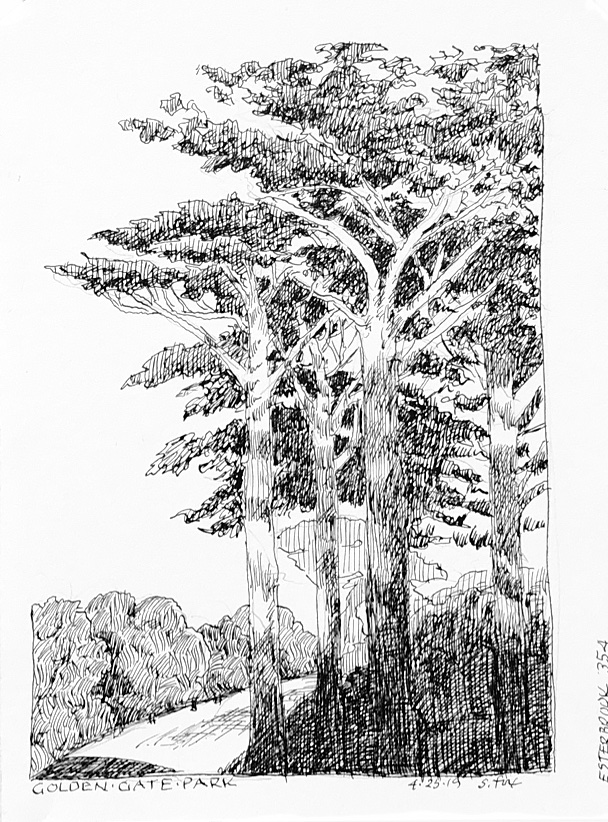
“Golden Gate Park” Esterbrook #354 nib on 6×4″ Strathmore 300 vellum bristol

I’ll have some paintings to show soon, but lately I’ve been mostly diving into dip pen and ink sketch studies, trying out various nibs I’ve been accumulating for the last year. I used dip pens for calligraphy and drawing back in the 1970s/1980s, but moved away from pen and ink for color illustration and then, for the last 20 years, oil painting.

Life moves on, changes are made and now I’m going to be painting somewhat less, but still entering a selection of good juried shows and doing subjects that I’ve wanted to get to for quite awhile. I’ve also realized that I don’t really enjoy painting on location. It’s always felt like, well, Work. But sketching? Never anything but a joy and a pleasure. So I’ll be doing my oil painting in the studio from now on and working on location in pen and ink, sometimes watercolor and maybe some other dry media like Berol color sticks.

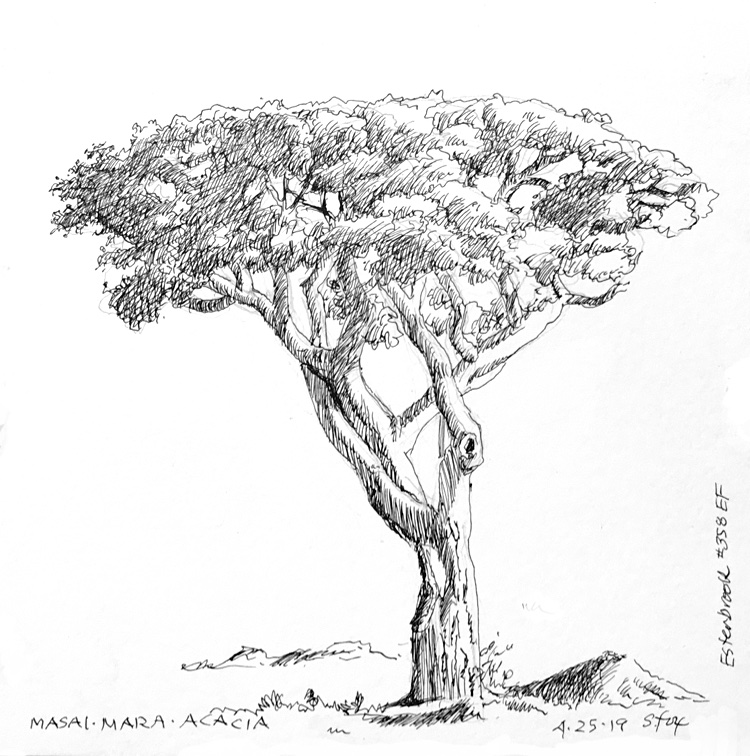
“Masai Mara Acacia” Esterbrook #358 EF on approx. 4×6″ Strathmore 300 vellum bristol

I’ve done these three landscape and tree studies in the last couple of days, trying out what are considered to be some of the finest nibs made specifically for artists.

I’ve also added handlettering back to the mix, something I’ve also did back in the last century. You can learn more about that and see three sketches that also use pen lettering over at my SketchWild site. Check it out and let me know what you think in the comments!

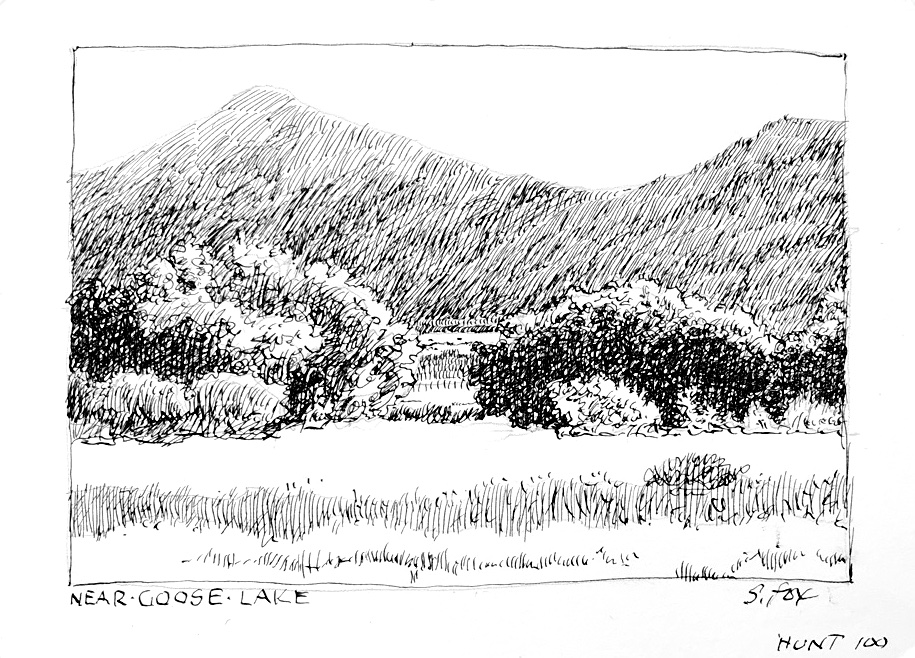
“Near Goose Lake” Hunt 100 nib on 4×6″ Strathmore 300 vellum bristol

Test Driving Dip Pen Nibs

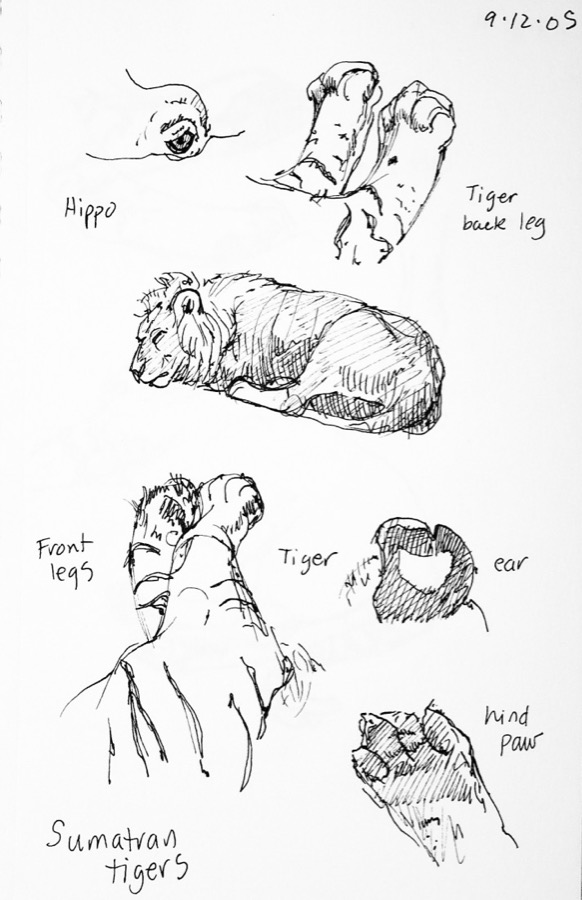
Once upon a time (back in the mid 1970s), when I first had professional art aspirations, my first media was pen and ink, heavily influenced by medieval illumination and Alphonse Mucha. I used them for many years when I was a freelance graphic designer. In the early 1990s, after getting a BFA Illustration from the Academy of Art (then) College, I was able to realize a childhood dream and spent two years in private study with a local artist learning to paint in oil. And since 1997, that’s what I’ve pursued professionally. But I never quite let go of pen and ink, using it for sketching on my travels. Everything from sketching animals…

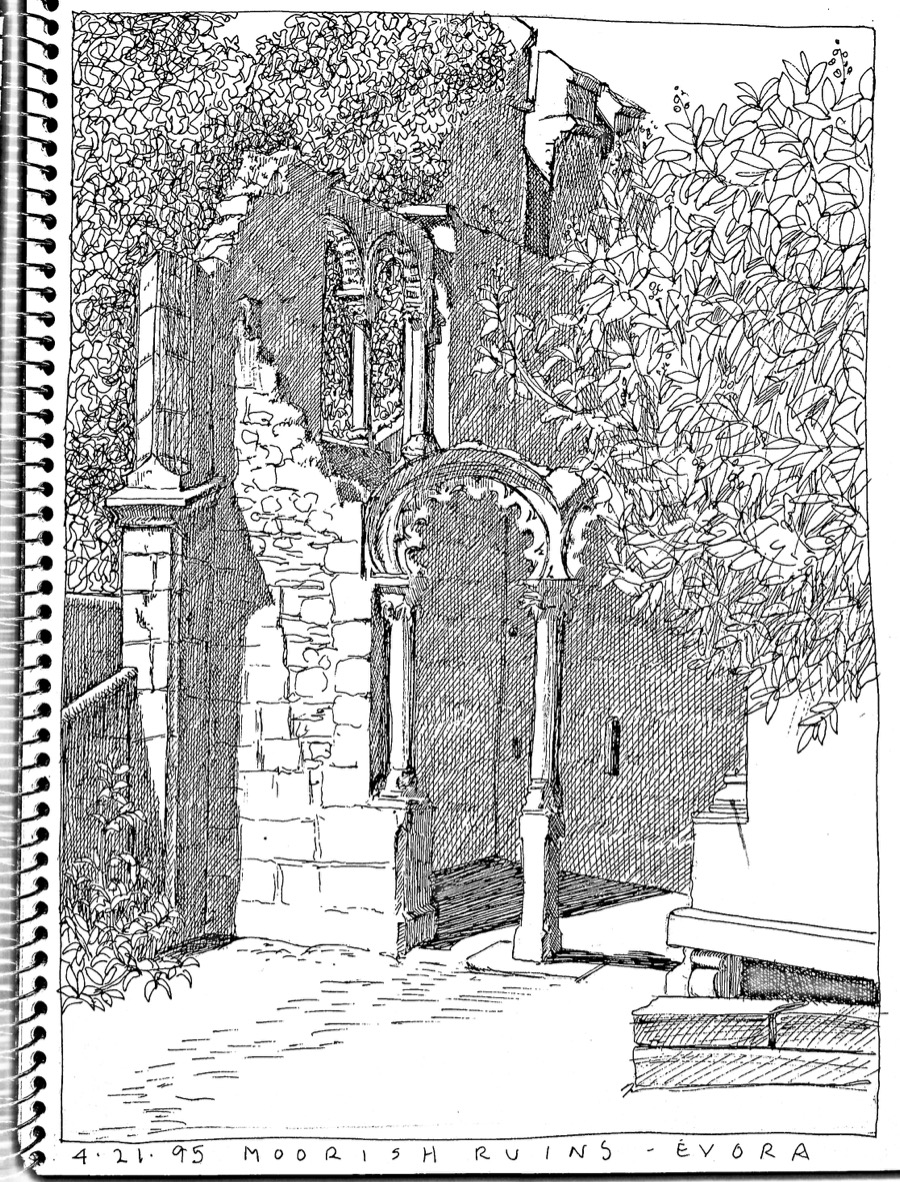
…to spending a morning drawing these ruins I saw in Evora, Portugal.

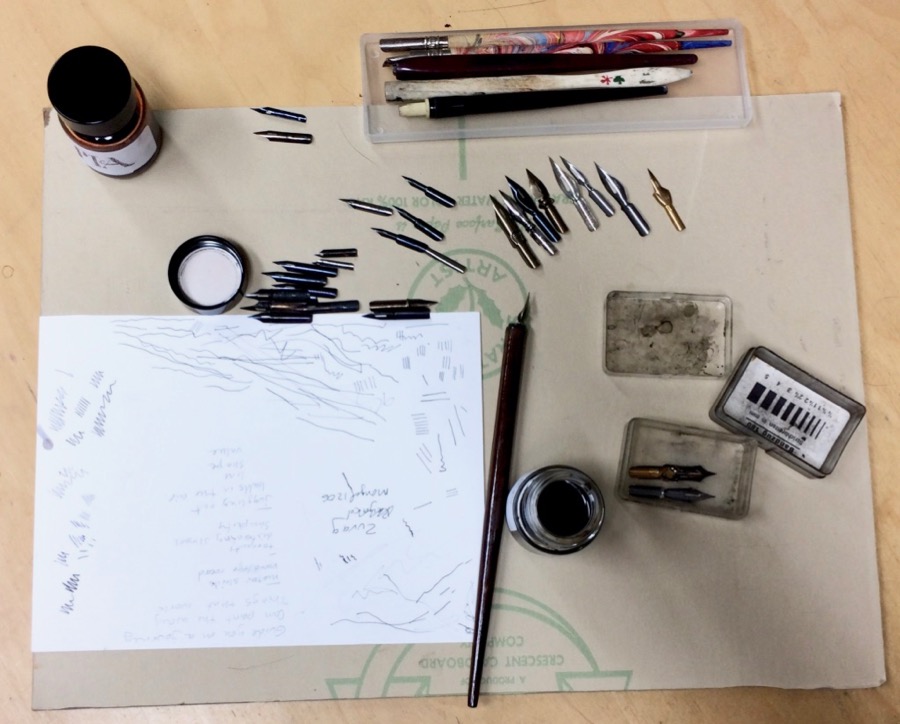
The revival of location sketching with the urban sketchers movement and more has inspired me to return to my roots. I’ve been using Sakura Micron pens for years for my Mongolia journals, both for writing and sketching, along with other trips, but had become increasingly irritated with them. They don’t seem to hold a consistent tip anymore, which means I can’t trust them. I did some research and finally settled on what now appears to the the high quality standard, Copic Multiliners, and bought a full set of them. But…dip pens still beckoned. They have a feel and make a line that can’t be created any other way. So for a year now I’ve been building a collection of nibs via Etsy and eBay and, using Jet Pens excellent reviews, buying a half dozen different bottles of ink, experimenting a bit between my painting work. But can I use them in the field without making an unholy mess? Well, late 19th and early 20th century artists like Joseph Pennell, Henry Pitz, Earnest Watson, Arthur Guptill and William Robinson Leigh did it. And that led me to the wonderful world of inkwells, including ones made specifically for traveling. I’ll be doing an inkwell post in the future, along with discussions of nibs, ink and paper. Once my SketchWild site launches I’ll be offering dip pen drawing instruction. If you think you’d be interested in that let me know in the comments.
Over the past month or so I’ve been “test driving” nibs while also trying out possible painting subjects. Of of yesterday, here’s what I’ve done:

I was treated to an EXTREMELY rare sighting of wild bactrian camels, a herd of sixteen or so, heading south in the Gobi in 2016. They crossed the road in front us and were a long way off, but my photos were good enough to do these little movement studies, freehand with no pencil underdrawing. I used a Hunt 100 Artist nib and Platinum Carbon ink on Strathmore 300 vellum bristol, a 12×9″ pad. All of the drawings in this post were done on that paper.
I was considering entering a juried show that required corvids as the subject. I ultimately decided not to enter but did have fun trying out possible subjects with my dip pens, once again directly with no pencil underdrawing. I’ve had fun getting nibs from a variety of countries including Italy, France and England. Even some from the era of the Soviet Union with a hammer and sickle on them, purchased through Etsy from someone who lives in Ukraine! And they’re a really nice nib!
The subject here is takhi/Przewalski’s horse, all photographed in Mongolia. This sheet really shows how different the various nibs are. Hunt 100 Artist/Platinum Carbon ink; Gillott #290/Platinum Carbom ink; Gillott #170/Platinum Carbon ink; Gillott #303 EF/Noodler’s Black ink; Gillott #404/ Perle Noir ink; Esterbrook 356 Art & Drafting/Diamonte Jet Black ink


Contining on: All done with Higgins Fountain Pen India Ink. Hunt #102 crowquill; Hunt #108 crowquill; Gillott #659 crowquill; Esterbrook #48 Falcon; Hunt #100 Artist (new); Gillott #293 Public Pen; Hunt #103 Mapping; Hunt #100 Artist (new); Hunt #100 (vintage)

Over the last couple of days I’ve done a series of small drawings on the Strathmore 300 vellum bristol. This time, unlike the ones above, I did do a light preliminary pencil sketch. They took maybe an hour and change at most. The purpose was to explore how each nib feels when used for an actual drawing. All of them have things I like about them but I found I really did like the Gillott #303 Extra Fine quite a lot.

Race horse-Hunt #100 (new)
Domestic bactrian camel-Gillott #303 Extra Fine
Domestic Mongol horse-Gillott #170

On the ones above I added the background shape both to pop out the white of the light sides of the animals and to see how filling in an area would work with that particular nib. All were ok, but want to experiment more.

Siberian ibex-Gillott #29
Pika-Hunt #102 crowquill; not thrilled with how the fur came out but that’s why it’s good to experiment

And the Copic pens? Love, love, love them. I’ve joined artist Cathy Johnson’s “Sketch With Me!” Facebook group. She does virtual events one weekend a month. This is what I posted in October, an arrangement of squash from our garden. Copic pen and watercolor in a Stillman and Birn Zeta series wirebound sketchbook.

I’m Now On RedBubble!

C is for Create- 900
My RedBubble shop is open just in time for the holidays!
Fifteen images of my work, including paintings, illustration and pen and ink drawings, are available on a variety of products…prints, cards, journals, pillows, clothing, scarves, phone and tablet cases and much more. So if you or someone you’re shopping for is out of wall space, but love art, you may find the perfect gift on RedBubble.
Come check my offerings here!
(The image “C is for Create” dates back to when I was a freelance illustrator)
 

Watercolors From My Latest Trip To Mongolia, Part 2. And Horses!

Ikh Nart 1

I go to Ikh Nartiin Chuluu (Ikh Nart, for short) Nature Reserve on every trip to Mongolia. It’s where I went on my very first one in April of 2005 to participate in an Earthwatch Institute-sponsored expedition to assist in research that has been carried out there since the mid-1990s. For the two weeks the team of ten of us were there it never got above 32F/0C (not exactly spring weather on the north coast of California where I live), with almost constant wind. Loved every day of it. As of 2016 I bought my own ger with furnishings and have been given permission by the reserve director, who was one of the argali sheep researchers on the Earthwatch project, to set it up in the reserve. So I’ve known him for a long time and am very grateful for being able to “live” in this very special place for a week or more a year. When I’m not there he has the use of the ger for the reserve’s guests.

This year I was allowed to set up at the research camp, which was very convenient since it’s one of the best places to see wildlife. The caretaker, Ulzii, and I have also known each other since that first trip, so I had a trusted back-up just in case I needed it. Which was good because Ikh Nart had gotten no rain to speak of when I got there and then had three corking good storms come through in five days. I got to watch the land go from brown and parched to green with flowers blooming. I also watched the dry streambed turn into quite a “raging” torrent for an hour or so. Many photos and video, so that will be the topic of a future post and a YouTube video.

I did my usual tramping about wildlife watching, also sketching and painting. I still need to scan my journal, which I do a lot of drawing in, but here are my watercolors.

Ikh Nart 2
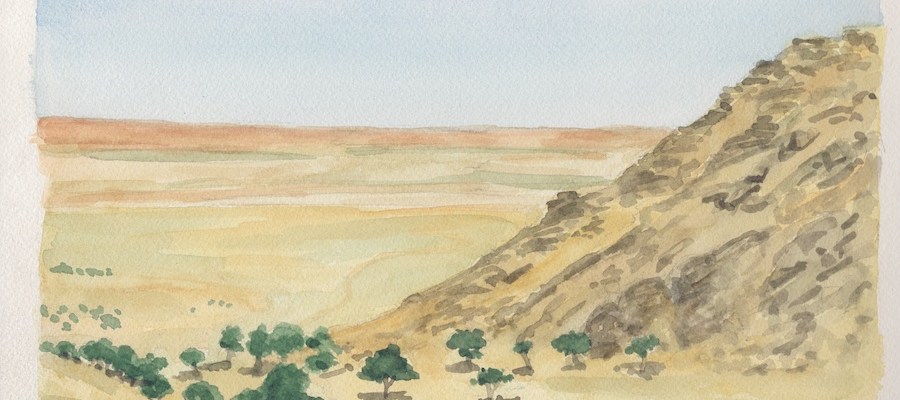
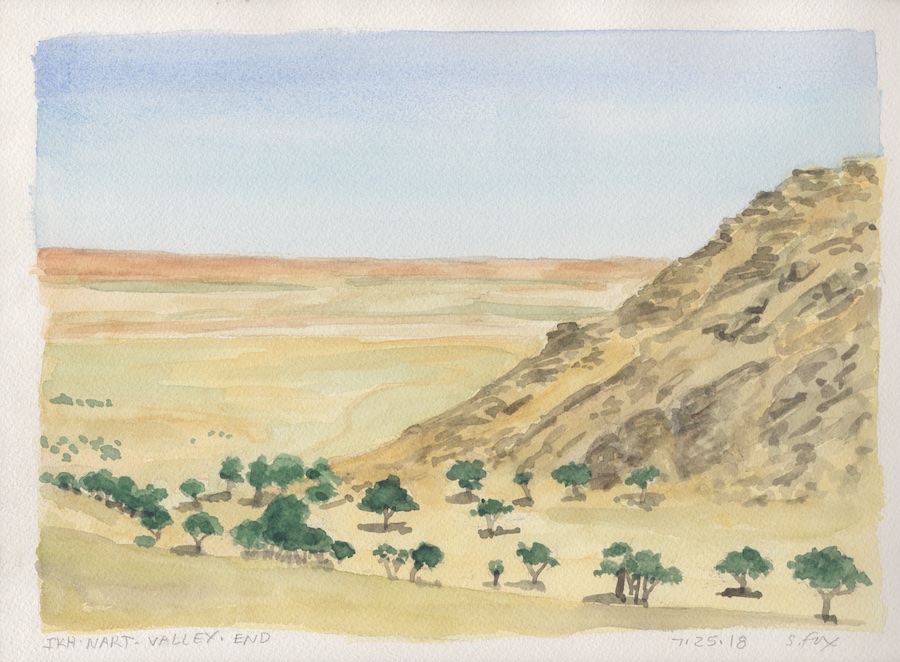
The research camp valley’s west end where it opens out onto the steppe. I’ve always loved this view. Watercolor 9×12″ on Arches 140lb.cold press block

Ikh nart 7
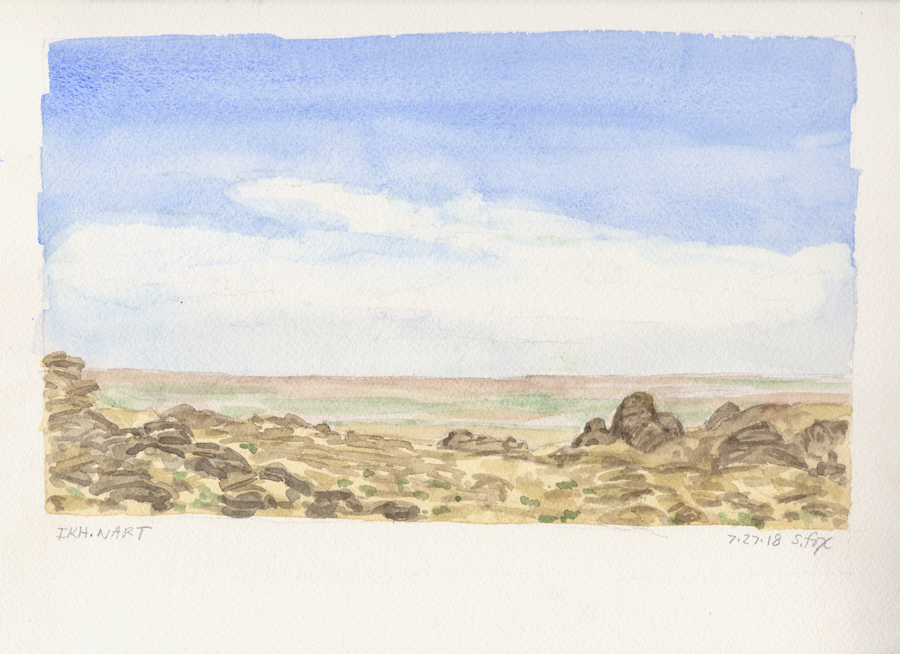
Ikh Nart view west to the steppes. Watercolor 9×12″ 140lb. Arches cold press block

Ikh Nart 5
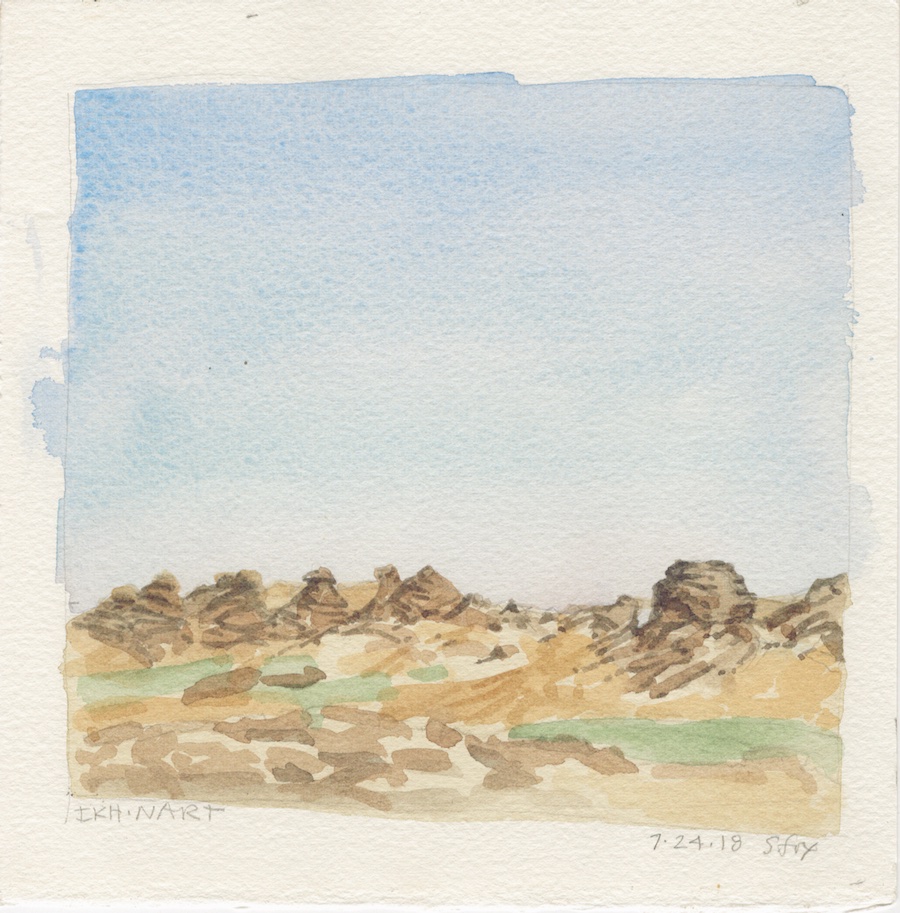
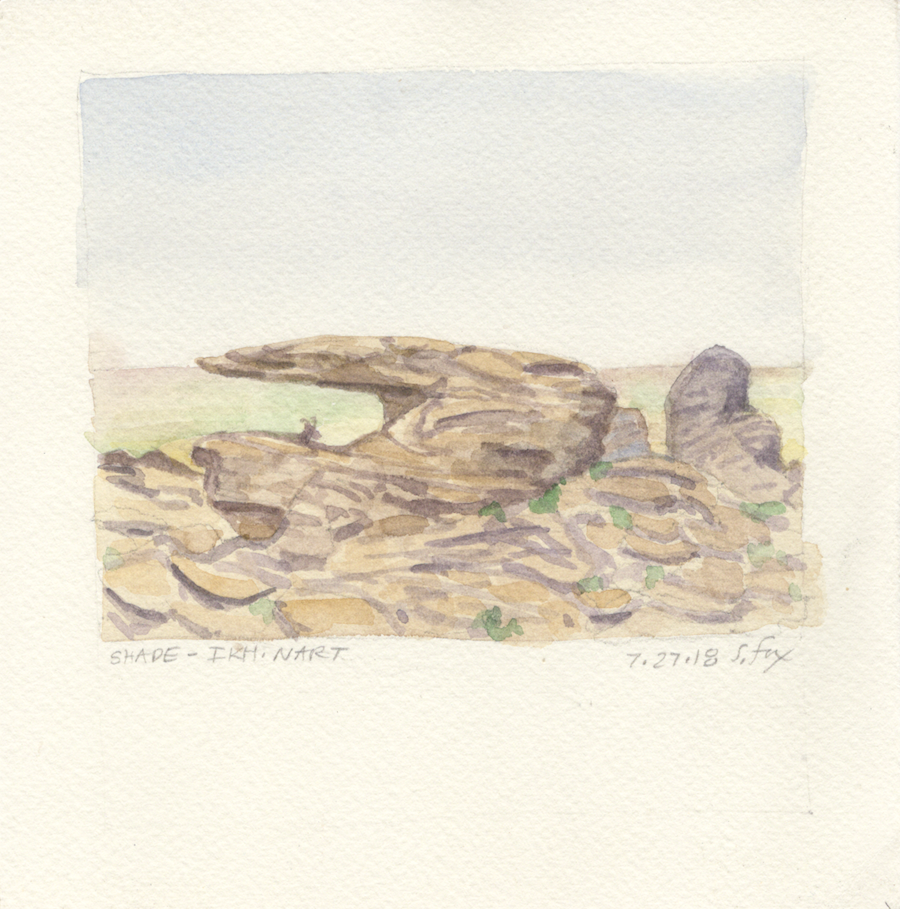
Ikh Nart rocks. Watercolor 8×8″ Waterford 140lb. cold press


I was out hiking the south edge of the valley and spotted this dramatic overhang. Found some nice flat rocks to sit on and lay out my paints. Looked up and there was an animal standing under it looking at me. Grabbed some quick photos. Then it lay down with just its head showing. Before I finished the painting it left, so I added it from memory. But, when I got back to camp and downloaded the day’s images onto my MacBook Pro I saw that it hadn’t been an ibex, but was instead a female gazelle! Twelve trips to Ikh Nart over the years and this was the first time I’d seen a gazelle in this part of the reserve. But for the painting, an ibex she will remain.

Ikh Nart 3
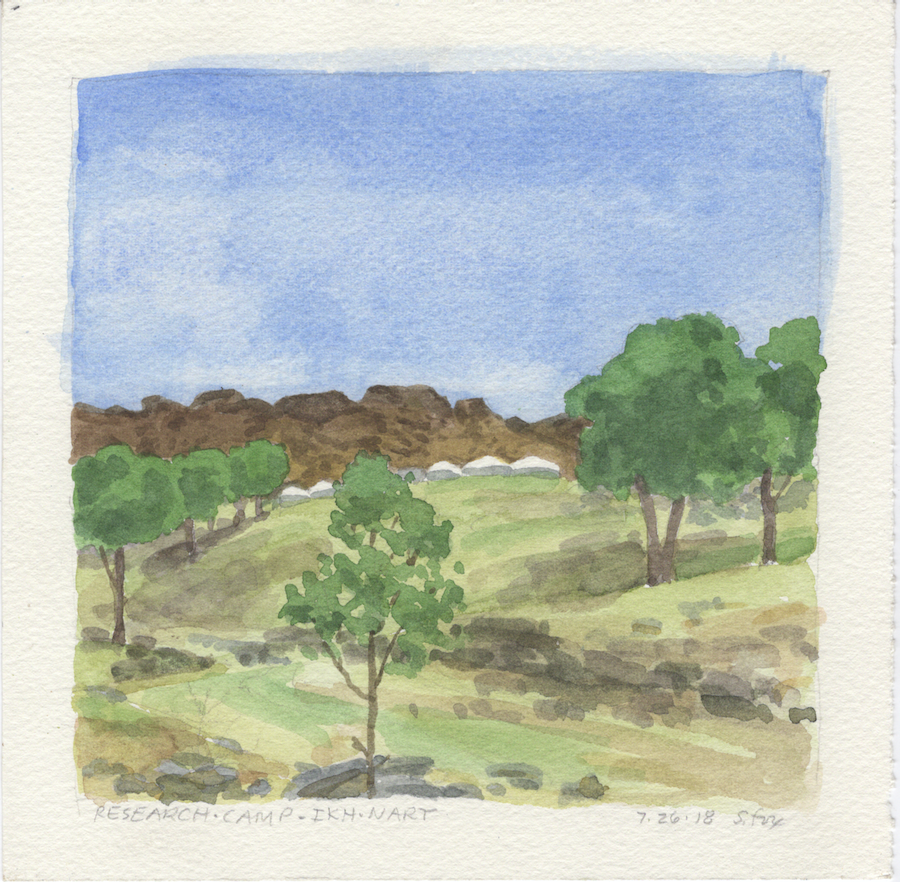
Looking back up the valley to the research camp. Watercolor 8×8″ Waterford 140lb. cold press

Ikh Nart 4 (2)
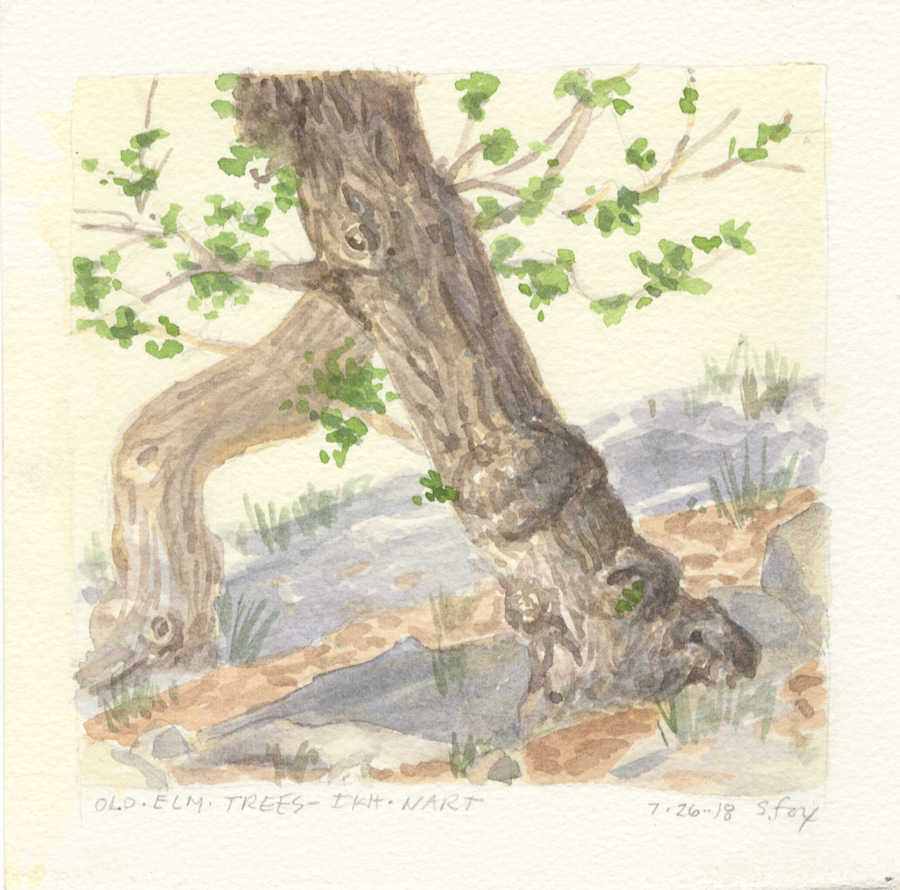
Elm trees. Watercolor 8×8″ 140lb. Waterford cold press

It was getting hot so I left the top of the valley and went back down into it to look for a location with shade. I found it in a clump of old elm trees and did this study, along with the view towards the research camp. When it hasn’t rained a number of species lose all their leaves and look like they’ve died. But add any amount of rain and they seem to almost instantly leaf out again. I was working away totally focused when I heard a noise behind me. I turned and saw this…

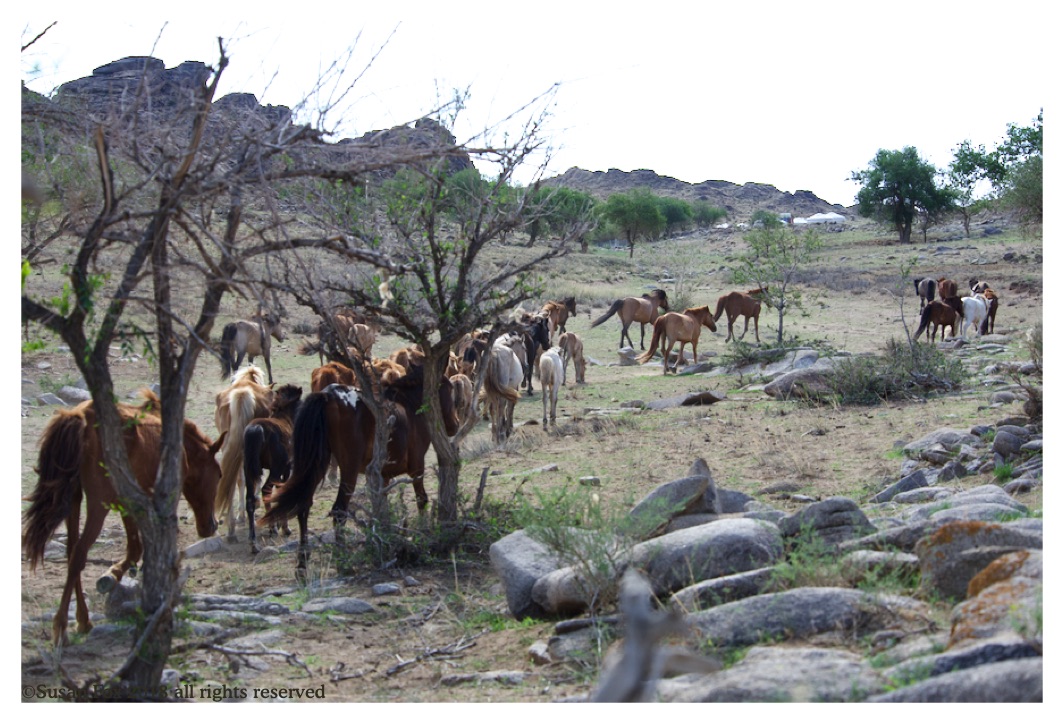
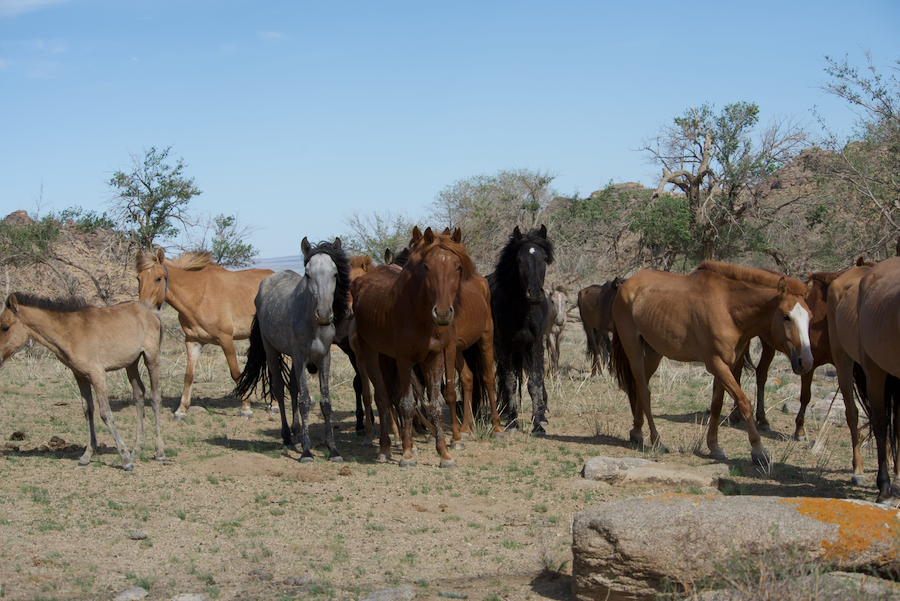
horses

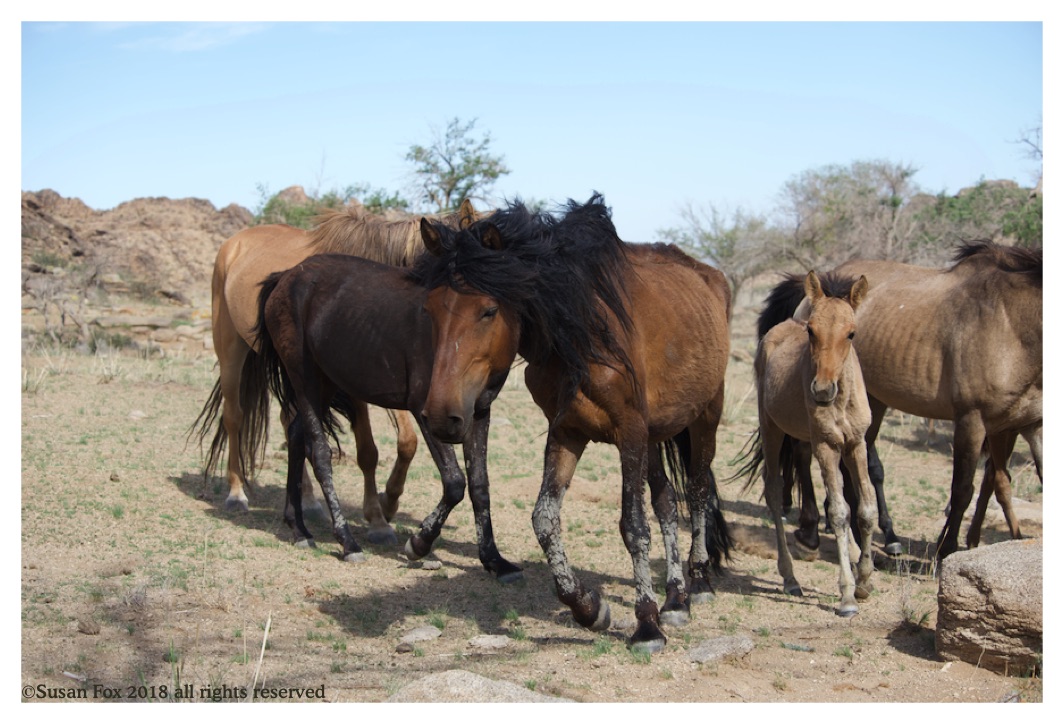
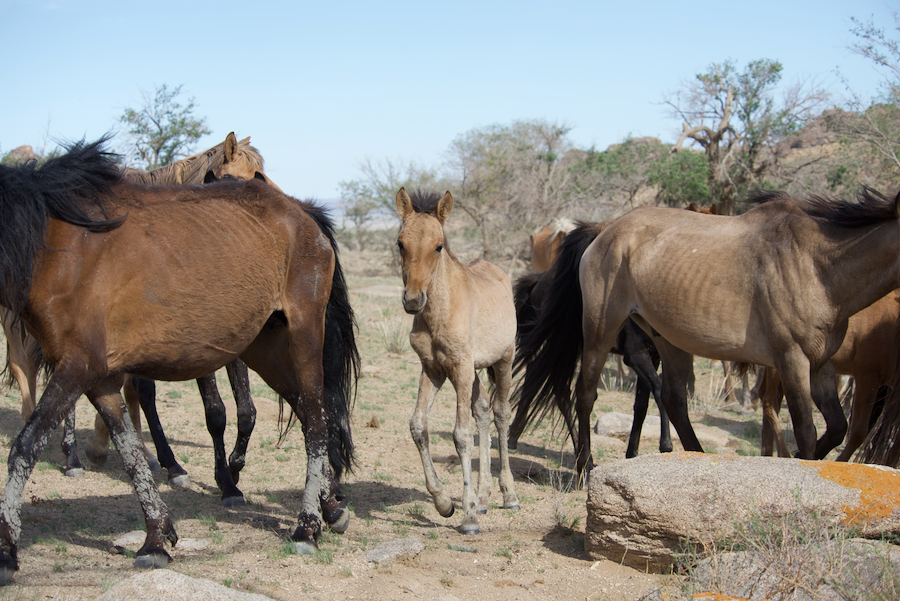
It was a “burrrr” and a snort from this herd of domestic Mongol horses who wanted to get to the spring to drink. And I seemed to be in the way. I looked at them. They looked at me. Then the stallion made his decision.

horses 4_wm

horses 2

The herd split and went around me on both sides as I madly snapped as many photos as I could.

horses 3_wm

They rejoined and continued on to the spring. As you can see they were very thin from lack of graze, especially the mares with foals. This was the third dry year in a row. But the storms that came through, I hope, brought enough rain to let them fatten up for the long, very hard Mongolian winter. There are no horses tougher than these, so they’ve got a good chance.

My Blog Is Now My “Journal”. Watercolors From My Latest Trip To Mongolia, Part 1

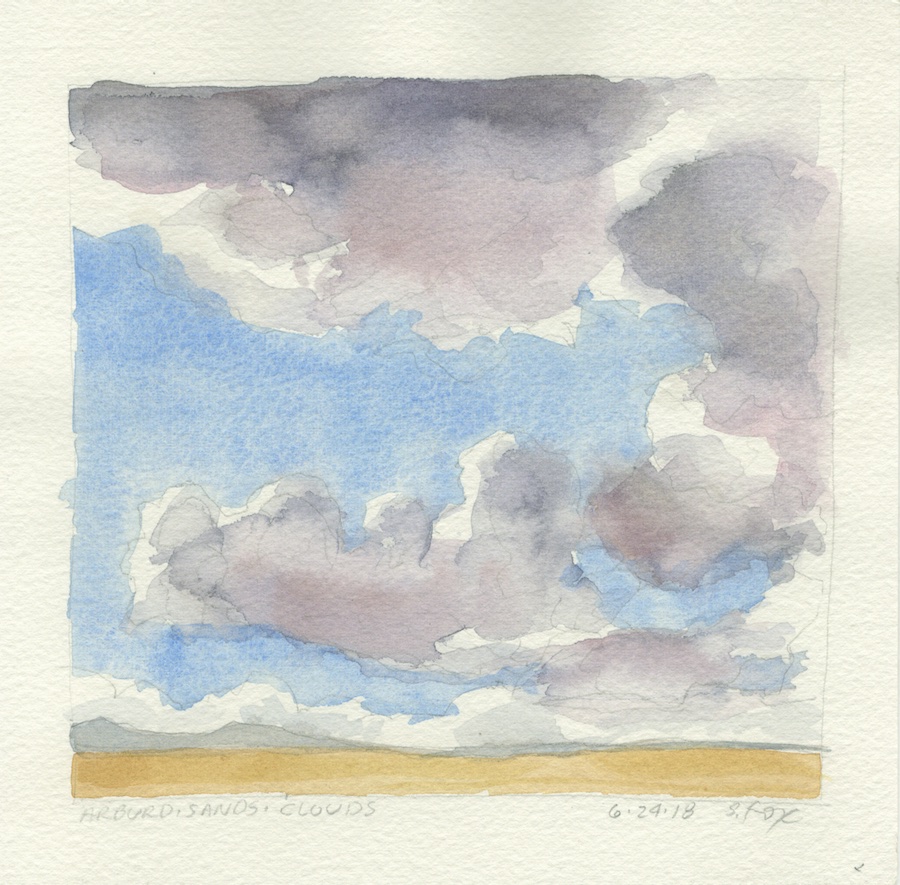
Arburd Sands 3
Yarka watercolors on Waterford cold press paper

I returned on July 31 from my twelfth trip to Mongolia since 2005. I traveled to a number of places, starting with Arburd Sands ger camp in Bayan-Onjuul Soum, Tov Aimag, about two hours south-west of Ulaanbaatar. The area features a 20km stretch of dunes running east-west, the northernmost extent of the Gobi. I enjoyed capturing the clouds as they drifted by.

Arburd Sands 2
Yarka watercolors on Waterford cold press paper


Arburd Sands 4
Yarka watercolors on Arches cold press paper

A group of camels was nice enough to move through the scene.

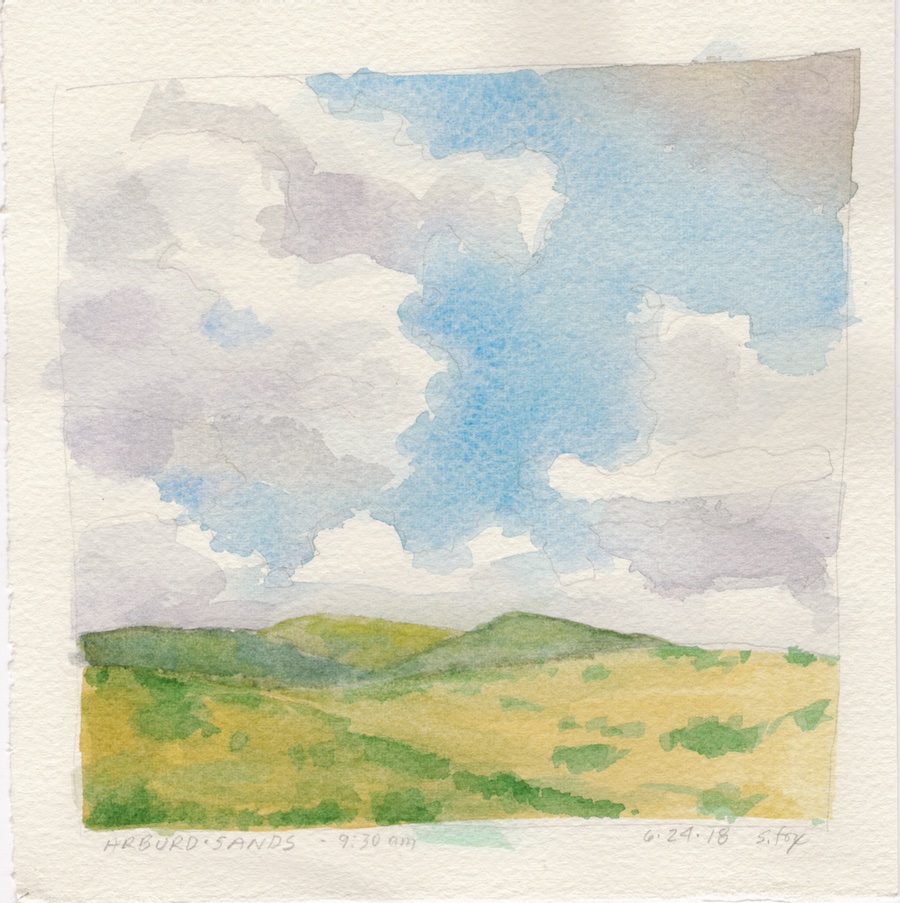
Arburd Sands 1
Yarka watercolors on Waterford cold press paper

This was actually the first one I did as a warm-up. A relatively overcast day in a country that gets 250 days of sunshine a year.

In the Field: I Go To A Plein Air Workshop With Paul Kratter; But First, A Stop At The San Francisco Zoo

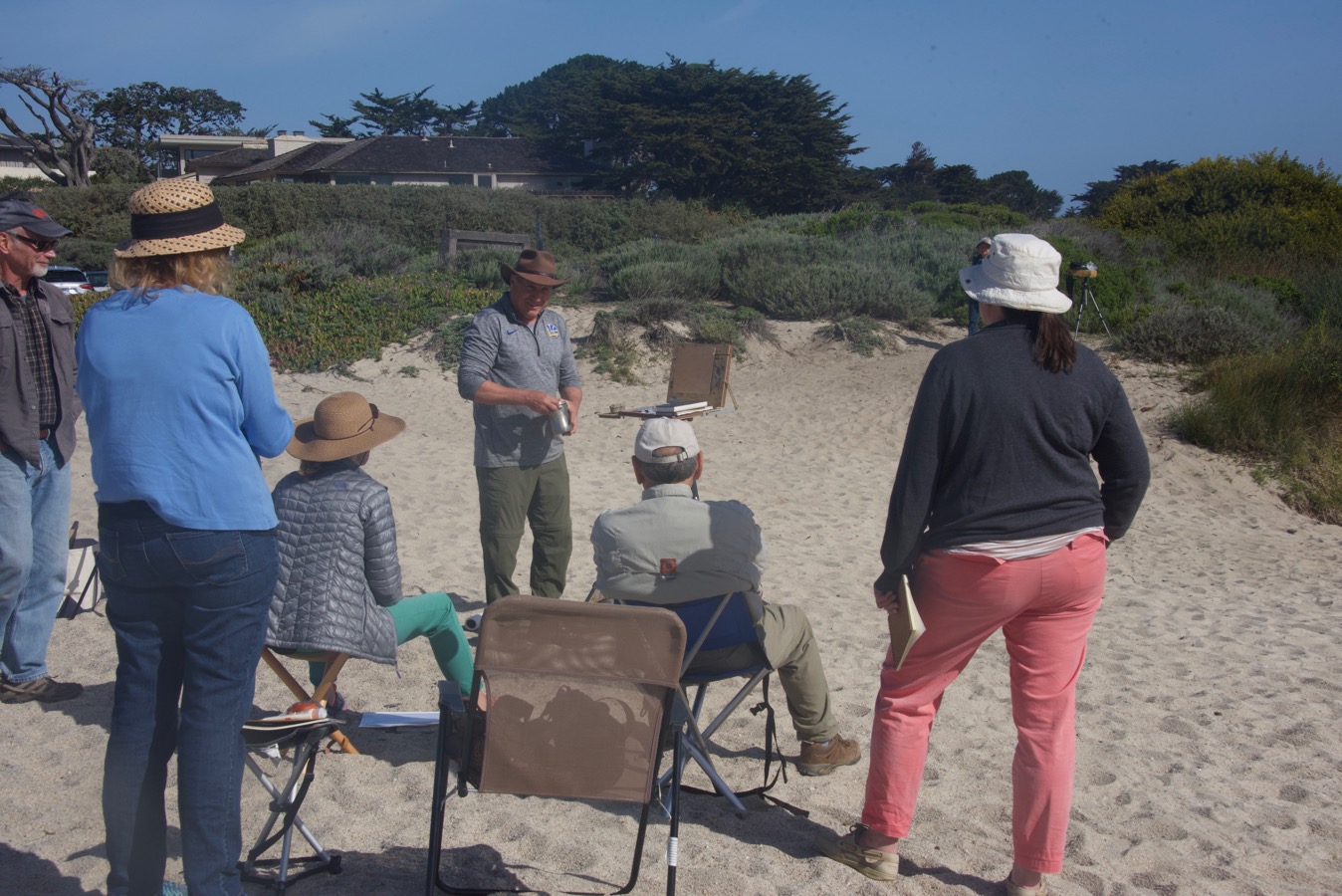
Paul gets the workshop under way with a demo at Carmel River State Beach.

Paul gets the workshop under way with a demo at Carmel River State Beach.

I headed down the road April 21 for a plein air workshop with an artist I’ve admired for some time, Paul Kratter. I’ve always been sorry that I missed having him as an instructor in animal drawing, by just a year, at the Academy of Art University (then College) in San Francisco, where I earned a BFA Illustration in 1989. But we crossed paths and connected on Facebook a few years ago and I’m a great admirer of the plein air work he’s known for these days. It has the crispness and concise draftsmanship that one sees in the work of many artists who have an illustration background. So when I saw that he was going to be offering a workshop, “From Sketch to Painting”, within driving distance of where I live in Humboldt County, I signed up immediately.

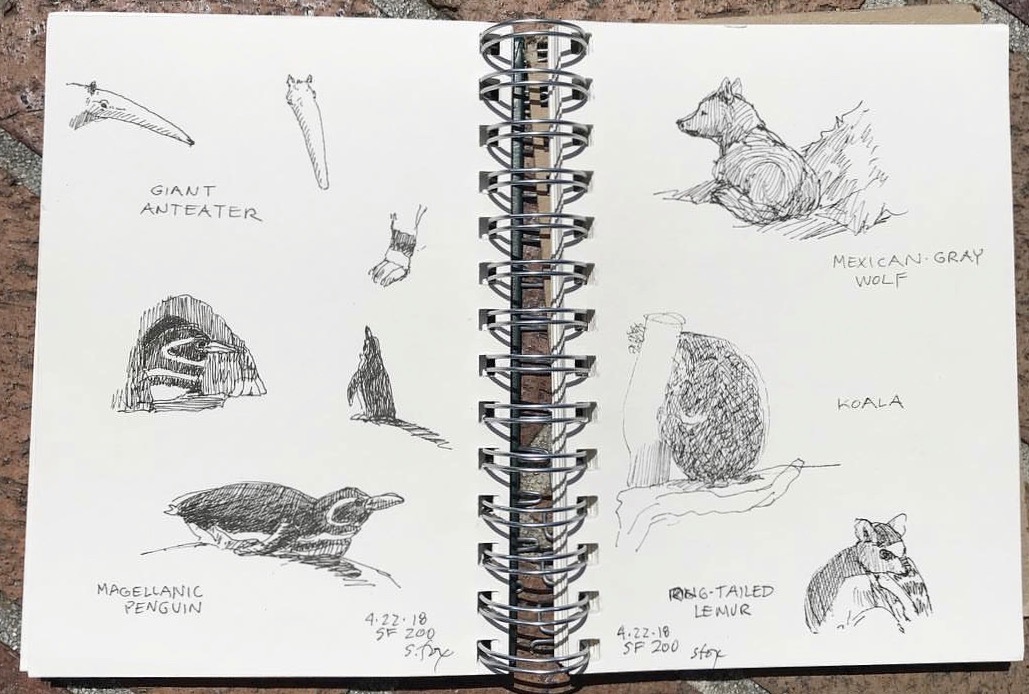
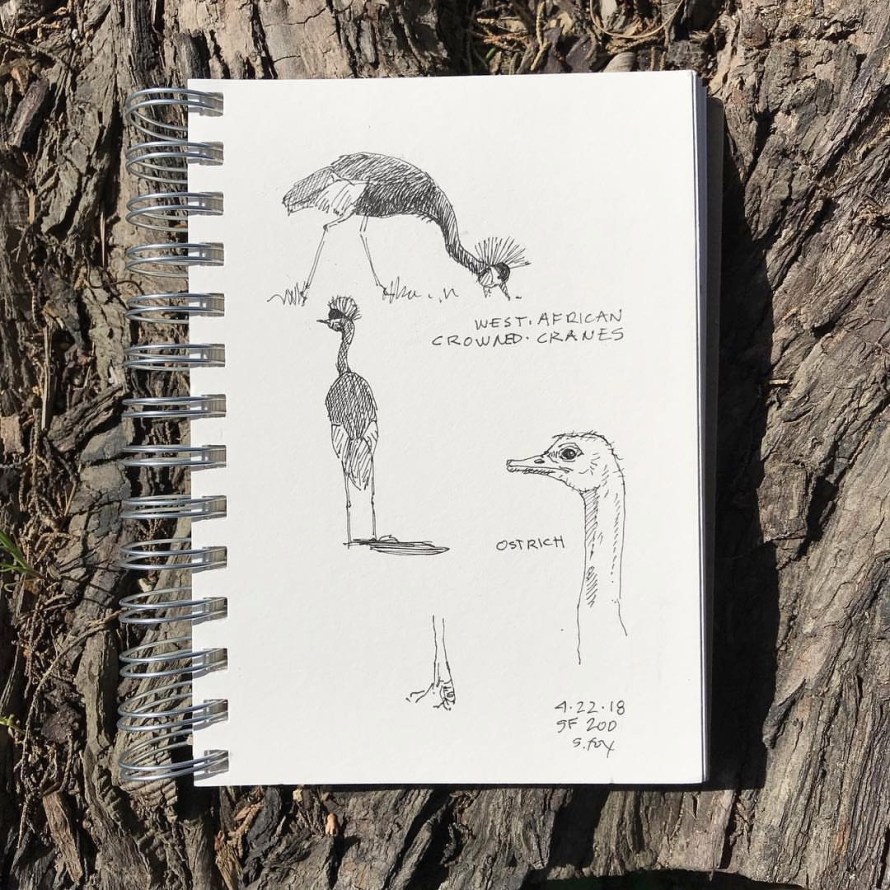
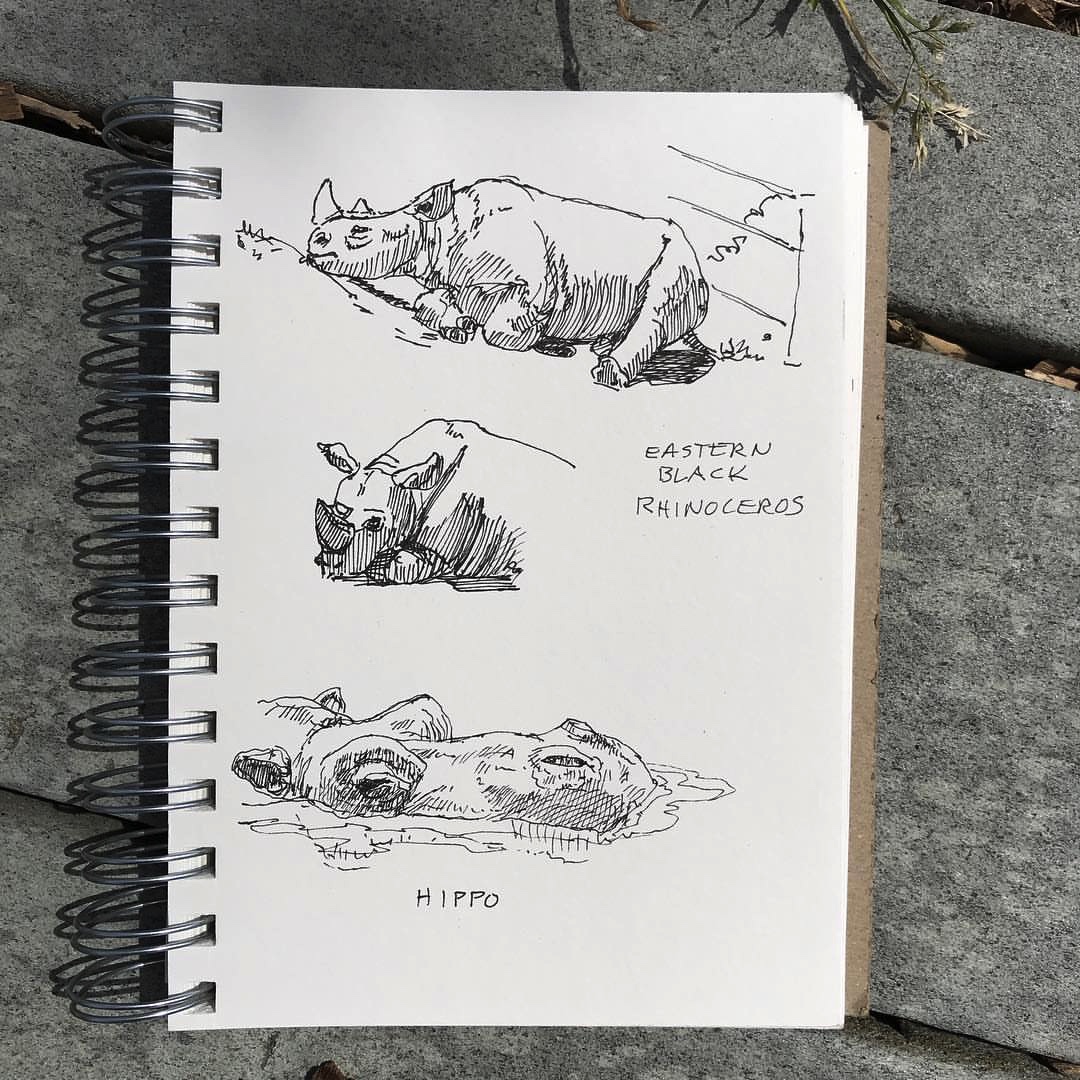
Looking to capitalize on the trip, I left a day early and went as far as San Francisco, staying the night at an inn right across from the San Francisco Zoo. Sketching live animals is something I’ve been doing since 1989, starting at the same zoo while I was at the Academy. I was there when they opened in the morning and left to head down to Carmel in the early afternoon. Here’s the results. I only had, at most, a minute or two to capture most of them. The hippo and penguins were nice enough to stay still a bit longer. The koala never even twitched. I used a Sakura Micron .01 pen in a 7×5″ Pentalic Nature Sketch sketchbook.
SF Zoo 2

zoo

I arrived in Carmel, checked into my Airbnb room, got a bite of dinner, then went to Carmel Visual Arts to watch Paul do a demo by way of introducing what he was going to teach us over the next three days.

The next morning we all met at our first location, Carmel River State Beach, where Paul did another demo. I’ve personally never been much of a fan of them since in my experience they’ve mostly been about how the instructor paints with very little that was relevant to me and my goals as a painter. But both Paul’s and Scott Christensen’s (a local artist friend and I attended his 10-day plein air intensive ten years ago) were full of useful information.
2

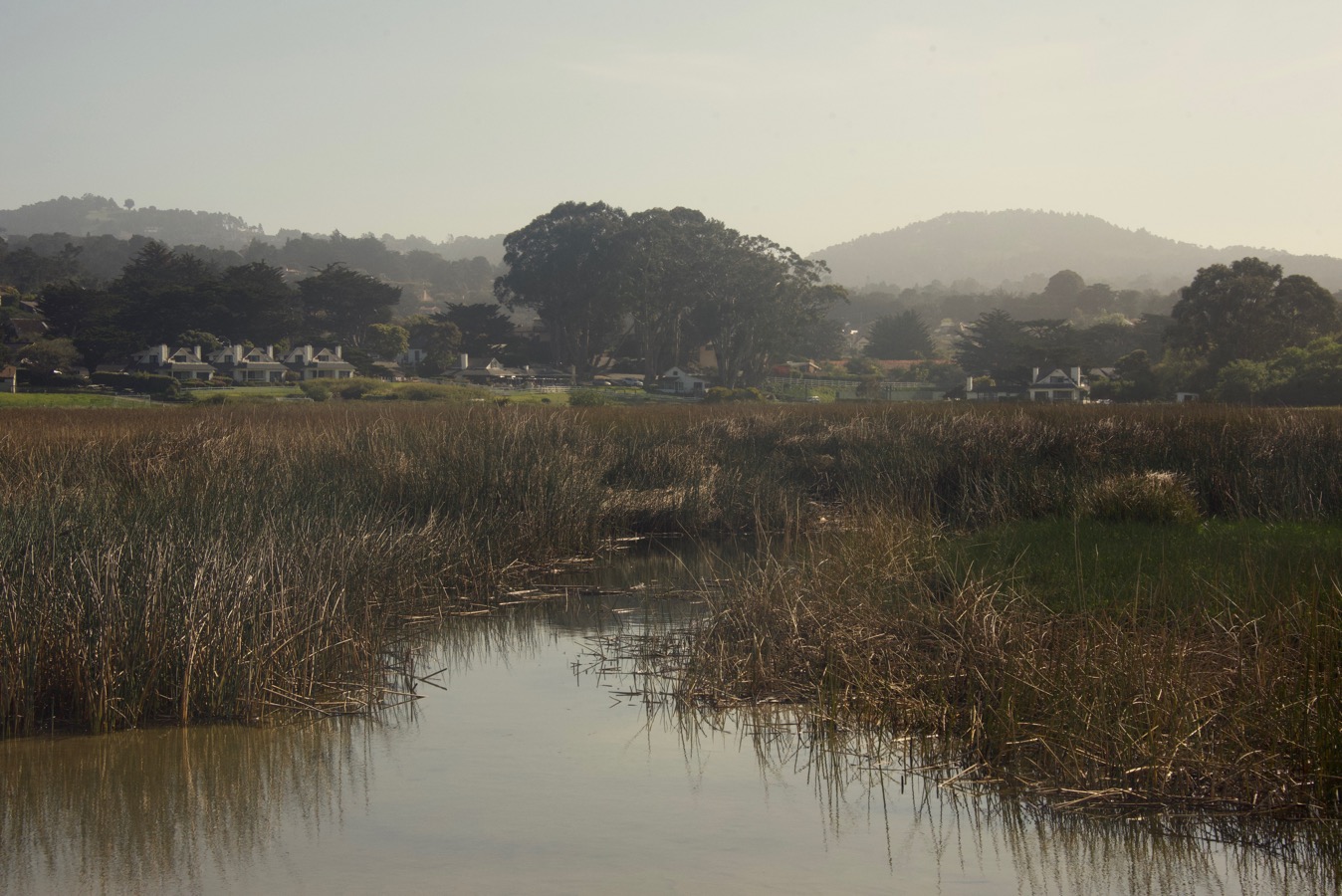
The motive or motif (plein air-speak for what the artist has chosen as her or his subject). Not the greatest light, but some decent atmospheric perspective, with the hills becoming lighter the farther back they were.
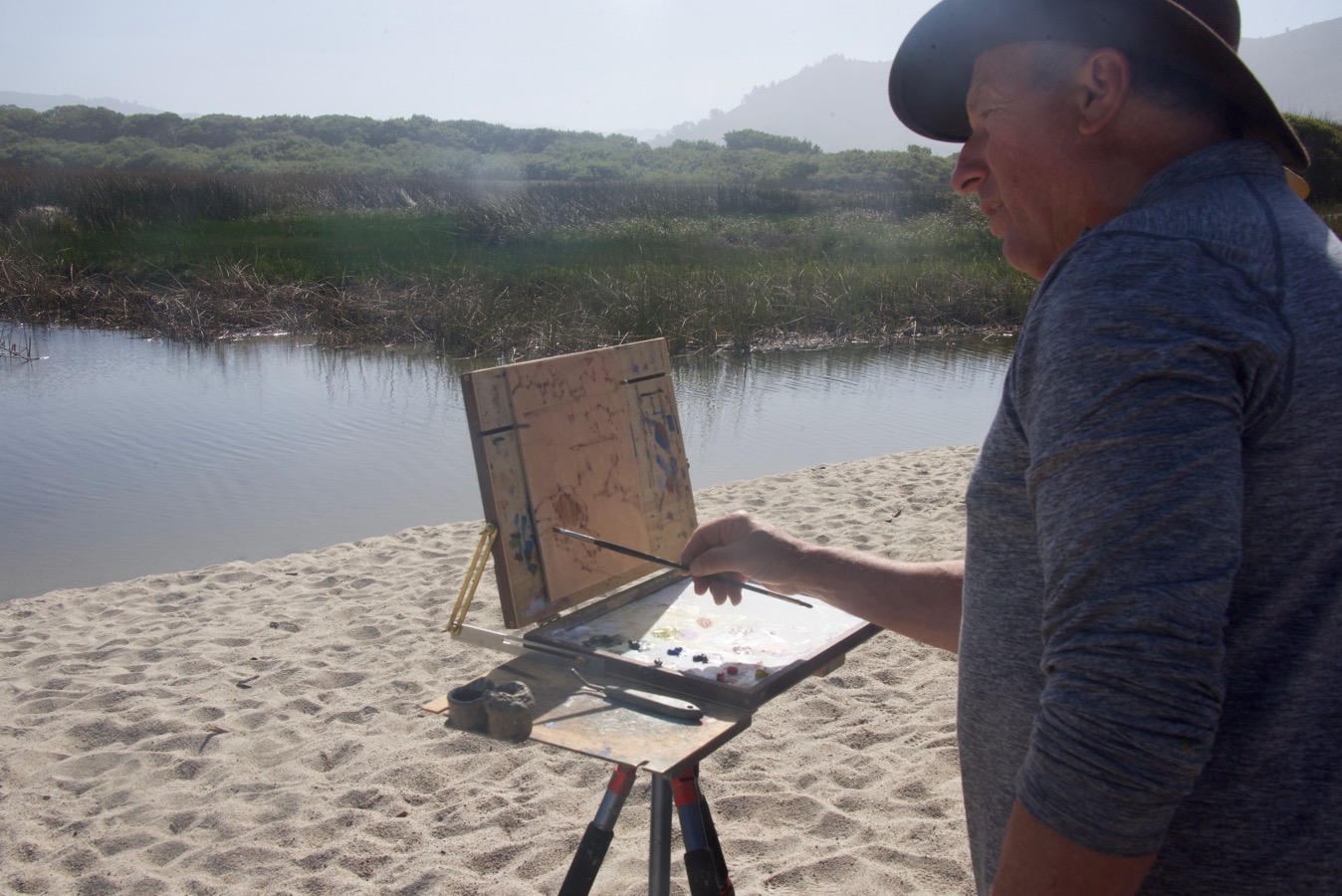
Paul uses an Open Box M that is mounted on a camera tripod. He starts with an indication brush drawing of the main shapes using a brush called a "bright". It's shorter than a flat which is a, well, flat rectangle. He moved his hand in sharp, short strokes

Paul uses an Open Box M that is mounted on a camera tripod. He starts with a brush drawing to indicate the main shapes (only 3-4 on a small piece) using a brush called a “bright”. It’s shorter and more square than a flat which is, well,  a flat rectangle. He moved his hand in sharp, short strokes. No niggling, searching or doodling.
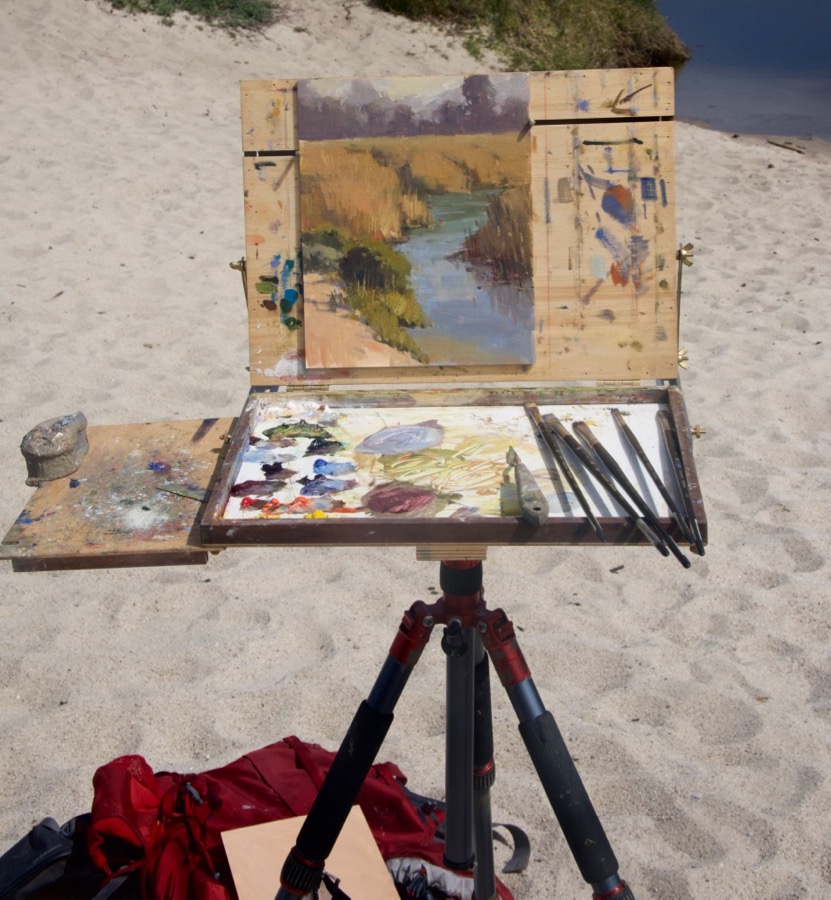
5

The finished demo. I was really interested in how he moved away from the literal colors, rearranged elements to suit him then, to top it off, changed what had become a blue sky back to the more atmospheric yellowish tone that you can see in the photo. Lots of food for thought, filtered through how I have seen my motifs when I’m out painting..
6

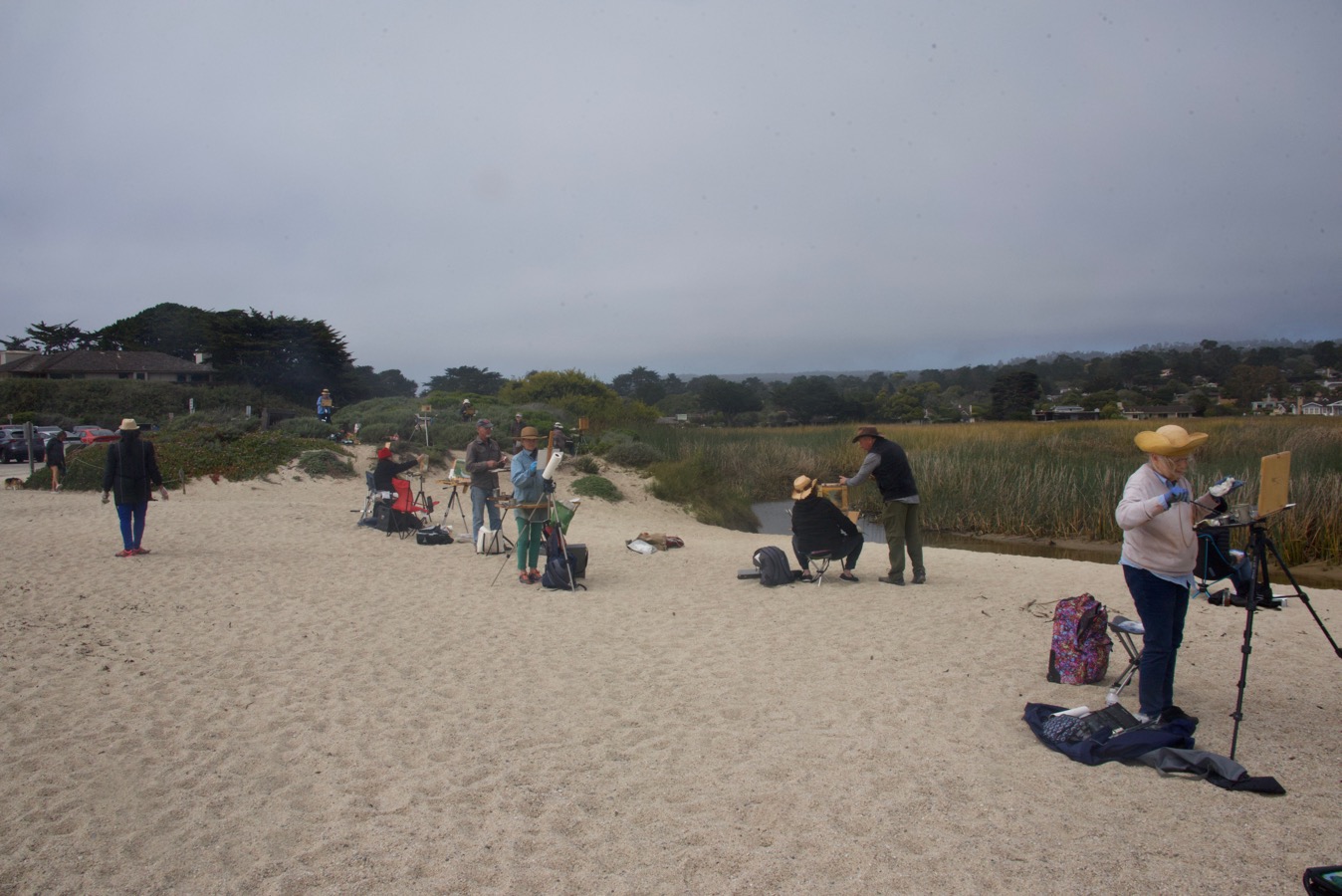
Plein air painters “on the job”. I had my old Soltek easel which has a VERY persnickity mechanism at the feet that doesn’t go well with sand or dirt. I’d anticipated this and brought some cutdown plastic bags that new brushes are packed in by art suppliers and rubber bands to hold them onto the ends of the legs. I have a pochade box I bought years ago at the Sennelier art shop in Paris and I’m going to switch to it before I go out again. How I mount it on my tripod will be the subject of a future post.
7

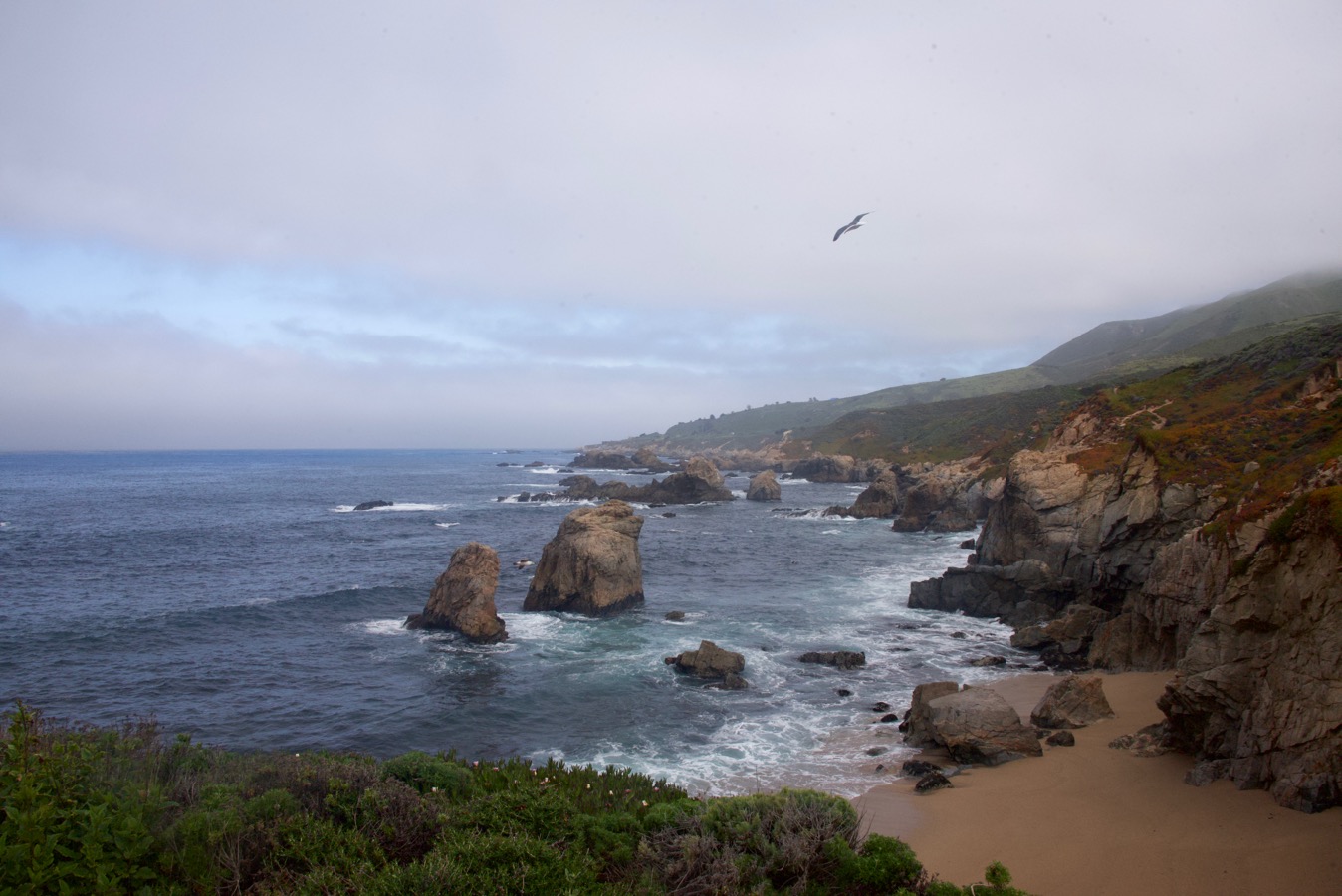
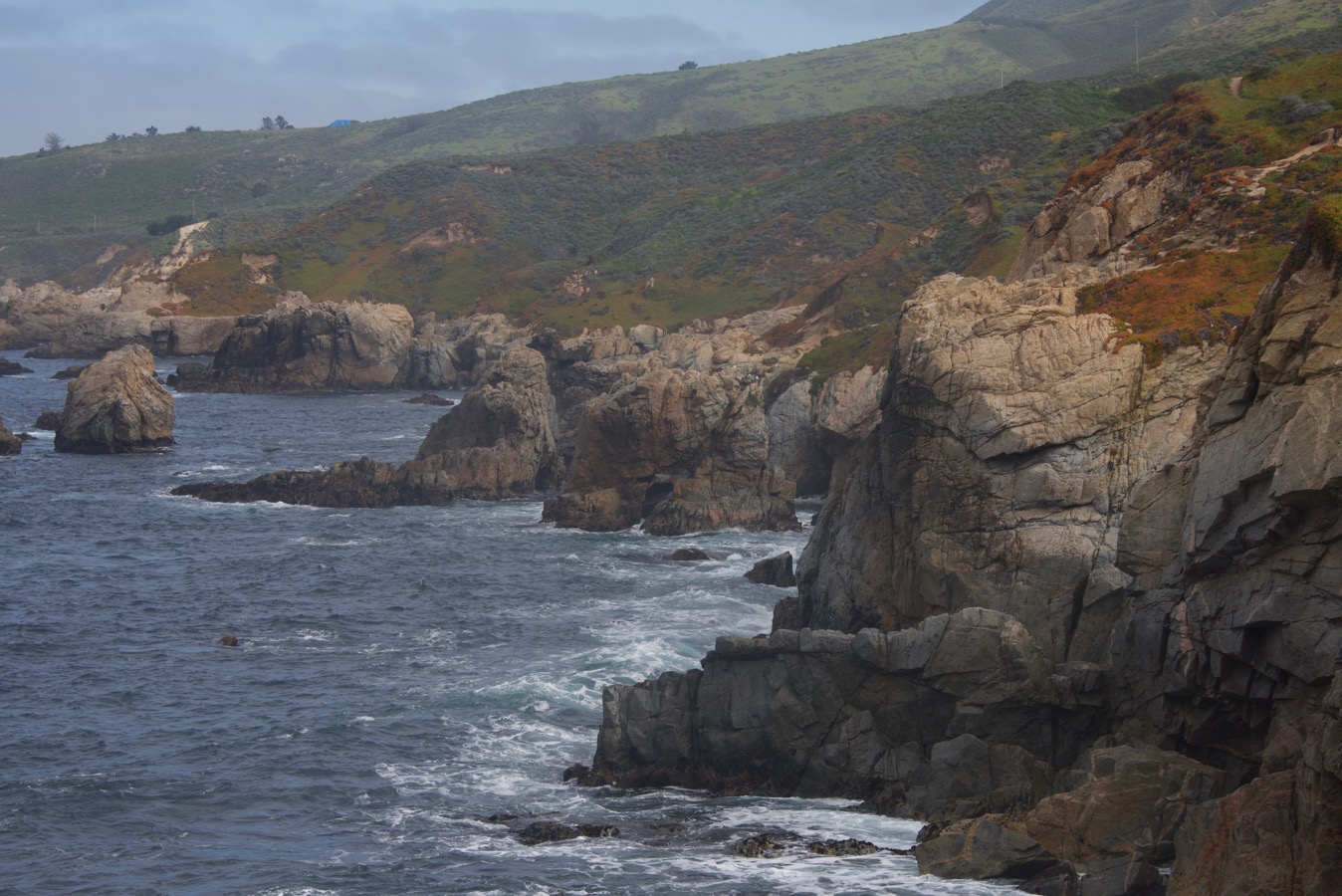
The next day found us at Garrapata State Park, where we were stuck having to choose between scenes like this…
gsp

This…

gsp w

Or this…

I only watched the first part of his demo since I really wanted to get a first pass done on the piece I’d started before we had to break off and meet for dinner. I get a lot out of watching other artist’s “starts”.
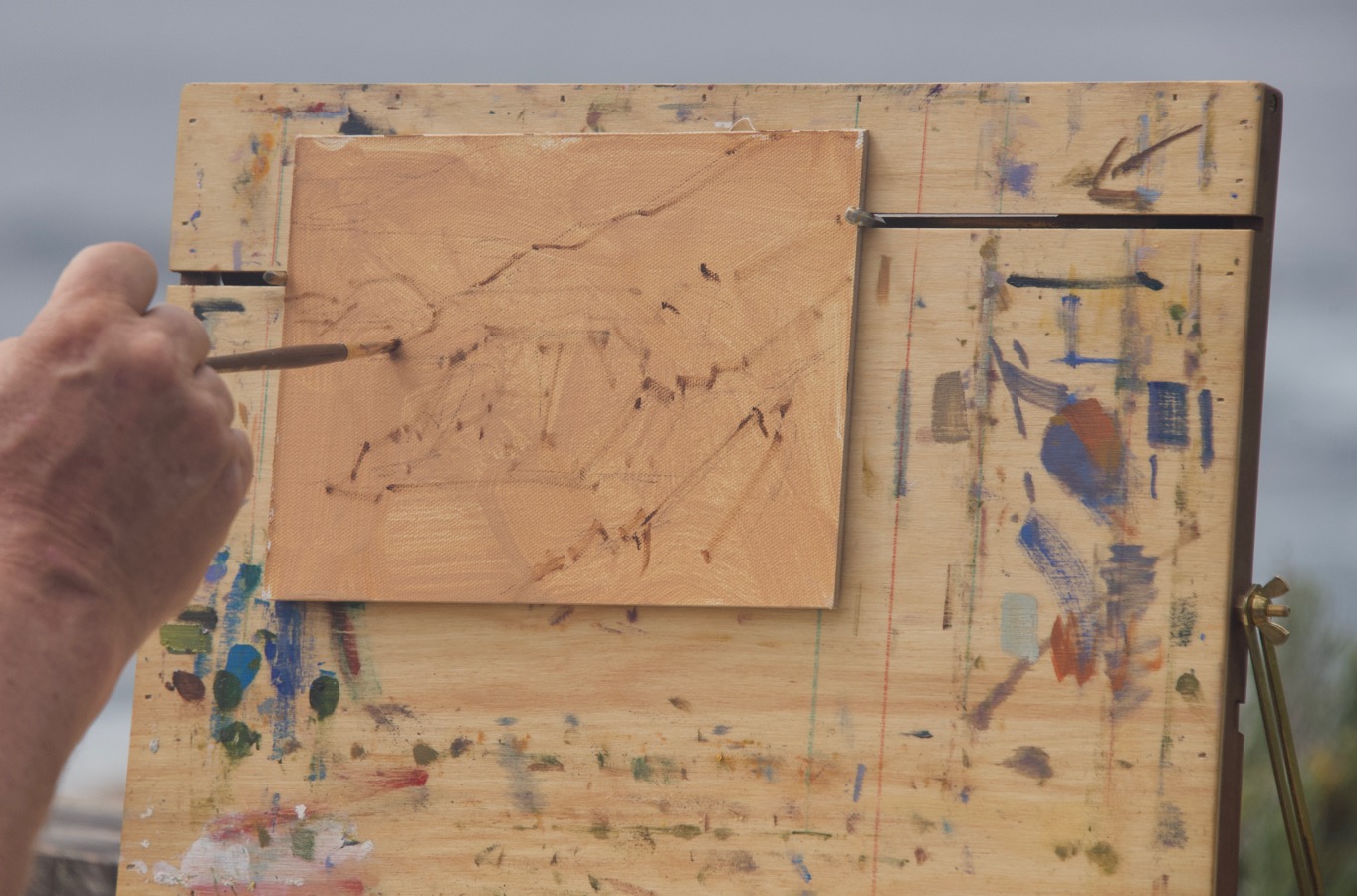
GPS d1

This is a good example of one of Paul’s starts. Basic shapes, no detail.
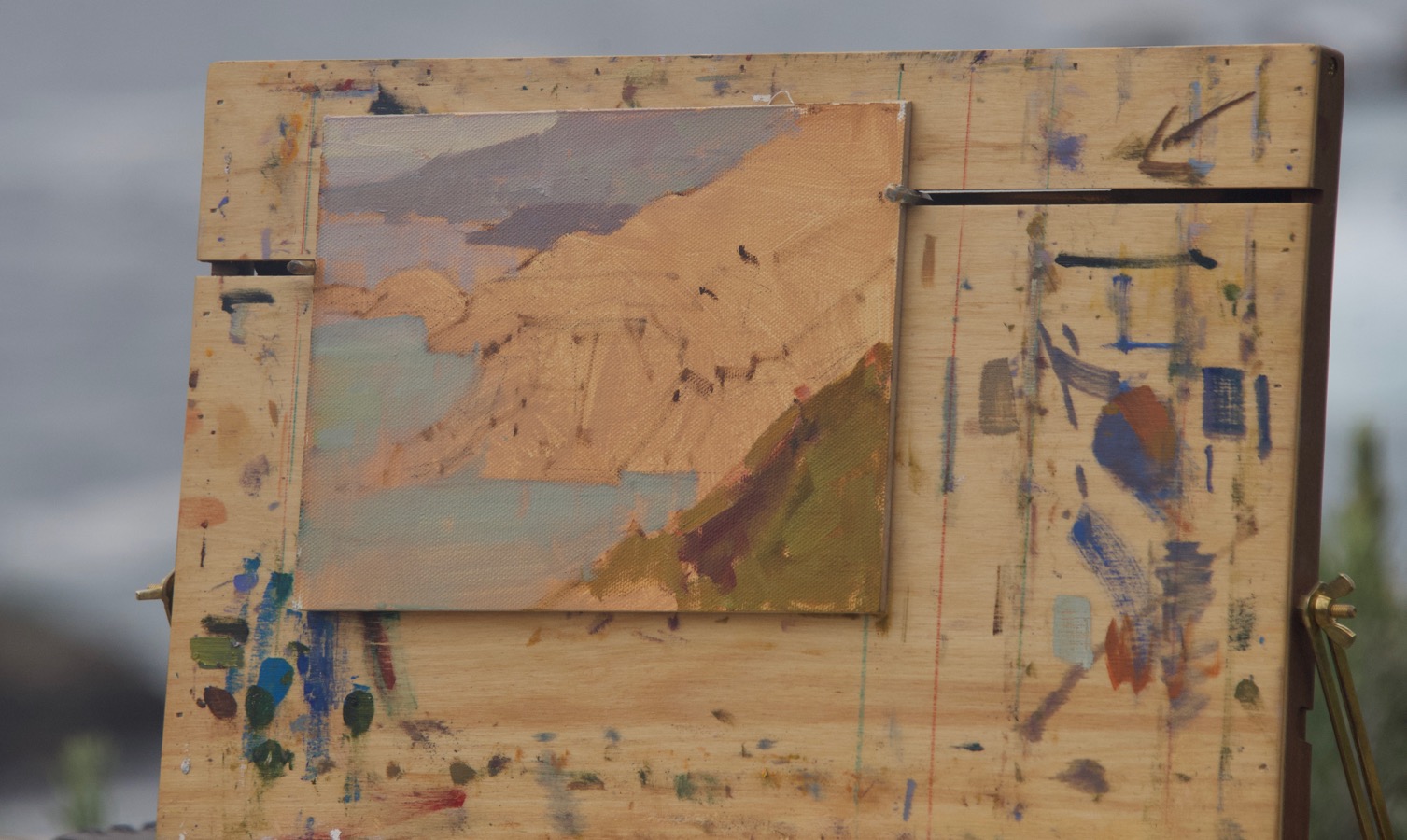
gsp d2

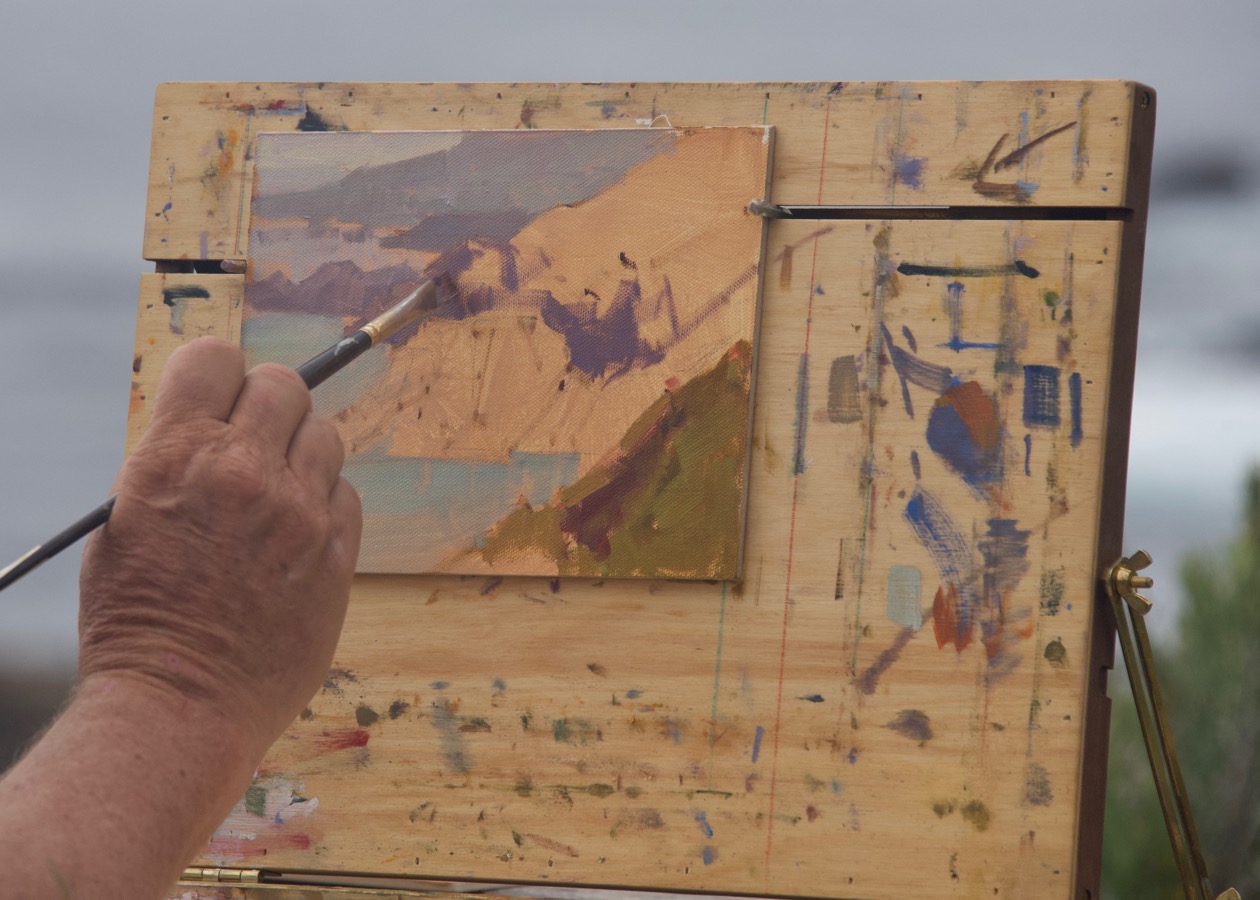
He then did a first pass with color, quickly filling in the shapes, paying attention to value relationships and color temperature. Farther away means lighter and cooler as the general rule.
gps d3

He’s now adding the shapes of the shadows. Notice how loose they are. No hard edges.
PKW 1

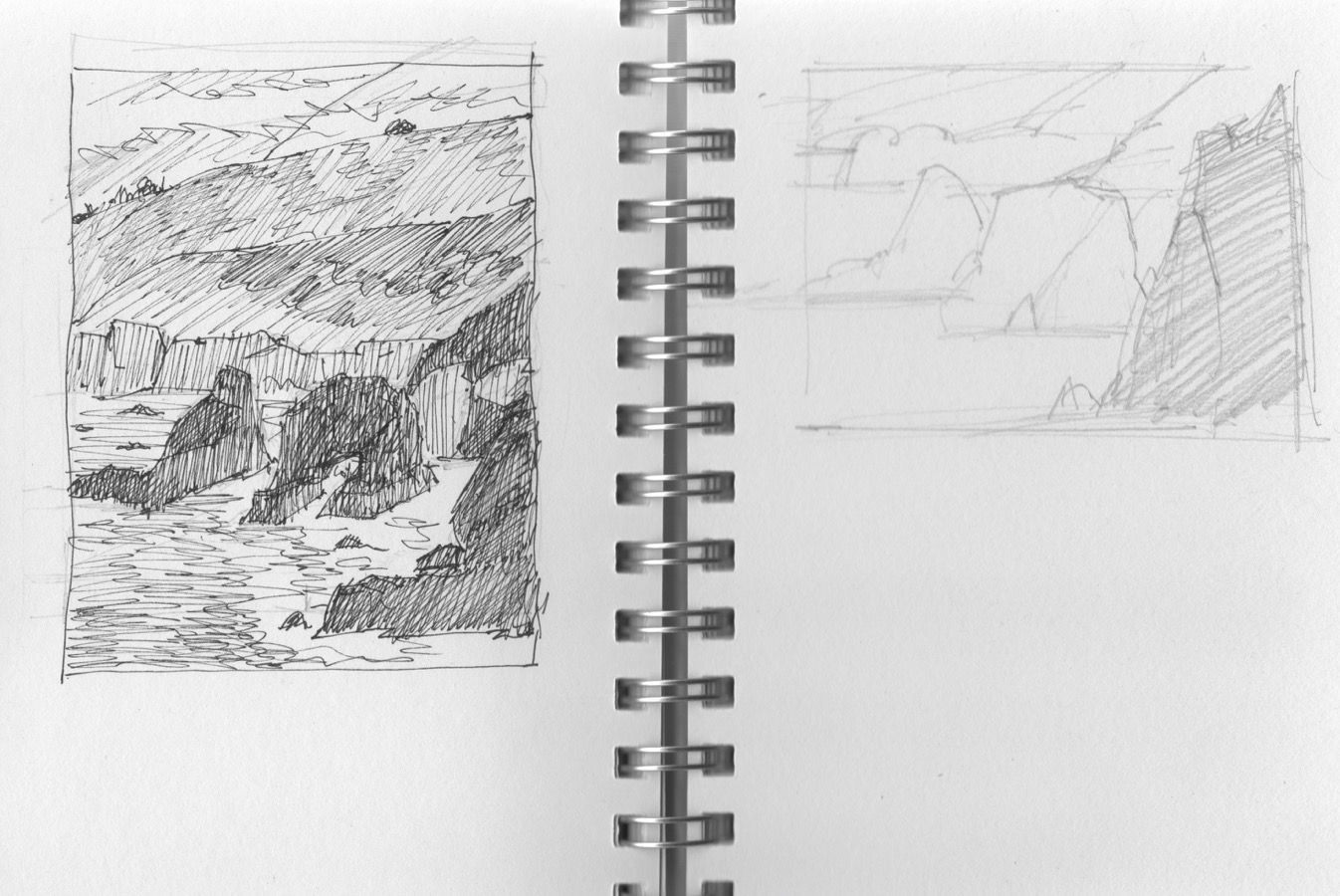
In the meantime, I’d spent the morning working on understanding how to do the preliminary sketches with a pen. I absolutely understood the value of doing them, but it took awhile to start to get the knack of it and make good choices. I made a hash of the first one. Paul was nice enough to do the sketch on the right to demonstrate finding just a few large shapes, which makes for a much stronger composition. He also thought that what I was most interested in would work better as a horizontal than vertical composition.
PKW 3


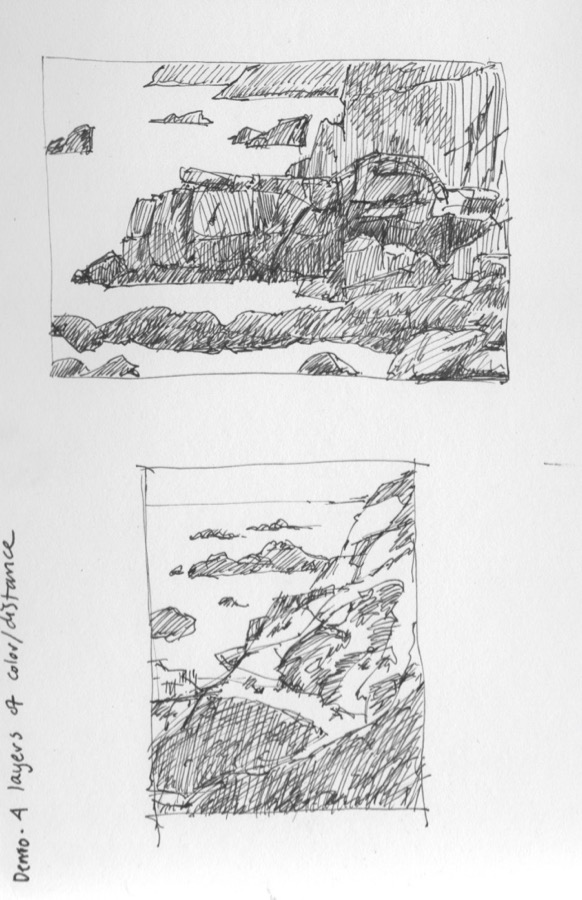
I soldiered on and finally felt like I was starting to get the hang of seeing what I was looking at in a better way.
PKW 2

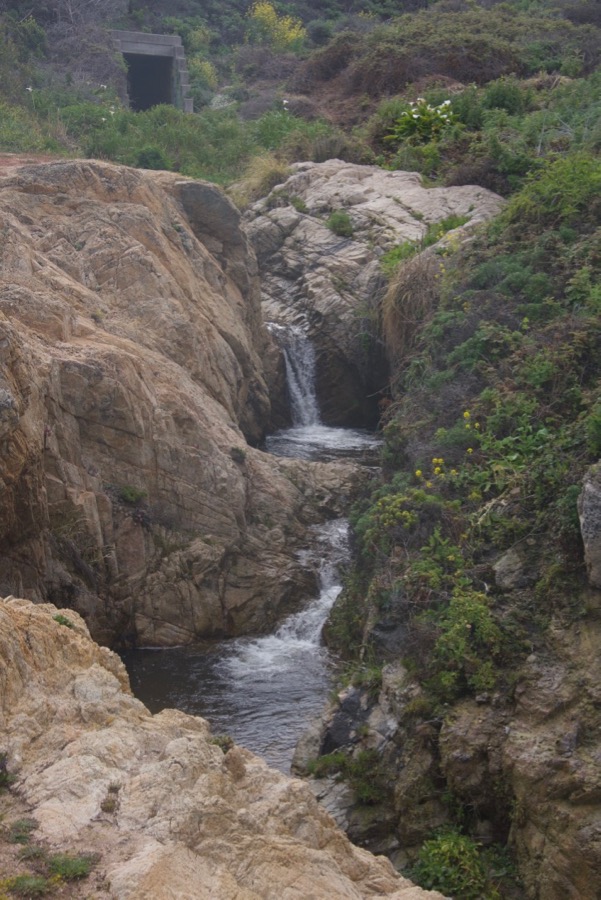
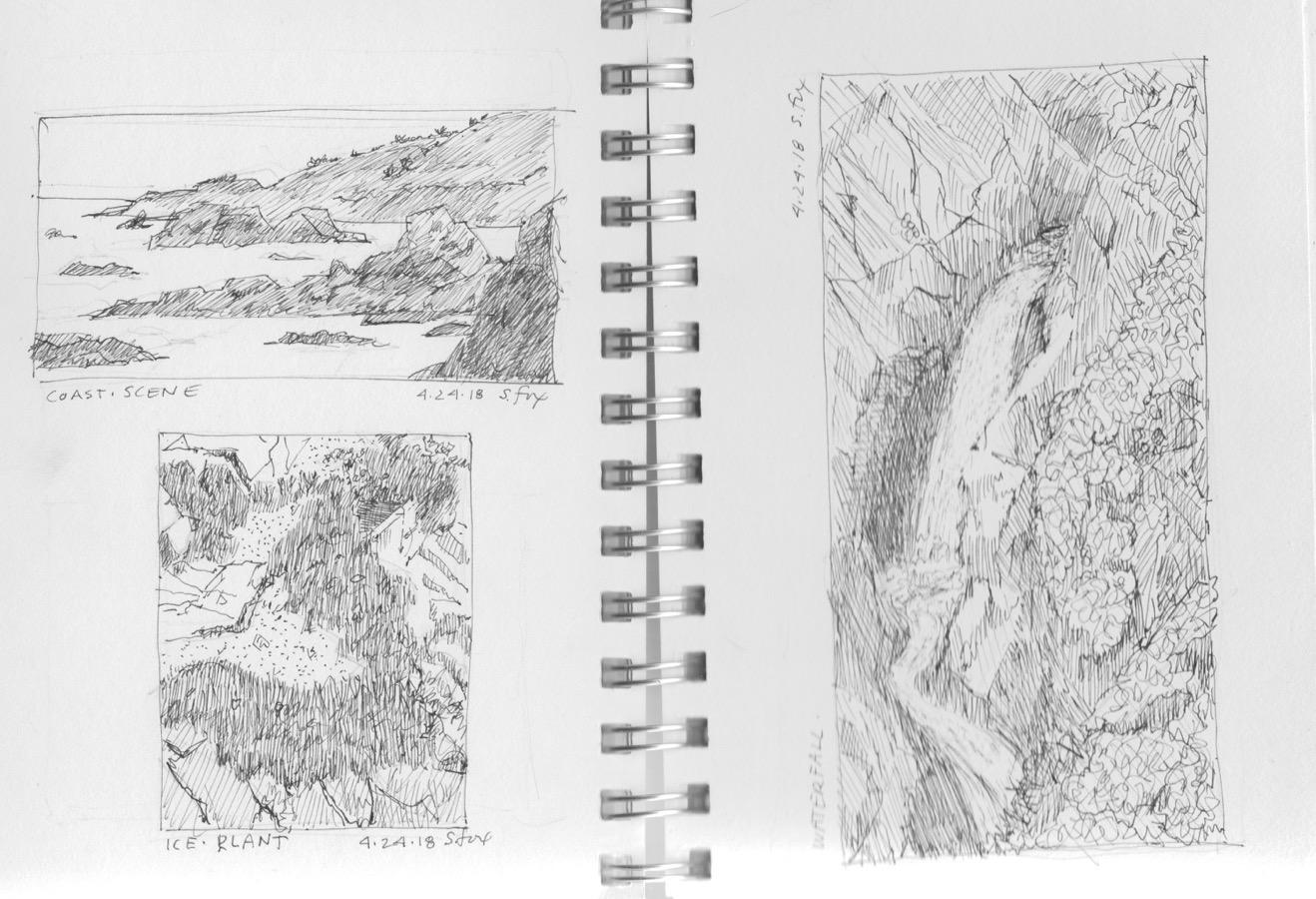
It got a little easier with each sketch. Then I tackled the waterfall. I ended up losing value contrast because of too many lines in the water. What a mess. After consultation with Paul and understanding where I’d gone wrong, when I got home I took an #11 Exacto knife and scrapped out the water. While not great, it was definitely an improvement. And I learned something valuable about keeping water the lightest value, the white paper color, as a starting default. It’s important not too get attached to sketches like this and to use them as a way to problem solve with pencil or pen, doing whatever it takes to fix or improve them. They’re simply a means to an end, but an important one.
PKW lunch

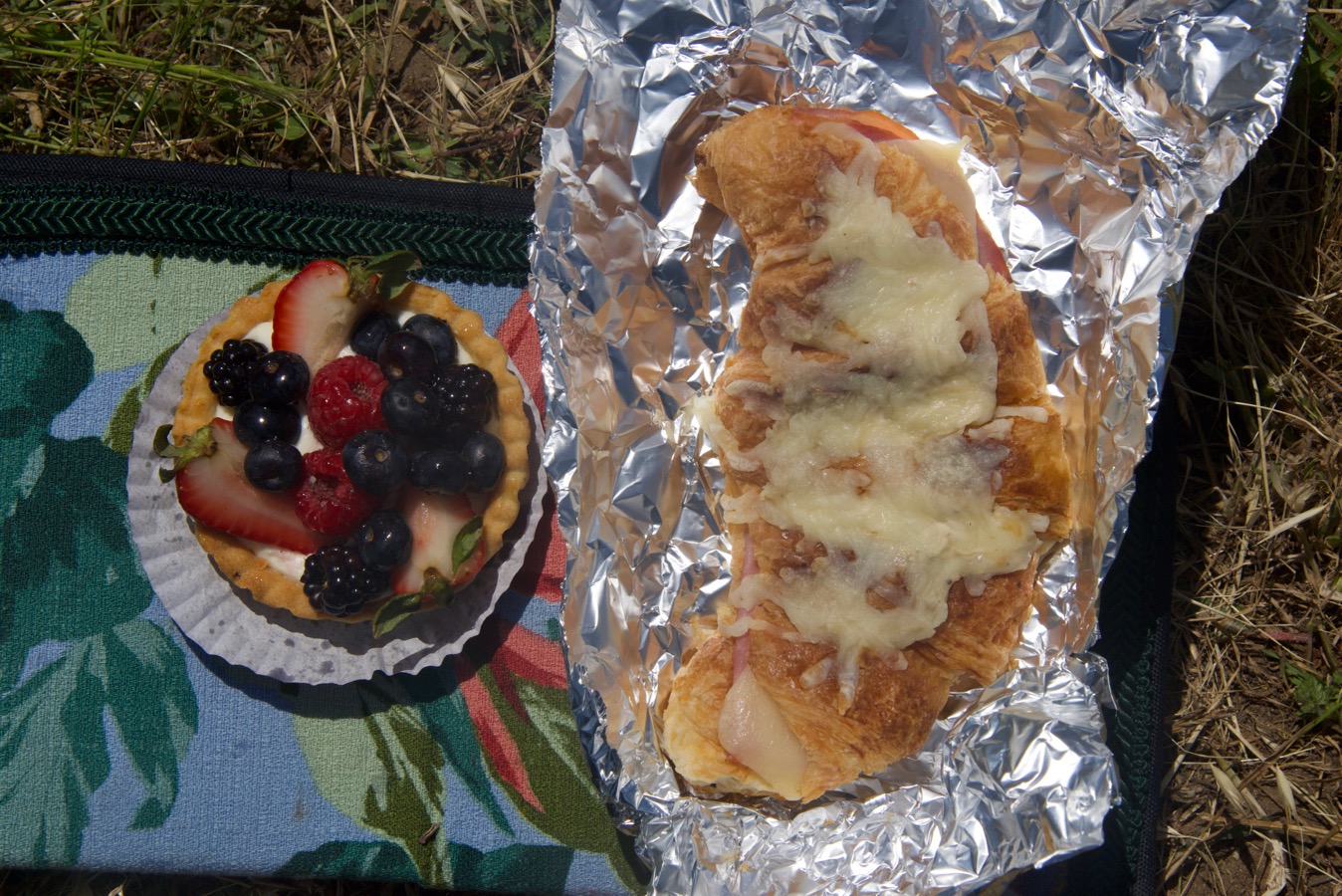
Oh, yeah, I did have time for lunch, suffering for my art, but not much.
11

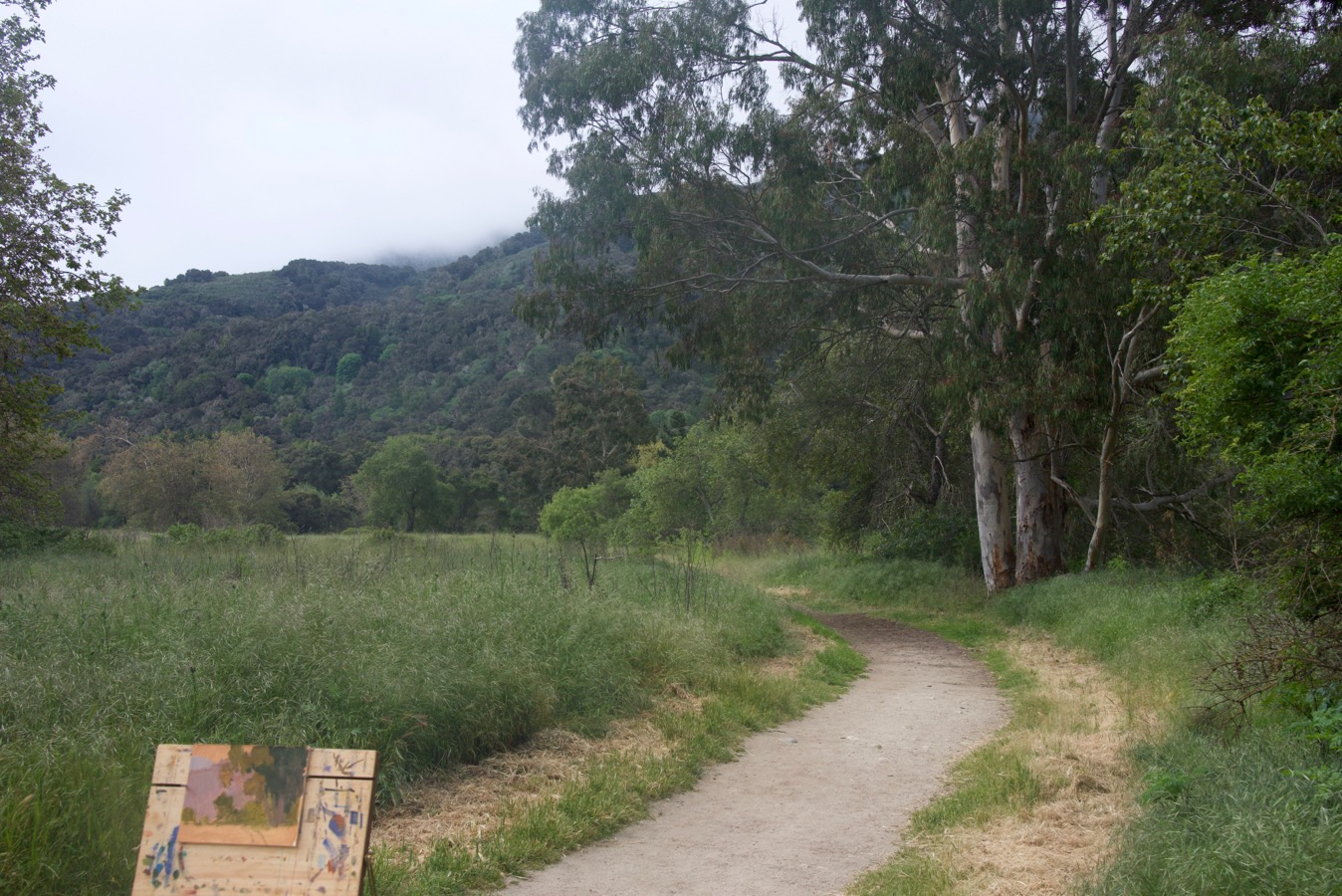
The third and final day we went out to a great regional open space to the east to try to get out of the coastal overcast. It was time for the iconic eucalyptus trees (introduced from Australia as they were) beloved by California plein air painters for over a century.
8

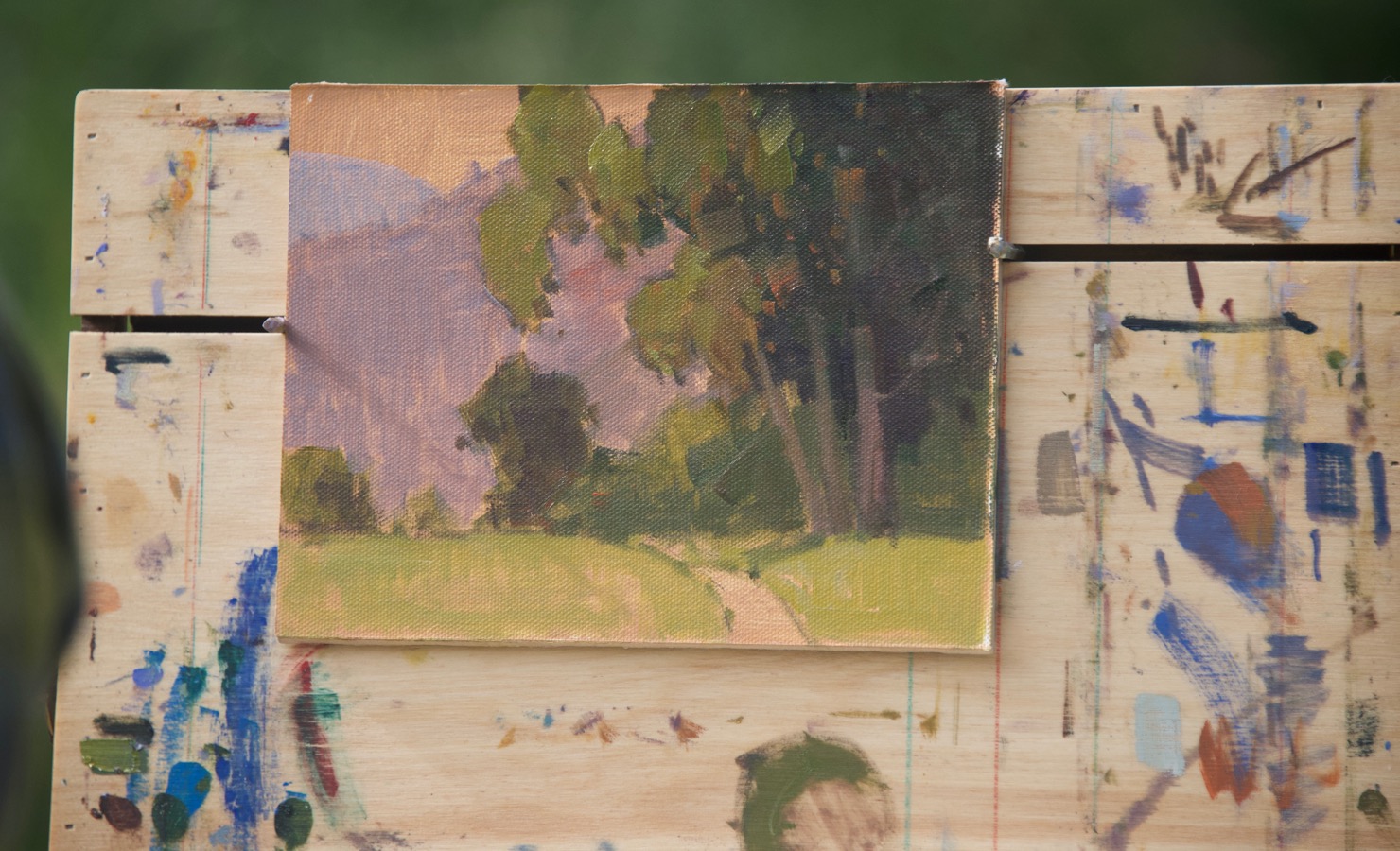
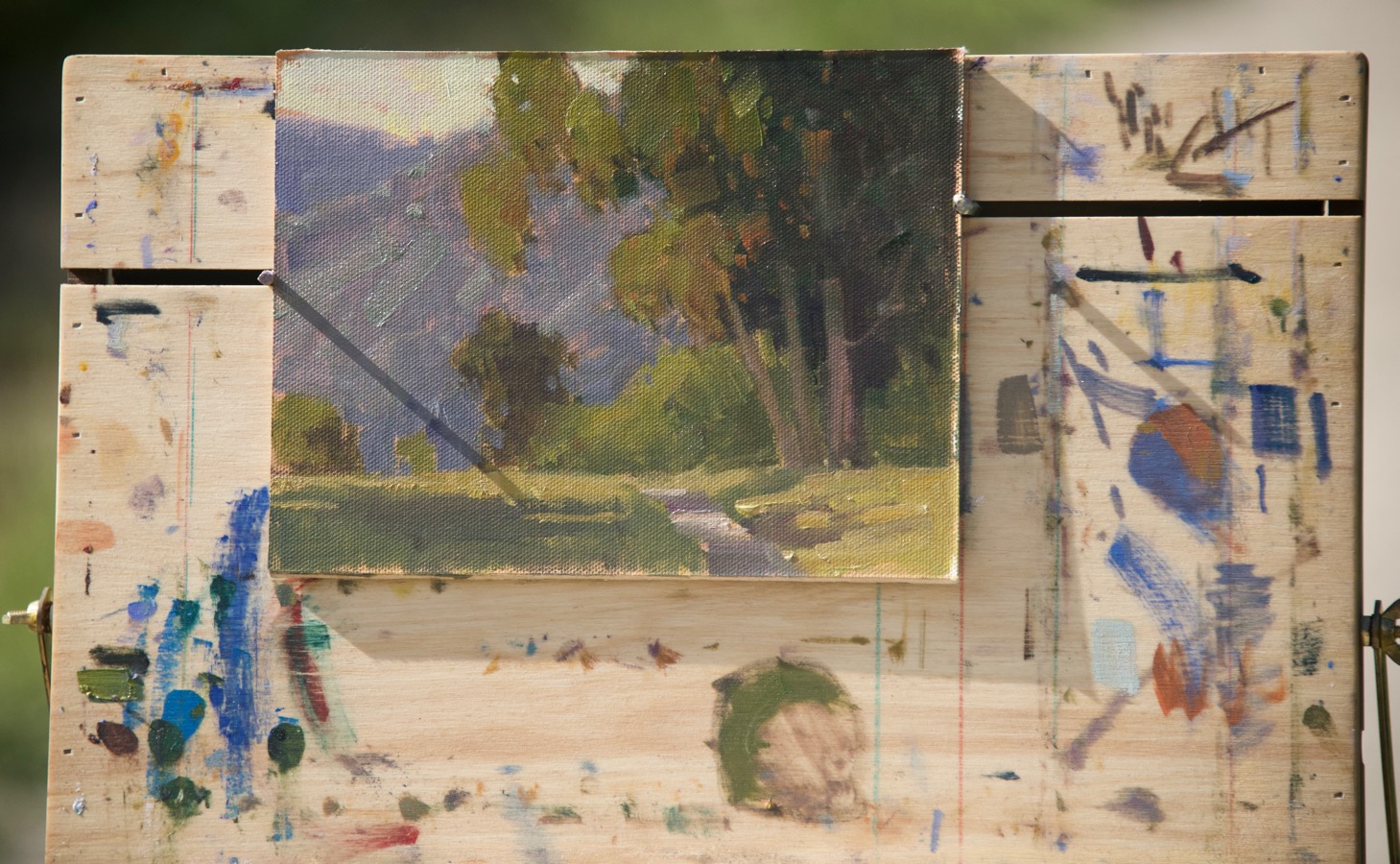
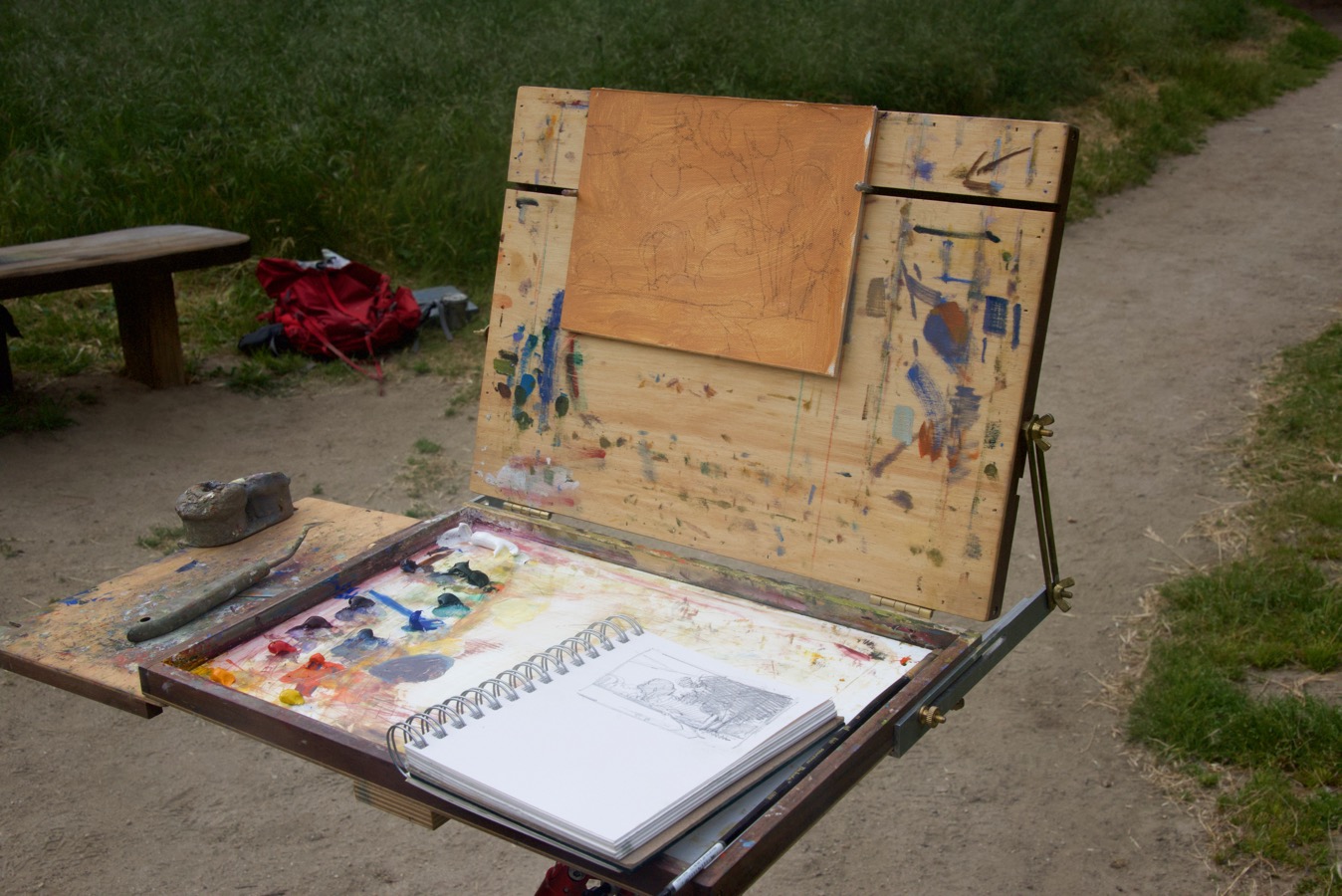
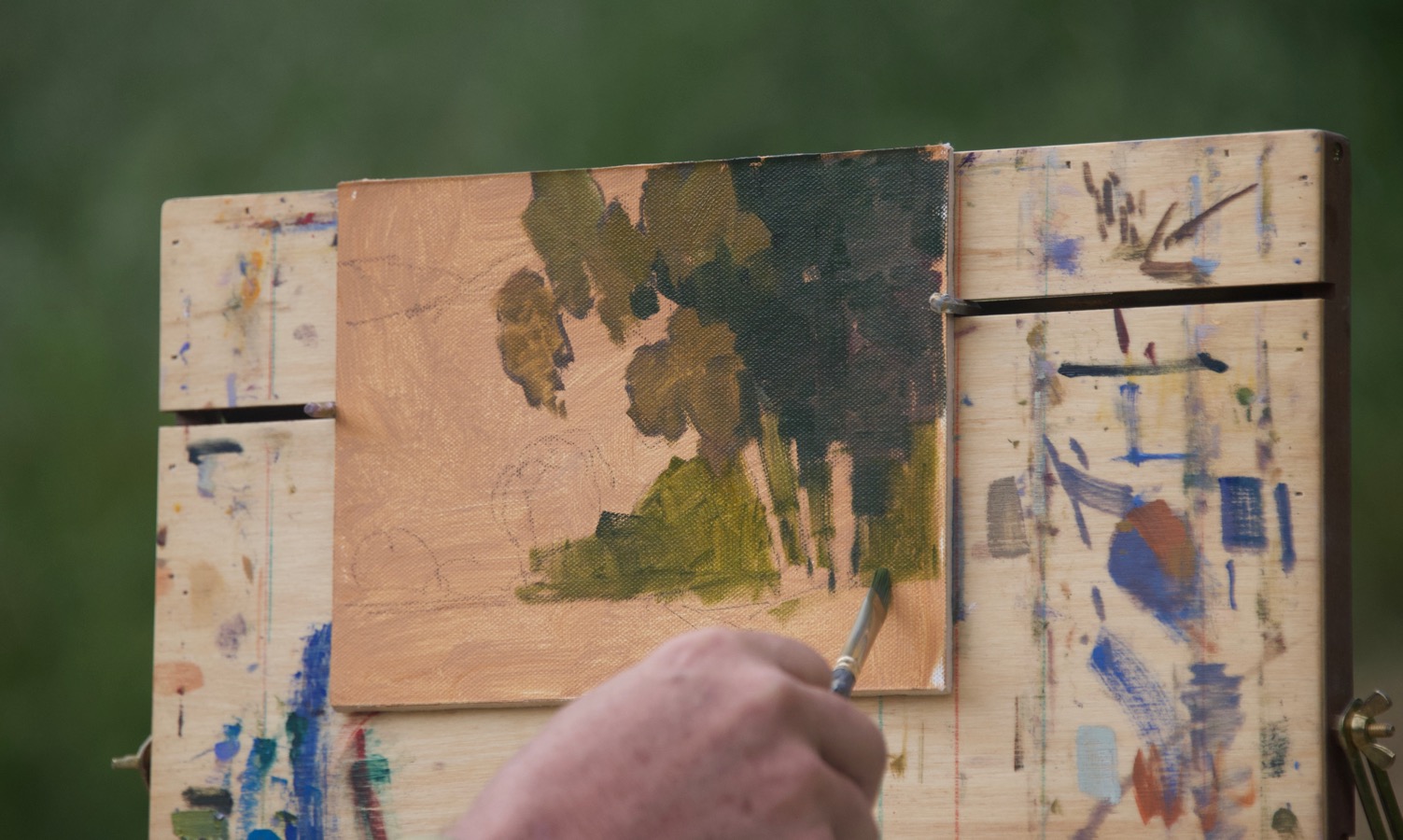
You can see Paul’s preliminary sketch and, faintly, the pencil layout on his panel. Here’s the sequence of the demo:
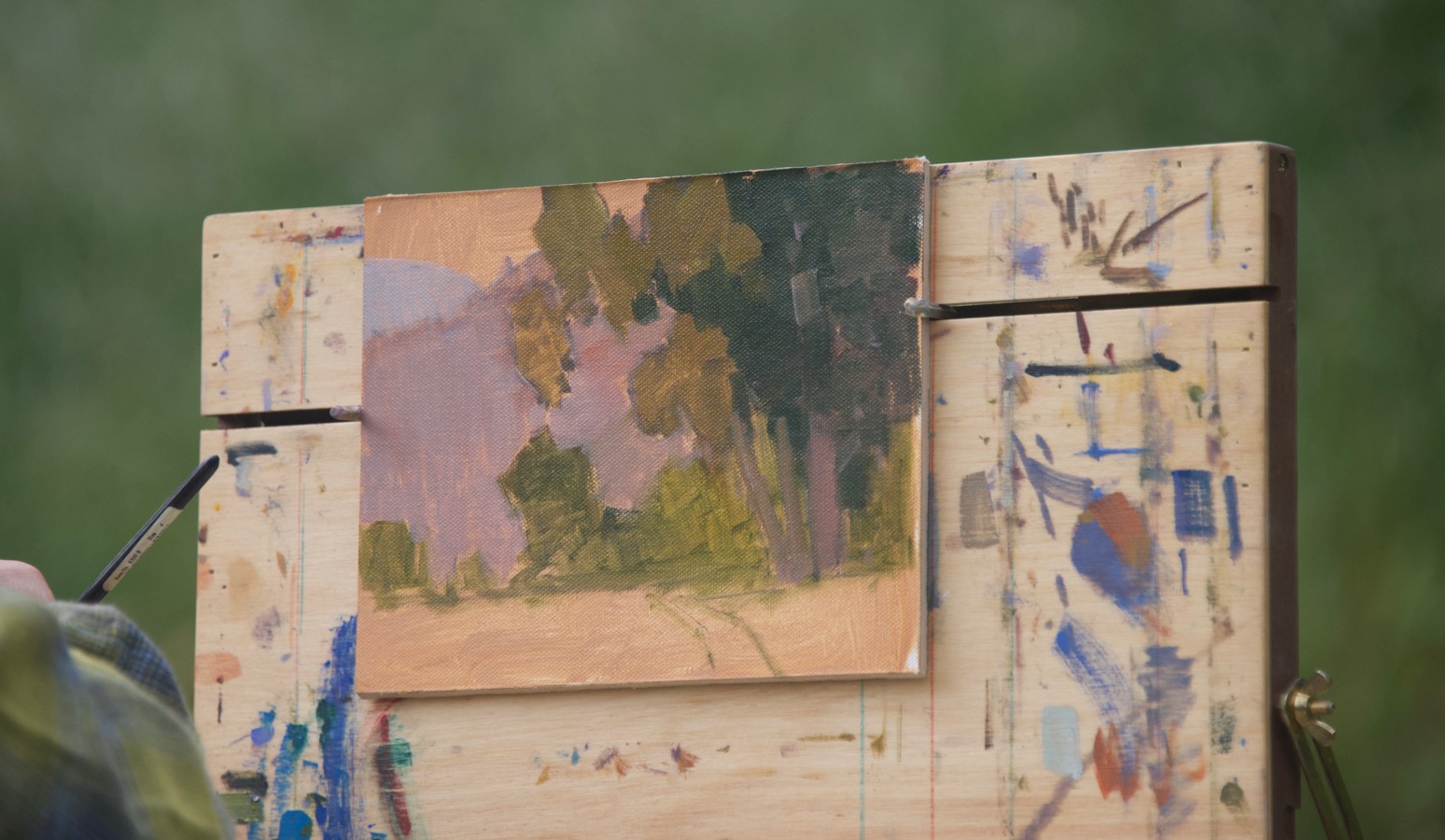
9

10

12

14

15

And I’m most pleased to say that this lovely painting is now in our personal collection.
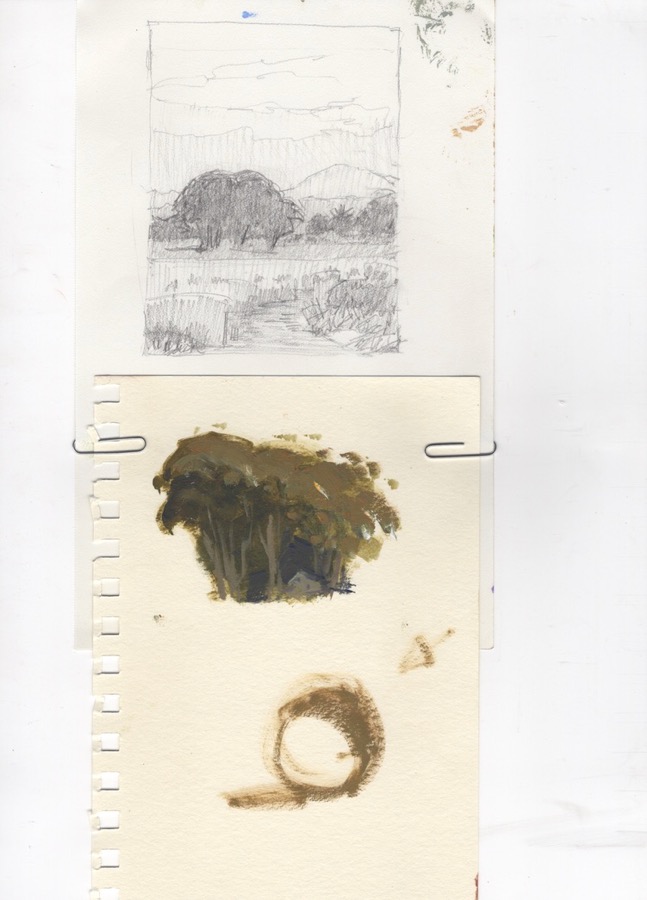
PK example


I had also decided to paint the eucalyptus trees. I was definitely focused on the overall composition and value relationships in my sketch. Paul is a connoiseur of trees, looking for the same individuality that I seek when I’m drawing or painting an animal. He came by, saw my sketch and then took a few minutes to do a custom demo and talk about capturing light direction correctly. I love having examples like this to refer back to when I’m home, so thank you Paul!
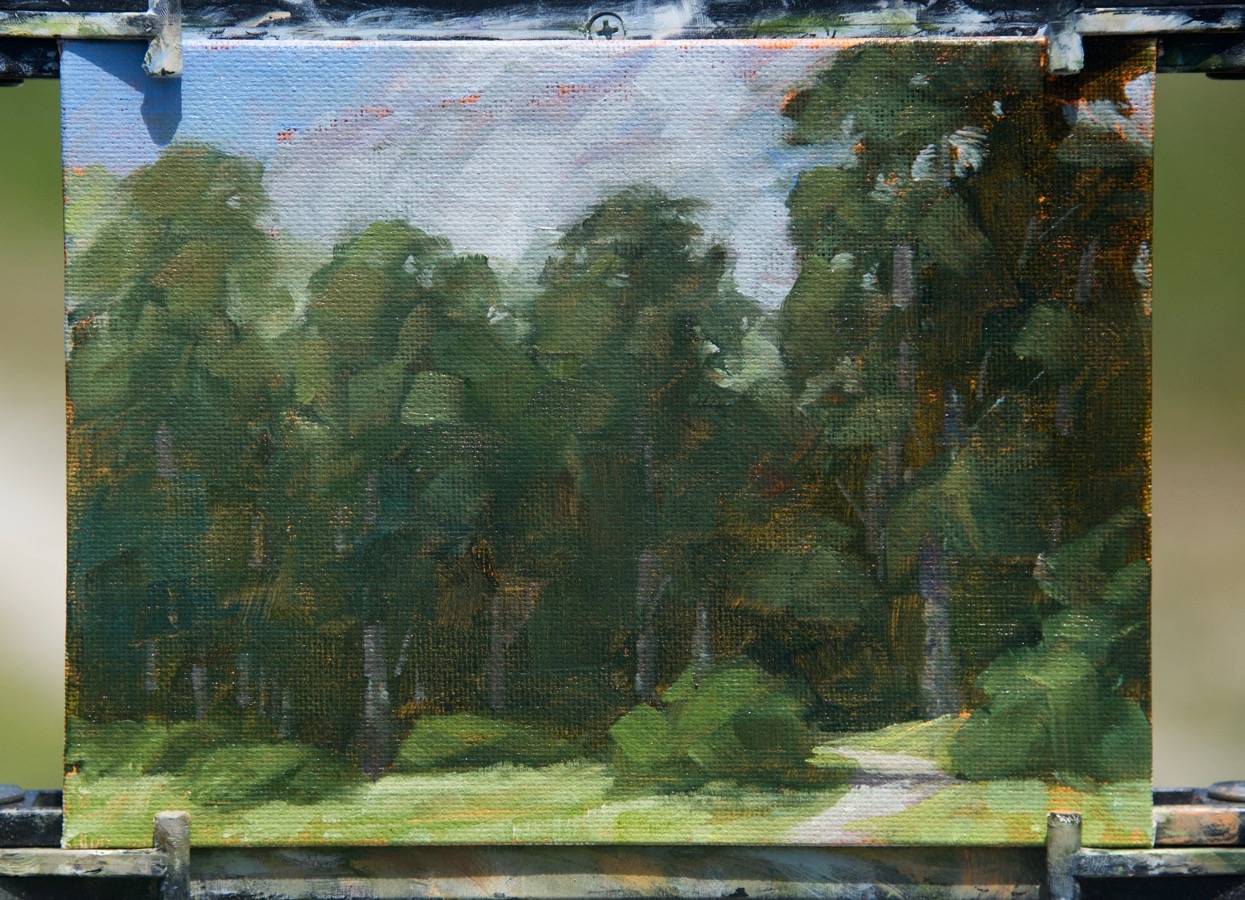
my trees

The final piece I did in the workshop. Went to a smaller size and a larger, flat brush and got loose. I’m happy overall with the result and brought home something I can build on. I go to a workshop planning to “fail”, not make pretty pictures that simply repeat what I already know. Why pay money for that?

A big, big thank you to Rich Brimer, the Director at Carmel Visual Arts, for a very well designed and run workshop! I had a great time and learned a lot.

The Times They Are A Changin’…

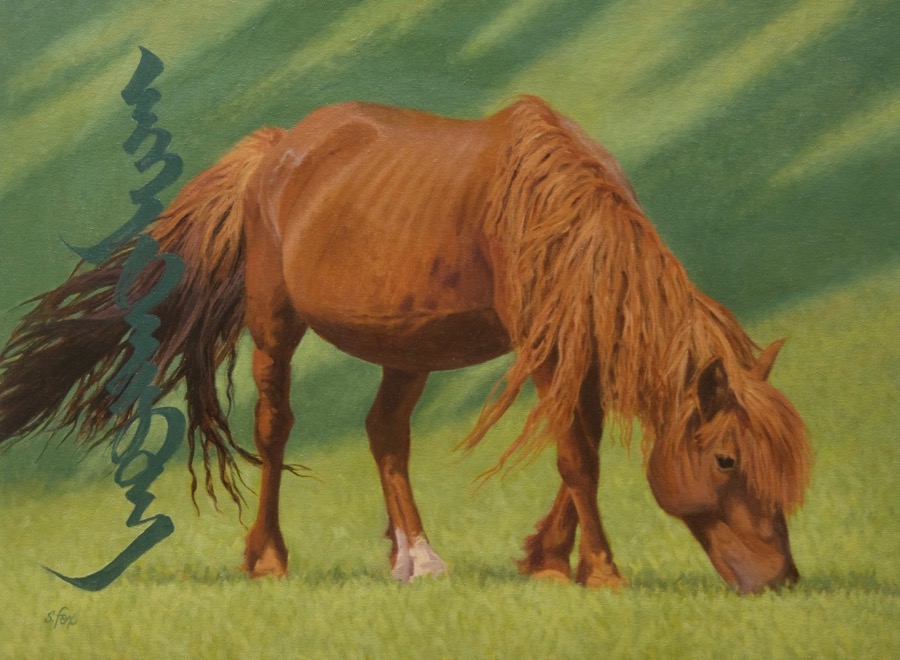
“Peaceful” oil 18×24″ $3000

On December 10, 2007 I published the first post on my new blog. Since then, except when I’ve been traveling, and sometimes even then, I’ve posted once a week and, for a year or two, twice a week. In the last few years, however, the way people get their information online has changed. Instead of sitting at a desktop or laptop computer they’re now mobile on smart phones and tablets. And they aren’t reading blogs much, as least as compared to the past. Long form is out, Tweets and Instagrams are in. My stats from the past few years show a steady drop in views. Super popular bloggers like John Scalzi have seen this happen too. So it’s time for a change. But….
One of the valuable things about my blog is the body of information that has accumulated about me, my art, my travels and whatever else has caught my fancy. I link people to various posts for a variety of reasons and for that it’s a resource that I will continue to use.

But it’s time to tweak my choices of the social media platforms I plan to use most in the coming years. My blog is now a “Journal”. I’ll post when I have information to communicate that requires the long form that a blogging platform is so great for. I plan to still post multi-part series on my travels, especially Mongolia, and I have some very interesting things in the works for 2018 that I’ll be announcing and discussing on my Journal.

I’m becoming much more active on Twitter (s_fox), Instagram (foxartist), LinkedIn (Susan Fox), along with my new Facebook group, FoxStudio, which you can find here. I’ll be closing down my public FB page on Dec. 31. You can also stay in touch with me through my quarterly newsletter “Fox Tales”. If you’d like to subscribe, just message me through my Contact page. Look for the announcement of the launch of my Patreon site in January!

Thank you to all my followers who have welcomed me into your inbox all these years! You’ll still hear from me, just not as often. I wish everyone the best in 2018!