My name came up on Julie Chapman’s blog about the article by Thomas Mangelsen in Wildlife Art Journal. In addressing the post and comments there, I ended up adding to my thinking about the issue. The post is here. Here’s my comment.
I guess since my name has come up, I ought to show up and comment here, although I suspect that my comments on the Wildlife Art Journal article make my feelings about the subject pretty clear. I have thought a lot about game ranches since my two experiences at them and have come to feel that they are not a place that I choose to go, for the reasons that I and Mangelsen enumerate.
So, FWIW:
I don’t believe that for him, and I agree, the issue is being a purist, but of being honest about how and where one collects images of genetically wild animals. If the photo is not labeled “captive”, then people are free to assume, as most do, that the image was taken in the wild, as Larry, and I at one time, believed. Truth in advertising, I guess. That’s not at all the game ranch’s fault or responsibility.
Painters don’t have the same issue of attribution that a photographer has, since a good artist generally uses multiple reference, or brings a unique point of view, for a painting and doesn’t simply copy a single photograph, theirs or anyone else’s.
I think as we live our lives we all end up in the position of having friends, sometimes quite good friends, who do things or have beliefs that we don’t agree with. The choice is either to accept that or end the friendship. Mangelsen chose to stay friends with Bob Kuhn.
By “old school”, I think that he may have been referring more to a way of thinking about animals that has changed dramatically in the last twenty years. We have gone from Descartes’ view that they are “machines”, driven by instinct, feeling no pain and having no souls to a recognition that we share the world with many sentient species. Year by year, the definition of what separates homo sapiens from animals has to be modified. Oh, they use tools. Oh, they recognize themselves in a mirror. Oh, they have culture. Oh, they have a sense of fairness. Oh, they lie and cheat. And the list goes on.
I have found that in order to reconcile, and be personally ethically consistent with, what I have learned over the years about animals and from my involvement in animal welfare (definitely not PETA-type animal rights, a whole different deal) and dog and cat rescue, I can’t justify going to game ranches.
I can, with reluctance, accept zoos that are heavily involved with education, conservation and the preservation of endangered species. I’ve pretty much reached the point where I choose not to support activities in which animals are used for human entertainment where there is a significant risk of abuse, either physical, emotional or psychological. I await the day when animals are no longer needed in any kind of research because computer models are superior.
My thinking is constantly evolving in this area as I add to my knowledge. My husband and I decided last year to no longer eat meat that we cannot source and that we do not know to have come from animals who have been treated humanely. This includes eggs. We refuse to support industrial animal agriculture, with its battery cages, feedlots and cruel confinement.
I wish to emphasize that these are all personal choices. I have no wish to dictate what other artists, photographers or people, in general, choose to do.
I think you can see that my decision about game ranches is just one part of a larger question that I’ve been thinking about for years- What is the appropriate relationship between humans and the fellow creatures we share this planet with?
PS, Larry- Barry Bonds- Being a Giants fan, I watched the whole thing play out. My opinion, and it is just my opinion, is that he probably used something in the 1980s at a time when many players did, so maybe the playing field was effectively re-leveled during The Steroid Era. Maybe he should be prosecuted (he’s charged with perjury, not substance use per se), but then there’s quite a few other ball players who used stuff and lied about it. How come they’re not on trial? His biggest problem has maybe been his attitude, which alienated the sports media, who often seem to feel an amazing sense of entitlement in what they feel they are owed by pro athletes. I’m not pro or anti Barry, by the way. It is what it is. Giants fans have moved on.
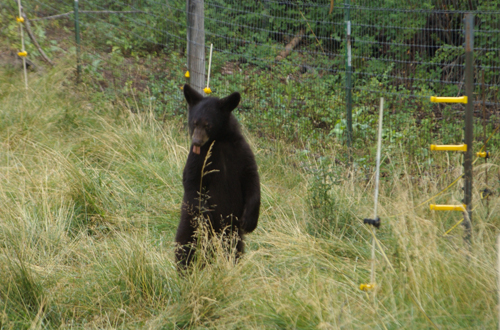 This bear cub was allowed to repeatedly shock itself on the electric wire in order to “teach” it to stay within the enclosure. The cub cried in pain every time and is seen here licking the spot that touched the wire. The keeper also “cuffed”, as in hit, the cub to “discipline it the way a mother bear would”. To my knowledge, the keeper had no formal training, certification or degree in animal behavior. This was in front of a number of artists, including me, and clearly the keeper had no problem with us seeing how the cub was being introduced to working with humans.


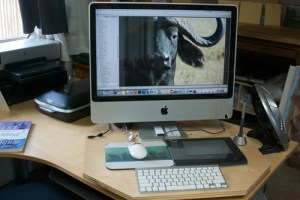 Using the image on the monitor, I did this value study-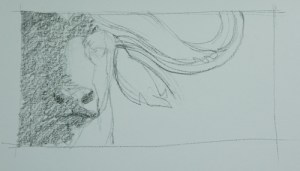
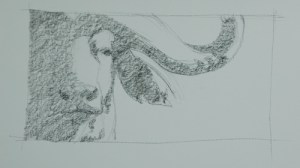
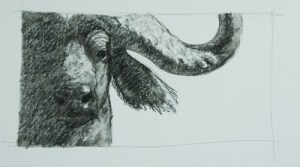 The finished study. The shadow area is treated as one big shape and I’ve “lost” all the rest.
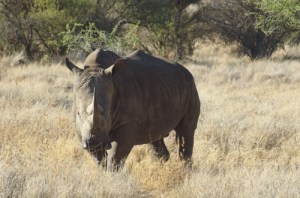 The starting image; a white rhino I photographed at the Lewa Downs Coservancy, Kenya, in 2004. The light side and shadow side are very distinct.
 The initial drawing. Why red? I could make up a really cool explanation, but actually I picked it up from Scott Christensen. Sometimes I use other colors depending on what I have in mind for the painting, but I tend to fall back on the red for these quick studies. One less decision to make.
 Once again, I’m laying in the shadow as one big shape.
 I’ve added color to the light side and also used the same tone for the background. Notice that I have left brush strokes showing for visual texture and that there are four different color temperatures in the shadow.
 I’ve now covered the background with paint and picked out the lightest areas on the rhino.
 The finished study, which took less than two hours. I lightened the background to pop out the shadows, added a darker tone on the left to pop out the side of the head and added some final brushstrokes at the bottom to suggest grass.
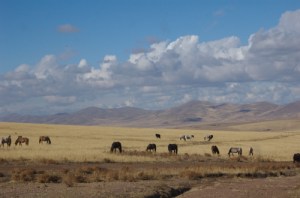 I love the colors, the clouds, the Mongol horses grazing, but compositionally it’s a long way from a painting. My plan is that this will be a major work, as in large, maybe 3’x4′ or more since I want the horses to be big enough that I can really paint each one individually. I learned this approach in art school when one of my teachers showed our class a painting he did of the Founding Fathers signing the Declaration of Independence. Why so big, we asked. Because I didn’t want to paint the heads any smaller than an inch high, he replied. Oh, we said. Taking that as a beginning, he knew how big the painting would end up being. I’m thinking each horse at 3″ to 4″ from the back to the ground. This could change, but it is a starting point.

 Notice that he hasn’t rendered a single individual leaf. But you know by the shape that it’s a tree. He’s “lost” all the leaf edges, but has “found” the backlighting. This design has only three major shapes: the tree, the background and the ground at the bottom. When you can simplify this way and see the big shapes, you gain so much control instead of letting detail control you.
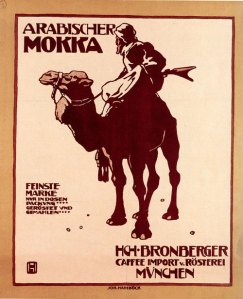 Ludwig Hohlwein was a master of shape design. Too bad he was happy to do work for the Nazis. In any case, here is a camel, done in two values and mostly in shadow. Add the rider and you have three values total. Nothing more is needed. As my Illustration 2 teacher said, “The simpler statement is the stronger statement”.
 Bart Forbes was working at the same time as Fuchs. He had his own take on “lost and found” and this is one of his best known images. Once again, very limited values. No excruciating rendering of the folds in the pants, but you still know exactly what they are, what color they are and that the light is coming from the left. The figure is fully defined and separated from the background by the shapes.
 David Grove came along and pushed things a little farther. Now most of the edges of the figure are lost. Or you could say that the light side of the figure is found and pulled from the background. Either way, you won’t miss that plaid shirt.
 Then Robert Heindel took lost and found to a whole new level with his paintings of dancers. (He also did the posters for Cats.). You have no trouble seeing what is going on. Her head is down and one leg is bent, with the edges appearing and disappearing seemingly at random, but of course it’s all carefully planned and the result of years of experience.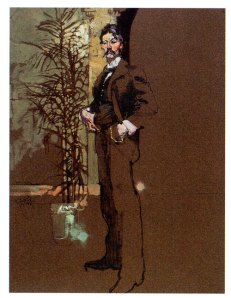
 Finally, sometimes you encounter an image that causes a permanent perceptual shift. This is one that did it for me, by one of my all-time favorite painters, Frank Frazetta. A lot of people never got past the subject matter, but this is someone who knew the craft of painting inside out and backwards and could draw rings around most people. He was one of the masters of lost and found. This tasty piece is painted on bare masonite! Heaven knows how archival it will be, but jeez. The warm shadow in the torso of the middle figure is the masonite showing through. I was totally blown away when I realized what he had done. Now this was before I was able to go to any major art museums and once I did, I saw that letting the ground show through is a classical approach that has been around for a long time. Another reason why it’s so important to see originals. Fragonard did a famous painting of a girl in a yellow dress, reading. The warm shadow on her back is the ground showing, same as in the Frazetta, except it was a paint layer, not the support itself. Maybe that’s where Frazetta got the idea. He just did it with Neanderthals instead of a pretty girl.
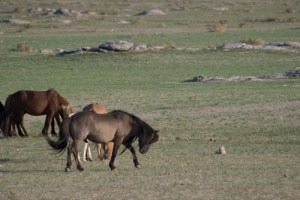 Here’s the reference image that I started with. It was taken in September 2008 at Ikh Nartiin Chuluu Nature Reserve. This group of horses wandered right past the ger camp one evening. I got lots of great pictures. Looking at them when I got home, I was struck by the stallion’s pose as he showed off around the mares. I haven’t done too many domestic horse paintings and I wanted to really focus in on understanding their structure and capturing the sheen of the coat, so I decided to use a fairly large canvas and only paint the horse.
 Here’s how I started. The support is gessoed canvas on hardboard and measures 24″x36″. I did an initial lay-in with a brush. All I cared about at this point was getting the horse where I wanted him on the canvas and indicating the proportions correctly. You can see on the front leg that is lifted where I have started to do the actual drawing.
 This step shows the finished drawing for the head, shoulder and front legs. At this point, I had dragged out all my books on horse anatomy to double check the structure and confirm that I had understood it correctly. Changes are easy to make at the drawing stage, but I’ll wipe out and re-do at any point if I see something that’s wrong. That’s just the way it goes sometimes and I don’t fight it or make excuses to myself anymore. I also have a full-length mirror behind me and I use it constantly to check the drawing for accuracy. I’ve designed the mane and the tail shapes, some of which are planned to go off the edge of the canvas so the horse isn’t floating and looks more like he just happened to be walking through the frame.
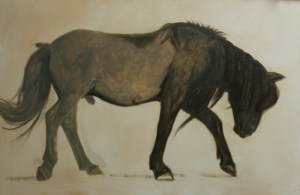 I’ve finished the initial color layers and am starting to paint with the knowledge that the strokes I make now will quite possibly be visible in the finished painting. I’m always refining the drawing as I go. One of the things that interested me about doing this particular piece is that you can’t see his eyes at all, so I wanted to capture his attitude and character from his body language and by painting him big on the canvas. I was also thinking of the design of the positive space -the horse- and the negative space -the background.
 Most of the basic lay in is done. All my darkest darks and medium tones are in, except for those patchy looking bits that I haven’t gotten to yet. Now the fun starts….all the juicy highlights, modeling and finishing touches that are a reward for the prep work leading up to it.
 Susan Fox, American Artist