Bobcat and Bighorns

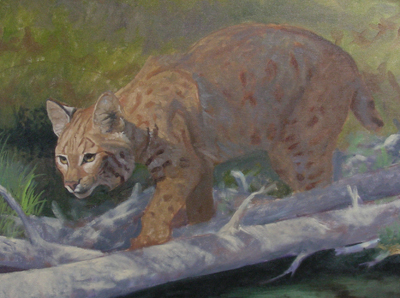
The bobcat painting is done. I’ve called it “Stepping Lightly”. It will make it’s debut at Wild Visions2, the group show with five other Humboldt County artists next month. The opening reception will be August 9 from 6-9pm. More later about the show and the other artists.

“Stepping Lightly”                   oil                               18″x24″

Now, a cautionary tale about reference and using captive animals as models.

I’m doing a painting that is a first for me, three panels. Here’s the reference I’m using. The animals were photographed at the Denver Zoo and the landscape is from up on Logan Pass in Glacier National Park.
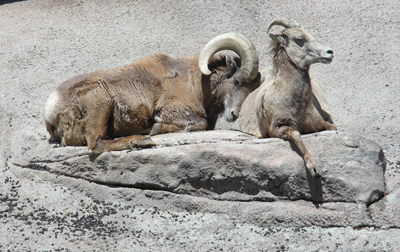
Is that a great pose or what? It was morning, warm and sunny, and the ram was getting sleepier and sleepier and finally his head gently dropped onto the ewe’s back. She never even twitched. Click. Gotta paint it. But where to put them? I chose this rocky outcropping in Glacier because I liked the shapes and knew that bighorns were often seen in the area. I did a preliminary drawing of the animals with the idea of showing them on a shelf of rocks. I wanted to communicate how comfortable bighorns are in an environment that we would find “challenging”. Here’s an in-progress shot that shows my setup with my iMac.
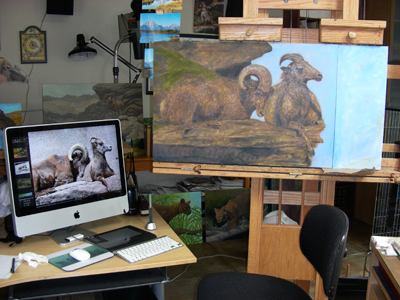
It’s great because Aperture lets me zoom in and out as needed very easily.

Another in-progress shot with the side panels propped on either side. At this point, I sent a jpeg to wildlife artist Laney, who has said nice things about my work the couple of times I have met her. She specializes in bighorns and I wanted her to eyeball the animals for drawing or any other problems. She replied very promptly and said that overall it looked good, but that the ewe’s hoof was in the wrong position compared to the rest of the leg and that the ram’s muzzle was too thin.

I went back to my reference and compared what I had with an absolutely wonderful book, Mountain Royalty, by famous Alaska artist Doug Lindstrand. As you can see from my photo, the ram in particular is shedding out, so it was a little hard to see the structure. Doug’s photos solved that problem and there was even a picture of a ram in a similiar position.

What I ultimately found was that while I had accurately drawn what was in my reference, it wasn’t “right”. The ewe’s hoof was at that funny angle, but that didn’t mean I should paint it that way, so I fixed it. When I compared my reference ram’s head with the ones in the book, I found that his head was really quite odd. Longer, thinner and with a roman nose that was much more exaggerated than the wild sheep. So I fixed his muzzle and re-proportioned his head as needed.

The other question I had for Laney was whether or not this behavior might be observed in the wild. She replied that the rams were only with the ewes in winter, so maybe I’d like to add some snow. Ah, well. In the zoo, of course, the animals are pretty much together all year around. In the wild when I shot my reference at the beginning of May, it was unlikely. Cue the snow reference. And, what I found was that it was the frosting on the cake since it brought the cool of the sky into the rock area and helped pull the whole thing together. Thanks Laney!

The moral of this story is that you can’t have too much reference, don’t assume that zoo or captive animals look the same as wild ones, do your fieldwork and learn about your subjects and finally, it is tremendously helpful to have a knowledgeable eye like Laney’s to look over what you’ve done and to it keep on track.

I finish the painting today and it goes in for framing tomorrow. I’ll post an image of it once it’s on the wall at the show.

ART THOUGHT FOR THE DAY

Experience enables you to recognize a mistake when you make it again.

Franklin P. Jones

Drawings from live animals and new painting

From the stats it looks like the post of my pet sketches was one of my most popular so far, so here’s more. These are done the way I usually work, with a fine tip gel pen. They’re done fast. Under five minutes, sometimes under two.

Niki, our tri-color rough collie

From the San Francisco Zoo. He really did hold still long enough for this head study.

These were ultra-quick, a minute or less, but I caught the gesture. Also San Francisco Zoo.

And, looking through my old sketchbooks, I came across the studies I did at Julie Chapman’s workshop in 2005. These are of Daisy, the badger, who alas, is no longer with us. Notice that I didn’t worry about eyes. I was trying to capture “badgerness”.

If you decide to try this, and I hope you do, keep in mind that every animal is an individual and look for what makes them them. If you like what I do, I think that’s a big part of it.

I’ll end with the bobcat painting, now called “Stepping Lightly”. I’m thinking of punching up the highlights on grass and maybe futzing (that’s the technical term, of course) with the logs some more, but that’s about it.

PLANET SAVER TIP OF THE DAY

This one’s easy. Start to become aware of how you use energy. You can save money and help slow down climate change by using less and using it more wisely. Just little stuff to start- turn lights off when you leave a room, don’t leave the tv on if no one is watching, turn your thermostat down a couple of degrees or up, depending on the temperature where you are.

Now, you must know that this kind of thing, while necessary and desirable, is the “low hanging fruit”. It requires simple changes of habit, not real sacrifice. If you’re already doing the above and are ready and able to take the next steps, consider updating your older appliances to new, energy-efficient models. Change your incandescent light bulbs to compact flourescents or LEDs.

For more information and actions you can take, check out www.motherearthnews.com and www.builditsolar.com

What ideas would you like to pass on to me and my readers? We’re all in this together, after all.

News Flash!

“Autumn” has been accepted into the 16th Annual Juried Art Competition Show and Sale at the Breckenridge Fine Arts Center! It will be there from August 25 through September 28.

Paintings in Progress

A few of you may remember that I was posting images of an elk painting in progress. I’m sure the suspense has been killing you. As it happens, it was a bust. Too many problems with the drawing of the elk that I saw after I’d let it sit awhile. Win some, lose some.

But here are two that are well on the way-

First is a bobcat I photographed at the Triple D Game Ranch and transferred to a more interesting setting that I shot on the Firehole River in Yellowstone. The trick, of course, is to make the light match when the reference is from two different locations, like Montana vs. Wyoming. However, both are morning light.

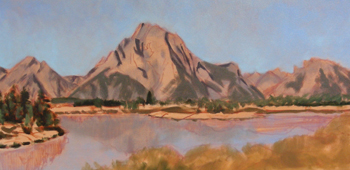
The second is Mt. Moran at Grand Tetons National Park with the famous Oxbow of the Snake River in the foreground. I’ve got three pieces of reference up for this one. One is overexposed for the mountains, but has the compositional angle I want and great reflections. The other two have rich color and show more detail of the mountain. For this subject, as I learned from a workshop I took a few years ago with Jim Wilcox, one has to introduce some atmospheric perspective in order for the painting to “read” correctly. The air is soooo clear that the Tetons look to be a few hundred yards away, but actually they are around 10-12 miles from the major vantage points along the road. So, getting the value relationships right is critical. And so is being decisive and accurate in the drawing of the mountain. It’s really a portrait in rock. Stay tuned.

ART THOUGHT FOR THE DAY

I see a flower. It gives me the sensation of the beautiful. I wish to paint it. And as soon as I wish to paint it I see the whole subject-flower-changed. It is now an art problem to resolve.

Georges Vantongerloo

Show news!

I just received notice that my painting “Thompson’s Gazelle” has been accepted for “Art and the Animal Kingdom XIII” at the Bennington Center for the Arts. This is the third year in a row that I have gotten into this show, plus twice into their “American Artists Abroad” exhibition. John Seerey-Lester, who I have studied with a number of times over the past ten years and who knows African wildlife very well, to say the least, was the guest juror, so that makes this one quite special. You can see the painting on my Feb. 26 post.

ART TALK

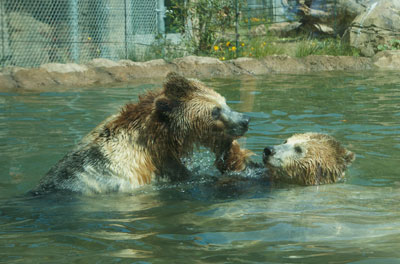
So, here’s one example of the kind of reference I got at the San Francisco Zoo this past weekend. Just about filled a 1Gb memory card with the antics of these two sisters, who were orphaned up in Montana and have found a home in San Francisco. They played up a storm in the water for about ten minutes. I wasn’t sure what would happen shooting through the thick glass, but other than a slight cool cast, they’re not bad. Upon review, as expected, no one of the photos I took is quite what I’m envisioning, but parts of them are excellent.

The gorillas were very active, as were the penguins. Got some kangaroos in mid-hop. Big cats pretty much flaked out. It was amazing to look at the enclosure walls closest to the public and realize that Tatiana, the Siberian tiger, was able to go straight up and over one. Now there’s more concrete wall, glass and heavy cyclone fencing secured with cables. Signs everywhere with shushing lips and others with the prohibition about teasing or harassing the animals and a phone number to call to report any such activity. Quite a few times, I heard parents quieting down their children. In general, it seemed quieter and more polite even on a busy weekend, which made the zoo a pleasanter place to be, really. Nicer for the animals too.

Eggs and Elk

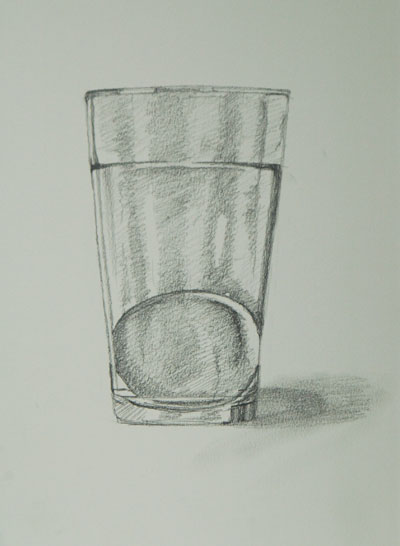
Ok, here it is, as promised. Sure to bring a million dollars at auction 1oo years after I’m dead and gone (which means it will probably go for about five bucks). Took about 30 minutes.

egg-in-water-glass.jpg

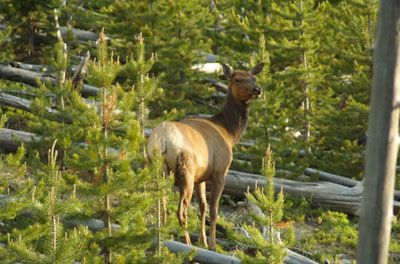
I thought that I might start to post works in progress which, one, always gives me something to blog on, and two, may provide one answer to “How do you artists do this stuff?” So, here we have a start of a cow elk that I photographed in Yellowstone in June of 2005, along with the reference photo. I was “game driving” between Mammoth and Norris and up on a hillside a group of elk were grazing. As you can see, they were in one of the burned areas. Lots of downed tree trunks and fresh new pines coming up.

yellowstone-elk2005-06-25.jpg

cow-elk-in-progress.jpg

The first questions I ask myself when I have an idea for a painting or am inspired by reference I shot are:

1. What makes me want to paint this? In this case, it’s a combination of the light, her graceful pose and I haven’t done an elk painting for awhile. A painting needs one strong idea and everything else is subordinated to it (Thanks, Scott Christensen). Every artist finds their own way to do that.

2. What is the best size and proportion of canvas to communicate the idea of this painting? (Thank you, John Banovich) As you can see, since my idea is the cow elk with the great light, most of the background was extraneous, so I chose a vertical format. This is a simple subject and, for me, didn’t really call for a big canvas, 16″x12″ seemed about right. But someone else might have decided that female animals don’t get the prominence in the art world they deserve and done her six feet high. Both are equally valid choices. I’ve had viewers of my paintings comment that they like seeing something besides bloated trophy males and enjoy my more off-beat subjects, which is encouraging. But ultimately I paint what I want, the way I want and then try to find a market.

3. As I lay in the drawing with a brush, I’m already thinking about the value (light/dark) pattern. I want the area of highest contrast where I intend the viewer’s eye to land. So, from the beginning I’m altering my reference to suit the idea of the painting. This brings us to the use of photographs in painting; the good, the bad and the sometimes seriously ugly. I have strong opinions about it (surprise. not.), but that’s a topic all by itself. Suffice to say for now that if you don’t have a strong idea of what your painting is about, then you may end up as one of those legion of artists who end up copying their photos, rather mindlessly sometimes. The key is “mindless”. Photorealists have made a quite conscious choice to work a certain way. Do what you want how you want, but do it by choice, not default.

So, here we are after two sittings. During the first, I solved the design: where the animal would be, how big and roughly how the surrounding habitat would go. In the second, which took about an hour. I refined the drawing, laid in my darkest tones and figured out roughly where the small pine trees would be, watching out for bad tangents (which is when two objects on different planes touch, which destroys the illusion of three dimensions) and deciding where the areas of highest contrast would be. California landscape painter Kevin Macpherson comments in one of his books (buy both if you want to self-study oil painting) that a painting is a series of corrections, which is so, so, SO true. When everything is corrected, you’re done. So simple, really.

Final notes (for now): I work mostly with round brushes. I like the calligraphic marks I can make with them, having been a calligrapher and sign painter at one time. I go 3-5 shades darker in value all over and then come back in with successively lighter values. I also try to work “lean to fat”, artist talk for going from thin paint to thick paint. Look at some traditional oils next time you’re at a fine art museum and you can see it. It’s one reason only seeing reproduction is of such limited use. Everything is flattened out. Original paintings have a literally third dimension of paint thickness. Fellow artist Julie Chapman’s work is a perfect contemporary example. You can’t really appreciate her lush, juicy brushwork unless you’re looking at the real thing.