Mongolia Monday: The Best Camping Trip Ever, Part 2 – Baga Gazriin Chuluu Nature Reserve, Delgeriin Choiriin Khid

Even though I only spent two days there last year, Baga Gazriin Chuluu was a place that I really looked forward to visiting again.

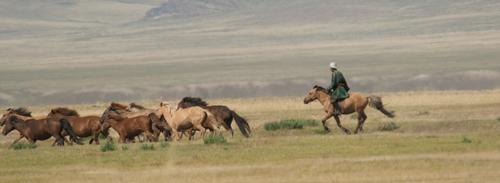
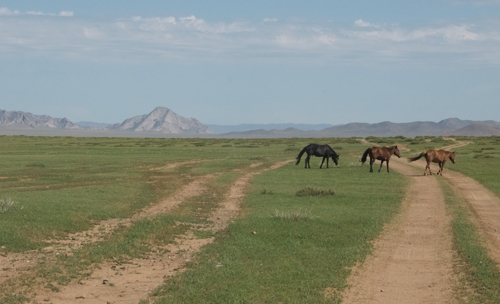
A harem of local horses near our camp

One of the best experiences was visiting the ger of Yanjmaa, who had made boortz soup from scratch for us and served me a bowl of the best yogurt I’d ever had. Would she still be around? Although she had relocated her ger, the answer was “yes” and we had another lovely visit, but also learned something disturbing about the wildlife of the reserve.

There was a zud in Mongolia this past winter, which is a combination of a dry summer and a very severe winter. It was a national disaster that was occurring the same time as the quake in Haiti, so there was very little media coverage until early in 2010. The last estimate I read said that around 10 million head of livestock died.

Yanjmaa told us that no argali or ibex had been seen in Baga Gazriin Chuluu since February.  Before then, she had gone out one morning, and to her surprise, found a large ibex billy in with her domestic goats. He was very weak, so she managed to get him into her ger and onto her bed, hobbling him when he started to thrash around.

Having been a vet before she retired, she tried to treat him by offering him cold water and a medicinal plant, shavag, which contains lots of vitamins. Finally, she moved him back out to the goat enclosure, where he died.

Our first thought was that the argali and ibex had all died, like the ibex, but later on that day, it occurred to me that wild animals sense what is going on in their world and that it was more likely they had all simply left as the weather became extremely severe. In some parts of Mongolia, the temperatures dropped to -50F.

Talking with the reserve ranger, Batsaikhan, the next day, we confirmed that the ibex and argali were gone, around 160 animals total. Khatnaa had told me that he had seen 10+ argali about 20 km east of Arburd Sands, which is about a four hour drive north of Baga Gazriin Chuluu, on July 5, a week earlier. This was outside their normal, known range and preferred habitat.

That evening, Batsaikhan came by our camp to give us really good news. A group of visitors had reported seeing a group of argali just within the reserve! Perhaps they and the ibex will all, or mostly, come back to Baga Gazriin Chuluu now that the weather is good. I hope so.

On our way to find Yanjmaa, we had passed through an area that had a number of vulture nests, one of which was on a cliff near the road with a fledgling cinereous vulture in it. I got some good photos from down below, but Khatnaa climbed up behind the nest and came back with some amazing images. We went back the next day and this time I climbed up with him and found myself just slightly above the nest, about 8 meters away. What a photo op!
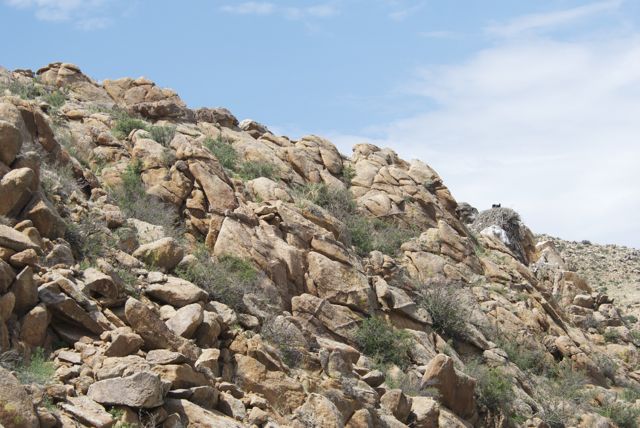
Cinereous vulture nest from below

He/she knew we were there, but never showed any stress. The adult had taken off as soon as we got out of the car, so I felt comfortable staying for awhile and taking almost 100 photos.
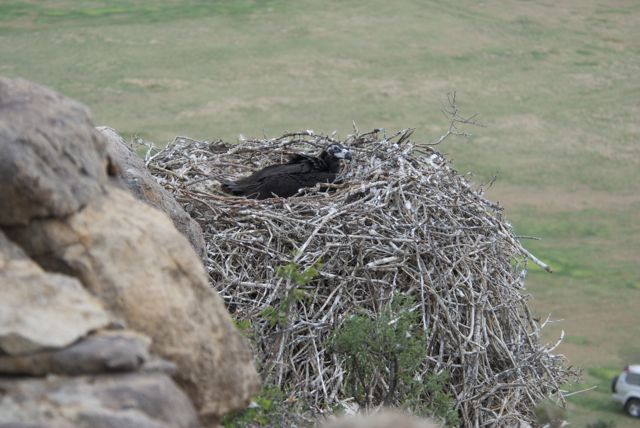
The young occupant

Later that afternoon, we took a side trip out of the reserve to visit a local monastery, Delgeriin Choiriin Khiid. It was one of the many, many monasteries destroyed in the late 1930s, but is now being rebuilt. There are 15 lamas in residence. I was allowed to take photos in the interior of one temple, which is in a large ger.
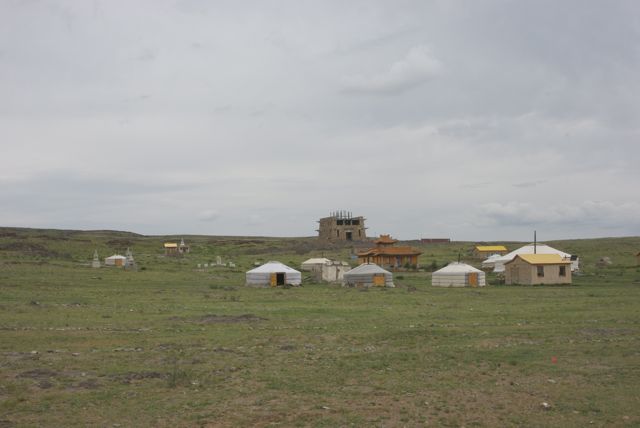
Monastery grounds
Interior of ger temple

The next morning we departed for the fabled Gobi.

Mongolia Monday- The Three Manly Sports of Naadam

Coming down to the wire now. Departure for Mongolia is the day after tomorrow. This will probably be my last post until the week of the 25th. In the meantime, enjoy these videos of some of what I’m hoping to see this coming weekend.

“Naadam” means festival in Mongolian. The biggest festival of the year is the one coming up this weekend in UB. Smaller naadams will be taking place before and after the national event and one or two of those are what I’m shooting for since one can get a lot closer to the action.

First up- Archery:

Second- Wrestling:

Third- Horse racing:

And, finally, a short video that not only includes the events above, but winter camel racing.


Mongolia Monday: Boroo (Rain)

Mongolia gets very little rain and most of what does fall comes in the summer. After the brutal winter zud (a drought year followed by an extremely cold winter with heavy snowfall) that hammered the country these past months, a year of good rainfall would be a blessing, indeed.

Being a herding culture, the Mongols have always depended on rain to grow the grass they need for their animals. The rainy season is short, so I suspect that as wonderful as a Mongolian summer is, it’s also a time for some anxiety.

In 2008, rain came late, at the end of August. My husband and I were at Ikh Nartiin Chuluu Nature Reserve. We arrived on a beautiful evening. It started to rain at around 3am and didn’t stop for 18 hours (we counted). But we had perfect weather for the rest of the trip.

In 2009, on my Artists for Conservation Flag Expedition, it was definitely the rainy season, even though there wasn’t enough to break the drought.

Here’s a few of my favorite “boroo” photos. (Note: “Boroo” is pronounced more like “baurau”, with a rolled “r”.)

Naadam opening ceremonies, July 2009; the colorful show goes on for everyone, including the Mongolian State National Grand Orchestra
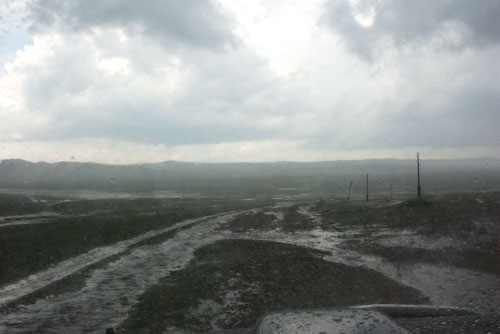
Heavy rain/hail en route from Ulaanbaatar to Arburd Sands ger camp, July 2009
One of the hailstones; roof of vehicle was dented
On-coming rainstorm at Ikh Nartiin Chuluu Nature Reserve, July 2009; it rained hard for an hour and a half so I just stayed in the cozy ger; the white rectangle in the background is one of the toilet enclosures. Yes, it was a bit of a walk.

Rain has, so to speak, seeped into the culture to the point where it’s a leitmotif in many of the music videos I’ve watched and clearly has romantic connotations. Sometimes it seems like there has been an informal competition between groups and singers to see who can work the most rain into their video.

Here is one from Javhlan. Imagine this singer with an absolutely glorious voice, standing in the woods singing as the crew poured “rain” onto him. I’ll bet he only needed one take.

And, taking it even further, is A Capella’s “Boroo”. Hope it was a warm evening.

Finally, instead of a set-piece like the previous two, Guys 666, who normally seem to be hard rappers, did this video, also called “Boroo”, that tells a story, albeit not an entirely happy one.

Mongolia Monday: Teaching Myself Mongolian

Today I thought I would share how I’m studying to learn Mongolian. I had two years of German in high school and before that, had had some private lessons in Japanese before a trip that my mom and I took with two other couples to Japan in 1968 when I was fourteen. That’s pretty much the extent of my foreign language experience. (Trying to teach myself Welsh was a non-starter and I don’t know that learning to read the Canterbury Tales in the original Middle English counts)

Before my second trip to Mongolia in 2006, I decided that I both wanted and needed to learn at least a little of the language since I was going to be traveling on my own for over three weeks with only Mongolian guides and drivers. The guides, at least, speak decent English, but I was going to be finding my way around Ulaanbaatar on my own part of the time.

The first sign I could read; the ubiquitious "KHAN BANK"; Hovd,Sept. 2006

I advertised in our local news/art/culture weekly for a Mongolian tutor (in rural Humboldt County, California?) and, guess what, I got a phone call within two days. Seems a woman from Mongolia, who had met and married an American guy who was there serving in the Peace Corps, was at a party with her husband and a number of people asked them if they had seen the ad.

It turns out that she had only been in this country for a couple of months, so her English was still very uncertain. He called me and we set up a meeting between her and I. It went well and we were able to get together about a half dozen times before I left. Even better, we’ve stayed in touch and become friends with them.

She drilled me in basic pronunciation, got me going with some basic vocabulary and taught me necessary phrases like “hello”, “thank you” and “I’m from California”. Her husband contributed a word to use if someone hassled me- “Yasambay!” (sic), which means “What are you doing?”, the idea being that the person would be so shocked at hearing Mongolian from a non-Mongol that he/she would immediately stop whatever they were doing. As it happens, I’ve had no occasion to say it so far.

That tutoring, plus a copy of the Lonely Planet phrase guide for Mongolian is what I had until last year.

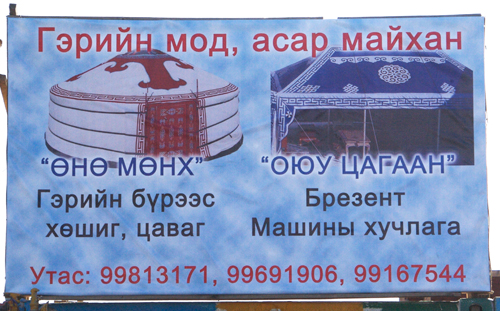
Banner for tent sales, Narantuul Market; Ulaanbaatar, May 2005- top line: "GERIIN MOD, ASAR MAIKHAN" - Geriin is, I believe, the possessive of ger, the felt "tents". Maikhan are the summer tents; "ONO MONKH", followed by "GERIIN BUREES KHOSHOG, TSAVAG"; OYUU TSAGAAN", followed by "BREZENT MASHIN KHUCHLAGA"; last line "UTAS", "Call:"

After sitting mute, and depending on a translator, during my three days of meetings with the herder women in July of 2009, I decided that it was time to get serious. While I was in Ulaanbaatar I bought Mongolian-English and English-Mongolian dictionaries.

When I got home I started to comb the web for a language program and found one from Transparent Language. (None of the other major foreign language companies offer Mongolian as far as I can tell). It is based on word lists that are viewed on “cards”. Each word is in Mongolian Cyrillic and and a transliteration into the Latin alphabet. One can also listen to a male native Mongolian speaker and repeat back each word. It even lets you slow down the speaker so you can hear the word better. There are a variety of other activities like typing out the words and some simple games.

I had also bought a small stack of music CDs and rapidly realized that I could use them, too. The perfect two-fer, listen to cool pop and rock music and study Mongolian at the same time.

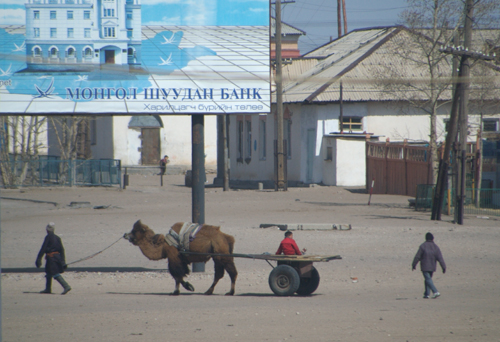
Billlboard; taken from train on the way to Ikh Nartiin Chuluu, April 2005 (I may have started to fall in love with Mongolia at this point, seeing the bactrian camel cart)- "MONGOL SHUUDAN BANK"

But I was still struggling to get anywhere. As it turns out, my husband had to learn Russian when he joined the Air Force (and if I say any more, I’ll have to kill you). He told me the first thing he and his classmates had to do was memorize the Russian alphabet overnight. He suggested that I back up and learn the Mongolian cyrillic alphabet. I managed that in a few evenings and suddenly it got a little easier.

I’d started to “collect” words, writing them on a pad of paper. That reached its limit of practicality pretty quickly. I bought a copy of Bento, the consumer-level database program for the Mac and created my own word list, which is divided into categories like English, Mongolian, part of speech and subject (animal, food, furniture, etc.). I can sort my list by any of them, which is very useful and why I bought a database. It will be on my laptop, which travels with me, but I’m also going to print it out in each category to have handy in the car or when I’m walking around.

Recently, a commenter on another post told me about Anki, a downloadable program that generates “cards” with whatever content one wants like, say, Mongolian words. This is the same model the Transparent Language package, Byki Deluxe, uses, but those are pre-set. I’ve downloaded Anki, which is free, but haven’t had time to mess with it.

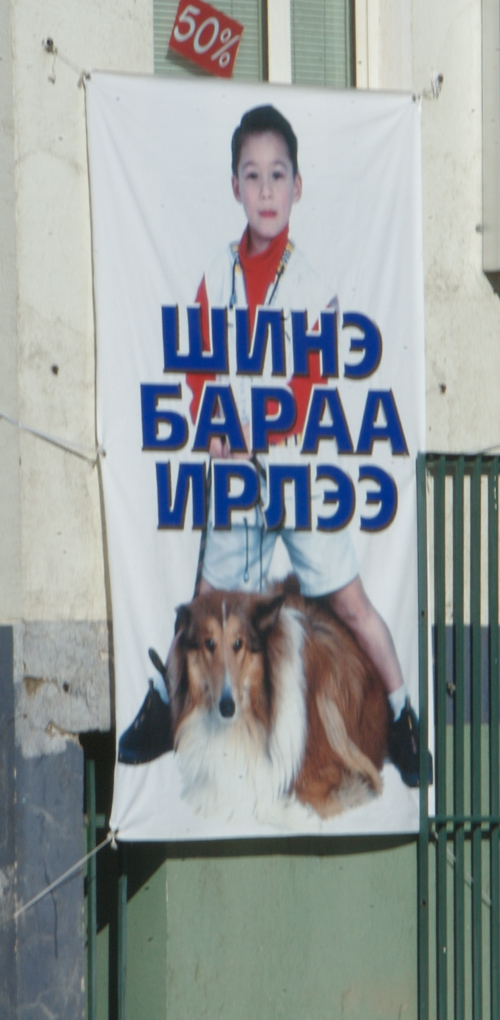
Well, that banner was a surprise. Are there actually any collies in Mongolia? I have no idea. Ulaanbaatar, Sept. 2006- "SHINE (new) BARAA (merchandise) IRLEE ("has arrived", I think it means)"

Then a French Facebook friend (say that fast three times) told me about PowerWord, which includes Mongolian as one of their offerings. So, for $8.99, I now have a Mongolian language program on my iPhone, too. It is also based on word lists, like Byki, but so far I think I like the way it’s organized better. It also has a spoken component, this time with a female voice.

Of course, the best and fastest way to learn will be immersion in the language once I get to Mongolia. But I hope I’ve “primed the pump” for rapid progress with the study that I’m doing before departure.

Chinggis is everywhere; Ulaanbaatar, Sept. 2006- "ENERJI"; the lines above and below the main word are in a script that I can't quite figure out for every letter. The block lettering is easy by comparison.

Comments and corrections welcome!

Mongolia Monday- 6 Things I Haven’t Seen Or Done In Mongolia. Yet.

It’s the last installment of my six part series. This week it’s going to be what I haven’t done yet. Of course, it’s an endless list, even for one country, because there’s always something new crossing one’s radar. But I wrote down the first six thoughts that came to mind and found that I do have a good list of things that I really do want to do or see and that are reasonably achievable.

Not having done them yet, I don’t have images. But I’ll share some which I took on previous trips that are related and also have inspired my list.

1. Gallop on a horse across the countryside– I am not a rider, but I’ve always wanted to do this (maybe it was all the western movies I watched as a kid). I looked into it once and the riding teacher I spoke with said six weeks of lessons at least to get to that point. Needless to say that didn’t happen. But in Mongolia…..I trust the horses and the horsemen, so maybe it’s possible. We’ll see.

Herder with horses near Hustai National Park, Sept. 2008

2. Attend the Yak Festival– Now really, who could resist that? Not me, that’s for sure. My current understanding is that it was started by a dairy company and is held around the first weekend in August, which means I can probably go this year! According to the Wikipedia entry for “Yak Racing” the activities include “…yak racing and showing, wild stallion and yak rodeo riding, milking contests and other traditional Naadam events of horse racing, wrestling and archery.”

"Ride me? The heck you say." Yaks at Gun-Galuut Nature Reserve, July 2009

3. See Burkhan Khaldun– This is the sacred mountain where Chinggis Khan dedicated himself to Tenger, the Sky, went to pray and, on a few occasions, hide from enemies. It is still an important place in Mongol culture. I don’t know if non-Mongols are allowed or welcome onto the mountain, but I would like to see it.

Tahilgat Hairhan in the distance; en route between Baga Gazriin Chuluu Nature Reserve and Ulaanbaatar, July 2009

4. Take a lesson in writing the ancient Mongol vertical script– Back in the 1970s and 1980s, I worked as a sign painter, graphic designer and calligrapher. I’ve always loved lettering and type. I spent a lot of time learning to letter with a sign painting quill (brush), along with pen and ink. “Oriental” brush lettering never particularly attracted me, however. Then I went to Mongolia and saw the vertical script, which Chinggis Khan adopted from the Uighar people because he realized that he couldn’t run his empire without a writing system. As you can see  below, it’s still in use today, 800 years later. And it’s stunningly beautiful.

One of the first times I saw the Mongol script; large banner on building across from my hotel, Ulaanbaatar, Oct. 2006

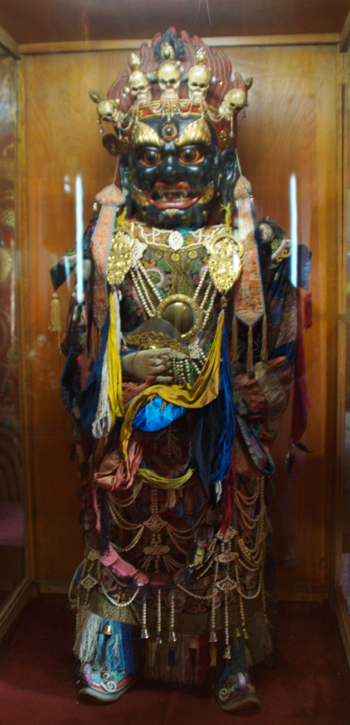
5. See Tsam Dancing– Today it’s a Buddhist ritual of relatively recent (late 18th century) origin, but it has it’s roots in ancient shamanistic beliefs. Basically an exorcism ritual, it has a set “cast of characters”. The fantastic costumes and masks must be seen to be believed. Fortunately, many of them are on display at the Chojin Lama Museum in Ulaanbaatar. When I saw them the first time, I was captivated without having a clue about what they were for. To see them in use would be wonderful.  For a fuller explanation, go here.

Tsam dance costume, Chojin Lama Museum, Ulaanbaatar, Sept. 2006

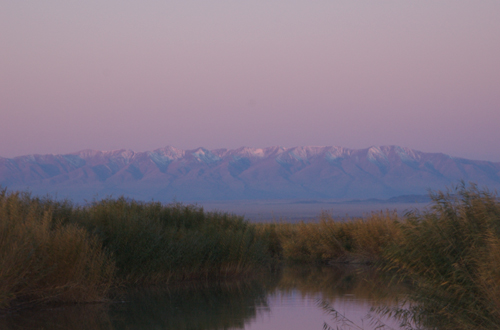
6. Hike in snow leopard habitat-Which is a lot more realistic than saying “see a wild snow leopard”.  There are between 500 and 1000 snow leopards in Mongolia, according to the Snow Leopard Trust. Their habitat covers over 100,000 sq. km, so obviously the odds of seeing one are really slim to none. But one can get out into the mountains where they live.

Jargalant mountain, a far eastern spur of the Altai Mountains, Sept. 2006

New Painting! After the Race; Scraping Sweat

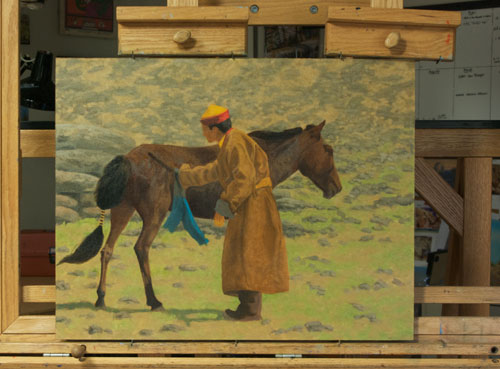
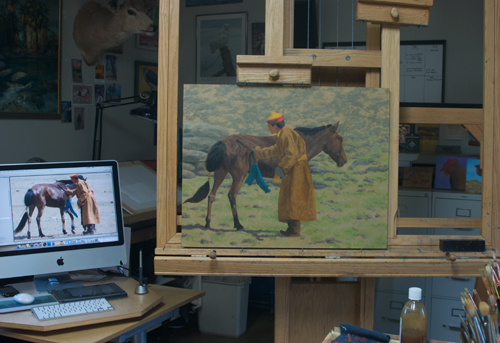
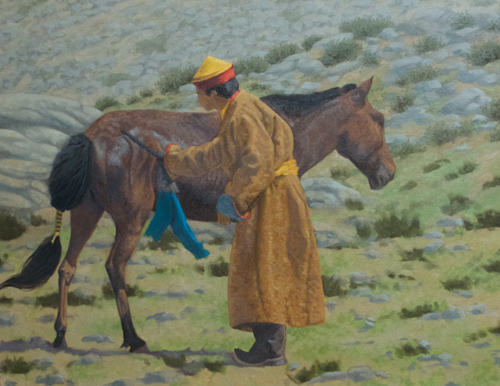
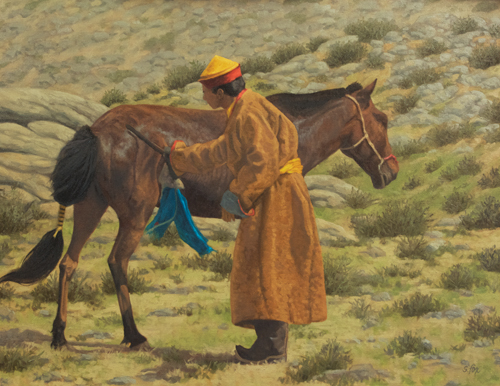
When traveling in Mongolia, one often sees the herders out taking care of their animals. Often they’re wearing western clothes, but a lot of them wear del, the traditional long garment. It’s very practical and makes them look very dashing. What isn’t quite so dashing are the ubiquitous baseball caps, however inexpensive and practical they are. So when I was at a mountain blessing ceremony at Bag Gazriin Chuluu and was walking around after the horse race, this gentleman really stood out with his red and yellow hat. I have no idea who he was, but he was scraping sweat off one of the horses with a special blunt, flat blade. I believe the sweat from a winning horse is considered to have the strength of that horse in it and so is very auspicious. The blue scarf is a khadak, which is used for offerings.

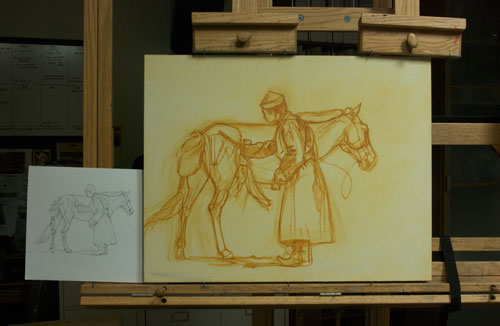
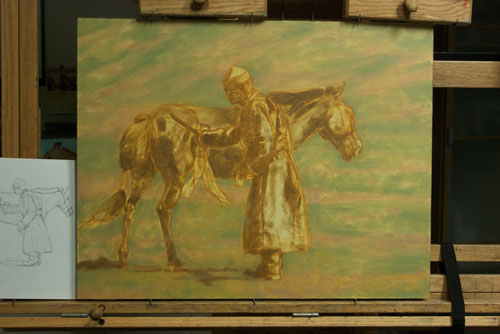
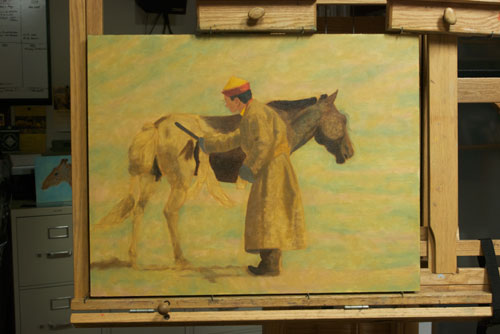
Here’s the step-by-step for “After the Race; Scraping Sweat:

Brush drawing with pencil preliminary
First pass of all-over color, plus shadow shapes; notice background goes in opposite direction of horse
Next color pass; starting to define the drapery of the del
Needed another element in background, so I added the rocks in mid-ground on the left to anchor horse and man
One of the two main pieces of reference on the iMac; I like his gesture in this one but needed another for the horse's head; there was a third reference shot for the background
All elements in place; everything is staged for the final push; spent yesterday finishing the background and making lots of tweaks and corrections to the horse; notice that the background has now been divided into two planes for more visual interest
After the Race; Scraping Sweat 22x28" oil on canvasboard

Mongolia Monday- 6 Places For Chinggis Khan Fans To Visit

The only thing many people know about Mongolia is that it is the place from which Chinggis Khan and the Mongol Horde rode forth to conquer the largest land empire in history. The Mongols’ view of him is very different than the one westerners grew up with. Far from being a bloodthirsty “barbarian”, he is considered more as Americans do George Washington, as the father of their country. He united the Mongol tribes in 1206. The last vestiges of his empire lasted until the 18th century, although it had split into many separate parts long before. He was their lawgiver and his pronouncements carry weight and provide some guidance in the country to this day.

Mongolia became the world’s second communist country in 1921. Not long after, the memory and public acknowledgment of Chinggis Khan was, except for a very few brief periods, actively suppressed. This changed, it appears, almost instantly, when Mongolia became a democracy in 1990. He is THE major cultural icon of Mongolia today. In fact, I just realized that I’m writing this wearing my Chinggis Khan t-shirt that I bought when I was there in 2006. There is also Chinggis Khan beer and vodka. Large wall-hangings with his portrait are very popular. You see him on billboards. He and his warriors ride into the National Naadam stadium during the opening ceremonies. There is a pop singer named Chinggis Khan. And, as you will see below, one can put together quite an interesting tour of the country visiting statues, monuments and a variety of locations associated with him.

I’ve been to three of the ones listed here and hope to visit the others at some point. Who knows, maybe this summer!

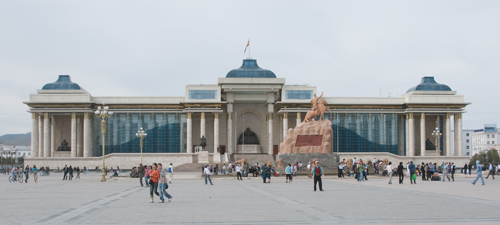
Government House, Sukhbaatar Square, Ulaanbaatar
Chinggis statue

1. Sukhbaatar Square- When I first saw the Government Building in 2005, it was a socialist era plain brown rectangle. The next time, in 2006, it was covered with scaffolding and it looked like a major change in the facade was under way. By the time I saw it again in 2008, the transformation was complete as you can see in the first image. It’s now one of my favorite government buildings ever. And the centerpiece is an enormous statue of Chinggis Khan.

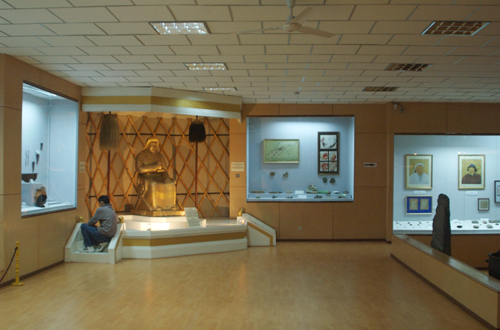
Chinggis Khan room at the National Museum of Mongolian History
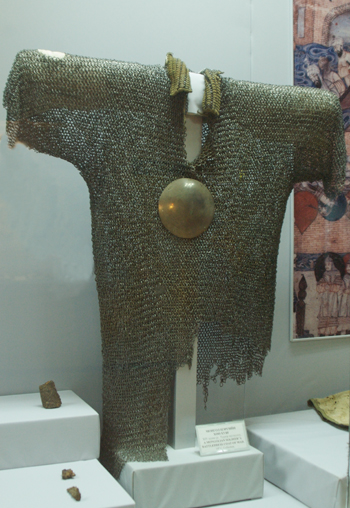
Mongol chain mail hauberk-13th-14th c.

2. National Museum of Mongolian History- There’s a rather large room devoted to Chinggis Khan and the Mongol Empire on the 3rd floor. Lots of interesting artifacts, including the chain mail hauberk show above. There are supposed portraits of Chinggis, Kublai and other Mongol khans, but I believe they are Chinese in origin and created after the lifetimes of the subjects. One unexpected display has an actual letter between one of the later Khans, Guyuk,  and the Pope. There was a surprising amount of communication between the Mongols and western Europeans from the 13th century on, although usually at cross-purposes. The Europeans wanted the Mongols to help them beat the Saracens and the Mongols wanted the Europeans to submit to them and become part of the Empire. Needless to say, neither party got what they wanted.

The world's largest equestrian statue
The view looking east as Chinggis would see it

3. The Chinggis Khan Equestrian Statue- It’s 40 meters high and on a 10 meter high base and is covered in aluminum. If you look at the horse’s mane, you can see the people who had taken the elevator up into the horse’s body. There’s a restaurant, gift shop and other facilities in the base. The second image shows what the statue “sees”. Out beyond those mountains is the origin point of the Khalkha Mongol people, who westerners think of as “Mongols”, although there are quite a few other ethnic Mongol groups.

These next three are the places that I haven’t been to yet, so there’s no images.

4. The Onon River– In the mountains near this river’s junction with another, Balj Gols, is where Chinggis Khan is believed to have been born. Although westerners think of the Mongols as a steppe people, they originated in a mountainous area that is part of the southernmost extension of the taiga or boreal forest. This is where the first monument to Chinggis Khan was erected during the socialist era. The people responsible ended up being purged. There is also a stone marker near the village of Dadal, placed in 1990 to commemorate the 750th anniversary of the writing of the Secret History of the Mongols, almost the only primary reference material available about the Mongols during the time of Chinggis Khan, although it survived only as a Chinese transliteration.

5. Avarga- This site on the Kherlen River is supposed to be the location of Chinggis Khan’s “capital”. It is believed to have served as his base from 1197 until the end of his life. I’ve been told that there are two noisy ger camps in the immediate vicinity, so it looks like a day trip or camping out will be the preferred options.

6. Burkhan Khaldun- This mountain, where Chinggis Khan took refuge from enemies before he became Khan of all the Mongols and journeyed at various times in his life to pray to Tenger (the Sky), is located within the Khan Khentii Strictly Protected Area, which the Lonely Planet guide describes as “Chinggis Khan territory”. There is an ovoo on the mountaintop that is visited by the Mongols. I don’t know if it’s ok for non-Mongols to go onto the mountain, but I would at least like to see it.


I’m Featured In Wildlife Art Journal! Plus Here’s My Latest Painting.

I’m please to announce that the Letter from Mongolia which I recently wrote for Wildlife Art Journal was posted on their website this morning! It’s illustrated with lots of paintings, drawings and photos, many from my Artists for Conservation Flag Expedition last July. Thank you to Todd Wilkinson and the rest of the staff for providing the only publication (it’s online only, no print version) dedicated to wildlife art!

And yesterday I finished the warthog painting. Here’s the  step-by-step from last week. I’m calling it “Gonna Run In 3…2…1”

Gonna Run In 3...2...1 20x30" oil on canvasboard

Mongolia Monday- Choidog, Legendary Mongol Horse Trainer, Has Passed Away

Choidog and Black 18x24" oil on canvasboard

I’m going to have to once again interrupt my current series to share some news and the accompanying memories-

I got word last week that Choidog, the subject of my painting “Choidog and Black”, which is currently in a national invitational American Academy of Equine Art show in Lexington, Kentucky, passed away in late March. He was about 80 years old and was healthy until the very end. Choidog was one of the legends of Mongolian horse training, having won the national Naadam race three times.

I first encountered him on a fall 2008 trip to Mongolia when my husband and I stayed at Arburd Sands ger camp, which is operated by one of his sons and daughters-in-law. We were invited to his ger by them for the family’s annual foal branding. It was a magical afternoon, which you can read about here. He was every inch the proud Mongol horseman and we knew that we were in the presence of someone special.

At the ger camp, there was a book, “Horse People”, by Mattias Klum. One chapter was about Choidog and his family. I glanced through it, only casually interested, since my focus at the time was almost exclusively on wildlife.

Last July, on my Artists for Conservation Flag Expedition, I had the opportunity to see him again, as his ger happened to be only a kilometer or so from Arburd Sands ger camp, where I was staying for one night on the way to a nature reserve. He didn’t have much to say to me and directed almost all his conversation to my male guide, but that was fine because it let me just sit and quietly watch him as he lay at ease on the bed opposite.

This time, I searched out the “Horse People” book at the ger camp and read, really read, the chapter about Choidog.

Later in the trip, I was visiting a young horse trainer and his wife at Ikh Nartiin Chuluu Nature Reserve. Once again I was in a ger sitting on the floor drinking suutei tsai (milk tea) while a conversation went on around me since I don’t speak much Mongolian yet. I noticed a magazine tucked up between the roof felt and a support pole. There was a photo of a man on the cover and it looked like, even from across the ger, Choidog. I finally had the Mongol scientist I was with ask about it. The young man took it down and handed it to me saying “You have sharp eyes”. It was a much younger Choidog and the magazine, which was for and about Mongol horse trainers, had a feature article on him with photos from the Naadam races he had won in the 1960s.

When I got home, I found a copy of “Horse People” on Alibris. One passage that struck me was Choidog saying that “In Communist times each family could only own 75 horses. The rest went to the state. Now we can own herds of 300-400, if we can manage it. There’s no limit. In communist times it was strange for someone to have his own herd.” This was in about 2002.

I was told, at the time we were there in 2008, that he had between three and four hundred horses. When I mentioned this to the young horse trainer at Ikh Nartiin Chuluu, his eyes got rather wide and he remarked that that was a lot of horses.

The chapter ends with this passage: “He can mount his ‘favorite black’ stallion and thunder off into the unending pastures, just to feed his heart. “To run on horseback in the morning is high exhilaration.” he says, eyes shining. “It is to feel alive, completely awake.” ”

I hope your heart is well-fed, Choidog. Bayartai.