Mongolia Monday- 6 Great Places To See Wildlife

The travel season is almost upon us. I’ve got my plane tickets for my July departure to Mongolia. For anyone else thinking about or planning to go there, I thought I’d offer one list a week for six weeks, of six “themes” for things to see, with six suggestions.  I’ll start with the one that’s probably nearest and dearest to my heart – wildlife viewing destinations. I’ve been to all of them at least once.

Takhi grazing, Hustai National Park

1. For horse-lovers, Hustai National Park is a must if you are going to Mongolia. It is one of three places where tahki (Przewalski’s horse) have been reintroduced and is only about two hours west of Ulaanbaatar, mostly on tarmac road. You may also see marel (a species of elk), Mongolian gazelle, marmots and a variety of birds, such as demoiselle cranes, golden eagles, saker falcon, and black storks. There is a permanent ger camp that is open year around. The main building has a pleasant dining hall. There are three large concrete “gers”. One houses a gift shop, one has displays about the park and another is where presentations about the park are given by staff scientists. You can explore the park by vehicle, on foot or horseback. When I was last there in the fall of 2008, there were 15 harems of over 200 horses.

Reedbeds, Khar Us Nuur National Park

2. Bird-watchers should consider traveling out to western Mongolia to go to Khar Us Nuur (Black Water Lake) National Park. Khar Us Nuur is the second largest freshwater lake (15,800 sq km) in Mongolia . The Khovd river flows into it, creating a large marsh/wetland that is home to the largest remaining reed beds in Central Asia. The lake provides habitat for wild ducks, cormorants, egrets, geese, wood grouse, partridges, the rare relict gull and also the herring gull.  May and late August are the best birding times.  Another freshwater lake, Khar Nuur (Black Lake), which is connected to Khar Us Nuur via a short river called Chono Kharaikh, hosts the migratory and globally threatened dalamatian pelican. Direct access to the lakeshore is limited due to the reedbeds, but there is open shoreline near the soum center (county seat) on the north shore and an observation tower on the east side. As far as lodging, I can’t make any recommendations since I was rough camping when I was there, but I’m sure there’s something in or near Hovd, the main town. From Ulaanbaatar, flying to Hovd is the only practical way to get there since it’s about a thousand miles west of the capital.
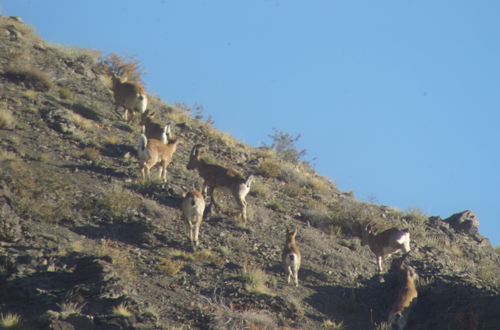
Siberian ibex, Gobi Gurvansaikhan National Park

3. The legendary Gobi is home to Gobi Gurvansaikhan National Park, created partly as a refuge for an endangered population of wild bactrian camels. They are in a remote and inaccessible (except for researchers) part of the park, however. There are also snow leopards and argali, which visitors should not expect to spot. What there is a good chance of seeing are Siberian ibex, pika, two species of gazelle, steppe eagles, golden eagles, lammergier or bearded vultures, black vultures and a variety of smaller birds. I stayed at Nomadic Journeys’ Dungenee eco-ger camp, which is taken down at the end of each season, leaving almost no trace. The kitchen and dining “room” are in connected gers. The setting is terrific, on an upland that has the park’s mountains in one direction and the Gobi stretching out in the other. To get there from Ulaanbaatar one either drives south on the main road, which is an earth road and takes, I think, two days, or flies into Dalanzadgad, which takes about two hours.

View of Steppe Nomads Ger Camp overlooking Kherlen River; the wetland is off to the right with the base of Mt. Baits behind it, Gun-Galuut Nature Reserve

4. A relatively new park, Gun-Galuut Nature Reserve is only a couple of hours east of Ulaanbaatar, mostly on tarmac road. There are two main wildlife attractions here: around 100 argali mountain sheep, which live on Mt. Baits and a wetland area with endangered white-napped cranes, along with a variety of other birds like cinereous vultures, demoiselle cranes, black storks, whooper swans, ducks and terns. The permanent ger camp has a lodge which houses a dining hall and bathroom facilities. There are many activities to choose from besides wildlife watching, including boating, archery, yak cart and horse riding, hiking and homestays with herder families, all of which provide employment for local people. This was the first stop on my Artists for Conservation Flag Expedition in July of 2009.
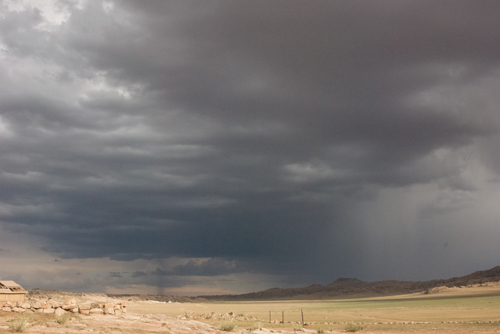
View from my ger, with passing summer rain storm, Baga Gazriin Chuluu Nature Reserve

5. I knew nothing about Baga Gazriin Chuluu Nature Reserve when I arranged to go there as part of my July 2009 Artists for Conservation Flag Expedition other than it had argali. I was only there for two days, but they were two of the most memorable days I’ve had in four trips to Mongolia. The reserve is home to about 60 argali, which are more tolerant of people and vehicles than the ones I’ve seen elsewhere, along with Siberian ibex, cinereous vultures, columbia rock doves and other birds.  The rocky uplands cover a smaller area than Ikh Nart (no.6 below), and are easy to get around in on foot or by vehicle. There is a ger camp tucked up against one of the rock formations with an amazing view down the valley. A concrete “ger” serves as the dining hall and has a covered patio area. There is a toilet/shower block, for which the water is heated by solar power. Baga Gazriin Chuluu is about a six hour drive on an earth road southwest of Ulaanbaatar.

Argali ewe with two lambs; one with radio collar, Ikh Nartiin Chuluu Nature Reserve

6. And last, but certainly not least, Ikh Nartiin Chuluu Nature Reserve, my destination when I first went to Mongolia on an Earthwatch project in spring of 2005. Ikh Nart may be the best all-around place to see wildlife in the country. There are argali mountain sheep, Siberian ibex, corsac fox, red fox, tolai hare, cinereous vultures, golden eagles, black kites, kestrels and many other birds. Nomadic Journeys also has an eco-ger camp here, Red Rocks, and offers guided and unguided trips. It is a great place to hike. There are fabulous rock formations, some of which have Tibetan inscriptions carved on them. You will need a GPS since, while there are some dirt tracks, there are no marked trails. This was the third stop on my Artists for Conservation Flag Expedition in July of 2009. Ikh Nart is a seven hour train ride or a five to six hour drive south and slightly east, mostly on tarmac, from Ulaanbaatar.

There are more photos in other posts on this blog. Look under “Mongolia” on the blog roll at the right or do a name search.

Mongolia Monday- Mongol Culture in Music Videos

As I’ve wandered around YouTube looking for music from Mongolia, one thread I’ve noticed is the use of traditional clothes, historical themes, stories and cultural elements across musical genres. I thought I’d share four of my favorites this week.

First up is Batbold, whose video “Bi Mongol Hun” or “I Am A Mongolian” is a visual compendium of traditional Mongol steppe culture. One of the things I like about it is seeing how the bowls, buckets and other household items that you see for sale in the antique shops in UB were and are actually used by the herders.

Sometimes the videos tell stories. The famous Mongolian rock band, Haranga, seems to have dipped back into history, possibly to the time of Chinggis Khan, for this song. I’ll admit that I’m a little hazy on the plot, not being able to understand the words, but the horse is clearly the star. Anyone who can explain this song or provide a translation of the lyrics, please comment!

Other times, all you need is horses, snow and a song about a woman.

Finally, an all-star cast (I recognized Ganaa from the vocal group Camerton), provides an eight minute crash course in Mongol history and culture. Fabulous traditional costume. All singing, all dancing!

Enjoy!

Mongolia Monday- Favorite Ger Photos

Two of the things I like best about traveling to Mongolia are staying in a ger and visiting people in their gers (“ger” means “home” in Mongolian).

Actress Julia Roberts was hosted by a family of horse trainers during the filming of an episode of the PBS series “Nature” called “The Wild Horses of Mongolia” (which isn’t what it was about, although there was a little takhi footage from Hustai National Park included). At the end, she’s sitting in a ger filled with Mongolians, looking into the camera with this big grin, saying something to the effect of “I’m sitting here in this ger and I don’t understand a word of what these people are saying, but I’m as happy and content as I’ve ever been in my life.”

Yup, she nailed it. I feel the same way. There’s something about the quality of space created by a ger that is very special. I’ve been in clean ones, dirty ones, sat on stools, beds and the floor, seen beautifully furnished ones and ones with next to nothing in them and I get the same content feeling in all of them. Hand me a bowl of suutei tsai (milk tea) or airag (fermented mare’s milk) and some aruul (dried yogurt) or tsotsgii (cream) and I’m a happy camper (and a cheap date too, I guess, although my husband would probably beg to differ). Anyway, here are some of my favorite images of gers from my four trips to Mongolia.

First, ger camps:

My ger at Gun-Galuut Nature Reserve (AFC Flag Expedition), July 2009
Dungenee Ger Camp (Nomadic Journeys), Gobi Gurvansaikhan National Park, Sept. 2006
Dungenee ger interior; notice large rock to help hold it down in high winds, Sept. 2006
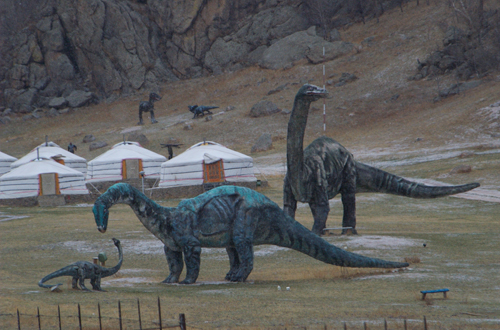
Dinosaur Ger Camp, Gorkhi-Terelj National Park, May 2005 (haven't stayed here; yet)
Arburd Sands Ger Camp (Nomadic Journeys) with lightening storm, July 2009
Red Rocks Ger Camp (Nomadic Journeys) with oncoming storm, July 2009; two hours of heavy rain soon followed
Dining ger door, Red Rocks Ger Camp, Ikh Nartiin Chuluu Nature Reserve, Sept. 2008

In 2005, I got to visit a ger factory and see how they are made:

Ger factory, Ulaanbaatar, May 2005

Then we went to the Black Market where you can buy anything ger; from individual parts to the whole thing.

Everything ger at the Black (or Narantuul) Market

The research camp at Khomiin Tal (takhi reintroduction site) in western Mongolia is spectacularly sited in a river valley:

The research camp at Khomiin Tal, western Mongolia, Sept. 2006
Ger interior with goat meat, Khomiin Tal, western Mongolia, Sept. 2006

My first experience of staying in a ger was during my first trip to Mongolia on an Earthwatch project “Mongolian Argali” (now called “Wildlife of the Mongolian Steppe”; highly recommended) in the spring of 2005. The camp is much bigger now; seven gers, two containers and a volleyball court:

The research camp at Ikh Nartiin Chuluu Nature Reserve, Earthwatch project, April 2005
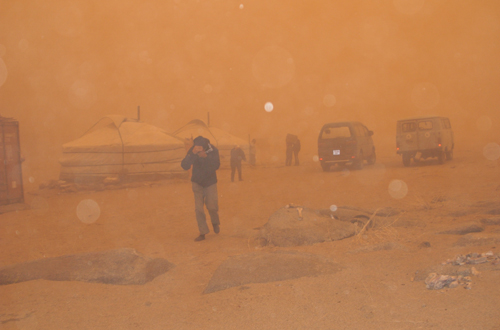
Typical spring dust storm, Ikh Nartiin Chuluu Nature Reserve research camp, April 2005; photo taken out the door of the ger; circles are the flash bouncing off dust particles; the wind was howling, too

And, private homes:

Small ger with aruul drying on the roof; en route from Baga Gazriin Chuluu Nature Reserve to Ulaanbaatar, July 2009; my guide helped me buy some aruul from the family
Prosperous establishment in the Gobi, Sept. 2006; they breed racing camels
Dung fuel with traditional gathering basket, western Mongolia, Sept. 2006; the owner manages a nearby salt deposit
Ger in western Mongolia, Sept. 2006; we bought fresh cow's milk from her
Gers above the Tuul River, near Hustai National Park, Sept. 2006; they have great view!
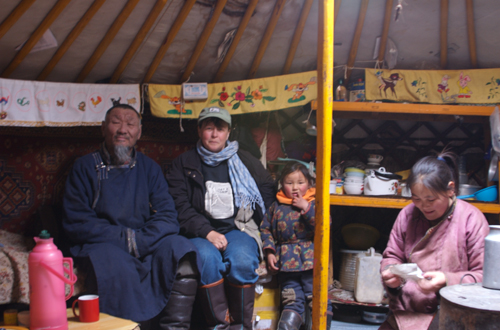
Ger visit, near Hustai National Park, May 2005; my first encounter with Mongolian hospitality, but not the last!

An Olympic Drawing Opportunity

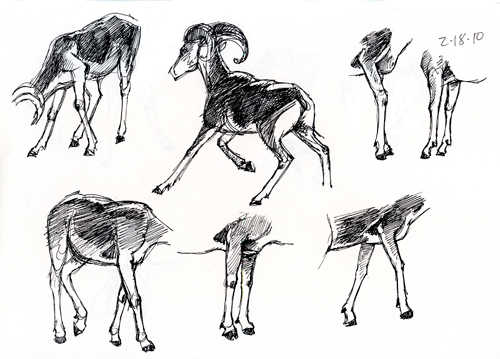
If you’re watching the Olympics you know that it sometimes seems more like ads interspersed with some sporting events than the other way around. I’ve also realized that I don’t know how argali sheep are put together as well as I need to, especially the legs, and I’ve got a major takhi painting coming up

Put the two together and I’m getting some good sketching time in. I’ve got all my images from my last two trips to Mongolia on my MacBook Pro, sitting in iPhoto, which happens to have a great enlargement function. I’ve set the laptop on a small folding table (are they still called “tv trays”?) and am using a 9×12″ sketchbook.

These are drawn with a fine felt tip pen with no preliminary pencil work. I either get it or I don’t. None take more than about five minutes, so there isn’t a lot of time invested. The purpose is to hone in on areas that I don’t understand as well as I should. Purely process, not result. Plus, I keep in mind that photos flatten objects, so I need to compensate for that when drawing three dimensional animals.

I started with a page of takhi, plus a cow I saw at Hustai.

Then I moved on to argali. One of the challenges is to keep the legs and body in proper proportion since the legs are really skinny and long. There isn’t a lot of muscle definition to play with, like with horses, so one has to nail the overall shape.

I’m struggling with the horns, too. They move back and around in space and I’m suspicious of how the camera might distort them. What I really need is to draw from the live animals. But there are none in zoos that I know of and in the wild you’re lucky to watch them from 600 meters (over 600 yds.)

Ideally, I’d have my Leica Televid spotting scope, which would solve the problem, except that it is entirely impractical to haul it around in the terrain where the argali are, at least for me. So it’s photographs and a pair of domestic ram’s horns that I brought back from England some years ago. I don’t have access to taxidermy mounted argali, but the problems there would whether or not the horns are typical, how good the quality of the mount is and is it a Mongolian argali.  Notice that I started on the left with only basic shapes and didn’t worry about modeling or “color”.

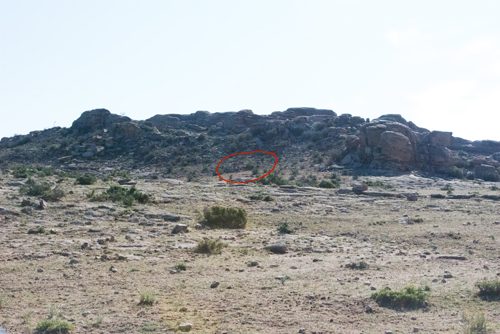
The best images I have of argali so far are a group of six rams at Baga Gazriin Chuluu Nature Reserve. They were considerate enough to have parked themselves in the open within sight of the main road through the reserve in great morning light. I would have been lucky to have spotted them, but the local man living in the reserve who my guide hired to go out with us both mornings that I was there saw them right away. Here’s a long shot from where we stopped. They’re right back against the rocks, in the middle.

I’ve circled them in red.

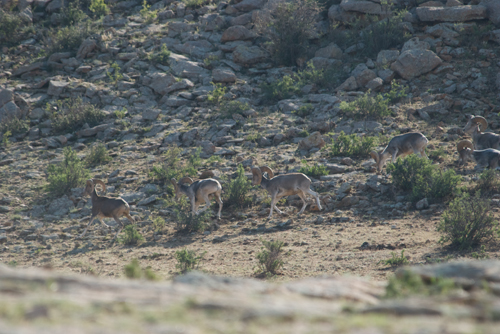
Piece of cake, right? Here’s what I got when I zoomed in with my Nikon Nikkor VR 80-400 lens. These are 10mg files, so they can take quite a bit of enlargement and stay sharp. I’ve got about 84 images total to work with. There’s something useful in all of them. Love these guys.
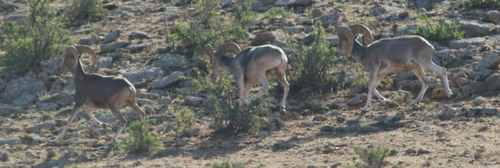
Here’s a close-up of the three rams in front. A perfect Exhibit A of the subject of a previous post about why you have to get out there and do the fieldwork. There’s no other way to get this kind of reference (Buying it from someone else doesn’t count). Game ranch animals won’t do it either. They’re out of context and, unless you’ve observed the species in the wild, you have no idea whether or not any behavior that you see is “real”.

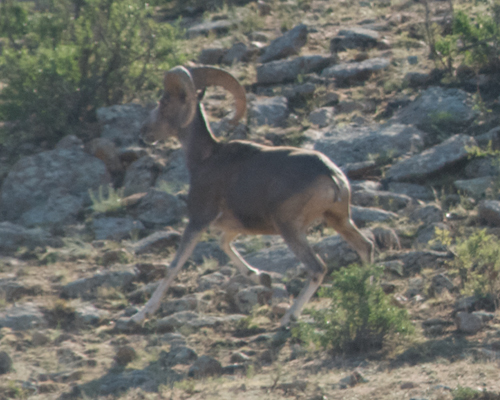
And closer yet of one I drew last night. Everyone was fat and sassy and in great condition. Notice that the younger ram is much browner than the older ones. His behavior was different, too. He was a little more skittish, kept more space between himself and the others than they did between each other and was last in line when they all finally moved up into the rocks.

Great stuff! Action, a terrific pose, rim light. Here’s the page of sketches that include this ram.

Give it a try! It’s a great way to keep training your eye.

Mongolia Monday- New Painting Debut!

Last week was pretty intense. I had a painting to finish for submission to an invitational show (which it may or may not be accepted into; we’ll see). It’s by far the most complex and difficult one I’ve taken on so far. The kind where, once you’re well into it and can see what level of effort it’s going to take to pull it off, you wonder if you’re out of your mind. But I felt really driven to paint it, so off I went. I think it took somewhere between 60 and 80 hours, spread over about three weeks, but I wasn’t really counting. I didn’t have time.

I normally post about my painting activities on Fridays, but when you see the reference image that inspired me, I think you’ll agree that it’s right for Mongolia Monday.

I photograph the process when I do “major” paintings, both to have a record and to be able to refer back to previous points while it’s in progress. I thought you might enjoy following how this one developed.

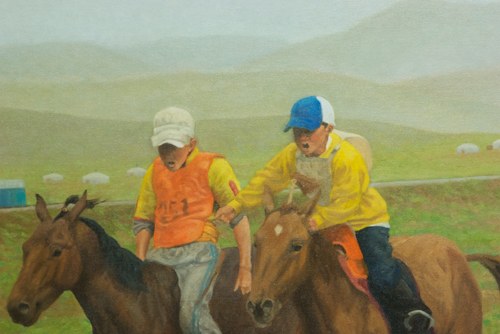
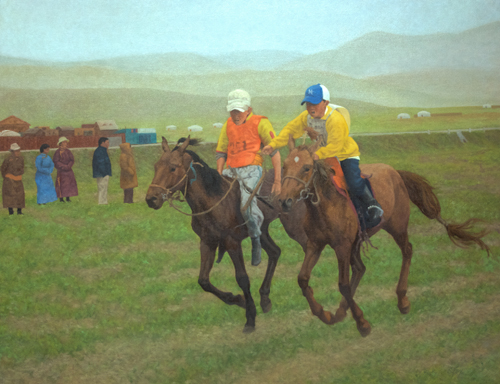
So, to start, here’s the image that said “PAINT ME!” It was taken at a local Nadaam in the town of Erdene, which is about an hour east of Ulaanbaatar, in July of 2009. It was pouring rain when we arrived, just in time to see the finish of the horse race. Fortunately, it stopped and, although it was cloudy and muddy, we had a great time and I got at least three or four more painting ideas from the afternoon.

I loved everything about this image: The two horses neck and neck. The fact that one boy is using a traditional Mongol wood saddle and the other is riding bareback in stocking feet and how different it makes their body positions as they ride flat out for the finish line. The way the orange and yellow is repeated in their clothes and the saddle.

The only thing missing was great light. Hum, what to do? I decided that rather than trying to change the light, since July is the rainy season (or at least it’s supposed to be) in Mongolia, which means that at least some of these races happen in wet conditions, I’d just go with it and make the fact that it was a rainy day part of the story.

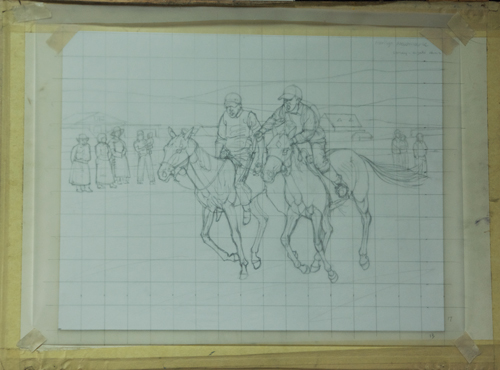
The  background didn’t do anything for me and since most of the people who will view the final painting won’t be familiar with the setting or situation, I needed to add some context. The first step was to do a pencil drawing that included all the elements to make sure everything would go together even though I used at least six different photos for the final composition.

The drawing is done on 19×24″ tracing paper. The finished painting is 28×36″. The grid lines are a traditional (dated back to the Renaissance) method of transferring a drawing to the larger surface. Notice how many spectators there are and where the buildings are. I had already decided to leave out a line of cars that were behind the people.

I have also decided to paint these scenes as I see them. I’m not going to “romanticize” them by substituting traditional hats for the baseball caps or putting the kids in del. While I’m very interested in Mongolian history and might do paintings with historical themes, with historic costumes and armor, if I can get the reference, for the most part I’m interested in Mongolia as it really is right now, in the 21st century.

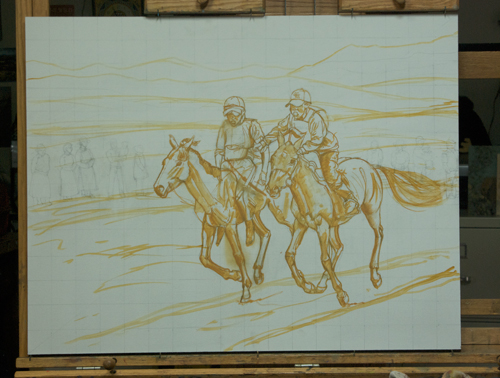
Once the drawing is transferred to the canvas with a pencil, I re-draw it with a brush, always correcting and refining as I go.

In this case, I decided to start by laying in the background first. I wanted to establish the lightest lights and also the atmospheric perspective of the mountains in the distance. You will also notice that I’ve ditched all the people on the right and cut down the number of people on the left. The buildings are gone, too. I really felt that I needed to simplify things. One of the lessons I’m learning is how what works at one size may not work at a much larger size. It’s what stalled me on the big argali painting.

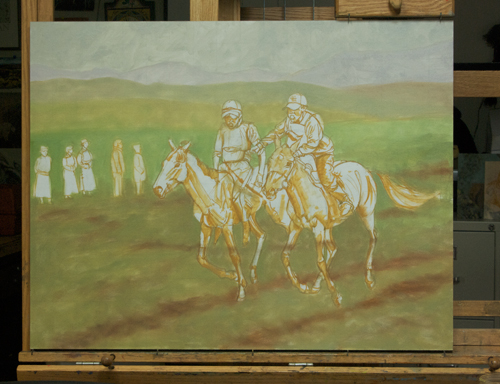
Next, I laid in the first layer of color on the figures, going dark so I could come back in with lighter colors. Everything is in what is called “local color”-the “real” color of an object not affected by a light source. Notice the drawing is pretty much gone, but that’s ok because, I know I can get it back as I go.

Now, I’m past the opening stages. The set-up is done and the constant process of painting, correcting and refining has begun. I’ve laid in the folds on the boy’s clothes and gotten the basic modeling done of the muscles and structure of the horses. Where before, the background had seemed too crowded, now it seems too empty and the people are just standing there, isolated, with no context.

Here you can see how I work. The computer is a 24″ iMac with a glossy monitor, so it’s like painting from very large transparencies. I can easily toggle back and forth between the various images that I’m using. You can see that I’ve added the buildings back in, but now they are behind the spectators, which creates one visual unit instead of two scattered ones. And now there are gers in the background. I’m thinking at this point about the white of the boy’s hats being repeated in the hats of two of the spectators, then repeated again with the gers. So it’s kind of like a bar of music with the white elements as the “notes”.

Here’s a detail of the people and buildings in progress. The good people of Erdene would probably be really confused if they saw this because I’ve used my “artistic license” to move and rearrange the structures to suit me. But I’d like to think that they’d recognize their friends and neighbors. Unfortunately, the pattern on the one woman’s blue del ended up being too visually distracting, so I had to make it just a plain blue. All the colors are intended to relate to each other in a somewhat limited palette and not compete with the jockeys. Oh, and that’s the Mongolian flag at the top of the blue building. Couldn’t leave that out. Notice also that I’ve added the road that runs through the town.  It’s on a diagonal, which is more dynamic than a horizontal. I want it to support and emphasize the main action. That’s also why the lines of dirt at the horses feet are on the diagonal, as you can see in the image above.

Here’s a detail of the jockey’s faces in progress, along with the horse’s heads. They all went through three or four repaints before I got them the way I wanted them. Notice that I haven’t painted any of the tack yet, other than the orange saddle. That’s the final level of detail that I leave for the final orchestration. Also, the paint has to be dry so that if I make a mistake on a stroke I can pull it off without wrecking what I’ve done underneath.

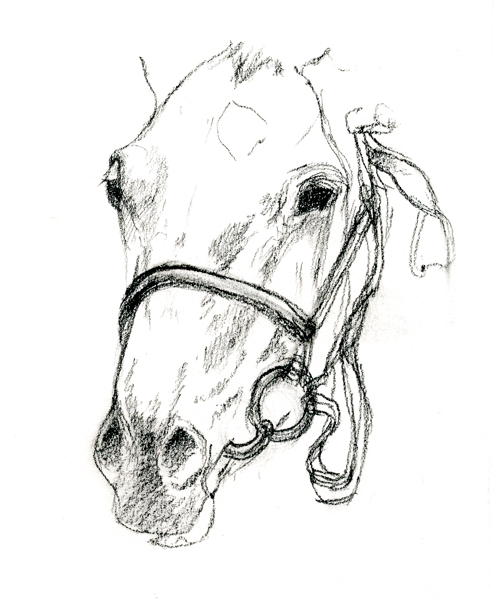
At one point, I stopped, got a piece of paper and a charcoal pencil and did a couple of studies of the boys and the bridle of the horse on the right to make sure that I understood the shapes correctly and could paint only the ones I needed.

I highly recommend this. Instead of flailing around in paint, hoping to somehow get it right, do a quick drawing to work out the problem. It saves a lot of time, paint and frustration.

One thing I noticed almost at the end was that, as a design decision, I had the right-hand horse’s tail flowing off the canvas. When I was looking at another image for another reason, it hit me and I remembered that the race horse’s tails are bound part-way down. What an awful mistake that would have been. Quick scrap down and repaint.

And here is the finished painting: Rainy Day Finish; Erdene Nadaam, 2009

Some Of My Latest Drawings

I’m in the middle of a rather large painting (no, not the argali one; a subject for another post; short, short version: got stuck, needed to let it sit for awhile), so I thought I would post a few drawings that I’ve done recently and then get back to the easel. It’s juried show painting season, so I’m trying out different reference images to see if I think they’ll make a painting. These were all done with Wolff’s carbon pencils on Canson Universal Recycled Sketch paper, which turns out to be quite a nice combination.

Ibex billy; from Baga Gazriin Chuluu, July 2009
Bactrian camel, Arburd Sands, Sept. 2008
Bactrian camel, Arburd Sands, Sept. 2009
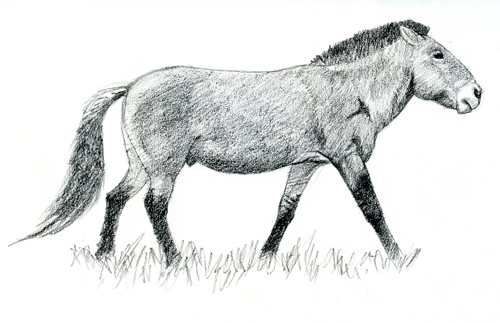
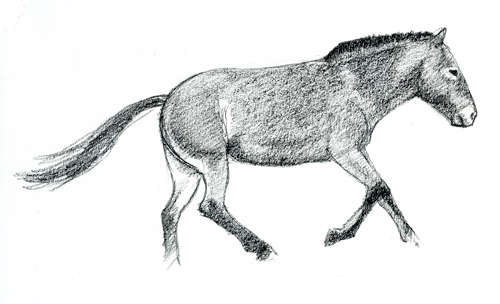
Takhi stallion "Temujin", Hustai National Park, Sept. 2008
Takhi mare, Hustai National Park, Sept. 2008
Takhi foal, Hustai National Park, Sept. 2008


Mongolia Monday- The Saga Of The Scissors

When I went to Mongolia last July on my AFC Flag Expedition, I knew that arrangements had been made to meet with some unknown number of women at the Ikh Nartiin Chuluu Nature Reserve research camp to talk about helping them set up a felt crafts cooperative. I sorted through all my sewing stuff and came up with a pretty good-sized bag of needles, thread, notions and one extra pair of very good sewing scissors to donate to the cause. You can read about the meeting and see photos of the four intense days I spent with the women here.

The scissors, I found out late on the third day, were very, very, did I say very, popular. I was asked during a last meeting of everyone, if I could get more scissors. Sure, I said, how many pair? One for everyone, so 20 pair. I knew I could figure out some way to do this, so I said yes.

Then a burly man in a del, clearly one of the herders who had spent most of his life out of doors and who had quietly come in and was sitting by the door, raised his hand. Through my translator, he shyly asked if it would be possible to get 21 pair. His wife hadn’t been able to come to the meeting, but he would like to give a pair to her because it would make her happy. Yes, of course. I still choke up a little when I remember him sitting there in a ger full of women (Mongol women can be formidable), summoning up the courage to ask a total stranger for something for his wife.

My gift scissors being used to cut out the fabric for a del for my husband. The women made two, one for each of us, in three days. Notice that there is no paper pattern. The skill to make these traditional Mongol garments is either passed down or there are classes where it is taught.

Then, during a series of “competitions” that celebrated the end of the meetings, everyone divided up into teams to do skits. One team did theirs on where the scissors were because everyone was wanting to use them.

I think what is being said is something like "I need to cut this. Where are the scissors?"

Fast forward and I’m back at home. My husband generously offered to donate the money to purchase the scissors through his company. I got on the internet and in touch with one of the staff people at the Denver Zoo Foundation. It turned out that a fabric store chain had 8″ Gingher sewing scissors on sale at a very good price. Sewers know that Ginghers are about the best you can get and that’s what I wanted the ladies to have.  So they were ordered and delivered to my contact person at the Zoo.

Next was how to get them to Mongolia. We’d hoped to send them over with someone, but no one was going in the near future, the scissors weighed a fair amount and, with security being what it is, we felt like it was a lot to ask for someone to take them on a plane, even in checked luggage.

The Director of the Conservation Biology Department, which is who I work through, said that the only reliable way to make sure they got to where they needed to go was via FedEx, so that’s what we did. That cost over $400. My husband had included $100 for shipping in his original donation and the Zoo picked up the rest. So far so good.

The scissors arrived at the airport and then it got complicated with customs paperwork that none of us knew had to be done ahead of time. More fees, which my husband covered. But the scissors were in UB and in the possession of the right person, who would make sure they got to where they needed to go.

All along I’d had this vision of the scissors arriving in the winter when the women didn’t have as much work to do, so would have time to make felt items to sell this summer. And it would be cold and things would be difficult, but maybe this would be a nice mid-winter surprise. And I would be announcing that this endeavor of my Art Partnerships for Mongolian Conservation had been successfully concluded.

Unfortunately, this winter has turned out to be what the Mongols call a “Zud”, heavy snow and extreme cold, as in below -40F, which is a “normal” winter low. Haiti has the world’s attention, deservedly, but for those of us who care about Mongolia, there is a crisis happening there, too. I wrote to the scientist who goes to Ikh Nart every month and who is going to deliver the scissors, asking how my friends are. His reply was that he hasn’t been able to contact anyone, but will let me know when he does. I suspect that he can’t even get to the area right now. Conditions may not improve until April. I know that the Mongols are resourceful people and they’ll help each other through this, but I am concerned. I’ll be very glad when I hear that everyone is ok.

I’ll post as soon as I have news. In the meantime, I’m making my plane reservations for the next trip in July/August.

Mongolia Monday- An Extremely Hard Winter In Mongolia

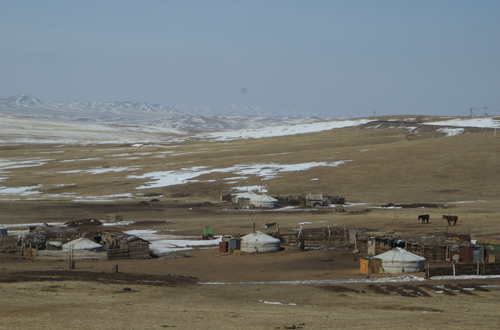
Gers in "winter quarters", late April 2005

I was going to do a book review on “Genghis Khan and the Making of the Modern World” this morning, but in the modern world of Mongolia, the country people are suffering through a very severe winter. A Facebook page that I follow “Mongolian Business and Economy News” posted a link to this AP story “United Nations Warns Extreme Cold, Heavy Snow in Mongolia Threatens Lives”, from which there are a few quotes below.

The page administrator asks “Will anyone hear our plea when the whole world is focused on providing aid to Haiti. I guess most of the help and aid should come from domestic sources, but most people barely have enough money to support themselves, let alone helping herders.” He or she is looking into setting up a fund.

I’ll post more about this as it unfolds. I have herder friends, the women who have joined the felt crafts cooperative at Ikh Nartiin Chuluu, who I am concerned about. I have no idea how they are doing, but am going to try to find out.

—————-

“…..extreme winter weather that has killed more than 1 million livestock in Mongolia is likely to harm the country’s food supply and worsen poverty.

Nineteen of Mongolia’s 21 provinces have been hit by heavy winter snow and temperatures that have plunged below minus 40 degrees (minus 40 degrees Celsius)…….

……..particularly concerned about pregnant women cut off from medical facilities by the heavy snow – three have reportedly died in childbirth so far…….”

—————-

New Painting! “After The Race; Baga Gazriin Chuluu”

There’s this saying about combat flying- hours of boredom interspersed with moments of stark terror. At a far less dramatic level, painting seems to have a similar rhythm sometimes. We spend days or weeks working on paintings and, suddenly, some get finished, signatures go on, photos are taken and, ta da. we’re ready to move on. I finished this painting a couple of days after the one I posted last Friday.

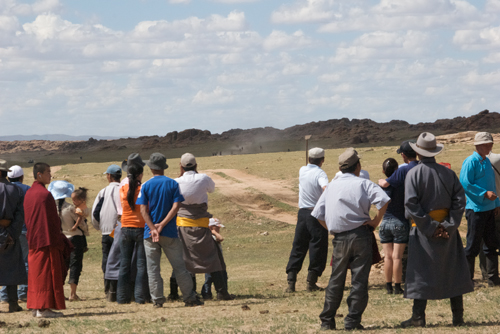
This piece is a scene from the mountain blessing ceremony that I had the good fortune to attend at Baga Gazriin Chuluu. There had already been an anklebone shooting competition, but the horse race was the event that everyone dropped what they were doing for. The Buddhist monks who had been sitting in a tent, chanting, came out and joined their families and friends. For at least a hour before the race, the kids had been warming up the horses by walking them in a big circle, sometimes singing as they rode round and round.

The horses were two-year olds, all stallions. As it turns out the Mongol word for horse, “mor” includes the fact that the horse in an ungelded male. That’s the default. Then there are geldings and mares. Being young colts, the race was a short distance- 7km. (The main national Naadam race for fully adult horses is 56km.) As with all Mongol horse races, after warm-ups the jockeys rode their mounts out to the starting line at a walk or trot, followed by a few vehicles which I assume included the starter and some of the trainers.

Everyone went out of sight behind a large rock formation. We all waited at the finish line, a small pile of rocks which held up a pole that had a colorful red scarf flying from it like a flag.

Horse race with spectators, Baga Gazriin Chuluu, July 2009

Pretty soon the crowd stirred and, looking out, we could see the dust from the horses. In just another minute or two they started to reach the finish line. I got as many pictures as I could.

The trainers checked the horses over and some scrapped the sweat off them, although none were lathered up or even looked particularly tired. Then the jockeys spent most of the next hour circling the wrestling competition, cooling down their mounts. That’s when I got the image I used in this painting.

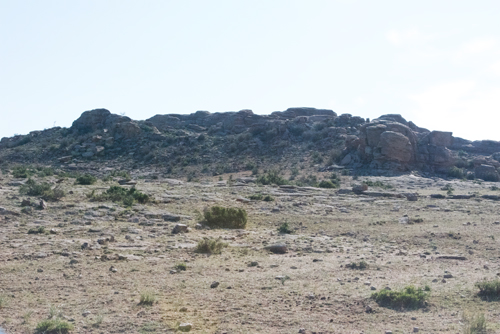
I’ve also included the reference photos since I think too many animal artists just use whatever setting the animal is in when the picture was taken and don’t consider other options. In this case, the background was pretty boring. But, a short distance away were these really great rock formations.

The young rider:

The background:Put them together and….

After The Race, Baga Gazriin Chuluu 16x20" oil on canvasboard

The rocks were deliberately placed so that the boy would be against the large shadow area. I kept things on a diagonal so that the background would be at a different angle from the main subject and keep the composition from being too static. After going 14km, the rider was still having to pull firmly to keep his mount at a walk. I wanted all the elements of the painting to support that pent-up energy.