I’ve posted a number of music videos here on my blog, but it occurred to me this morning that so far I’ve not posted any spoken work. I happen to love listening the Mongols speak their language, even if I mostly don’t know yet what they are saying. I thought that you might enjoying hearing what it sounds like.
Here’s a YouTube video of the recitation of a famous poem “Love One Another, My People” by one of Mongolia’s most beloved poets, O. Dashbalbar. It is followed by an English translation.
It’s accompanied by “White Stupa No. 1” from one of Mongolia’s favorite composers, N. Jantsannarov. The images are a wonderful look at Mongolia. I recognized quite a few of the places.
Love one another, my people, while you are still alive. Don’t keep from others whatever you find beautiful. Don’t wound my heart with heedless barbs, and Don’t push anyone into a dark hole.
Don’t mock someone who’s gotten drunk, Think how it could even be your own father. And, if you manage to become famous, Open the door for happiness to others! They should also not forget your kindness. To someone who is lacking a sngle word of kindness, You should search for it and speak it out. Whether outside in the sun or at home when it’s cold, Don’t spend one moment at rest.
Don’t use harsh words to complain, you women,
About the kind young man you remember. Speak lovingly to those who loved you! Let them remember you as a good lover.
Our lives are really similar, Our words constrict in our throats the same way, Our tears drop onto our cheeks the same way – Things are much the same as we go along the road. Wipe away a halt woman’s tears without a word, Talk your lover up when she’s tripped and fallen!
Today you’re smiling, tomorrow you’ll be crying. Another day you’re sad, and the next you’ll be singing. We all pass from the cradle to the grave – If for no other reason, love one another! People must not lack for love on this wide earth! I grasp happiness with the fire of my human mind, The golden shines lovingly upon us all the same, and So I think that loving others in the path of life, I understand that to be loved by others is great joy.
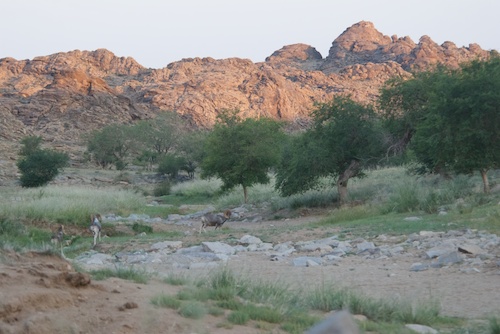
Sunrise in the valley where the research camp is...with argali
I’m proud and pleased to announce that I am one of four Americans and seven Mongols who have recently been appointed by the Dornogobi Aimag Governor (an aimag is the equivalent of a state or province) to the Ikh Nart Natural Resource Area Working Group!
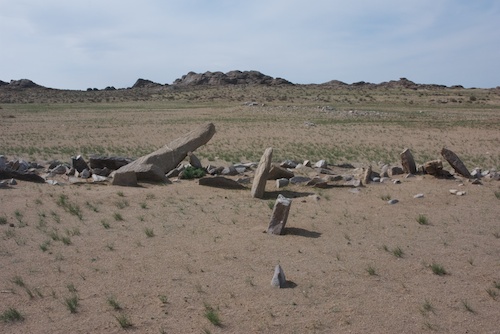
Ancient Turkic grave; there have been humans at Ikh Nart for a very long time
Ikh Nartiin Chuluu Nature Reserve is becoming a model for how a reserve or park can be managed in Mongolia, which has set aside one of the largest percentages of its land area of any country, 13%, as protected in some way.
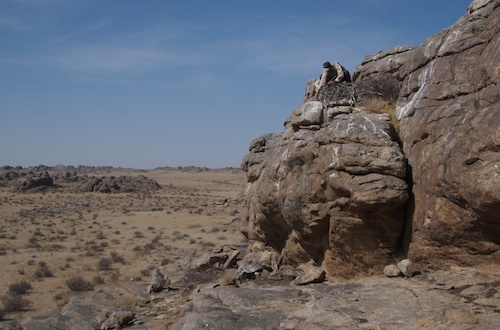
Pictographs near a well
The other Americans are Dr. Richard Reading, the Vice President for Conservation at the Denver Zoo, who in charge of the research camp that was established at Ikh Nart in 1994; retired Anza-Borrego California State Park Superintendent Mark Jorgensen, (Anza-Borrego is officially a sister park to Ikh Nart and its supporters have been very generous in their support of Ikh Nart, donating both money and equipment like spotting scopes and binoculars) who will continue to nurture the sister park relationship; and retired state park employee Lynn Rhodes, who has been offering her expertise on law enforcement policies and training.
Dr. Reading inspecting a cinereous vulture nest
I have been tasked with continuing to support Ikh Nart Is Our Future, the women’s craft collective and also to publicize Ikh Nart and the collective outside of Mongolia.
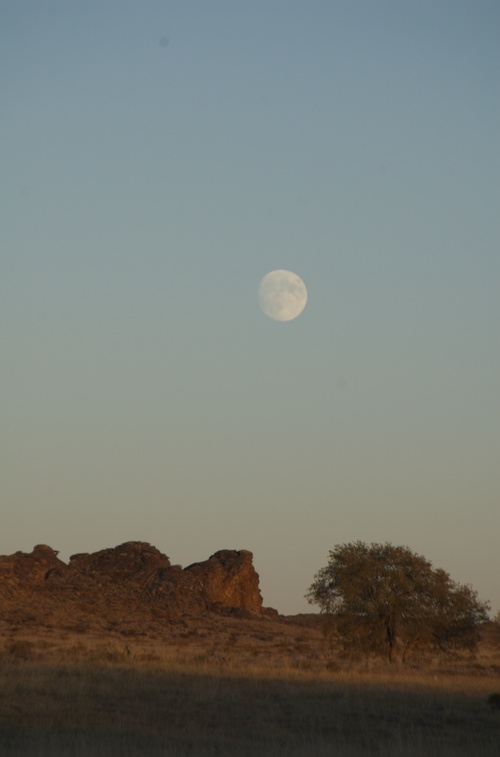
Ikh Nart moonrise
The Mongols in the Group include the scientist in charge of argali research for the Mongolian Academy of Sciences, Amgalanbaatar (Amgaa), who has become a good personal friend; the head of the aimag’s environmental agency; two soum (county) governors; the reserve ranger; and a representative of the local herders. So I will also have an opportunity to see how another country’s government operates at a local level.
Four Siberian ibex
I feel very privileged to be included in this on-going effort to conserve a very special place and to work with the Mongols in doing so.
Local herder Choibalsan and I at the end of the Earthwatch project, April 2005; I still see him most times I visit the reserve
UPDATE AS OF MARCH, 2012: As of a few months ago, the Working Group decided to create an advisory council on which the four westerners would serve. I am now a member of that council. My direct work with the collective, Ikh Nart Is Our Future, has not changed.
Just for a little context….Prairie Creek State Park, Humboldt County, California
I grew up in forests. Redwood forests, to be exact. Camping out meant drippy, foggy mornings and warm sweatshirts with, maybe, sunshine in the afternoon. In August. None of it ever bothered me because I loved being enclosed by those wonderful trees. My mom always loved the desert. Me? Not so much.
Then I went to Mongolia and on my second trip in 2006 spent a few days in the Gobi. And found it quite interesting. Enough to want to go back.
Which I did in July of 2010. And got hooked. Totally. It was hot, sometimes humid, we had to be careful to make sure we had enough water, we fought off mosquitos with dung smoke at a remote lake and I can hardly wait to go there again. I love the Gobi.
Gobi earth road, through sand and saxaul forest near Orog Nuur (remote lake)
So when Dr. David Wagner invited me as one of 30 artists to spend a week traveling to, learning about, sketching, painting and photographing the Sonoran Desert and then creating work for a 2013 show at the Arizona-Sonora Desert Museum in Tucson, Arizona, I accepted immediately, thinking it would be interesting to compare and contrast these two arid environments.
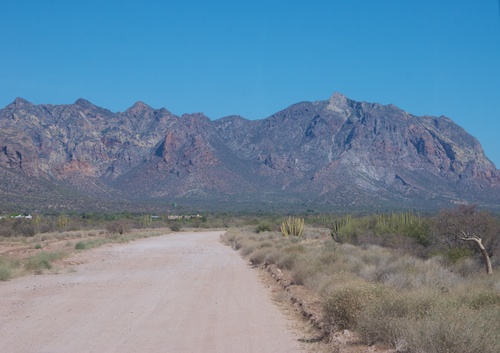
“Earth road” going towards Nacapuli Canyon, Sonoran Desert
I’ve pulled together my research and travel experiences and here’s what I’ve learned, illustrated with images from both places.
GEOGRAPHY:
SONORAN DESERT: Located in both the United States and Mexico
THE GOBI: Located in both Mongolia and China
Which means that both deserts cross an international boundary.
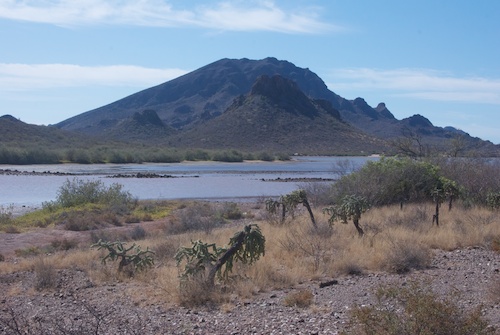
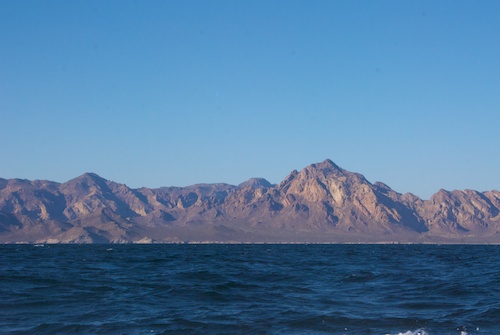
Tetakawi Hill: Mountain and sea, Sonoran DesertMountains and lake: Orog Nuur with Ikh Bogd mountains; demoiselle cranes at lakeside
SIZE:
SONORAN DESERT: 100,000 sq. miles
THE GOBI: 500,000 sq. miles, which makes it the 5th largest desert in the world
Nacapuli Canyon, Sonoran DesertYolyn Am (Vulture Gorge), Gobi Gurvansaikhan National Park, Sept. 2006
ELEVATION:
SONORAN DESERT: sea level to 12,600ft (San Francisco Peaks, Arizona)
THE GOBI: 3,000-5,000 ft. above sea level on a plateau; the highest mountain peak reaches almost 13,000 ft. (Gobi Altai mountains)
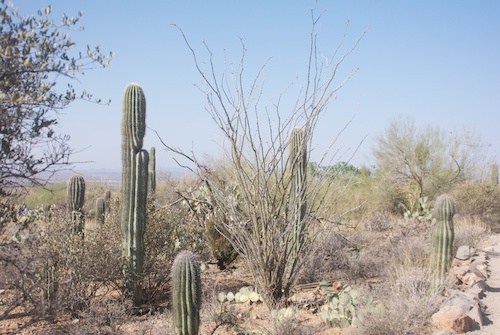
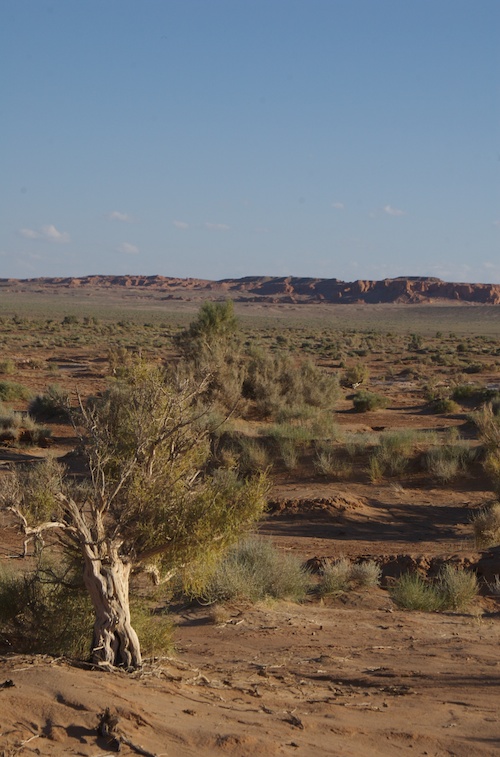
Sonoran Desert landscape with chollo and saguaro cactus, Arizona-Sonoran Desert Museum groundsGobi landscape, saxaul trees with Flaming Cliffs in the background
CLIMATE:
SONORAN DESERT: Hot with some colder winter areas at higher elevation. Snowfall rare except in mountains. Temperatures: summer- up to 120F (180F surface temperature has been recorded in Lower Colorado River Valley); winter- average low of 39F. Rainfall: bi-seasonal rain pattern- Dec./Mar., July/mid. Sept.; in some areas, multiple years without rain. Wind: winds blowing onshore bring the summer “monsoon” rains; hurricanes possible.
THE GOBI: “Cold” desert due to location on a plateau. Frost and snow can occur on the dunes. Temperatures: summer- up to 140F; winter- down to -40F; up to 50F temperature swings in 24 hours. Rainfall: one rainy season-July/August; up to 7.6″, some years with no rain. Wind: winds up to 85mph can create dust storms (usually occurring in March/April) large enough to be seen from space.
Estero Solado, a tidal estuary with no inflow, therefore it is always salineThe Flaming Cliffs beyond small Gobi lake, Sept. 2006
MARINE INFLUENCE:
SONORAN DESERT: Coastal areas on the Baja Pennisula and the east coast of mainland Mexico experience marine influence.
THE GOBI: Mongolia is a land-locked country, so the Gobi has no marine influence.
SONORAN DESERT: There are seven ecoregions: Tundra, Coniferous Forest, Temperate Coniferous Forest, Grassland, Chaparrel, Desert, Thornscrub (wet desert), Tropical Forest (source: Arizona-Sonora Desert Museum); sand dune fields of various sizes common.
THE GOBI: There are two or five ecoregions, depending on the source: 1) Eastern Gobi Desert Steppe, Gobi Lakes Valley Desert Steppe (World Wildlife Fund) 2) Eastern Gobi Desert Steppe, Alashan Plateau Semi-desert, Gobi Lakes Valley Desert Steppe, Junngar Basin Semi-desert, Tien Shan Range (“Alternative sources” Wikipedia entry for Gobi Desert); 5% of the Gobi is covered in sand dunes, much of the remainder in gravels of various kinds.
Avocets in the Estero Solado, Sonoran DesertAvocets, Orog Nuur, The Gobi, July 2009
HUMAN ACTIVITY:
Animal herding is common in both places. In the Sonoran Desert, there are cattle and some horses. The cattle graze on their own, the horses get fodder. In the Gobi, there are domestic bactrian camels, goats and some horses. In the more arid areas, camels do the work of horses. All animals graze on their own unless there is a severe winter, then they are fed fodder.
Food growing occurs where there is enough water. In the Sonoran Desert, water comes from springs, groundwater and wells. The growing season is very short- July and maybe into August. In the Gobi, there are lakes in some areas, springs and wells. The growing season may be as long as from April to October, depending on rainfall.
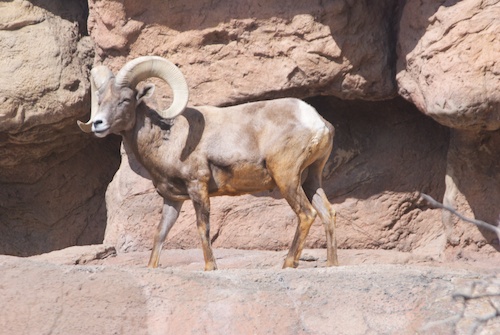
Desert bighorn ram, Arizona-Sonoran Desert Museum, March 2010Argali ram, Ikh Nartiin Chuluu Nature Reserve, April 2005
WILDLIFE:
SONORAN DESERT: 60 mammal species, including desert bighorn, jaguar, Mexican grey wolf, kangaroo rats, saiga antelope; 350 bird species, 15 which are endemic; over 100 reptile and 20 amphibian species. Endangered mammals: jaguar, Sonoran desert pronghorn. Endangered birds: cactus ferruginous pigmy owl, southwestern willow flycatcher
THE GOBI: 40 mammal species, including argali sheep, snow leopards (Altai Mountains) grey wolf, jerboas, Sonoran pronghorn antelope; the only reasonably reliable count for bird species that I could find on the web is 240 (from the Juuchin Tours website) specifically for Gobi Gurvansaikhan National Park. 15 reptile and amphibian species. Endangered mammals: Gobi bear, wild bactrian camel. Endangered birds: lammergeier, houbara bustard
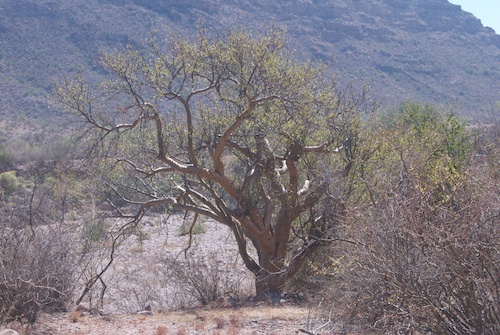
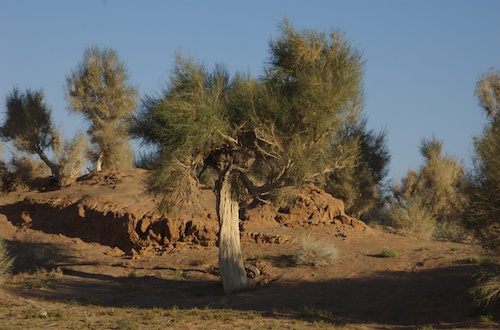
Sonoran desert tree that stores water in its trunkSaxaul tree, which has wood so dense from slow growth that a branch, thrown in the water, will sink
FLORA:
SONORAN DESERT: 2000 species of plants; known for: saguaro cactus
THE GOBI: 410 species of plants; know for: saxaul trees
For my Mongol friends, a desert that meets the sea
So there you have it. What I found to be a useful and interesting comparison of two of the great deserts of the world.
I want to thank Dr. Wagner for inviting me along on this wonderful trip and all my fellow artist traveling companions. Did we have fun or what? You’re the best!
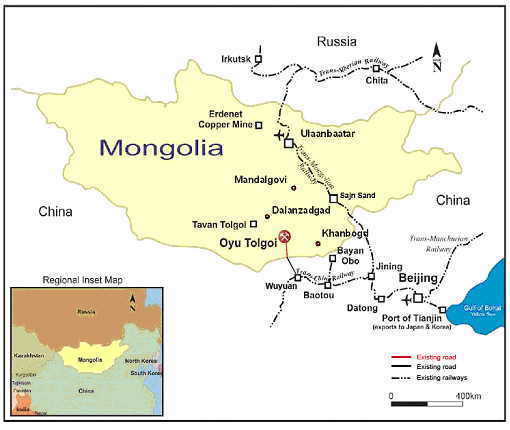
Map showing location of both Oyu Tolgoi and the coal mine, Tavan Tolgoi
The world’s largest undeveloped copper deposit, which also turns out to include significant deposits of gold and silver, is located in the Gobi of Mongolia at a site called Oyu Tolgoi, which means “Turquoise Hill”. The story of choosing who will operate the mine and how that was negotiated is a long and convoluted one. The super-short version: Nothing much happened until the Democratic party took power a few years ago. Not long after, a joint venture of two huge mining concerns, Ivanhoe and Rio Tinto, along with the government of Mongolia, was formed and work began.
Why would I blog about this?
Two reasons:
First, it will be a major test of how well Mongolia is able to enforce its environmental laws, since this the first mine to come online since the changeover from communism to democracy. It will be both open pit and underground. The size of the deposits is mind-boggling: (as of 2010) 79 billion pounds (35,833,000 tonnes) of copper, and 45 million ounces (1,275,000,000 grams) of gold. In ten years, over 3 million ounces of silver is expected to be produced. The copper extracted on a yearly basis will account for 3% of the world total.
Mining activity at this site is expected to continue for 45 years and account for 30% or more of Mongolia’s GDP. Mongolia has set up a sovereign wealth fund to handle the anticipated $30 billion in royalties and tax revenue. Once the contracts were signed a little over a year ago, Mongolia received its first check for….$10 million. How will the traditional Mongol land ethic, not to mention environmental and conservation considerations, hold up in the face of this kind of money pouring into the country?
The mine site
Needless to say, this single mine is a total economic game-changer in a country where the current average income is $3200 a year. And this is one mine. There is a huge coking coal deposit, Tavan Tolgoi, also in the Gobi, that will be developed in the not to distant future. There is already a new east-west railway planned to move the coal to the current north-south line, along with many other planned improvements in infrastructure.
Second, I personally know two Mongols who work at Oyu Tolgoi. One was a bird researcher I met on my very first trip to Mongolia in April of 2005 when he was at Ikh Nart during the Earthwatch team. I saw him again my first evening in UB this past July when I was invited to attend the farewell dinner for the most recent Earthwatch team. He had recently become the Environmental Officer at the mine. We’ve been Facebook friends for almost a year.
The second is a guide I’ve had on two of my trips, once in 2006 and again in 2008. He has worked as the Safety Officer for the subcontractor who is sinking the main shaft for, I think, a little over three years. He’s down at the site for a month at a time and must stay within the fence perimeter. Then he comes back home to UB for two weeks. He found me on Facebook a few weeks ago and we had a great “catching up” chat.
Employee housing: gers, of course
The two men have met a couple of times at the mine site, so it’s a small world story. To be continued….
My plan was to go back to Kenya in 2005 for an Earthwatch Institute-sponsored research project “Lions of Tsavo”. But I was leafing through the new Expedition guide and a project I hadn’t seen before caught my eye, “Mongolian Argali”, whatever those were. Oh. Wild sheep. But….Mongolia. Now there was a place that seemed like it might be interesting to travel to. And who knew how long the project would last. Some went on for a decade or more. Others only for a year or two. I called the Earthwatch office, changed projects and, without realizing it at the time, changed my life.
Argali (Ovis ammon) are the world’s largest mountain sheep. A big ram can weigh close to 400 pounds. The horn curl can reach 65″. Their preferred habitat is rocky uplands, mountains and steppe valleys. They are currently listed on the IUCN Red List as Near Threatened and Appendix II of CITES. Accurate population estimates are hard to come by. The most current one is perhaps as many as 20,000 in Mongolia. It is known that the total continues to drop in the western and central parts of the country, is stable in the south, but seems to be increasing in the east.
Group of four argali rams, Ikh Nartiin Chuluu, 2005
Threats include poaching, both for subsistence meat and for the horns, which are now in demand in China for use in traditional medicine. It has also been shown that there is a nearly 100% grazing overlap between the wild argali and domestic livestock, which includes horses, sheep, goats and cattle. Predation by the herder’s domestic dogs, particularly on lambs in the spring, is also a problem. Trophy hunting is not currently a large factor, but the license fee income (18,000 USD) ends up going almost entirely to the federal government. Very little trickles down to either the local people or for conservation projects. One response at the local level has been to create reserves where hunting is not allowed.
As you can see below, there is now an Argali Conservation Management Plan. My on-going involvement with the womens’ craft collective comes under item four on the list.
“Additional conservation measures are desperately required in Mongolia. Clark et al. (2006) outlined the following:
• Implement the recommendations outlined in the Argali Conservation Management Plan. • Improve enforcement of existing legislation that would help conserve argali. • Enhance conservation management in protected areas where argali are found at high population densities, and increase the capacity of protected areas personnel and other environmental law enforcement officers. • Work to improve the livelihoods of local communities in areas where argali are protected by local initiatives and re-initiate community-based approaches to argali conservation (Amgalanbaatar et al. 2002a). • Develop public education programmes to raise awareness of the status of and threats to the species. • Continue ecological research, monitor population trends, and study the impacts of threats, including work in the Altai and Khangai Mountains to complement research occurring in the Gobi Desert. • Implement the recommendations from the Mongolian Wildlife Trade Workshop as outlined in Wingard and Zahler (2006).
Argali ewes and lambs, Ikh Nartiin Chuluu, 2005
Until a joint research effort was started by the Mongolian Academy of Sciences and the Denver Zoological Foundation at the Ikh Nartiin Chuluu Nature Reserve in 2001, very little was known about argali ecology, behavior and population status. This was the research that I had signed up to help with as part of the second Earthwatch team ever to go to Mongolia.
It was April of 2005. Spring in Mongolia is a time of cold, wind and dust storms. Daytime temperatures during the team’s two week stay, living in a traditional felt ger, sometimes only reached 32F. I had the time of my life. When they found out I was an artist, one of the scientists asked if I would be willing to go out and do direct behavioral observations. And that’s what I did for the last three days, trekking out alone into the 43,000 hectare reserve with a clipboard, data forms, GPS, cameras, water bottle and snacks, trying to see the sheep before they saw me, otherwise any data I collected was invalid.
I saw this large group at Ikh Nartiin Chuluu in 2008; seventeen animals, I think, and they ran up that vertical cliff like water flowing uphill
Although a lot of the animals were in poor condition coming out of a typical Mongolian winter in which temperatures can plunge to -40F, I saw many groups that included rams, ewes and lambs, gathered some useable data and got some pretty good photographs. It was a perfect two-fer. I was able to contribute to scientific knowledge of a species and at the same time get information that would be invaluable for painting them.
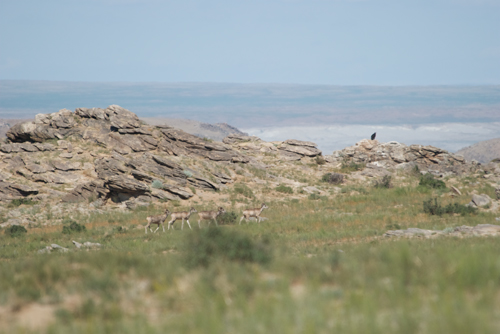
A typical sighting of some ewes and older lambs at Ikh Nart, but with a cinereous vulture, the world's largest, sitting on a rock in the background; in the distance is the desert steppe
I’ve been back to Ikh Nart five times since then and argali have become a particularly favorite subject. I’ve also seen them now at two other locations: Baga Gazriin Chuluu Nature Reserve and Gun-Galuut Nature Reserve.
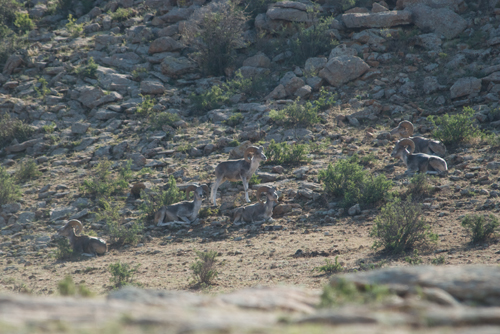
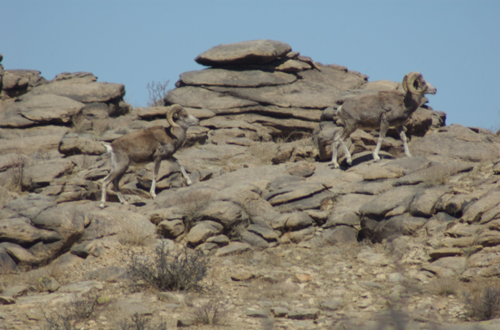
Driving into Ikh Nart in 2008; a grab shot from the car of four ramsRams on rocky hillside at Gun-Galuut Nature Reserve in 2009; the key to spotting them is to look for movement and those long, thin legs, which don't seem to quite fit the landscape; this was with my 80-400 mm lens (effectively 600mm on a digital body) at maximum zoomThis group of rams, at Baga Gazriin Chuluu Nature Reserve were about 800 meters away within plain view of the road through the park; "lazy" animal watching
I thought that I would share some of the photos I’ve taken and the paintings that have come out of them. It usually takes around three, often quite a few more, reference shots since I move animals around, change backgrounds or whatever it takes to make a composition work. I’m only going to show the main animal reference that I worked from. This fieldwork is critical. When working on a painting, I’m also remembering what it was like to be at that place, how the wind felt, the utter quiet when I stopped for a break, then trudging along, looking up and seeing that the sheep had already spotted and were watching me.
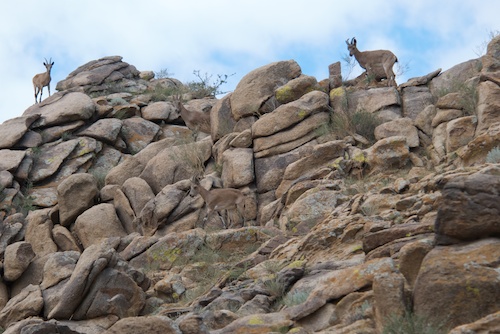
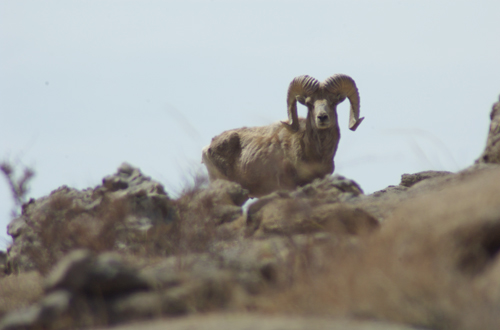
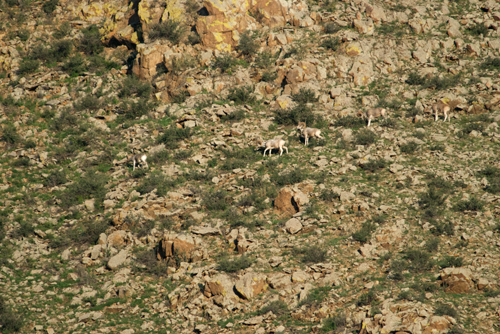
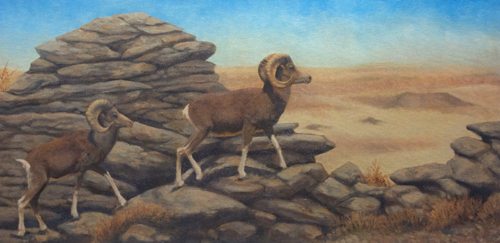
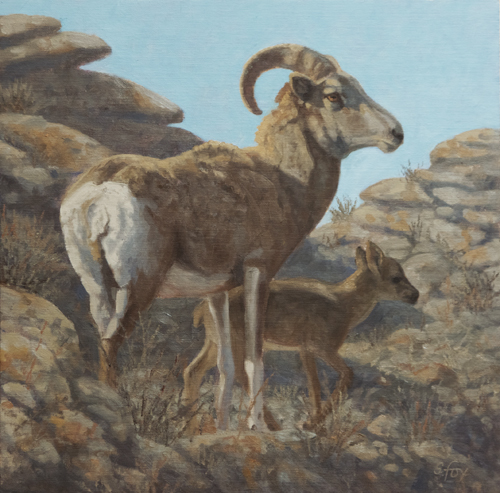
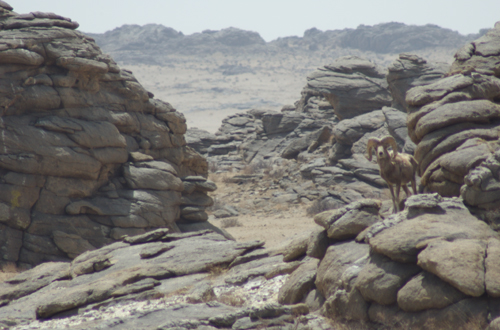
For one of my first argali paintings, I wanted to show them in the fantastic landscape of Ikh Nartiin Chuluu; April 2005Ikh Nartiin Chuluu Argali 15x30" oilArgali ewe, Ikh Nartiin Chuluu; April 2005; I added a lamb and moved the ewe up so her head would be against the sky for maximum contrastArgali Ewe and Lamb, Ikh Nartiin Chuluu; 12x12" oil on canvasboardOld ram, Ikh Nartiin Chuluu; April 2005; He's probably long gone, but we spent a, for me, memorable half hour together as he let tag along behind him after checking me out; that's also him in the first photo at the top of this postMutual Curiosity 17x30" oil
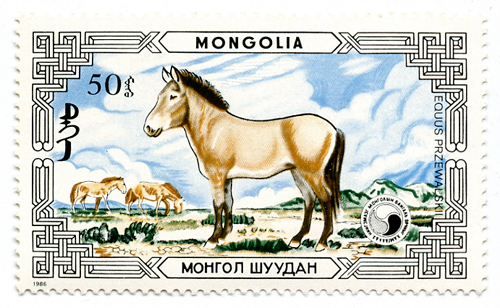
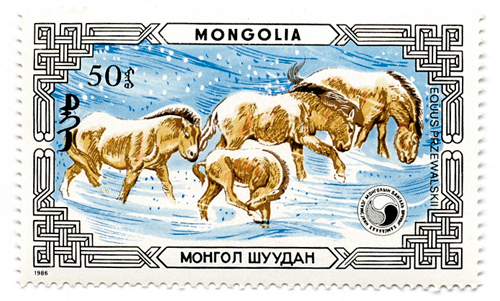
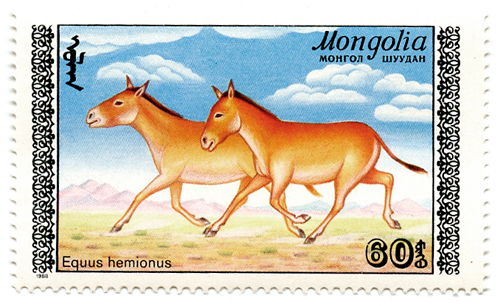
Concluding this series on postage stamps for now, today’s post features the two native equids of Mongolia, the takhi, traditionally known in the West as Przewalski’s horse, and the Khulan, one of a number of species of wild ass.
Takhi are the only remaining species of true wild horse. What Americans call “wild horses” or mustangs are really, simply, feral domestic horses. The two species diverged around 500,000 years ago, so the takhi is not the ancestor of modern horses, nor have any ever been successfully tamed, other than a few instances where a young horse was taught to tolerate humans riding it for a short time. The last wild takhi was a stallion seen in 1969. Captive animals started to be reintroduced to Mongolia in the early 1990s. Being a horse culture, the Mongols are very pleased to have takhi in their country again. And it’s not a surprise that they have been featured on a set of postage stamps.
Khulan are also known as the Mongolian wild ass. Their survival is threatened by habitat reduction and they are also subject to poaching. Not a great deal is known about their behavior or even their total numbers. However, there is an organization, started by a French researcher who is a friend of mine, which carries out the research needed to learn about the ecology of the animals and what their survival requirements are. You can find out more about her project here.
Unlike the takhi, which is a grassland species, the khulan live in the arid environment of the Gobi.
I ordered these to get the first stamp shown, but the whole set, uncanceled and in perfect condition, is so well-done that I wanted to share them all with you. I think that they are of interest not only because of their subjects, but as lovely little works of art. I wish I knew who the artist was.
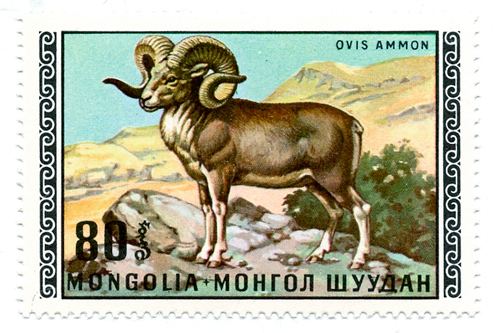
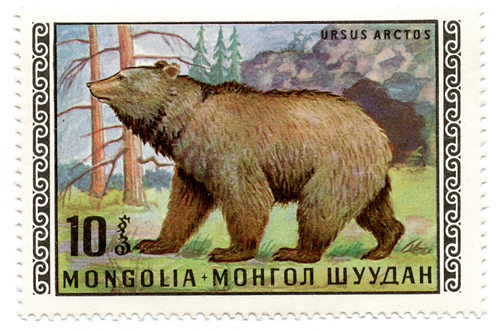
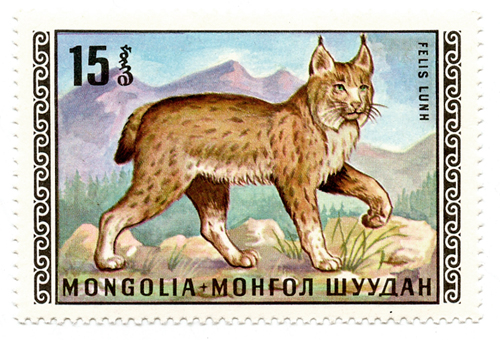
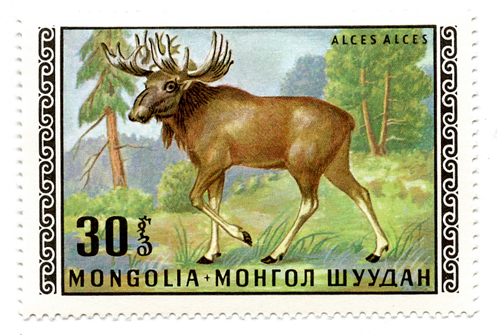
Argali (Ovis ammon); the legs are a little short, but otherwise this is quite good; found in the high mountain zone and mountainous areas of the GobiBrown bear (Ursus arctos) : found in the northern mountains of Mongolia , which is the southernmost part of the taiga or boreal forestLynx (Lynx lynx); found in the taiga (forest zone)Siberian marmot (Marmota sibirica); has undergone a tremendous population crash in recent decades; now exists in localized populations; found in the mountain forest steppe transition zone and the steppeMoose (Alces alces), called "elk" in Europe: found in the taiga; same species as found in North AmericaWild boar (Sus scrofa); found in the mountain forest steppe transition zone; a small population also inhabits the reed beds of Khar Us NurWolf (Canis lupus); found in the taiga, mountain forest steppe and steppe
Next week, I’ll be featuring two Mongolian equids, the takhi and khulan.
At the door of the skytent,
holding a golden lantern,
by the light of my golden lantern, I can see
that the old ones are coming,
mounted high upon white clouds.
A gentle creature, smelling still of milk
is coming, wading through the milky ocean.
Through tantric practise and endless recitation,
a monk has shrunk his body, small as an elbow, and
he’s coming, flying cross-legged.
The door of the skytent
swings quietly open…
Twenty-one young girls, their eyes all-seeing and clear,
are coming into the Buddha’s presence.
The pure heart, free of sorrow,
free now from the world,
have thrown the door wide and stand amazed.
A child comes to her mother, and
a mother comes to her child, and
they go seeking the profundity they lack.
The door of the skytent
swings quietly open…
And every time that door swings quietly open,
It steals a count of breaths
from life’s red bulb.
Gold and silver fishes,
impermanent, seem permanent
inside.
They are content in their own way.
at the door of the skytent
holding a golden lantern….
Translated from the Mongolian by Simon Wickham-Smith, with whose kind permission this poem is presented to my readers
The image at the top is from Onglyn Monastery, one of the many that was destroyed in the late 1930s by the communist government. The ruins are extensive since there were two large monasteries that faced each other and could house over 1000 monks, but there is a re-building effort under way, including the small temple building where I took this photo. It seemed appropriate to use an image from a “re-birth” for a poem posted to celebrate Tsagaan Sar, the White Moon, and the beginning of a new year.
Final note: I’m waiting for some new animal stamps to arrive from eBay for Part 3 of my posts on Mongolian stamps.
I got the email telling me to go the site and check the acceptance list yesterday morning at 9am. It was in alphabetical order, so I slowly scrolled down, holding my breath. And saw my name. Twice! I entered three pieces, so two out of three.
One of my goals for many years has been to have my paintings accepted into juried shows that are outside the “wildlife art ghetto” to which the genre of animal art has been foolishly and ignorantly consigned by many in the mainstream art world, even though great artists who these same people often admire also painted animals.
Clearly, the good folks at Greenhouse Gallery don’t share that bias, bless their hearts.
I’m proud to be an animal artist and know that our genre’s best work easily stands with the best in any other field of representational art. And I also know that to paint animals successfully requires a specific depth of knowledge that is not appreciated by those outside the field.
Here are the two paintings that will soon be on their way to San Antonio, Texas:
Done for the Day 17x30" oil on canvasboardTakhi Stallion, Hustai National Park 17x30" oil on canvasboard























 Susan Fox, American Artist