I’ve known since my first trips to Mongolia that art is an extremely important part of the culture, but had not found a way to meet or connect with any of the artists themselves. Until now.
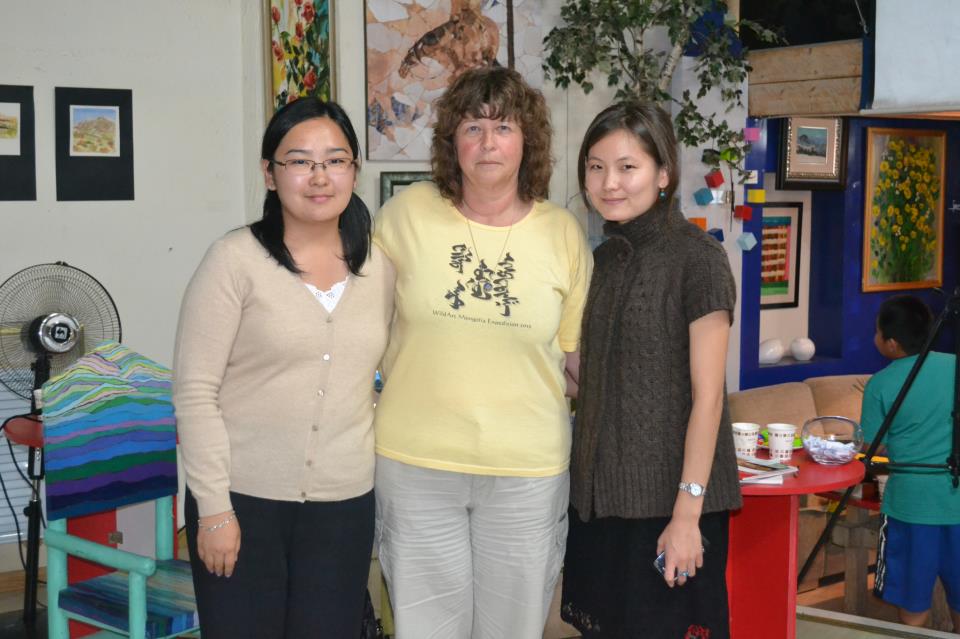
Thanks to Janna, the Director of ArtiCour Gallery, who hosted my Ulaabaatar art event on September 22, I got my wish and then some. The gallery represents some of Mongolia’s most prominent and honored painters. Some of them were kind enough to come to the event and two invited me to visit their studios, which I did the next day. I had a wonderful time, thanks to Janna and Khaliunaa, who was one of my interpreters for the art event (along with Buyandelger) and who was nice enough to come along so that I could talk to the artists.
Although they did not have access to the West during what the Mongols call “socialist times”, many Mongolian artists traveled to Moscow, St. Petersburg and other Eastern Bloc countries to study in a variety of art academies and schools, so they were trained in classical, academic methods. They were limited in what was acceptable to paint, Impressionism apparently being totally off-limits, but still found ways to express themselves with great originality. With the coming of democracy in 1991, the artists of Mongolia became free to go wherever their artistic vision leads them.
The following is a “album” of my visit to the studios of six artists, all members of the Union of Mongolian Artists, which was founded in 1944 and has its own large, airy gallery space in the heart of Ulaanbaatar. I’ve been going there every trip since 2006 to see their exhibitions.
The studio photos and some of the art images were taken with my iPhone. Some of the other painting images I scanned from materials like brochures and booklets that the artists gave to me as gifts. I hope you enjoy this “studio tour” and you can be sure that there will be more to come in the future.
The artists are presented in the order in which I met them.
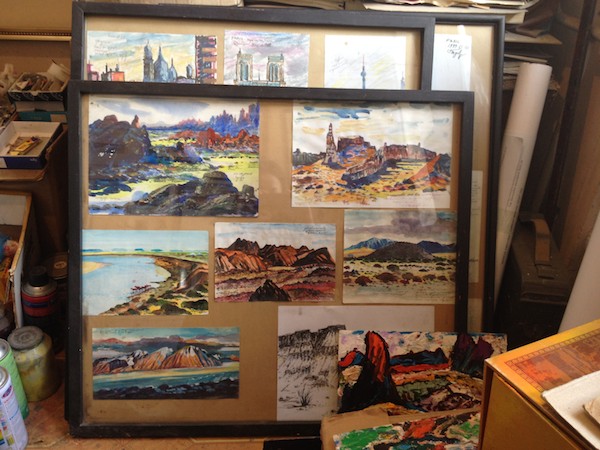
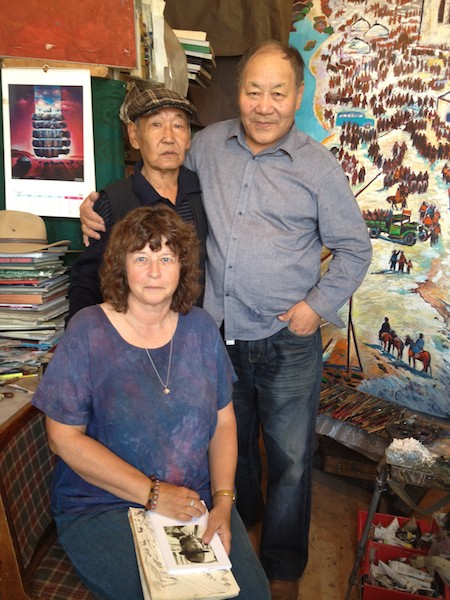
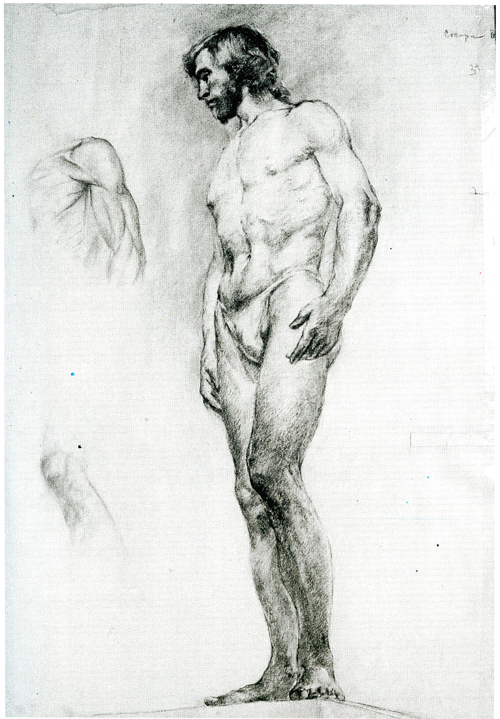
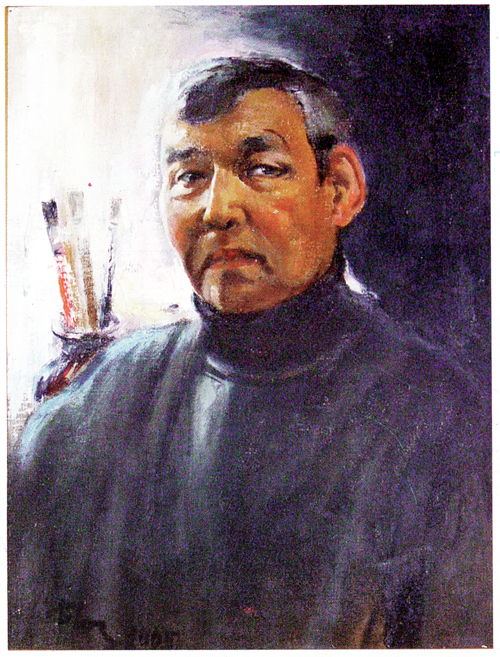
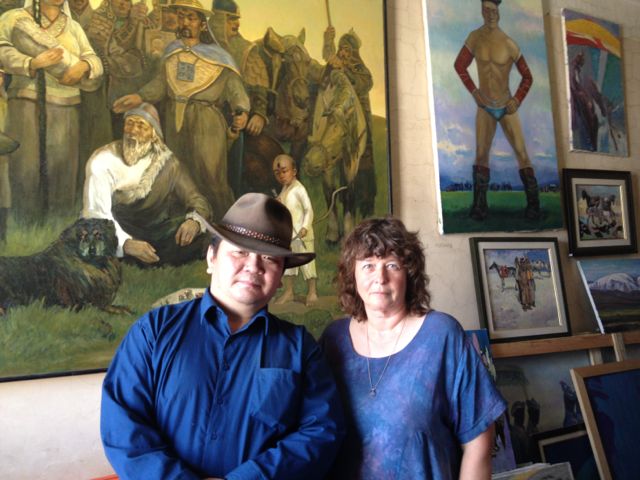
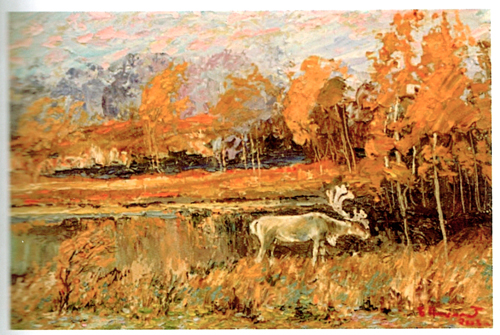
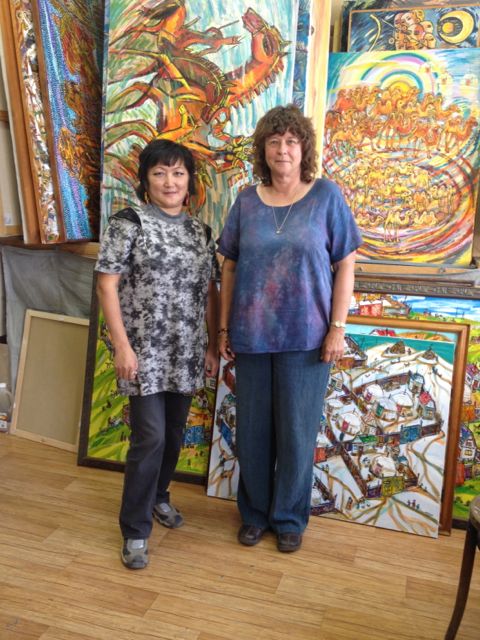
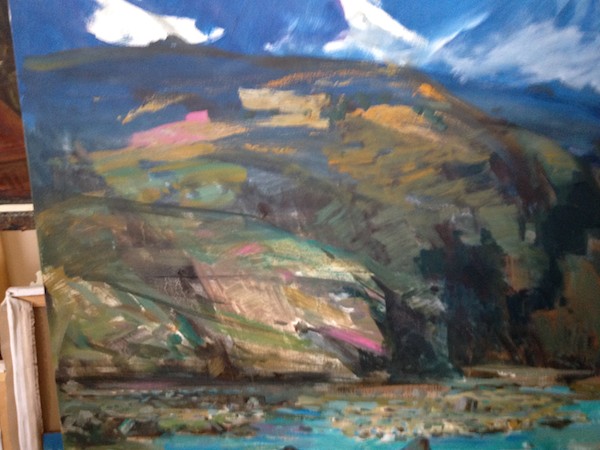
E. Sukhee, who I was told is one of the most eminent artists in MongoliaUulen Choloonii Nar by E. SukheeG. Dunburee; he was definitely the extrovert of the groupDunburee’s famous painting “Ikh Khuree”, a scene of Ulaanbaatar in the 1920s, one of a seriesSome of Dunburee’s location paintingsFellow artist, Sosobaram, who stopped in for a short time, Dunburee and ISosobaram gave me a lovely booklet of his life and work. I scanned this and the following two images from it. Here is one of his drawings, I think from when he was a student.Tsagaan Sarnai by B. SosorbaramAvto Portret 2006 (Self Portrait 2006) by B. SosorbaramS. BayarbaatarTalin Unselt by BayarbaatarNatsagdorj- one of the very few watercolor artists of his generationIkh Taigin Namar by Natsagdorj; he is from the northern part of Mongolia and at one time specialized in images of the Tsaatsan or “Reindeer People”.Tugs-Oyun SodnomGer District 2009 by Tugs-OyunD.MunkhLandscape in progress- MunkhLandscape in progress- detailFinally, Tugs-Oyun, me and Janna Kamimila, the Director of ArtiCour Gallery, who arranged this memorable afternoon with the artists, who couldn’t have been more welcoming
I arrived home from my seven week trip to Mongolia last Tuesday. I’ve been alternating catching up and doing….nothing or at least nothing more strenuous than watching a baseball game. The first order of business was to download and start categorizing the over 8000 images I shot on the trip. I always feel better when everything is safely on the hard drive, backed up to the remote Vault and visible in Aperture.
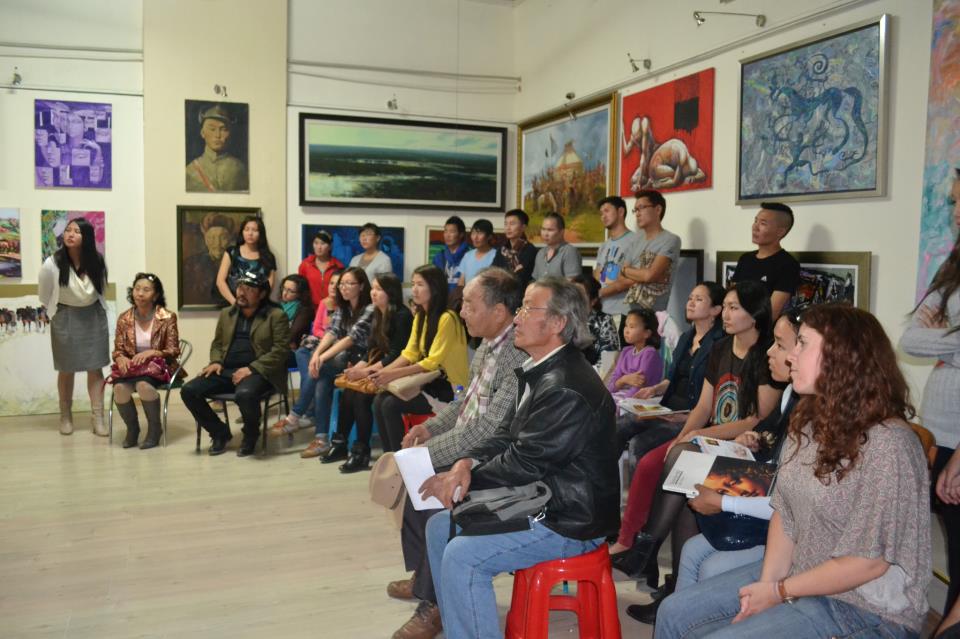
My final days in Ulaanbaatar were a bit of a whirlwind. The art event at ArtiCour Gallery was great! There was a steady stream of people all day, some of whom I knew. There was a lot of interest in the WildArt Mongolia Expedition and at least three artists expressed an interest in going next year. Many art students came by. The director of a Mongolian magazine which publishes articles on artists stopped in and said that they want to do an article on my and my work! Even more special to me personally, a number of very prominent Mongol artists attended, all of them members of the venerable Union of Mongolian Artists, which was founded in 1944. Two of them invited me to visit their studios. But that will be a tale for another post.
Here’s a selection of photos taken at “American Artist Susan Fox-The WildArt Mongolia Expedition”, which was the first in ArtiCour’s new Visiting International Artists series.
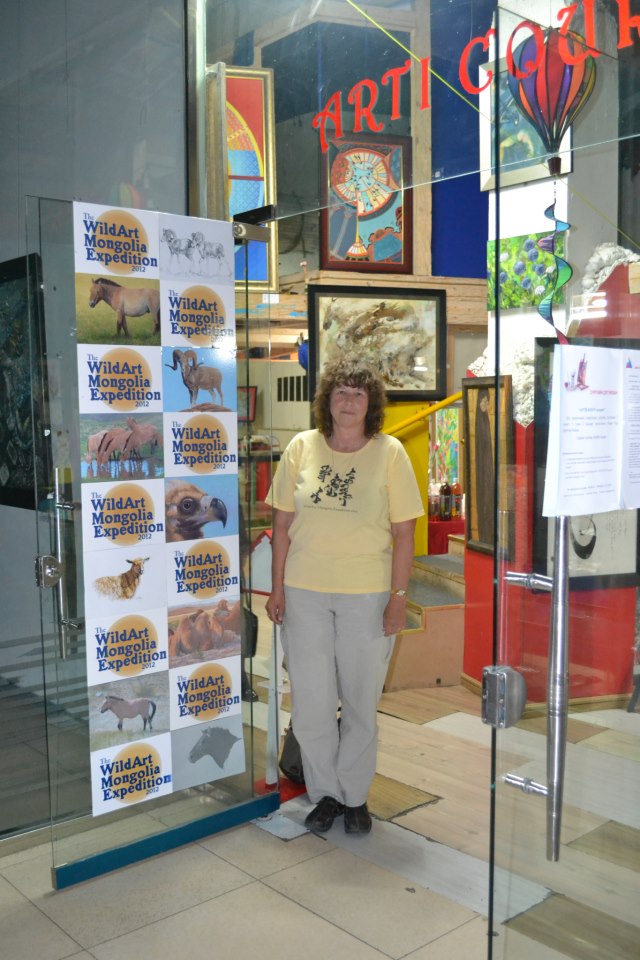
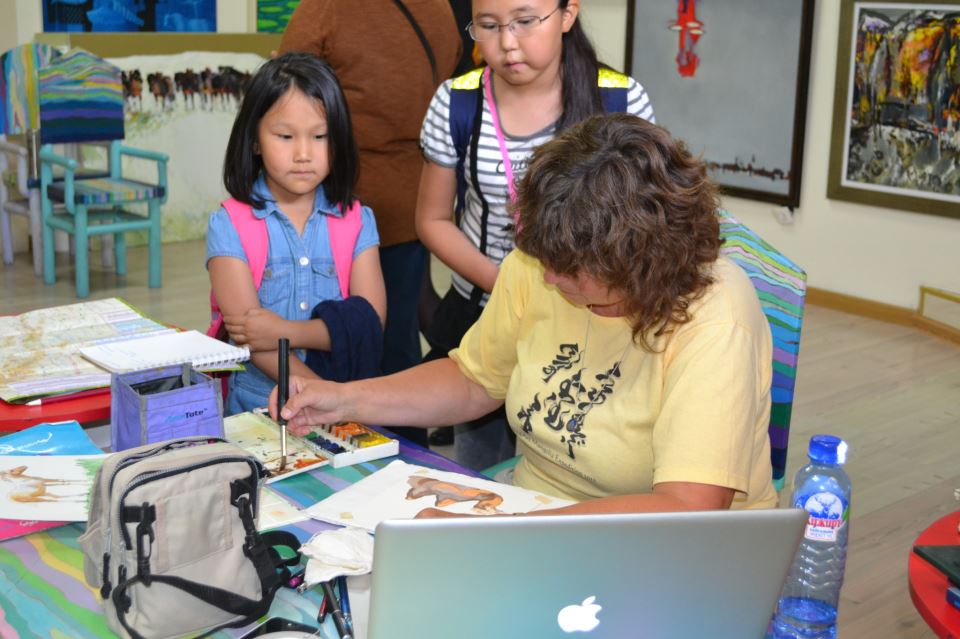
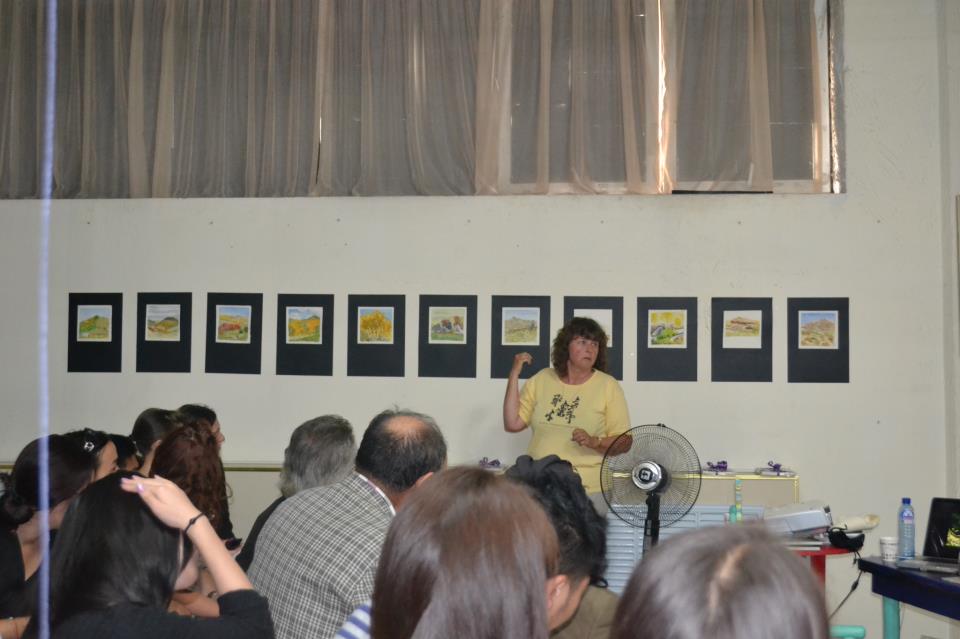
Entrance to ArtiCour GalleryMeeting E. Sukhee, one of Mongolia’s most famous artistsWatercolor demonstrationBactrian camel. watercolor demoDisplay of watercolors I did on location over two afternoons while I was visiting Hustai National Park, one of the three places in Mongolia where takhi (Przewalski’s horse) have been reintroducedMeeting Dunburee, also a very prominent Mongol artistDoing a fast sketching demo during my evening presentationI couldn’t have had a better, more attentive group and they asked some great questions later on.Meeting with Ekhbat Lantuu, President of the New Century Art Association, which promotes environmental issues through the arts.My interpreters, Khailiunaa and Buyandelger, without whom I wouldn’t have been able to talk to anyoneJanna Kamimila, the Director of ArtiCour Gallery and my host
As I mentioned in my last post, I’m going to be publicizing the WildArt Mongolia Expedition while I’m here. On September 22, I will be at ArtiCour Gallery, just off Sukhbaatar Square, from 11am to 7pm, meeting Mongolian artists and friends, talking about the Expedition, sharing images of my work and doing demonstrations of sketching, watercolor and iPad drawing. I’ve created a Facebook Event here.
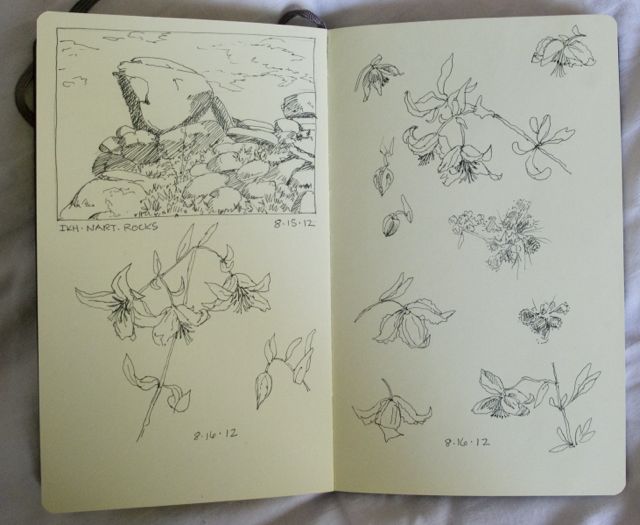
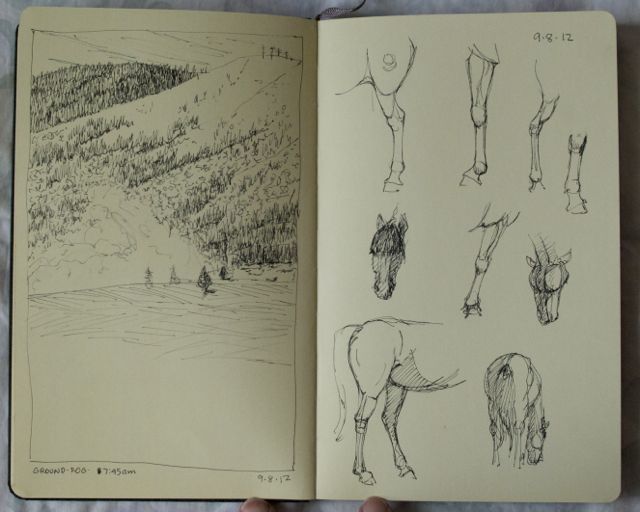
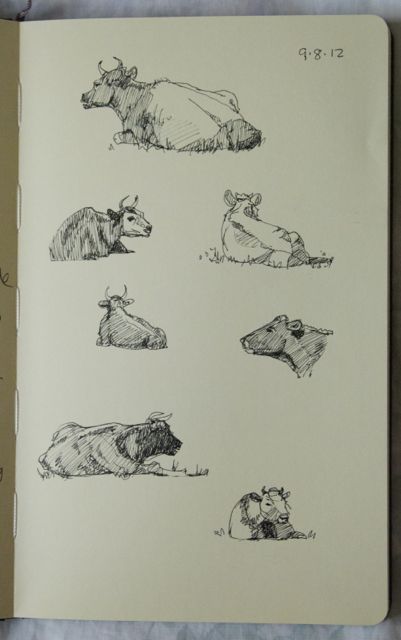
I’ve been able to get in some good field sketching time this trip and thought I’d share a selection of what I’ve done so far. In August I went to Ikh Nartiin Chuluu and Arburd Sands. Once the Expedition in September was postponed, I needed to make other plans. I’ve spent six days at Jalman Meadows ger camp in the Khan Khentii Mountains and got back yesterday from four days back at Ikh Nartiin Chuluu, this time staying at Nomadic Journeys’ Red Rock ger camp. Tomorrow morning I go to Hustai National Park for four days to observe, photograph and, with luck, sketch takhi.
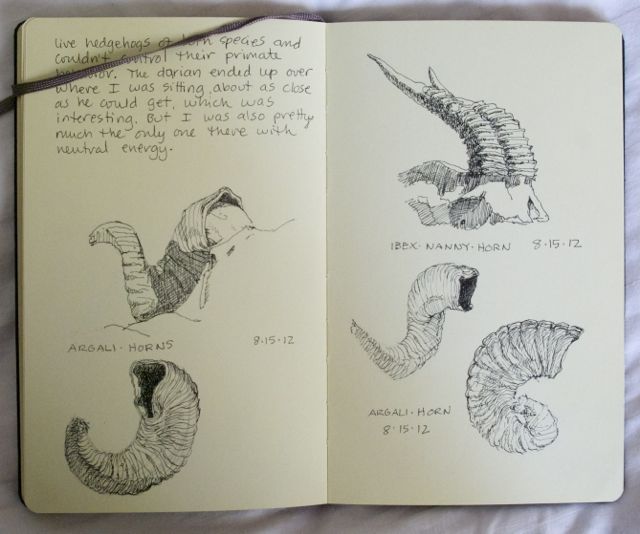
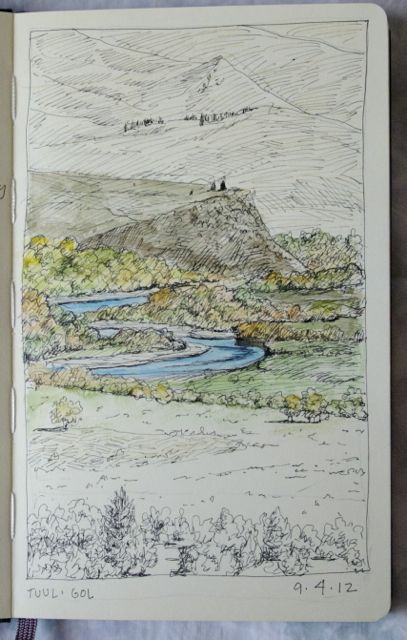
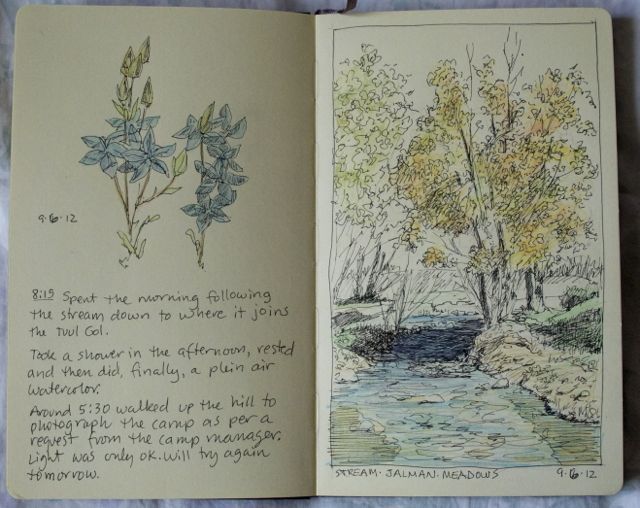
I’m using a Moleskin Sketch journal with Sakura Micron .01 and .02 pens and water- soluble colored pencils.
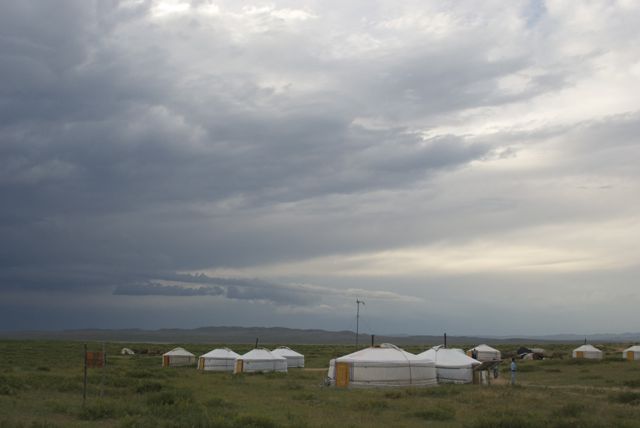
Arburd Sands ger camp with a summer storm coming in
As I noted in my previous post, in Mongolia flexibility is important. So when I got back from my weekend at Arburd Sands ger camp and found that the other artist had cancelled due to a family emergency, I had to get flexible and fast.
The WildArt Mongolia Expedition is now postponed until September of 2013. I will be traveling in the countryside to other locations between now and when I head for home. I’ll post about them when I can.
The great news is that I am working with a young Mongolian man, Byambakhuu Darinchuluun, who lives in New York and who has contacts all over the United States with the various Mongol-American communities and also here in Mongolia. We will be publicizing the Expedition while I’m here in the country, explaining this special, first-time collaboration between Mongol and American artists I’ve planned that will also support conservation. And we’ll have time to extend and refine this important initiative.
To that end I will be the focus of a special event, “American Artist Susan Fox- the WildArt Mongolia Expedition”, on September 22 at ArtiCore Gallery Company, which is right in the middle of Ulaanbaatar, across from Sukhbaatar Square. I’ll be meeting local Mongol artists, talking about the Expedition, giving a presentation on my work and demonstrating my fast sketching technique.
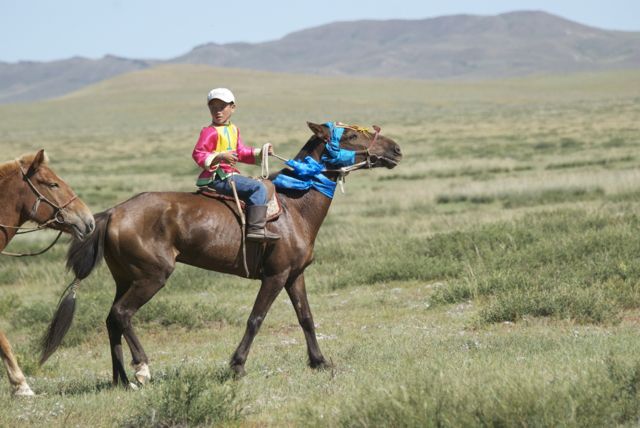
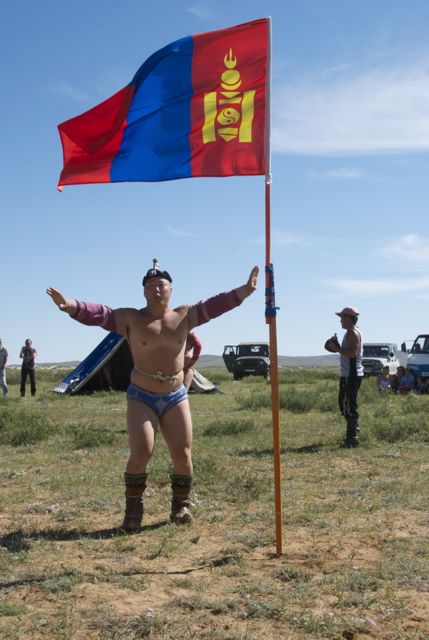
I had a wonderful time at Arburd Sands ger camp last weekend, which was hosting their first naadam for visitors. I got to see the horse race from the beginning through the middle and end and took around 700 photos plus video. There will be more on that later, but here’s a few photos that I particularly liked, including a couple of Mongol bokh, or wrestling.
I got to ride in the car which paralleled the horses.The ones taken through the windshield communicate the excitement quite well.This is the winning horse, quite a beauty and he won by quite a bit.Some of the wrestlers are big guys.Doing the Eagle Dance before a bout.
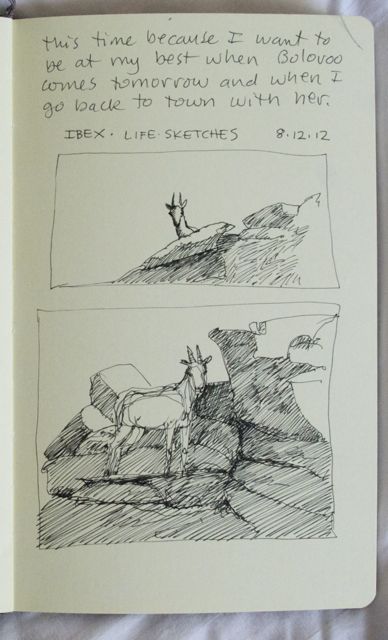
They almost always see you first. That’s a nanny on the left and a three year old billy on the right. You can tell their age from the ridges on the horns.
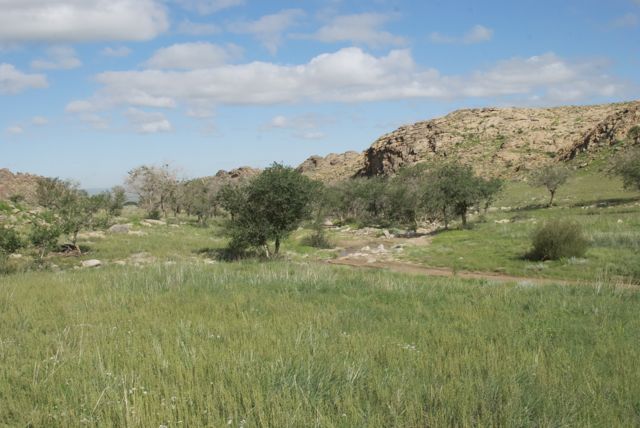
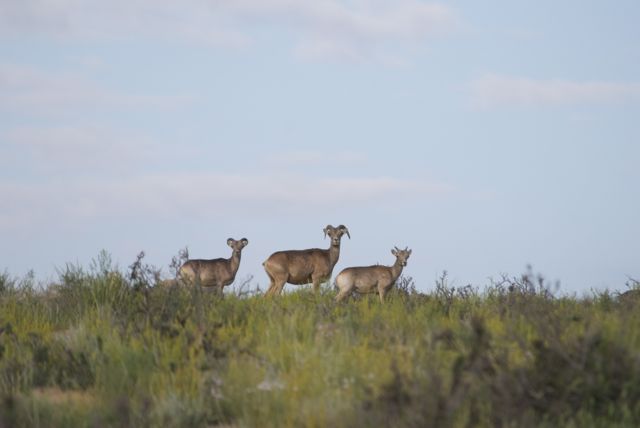
It was Siberian ibex this time at Ikh Nart. I’d see them on previous trips and always take photos, but my main goal has been seeing as many argali as possible. This year most of those were 20km or so to the northeast, so it was not possible to walk to where they were, at least for me, and I didn’t have a car and driver this time. I’m good for about 8-10km or so a day, especially if it’s hot. And was it hot! Probably close to 100F on a couple of days and not starting to cool off until around 10:30 at night. We also had a couple of rain storms move through during the eleven days that I was there, one with quite a light show.
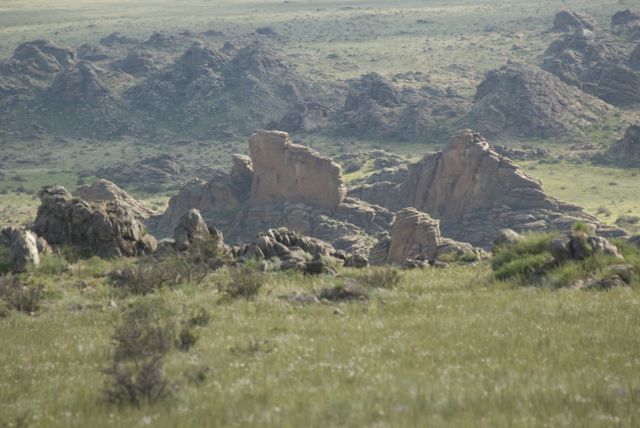
The valley were the research camp is located. The ibex were up on the rocks down on the far left hand side
I walked down the valley the first day, followed a slope up to the top, sat down to sketch the scene in front of me, looked around and there behind me I saw that I was being watched by an ibex. Forget the sketching, the wildlife fieldwork was on!
Close-up view of the previous photo. That’s a nanny on the left and a young billy on the right.
It turned out there was a group of around a dozen nannies and kids, one of each wearing radio collars, who were hanging around two adjacent rock formations. The first day there were also two young billies, one two and one three years old, judging from the ridges on their horns. I saw and photographed them in that same location three out of the next four days, shooting hundreds of images, around 900 in all. So you know one subject I’ll be painting this winter….
Ibex nanny wearing radio collar
My main reason for going to Ikh Nart, though, was to have my annual visit with the members of Ikh Nart Is Our Future, the women’s felt craft collective that I support. I had a very good meeting with the director, Ouynbolor, during which we spoke (through a translator) about how things had gone since I last saw her and what she needed me to do for this next year. Coming up will be a larger quantity of the full-color brochures I and staff at the Denver Zoo had produced to explain the collective to visitors to the tourist ger camp. They will also now be produced in Mongolian, not just English. There were also matching product tags in three sizes. They worked well, but a much larger quantity of those will also be needed for next year.
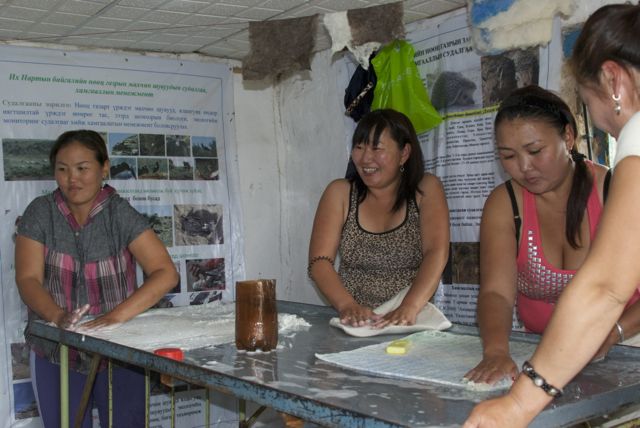
Collective members at work on various tasks
I registered a url for the collective last year, knowing that they wanted to have a website. At the meeting we were able to work out the content and a way to communicate while it’s being put together.
Making felt; the wool is laid out in cross-wise layers, wrapped in a piece of tablecloth, thoroughly soaked with hot water and then saturated with soap, which is the ingredient that melds the fibers togetherThey got me into the act too, helping to work the soap into the wool
The really special part is that I was able to arrange to go to the soum center (county seat), Dalanjargalan, for a night and a day. I had always met the women at either the research camp or the tourist ger camp and felt that it would be very beneficial to spend at least a little time where they live (when they are not out in the countryside at their gers with their animals) and learn a little about their lives. I got a walking tour that included the local school and shop. I stayed in the home of one of the collective members. Had lunch at the home of another and, in the afternoon, around a dozen members gathered at “the office”, a little building that used to be a gas station, to process their wool, turn it into felt and also work on various items that they will sell. I saw the felt presses that I had helped them acquire in action, along with the good sewing scissors they had requested in 2009. They have quite an operation set up now and work very efficiently and with great care and conscientiousness. I shot both still photos and around an hour of video with my new Panasonic recorder, enough to put together a little YouTube video after I get home.
Collective member with lovely pictorial peice done completely with different colors of felt
My ride back to camp arrived later than expected, around 10:30pm, and the reason was that they had seen and captured two very young long-eared hedgehogs that were crossing the road in front of the car! Hedgehogs are one of the species being studied at Ikh Nart, by a graduate student named Batdorj. Within a kilometer of leaving Dalanjargalan, a third one dashed across the road, this time an adult darian hedgehog, and it was captured too, riding back to camp on the lap of one of the students wrapped in his jacket. I was able to get a lot of photos and also video the next evening before they had radio transmitters glued to their backs and were transported back out to the general area in which they’d been caught. And yes, there will definitely be hedgehog paintings, cards and prints coming up.
Darian hedgehogYoung long-eared hedgehog
I also had time to just wander around the reserve and see what there was to see and it turned out to be….wildflowers! The rains have been very good this year and everything is green, green, green. I’ve been to Ikh Nart in August before, but have never seen so many different flowers and so many that I had never seen there before. It was like walking through a huge flower garden.
Wildflowers
Finally it was time to depart. We were taking the train overnight to Ulaanbaatar. Most of our luggage, except for what we needed for the night, was taken back to UB by car in the afternoon. The rest of us caught the 1:14 am train and arrived about 8:30 am. I had never done this before, but managed to get around five hours of decent sleep. We were taken back to Zaya’s Guesthouse, where we got showers and sorted our dirty clothes for laundering. The rest of the day was spent getting lunch and puttering around, catching up on emails. The next day I spent most of the afternoon doing a massive download and back up of all the photos and videos I’d shot.
Late afternoon on the north side of the valley
So now I’m at Zaya’s, which I highly recommend to anyone coming to Ulaanbaatar. The rooms are sparkling clean, there is free wifi and the location is very convenient, right off Peace Ave. not far from the State Department Store. There is a common living room with a very comfortable sectional sofa and a full kitchen for the use of guests.
I did see argali a couple of times
As for the WildArt Mongolia Expedition, I’m now working on the last bits of planning and arranging, some things having changed since I left the US. Flexibility is important when doing things in Mongolia. It makes some people really angry when something doesn’t go right or on schedule (so this is not a country they should visit), but I’ve found that it creates possibilities that wouldn’t exist otherwise.
I’ll be in UB for the next 2-3 days, then I’m hoping for a long weekend at a ger camp I’ve stayed at before. Stay tuned!
First night out on two-week camping trip, July 2010
If everything goes as planned, I will soon be in Ulaanbaatar, Mongolia. Four days in town and then off to Ikh Nartiin Chuluu Nature Reserve for eleven days. I’ll post when I can. In the meantime, here’s a few photos of favorite camping spots from past trips.
I’m almost packed, just the roll-on to finish, mostly the camera equipment. I’ve developed a packing list over the years that definitely reduces the stress, plus most basics are now available in UB if needed.
I did make a final purchase. Everyone is different in what little things make travel more comfortable. For me, it’s sleeping on the same surface every night (Thermarest pad), having a real pillow ( a cut down bed pillow that fits in the roll-on), a hot coffee-like drink first thing in the morning (coffee packets, ceramic mug and immersion heater) and, this time, two decent sized travel towels.
A real favorite; camping at Baga Gazriin Chuluu, July 2010
I’ve used a pair of ok cloth ones for at least six years. They were some of the first travel towels on the market, at least at REI, and worked ok. They dried fast and rolled up pretty small. But they developed a kind of “chalky” feel and weren’t big enough to really wrap up my wet hair. One last trip to the local outdoor store and I now have two 20×40″ microfiber towels from Sea To Summit. Even though they are bigger, they roll up smaller than the old ones. Not cheap, but after bumping up against the limitations of the others, I finally decided the heck with it and got something better. A test at home was successful, so it looks like I’m set.
Camping on the steppe, August 2011; beautiful, quiet and classically Mongolian
Gers north of Bayanhongor, Hangai Mountains, July 2010; watercolor on Annigoni 100% cotton paper
My intention is to do at least one sketch a day this trip. So I wanted to be in a groove before I leave. I also needed to refine my portable art studio. So I spent yesterday working from previous trip photos as if I was at the scene, reliving a little of what it was like to be there and imagining having just enough time during a lunch stop to get out the paint and do a quick study. So none of these took more than about 20 minutes.
The idea is to work fast, get an impression down and move on. Here’s what I’m taking this year:
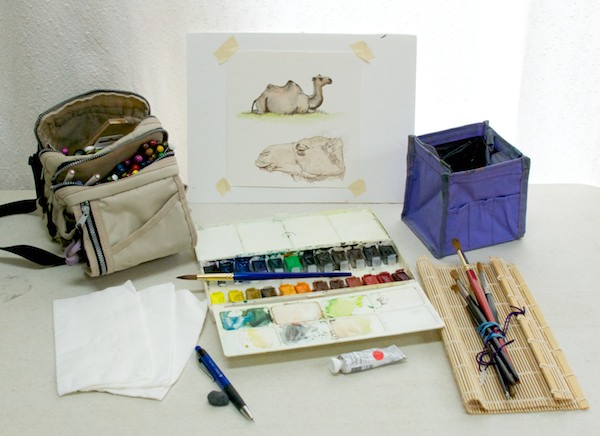
My portable field studio
The bag is a re-purposed point and shoot camera bag and it’s turned out to be perfect. In the front is a roll of drafting tape, kneaded rubber erasers, extra mechanical pencil leads and a pencil sharpener. Next pocket back is a set of water soluable Derwent colored pencils. In the back are Sakura Micron pens in a variety of sizes and colors, a couple of draughting pencils, a couple of mechanical pencils, a sandpaper pad, blending stumps, a tube of white gouache and a watercolor brush that breaks down to half its length.
The watercolor set is from Yarka. I use napkins, slightly used, from restaurants, for rags. Extra brushes go in the bamboo carrier. Water for painting goes in the collapsible plasticized cloth “bucket”.
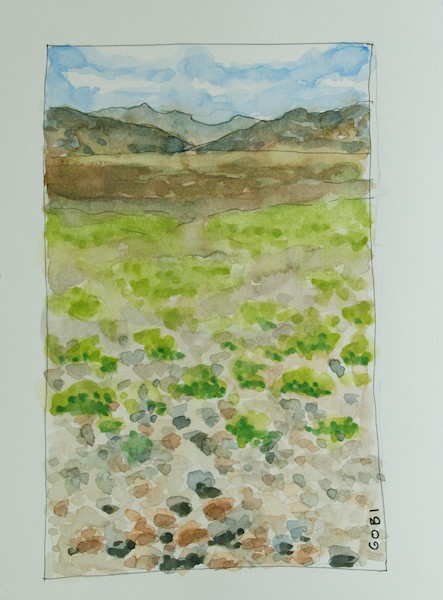
Gobi landscape, July 2010: watercolor on vellum bristol; I ultimately decided against taking the bristol paper in favor of more watercolor paper
The support is a piece of lightweight foamcore. The drafting tape, which is lightly adhesive, doesn’t pull up the paper surface.
For paper I’ll have my Moleskin sketchbook journal and a stack of 7×7″ watercolor paper cut down from a pad that I got many years ago in England, brand unknown, and, so that I can work on a toned surface (inspired by Thomas Moran’s location studies of Yellowstone that he did while traveling with the Hayden Expedition) a pad of Anigoni 100% cotton toned paper, which happily takes a variety of media.
Here’s some more of my favorites from yesterday, all done from photos that I took on previous trips to Mongolia:
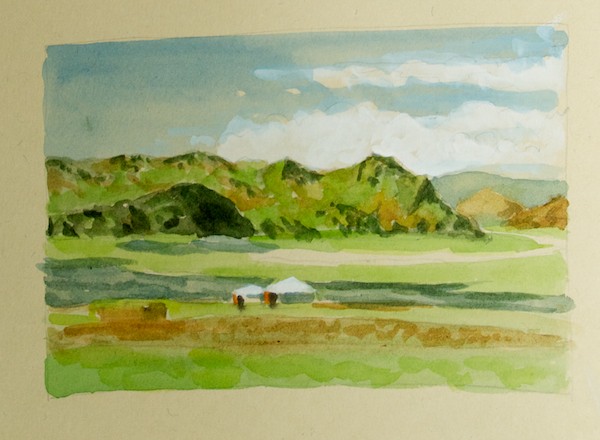
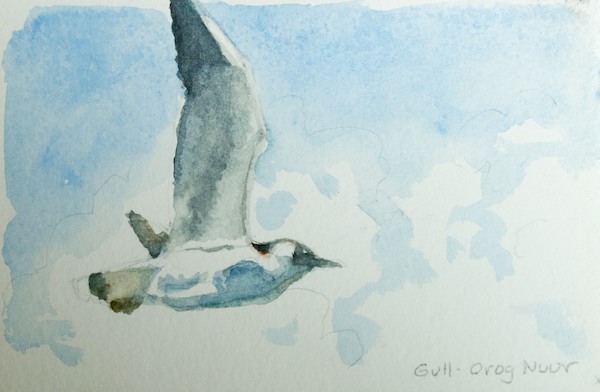
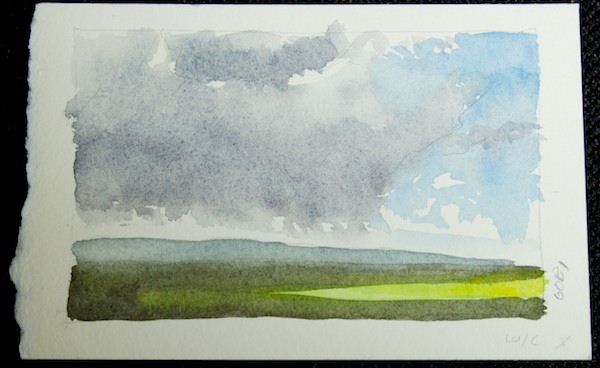
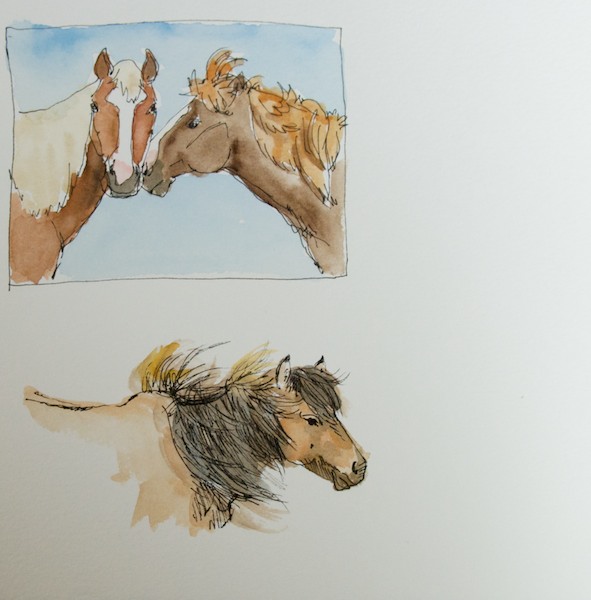
Gull, Orog Nuur, Gobi, July 2010; trying out the watercolor paper; I haven’t done any watercolor work at all for a long time, so needed to figure it out again.Gobi, July 2010; did this one in both watercolor, shown here, and the vellum bristol to see which I liked better; both work, but the watercolor paper allows for more edge variety.River valley north of Bayanhongor, Hangai Mountains, July 2010; Two studies on the Anigoni toned paper; watercolor with white gouacheHorses at Gun-Galuut, August 2011; I wanted to practice doing animals before I was sitting in front of the real thing. Watercolor, Micron pen; I started with the watercolor, then did the penwork, then went back and knocked in the shadow areas and the water; about ten minutesHorses at Gun-Galuut, August 2011; watercolor and Micron pen on w/c paper; each about 15 minutesBaga Gazriin Chuluu, July 2010; lots of rocks where I’m going, so did a couple of studies; Notice that it’s not necessary to finish everything to the same point, especially when time is limited; watercolorIkh Nartiin Chuluu, August 2011; rocks with an argali; watercolor
Mongolia country map with destination areaExpedition destinations by species
I leave for Mongolia a week from tomorrow!
I posted about one of the three WildArt Mongolia Expedition destinations here. Today I’m going to cover the other two- the Altai Mountains and Sharga. The difficulty is that I have never been to any of them, so I don’t have any images to share. For Takhiin Tal, I used a photo from Khomiin Tal, the newest takhi release site, which is to the north. So I’ll post a couple of my own images that show similar terrain, based on what I’ve seen for both on Google Images.
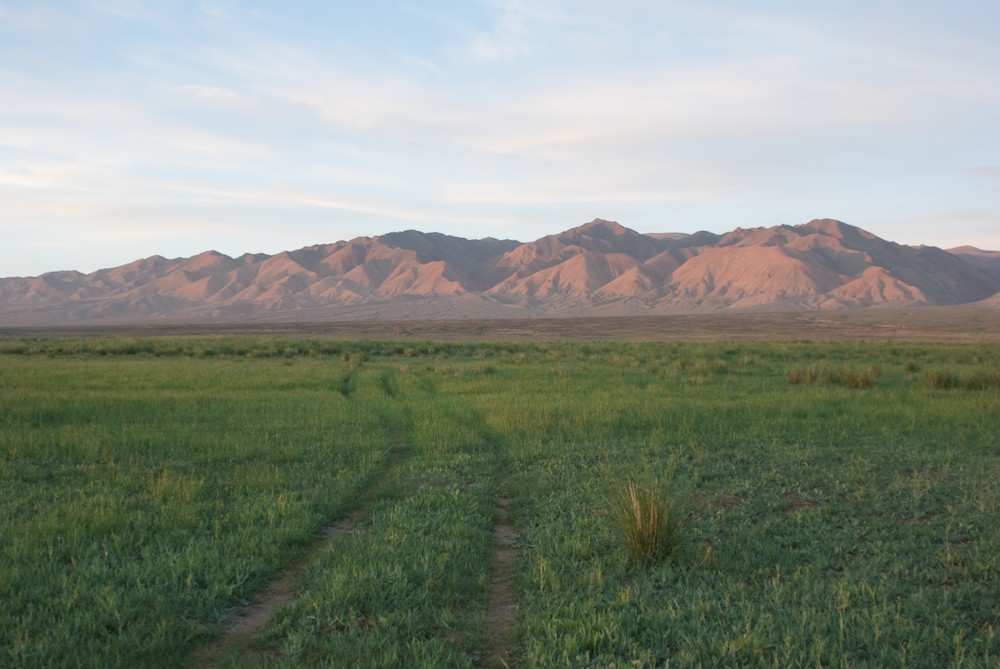
The Mongolian Altai Mountains in Mongolia are the extension of a range that extends east from Kazakhstan. I saw the Gobi Altai Mountains during my 2010 two-week camping trip when we went to Orog Nuur, a remote lake. Farther west they are much higher and more rugged. The Expedition is going in September to be there between the summer heat of the Gobi and snow beginning in the mountains. We will go to the Altai Mountains first, in early September, but snow is still a possibility, so I’ll have a down bag and thermals, just in case.
Gobi Altai mountains at sunrise, Orog Nuur, July 2010
The reason we’re going is to see snow leopard habitat. These elusive cats are essentially impossible to spot. Researchers who have trapped and collared them have walked away and looked back to where they know they left the cat and have been utterly unable to see it. But we’ll keep an eye out anyway.
Sharga was an area of Mongolia that I had not heard of until I added saiga antelope to the list of the Expedition’s featured species. They are critically endangered. Less than twenty years ago there were over a million. The population crashed to under 50,000 in ten years, the most extreme drop ever seen in a large mammal species. Poaching and lax law enforcement after the fall of the communist government in the 1990s were the cause. Intense conservation efforts are under way to save them and build up the population, something we plan to learn more about.
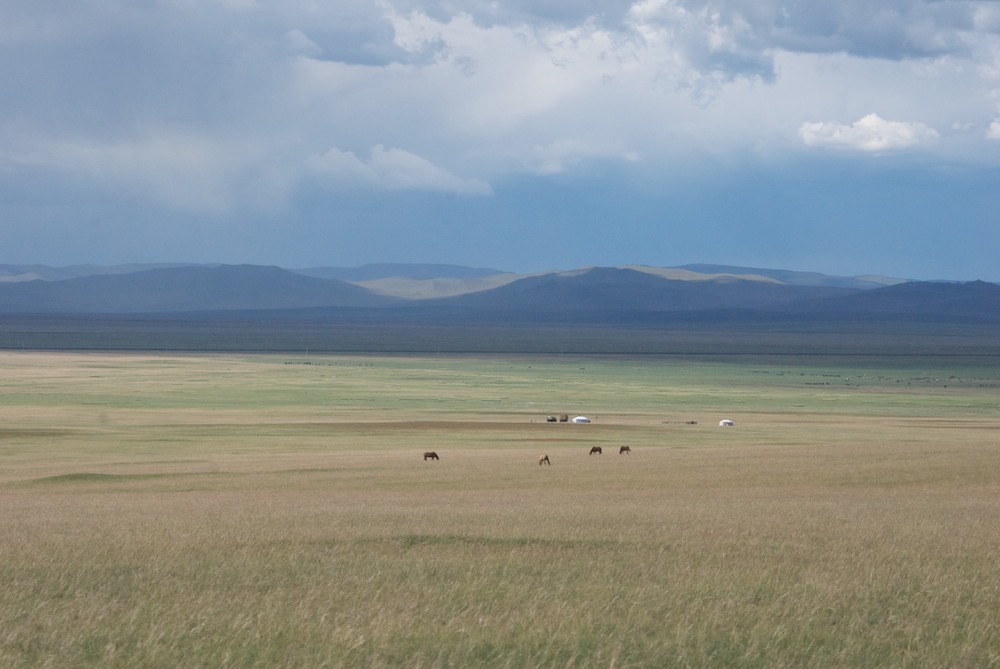
Steppe grasslands, July 2011, traveling north from Ikh Nartiin Chuluu to Gun-Galuut
Sharga has some of the last stretches of the vast steppe grasslands that once extended from almost the Pacific west into Hungary. It is an area also known for producing what are considered by many to be the best horses, called Sharga Azarga, in a country that seriously knows horses.
Arrangements are being made for a local reserve ranger to accompany us to help spot the saiga since they apparently now run at the slightest sight of humans and understandably so.
One of the missions of the WildArt Mongolia Expedition is, by traveling to these remote, beautiful places, to use the art that we will create to draw attention to them and the wildlife that lives there.
It’s time to cover the new stuff I’m taking with me to Mongolia this year, some of it pretty significant. As in years past, I’ll report back once I’m back home. Onward!
Panasonic HDC-HS 80 video recorder- I finally decided to get my feet wet with video a couple of years ago and bought a FlipHD. I found that I liked having the option, but it’s now defunct and the image quality wasn’t all that good. However, I did get footage of takhi at a waterhole at Hustai that sold me on video. My problem is that I already carry two camera bodies and the video cameras that looked like good enough quality to bother with were 1) over $600 and 2) at least the size of my Nikon D80 bodies, so that was a non-starter. But then I found these smaller HD units. I went with this little Panasonic (4 1/4″ x 2 3/8″) from B&H Photo and Video because it got really good reviews, I can carry it in my pocket and it only cost $299 (price seems to have gone up). It seamlessly downloads into iMovie, too. The zoom isn’t very good at the maxiumum, but short of that, image quality is very good. So now we’ll see how it does in the field conditions of Mongolia…
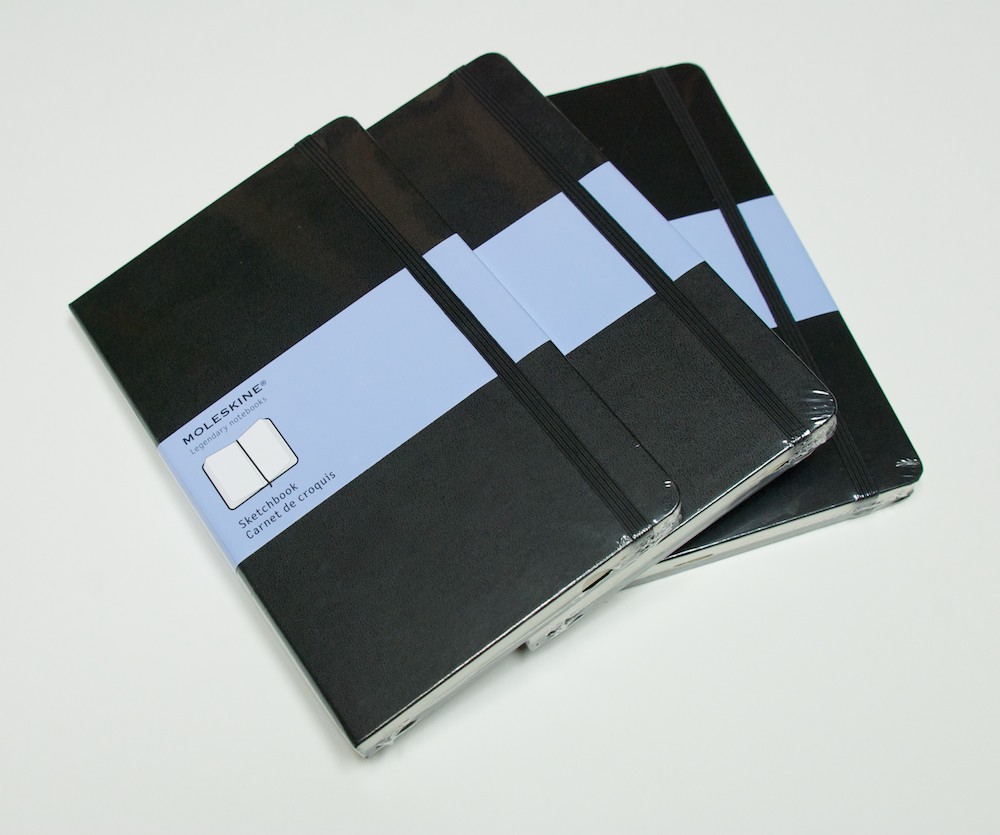
Moleskin sketchbook journals
Moleskin Sketchbook Journals– This will be the third year I’ve used them and I’m sold on them for their sturdiness and the quality of the paper that will take ink, colored pencil and watercolor equally well. The pocket in the back cover is really handy for those scraps of paper that seem to accumulate on a long trip. I’m taking three this time because I plan to do at least one drawing a day if I possibly can. They will also constitute the official journals of the WildArt Mongolia Expedition in September and I don’t want to run out of pages for what I think will be one of those trips of a lifetime.
iPhone 3G
iPhone 3G- Apple’s phones are “locked” which means you can’t swap the sim cards if you are in another country or, well, you’re not supposed to. I’ll have my 4GS for everything but phone calls. For the past three trips I took my old Motorola Razr, getting sim card for it and using it for my mobile phone in Mongolia. It was the latest thing when I got it, but now it drives me nuts. Lots of Mongols text and texting on the Razr was a colossal pain. So now I will take my old iPhone, have it unlocked, pop in a new sim card and finally have a smartphone for when I’m over there.
GearTie rubber twist ties
GearTie reuseable rubber twist ties– bought these on a whim at REI. Two for $6.75. The only thing I have in mind at the moment is to use one of them for my rolled up Thermarest pad and when I tried it I found that it’s great for that. My suspicion is that these will be more useful than the cloth straps with quick release clasps because they are flexible, but not soft. I’ll try suspending one between a couple of ger roof poles to see if it’s useful for drying something like a pair of socks or forming a hanging hook.
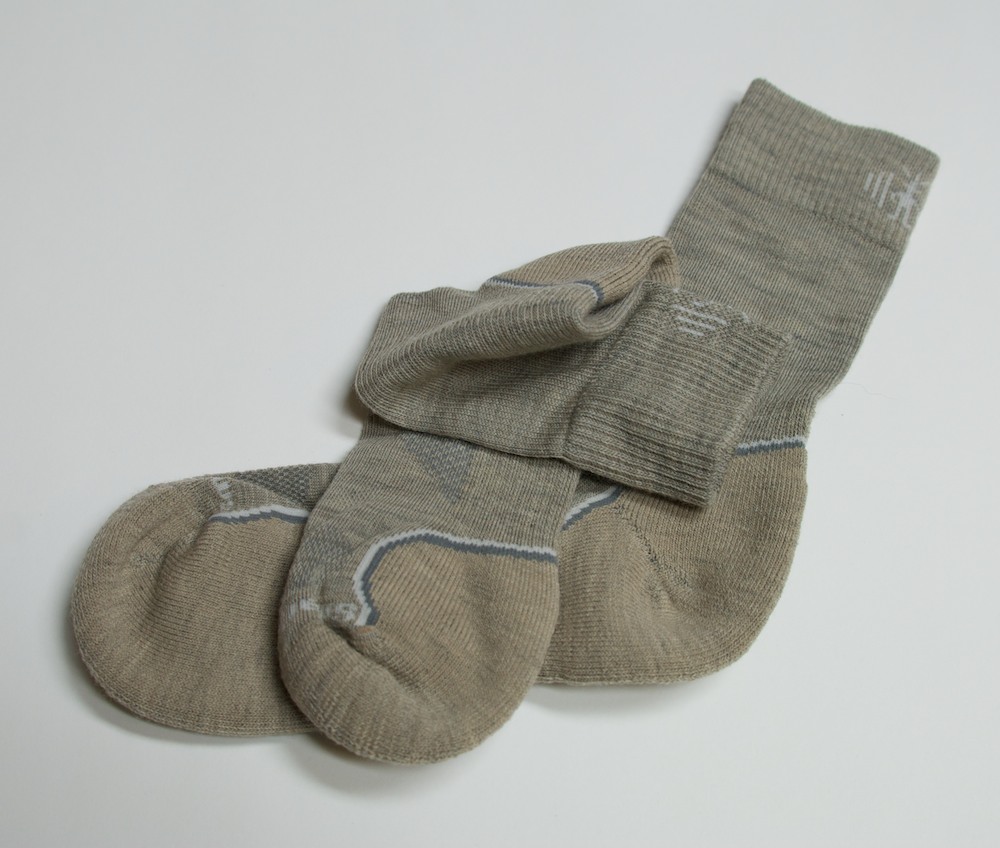
Smartwool socks
Smartwool socks–I’ve been using Thorlos for years for my go-to hiking socks. They’ve gotten pretty expensive and REI had these on sale for $9.48 a pair, so I bought four pairs. Wool has been rediscovered in the outdoor activity world for its sustainability, warmth and comfort. And these are certainly comfy.
Nikon Nikkor AF-S VR 28-300 mm lens
Nikon Nikkor AF-S VR 28-300 lens– It was nip and tuck whether or not I’d get this in time. For a couple of months there were none to be had in the country, probably due to the great reviews it’s gotten. But B&H came through and I’ve had it long enough to see what it can do. Wow. This is a major upgrade from the Promaster that I let my local camera guy talk me into, which was a big mistake and a story for another day. Before that I’d had a Tamron, which is really the only other option. But you can’t beat Nikon optics. This lens is bigger and heavier than either of the others, but it has Vibration Reduction and the motor is essentially silent. It focuses fast and accurately. So now both D80 bodies have Nikon lenses (an 80-400mm on the other) and life is good.
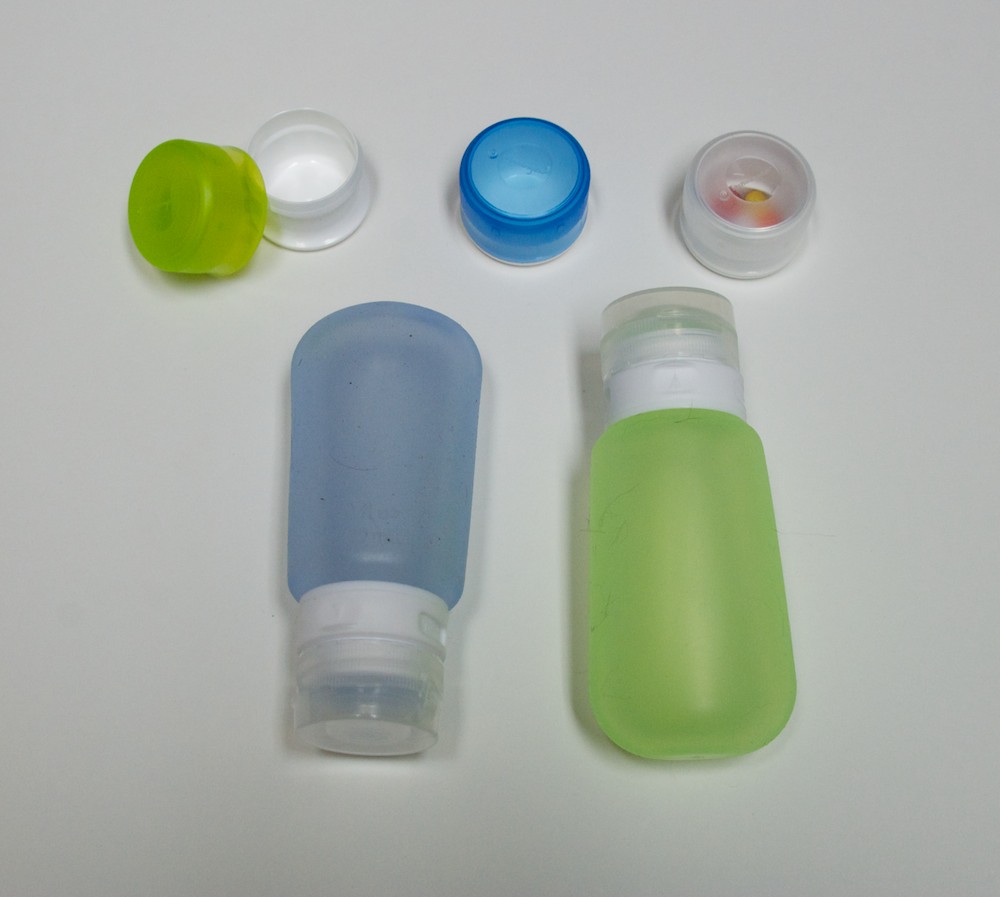
GoToobs and GoTubbs
GoToobs and GoTubbs- another REI find from a company called humangear. Ok, I’m an artist and am attracted by color and bright shiny objects. But these looked really practical for my needs. The tubes carry 3 oz. and have a nifty ring around the neck with a variety of contents listed that one can choose by moving a outer ring. I’ve chosen “shampoo” and “conditioner”. There’s even a blank one. So no more labels coming off or fading out. The “tubs” are a new solution. Instead of twist tops, the lid comes all the way down the sides. You pinch it on either side to release it. The idea is that you can open them one-handed, which might be handy at night. Both are food safe and recyclable (No. 5).
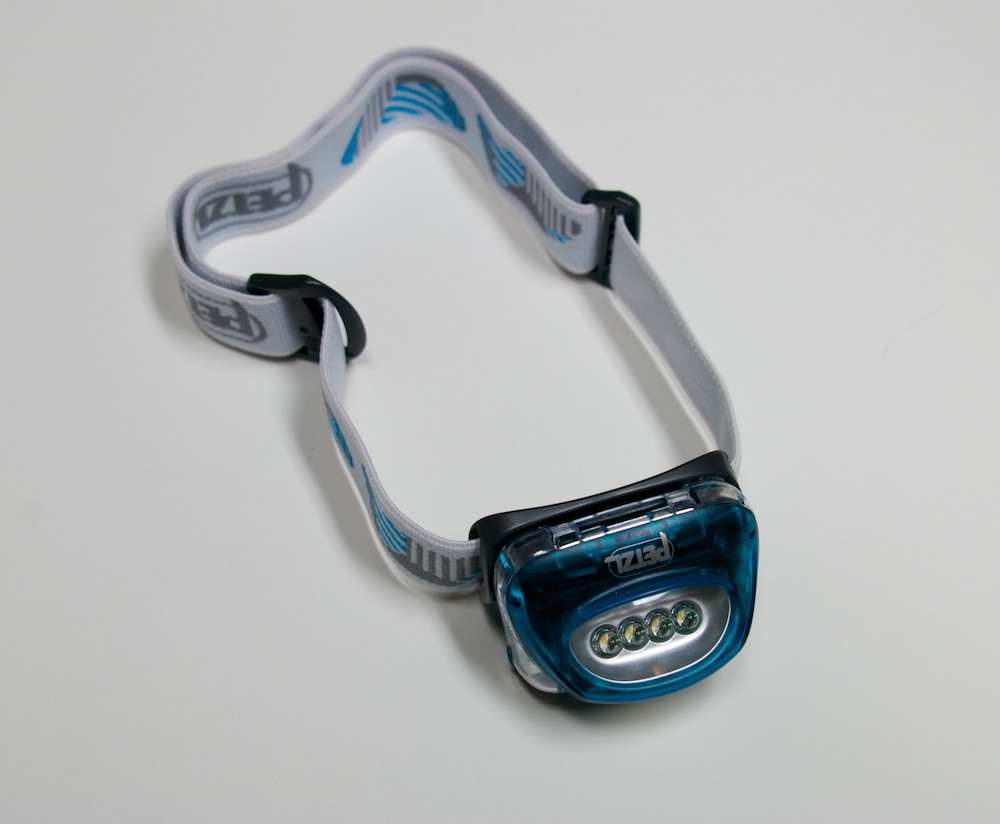
Petzl Tikka 2 headlamp
Petzl Tikka 2 headlamp– there wasn’t actually anything broken with the last one, except that it was a pain to get open when I wanted to open it and had a talent for falling open and dumping one or more batteries at really inconvenient times, like in a tent at night on the slopes of Bogd Khan. That one really did it, because I had to use the light from my iPhone to find the batteries and get them back where they belonged in the right orientation. Once again at REI, I searched the headlamp rack for something under $50 that didn’t have the same stupid closure method. And would you believe that not a one of them did, of what they had in stock, except this one, which has a simple sensible plastic tab that snaps open and closed. What is so hard about that?
Close up of interior showing opening and closing tab
And finally, the piece de resistance, in a way….
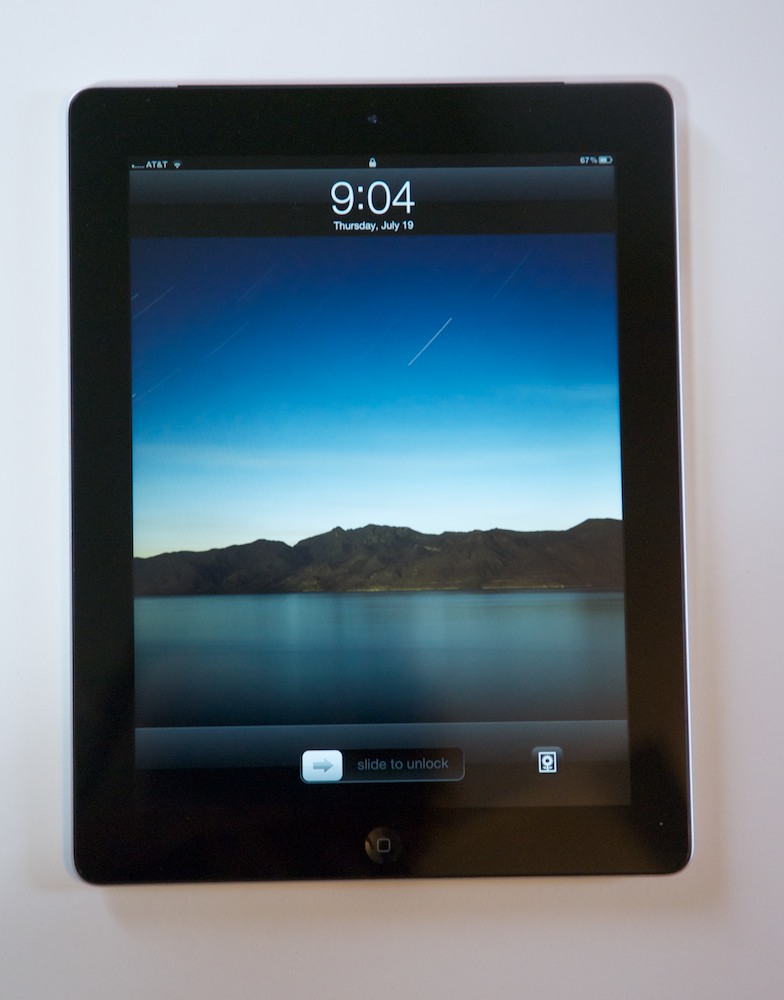
Ipad with Retina display
New iPad with Retina display– my first gen iPad has more than proved its worth in a variety of ways. We decided that my husband would “adopt” that one and we would get me the new one, which has the stunning new display and enough more power that it will run apps like iMovie. It’s much faster for web browsing, too. I’m waiting for the case and shield to arrive and will do a short post about them before I leave.
So, there you have it, this year’s gear. If you like to see the previous posts, they are in reverse chronological order here, here, here, here, here, here and here. I’m still using the jacket, down bag, messenger bag and some other items that have stood the test of the Mongolian countryside, including the Gobi.













































 Susan Fox, American Artist