Please Share This Link! It Shows What The BP Catastrophe Is Doing To Our Fellow Creatures

These are horrific images, but people need to see them. We must get off our dependence to oil or it will ultimately kill us and the planet. For a preview, here’s what it’s doing to the birds of the Gulf Coast-

http://www.boston.com/bigpicture/2010/06/caught_in_the_oil.html

An pelican covered with oil

I’m Featured In Wildlife Art Journal! Plus Here’s My Latest Painting.

I’m please to announce that the Letter from Mongolia which I recently wrote for Wildlife Art Journal was posted on their website this morning! It’s illustrated with lots of paintings, drawings and photos, many from my Artists for Conservation Flag Expedition last July. Thank you to Todd Wilkinson and the rest of the staff for providing the only publication (it’s online only, no print version) dedicated to wildlife art!

And yesterday I finished the warthog painting. Here’s the  step-by-step from last week. I’m calling it “Gonna Run In 3…2…1”

Gonna Run In 3...2...1 20x30" oil on canvasboard

Mongolia Monday- The 6 Ecosystems

Continuing on with our series, I’ve always thought it would be fun to do a trip that would start either in the north or south and travel through all six major ecosystems in Mongolia, which run roughly parallel to each other in bands going from east to west.

Here is a map that shows them very well. It’s from a booklet, “Mongolia’s Wild Heritage: Biological diversity, protected areas and conservation in the land of Chingis Khan”, that was published in 1999. It was a cooperative effort between the Ministry of Nature and Environment, the Mongolian Academy of Sciences, the Mongolian Biodiversity Project and the Worldwide Fund for Nature. I don’t know if it’s still available, but if you are interested, drop me a note and I’ll see what I can do.

Starting in the north:

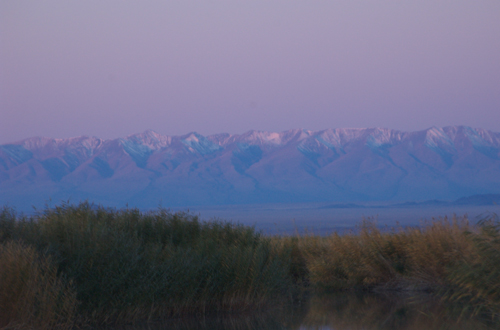
1. High Mountain– I haven’t been up into the mountains yet, but I did get the above photo of Jargalant Hairhan, which is part of the western Altai Mountains. The high mountains make up about 5% of Mongolia’s land. The climate is extreme. There are still some glaciers in the Altai Mountains. Animals that can be found there include argali, snow leopard, ibex, Altai snowcock and two species of ptarmigan. The photo was taken during my 2006 trip to Khomiin Tal on our way back to Hovd.

2. Taiga– the southermost part of the vast world-circling boreal forest, or taiga, extends into northern Mongolia.  It covers about 5% of Mongolia’s land area. The weather is also extreme with more rain and lower temperatures than most of the country. The most common species of tree is Siberian larch. Animal species include reindeer, wolves, wolverine, lynx, Eurasian river otters, stone capercaillie and three species of owl. This is the famous Turtle Rock, which I photographed in Gorki-Terelj National Park in May of 2005. It was snowing.


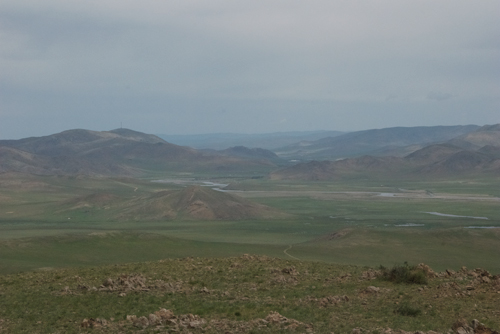
3. Mountain Forest Steppe- As the name indicates, this is a transition zone between the mountain forests and the grasslands of the steppes. It accounts for about 25% of the country’s land area. The mountains are of a lower elevation and include wide river valleys. Most of the population of Mongolia lives in this zone. Animal species include roe deer, elk (marel), wolf, red fox, Eurasian badger, Pallas’ cat, wild boar, great bustard, black kite and darian partridge. The image above was taken from Mt. Baits in Gun-Galuut Nature Reserve in July of 2009, looking north into the Kherlen River valley and on to the mountains.

4. Steppe– This is the landscape that most foreigners envision when they think of Mongolia. The famous grasslands cover about 20% of the country. The largest remaining area in Central Asia of this ecosystem is in eastern Mongolia. The climate runs from hot in the summer to cold in the winter, but not as extreme as the zones to the north and south. It provides much of the main grazing land for the herders’ livestock. Animal species include Mongolian gazelle, wolf, corsac fox, Siberian marmot, tolai hare, demoiselle crane, steppe eagle and saker falcon. The photo was taken en route between Ulaanbaatar and a ger camp at Arburd Sands in July of 2009.

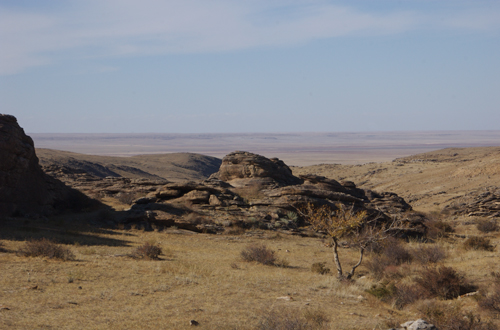
5. Desert Steppe- This is the transition zone between the grasslands and the Gobi (which means “desert” in Mongolian). It accounts for over 20% of the land area. Drought is frequent, along with strong winds and dust storms. Many herders live in this ecosystem, however. Animal species include takhi (Przewalski’s horse-reintroduced), khulan or wild ass, saiga antelope, marbled polecat, Mongolian hamster, houbara bustard, lammergeier and cinereous vulture. The image was taken at Ikh Nartiin Chuluu Nature Reserve in September of 2008.

6. Desert- The Gobi is one of the most famous deserts in the world, but, contrary to common belief, very little of it is sand. It’s mostly gravel and small rock and as you can see, there is vegetation. It accounts for around 25% of the land area. Where there are springs, families have truck gardens and it is well-known that the best and sweetest vegetables in the country come from the Gobi. The weather is, once again, extreme, climbing to well over 100F in summer and dropping to -40F in the winter. Animal species include wild bactrian camel (very endangered), Gobi bear (critically endangered; maybe 30 left), khulan, saiga antelope, argali, Pallas’ sandgrouse, saxaul sparrow and desert warbler. I took this picture in September of 2006. The red rock formations in the distance are the Flaming Cliffs, where the first fossil dinosaur eggs were found.

All this, in a country that is about twice the size of Texas!

This Will Probably Get Me In Trouble, But The Problem Isn’t Just At SeaWorld…..

OPINION ALERTI don’t think that you will be left in any doubt as to my opinions in the following piece. Civil, thought-out comments are welcome. All others will go in the virtual round file. And the protestations of those whose income relies in any way on the use of captive wild animals for profit will be taken with Upton Sinclair’s quote in mind: “It is difficult to get a man to understand something when his job depends on his not understanding it.I’m not out to necessarily change anyone’s mind or behavior, but if I make you uncomfortable about some assumptions you’ve had, well, I’ve done my job.

So, SeaWorld is in the news again with another “attack” by a killer whale/orca, resulting in a human death. SeaWorld is one of the public faces of Animals As Entertainment. Do not be deceived by their blather about science. They wouldn’t spend a dime on it if they didn’t need to to reassure the public that they are doing “good things” that benefit the animals. The trainers are simply enablers.

Heather Houlahan, over at her blog Raised By Wolves, has a dynamite post on the issues involved in “training” wild animals like orcas, how the so-called positive methods used have bled over into the training of domestic dogs and what really goes on in getting a five ton marine mammal to do what you want, say, to let you collect its urine.

At the intersection of humans, animals and profit, the interests of our species almost always triumph. But there’s some level of at least sub-conscious discomfort because the people involved seem to consistently insist that they love animals. But their income and the care of their families is dependent on the orca/wolf/lion etc. performing as needed. There is an inherent conflict here that the parties involved need to, no, must, ignore.

A partly hidden world of using animals to perform for profit are the game ranches that provide genetically wild animals for photographers, movies, tv and, increasingly, animal artists. When visiting them you hear the same thing as from places like SeaWorld: “Oh, they’re wild. They could hurt you. Can’t be trained by anything but positive methods.” Which means, I guess, that they aren’t actually beaten. But they live in a sensory-deprived environment, unable to express their normal behaviors and instincts and are totally dependent on humans for food…..just like the marine mammals at SeaWorld.

I’ve seen an adult snow leopard kept in a cage maybe equal to its full length (barely including the tail), only taken out for “training” and to perform. A baby bear who was allowed to shock itself on an electric wire to “teach” it to stay with in the enclosed area. A badger who could not be handled, so her claws had grown to around twice the normal length. She was kept in a cage and only brought out for photo opps at a pre-dug hole, never getting to dig herself. But, hey, she lived to over twenty, so she must have had a good life, right?

These places breed animals too. Want a cherry-red fox, a particularly desirable color variant? If you’re in that world, you know who to call. Need a white wolf/black jaguar/bobcat/lynx/grizzly cub/cougar/snow leopard/Siberian tiger/Barbary lion? They’re all out there, for a price, just waiting to become stars who make their owners (with luck, lots of) money.

And what happens to the ones who don’t want to socialize to humans or simply refuse to perform and pay their way? I have no personal knowledge, but the economics of running such a business and the fact that zoos and sanctuaries, as far as I know, won’t take these “surplus” animals is suggestive.

The animals at both the ranches that I’ve gone to are kept in enclosures that are, from what I’ve seen, the same size or smaller than the worst, crappy old-time zoo cages that you can imagine. But since the ranches are “regulated” by the Agriculture Department, they come under the heading of livestock, just like cows and pigs, so official zoo standards of care don’t apply. Sweet, uh?

If the accredited zoo standard of care for game ranch wild animals was required, these places would be out of business tomorrow. And lax state regulation and oversight is probably one reason why the ranches are located in the states they are. But I actually did hear the owner of one place complaining about the owner of another because his violations were so constant and egregious that it had brought the Feds down on him and now all the others were facing increased scrutiny. Life is SO unfair.

The motive is the same as with places like SeaWorld- using captive, genetically wild animals for profit by making them perform certain behaviors for humans as and when required. The ranches, so far, fly under the public and animal welfare radar. But pretty much every calendar and a lot of magazine articles that you see and read, with photos of snow leopards, wolves, cougars and the like, are almost certainly captive animals from these ranches. I’ve even recognized some. Oh, there’s Jimmy the cougar and Princess the snow leopard (made-up names).

I must admit to some frustration with artists who profess to care about wild animals enough to spend their professional lives painting them, but have let their desire to be physically close to them and get reference images blind them to what is going on from an animal welfare standpoint. (See above quote by Upton Sinclair) And of course the people who own the ranches are nice folks. I don’t doubt it. I’ve met some of them. I’m sure they believe it when they say that their animals are treated well. But there’s that pesky inherent conflict again.

(I’m ambivalent about zoos, too. But, as another artist put it, she sees the animals in them as the individual sacrifices necessary to save entire species. And real conservation and science goes on at most of them. So, to me, they can justify their existence, more or less. However, I’ve talked to more than one keeper who seemed very certain that they knew what a given animal in their care needed to be “happy”. But is any kind of human introduced “enrichment” or fiddling with the enclosure really enough? And how can the humans really know? See above quote by Upton Sinclair. I’ve seen a depressing amount of stereotyped behavior like pacing and paw-licking at all the “good” zoos.)

The question, to my mind, isn’t how genetically wild animals are treated in captivity when used for human entertainment and profit, but whether should they be kept at all.

(A final note: I have no use for PETA or any other animal rights organization of their ilk. PETA kills 97% of the animals that are unfortunate enough to fall into their clutches. Their agenda is to end the keeping of all animals by humans. They are batshit crazy extremists. See this post on Pet Connection for more information. My concern is animal welfare. And if you are unclear on the difference, use teh googles.)

A Special Visit to the American Museum of Natural History

I was one of a large group of artists in attendance this past weekend at the opening of the Artists for Conservation juried show “The Art of Conservation”, which is at the Hiram Blauvelt Art Museum in Oradell, New Jersey. There were two full days of activities planned for us and we made the most of them.

Considering my lifelong interest in animals and nature, I’m almost embarrassed to admit that while I have been to New York a few times, until this past Friday I had never been to the American Museum of Natural History (AMNH). On the other hand, the amazing tour we were taken on by Stephen C. Quinn, Senior Project Manager in the Exhibition Department, who is also a member of Artists for Conservation, along with being on the Executive Board of the Society of Animal Artists, more than made up for it. (We also had a day at the Bronx Zoo, courtesy of the Wildlife Conservation Society, but you’ll have to wait for the paintings to see what I found there.)
Stephen first treated us to a presentation on the legendary AMNH dioramas that fill the Akeley Hall of African Mammals, the hall of North American Mammals, Sanford Hall of North American Birds and other parts of the museum. The research, skill and art that went into their creation is also pretty legendary.

(Animal artists take note:) Nothing in them is generic. The background settings are all real places. Museum artists were sent out into the field and did wonderful studies en plein air. The animals themselves are all individuals, which lifts them far beyond any other taxidermy animals I’ve ever seen. Each specimen was carefully measured in the field and that data was used to create exact forms on which the skins were mounted. Attention was paid to each muscle so that it accurately reflects whether it was tensed or relaxed. These are the only mounts that I feel that I could confidently draw from and know that they are accurate.
African lions
African lions
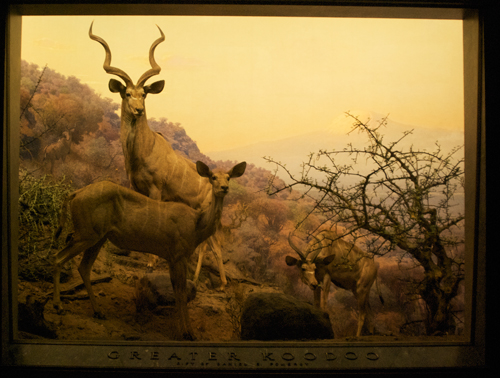
Greater kudu
Greater kudu
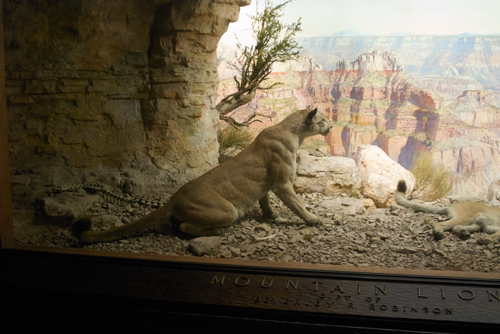
Cougar
Cougar
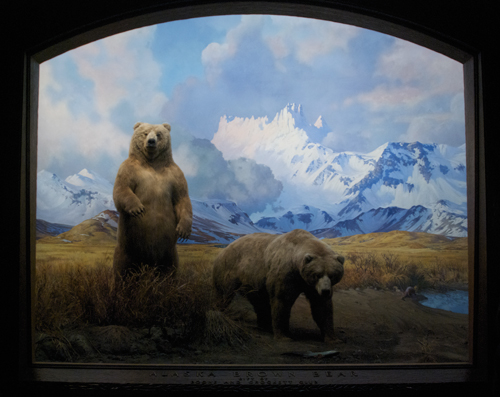
Alaskan brown bears
Alaskan brown bears
Alaskan brown bears, background diorama detail
Alaskan brown bears, background detail
Alaskan brown bear, background diorama detail
Alaskan brown bear, background detail
Bighorn sheep
Bighorn sheep
Bighorn sheep, background diorama detail
Bighorn sheep, background detail from around the curve on the left
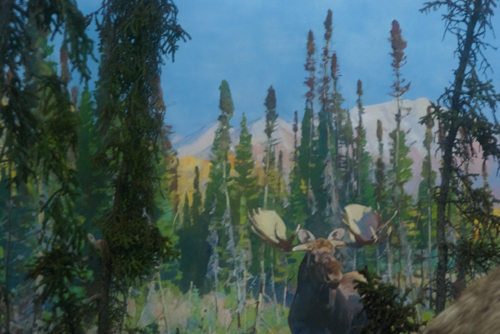
Moose, background by Carl Rungius
Moose, background detail
Moose, background detail; yup, it's a Rungius
Background; I must not have thought much of the animals because I didn't photograph them
Background; I forgot to photograph the rest of it

The backgrounds are like little master classes in landscape painting. Absolutely stunning. The above images just hit the highlights of some of the details that caught my eye.

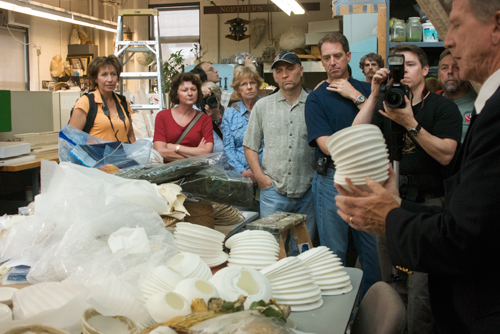
As it turns out, a very special exhibition on the Silk Road, “Traveling the Silk Road: Pathway to the Modern World”,  opens on November 14 and Stephen took us behind the scenes into the studios and workshops where all the preparations are being done. We also got to see the space where it will all be installed Real Soon Now. A major feature is a partial reconstruction of the sunken dhow (a type of Middle Eastern ship which is “sewn” together, not nailed) that was recently featured in National Geographic magazine. It was found packed with thousands of bowls and other merchandise being exported from China to the Middle East. Until it sank.

The dhow section under construction with some of the pot. A mould was taken from one of the real ones.
The dhow section under construction with four of the pottery jars. A mold was taken from one of the real ones.
Some of the bowls, ready to be painted
Stephen tells us about how the bactrian camels are being made
A board with some of the reference the artists are using
The mold for casting the camels' bodies
A few of the camel heads

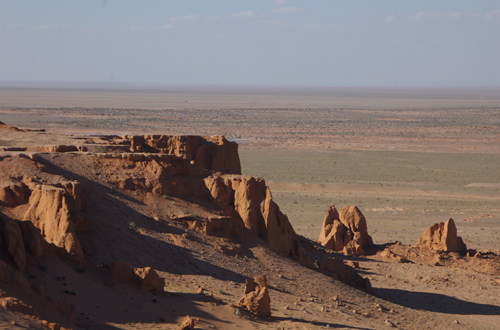
Eventually we were turned loose to explore the museum on our own for a couple of hours. I knew exactly what I wanted to find – some of the fossils that Roy Chapman Andrews’ Central Asiatic Expeditions of the 1920s brought back from The Flaming Cliffs (which are located in the Gobi, Mongolia; you knew I’d work Mongolia into this somehow, right?). Andrews was there as part of his work for the museum, so that’s where all the goodies ended up. I visited the cliffs myself in September of 2006 and was able to sit a short distance away to watch them as the sun went down. Flame they did, as you will see below.

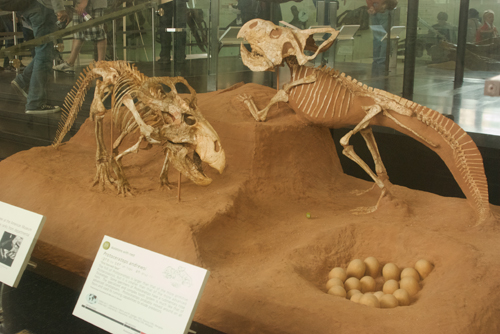
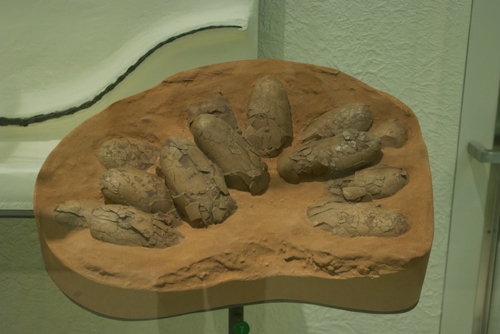
It took a little searching, but I found a most of an entire wall in the Ornithischian Hall dedicated to those finds, including a clutch of fossilized protoceratops eggs. The first dinosaur eggs ever found came from Andrews’ Expeditions work at The Flaming Cliffs or, as the Mongols call the area, Bayazag, which approximately means “Place of the saxaul trees”.

Protoceratops pair
Protoceratops pair
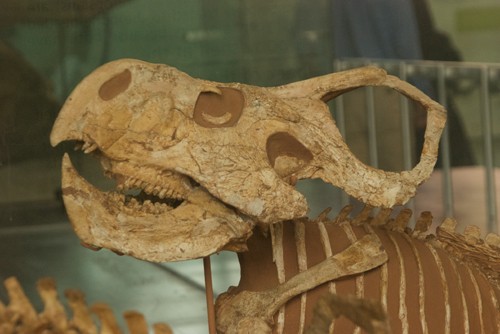
Head detail
Head detail
Fossil dinosaur eggs; they had one that you could touch, too!
The Flaming Cliffs with the saxaul "forest" in the background

Saxaul trees grow very, very, very slowly, so the wood is extremely dense. So dense, in fact, that if a piece of it is thrown in water it will sink. Most of the trees that I saw were ten feet high or less, so this isn’t “forest” as most Westerners think of it. And, not surprisingly, given the state of the planet, they are slowly disappearing due to being cut for fuel. Not quite endangered yet, but getting there.

Sunset, The Flaming Cliffs
Detail
Detail of the incredible color; Amusingly, the Mongols I was with found the moonrise happening behind me to be of much more interest

Lining the walls of the fossil rooms above the displays were some of the paintings that Charles R. Knight did during the time he worked at the museum. One of the first animal drawing books I got as a child was “Animal Drawing, Anatomy and Action for Artists”. I wasn’t really old enough to read it, but I copied and looked at the pictures for hours. As far as I know, it’s still available from Dover Books, but probably for more than the princely sum of $2.00 that my parents paid for it in the early 1960s. I really ought to go back and read it now. Might as well learn from the best.

Painting by Charles R. Knight

As a final bonus, there was this lovely drawing by J. B. Shackleford, who participated in the Central Asiatic Expeditions as the official photographer. His place in paleontological history is assured, as you will see from this quote from Michael Novacek’s  terrific book “Dinosaurs of the Flaming Cliffs”:

“The expedition photographer, J.B. Shackelford, hung back with the caravan of spindly-wheeled Dodge motorcars. To pass the time, Shackleford took a brief walk. Far to the north on the horizon he could see some volcanic hills that looked like islands floating in a sea of pink sands. As he walked in this direction, he saw an abrupt edge to the burnished grass, and a thin orange line beyond. He walked to the edge of the plateau. There below him extended a fantasy land of orange-red cliffs and spires. As Andrews later wrote, “Almost as though led by an invisible hand, he (Shackleford) walked straight to a small pinnacle of rock on top of which rested a white fossil bone.” This was the skull of a parrot-beaked, frill-headed dinosaur, a year later named Protoceratops andrewsi.”

Drawing by J.B. Shackleford

I probably didn’t even manage to see half of the museum, so I have ample excuse to go back again. Which I shall.

Plans are Coming Together

Let’s see….my Flag Expedition page should be live soon over at Artists for Conservation. I have confirmed that the weather is likely to be hot, hot, hot. Unless it rains, in which case it could be cold enough that I’ll want my down bag.

I spent three hours on the phone last night with Gana Wingard, the scientist with whom I am working on the women’s craft cooperative. She sent me a great email this morning entitled “The Grand Plan” and then noted that, of course, it’s all subject to change. But we now have hashed out a way forward and know what we need to do, who we need to talk to over there and when and in what order it will probably happen.

It reminds me of one of my favorite exchanges towards the end of one of my all-time favorite movies “The Wind and the Lion”. The Raisuli and his men are on their way to a small village, returning Mrs. Pedicaris and her two children to a contingent of American marines and, after hearing their destination described, along with the myriad dangers likely to be lurking there and the possibility that he could be killed,  The Raisuli says “It is good”. His right hand man says “What is good?’. The Raisuli answers “It is good to know where we are going.”

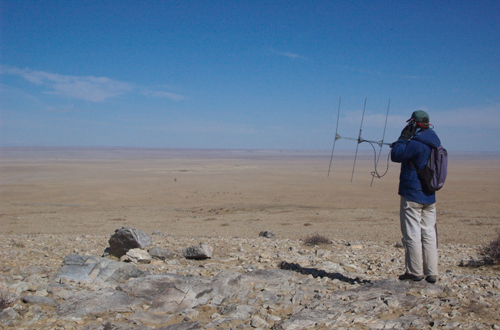
It turns out that Gana will be bringing radio telemetry equipment because she needs to find all the radio-collared argali or as many as possible before the next Earthwatch team arrives on August 2. There are plans to try a new population survey method since, at this point, it’s not really known how many animals are in the reserve. This is great news for me, since I will now be able to go out looking for sheep with someone who knows the reserve really well and is as motivated as I am to spot the animals.

Here are a couple of photos that I took on previous trips of the scientists using radio telemetry equipment. The research project now has some GPS collars, which send in the data via satellite, but those are relatively expensive, so there are still animals that need to be tracked the old fashioned way.

Amgaa doing radio telemetry just below an ovoo, Sept. 2006
Jed Murdoch searching for a collared Pallas Cat; he never got a signal and the cat had vanished, April 2005
Jed Murdoch searching for a Pallas Cat he had captured and collared; he never got a signal and the collar was never found, April 2005
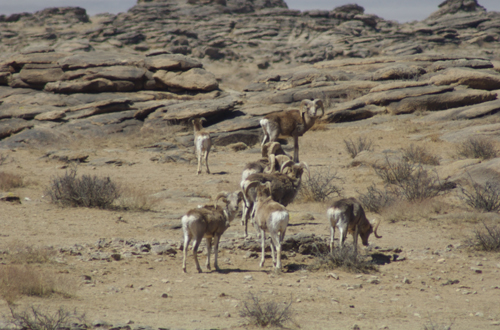
My "grand finale" sighting in 2005; a good-sized group; note the ewe left front wearing a radio collar
My "grand finale" sighting in 2005; a mixed group of eight argali; note the ewe left front wearing a radio collar; one of the handy things about argali is their habit of stopping to look back, which provides an opportunity to get photos of something besides their butts as they run away

Our plan is to “game drive” in the mornings and evenings, when it’s relatively cooler (Gana said that temperatures went over 100F last July. Okaaay.). During the day we will have our meetings with the women, for which the groundwork is being laid by another of the scientists, Amgalanbaatar (which means “peace hero” in Mongolian; see above photo), who we all call “Amgaa”. He is now at the reserve and is passing the word about the meeting and the hoped-for dates. Everything is tentative because summer is when the women have the most work do to, milking animals, making aruul and airag and also felt. We don’t know how many will come, but we know that they are interested. They will need to arrange to have someone watch the children and will want to be home in time to make dinner. Gana expects that they will arrive both on horses and motorbikes.

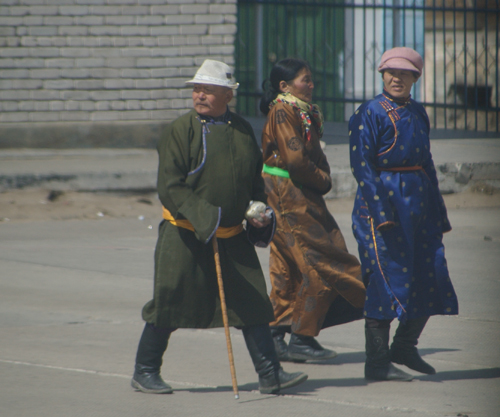
There are about 100 families living in and around the reserve, depending on their livestock for their living. The women all know how to sew and, in fact, the country women are the repository of the skills needed to make garments like del (the long robes). The younger women who have been brought up in town don’t learn to sew anymore. The material to make a del, outer fabric, liner fabric and trim costs about $30. Some of the women also do embroidery and since that’s something I’ve done on and off for many years, I’m really looking forward to seeing their work.

Three Mongols wearing del; train station, April 2005

After talking with Gana, we’ve scheduled a third day for me to get together with any of the kids who are interested in art. I’m taking some sketchpads, pens and pencils. Should be a fun way to pass a hot afternoon.

We plan to go to Ikh Nart on the 23rd and return to UB on the morning of the 28th. That will give me a day and a half to tie up loose ends. Five days and counting………..

Visit the AFC site here

Should Artists Go To Game Ranches To Shoot Reference?

Every artist and photographer will have to decide for themselves.  For me, after having been to two of game ranches and having been involved in animal welfare and rescue for the past four years, the answer is “no”.

I do want to make the point, as did Mangelsen, that I am specifically addressing game ranches; not zoos, reserves, sanctuaries or other places with wild animals which have vets and other staff trained in animal care and where the animals are not there for the purpose of “modeling” or “acting” for photographers or artists or to be used in movies, tv or advertising.

Here’s the link to a blog post in the new online publication, Wildlife Art Journal, in which Todd Wilkinson introduces an article by legendary wildlife photographer Thomas Mangelsen. Mangelsen pulls no punches and I applaud him for exposing to the light of day something that’s been hidden for too long: the price the animals pay so photographers and artists can get “that perfect shot”. For example:

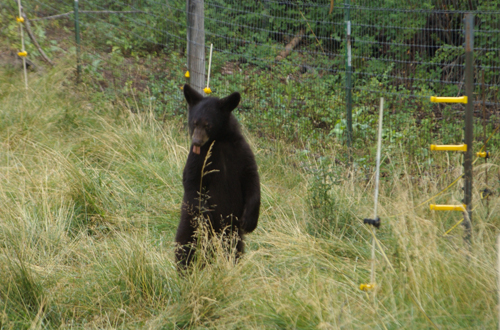
baby-bearThis bear cub was allowed to repeatedly shock itself on the electric wire in order to “teach” it to stay within the enclosure. The cub cried in pain every time and is seen here licking the spot that touched the wire. The keeper also “cuffed”, as in hit, the cub to “discipline it the way a mother bear would”.  To my knowledge, the keeper had no formal training, certification or degree in animal behavior. This was in front of a number of artists, including me, and clearly the keeper had no problem with us seeing how the cub was being introduced to working with humans.
Is any painting or photograph worth being complicit in a fellow creature being treated this way?

UPDATE 6-17-09: I have just learned that the person who is referred to above no longer works for that game ranch. He was fired because of how he treated the animals. Very good news indeed.

Here’s the comment that I left for Mangelsen’s article, which is here:

Finally. It’s not just me who’s wondered….

Posted By Susan Fox on Jun 14, 2009

I’ve been to workshops at two of these places and came away very ambivalent since I am also involved in animal welfare (NOT PETA-style animal rights) and dog and cat rescue. Yes, I got some “great” photos, but the other 10-20 artists who were there got almost exactly the same image.

I’ve noticed a proliferation of cougar paintings over the past few years, which coincide with a whole bunch of artists going to shoots put on by one particular ranch. How big a market is there for cougar paintings? Especially when so many show the same animal on the same red rocks? Do cougars even live in that habitat? I dunno.

Part of what makes me and my art interesting to people (Read: potential buyers) are the stories behind the paintings. So, what do you think a buyer finds more compelling:

“I was at the Lamar Valley in Yellowstone and had set up my easel to paint, but ended up watching one wolf attempt to distract the bull bison who had taken up a defensive posture while a second tried to dart in and cut out a calf. After a half hour they gave it up and, all of a sudden six more wolves popped up out of the grass and they all trotted off “(true story)

Or
“I photographed these two wolves splashing in the water and playing. One was the mother of the other, who was a young adult. No, I have no idea if one would see that interaction in the wild. I have no idea if wolves “play” in the water. I have no idea if they run around chasing each other like two crazy border collies.”
Or
“The cute baby raccoon was brought out and inserted into a hole in a tree stump that was placed on a table.”
I did paint that one and have it available as a giclee. I described him and what he was doing accurately, but otherwise feel that I committed at least a sin of omission. And, when people ask me, as they often do, if or where I saw him in the wild, I tell the truth. I like the image, it was fun to paint, but it and another of a captive animal have become somewhat problematical for me.

I’ve made it a point to do the travel, study and fieldwork required to see wildlife where it lives and learn about a species’ behavior and how it interacts with its habitat. Taking pictures of captive animals I’ve never seen in the wild turns out to be useless to me in that regard. There is so very much more to painting animals than their surface appearance, however appealing.

One thing I always tell people is that I don’t paint what I haven’t seen. And, of course, I have seen the captive animals. But I’ve decided finally that that’s not good enough. Taken out of the context of their habitat ultimately ruins their value to me for reference, except as a supplement to what I would shoot of the real, wild versions. It’s a step better than buying someone else’s photographs to do finished paintings from (as opposed to reference for a detail of some kind), but not good enough for me anymore.

As far as my visits to two game ranches:

I remember seeing, briefly, the cages, one that had an adult snow leopard in it. It was a quarter of the size of a kennel that would be considered an acceptable minimum for a large dog. There was barely enough headroom for the animal to stand up and turn around. It was in a covered area with no natural light.

I remember the baby black bear who was allowed to repeatedly come in contact with the electric hot wire around the enclosure area in order to “teach” him to stay within the boundary. He was also “cuffed” multiple times to supposedly duplicate the discipline of a mother bear. What would you think of someone who did that with a puppy or kitten? How in the world would a human with no background or education in animal behavior, as far as I could tell, have the faintest idea what a momma bear would cuff her cub for?

I remember the owner of one game ranch complaining to us about the owner of another one because the guy had gotten caught and cited by the Feds so many times that it had drawn increased scrutiny onto everyone else.

I remember speaking with a fairly well-known wildlife artist at a show, gingerly asking her about the game ranches. She immediately and strongly assured me that the animals were never mistreated to make them “perform”. I changed the subject.

I’ve wondered more than once when a litter is born, what happens to the babies or youngsters who aren’t willing to be socialized to people. If there are five wolf pups and only one can be handled, what happens to the other four? I think I can guess, but currently have no direct knowledge. However, these people are running businesses that need to make a profit, not sanctuaries.

I believe that there is an inherent conflict in the use of animals for profit at these game ranches. The owner’s revenue stream, profit, mortgage and care of their families is dependent on their ability to “deliver the goods”. And I think, with what I’ve seen in the pet rescue world, history has conclusively shown that if there is a choice between what serves human profit vs. what serves the animal’s interest, the animal almost always comes out on the short end.

Is there a disconnect between wildlife and animal artists who paint what they do out of love for animals, but who then patronize places that are questionable at best? Does the excitement of seeing the animals closeup and getting great photos bury any nagging little doubts or questions about what is going on at these ranches? Is it more convenient to take the explanations of the owners at face value about how they run their business?

I’m not saying that the owners are bad people or that there is deliberate abuse or cruelty going on. But, ask yourself honestly, are the conditions you’ve seen, if you’ve been to the ranches as opposed to the locations, appropriate or right or fair for any animal, much less wild ones.

I am ambivalent no longer. I will no longer patronize game ranches and I urge my fellow wildlife artists to look into their hearts and consider whether or not they should, either.

It’s Official! I’m Going Back to Mongolia!

portrait

{Address}

Visit the AFC site here

Gallimauphry

Rainbow from last week's storm

A great old French word that I picked up many years ago when I was active in the Society for Creative Anachronism. It means “a jumble or hodgepodge”. Which is kind of what today’s post is.

SOFTWARE THAT I USE to keep things moving and, with luck organized. FWIW.
I switched to Apple at the end of 2008 and have never looked back. I tease my husband, who still uses a PC, about when he’s going to come over from The Dark Side. He might, at some point, if his business requirements allow. In the meantime, other than house network stuff, which is still his balliwick, I can now handle my system with a minimum of whining at him for technical support.

1. MobileMe– keeps a bunch of data like my address book, email, notes, etc. in an online Apple “cloud”, which lets me effortlessly keep my iMac, MacBook and iPhone synced.

2. Quicken– checkbook balancing trauma is a thing of the past. At last. I also record my credit card transactions.

3. Flick!– just started to enter the records of my paintings. I used to have Working Artist, which I absolutely hated, but everything else available for the PC was worse. Flick! has a clean, attractive interface and responsive tech support. It’s built on Filemaker, the Mac-based database standard.

4. Aperture– Apple’s image management software; handles my closing in on 30,000 images effortlessly. Lets you open images in Photoshop with one click. Set up whatever categories (which it calls Projects and Albums) work best. The RAW files are resident on the iMac for speed, but are backed up to an external Time Machine hard drive,  so every image exists in duplicate. We hope to eventually keep an additional set on a Buffalo Terrastation that will be kept in the garage, which is a separate building. Am I paranoid? After experiencing a real, physical back up hard drive crash a couple of years ago with a machine that was supposedly designed to recover from something like that and having the vendor essentially shrug and say “Too bad”, and in which I lost forever a bunch of images of older work, you betcha. CDs are not archival. None of them. A high quality external hard drive is the only way to store images for the long haul.

5. Photoshop CS4– can’t imagine how I’d function without it. The relevant difference between it and Elements is that Elements doesn’t let you do CMYK conversions and other tasks necessary to prepare images for commercial reproduction. I use Photoshop for just about everything image-related.

6. iTunes– last year we converted over 700 CDs to digital. No more getting up to change discs and no more discs taking up valuable shelf space. All my music is right on my desk. Hey, it’s a big deal when you grew up with a record player and a stack of 45s and LPs.

SPEAKING OF MUSIC

Unless I’m writing, talking on the phone or doing concept work (thinking up ideas for paintings), the music’s on. I lived in the San Francisco Bay Area for most of the 1980s and there were still quite a few musicians from the 1960s around and working in various bands. Guitarist John Cippolina was one of them. He was best known as the lead guitarist for Quicksilver Messenger Service. I saw him in the mid-1980s in a band called Terry and the Pirates. It turns out there’s a two album set of recordings by the Pirates and, if you want to spend 99 cents on one of the hottest, driving SF-style rock songs out there, buy “Something to Lose”. Cippolina on the guitar and Nicky Hopkins, who was also in Quicksilver for while, on the piano. Crank. It. Up.

Species tulips, hellebores, flamingos
Species tulips, hellebore, flamingos

GARDEN REPORT

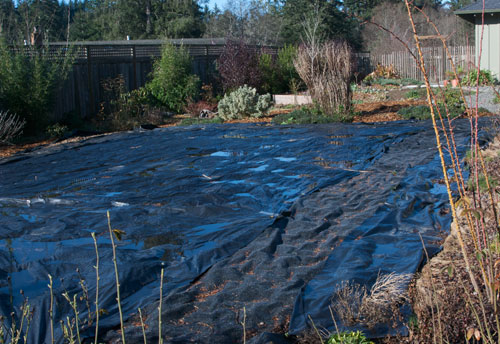
Frogs are at it around the clock now, crocus and early daffodils are blooming, tulips are up. Primroses going strong. In the neighborhood, the willows and Indian plum are starting to leaf out already. We’ve covered the front “lawn” (34’x19′) with black plastic and are going to turn it into a vegetable garden.

Soon-to-be-vegies!
Soon-to-be-vegies!
Pansies, Pickwick crocus, tulips

BOOK REPORT (and also PLANET SAVER TIP OF THE DAY)

I’ve become increasingly concerned about what’s happening/happened to the food supply in this country. The pet food recall in 2007 definitely got my attention. Oh, and then there’s the Peanut Thing. Now I’m (finally) reading The Omnivore’s Dilemma by Michael Pollan and it is really crystalizing my thinking. One of the basic points is that industrial scale food production, in and of itself, is a major problem, both in the animal suffering it causes and the loss of nutrition and taste in fruits and vegetables. Plus the environmental cost of moving all that stuff an average of 1500 miles. And who would have thought that corn and the excessive amount of it grown is literally the root of the problem.

It’s time to, as Pollan says, “opt out” of the industrial food chain. His book is an exploration of how that food chain works, what the consequences are and how new alternative food chains are being formed. Anyone who wants to make conscious, sound and informed decisions about what they eat needs to read this book.

For us, we’re becoming much better label readers (citric acid is from corn!?). We’re going to concentrate even more on sourcing our food locally. We already do not eat factory-farmed animals or animal products. Period. I’ve mentioned the vegetable garden. We also plan to get chickens later this year to provide eggs.

The great thing is that the information and alternatives are out there, especially for those of us who are fortunate enough to live in California. Obama mentioned in his State of the Union address that subsidies would be cut for “agribusiness”, which is long, long overdue. In the meantime, what we can do is vote with our pocketbooks.