Back In The (Figure Drawing) Saddle

A new year brings new challenges and, for me, one is to get back to drawing from a live model. As it turns out, there is a weekly drop-in figure drawing session about 15 minutes from where I live. Five bucks for two hours. Can’t beat that. It’s hosted in the studio of a well-known local figurative artist. Besides her, there were five of us and a very, very good model. I went for the first time last night.

I did a LOT of this kind of drawing when I was in art school in the late 1980s, up to nine hours a week for three years. But since then I’ve done very little, partly because I’ve been trying to get a handle on oil painting and partly because I couldn’t find a group that didn’t think that 20 minutes was a short pose. This is much more to my liking- a bunch of thirty second and one minute poses, then some fives, then a couple of tens and a few fifteens. We drew for a solid hour, took a ten minute break and then drew another fifty minutes. Heaven!

I still had my masonite clip board, some, by now, “antique” rough newsprint and lots of different types of drawing media- compressed charcoal, conte crayons, charcoal pencils, etc. One of my goals was to simply try out different sticks and pencils to see what felt right and to get used to this type of drawing again. I had no idea what to expect. Would it be like learning to ride a bike and remembering how to do it years later or would it be more like riding off a cliff and having to make a very long climb back to where I had been since I last did it?

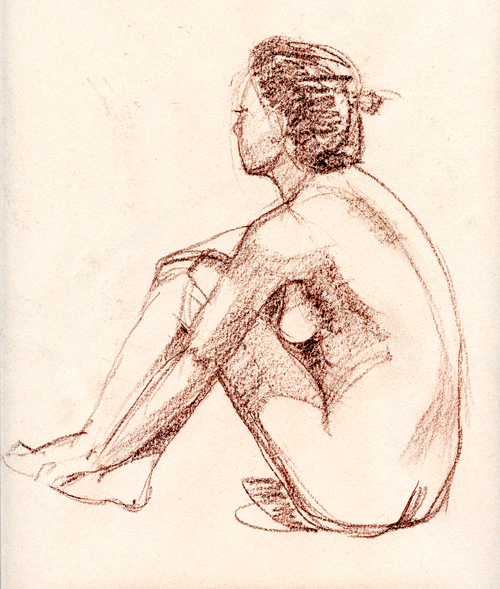
A little of each, I think. Here’s a progression of five drawings, starting with a thirty second gesture drawing and working up to the final 15 minute study. Needless to say, I highly recommend this to every representational artist, no matter what your subject matter. The human figure is endlessly challenging, but the point is less to turn out pretty drawings than to hone and train your eye.
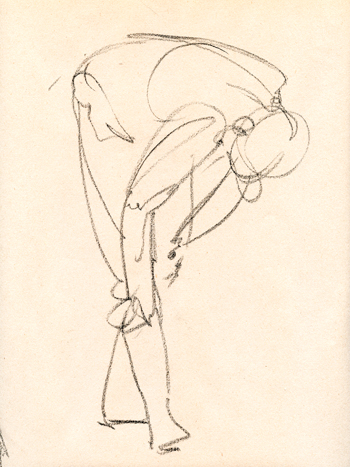
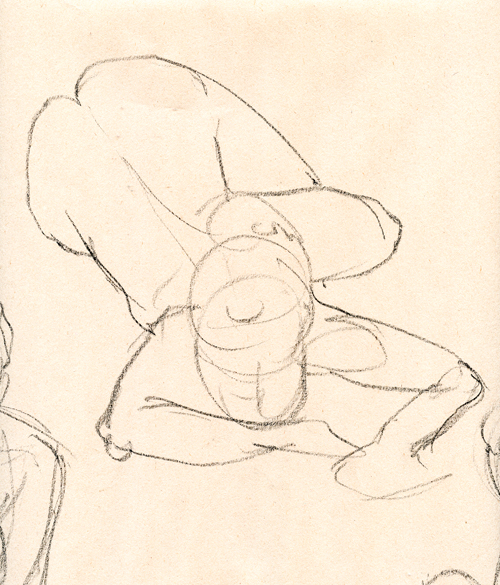
30 second gesture drawing-compressed charcoal
one minute study-compressed charcoal
five minute head study-conte stick
final drawing of the evening, 15 minutes; conte stick

I didn’t hurt to have a model that artists like Waterhouse, Millais and Rossetti would have happily hired.

11 Recommended Drawing Books For Animal Artists

by Bob Kuhn

Obviously, drawing skills are fundamental for the creation of visual art, whether it’s representational or not. By “drawing” I mean having the hand/eye motor coordination to make the marks you want, where you want them and the way you want them with your tool of choice, whether or not you approach your work using lines or shapes.

For the purposes of this post, however, I am talking about the use of “dry media”- pencils, charcoal and the like on supports such as paper and canvas. Plus the ability to represent an animal realistically and accurately. It goes hand-in-hand with the development of what I’ll call “visual judgment”, which is how you learn when you’ve made a mistake and what you have to do to fix it.

Part of the inspiration for the following comes from a comment thread I recently saw on Facebook in which an artist flatly stated that “passion” was the most important component of a painting. I would submit that passion uninformed by technical skill in areas such as drawing, design, form, structure, light, value, color and the handling of edges creates work that might have a certain initial level of visual excitement, but won’t stand the test of time or even close scrutiny. To my mind, lack of skill creates visual distractions that get in the way of the artist’s ability to express their passion. I also think that it can be used as a convenient excuse to get out of the hard work (it is HARD and it is WORK) of creating art.

by Walter J. Wilwerding

I recently was a member of the jury which evaluated applications for membership in the Society of Animal Artists. Five votes were required for acceptance. The  jurors were all artists with very keen eyes who were also uncompromising in their standards. I enjoyed the experience very much, both for the chance to see a lot of animal art and to learn from the other jurors. It was an objective process. The judging was not based on “like” vs. “not like” or “passion” or other vague emotional responses. The drawing of the animal was the first thing we looked at, whether it was a painting or a sculpture. Accuracy and an understanding of the structure of a species, plus a firm grasp of basic anatomy (“A leg can’t bend that way.”) were key. If the drawing of the animal was faulty, the application was rejected. It was one of the most consistent problems I saw in the work we viewed.

If, after taking a long, objective look at your work, you can see that there is room for improvement in your drawing skills, consider these books, which are from my own library and that I have found useful over the years. In no particular order:

-Drawing and Painting Animals by Edward Aldrich

-Animal Drawing, Anatomy and Action for Artists by Charles R. Knight

-Animal Drawing and Painting by Walter J. Wilwerding

-The Art of Animal Drawing by Ken Hultgren

-Drawing Animals by Victor Ambrus

-The Animal Art of Bob Kuhn…A Lifetime of Drawing and Painting by Bob Kuhn

-Drawing With An Open Mind by Ted Seth Jacobs

-The Pencil by Paul Calle

-Fast Sketching Techniques by David Rankin

by Charles R. Knight

And, for animal anatomy, you need both of these:

An Atlas of Animal Anatomy for Artists by W. Ellenberger, H. Dittrich and H. Baum

Animal Anatomy for Artists, The Elements of Form by Eliot Goldfinger

by Ken Hultgren

I’m sure that there are other good and useful books about animal drawing and anatomy and I invite you to share them via the comments section.

New Painting, New Drawings And An Interesting Call For Entries

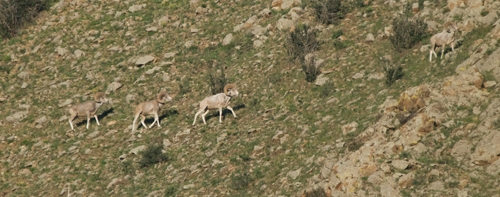
Sort of an odds and ends Friday as the year winds down. The deep freeze is over here in coastal Humboldt County and it’s back to nice normal rainy weather with nighttime lows in the 40s. I’ve been getting in some good easel time of the past few weeks. Here’s a new argali painting from reference that I shot in July at Gun-Galuut Nature Reserve. I watched this group of rams work their way across the rocky slope for almost an hour. “Uul” is Mongolian for “mountain”.

On The Slopes of Baits Uul, Gun-Galuut 18x24" oil on canvasboard (price on request)

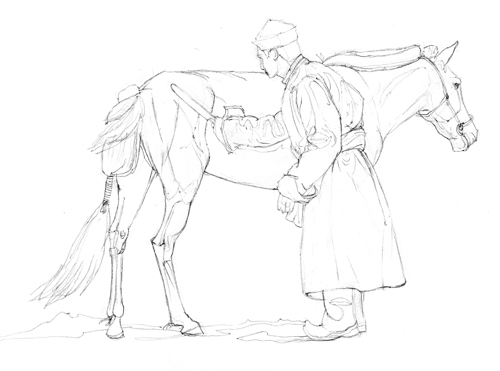
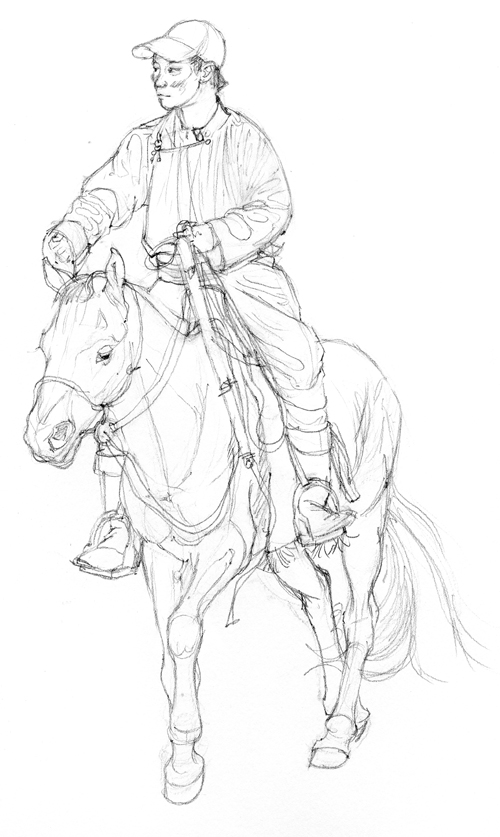
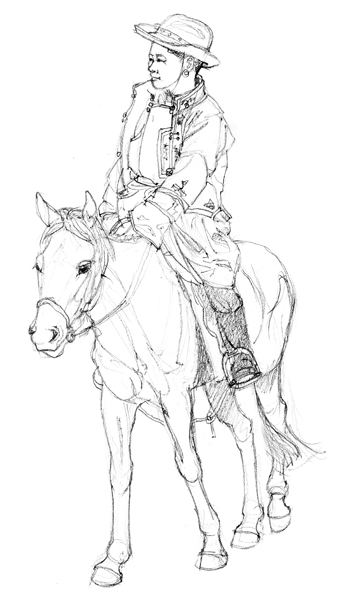
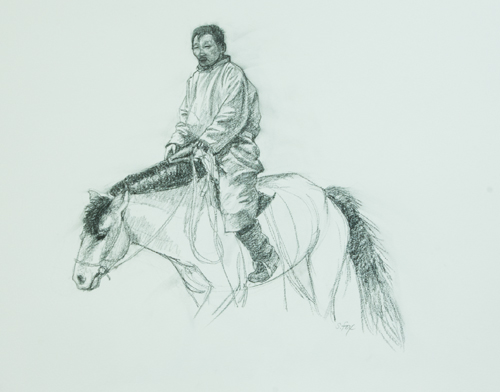
I’ve also decided that I want to paint not just the domestic Mongol horses, but the people who ride them. Which brings me back to wrestling with human figures, as described in an earlier post. I get a better result if I can scan the drawings rather than photograph them and also wanted to really hone in on accuracy, so these are smaller and done with a Sanford Draughting pencil, but on the same vellum bristol (which erases very nicely). The heads ended up being only 3/4″ high, which is pretty small, but it reminded me of a story from art school that I thought I might pass along.

One of my teachers was Randy Berrett, a very good illustrator who chose to work in oils. This was kind of masochistic, in a way, because it added a layer of complexity when he had to ship out a wet painting to meet a deadline. In any case, he was showing some examples of his work in class and one was a really large painting of the signers of the either the Declaration of Independence or the Constitution, I can’t remember which. Someone asked why he painted it so large. Randy’s answer really struck me at the time and has stayed with me. It’s something worth remembering when planning a painting. He said that he wanted the heads to be at least an inch high and that requirement controlled the final size of the painting. I’ve sized more than one painting on the basis of that criteria since then.

The first drawing combined two pieces of reference. One of the horse and one of the man. In the latter, he was in front of the horse’s head. In the former, I didn’t like the pose of the horse. Moving the man back works much better. The sweat from a winning horse is considered to be good luck. There are special scrapers made to remove it.

Scraping the sweat after the race, Baga Gazriin Chuluu
Local herder, Erdene Naadam
Boy on horse, Erdene Naadam

Part of the reason I did the previous two was to see if the images “drew well” and to work on horses coming forward at a 3/4 angle. The final two are head studies, in which the heads are 1 1/2″ from forehead to chin.

Local herder, Erdene Naadam

Local herder, Erdene Naadam

Finally, the folks at Eureka Books in Old Town, Eureka have decided to hold a special art show. Here’s the Call for Entries.

Three Drawings of Mongol Horses and Riders

Drawing and painting animals has always come more easily to me than humans. No idea why, that’s just been how it is. But now, I’ve gotten really interested in the Mongol horses and the lives of the herders who breed, train, ride and race them. And I want to paint all of that, so now I really do have to get up to speed with people. These drawings are part of that process. They each took a few hours and I enjoyed doing them a lot.

Erdene-naadam-rider
Horse and Rider at Erdene Naadam, 2009; compressed charcoal on vellum bristol
BGC-boy-on-horse
Horse and jockey, mountain blessing day horse race at Baga Gazriin Chuluu, 2009; charcoal pencil on vellum bristol
Choi's-father
Herder and horse, Ikh Nartiin Chuluu, 2005; charcoal pencil on vellum bristol

Sketching In New York

I just got back last night from a two-day trip to New York. One day was taken up with the Society of Animal Artists board meeting (of which, more later) and the second day with wandering around Greenwich Village sketching and then hitting some jazz clubs in the evening with fellow artist Guy Combes, who lives across the river in New Jersey as the artist-in-residence at the Hiram Blauvelt Museum of Art.

I hadn’t done any “urban” sketching for quite a long time, but the area of New York that I was in could keep an artist busy for a lifetime. As it was I did the four following sketches in a  5.5×8.5″ Strathmore Series 400 recycled paper sketchbook with a Pentel “Energel” .5 pen.

Nothing fancy here. These are about the process and just having fun.

11-05-NY-1

Notice that I didn’t get into rendering a bunch of leaves on the big shrub. It’s just a shape.

11-05-NY-2

11-05-NY-3

All the little dark marks are what is left of old pier pilings.

11-05-NY-4

I stood on the opposite corner to draw this festive restaurant exterior with the piggy sign.

None of these took more than about twenty minutes.

Field Sketches/I’ll Be At Pastels On The Plaza Tomorrow

I’m going back to my two-a-week posts. Mongolia Monday will start up again on, um, Monday, along with my eBay auction listing. Fridays and whenever the spirits moves me will be everything else: paintings in progress, etc.

Here are some recent pages from my sketchbook. They are done with whatever fine point liquid gel pen Staples had last time I needed some new ones. No preliminary pencil work, I just dive in with the pen and hope for the best. These were done at the Rolling Hills Wildlife Adventure’s zoo:

RHWA2009-1

RHWA-2

RHWA-3

RHWA-4

I finally sucked it up and sketched people for the first time in years on my way to the AFC “Art of Conservation” show opening weekend. Got to practice my furtive glance at San Francisco International Airport Gate 74. (ignore the date).

SFO-Gate-74

————–

I’ll be at PASTELS ON THE PLAZA in Arcata, California tomorrow morning from between 8 and 9am until probably around 11am. This now-traditional October event is a benefit for Northcoast Children’s Services and brings out well over one hundred Humboldt County artists who will fill the sidewalks around the Arcata Plaza with creative, fun and amazing pastel drawings, all for a great cause. Each artist has either found a sponsor or has been assigned one by NCS. The sponsor “buys” a single or double space and the artists donate their time. The Saturday Farmer’s Market happens at the same time, so it’s a big day-long street party. The pastels usually are visible for a couple of weeks or until the first winter rains hit.

How I Start a Big Painting & A Favorite Photo from Mongolia

One of the advantages of my illustration training is the process that we were taught for putting a picture together. I don’t do all the steps all the time, but now that I’m about to start one of the largest paintings I’ve done so far, I need the control that the process gives me.

My first sighting of argali at Baga Gazriin Chuluu Nature Reserve, thanks to Onroo the local camp staffer who knows the place and where the animals tend to hang out, was a group of rams in wonderful morning light. Mostly they were grazing and resting. For this painting, however, I wanted action. The essential image popped into my head and then it was a matter of getting it down on paper, which is one reason why the thumbnail process is so valuable.

Here’s some of the reference that I’m using:

Argali-G-G

I liked the pose of the big ram who is third from the left. This photo was taken at Gun-Galuut Nature Reserve. I dumped the image into Photoshop and did a horizontal reverse to get him going the direction I wanted. And then zoomed in as much as possible. The next three are from Baga Gazriin Chuluu. Talk about reference eye candy.

Argali-ref-shot

Argali-ref-shot-3

Argali-ref-shot-2

I did a couple of drawings of the main sheep to try out position and gesture.

Argali-2

In this one I added the a background to see how that worked.

Argali-1My idea is to channel a little Edgar Degas and have the animals coming in from the frame, not have all of them within the frame. This is too static, but it gives me something to bounce off of. Gotta start somewhere.

Here’s the thumbnail sheet. I’m trying to figure out where the three masses of sheep will be in relation to each other. Then I did another, larger sketch.

Argali-thumbThis is more what I had in mind. Almost everything is on a diagonal, which gets rid of the too-static quality of the previous sketch. As I draw and re-draw the animals, I’m able to get to “know” them better and can refine and push the poses.

I spent a good chunk of yesterday doing a finished scale drawing that will be transferred to the canvas via the ancient and honorable grid system. I ended up with three layers of tracing paper. The bottom one had the lines for the edge. The second one had the drawing of the sheep. The third was the landscape. I did one and it’s really nice, but not right for this painting. Replaced it with a new sheet and re-did it. When I was satisfied that I had more or less what I wanted, I re-drew the argali, once again refining and tweaking the drawing.

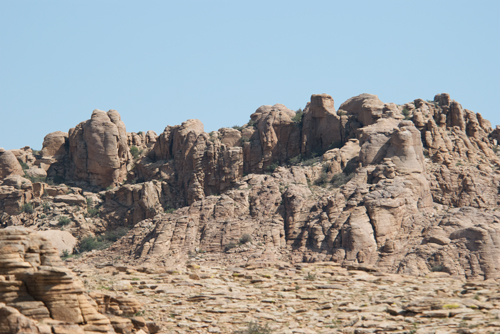
At this point, I have solved the design/composition problem and the drawing problem. Both may be re-visited at any time as needed if I see something that needs fixing, but the next step is a value study, that is, the pattern of lights and darks. We were told in art school that if we get the values in a picture correct, then we can do anything we want with color, which I have found to be true. One of the tasks that needs doing to take the Gun-Galuut argali and the image of the sunny rocks and make them work with the Baga Gazriin Chuluu morning light. For that I’ll do a color study.

I hunted through my reference once again for the sheep images that I thought would work best. And here is, so far, finished drawing. Still not sure about the argali on the left. I’ll see how it looks to me on Monday. I also think I need a little more “air” on the right side and maybe the top. Not much, maybe a half-inch.

Argali-big-draw

Finally, a favorite photo from the local Naadam at Erdene. Waiting for the race results.

Erdene-rider,-pink-del

Memorial Day Miscellany

First, I want to honor and express my appreciation for all the men and women who serve and have served in our armed forces.  I’ve read a lot of history and it’s true- Freedom isn’t free. But, America should never go to war except as a last resort and should never risk our soldiers lives without a compelling reason. My thoughts are with the families whose loved ones have died in service to our country.

———————–

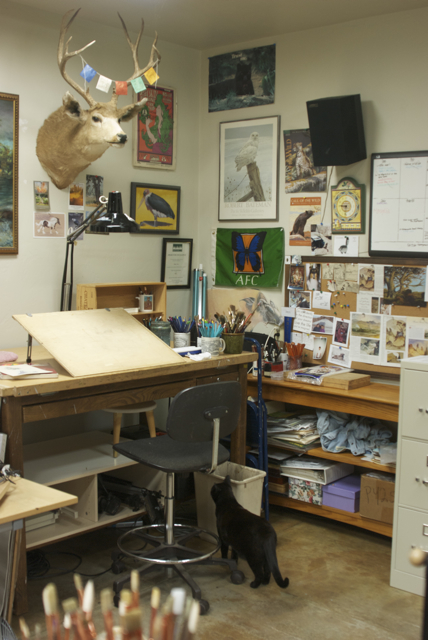
Besides coming down with a cold a couple of days ago, I sat down on Friday to start sketching and got diverted by re-arranging my corner workspace. So not much in the way of sketches or materials info. yet, but I am thrilled to have my wonderful old oak drawing table back in action. Shifting it 90 degrees lets me use the iMac so I can draw from it the same as with the easel. Here’s a couple of pics of the new arrangement. The Rocky Mountain mule deer head was a flea market find. There are also images from Bob Kuhn and Robert Bateman for inspiration. And my favorite 1960’s psychedelic poster, The Green Lady by Mouse and Kelly.

Eowyn inspecting the new set-up
Easel is on the right
Easel is to the right

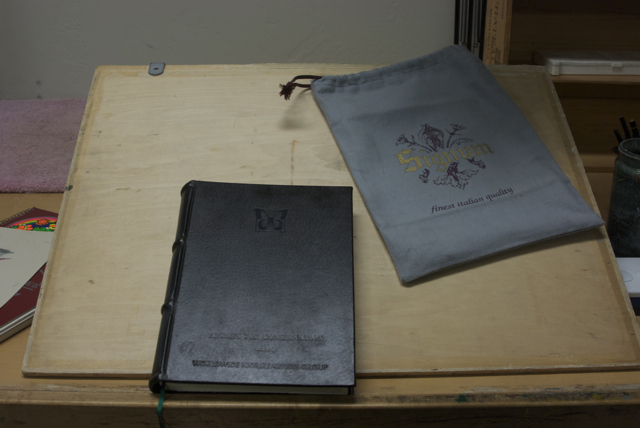
It’s time to start to pull it together for the upcoming Expedition. One part of it will be keeping a journal, which is provided by the AFC (Artists for Conservation). It’s bound in Italian leather and comes with its own bag. Nothing like a little intimidation.

journal 1Yup, I’ll be hauling this puppy all over central Mongolia for three weeks. I need to do a title page and a map Real Soon Now, but how to face the terror of the blank page? The thought of making a mess is paralyzing, but it must be overcome. I know, I’ll start at the very back-
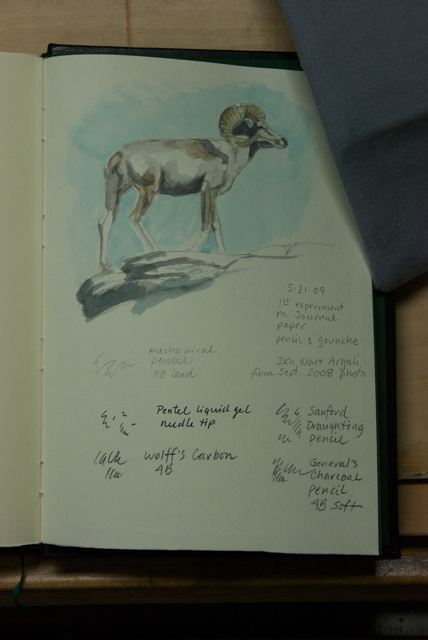
journal 2So I used an argali image from the trip last year that is representative of what I hope to see and sketch. I’m experimenting with ways to add color. This is Pelikan pan gouache used as a watercolor wash. The paper has a nice tooth and isn’t too soft, but I wanted to see how different drawing options worked, so that’s what’s on the bottom. The Wolff’s carbon pencil didn’t flow and the General’s charcoal pencil was too soft (for my purposes). A mechanical pencil with an HB lead and the Sanford draughting pencil worked well, as did the Pentel pen. I’ve got two kinds of Derwent watercolor pencils that I’ll experiment with next, along with a couple of other things.
Mongolia Monday And A Schedule Adjustment

As I am about two months out from my Mongolia trip, I’ve decided to consolidate my blog posts to Monday and then do quick updates as needed on other days of the week. For the next few months, most posts are going to have Mongolia content as I share my preparations and, with luck, the trip itself.

MONGOLIA MONDAY

I have my plane tickets and will be leaving on July 5, staying overnight in Seoul, Korea and arriving in Ulaanbaatar on the afternoon of the 7th. I’ll be taking the local United Express flight to San Francisco, Asiana to Seoul and MIAT to UB, and doing it in reverse without the overnight for my return on July 30. My current plan is to attend the National Naadam celebration in UB and then, in some order still to be determined, spend a day or two at Hustai seeing the takhi, travel to the Gun-Galuut Nature Reserve and the Baga Gazariin area to explore the argali habitat in those places, with hopes that I will be able to see and photograph them.

The one “appointment” that I have is to be at Ikh Nartiin Chuluu the week of the 20th for three days of meetings with the herder women to discuss their ideas for a crafts cooperative, which I plan to support. For this purpose, and for other projects that might come up in the future, I have established a non-profit association, Art Partnerships for Mongolian Conservation (APMC). Our mission will be to use the arts to promote conservation in Mongolia. My 501(c)3 sponsor is the Denver Zoological Foundation, which has set up an account for me so that donations made to APMC are tax-deductible. For more information, email me at sfox@foxstudio.biz.

SKETCHING VS. DRAWING

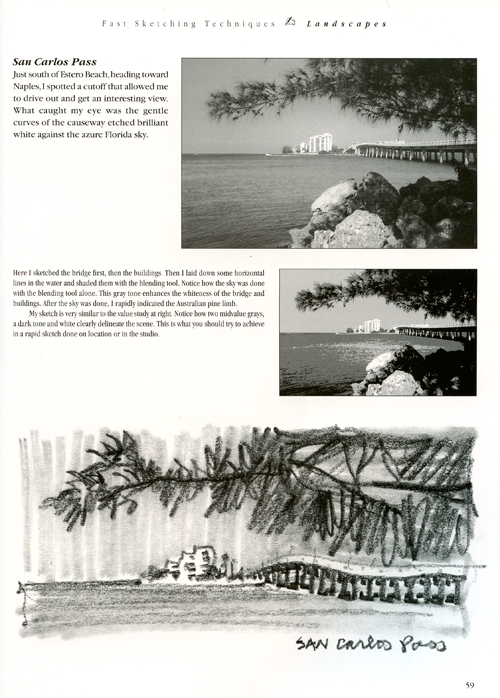
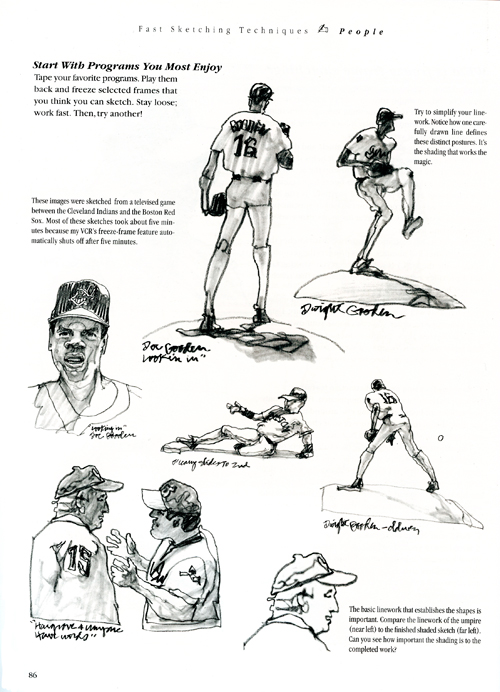
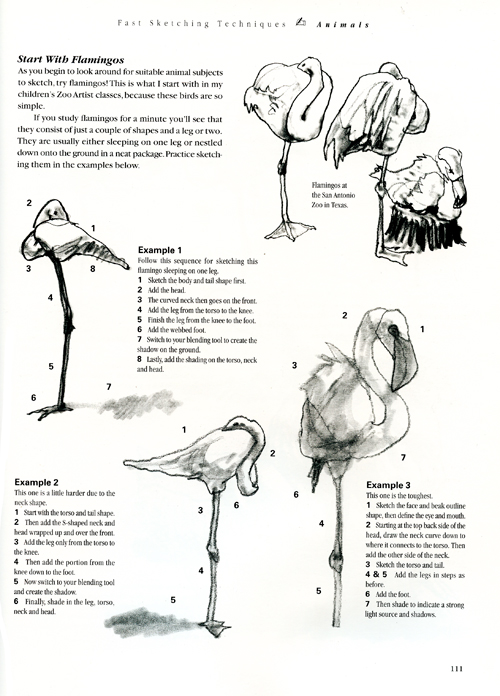
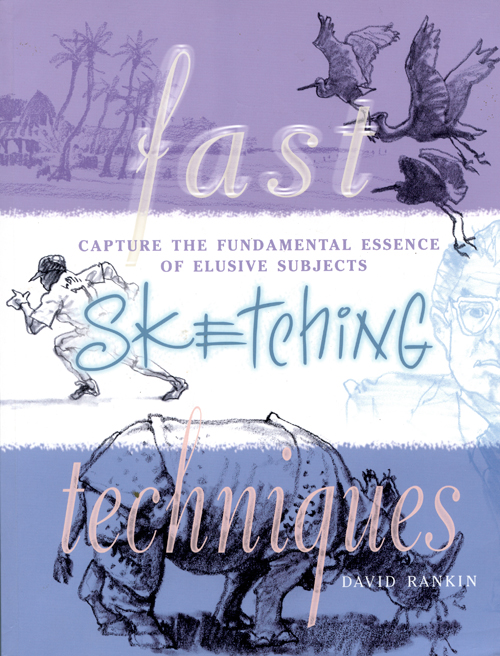
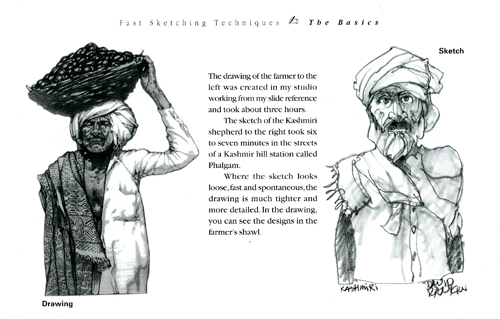
Last week I said that I would do a book review of an excellent “drawing” book. I got it out recently to use as a guide for honing my field sketching techniques for the upcoming Mongolia trip (see how it’s all dovetailing?). It’s called “Fast Sketching Techniques” by David Rankin, who, as it happens, won an AFC Flag Expedition Grant a couple of years ago to travel to the source of the Ganges River in India, one of his most favorite countries. He, dare I say it, draws a very useful distinction between drawing and sketching and does it in a way that I think encourages people to pick up a pencil and paper and give it a go.

Here’s where you can find it on Amazon, but it looks like it has gone out print, so you might end up with a good used copy. I highly recommend it. Here are a few pages to give you an idea of David’s approach. He is a signature member of the Society of Animal Artists, has been in every major wildlife art show multiple times and is an excellent teacher and “critiquer”. In short, he knows his stuff.

Book cover
Book cover
The difference between drawing and sketching
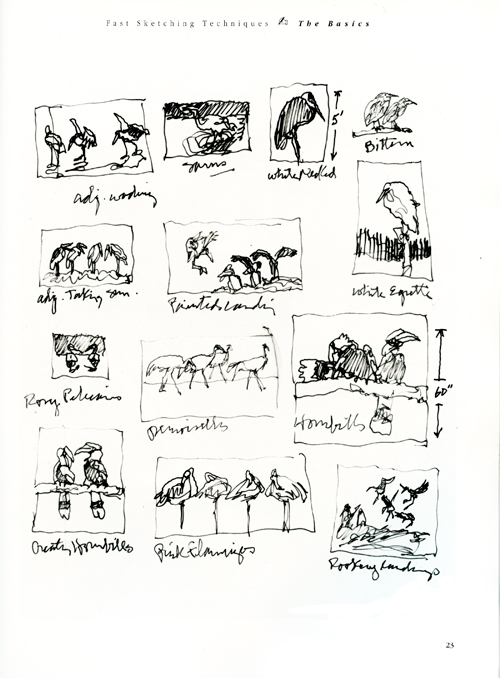
Quick, simple sketches that catch the essence of the subject without getting bogged down in detail
An example of how he interprets a scene quickly
Using pause on a tv recorder to do quick sketches
Instruction on how to work at zoos sketching animals

Next week, I’ll have post some of the sketch work I’ve been doing in order to get up to speed for the real thing.