Animal Sketching At The Denver Zoo!

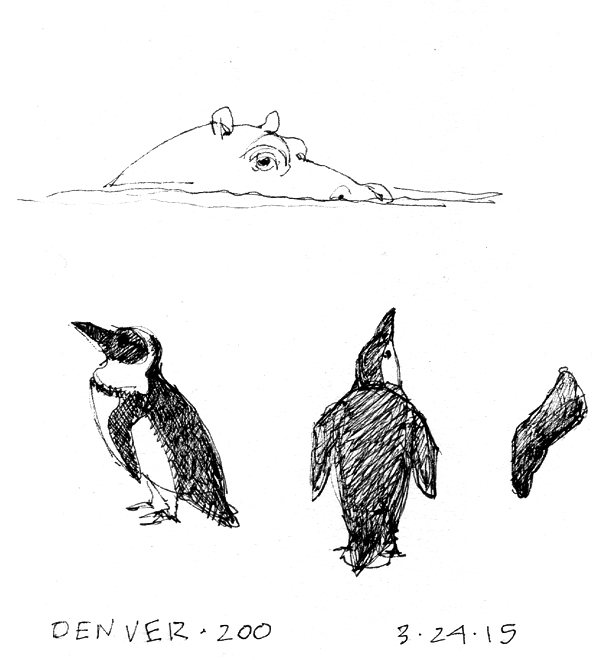
Hippo and penguins. I did the hippo in about 15 seconds since he went underwater at that point.
Hippo and penguins. I did the hippo in about 10-15 seconds since he went underwater at that point, so no time to add any tone or detail. The penguins were more cooperative.

I got to spend a day sketching at the Denver Zoo a week ago. There really is no substitute for drawing from live animals if one is an animal artist. Photos alone just don’t cut it and, even more, photos that you haven’t taken yourself. The kind of sketching I’m showing here is about process and observation, not a polished or finished result. I hadn’t done this for awhile so it felt awkward at first, but got easier as the day went on. I used a 7×5″ Pentalic Nature Sketch sketchbook and a .02 black Sakura Micron pen, both of which I keep in my purse, a roomy Tom Bihn bag which can also hold my iPad. So that’s it….paper and a pen. Anyone can do this and you’ll see animals, whether it’s a pet cat or a tiger, in a new way. Start with animals who are resting or otherwise not moving. What is challenging is exercising one’s visual memory by doing ones that are moving. You will see with zoo animals in particular that their movement often has a pattern. Observe that, pick a gesture or angle and start and stop as needed as the animal comes past again.

Steller's sea eagle and cinereous/eurasian black vultures. The eagle held still. The vultures were busy hopping around.
Steller’s sea eagle and cinereous/eurasian black vultures. The eagle held still. The vultures were busy hopping around.
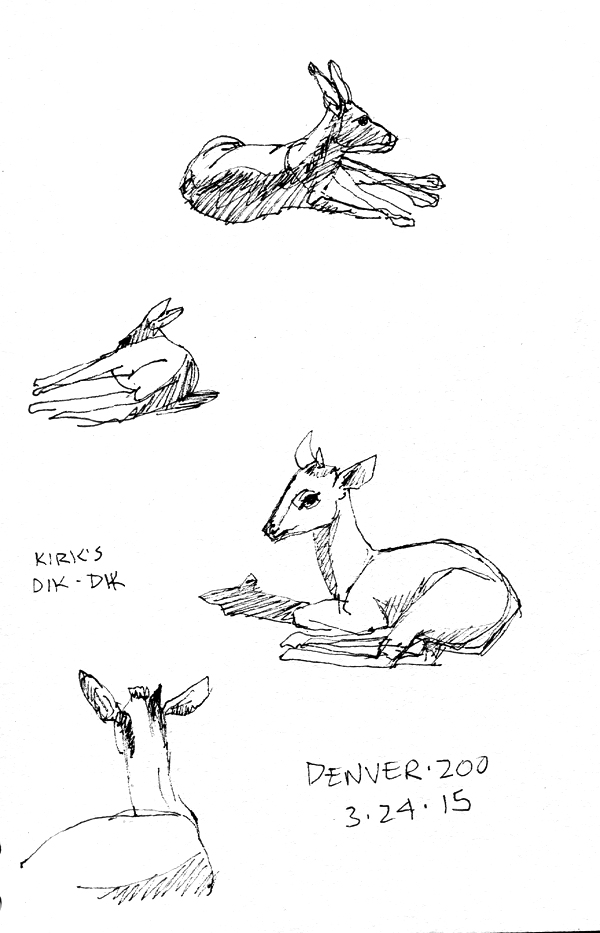
Kangaroo and Kirk's dik-dik. The kangaroos were towards the back of their enclosure. The dik-diks were pretty close.
Kangaroo and Kirk’s dik-dik. The kangaroos were towards the back of their enclosure. The dik-diks were pretty close.
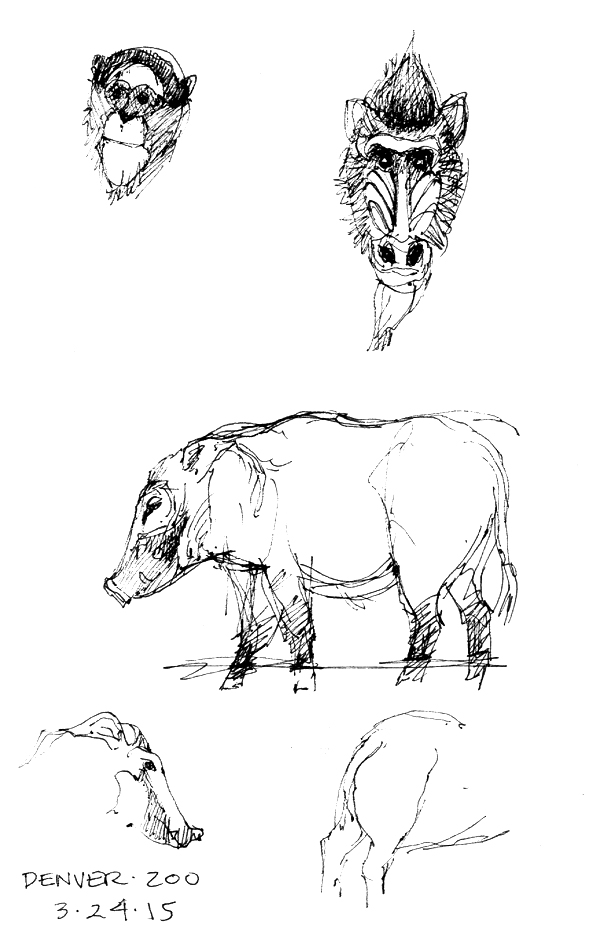
De Brazza's monkey, mandril and Red River Hogs
De Brazza’s monkey, mandrill and Red River Hogs. The De Brazza’s monkeys never stopped moving. It took awhile to even get a reasonably accurate head sketch. The mandrill just sat and looked at me. Red River hogs are one of my favorites, but I hadn’t had a chance to draw them much before. So the first one shows me searching for the shapes and proportions. Nothing wrong with doing that.
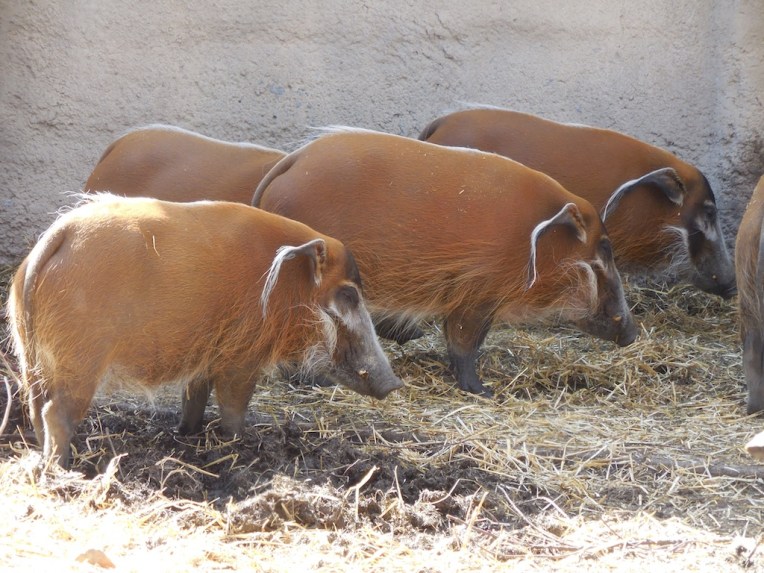
Red River hogs. What's not to like about drawing them?
Red River hogs. What’s not to like about drawing these guys?
Gorilla and giraffe. The big male was working on a treat stuffed into a wood cylinder. Even though his back was to me, I found the shapes interesting to draw. The giraffe was quite a way away so I couldn't really see the head all that well.
Red River hog, gorilla and giraffe. One of the hogs held still long enough to do a decent head sketch. The big male gorilla was working on a treat stuffed into what looked like a short length of wood. Even though his back was to me, I found the shapes interesting to draw. The giraffe was quite a way away so I couldn’t see the head all that well, but I really like drawing them, so what the heck.
The zoo has a small group of takhi/Przewalski's horses and of course I had to sketch them. I also shot some video.
The zoo has a small group of takhi/Przewalski’s horses and of course I had to sketch them. They also kept moving around, but this one stayed grazing for just long enough.
Takhi/Przewalski's horse and a bactrian camel laying on its side.
Takhi/Przewalski’s horse and a bactrian camel laying on its side. I did the camel to study the legs. Note how I used small circles to indicate the location of the joints.
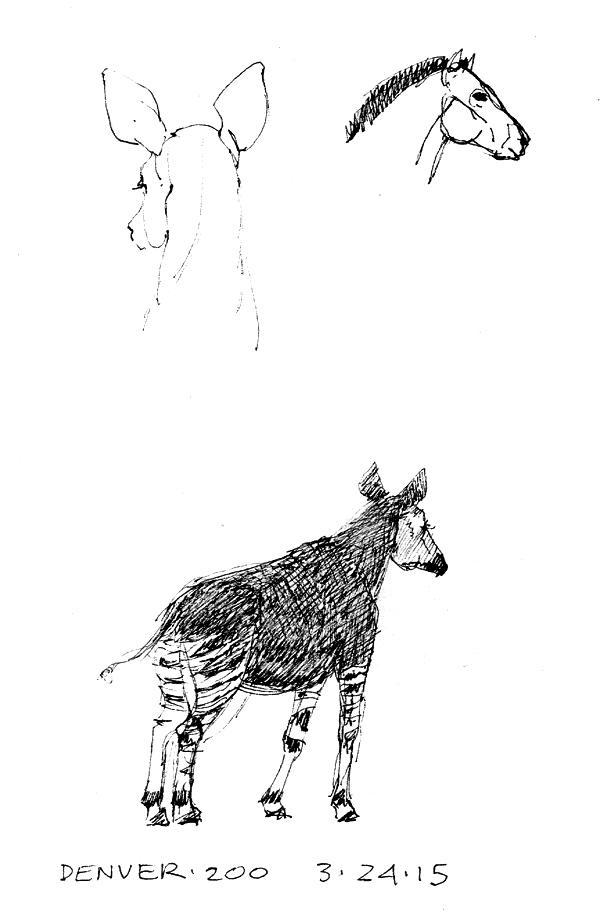
Okapi back of head, takhi/Przewalski's horse, okapi
Okapi back of head, takhi/Przewalski’s horse, okapi. With those ears, why not draw the back of the head? I think that’s my most successful sketch of the day. The okapi was mostly moving, so I had to pick a position and use my visual memory along with noting the stripe patterns on the legs. This was a species I had never drawn before and it was s little challenging to keep the odd proportions correct. It’s reasonably close.
Colobus monkeys, maned wolf
Colobus monkeys, maned wolf. The monkeys were up in their trees, moving around and swinging on the ropes. All I could do is try to capture the basic appearance and the gestures. The black one is from memory. The wolf whose back of the head I did was lying down. The other one was pacing so, as mentioned above, I waited until he/she came past me again to continue the sketch.

It was snowing the next morning, so I went to the Denver Museum of Nature and Art. They have a large, very good collection of taxidermy mounted animals set in nice dioramas. One generally does not rely on mounts since accuracy varies greatly, but for field sketching on a bad weather day, they’re perfect! And they don’t move! As with the zoo animals, I was after a quick impression sketch, not a detailed study, because I had limited time. But one could certainly bring colored pencils, larger paper and do more finished work. One might choose to focus in on, and really work to understand, how the feathers are lifting where the bird is grooming them.

Crane
Whooping crane
Warthog and anteater.
Warthog and great anteater. For both of these I was concentrating on the movement and expression. Also the markings on the anteater. Ran out of room for all of the tail, but didn’t worry about it.


Mongolia Watercolors And Sketches So Far; Having A Wonderful Time!

View from my ger, Delger Camp

I just returned from four great days at Delger Camp, operated in conjunction with Nomadic Journeys, and which is located at the Khogno Khan Nature Reserve, about six hours west of Ulaanbaatar. Staying in one place for awhile is very useful for getting in serious painting time. I do quick pen and ink sketches while on the road, but there’s usually not time to get out the watercolors.

Along with the paintings and sketches from this current trip, I also thought I’d share other pieces I’ve done up to now. Everything was photographed in less than optimal conditions in the apartment I have the use of, but I felt that sharing them while I’m still here would be fun and have an immediacy that would be missing if I waited until I get home in a couple of weeks.

They were done with either a Winsor Newton Cotman watercolor travel set or Yarka poured pigment watercolors and a Robert Simmons Sapphire brush. The paper is either Arches 140lb cold-pressed or a w/c paper I brought back from the Lake District in England many years ago. The pen sketches were done in a 7×5″ Pentalic Nature Sketchbook. I used a non-waterproof pen with a Koi waterbrush for the one with the tone and a .01 Sakura Micron pen for the others.

Gloomy day
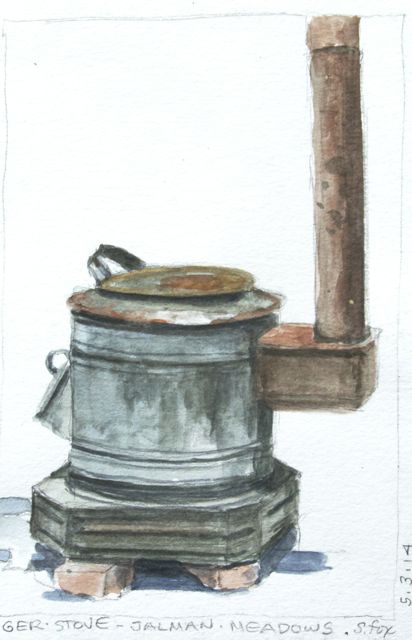
Gloomy day, so I did this watercolor study of the stove in my ger
Cloudy and rainy day
Cloudy and rainy day studies at Jalman Meadows and Gun-Galuut
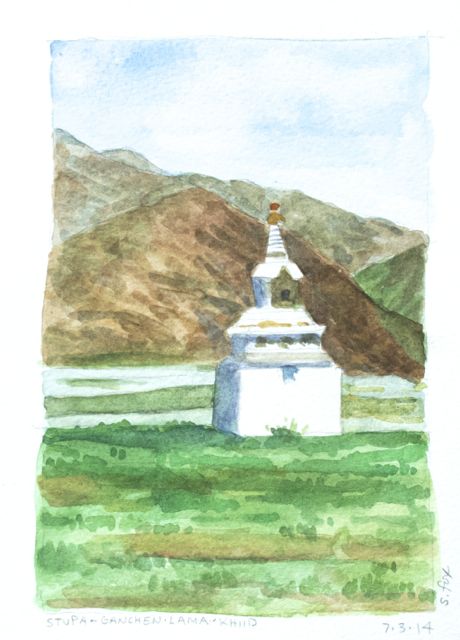
Stupa above river valley at Ganchen Lama Khiid, Erdenesogt
Stupa above river valley at Ganchen Lama Khiid, Erdenetsogt
Prayer wheel at
Prayer wheel at Ganchan Lama Khiid, Erdenetsogt
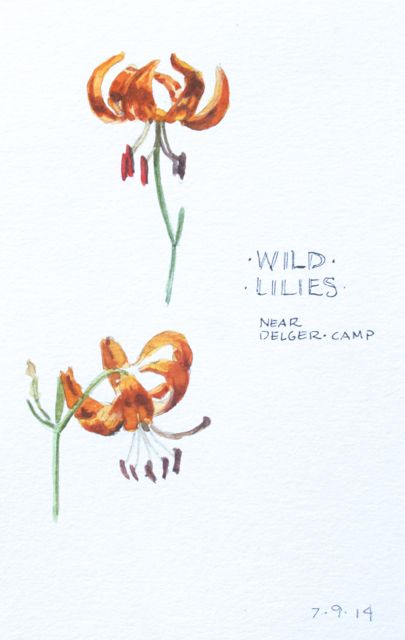
Lily studies, Delger Camp
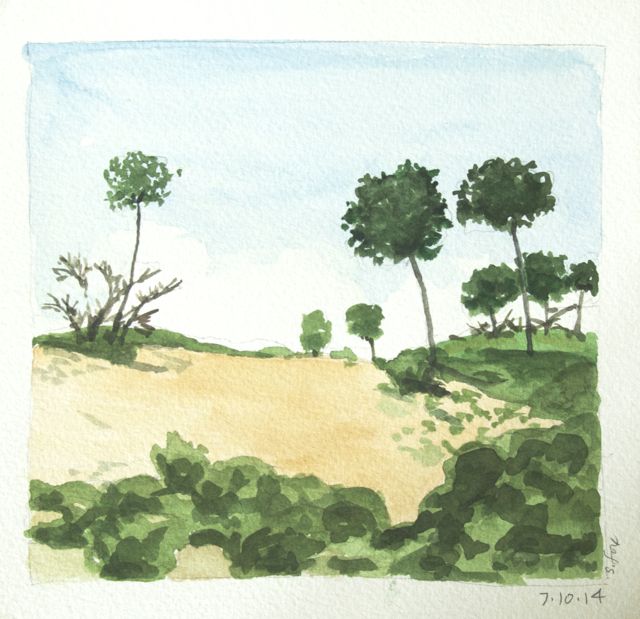
View of sand dunes, Delger Camp
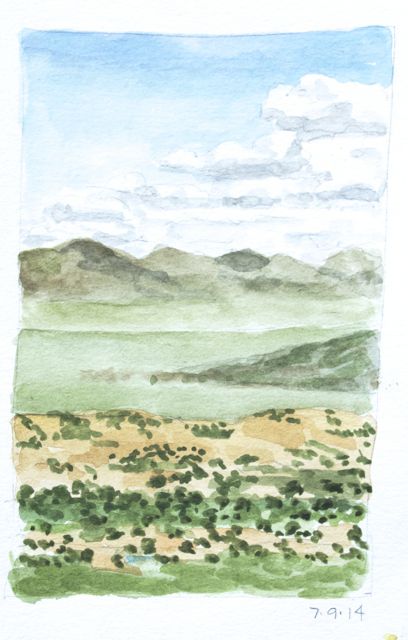
Valley north of Delger Camp
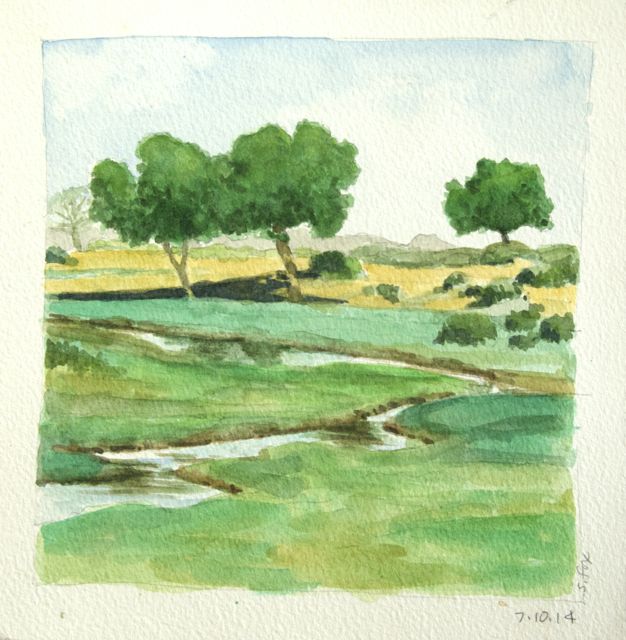
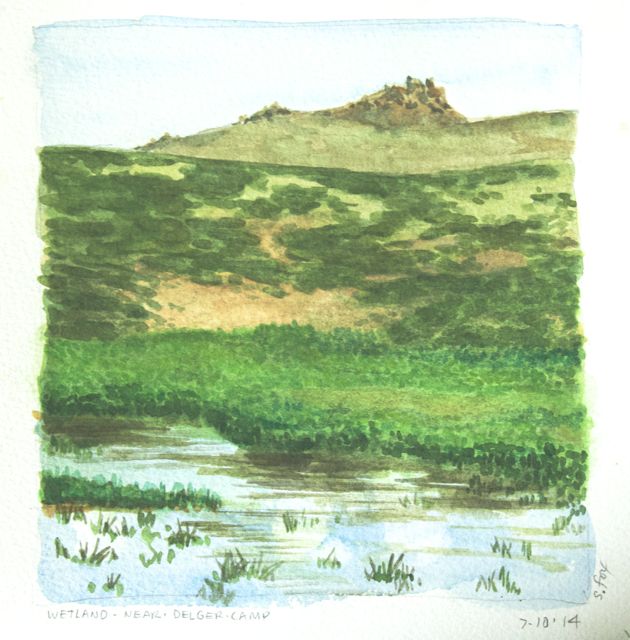
Wetland/dune area
Wetland/dune area
Dunes and trees
Dunes and trees
Variety of vegetation
Variety of vegetation, wetland area and surroundings
Storm light and storm clouds at Delger Camp
Rain to the south
Rain to the south
Clouds coming by
Clouds coming by
Mountains to the north of camp
Toned sketch
Toned sketch
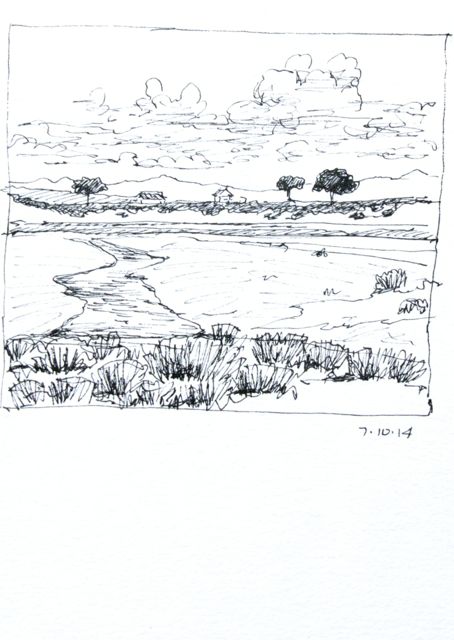
Quick sketch of wetland area (the driver was coming any minute to pick me up)
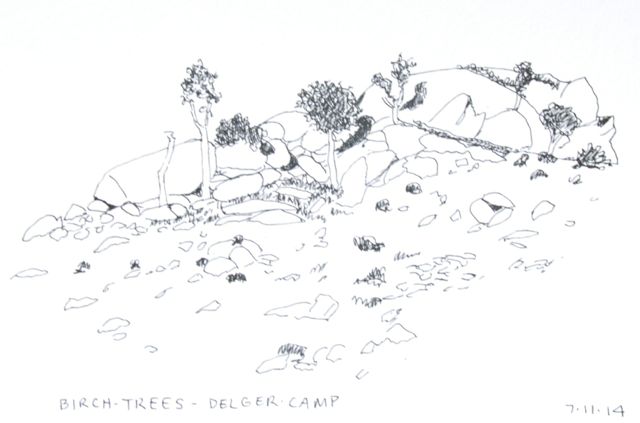
Rocks and trees
Rocks and birch trees
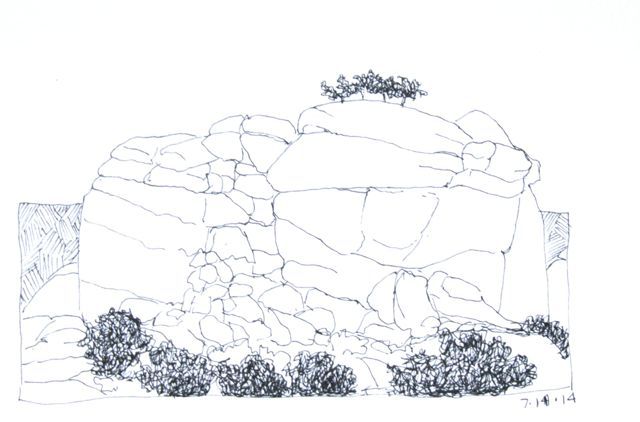
Rock formation
Rock formation
Wild poppies
Wild poppies
Birch tree
Birch tree


The WildArt Mongolia Expedition, Part 3: Arburd Sands to Boon Tsagaan Nuur

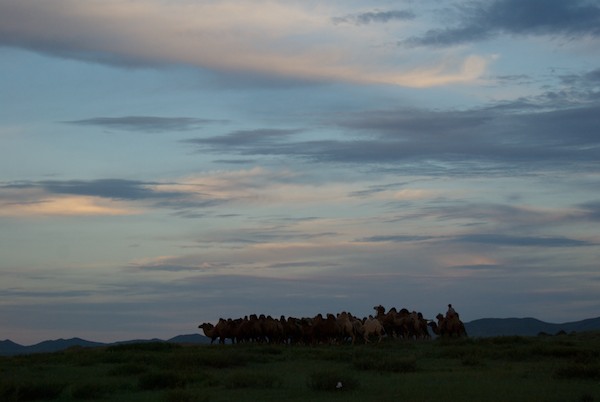
Arburd Sands sunset. With camels.

After a wonderful stay at Arburd Sands and Bayan-Onjuul Soum, it was time for the Expedition to start in earnest. Our first destination was Boon Tsagaan Nuur, a lake deep in the Gobi that is known for the excellence of its birdwatching opportunities, both in the number of birds and variety of species.

We headed west across country to join up with the main southern east-west road, parts of which are now tarmac. We hadn’t traveled for long when we came upon a herder’s ger just in time to see them milking their mares.

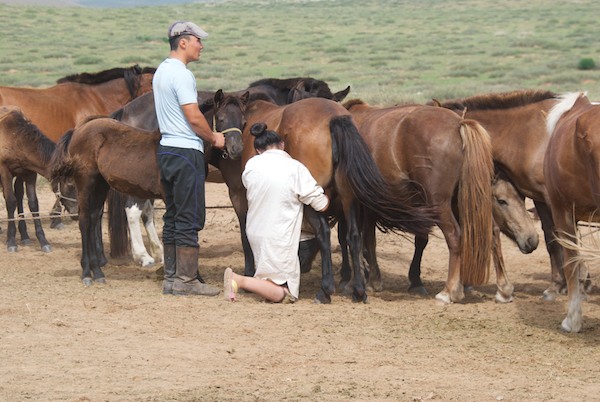
Milking mares
Milking the mares. The foals are tied to a picket line so that their mothers won’t go far and held near the mare so that she will release her milk. Enough is left for the foal to get a good meal. This process is repeated every two hours, 24 hours a day for weeks or months. One result is the famous fermented mare’s milk “airag”, which to me tastes like fizzy yogurt. I like it a lot.
Sharon takes a photo of Tugs-Oyun, who is riding in the other van
Sharon takes a photo of Tugs-Oyun, who is riding in the other van. We all loved her spiffy yellow glasses.
Getting water
Getting water from a local well with the assistance of a young local. An adult had entrusted the keys and the job to him, which he carried off in style.
Camping near Arveyheer
Camping near Arvayheer
Sharon shows Magvandorj how she photographs flowers close-up
En route to  Bayanhongor
En route to Bayanhongor
Ovoo en route to Bayanhongor
When we arrived at the place to get our water barrel refilled in Bayanhongor, we found that this young boy and his horse-drawn water cart was there ahead of us. A little bribe of candy and he was happy to post for us.
When we arrived at the place to get our water barrel refilled in Bayanhongor, we found that this young boy and his horse-drawn water cart was there ahead of us. A small gift of candy and he was happy to pose for photos. Many of the residential areas of the city are ger districts with no running water. People fetch it themselves, pushing or pulling a wheeled metal frame that holds a water barrel. Or they can have someone with a horse cart deliver it to them.
South down out of Bayanhongor, which is located at the southern base of the Hangai Mountains. We traveled down out of the uplands, passing a lot of interesting rock formations, but no gers.
Driving south out of Bayanhongor, which is located at the base of the Hangai Mountains, we traveled through a long stretch of  uplands, passing a lot of interesting rock formations, but no gers and relatively few livestock.
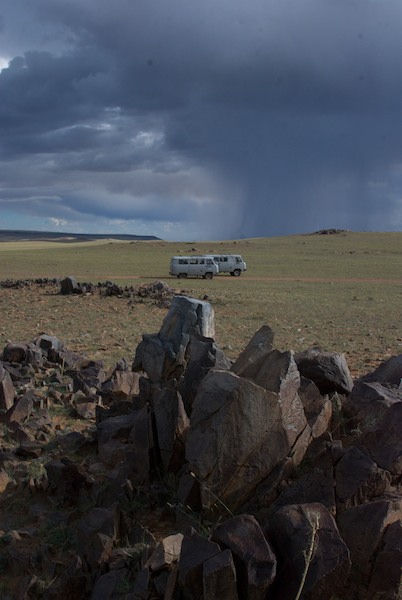
Reaching the Gobi, we saw the occasional ger. There was rain across a wide swath of the horizon.
Reaching the Gobi, we saw the occasional ger. There was rain across a wide swath of the horizon. As you can see, the Gobi is gravel, not sand, although there are isolated dune complexes.
We came to the soum center of Baatsagaan, located not far from Boon Tsagaan Nuur. No petrol available and I think at this point the drivers found out what was ahead of us...
We came to the soum center of Baatsagaan, located not far from Boon Tsagaan Nuur. No petrol available and I think at this point the drivers found out what was ahead of us…
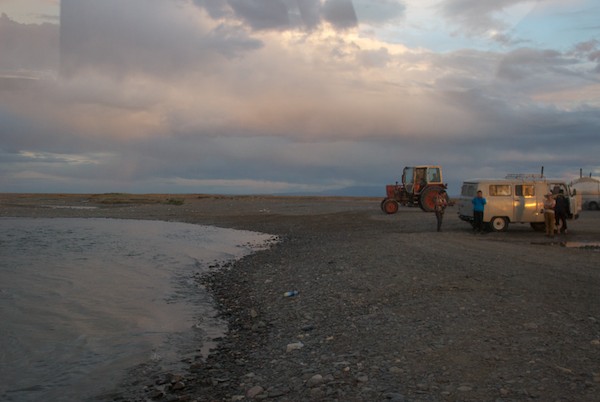
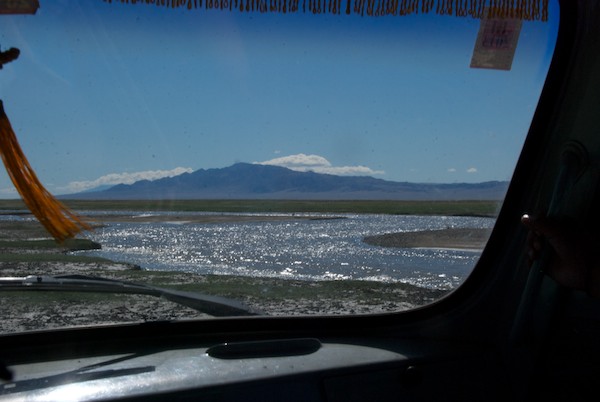
A lot of rain in the Hangai Mountains had poured down into the Gobi creating temporary rivers and streams. This was between us and the lake.
A lot of rain in the Hangai Mountains had poured down into the Gobi creating temporary rivers and streams. This was between us and the lake. So close, yet so far, since neither of our drivers could find a spot they felt confident taking the vans across. Now what?
Batmaa, the driver of the van I was in, grew up in this part of Mongolia and knows it well. He led the way north for quite a distance and then west. We passed really narrow spots like this and I wondered why we didn't just zip across.
Batmaa, the driver of the van I was in, grew up in this part of Mongolia and knows it well. He led the way north for quite a distance and then west. We passed really narrow spots like this and I wondered why we didn’t just zip across. But I learned many trips ago that things are often not as they appear to a non-Mongol and that we were going far out of our way for a reason. I had my suspicions though….
So tempting....
So benign looking and so tempting….
And then we came to this...
And then we came to this, clearly an established and well-organized operation of some kind.
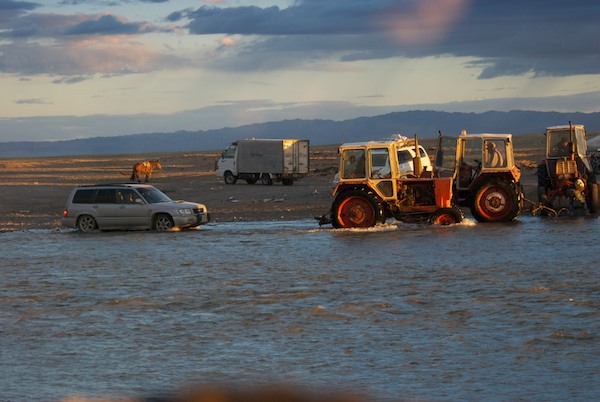
And, of course the answer was that Batmaa had brought us to the ford.
And of course the answer was that Batmaa had brought us to the ford. I would guess the only one for many, many miles around, judging from the number of tractors, gers, and vehicles waiting to cross.
And we got a preview of what was in store for us.
We got a preview of what was in store for us.
Uh...
Uh. Oh.
oh
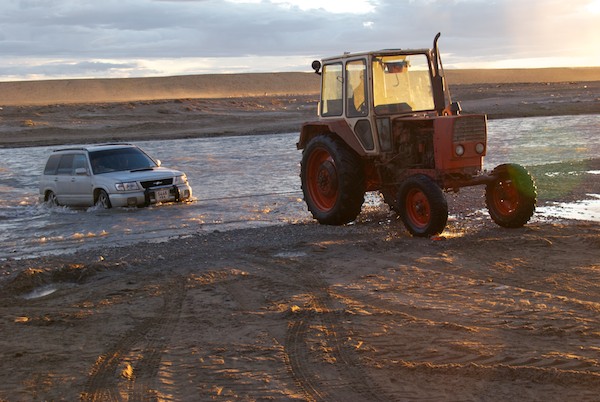
Through the deepest part.
Piece of cake, right?
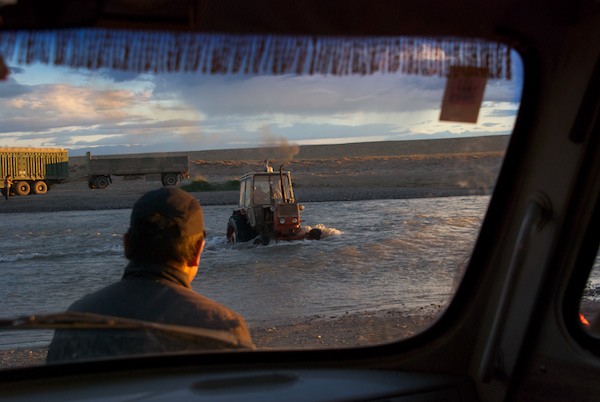
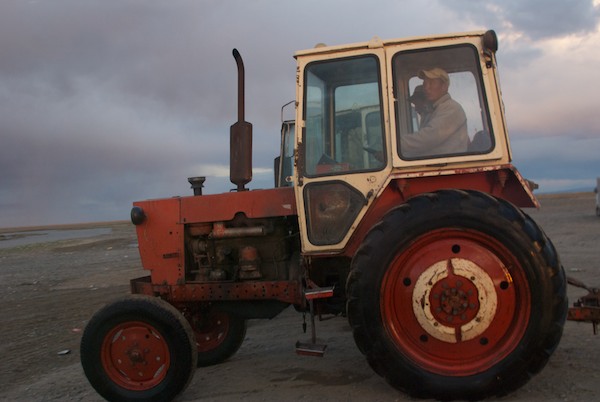
Now it was our turn. Here's comes "our" tractor.
Now it was our turn. Here’s comes “our” tractor.
Last minute directions/instructions. Sharon and I made sure all our gear was up off the floor, just in case.
Here we go.
Here we go.
Mid-stream.
Mid-stream.
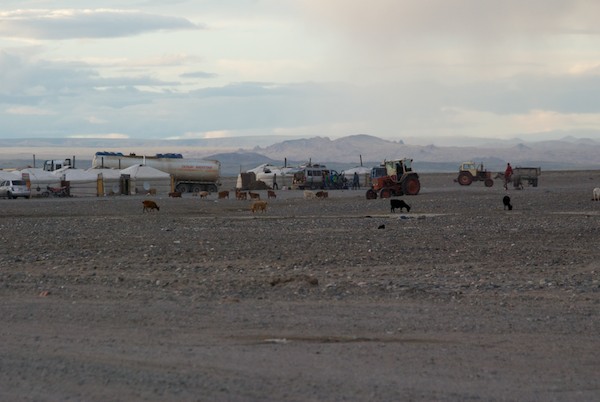
On the other side. Whew.
Our hero.
Our hero.
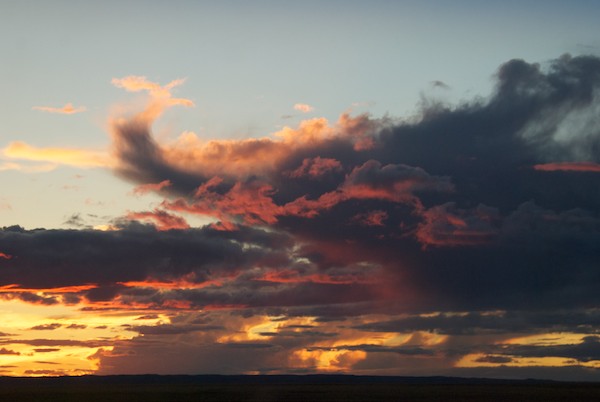
On to the south and east in the setting sun.
On to the south and then east in the setting sun.
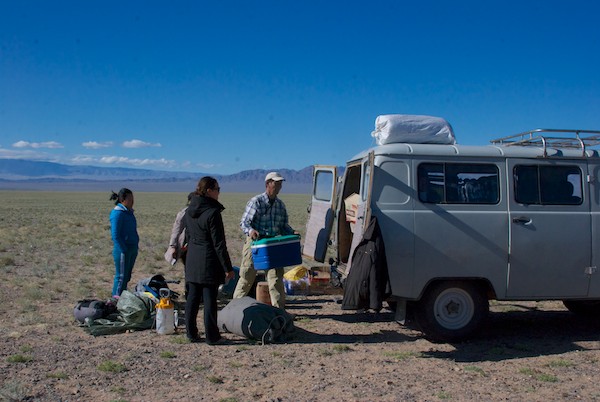
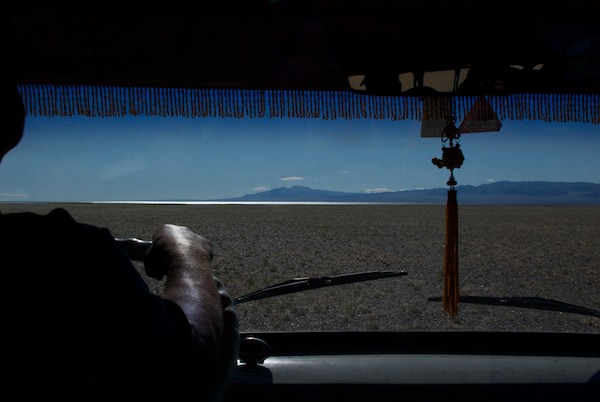
We drove on east, hoping to get back the lake, but finally gave it up and set up camp in the dark with a stiff wind blowing. Here we are the next morning.
We drove on and on, hoping to get back to the lake, but finally gave it up and set up camp in the dark with a stiff cold wind blowing. Here we are the next morning. Not too bad for just picking a spot at random. That is part of the Gobi Altai Mountain range to the south of us.
Catching up on my journal. Did I say it had been windy?
Packing up.
Packing up. The pump sprayer was for both washing our hands and, with an enclosure set up around it, our shower. It worked great and one could get hair and body washed with only a half liter of water, important now that we were going to be traveling through countryside where places to get water were at least a day apart.
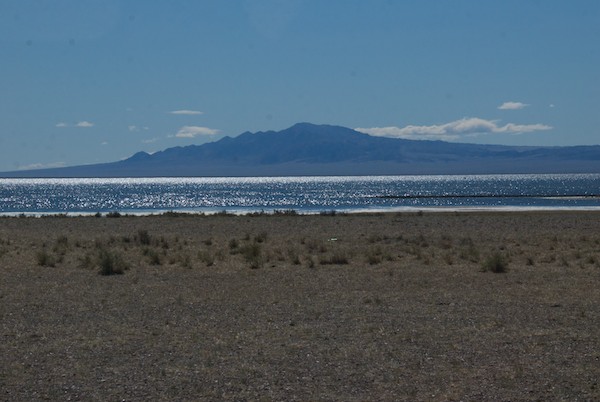
At last! Boon Tsagaan Nuur!
A last stop so that our drivers could consult with local herders.
A final stop so that our drivers could consult with local herders. Solar panels and satellite dishes are very common sights now at herder’s gers, along with motorbikes, mobile phones and small flat panel tvs. But this is still a tough environment to live in and only the knowledgeable and smart thrive.
We drove along the north side of the lake back to the east end, where the birds would be.
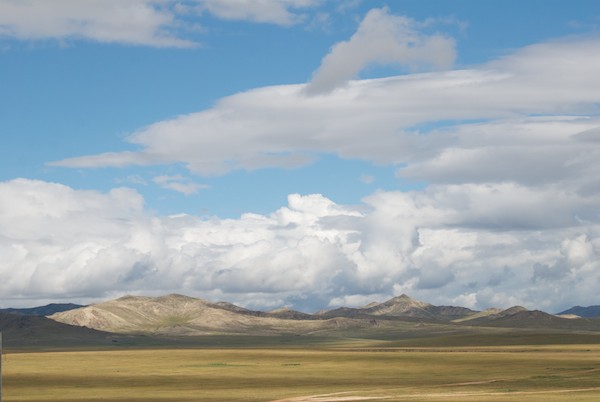
The classic landscape of Mongolia....
The classic landscape of Mongolia….
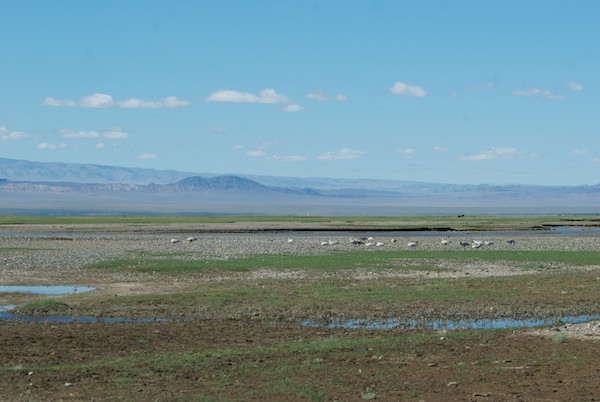
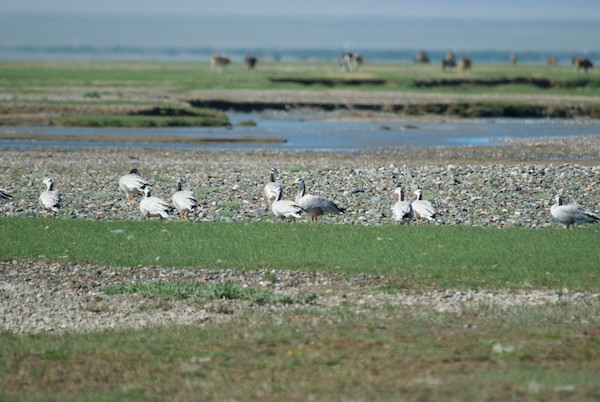
We hadn't even gotten to the lake yet, having come to a series of two streams we needed to cross when we spotted bar-headed geese!
We hadn’t even gotten to the lake yet, having come to a series of interlaced streams we needed to cross, when we spotted bar-headed geese!
We hadn't even gotten to the lake yet, having come to a series of two streams we needed to cross when we spotted bar-headed geese!
This species is famous for its ability to migrate from Central Asia to India. Over the Himalayas. At close to 30,000 ft. Which is the height an airliner can fly. Got some great photos from which there will be paintings.
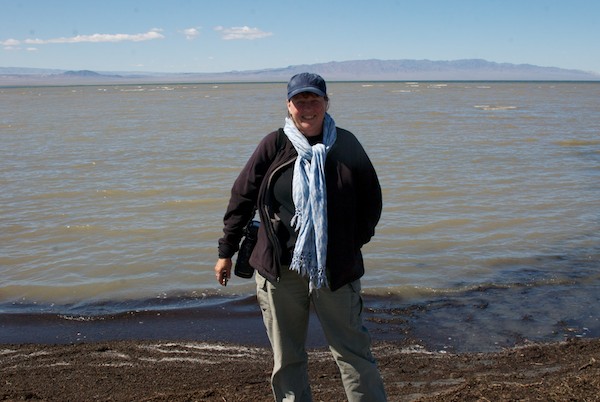
At last we reached the lakeshore.
One more river to cross. Our van stalled out in the middle, but Batmaa got it started again and we made it across.
Our cook, Soyoloo, and guide, Tseegii, walking down to the lake.
We had only meant to stop this close to the lake for lunch, but decided to camp overnight.
We had only meant to stop this close to the lake for lunch, but decided to camp overnight. The mosquitos weren’t bad at all, just annoying for a relatively short time.
The "I was here" photo. And was I ever glad to be.
The “I was here” photo. And was I ever glad to be. You’ll find out why in the next installment.


Studies From An Exhibition

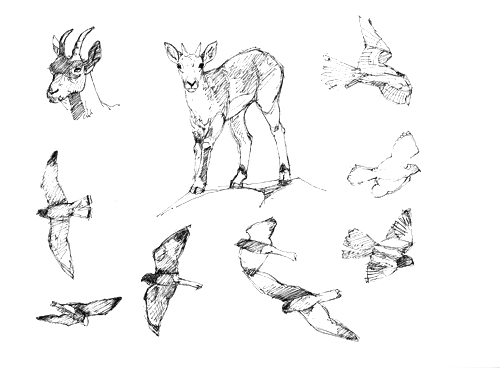
Siberian ibex, Annigoni toned paper, Sakura Micron pen and white gouache
Siberian ibex, Ikh Nartiin Chuluu- Annigoni toned paper, Sakura Micron pen and white gouache

During my week-long solo exhibition at the National Museum of Mongolia in August, I was there every afternoon except one. While there was a constant stream of people, over 100 each afternoon (I kept a tally), I was still “stuck” sitting there. So I took my MacBook Air, which is my primary image storage when I’m traveling, a sketchbook, a Sakura Micron pen and some pencils and, working from some of the photos, sketched and drew when I wasn’t chatting with visitors. It also gave them a chance to see an artist at work and many were quite interested.

So here’s a selection from that week, some of which, like the one of the baby marmots below, are intended as preliminary explorations for future paintings. Some are from previous trips, but the images haven’t yet been deleted from iPhoto.

Baby Siberian marmot,s Hustai National Park, August 2013
Baby Siberian marmots, Hustai National Park, 2013
Siberian ibex and lesser kestrels
Siberian ibex and lesser kestrels, Ikh Nartiin Chuluu, 2012
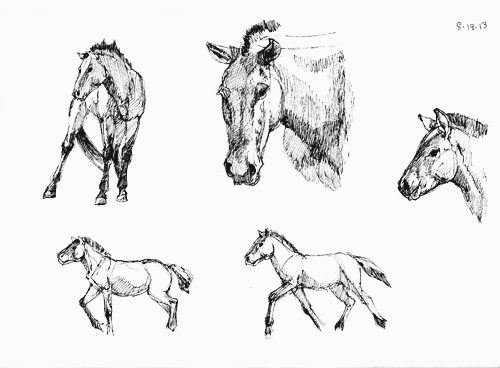
Takhi, Hustai National Park
Takhi, Hustai National Park, 2013
Argali ram, Ikh Nartiin Chuluu Nature Reserve
Argali ram, Ikh Nartiin Chuluu Nature Reserve,2010- graphite
Ox and Mongol horse, Jalman Meadows, Han Hentii Mountains
Ox and Mongol horse, Jalman Meadows, Han Hentii Mountains, 2012- graphite

Saiga Antelope Sketches

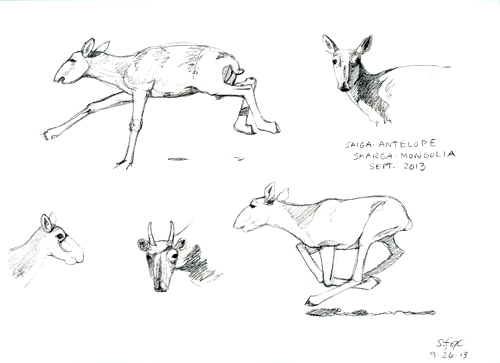
Saiga-4I did these two pages of saiga sketches last night while I was watching the Giants beat the Dodgers. One thing we were all struck with when watching them run was the strange body posture (which reminded me, for some reason, of a funny car drag racer) and very odd leg positions. I got a start with understanding how they run it that sequence at the top of the page.

It’s the same animal in the lower two sketches, but with a different head position. Kinda cute on the left and pretty alien-strange on the right.

Saiga-5Just working on learning what they look like on the above page. I had thought that we had only seen one male, but taking a close look, it appears we saw three. They have a much bigger “nose”, plus the horns, which the females lack.

Before I do any finished paintings I’ll need better reference for the heads and hooves, but I got so much more than I expected to, I can hardly complain.

I used a Strathmore premium recycled sketchbook and a .01 Sakura Micron pen.

Ch-ch-changes (And My First Animal Studies From The WildArt Mongolia Expedition)

Saiga antelope, Sharga, Mongolia, Sept. 2013

My eighth trip to Mongolia this year was the busiest ever. Not only did I have the WildArt Mongolia Expedition, but also the solo exhibition of my paintings at the National Museum of Mongolia. Before, after and in and around those was my yearly trip to Ikh Nart to meet with the women’s felt craft collective and visit the reserve, a quick weekend trip to Hustai, lunches and dinners with friends and, to top it off, gaining gallery representation at Mazaalai Art Gallery in Ulaanbaatar.

So not only do I have the WildArt Mongolia Expedition group exhibition next June or July to prepare for, but also the juried shows that I enter and creating new work for my gallery. All to say that after today, I will be doing one main post a week, not two, with the intention of posting every Wednesday. In between I’ll be doing shorter informal posts as interesting things come up.

I finally got back into the studio today after resting and catching up last week. Jet lag wasn’t bad, but I was tired, not surprisingly, since I’ve been going non-stop since June. Physically, I’m fine. Three plus weeks of remote travel on the earth roads of south-western Mongolia didn’t bother me at all. What seems to wear me down by the end of a trip is what I’ve come to think of as “decision fatigue”. Staying in Ulaanbaatar and traveling the way that I do in Mongolia is, in some ways, one long stretch of decisions,particularly since I’m often working and traveling with people from a different culture -the Mongols- and trying to function appropriately and correctly within that culture as much as possible. I reach a point where I need to park my brain in neutral for awhile. The prospect of 10-11 hours on a plane coming home becomes quite appealing. The only decision is which entree to have for dinner. Otherwise, I can mentally just flake out. Getting back into the home routine is nice, too, since the decision requirements are minimal.

My first task when I get home (besides unpacking and laundry), because I can’t really start to relax until I do, is to download all my photos (over 8300 this time) into Aperture on a local vault (Apple-speak for an external hard drive) and then back them up to a separate hard drive (a remote vault) that is kept in a different building, our detached garage. After that they need to be categorized, which usually takes a couple of days. Then I can really see what I’ve got.

And what I’ve got that I honestly didn’t expect to get was useable, paintable reference of the critically endangered Mongolian saiga antelope. They are all from quite a distance (see photo at top) and I will need to do research and call on the people I met in Darvi soum who protect them to help ensure that what I’m doing is accurate, but I got some great action shots of both males and females and some closer-in standing shots. I’ve done three pages of first studies to get a feel for what a saiga looks like. They are done on Strathmore vellum bristol with a Wolff’s 4B carbon pencil.

Saiga studies 1
Saiga studies 1
Saiga studies 2
Saiga studies 2
Saiga studies 3
Saiga studies 3

Mongolia Monday- My Cashmere Goat Drawing In Switzerland

Cashmere goat,  graphite on vellum bristol
Cashmere goat, graphite on vellum bristol

Back in January, I received an email query from a graphic designer in Switzerland. She had come across the above drawing that I had done of a Mongolian cashmere goat while doing a Google Image search and wondered if I would allow my “stunning sketch” to be used for hang tags on cashmere products that are to be sold in Switzerland’s largest department store. We quickly negotiated a rights and usage fee and I sent her an image to her specifications.

But I’ve learned how this kind of thing can go after working for fifteen years as a freelance graphic designer back in the 1970s and 1980s, so I haven’t announced it even though it’s pretty exciting. My fee was deposited in my Paypal account day before yesterday, so here is the design mockup that was emailed to me showing how my drawing will be used.

My drawing of a Mongolian cashmere goat on the proposed hangtag

Of course I have no idea where the cashmere they are using originates, although the odds are that it is Mongolia, which produces the world’s highest quality, but no matter where it came from, a Mongol goat will be used to help sell it.

People do ask if artists ever sell anything off the internet and I have sold originals that way. But this is another aspect….designers looking to license images for specific uses. Fortunately my commercial illustration training and background gave me the knowledge I needed to professionally negotiate an arrangement that served both our needs. I got a nice fee for a single use of a drawing that I had already done and they got an image that serves their client. Without the internet there’s no way they would ever have found it or me.

Getting Ready For The Big Cat Quick Draw On Sept. 17- Cheetah Studies!

I’ve been invited to participate in a very special event on September 17, The Big Cat Quick Draw, which will be held at the Bedford Gallery in Walnut Creek, California from 2-5pm. I’ll be one of nine artists painting and drawing from a live cheetah, Tango, from Sierra Big Cat Haven. We’ll have between 60 and 90 minutes to create our piece of original art.

Once we’re done, our work will be auctioned off to raise money for Project Survival’s Cheetah Education Center at the Soysambu Conservancy in Kenya.

If you’re in the area, you’re invited! More information here.

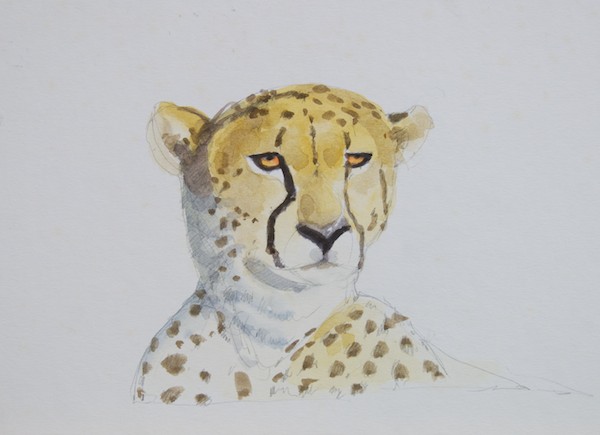
To get ready for this event, I needed to brush up on cheetahs and decide what media I think I will want to use. So I got out my pencils, watercolors and some different art papers yesterday and did some quick studies. My reference was photos I took of cheetahs in the Masai Mara, Kenya, in October 2004, when I was one of ten artists who went on a 16 day art workshop/safari with internationally known wildlife life artist, the late Simon Combes, the father of Guy Combes, who is one of the organizers of the quick draw.

First was a pencil drawing on illustration board with watercolor
Watercolor on Arches cold press paper
How fast can I do all those spots? Watercolor and pencil on paper I brought back many years ago from England, an unknown brand of very nice cold press
Graphite studies on vellum bristol

Mongolia Monday: New Drawings For Upcoming Paintings

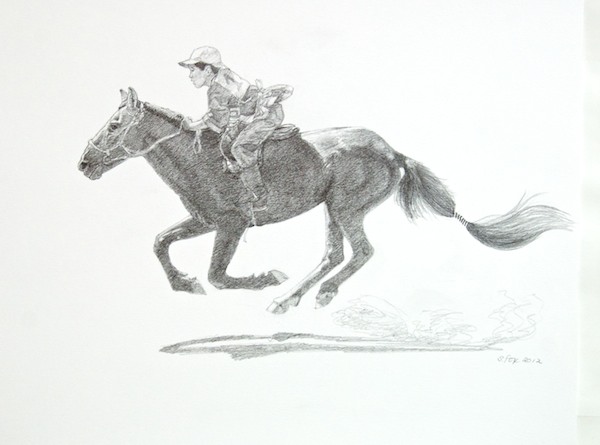
Winning horse and rider 14×17″ graphite on vellum bristol

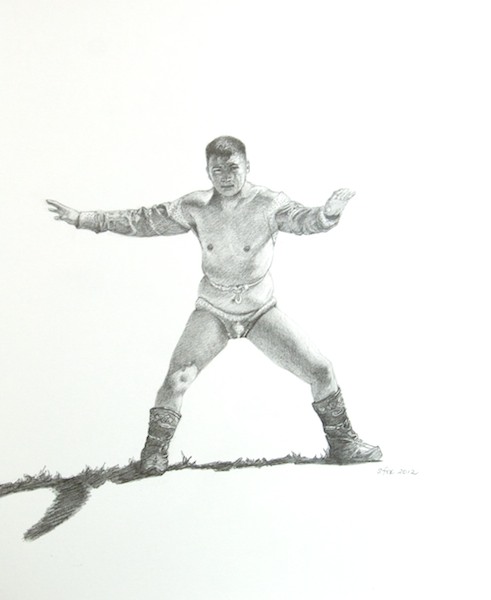
Particularly when it’s a subject I haven’t painted before or one that is somewhat complex, like a horse and rider, I’m more and more inclined to do finished drawings before I start the painting. It’s a good way to find out if the reference image “draws well”,  sort out parts that turn out to be tricky to understand, work out the essential value relationships and just get a general feel for the subject. The more problems I solve while doing the drawing, the more I can concentrate on the painting part. It allows me to simplify and refine the shapes since I will have drawn everything at least twice. Drawing is really the best way there is to learn what something looks like because the information is stored physically and mentally. Just looking at a photo or, worse, photoshopping and tracing a composition, doesn’t even come close.

So here are four drawings I’ve done over the past few days, all graphite on vellum bristol paper. They took four to six hours each. The reference photos all happen to be from the local naadam I attended when I was at Arburd Sands ger camp in August.

Local Naadam wrestler
Wrestler doing the devekh (Eagle Dance) before a bout
Cashmere goat