Mongolia Monday- Poetry Special, Part 1

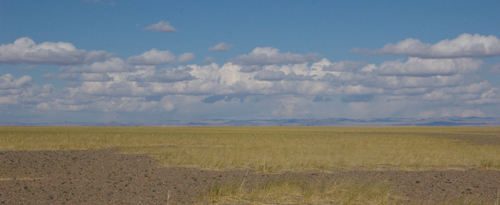
The Steppe, western Mongolia

As promised on Friday, here is Simon Wickham-Smith’s essay-by-request on Mongolian literature. Following are three examples of Mongolian poetry, accompanied by images that I have photographed in Mongolia. Next Monday in Part 2, Simon will talk about how he came to be involved in things Mongolian and some of the challenges that await the translator. I have sent a email to the Mongolian Academy of Poetry and Culture about importing and making available at least two of the books. When I have news, I’ll post it here. So, without further ado:

MONGOLIAN LITERATURE IN TODAY’S MONGOLIA

As with any literature, Mongolian literature is special simply because it is the expression of a society’s experience, values, tradition and culture.  That Mongolia is, as a society, almost totally unknown in the western world, makes their literature even more valuable to us, in that it opens to us a new way of understanding the world.

Over the past century, Mongolia has gone from an almost completely nomadic and herding society, through a period of Soviet-inspired communism, into a contemporary experience in which free-market capitalism dwells at peace within a traditional nomadic culture shaped by a renewed interest in Buddhism and Shamanism.

So this is a true melting-pot, then, full of diverse influences, full of individuals feeling themselves pulled in a number of very different directions at the same time.  And when we look at the literature, we find a similarly vibrant and confused picture.

During the communist period (1924-1990) , of course, writers were strongly discouraged from addressing religious or spiritual topics.  But Mongolians had at their disposal their shamanic tradition of animism, and so writers created a literature which celebrated the land, and which honored the ancestors in the form of the grasses and the hills and the trees.

As for the Buddha – for Vajrayana Buddhism had spread from Tibet to Mongolia during the latter half of the sixteenth century – writers used the word for the sky (tenger), which had traditionally also meant “god,” which in itself meant once more that religion could be discussed by means of the natural world.

Altar in main temple, Museum of the Chojin Lama, Ulaanbaatar

It is interesting to see how the ideas of Buddhism are beginning to come back into the literature.  Young poets such as T Erdenetsogt and Ts Bavuudorj are writing explicitly spiritual works, the former even incorporating Tibetan prayers into his poetry.  Older writers, such as G Mend-Ooyo and D Urianhai, coming from a period of samizdat literature and religious secrecy, approach the subject more indirectly.
Religious writing and writing about the natural world notwithstanding, Mongolian literature has a strong tradition of love poems.  Indeed, the most famous poet of the nineteenth century, the monk Danzanravjaa (1803-1856), combined the three themes of religion, sex and vodka, to create a powerful body of work which even today is still highly influential.

The tradition of love poetry is generally a celebration of young women and their somewhat intangible and transcendent beauty.  The erotic is very subtle, however, and is generally approached from a very oblique viewpoint.  Indeed, one of the criticisms of the novelist and poet G-A Ayurzana’s (by western standards fairly tame) novel The Illusion is that it has too much sex, and this book appeared only in 2003.

To read Mongolian literature, then, is to enter into a world which is similar to ours in very many ways, but whose cultural expression is framed by the cycle of the seasons, by landscape and weather, by gods and Buddhas, by theocracy and by seventy years of political despotism.

And now, three poems:

Horses, Arburd Sands

The story of my people soar with horses,
With wings they reach the golden sun.
The wind riffs through their untrimmed manes,
And, down the skyroad of Khormast,
They return to the lakes like migrating birds,
According to the customs of the golden earth.
The poems of the elders soar with horses,
With wings they reach the vibrant stars.
From the herds of letters formed within the mouth,
We have taken these migrating steeds.
And, from the hitching posts of our poets’ horses,
We have taken off for distant roads.
My horse, fly high, oh my horse.
Fly high, into the worlds of my desire.
From our wise elders’ heights of brilliance,
I offer my song to the spacious earth.
My horse, fly high, oh my horse,
Fly high, into the worlds of my desire.

T. Ochirkhuu (1943-2001)

Proud grandmother, Arburd Sands

ANCIENT SPLENDOR

Indeed,
The ancient splendor
of this land of Mongolia
It has brought us all to birth
In the lineage of Chinggis Khaan

Indeed,
With our destiny like the sky
With our mind in five dimensions
With our peaceful and broadminded decrees
Yes, this is the way of the Sons of Heaven

Yes, it is like moonlight
Among the stars
It is like an ornamented beacon
Among many people

Yes, like high radiation
From the peak of Mount Sumeru
Spreading its glare
May the protective spirit remain firm

Yes, through our savior Chingghis Khaan
We have become the rulers of all Mongolia
Before the banner of the Khaan
May we all bow down in joy

Historians argue that Ancient Splendor, a folk long song sung still widely in today’s Mongolia, was the anthem of the Great Mongol State
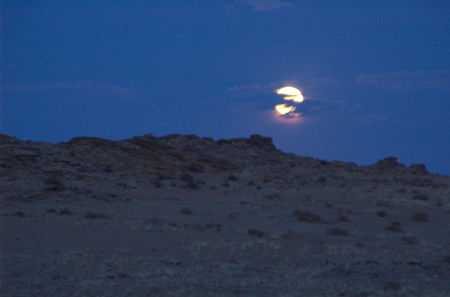
Moonrise, Ikh Nartiin Chuluu

THE HORSES NEIGH AT NIGHT UPON THE STEPPE

The brown steppe is like an ancient story,
There is no sound to be heard.
A traveller, wearied by the distant road,
Spends the night upon the steppe.

In the deep darkness, the objects of the sky
Stretch out white, like a mare’s tethering line,
He feels the nature of the peaceful steppe,
He watches the stars, as though the horse was missing.

The brown steppe is like an ancient story,
There is now sound to be heard.
Like what we sense among the stars,
The horses neigh at night upon the steppe.

D. Nyamaa (1939-)

Something Really Special for Mongolia Monday

When I was in UB, I found and purchased some anthologies of Mongolian poetry translated by one Simon Wickham-Smith. I googled his name and, lo and behold, there was a link to his Facebook page. So I wrote him a short note asking for permission to use some of the poems in my blog and to “be his friend”. Within a couple of hours I got an email back saying “Yes” to both.

I think it would be an understatement to say that Mongolian literature is not well-known in the West and yet I found the poetry that I have read beautiful, evocative and filled with compelling word images about the land and people. I’m hoping to be able to import the books and offer them for sale, but those arrangements have still to be worked out. in the meantime, Simon, at my request, has written two short essays; one on Mongolian literature and one on the story of his involvement in things Mongolian. The first essay will appear this coming Monday and the second on the following.

For more about Simon, visit his website at www.wickhamsmith.net or you can write to him at wickhamsmith@gmx.net

Here is the poem which prompted all this, which I wanted to use for the “bug” post:

Turkic gravestones near Hustai National Park

IN THE WILDS OF AUTUMN by B. Renchin (1905-1977)

Tiring the eyes, the wild steppe ripples
Yellowish and soundless.
Grasshoppers, the world’s voice, keep silent.
In the sky above only the storks are calling.
From the withered, yellow sphere of the sky,
Comes a lively and intriguing scent.
From the foreheads of the stone men in the cemeteries,
The hoarfrost melts into pearls of sweat.

New Painting, New Brushes, New Paint Colors!

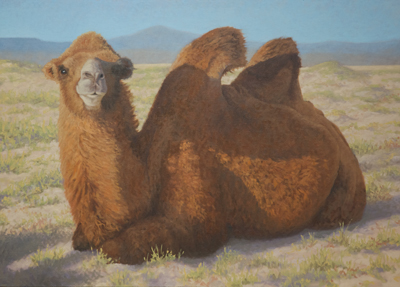
One among many of the great things about our visit to Arburd Sands ger camp in Mongolia was the herd of domestic bactrian camels that lived at the camp. They tended to wander off during the day, but were around in the mornings and late afternoons when the light was at its best (how did they know?) I had fun sketching them and here is my first painting of one.

Bactrian Camel, Arburd Sands, Mongolia

I really enjoyed trying to get the feel of the wooly coat and painting the pattern of light and shadow.

I’m always looking for ways to live more sustainably and responsibly. More and more it involves conscious choices, which means remembering to think about what one is buying or whether or not to buy at all. There is no way to live on the planet without using resources and, currently, the deck is stacked in favor of certain ways of doing things. But it’s been changing and I’ll bet the rate of change is going to increase Real Soon Now.

And, as anyone who has read this blog for awhile knows, I’m very interested in animal welfare issues.

With that in mind, I needed to get some new brushes. I’ve been using Silver Brush Limited Grand Prix Bristles for quite a few years now. Generally speaking, real hog bristle brushes for oil painting are the superior choice. Then I got one of my regular promotional emails from Jerry’s Artarama, who I have ordered art supplies from for twenty years. They were having a sale on Silver Brush brushes and this caught my eye: “How can you save the life of animals and actually help yourself at the same time?”

On offer was a synthetic brush Silver Brush calls “Silverwhite”. And that got me thinking about the use of animal products. I have no idea where the hog bristles in my current brushes come from. Probably China. What kind of conditions are the pigs kept in? No clue. My husband and I already don’t eat meat that we can’t source to a humane producer. What about something like painting brushes?

So, I ordered the synthetics and used a couple for the first time today and I like them a lot. I plan to switch to them. But then the question becomes “What are the Silverwhites made from?” Some kind of petroleum-based material most likely. Sigh. See what I mean? Choices. Synthetic brushes have been around for years, but I’ve never seen them marketed as “animal friendly” and had never thought of it that way before. The idea is kind of “buzzy” in that, assuming the bristles come from hogs raised for meat, it’s not clear how not buying brushes made from their bristles “saves” their lives, but, as I said, I did find it thought provoking.

I’m not going to get doctrinaire about it, but at this point I’m choosing the synthetic. Thoughts, anyone?

On the color front, I want to start pushing more toward a colorist approach. Camille Przewodek is a great contemporary example. She pushes color waaay out there. I looked at the supply list for her workshops (hope to take one sometime when I have the money) and decided to buy these, for me, exciting new colors: Permanent Green Light, Permanent Magenta and Manganese Bue Hue, all Winsor-Newton. Experimentation begins next week.

ART THOUGHTS FOR THE DAY

Everyone has talent at 25. The difficulty is to have it at 50.
Edgar Degas

Every good painter paints who he is.
Jackson Pollock

I realized that all the good ideas I’d ever had came to me while milking a cow. So I went back to Iowa.
Grant Wood

Bill Maher: “America can reboot.”

One of my favorite quotes from the whole election cycle tonight on Larry KIng when Maher was asked what the election meant for the country.

I’m thrilled that Obama won and so pleased and impressed by John McCain’s concession speech.That’s the McCain this life-long Democrat always respected.

We Did It.

And now the work begins.

Exercise your right to VOTE!

I’ve been fortunate enough to travel to quite a few different countries. I’ve read a lot of history. And I can tell you with utter certainty that Americans are some of the luckiest people in the world and in history. Don’t take for granted your right to vote.

Eighteen year olds got the right to vote when I was in high school. I spent part of my senior year earning twenty-five cents for every person I registered (it was 1972; I’ll save you the trouble- I’ll be 54 one month from tomorrow). I have never missed an election, except for a couple of times when I was new to an area and couldn’t vote knowledgeably. So I can complain all I want.

I believe that tomorrow’s election will decide the future of our country for the next generation and, yes, I’m voting for the young black guy with the funny ears. But whether you agree with me or not- VOTE!

Before we are liberals or conservatives; before we are Americans; before we are men or women; we are fellow human beings living our unique lives on this big, beautiful blue planet. Whatever the outcome, let’s find common ground where we can work together “with malice towards none and charity for all”.

Mongolia Monday- Bizarre to Beautiful “Bugs”

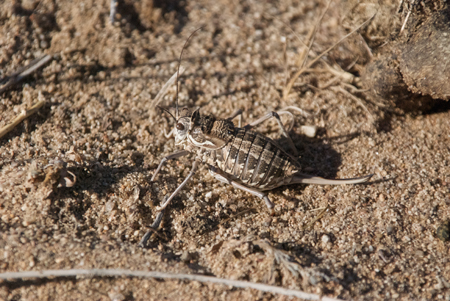
I probably should have run this post last week before Hallowe’en, but, in any case, here’s a variety of the insects that I’ve seen in Mongolia. Not all that many and I don’t know what the species are. Field guides are kind of thin on the ground for Mongolian wildlife. So if anyone can ID these critters, let me know and I’ll update this post.

The photos were shot on my 2006 and 2008 trips. I used a Nikon D70 with a Tamron 28-300mm lens in 2006 and a Nikon D80 with a Promaster (made by Tamron) 28-300 in 2008.

Saw this one in the Gobi. It was big- close to 3″ long.

Saw this one at Ikh Nartiin Chuluu Nature Reserve. There were specimens at the Natural History Museum in UB but, unfortunately, the labels were all in cyrillic Mongolian, which I can’t read. Yet. They are related to grasshoppers, but aren’t. That much I was able to find out.

Grasshopper at the ger camp, Hustai National Park

Another grasshopper photographed at Hustai.

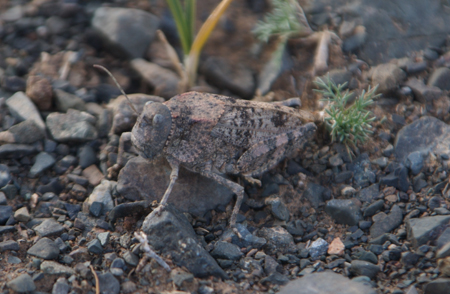
Large, almost 3″ grasshopper photographed near Dungenee Ger Camp, Gobi Desert.

Photographed same location as above. This one really matched the rocks.

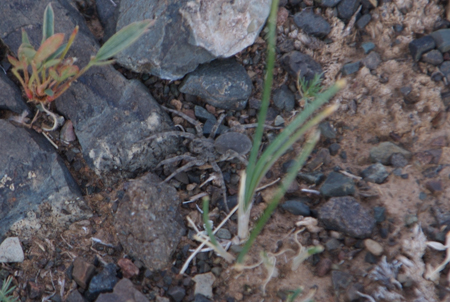
Only spider I’ve seen in three trips to Mongolia. Photographed same time as the two grasshoppers above.

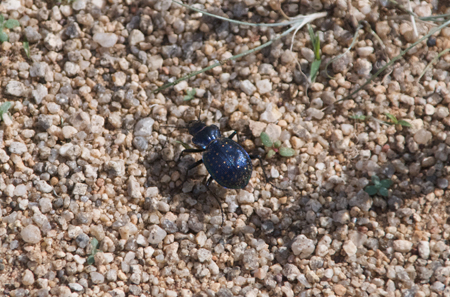
Beetle at Ikh Nart. The challenge was waiting until it scurried out into the sun so I could catch the deep blue color.

This was really one of the most dramatic wildlife spectacles I’ve seen in Mongolia. The beetle had pounced on the brownish insect and the battle was on, with the latter trying to escape from the former. The beetle inexorably manuevered the brown one around for what we thought was the death grip in which they were head to head. Then, suddenly, the brown one broke free and got away. It went on for minutes. I took quite a few pictures, but this one seemed to show the situation with the most clarity.

Ikh Nart butterflies.

Good Advice for Wildlife Artists

Personally, I have found that learning from good teachers is a great time-saver. What could take years of trial and error can maybe be addressed in an hour and then you get to move on to the next challenge.

In that spirit of benefiting from those who have gone before, here’s some thoughts about the making of wildlife art that I find worthwhile, illustrated with a few of the reference photos I’ve shot through the years.

KEN CARLSON:

“One of the challenges of painting a number of animals, particularly pronghorns, is to design an interesting grouping. What I try to achieve is an appealing overall shape; an uncontrived, natural look to the grouping…”

National Bison Reserve pronghorns; this one has possibilities
National Bison Reserve pronghorns; this has possibilities, but the "grouping" needs a lot of work

BOB KUHN:

“…the need to convey those gestures, poses and attitudes that spell out the character unique to the animal.”

Lake Nakuru cape buffalo; typical "I dare you"
Lake Nakuru cape buffalo; typical "I dare you". The painting I used this reference for will be on my website by the end of November

GUY COHOLEACH:

“You look into the eyes of a leopard in a zoo, and sure, you can get a lot out of them. But look into the eyes of a lion 30 feet away from you, when you’re standing right in front of him with no rifle, and let me tell you, they look a lot different. They do.”

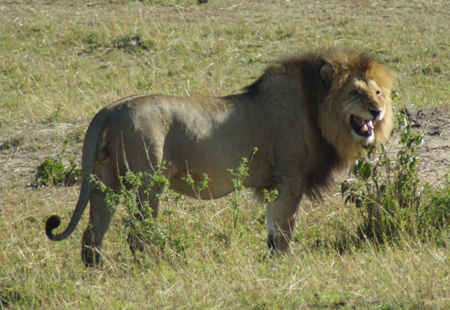
Masai Mara lion; I was in a car, but still...
Masai Mara lion; I was in a car, but still...(Actually, he's flamen. There was a more dominant lion nearby who was with a lioness.)

NICHOLAS HAMMOND author of Modern Wildlife Painting:

“The best of modern wildlife painters show us the mystery and death, memory and beauty and what is to be learned, or lamented, loved or wept for.”

And it helps to have an assistant

Happy Hallowe’en!

And Samhain, too!
And Samhain, too!

Mongolia Monday- Planes, Trains and….Camel Carts!

One of the most rewarding parts of travel is finding out how many ways there are to address the everyday challenges of life which are perfectly valid, but really, really different from how one does things at home. If the traveler is open to new experiences with an attitude of neutral curiosity, he or she might find that “difference”, in and of itself, is not threatening. Pity the impervious person who spends fair sums of money and time to travel and comes home utterly unaffected and unchanged. What an opportunity for the enrichment of one’s life wasted.

Mongolia is such a great place to get out of one’s own bubble. Customs and practices that haven’t changed in 1000 years exist happily alongside 20th/21st century technology. So, the country family holds its annual foal branding and a city relative records the occasion with her cell phone camera. Perfect.

(I would also like to note here that I have zero tolerance for those who want to deny more traditional cultures modern equipment, technology or goods because it will somehow “spoil” them. Selfish, romantic nonsense. The thought that a people like the Mongols could somehow be “spoiled” by integrating the modern world into their lives is ridiculous, IMHO. Lack of western technology does not equal stupid. Grant people the right to make up their own minds and choose what makes sense to them.)

Which brings us to today’s theme- how to get around, round, round in Mongolia. We will proceed from western high-tech to (for westerners) the picturesque.

Chinggis Khan International Airport, Ulaanbaatar
Train between Ulaanbaatar and Choir
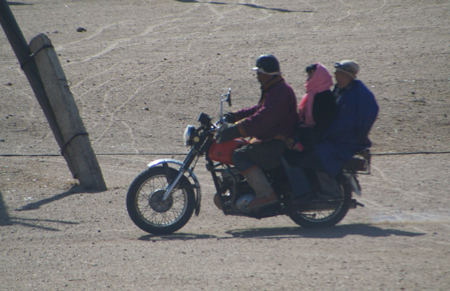
Motorcycle, western Mongolia

Love the seat cover!

A ride home from the train station
Truck with handcrank starter, Hovd, western Mongolia

The Mongolians might be the greatest mechanics in the world. Travel stories by writers who have gone there are filled with accounts of impossible repairs in the middle of nowhere. Lack of money, parts, towing services (Ha!) and the need to find a way has bred an amazing level of ingenuity, which I have personally experienced with awe and respect. But those are stories for future posts.

the fabulous Russian Fergon van

You travel in these to ensure you get there, not because they’re comfortable. Four gear shift levers and counting.

Tractor with hay, Hovd, western Mongolia
Tractor with hay, Hovd
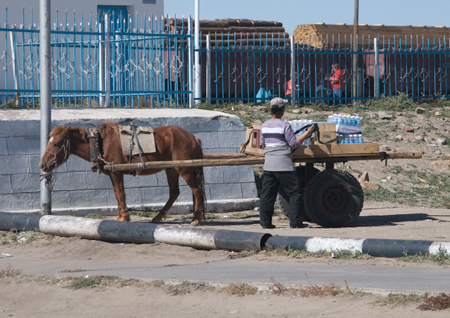
Horse cart with bottled water, Choir
Donkey carts, Hovd
Donkey carts, Hovd
Camel cart, between Ulaanbaatar and Choir
Rubber boat, Khar Us Nur National Park, western Mongolia
Rubber boat, Khar Us Nuur National Park, western Mongolia

My guide had talked about “the boat” (!?) when we were leaving Hovd for Khomiin Tal. Our last night out I found out what he was talking about. He’d purchased this inflatable boat when he was in Germany and this was his first chance to try it out.

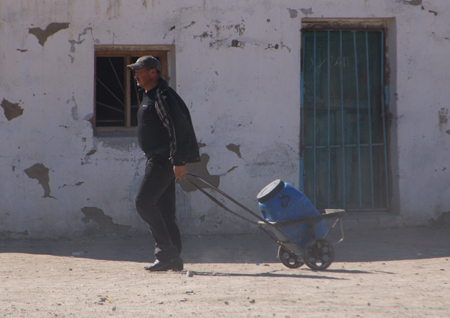
Hauling water in Hovd

There doesn’t seem to be much in the way of running water in the towns I’ve been in, so one sees it being hauled in these carts. It makes you think about your use of water and be more mindful of what it took to provide it.

Moving bricks to the kiln, western Mongolia
Home from shopping, Hovd

Lots of people have to walk to where they need to go, but, of course, the quintessential way to get around in Mongolia has always been on horseback.

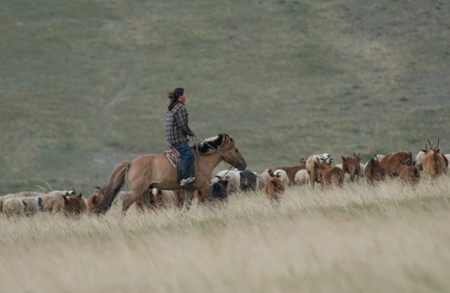
Herding goats near Hustai National Park

I like this picture because you can really see how she is riding standing up in the saddle. The stirrups are tied together under the belly of the horse to keep them in place. Ah, THAT’S the secret.

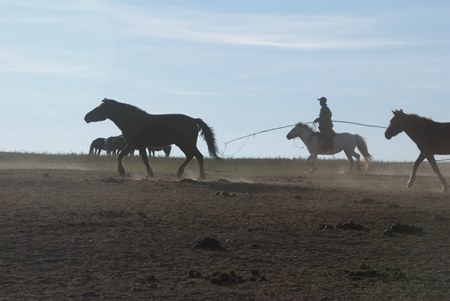
Choidog at the foal branding, Arburd Sands
Timeless
Timeless

Dog Day Friday

Niki, our collie
Niki, our collie

Because…

1. I just finished balancing my checkbooks. Ugh. But life has gotten better since I’ve started using Quicken. I highly recommend it to anyone who battles the balancing of the checkbook every month and sometimes loses. Since I have three accounts (plus the credit card)- business, personal and  “not-my-money” (for stashing sales tax, etc.), I have found an infinite number of ways to procrastinate. I was one of those math-challenged girls who was passed along in school. Even today, the mention of those “word problems” will start my stomach churning.

My husband has been a trooper through the years bailing me out and getting things balanced when they’re so tangled up I’m ready to scream. But supposedly, at least most of the time, I am an Adult, who really ought to be able to deal with this, right? Well, once I finally forced myself to sit down with him and Just Do It, and now that I’ve gotten the hang of it, it really is nifty and easy.

(Why is math such a problem for me? It took years, but I finally figured it out. It turns out that I always did great in subjects where I could literally “see it”, as in create a visual image. So, English, history, biology, no problemo. Math? Couldn’t process the information visually, so I was sunk. Same problem with inorganic chemistry. Knowing that now, it’s how I memorize numbers. I really do see the actual numbers in my mind’s eye. The anxiety with regard to the word problems came from my attempts to “make pictures” and run them like a little movie and when I couldn’t, the stress took over. )

So, yo, artists who want to make a living- you’ve got to get a handle on the money part somehow. Quicken is how. The reconciliation part is like MAGIC.

2. Sometimes I take photos that just holler “PAINT ME!” Usually it’s wild animals, but not always. We were at a state park when I spotted this chocolate lab laying by the lake. I loved his expression and the light on his coat, so I thought I’d see what I could do.

Where's the Ball?
Where's the Ball? oil on canvas board 12"x9"

And, I just finished this one yesterday. I love working the structure of animals that don’t have long fur. I shot this Jack Russell terrier at a riding stable in southern California.

What's Next?
What's Next? oil on canvas board 12"x9"

As you can see, I had fun with the background color. There will probably be more of that in the future. Prices available on request.

ART THOUGHT FOR THE DAY

Your time is limited, so don’t waste it living someone else’s life. Don’t be trapped by dogma- which is living with the results of other people’s thinking. Don’t let the noise of other’s opinions drown out your own inner voice. And most important, have the courage to follow your heart and intuition. They somehow already know what you truly want to become. Everything else is secondary.”

Steve Jobs

ON A LIGHTER NOTE

Outside of a dog, a book is man’s best friend. Inside of a dog, it’s too dark to read”.

Groucho Marx