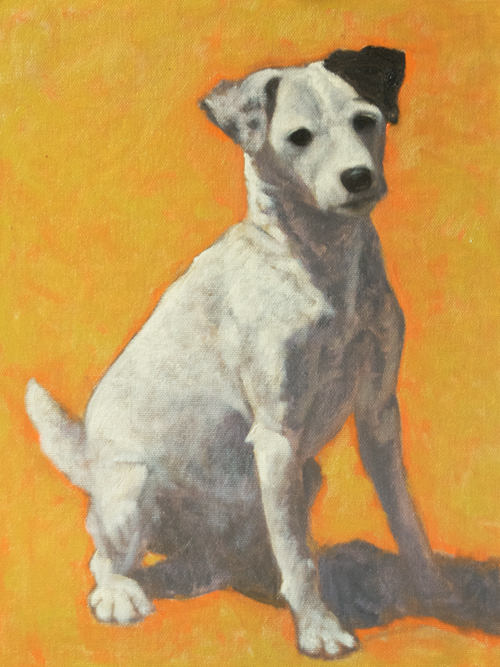
I saw this spunky Jack Russell terrier a couple of years ago at a riding stable in southern California and knew I was going to do a painting of him. Click to bid here
I saw this spunky Jack Russell terrier a couple of years ago at a riding stable in southern California and knew I was going to do a painting of him. Click to bid here
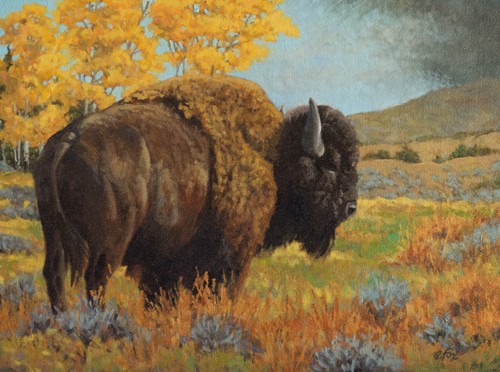
To purchase or for more information, click here
American Artist magazine has a very good blog called the “Artist Daily”. Today’s post is particularly interesting for artists who are wondering if they can sell on their own without a gallery. The answer seems to be “yes”. Check it out here.
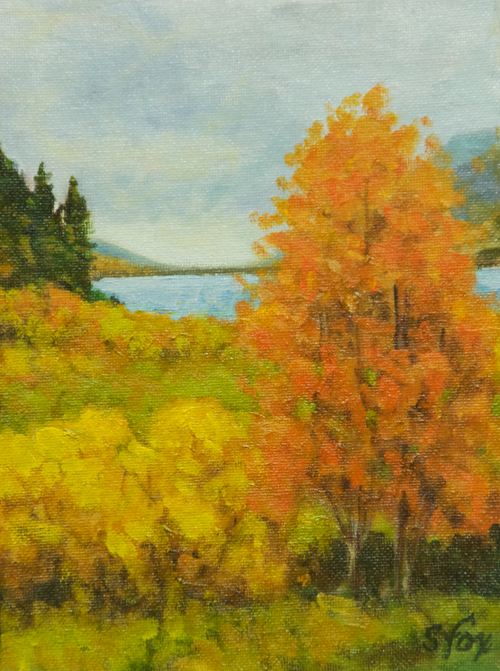
I photographed this simple, but colorful scene on a trip to Grand Tetons National Park.
I received a delightful surprise in the mail a few days ago. My friend and colleague Shawn Gould sent me a sweet little self-published book of some of his recent paintings. I’m writing about this for two reasons. One, because I thought that you would enjoy seeing his work, which is quite different than mine, and two, to look at what he has done from a marketing standpoint.
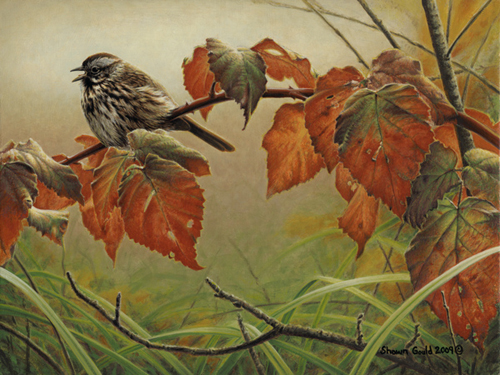
Shawn grew up in Iowa, but now lives about twenty minutes from me in Eureka, California. He started out as an illustrator, creating award-winning work for clients like National Geographic, the Smithsonian and the Audubon Society. For the last ten years, however, he has been creating beautiful paintings like the ones you see here. He’s a Signature Member of the Society of Animal Artists and his work has been accepted into a variety of national juried shows like Birds in Art, Art and the Animal Kingdom and Arts for the Parks.

Now, for the book, “Wild Sanctuaries”. I asked Shawn via email to tell me more about it. He said that “I have a lot of new work that hasn’t been seen by very many people, and the book seemed like a nice format to get it out to a targeted audience for a reasonable price. We sent out 100 books for less than the price of a one page magazine ad.”
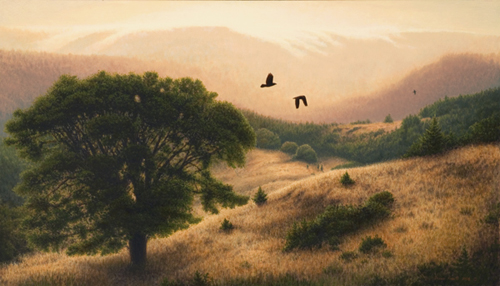
The publisher is a company called Blurb.com, who I had never heard of. I wondered what they were like to work with. “Blurb was great. Kristen (Shawn’s wife) did the layout of the book, and deserves all the credit for how it looks. If like me, you don’t know InDesign very well, blurb does offer software you can download from their site. I don’t think you have as much freedom with the layout, but it’s easier to use and does still look good.
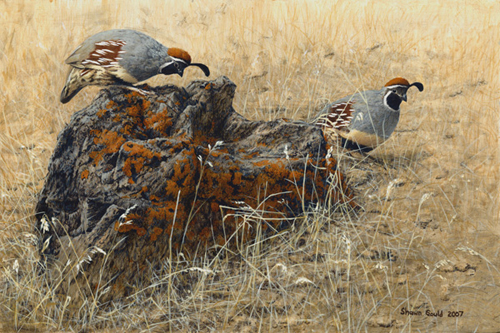
“Wild Sanctuaries” is available through Blurb on a print-on-demand basis, so Shawn hasn’t had to tie up any money in inventory. If you would like your own copy, for yourself or for a gift, it’s $30 plus shipping and handling and can be ordered here
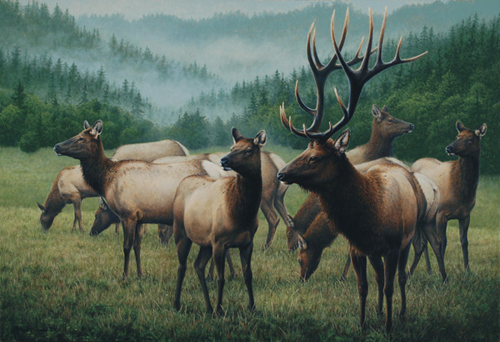
Given the down (down, down) economy, creating and producing “Wild Sanctuaries” took some courage and a leap of faith. But Shawn now has a powerful marketing tool that should prove increasingly valuable as conditions improve. Food for thought.
You can see more of Shawn’s work at www.shawngould.com
SHOW NEWS!
I recently received one of two Janie Walsh Memorial Awards from the Redwood Association for a painting that was in their 51st Annual Fall show. It even included $100 check! Here’s an image from the show. The painting of bighorn sheep, “Heavy Lies the Head” is mine. The show ended yesterday afternoon.

This is the first in an on-going series about one of the many delightful and unexpected discoveries that I’ve made since I’ve started going to Mongolia-
I was channel-surfing one evening when I was staying at the Narantuul Hotel in Ulaanbaatar during my 2006 trip and came across a music video channel. That’s where my introduction to the music scene in Mongolia began. Most of what is available for sale through outlets like Amazon are traditional “folk” music CDs, particularly performances of khoomi (throat-singing) and long song (in which female singers greatly elongate the notes). One could be left with the impression that Mongolian music consists only of these “indigenous” forms. One couldn’t be more wrong.
Great cultural synthesizers that they are, the Mongols seem to have picked up a number of western popular music idioms within five years of the changeover from socialism to parliamentary democracy and capitalism. In rapid succession that evening and on subsequent trips, I watched boy bands, rap groups, rock groups, neo-folk groups and a variety of male and female soloists. I found myself trying to scribble down names in Mongolian cyrillic. The first group that really grabbed me, and it will come as no surprise to anyone who knows the music scene there, was Nomin Talst. This last trip I “discovered” The Lemons, A Sound, A Capella and Pilots. Poking around on YouTube, which has hundreds of Mongol music videos, unearthed superb soloists like Ganaa (who was, and I guess still is, with one of the first successful boy bands, Camerton) and a woman who has an extraordinary voice, Maraljingoo. Here they are in a duet. I’ve never been able to figure out the plot in this one. (Any Mongols reading this want to help me out?)
Here’s a solo video by Maraljingoo:
And one from Ganaa:
Unfortunately, I haven’t been able to find a way to buy any of this music via downloads. I purchased a few CDs when I was in UB in July and a Mongol friend brought back a stack last month from a list that I gave her. Otherwise, I have a 100 song playlist on YouTube and listen to a Mongol Facebook friend’s internet radio station here. His 32,000 song selection really runs the gamut from old-style vocalists to hard rock and everything in between.
I really enjoy listening to Mongol pop music while I work on paintings and drawings with Mongol subject matter!
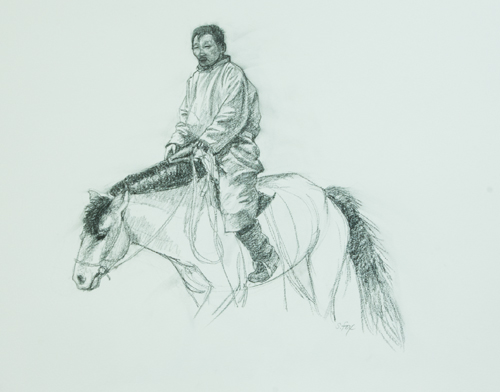
Drawing and painting animals has always come more easily to me than humans. No idea why, that’s just been how it is. But now, I’ve gotten really interested in the Mongol horses and the lives of the herders who breed, train, ride and race them. And I want to paint all of that, so now I really do have to get up to speed with people. These drawings are part of that process. They each took a few hours and I enjoyed doing them a lot.


I haven’t posted any poetry for awhile, so here are two that I rather like. They are from “Modern Mongolian Poetry”, which was published by The State Publishing House in 1986. This was before the “changeover” from socialism, which started in 1990. So there will be 20th anniversary celebrations in Mongolia next year. Both photos were taken by me on my July trip to Mongolia.

AUTUMN ON THE STEPPE
The boundless and spacious wasteland
Spreads yellow; and full-grown grasses sway
Grasshoppers, the world is completely silent,
Only the cranes soar the sky.
From the brown-yellow surface of the golden world
A scent rises, pleasant but strange,
And on the stone-mans’ forehead
Hoar-frost melts like beads of sweat.
B. Rinchen

IT’S AN HONOUR TO BE HUMAN
“I am a human being.” These simple words
Have a ring of dignity and pride.
That’s why
I think that it is the highest honour
To be a human being
In body and soul.
I do not like it, I hate
To be flame in the heat,
Ice in the cold.
But to warm the one freezing to death,
To cool the one gasping in the heat-wave,
Not to flatter the powerful,
Not to insult the weak,
To lend a helping hand to those who stumble,
To encourage those who suffer-
That is how to be a human being.
If you’ve carried dignity and worth
As a banner of struggle,
If you’ve never compromised with cunning and baseness,
If you haven’t feared death.
In the cause of truth and freedom,
Be proud of yourself and say:
“I’ve been a human being!”
L. Khuushaan
A few people are posting on Facebook about the fall of the Berlin Wall, which happened twenty years ago, so I wrote the following at a Note to post there, but also thought I’d share my memories here of that amazing point in history and our trip to Germany the following year.
——–
I and my husband, who arrived in Berlin (courtesy of the Air Force) six months after The Wall went up, watched it come down on TV 20 years ago. It was something we never thought we’d see in our lifetime. I’ll always regret that I didn’t hop on a plane and get over there to join the party.
We did visit Germany in December of 2000, three months after unification. We flew into Frankfurt, picked up a rental car and headed towards Berlin. I remember crossing the old border between West and East on a country road and coming to an autobahn Kreutz (intersection “cross”) with abandoned guard towers looming over the road in the half-light of a late winter afternoon. It was snowing and very quiet. We took an exit, drove into a village as night was coming on and suddenly found ourselves in the 17th century. Old, old houses and muddy dirt roads. I half-expected to see a horse-drawn cart amble by. The only gasthouse was closed and had obviously been so for many, many years. So we had to scoot back across “the border” to a “west” German town to find a place to stay.
The next morning we crossed the old border again. There were fence posts, but the wire was gone. Tacked to one of the posts was a campaign poster for Helmut Kohl, who had rammed through reunification, knowing it was the right thing to do. I thought the symbolism was very powerful and neatly summed up the dramatic change which had happened the previous year.
We drove on to Berlin through Erfurt. I have ancestors who came from around there and I wanted to see the medieval Cathedral, which has some statues (of Count Erhard and Countess Uta) that I had been struck by when I had seen them in a costume book. As we walked around the city, we drew some stony-faced looks, especially when people saw my camera. We were probably the first western “tourists” they had seen in a long time, if ever. I remember walking past a building that was completely collapsed on the inside and realized that it had probably been bombed during WWII and had never been repaired or replaced.
We found the Kristkindlemarkt in the main square and bought Nuremburger bratwurst and glugwein for lunch. Someone was doing a brisk business selling small, unassuming Christmas trees. There were no merchant booths like we saw in the west German cities. People seemed cautiously happy.
When we got to Berlin, we went down to the Brandenburger Tor or Brandenburg Gate. It was blocked off, but on either side were rows of tables and blankets laid on the ground. Covering both was the flotsam of the end of a country. For sale were East German military coats and hats, ID books, medals, various other documents, East German currency and pieces of the Wall. We bought one big chunk for ourselves and some smaller ones for gifts. I remember that the sellers weren’t speaking German, but a variety of other Eastern European languages.
We then walked all the way around the nearby Reichstag. The walls on all sides had obviously patched bullet holes from the final battle for Berlin.
It’s no longer there, but we also visited the Checkpoint Charlie Museum and saw all the desperately creative ways that people used to try to get from the East to the West, including a small convertible car whose doors had been filled with concrete to stop bullets. It was a convertible because the plan (which worked) was to duck down with the doors for cover and drive right past the guards and under the horizontal gate bars at the border.
Outside we found that Checkpoint Charlie itself, the gates and guard booths, were already gone. As we drove past where it had been, there, on the right hand corner of the first block, was a United Colors of Benneton store. I’ve always wondered how in the world they were able to negotiate a lease and get a store up and running in three months. It was the only western store we saw on that side. I’ve joked over the years that, yes, we got to the old East Germany ahead of McDonald’s. But not Benneton.
We drove around for awhile and then back to the west side of the city past enormous apartment buildings that were the personification of East “bloc” housing.
We went to Templehof airfield (where my husband worked for part of his tour), the sole remaining example of Nazi meglomaniacal architecture, courtesy Albert Speer. The scale of it, even though it was never finished, is almost obscene. But outside is the Berlin Airlift Memorial, which commemorates one of our country’s finest hours and that of the Allies who also participated.
My husband also did part of his tour at a location south of the city. We drove out that way one afternoon and he saw the Berlin skyline from the south for the first time, looking back across what had been no-man’s-land. The farmer’s fields were covered with sparkling frost and a few burned out lime-green Trabant cars lined the road. These quintessential communist-era cars were the subject of many jokes back then, such as “How do you double the value of a Trabant? Fill it with gas.”
Our stay in Berlin at an end, we drove back to Frankfurt via the east-west autobahn that was one of the only ways in and out of Berlin during the Cold War. The East Germans timed travelers. They knew how long it took to get to Berlin and you were asking for serious trouble if you stopped along the way. For us, it was a beautiful drive through the green forests of a Germany that was whole again.
 Susan Fox, American Artist