Takhi Stallion (Przewalski’s horse) 5×7″ oil on canvasboard- $45
I’ve completely revamped my sales page “Available Small Works…”, listing six graphite drawings and six affordable original oil paintings for sale. You can check them out here. They include a variety of animal subjects from different parts of the world, not just Mongolia.
If you are shopping for friends and family this holiday season, consider a gift of art!
You can read Part 1 here. The Expedition schedule was planned to coincide with the naadam (festival) that is held at Arburd Sands ger camp every year to celebrate the camp’s anniversary. Since we were going out to a part of Mongolia, the far western Gobi, where there were very few herders I knew this was the perfect opportunity for the participants to get a taste of Mongol culture and just have a fun time, which we certainly did!
We set up camp the afternoon before, having driven about five hours from Ulaanbaatar.
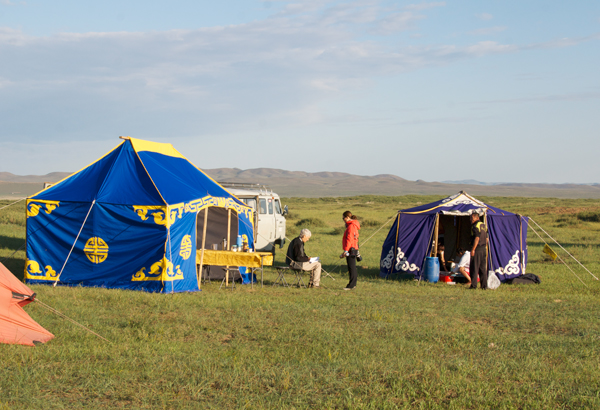
Camp Central at Arburd Sands, cook tent on the right, dining tent on the leftWas this a great campsite or what?
We had time the next morning to get in some painting and sketching…
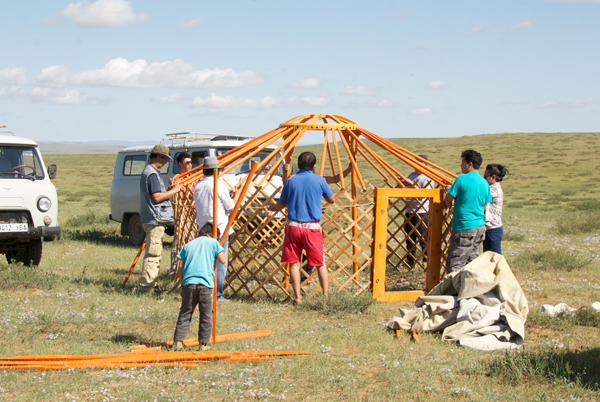
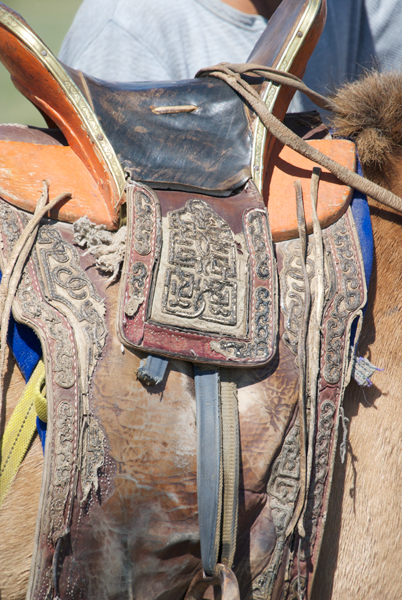
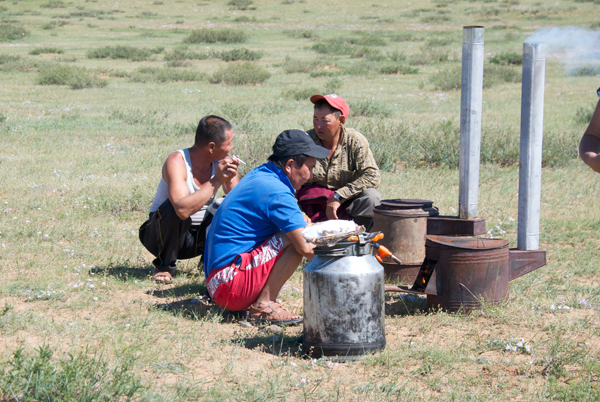
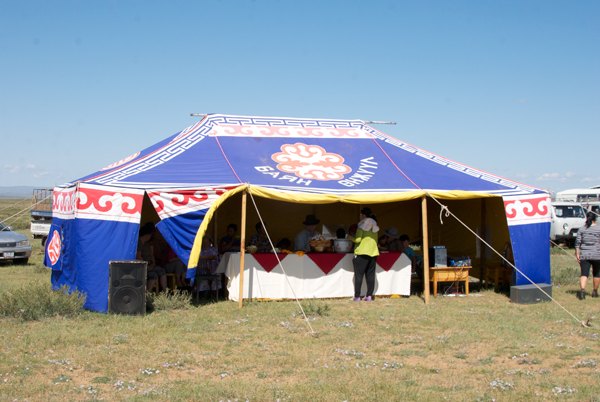
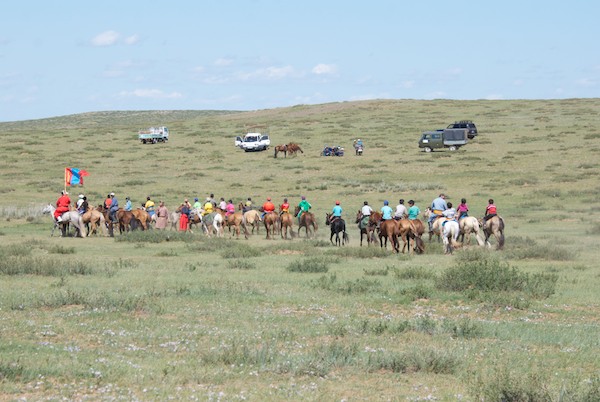
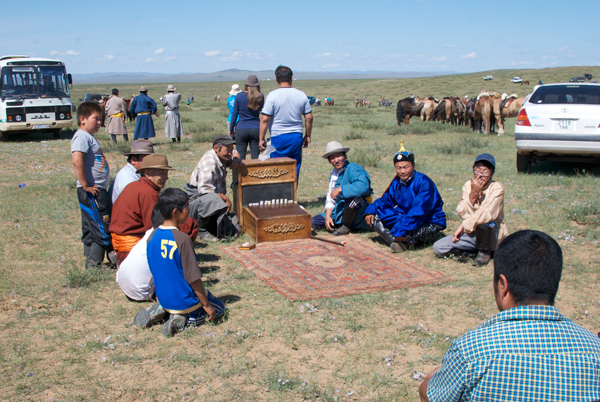
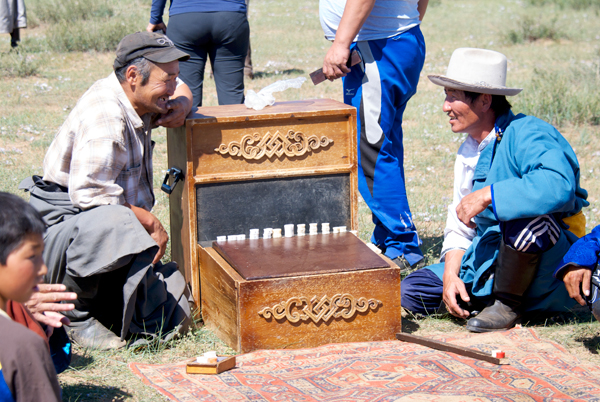
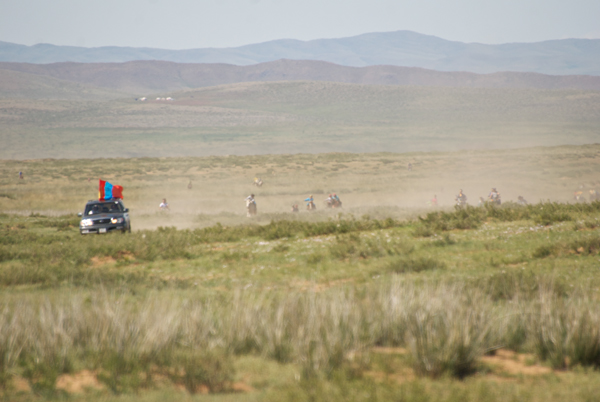
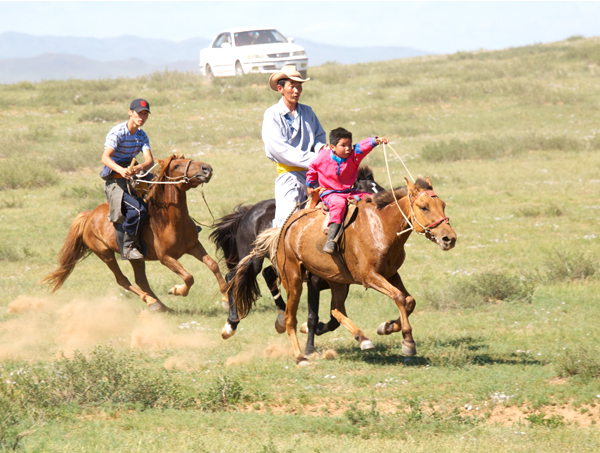
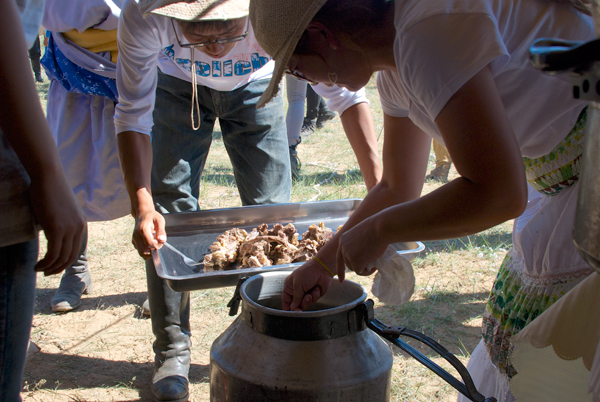
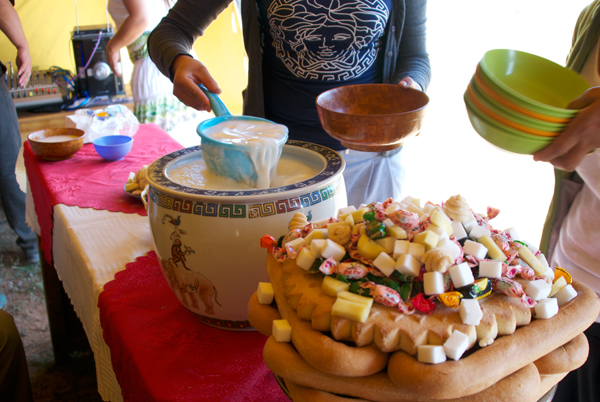
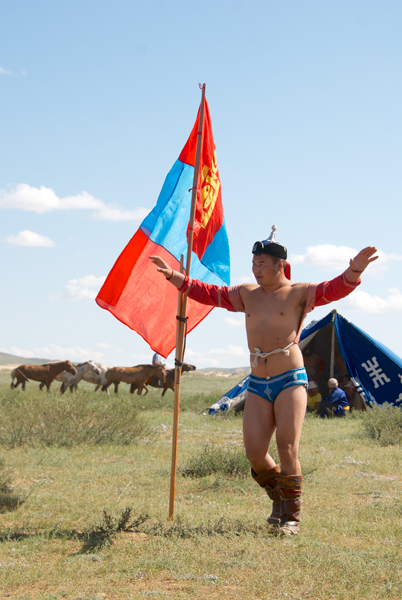
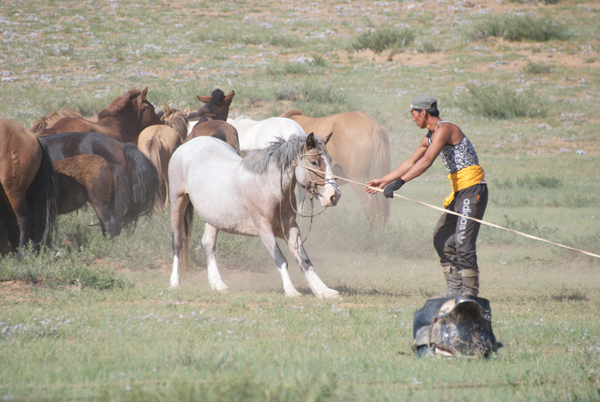
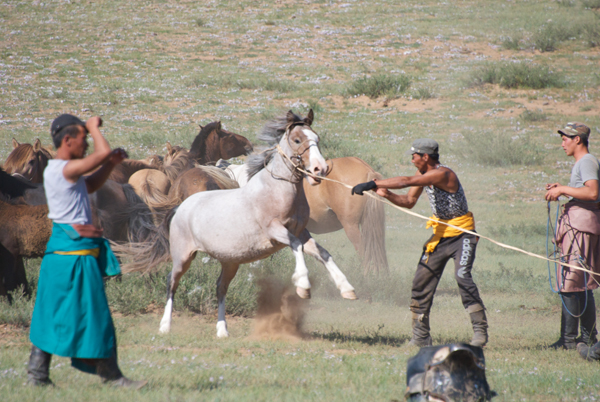
View from the dunesMagvandorj working on a landscapeTugs-oyun added the camels to her pieceSharon Schafer worked on recording the various plants in her sketchbookTime to go to the naadam!Some of us helped with the set-up, including putting up a gerWe took a few minutes to get a group shotThe local people had started to arrive, many on their horses. Here’s an example of Mongol leatherwork.Magvandorj and I sketched the horsesOur drivers, Batmaa and Sendag, helped with the real Mongolian BBQ….khorhog (mutton or goat cooked with extremely hot rocks in the metal containers)The tails of the horses who will be racing are wrapped part way down.The centerpiece of the naadam site….a big maikhan (summer tent)The opening festivities included a performance by a morin khuur (horsehead fiddle) player and a long singer who had a wonderful voice; and their brocade del were spectacularI’m presenting a painting I did of our host’s father some years ago. I had brought it to Mongolia for my exhibition at the National Museum of Mongolia and decided that it needed to stay in the country and with the family, which has shown me great kindness and hospitality over the yearsThe procession that starts the horse race. The jockeys are all singing a song to their horses that tells them that soon they will get to run and run and run.Three of the jockeys were young girlsHeading out to the starting pointIn the meantime, the anklebone shooting competition had gotten under wayThe target…stacked sheep’s anklebones; if hit they fall off the back into the boxThe competitors holding the piece of wood from which they launch an anklebone. You do not want to get hit by one if it goes off-lineAt last the horses and riders came back into viewRacing to the finish lineThe youngest riders were accompanied by at least one adult the whole wayOne of the girl jockeys. She exuded determination and seriousnessThe after-race feast…khorhog, salads and various dairy products like cheese, aruul (dried curds) and…The legendary mare’s milk of Mongolia….airagThen it was time for the wrestling, Mongol bokh. He’s doing the traditional Eagle Dance before a bout.And this youngster did a great job with his own version.The wrestlers in the traditional garb are more experienced and have probably earned rankings in the soum or aimag. Any local guy can enter and see what he can do, but the highest ranked wrestlers get to pick their opponent, so the odds aren’t good. There is no weight division. It’s everyone against everyone. The rules are very simple. First part of the body to touch the ground other than the feet means you lose. Within that simplicity is an infinite complexity of tactics and mind games. I’ve really become a fan.I found myself making a tough choice. I wanted to watch the wrestling, but a demonstration of catching and riding young horses had begun. The horses won out because I really needed more reference of riders using the urga (the long catchpole)We saw how 2 year olds are caught and ridden for the first time. It was a rodeo. This good-looking sturdy horse is feeling a bridle for the first time and he’s pretty sure he doesn’t like itHe really would rather notThe punctuation point and a moment later the bridle fell off, but all to no availProtesting in vain. As you can see, we could get as close to the action as we wanted. Some were a little too close, but no one was hurtMaybe not so bad after allJust love this photo of a young Mongol girl, totally at home on her horse and in her “nutag”, the land where she was bornOne of my favorite catch photos. The horsemanship we saw that afternoon was jaw-dropping, but nothing special for people put on a horse at age three. They ride like we walk.The winner of the horse race
“Ullswater” by William Heaton Cooper (http://www.heatoncooper.co.uk/)- My favorite painting by one of my most favorite watercolor artists.
Although oil painting is my first love, I also have done watercolors on and off over the years and have decided to use them for my location work in Mongolia. I’ve been down with a flu/sinus infection/staph infection for almost a month, so have gotten no painting done. I don’t want to expose myself to the fumes from oil paint and solvents just yet, so decided to brush up on my watercolor skills now that I’m up and moving again. I’ve built up a pretty good collection of books on the media over the years and have been going through them. I thought that I would share with you a list of what’s in my library.
TECHNIQUE: Watercolor…Let’s Think About It! by Judi Betts- Aquarelle Press, 1984 Watercolor with Passion by Alvaro Castagnet- International Artist Publishing, 2000 Watercolor by Design by Mario Cooper- Watson-Guptill Publlcations, 1980 The Watercolor Bible by Joe Garcia- North Light Books, 2006 Mastering the Watercolor Wash by Joe Garcia- North Light Books, 2002 Water-Colour Guidance by J. Hullah Brown, A. & C. Black, Ltd. London, 1931 Painting Watercolor Florals That Glow by Jan Kunz, North Light Books, 1993 Figure Painting in Watercolor by Charles Reid- Watson-Guptill Publications, 1972 Painting What You Want To See by Charles Reid- Watson-Guptill Publications, 1987 Portrait Painting in Watercolor by Charles Reid- Watson-Guptill Publications, 1973 Pulling Your Paintings Together by Charles Reid- Watson-Guptill Publications, 1985 Fundamentals of Watercolor Painting by Leonard Richmond and J. Littlejohns, Watson-Guptill Publications, 1978 Breaking the Rules of Watercolor by Burt Silverman, Watson-Guptill Publications, 1983
WATERCOLOR ARTISTS: Irises and Other Flowers by Elizabeth Blackadder, Harry N. Abrams, Inc., 1994 Mackintosh Watercolors by Roger Billcliffe, Carter Nash Cameron, 1978 Mountain Painter, An Autobiography by W. Heaton Cooper, Frank Peters Publishing, Kendal, Cumbria 1984 Sir William Russell Flint by Ralph Lewis and Keith S. Gardner, David and Charles, London, 1988 Margaret Merry’s Cornish Garden Sketchbook– self-published, 1994 English Watercolors by Graham Reynolds, New Amsterdam, 1950, 1988 The Glory of Watercolour: The Royal Watercolour Society Diploma Collection by Michael Spender, David and Charles, London, 1987 Nature Into Art-English Landscape in Watercolours by Lindsay Stainton, British Museum Press, 1991 (exhibition catalog) Turner Watercolors– The Tate Gallery, 1987
The list has many books from England, both because watercolor has always been an accepted, important media there and because my husband and I traveled to England quite a few times in the late 1980s to the mid-1990s, so I regularly brought books back home with me.
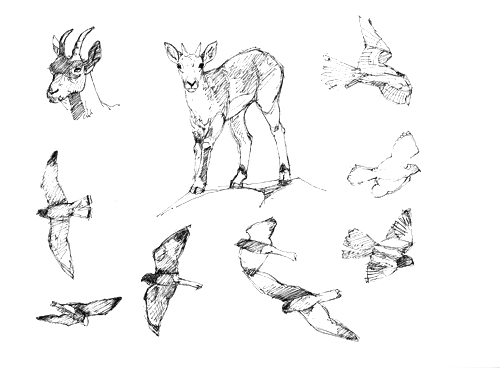
Siberian ibex, Ikh Nartiin Chuluu- Annigoni toned paper, Sakura Micron pen and white gouache
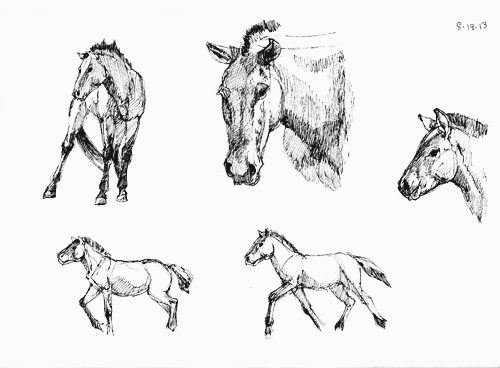
During my week-long solo exhibition at the National Museum of Mongolia in August, I was there every afternoon except one. While there was a constant stream of people, over 100 each afternoon (I kept a tally), I was still “stuck” sitting there. So I took my MacBook Air, which is my primary image storage when I’m traveling, a sketchbook, a Sakura Micron pen and some pencils and, working from some of the photos, sketched and drew when I wasn’t chatting with visitors. It also gave them a chance to see an artist at work and many were quite interested.
So here’s a selection from that week, some of which, like the one of the baby marmots below, are intended as preliminary explorations for future paintings. Some are from previous trips, but the images haven’t yet been deleted from iPhoto.
Baby Siberian marmots, Hustai National Park, 2013Siberian ibex and lesser kestrels, Ikh Nartiin Chuluu, 2012Takhi, Hustai National Park, 2013Argali ram, Ikh Nartiin Chuluu Nature Reserve,2010- graphiteOx and Mongol horse, Jalman Meadows, Han Hentii Mountains, 2012- graphite
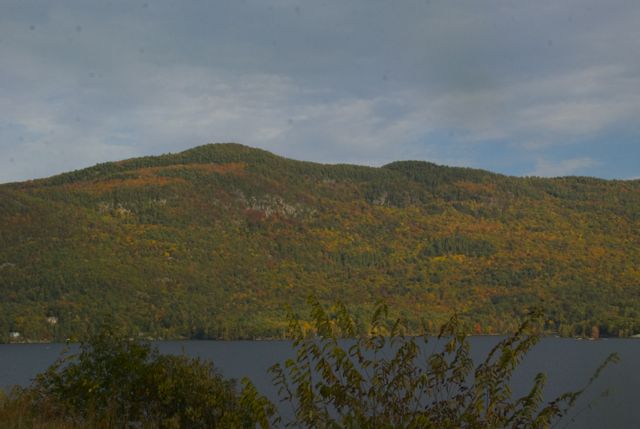
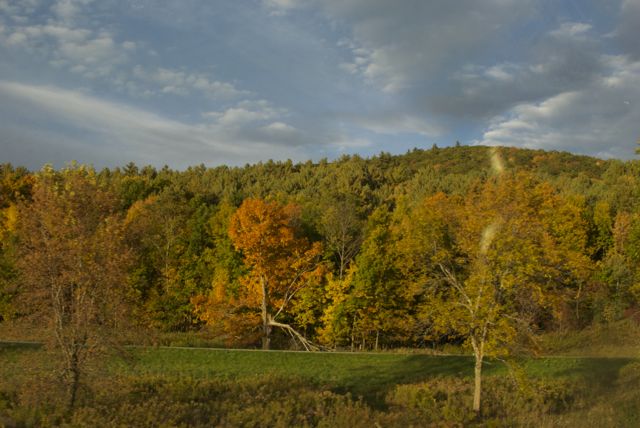
I’m in Bennington, Vermont, for the opening weekend of the Society of Animal Artists’ international juried exhibition “Art and the Animal” and also one of our two yearly board meetings. I came in a day early to make sure I was here in time in case of bad weather, so went for a drive north yesterday, from where I’d stayed at near the Albany airport, to Saratoga Springs State Park and onwards up into the Adirondacks, which I’d never visited before. It was a gorgeous fall day, as you can see. Today it’s been rainy, and now cloudy and gloomy, so my timing was good.
Lake George, the AdirondacksFall colors, the AdirondacksFalls at TiconderogaFall colors, VermontFall colors, Vermont
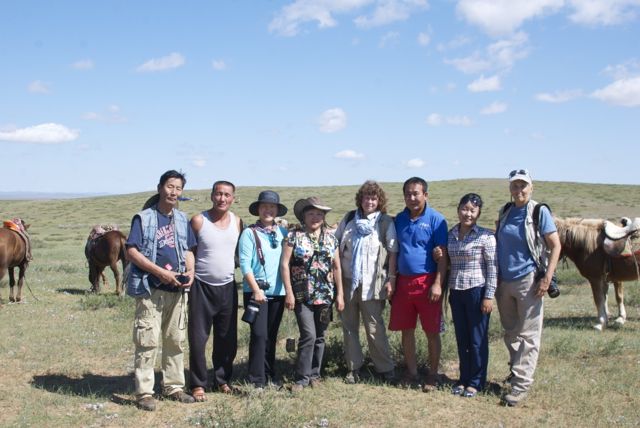
Expedition members and staff, from left to right: Oidoviin Magvandorj (Mongol artist), Sendag (driver), Odna (Mongol photographer), Tugsoyun Sodnom (Mongol artist), Susan Fox (American artist), Batmaa (driver), Tseegii (guide), Sharon K. Schafer (American artist); photo by Soyoloo our great cook
Two years of planning all came together on August 23, 2013 when the first WildArt Mongolia Expedition departed from Ulaanbaatar in two Russian fergon vans, heading south and then west for a nineteen day adventure that combined art, endangered wildlife, Mongol culture and spectacular scenery.
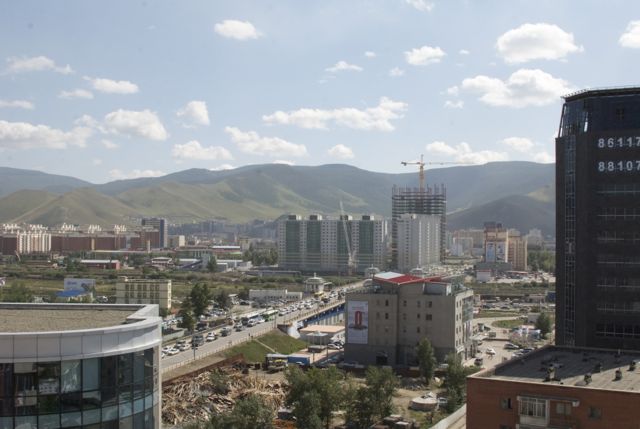
We began in this:
View looking south to Bogd Khan Uul from my 12th floor room at the Bayangol Hotel
And within a few hours, found ourselves traveling through this:
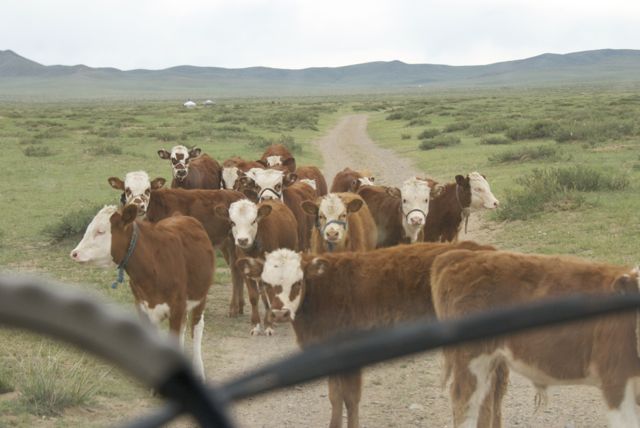
Heading south into the steppe-Gobi transition zoneJust one of those things you encounter on the road in Mongolia, local livestock
I had in mind a very special place for our first camp…But first we needed to fill our water barrel from a local well. We also got lots of great horse photos.
Getting water with assistance from local herders and a generator
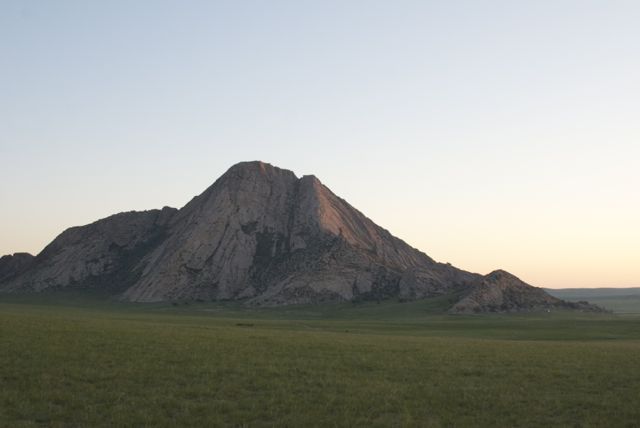
Then it was on to our campsite…near my favorite sacred mountain, Zorgul Hairhan Uul.
Zorgol Hairhan Uul
Once camp was set up, we relaxed and had afternoon tea in the maikhan (Mongol summer tent).
Chatting in the maikhan; from left to right: Guide Tseegii, artist Tugsoyun, artist Magvandorj, artist Sharon Schafer, photographer Odna
The next morning we were up in time to catch the first light on the mountain.
First Light
Magvandorj set up his easel and went to work.
Magvandorj painting on location
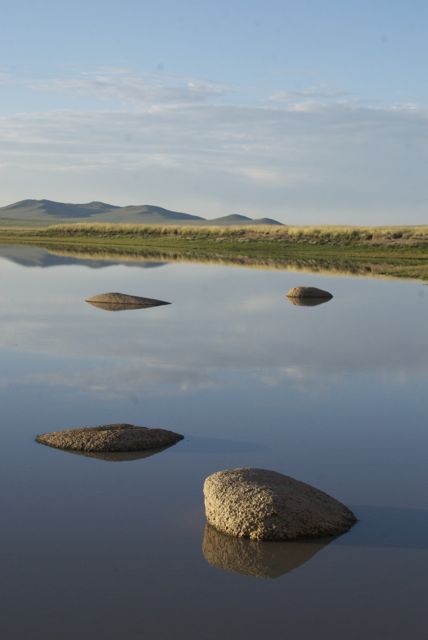
There was a small lake at the foot of the mountain, which we explored that morning.
Morning light on the small lake
Odna, Sharon and I took lots of photos.
Odna and Sharon
There was a white stupa at the base of the mountain.
The white stupa backed by a great rock formation
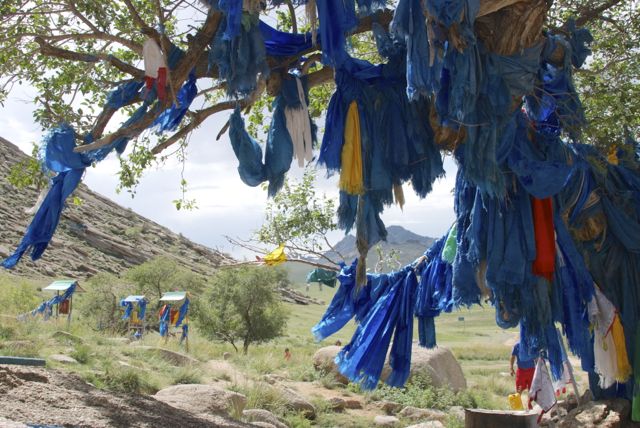
And a sacred spring on the backside, set about with prayer wheels and trees festooned with colorful khadag (offering scarves).
Khadag and prayer wheels
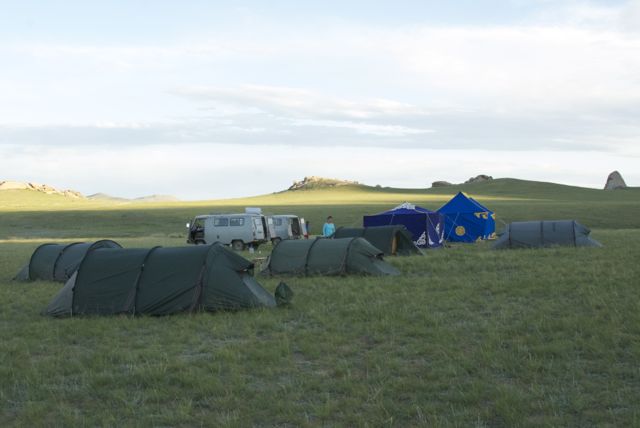
This is what our camps looked like during the Expedition.
The view from camp looking away from the mountain
By late morning we were packed up and on our way to our next stop, Arburd Sands ger camp and a very special event.
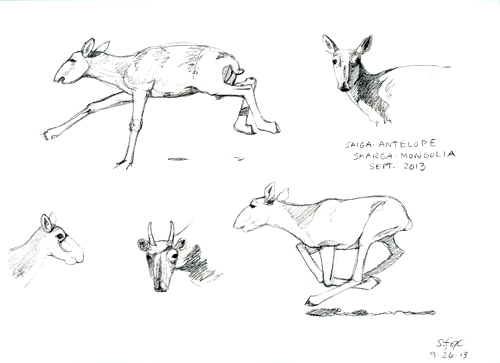
I did these two pages of saiga sketches last night while I was watching the Giants beat the Dodgers. One thing we were all struck with when watching them run was the strange body posture (which reminded me, for some reason, of a funny car drag racer) and very odd leg positions. I got a start with understanding how they run it that sequence at the top of the page.
It’s the same animal in the lower two sketches, but with a different head position. Kinda cute on the left and pretty alien-strange on the right.
Just working on learning what they look like on the above page. I had thought that we had only seen one male, but taking a close look, it appears we saw three. They have a much bigger “nose”, plus the horns, which the females lack.
Before I do any finished paintings I’ll need better reference for the heads and hooves, but I got so much more than I expected to, I can hardly complain.
I used a Strathmore premium recycled sketchbook and a .01 Sakura Micron pen.
My eighth trip to Mongolia this year was the busiest ever. Not only did I have the WildArt Mongolia Expedition, but also the solo exhibition of my paintings at the National Museum of Mongolia. Before, after and in and around those was my yearly trip to Ikh Nart to meet with the women’s felt craft collective and visit the reserve, a quick weekend trip to Hustai, lunches and dinners with friends and, to top it off, gaining gallery representation at Mazaalai Art Gallery in Ulaanbaatar.
So not only do I have the WildArt Mongolia Expedition group exhibition next June or July to prepare for, but also the juried shows that I enter and creating new work for my gallery. All to say that after today, I will be doing one main post a week, not two, with the intention of posting every Wednesday. In between I’ll be doing shorter informal posts as interesting things come up.
I finally got back into the studio today after resting and catching up last week. Jet lag wasn’t bad, but I was tired, not surprisingly, since I’ve been going non-stop since June. Physically, I’m fine. Three plus weeks of remote travel on the earth roads of south-western Mongolia didn’t bother me at all. What seems to wear me down by the end of a trip is what I’ve come to think of as “decision fatigue”. Staying in Ulaanbaatar and traveling the way that I do in Mongolia is, in some ways, one long stretch of decisions,particularly since I’m often working and traveling with people from a different culture -the Mongols- and trying to function appropriately and correctly within that culture as much as possible. I reach a point where I need to park my brain in neutral for awhile. The prospect of 10-11 hours on a plane coming home becomes quite appealing. The only decision is which entree to have for dinner. Otherwise, I can mentally just flake out. Getting back into the home routine is nice, too, since the decision requirements are minimal.
My first task when I get home (besides unpacking and laundry), because I can’t really start to relax until I do, is to download all my photos (over 8300 this time) into Aperture on a local vault (Apple-speak for an external hard drive) and then back them up to a separate hard drive (a remote vault) that is kept in a different building, our detached garage. After that they need to be categorized, which usually takes a couple of days. Then I can really see what I’ve got.
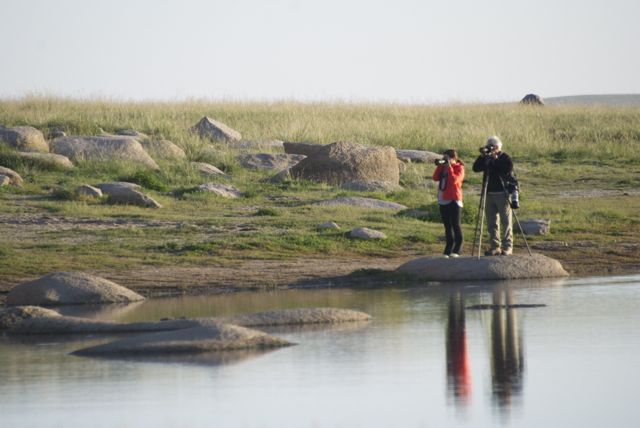
And what I’ve got that I honestly didn’t expect to get was useable, paintable reference of the critically endangered Mongolian saiga antelope. They are all from quite a distance (see photo at top) and I will need to do research and call on the people I met in Darvi soum who protect them to help ensure that what I’m doing is accurate, but I got some great action shots of both males and females and some closer-in standing shots. I’ve done three pages of first studies to get a feel for what a saiga looks like. They are done on Strathmore vellum bristol with a Wolff’s 4B carbon pencil.




























 Susan Fox, American Artist