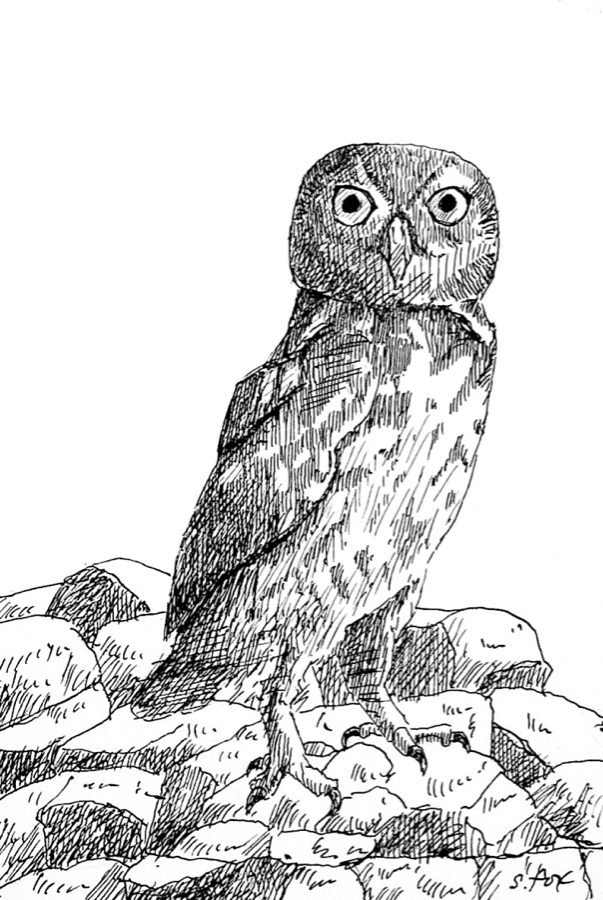
As I did last year, I’ve donated two pen and ink originals for the Explorers Club Annual Dinner auction. This year I decided to do birds that I’ve watched and photographed in Mongolia. I’ve seen little owls a number of times in a variety of locations…perched on a herder’s storage box near the shore of Orog Nuur, a remote lake in the Gobi, peeking out from behind a rock at Ikh Nartiin Chuluu Nature Reserve and a number of them sitting out by their burrows, which they’d dug into the ruined ramparts of an ancient Turkic settlement, Khar Balgas. Unlike the owls most of us are familiar with in every case it was full daylight.
“Hoopoe, Mongolia” 6×4″ pen and ink on paper
Hoopoes have a very large range…from Mongolia to Africa to Europe. I have found them to be one of the most challenging birds to get decent photos of. It’s almost like they tease you, letting you get…almost…there and then flying off to the next tree. But persistence has paid off at Ikh Nartiin Chuluu Nature Reserve in the valley where the research camp is located. My subject was one of a family group of three I spotted up on the top of the rocks in the late afternoon. I was able to approach just close enough by working my way towards them behind large rocks at the edge of the valley floor to get a number of photos with my 80-400 lens at maximum range.
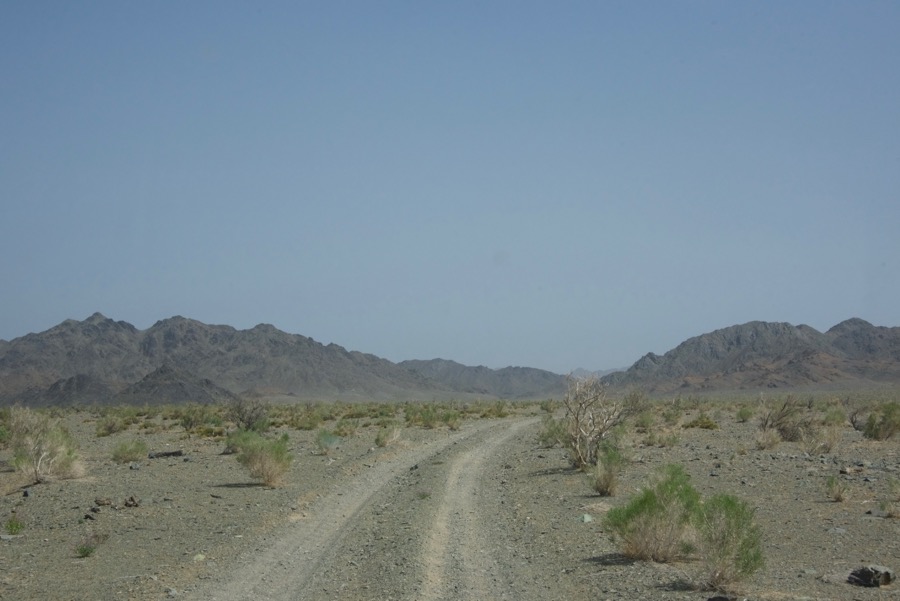
Departure from Great Gobi A, looking north on a hazy day
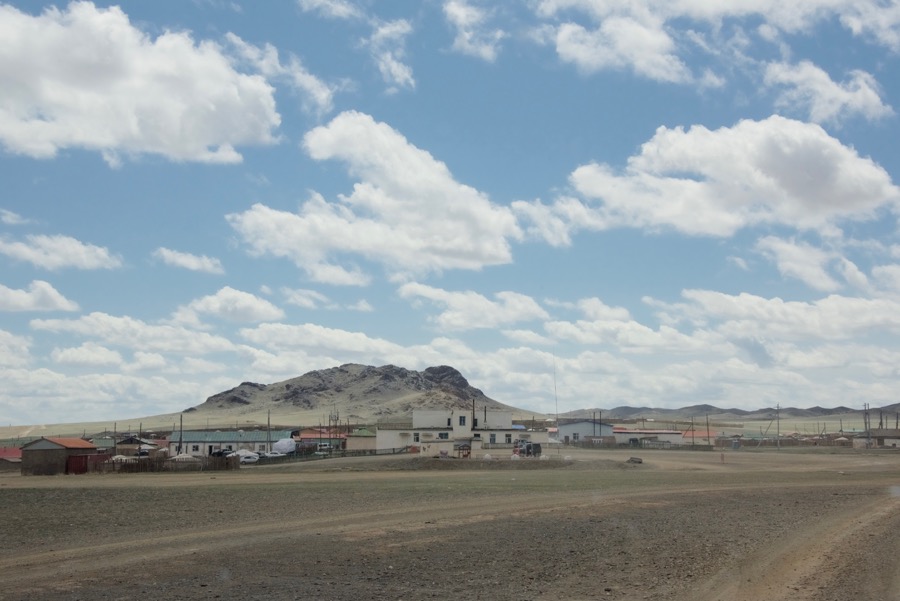
Our time in Great Gobi A at an end, we packed up and headed back north the way we’d come. The fuel level in the Land Cruiser was low so the first order of business was to get to a soum center, Bayan-Ondor, to fill up. We also had lunch there. Soyoloo, our cook, went into a cafe and arranged for us to use a table and to get a thermos of milk tea. This worked out very nicely.
Once again I’ve included a fair number of photos to show our route in case it might be of interest to someone else doing research about going there.
Heading north
The areas of haze created interesting atmospheric perspective
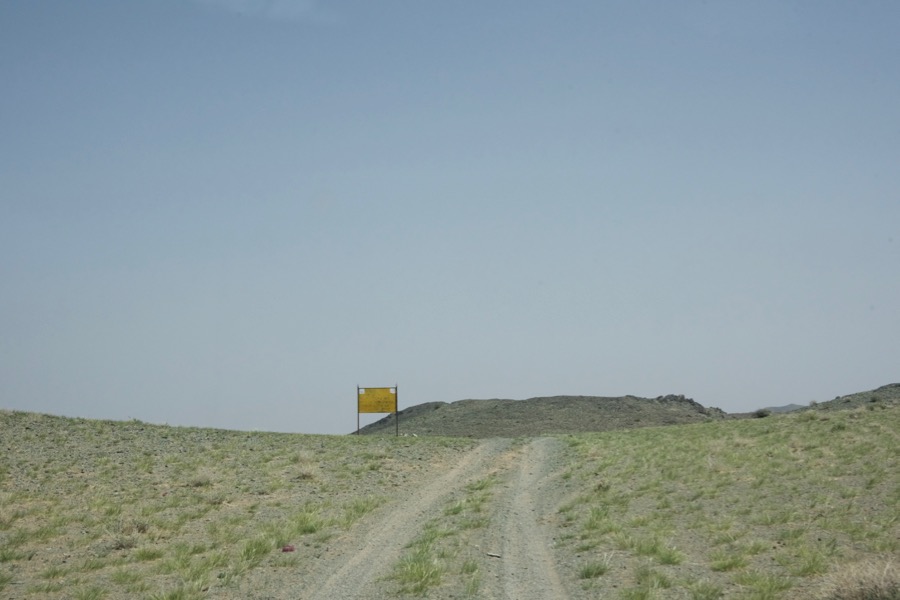
The boundary sign we passed going into Great Gobi A. I hope to see it again sometime on another trip there.
Not far north of the SPA boundary, we started to see livestock. There was a fairly large herd of goats in the distance. You can see that we are now in an area of more red soil than gravel.
We came upon this line of gers with no one around, as far as we could tell, since we didn’t stop. No dogs or any of the things outside that one sees at herder’s gers
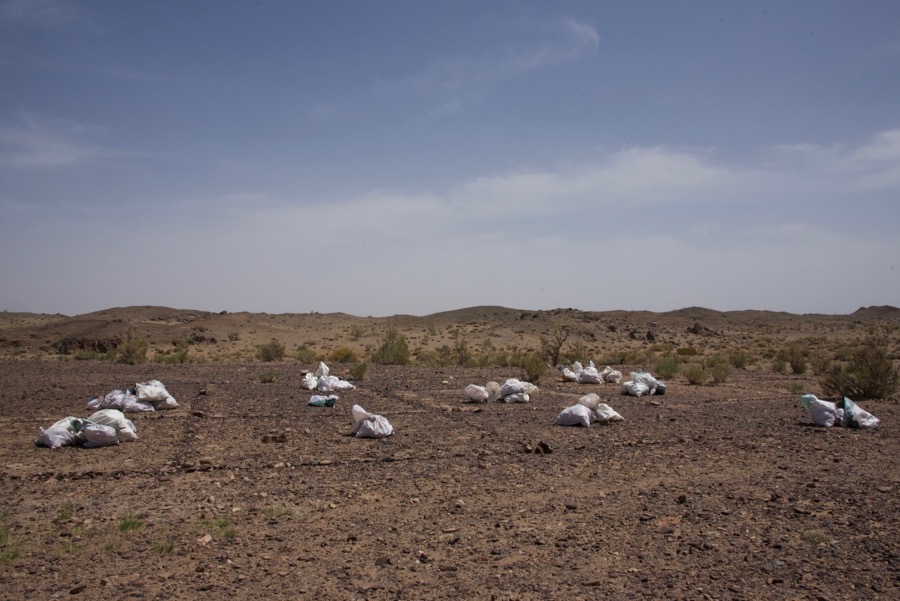
However, there was this cleared area which had been divided into a grid and bags of something laying within each square
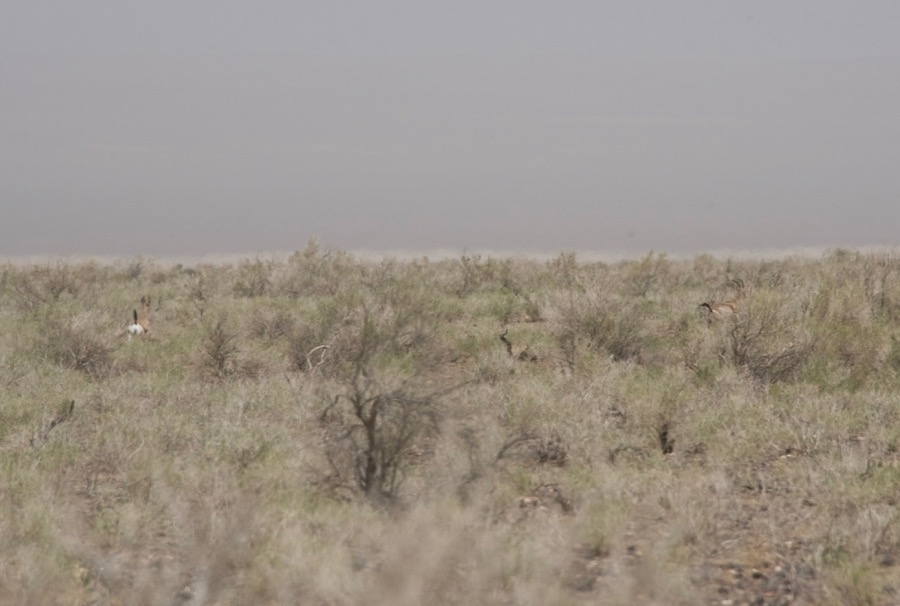
A little farther on and back into a shrubby area we suddenly spotted two gazelles! I was barely able to get a few grab shots from the car and then they were gone.
We stopped for some reason that I can’t recall now and someone saw this arachnid. She was over an inch long. No idea of the species.
We drove through the afternoon back through the basin and range topography
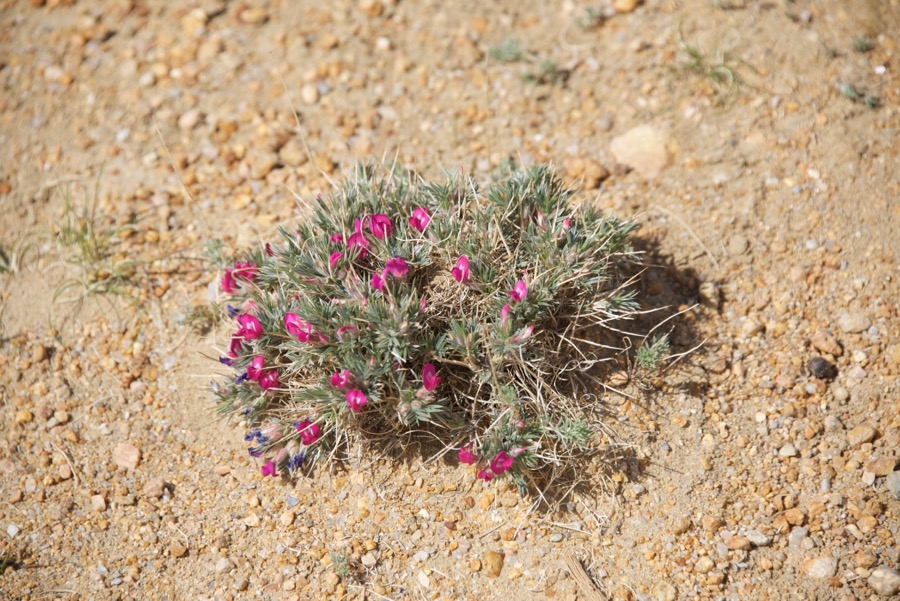
On another short stop I photographed a couple of wildflowers. From the shape of the flowers I think this one is a member of the pea family
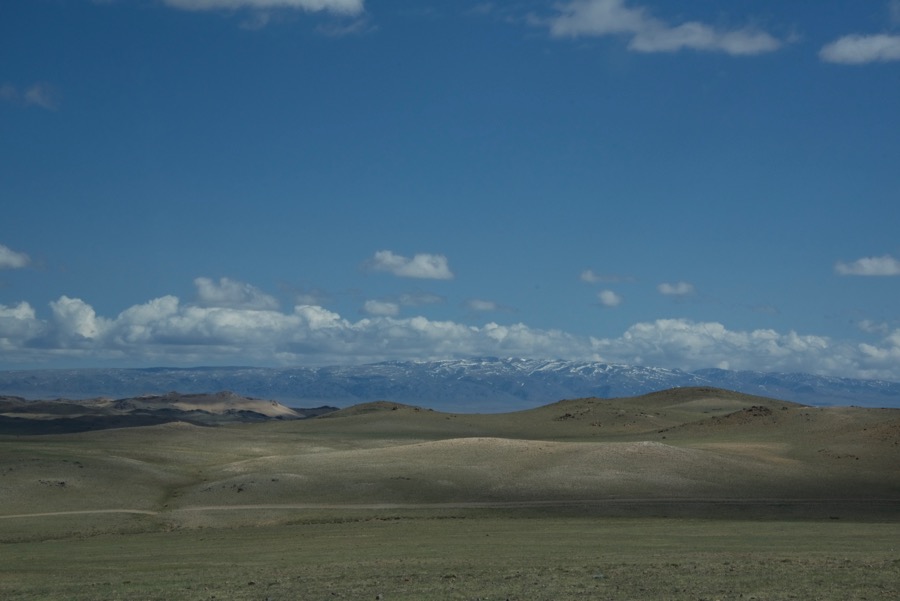
We finally had the mountain in view which had been totally covered in snow when we saw it on our way south
Bayan-Ondor, where we got gas for the vehicles and had lunch
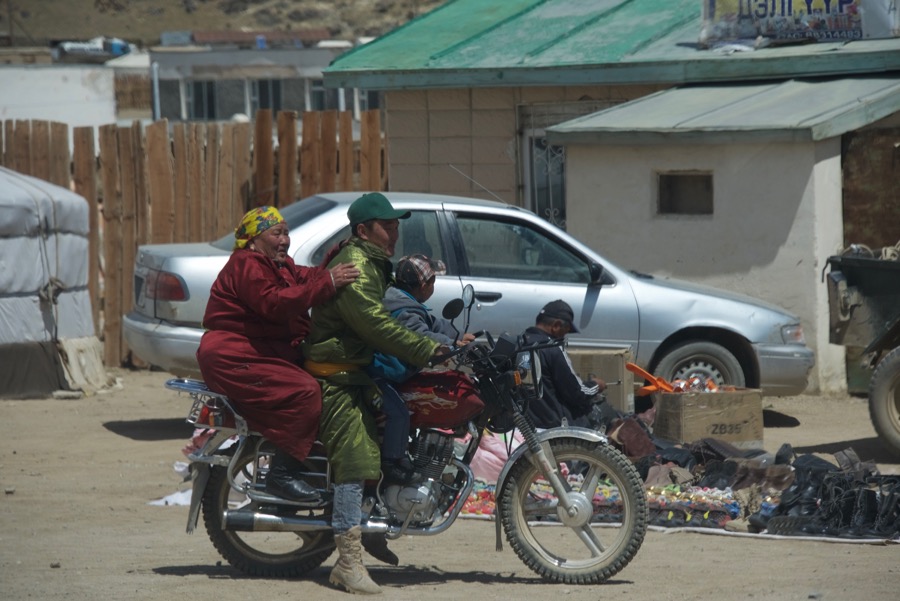
The man probably was bringing his or his wife’s mother into town to shop and maybe visit with friends
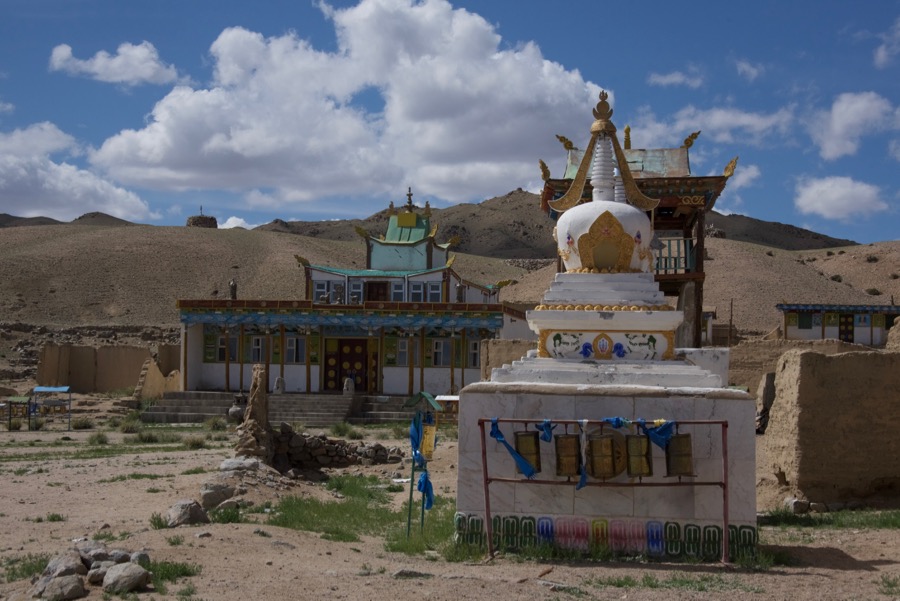
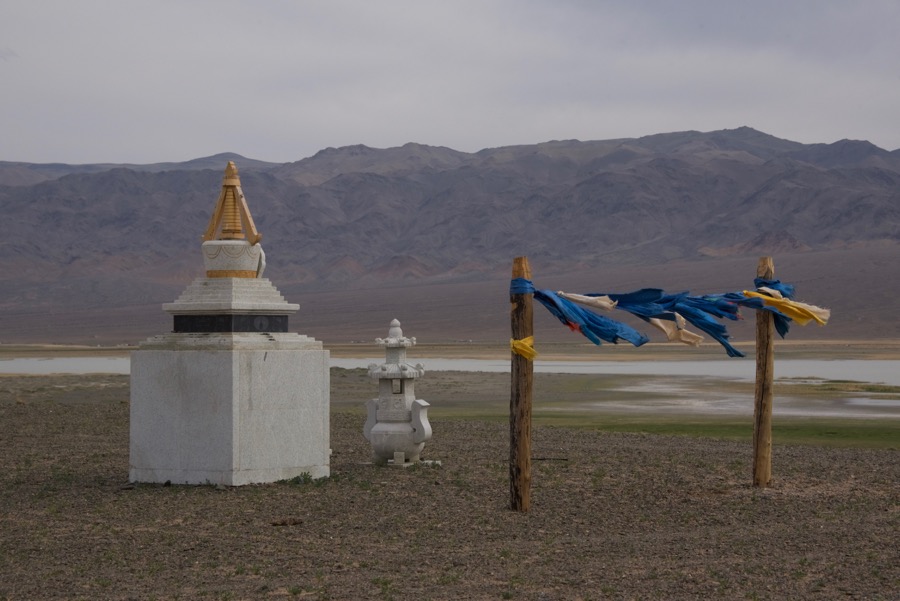
Then we were on our way to our next stop, Amarbuyant Monastery, which had been destroyed in the late 1930s as had been so many, but was supposed to be undergoing restoration. The Dalai Lama had been there and this stupa was built in his honor.
But we were on a very “local road” and Erdenbat had never been this way, so when we saw a herder and a little girl sitting up on rock keeping an eye on their livestock we stopped to ask directions. We were quite charmed by the two of them as a father out with his daughter, who he clearly had great affection for. She was very self-possessed, not an uncommon thing to see in Mongolian country kids
The herder decided that the best thing was to show us the way, so off we went with him in the lead
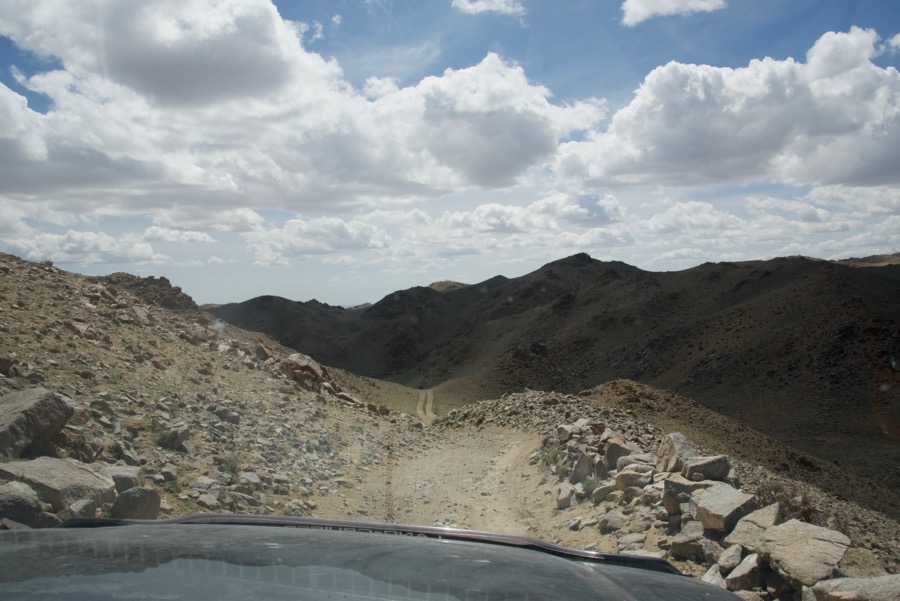
We finally reached a point where we could apparently go the rest of the way on our own, so we gave them each a gift as a thank you and went on our way through some pretty rugged terrain
We came upon a well and stopped for Kim and Oliver to see how they work. This one is typical in that a very large commercial tire has been split lengthwise to form the trough, a great reuse of something that would otherwise be thrown away
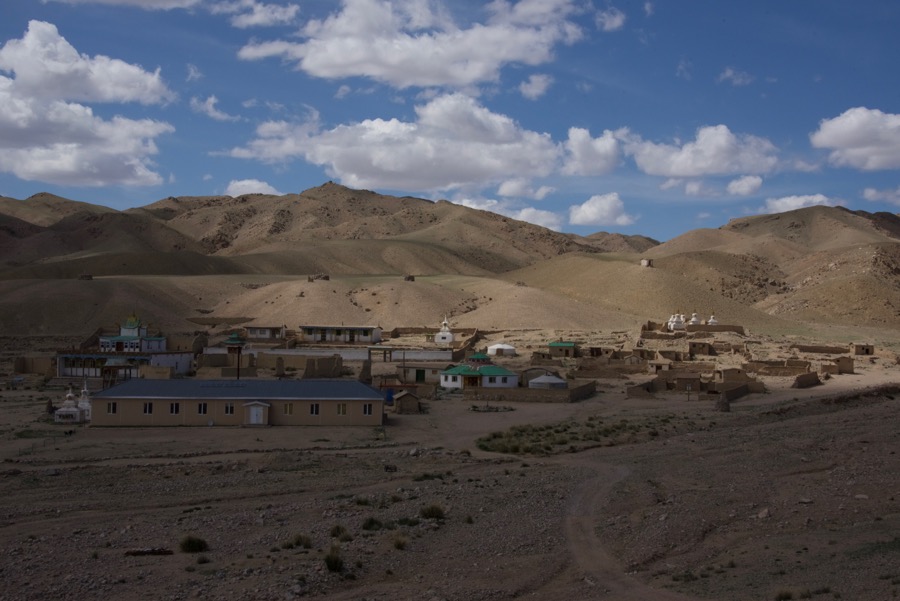
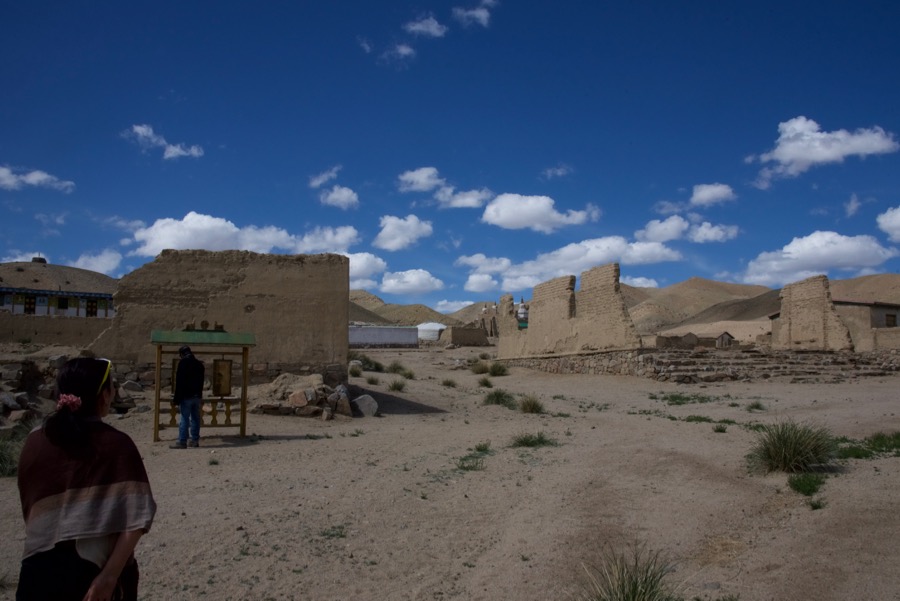
We came up over a rise and there before us was Amurbuyant Khiid…what was left of it. It had been a major commercial caravan route and a hive of activity. That all ended in 1937 when the Mongolian communist government destroyed it and hundreds of other monasteries in the country to break the political and social power of the lamas
Wall sections like these are pretty much all that is left
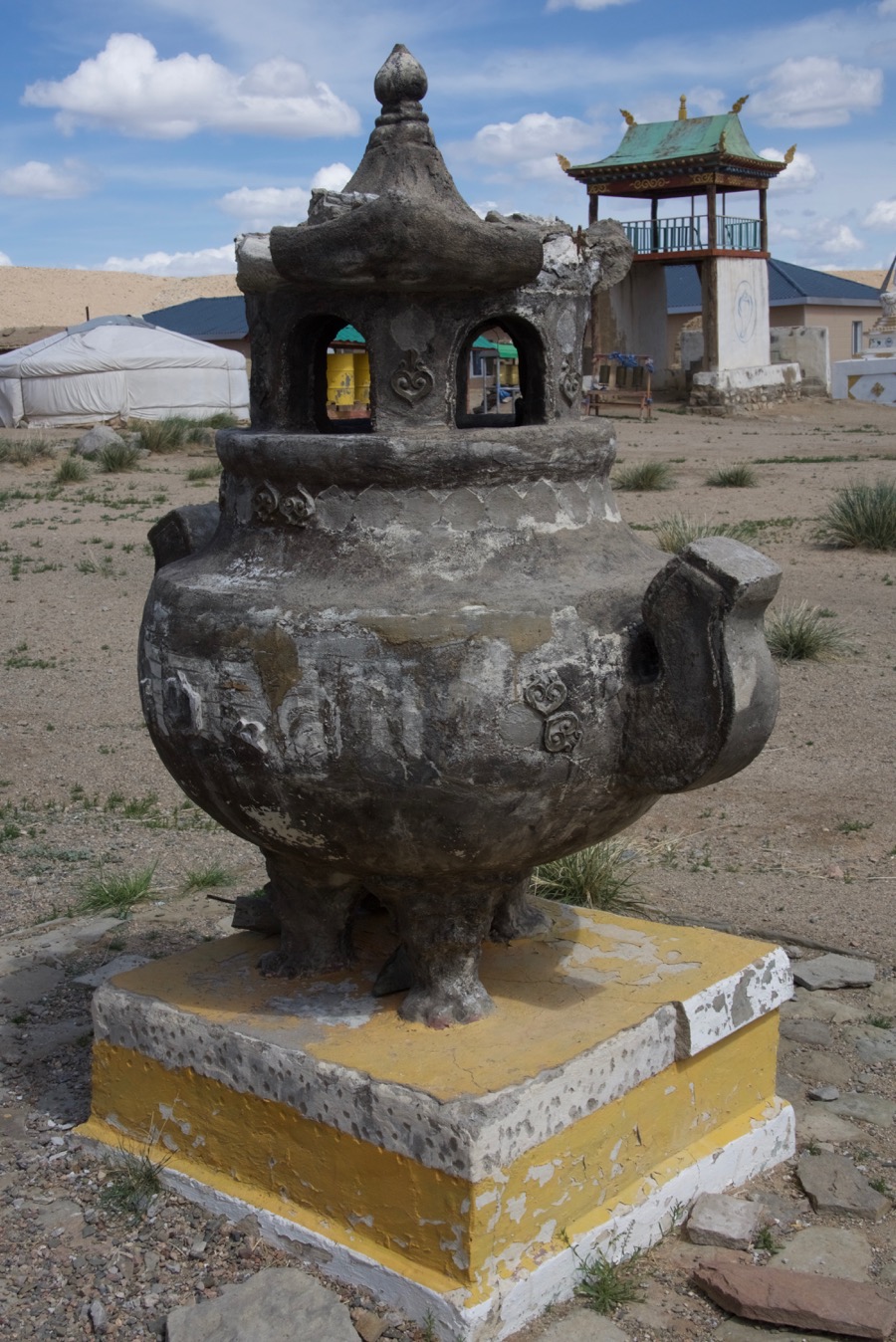
There were a very few artifacts to see like this incense burner, which would have been outside of one of the temples
There has been some rebuilding and there are monks and students in residence again. But it felt like rather a sad, isolated place. We asked for and were given a tour of the two temples, but not with much enthusiasm or welcome
I started to feel uneasy not long after we started to visit the second temple. Wasn’t sure why. There was a stillness I found unsettling and not just that it was quiet. We were shown a couple of large panels in the main temple that listed all the people who had donated to the restoration, along with the amounts they had given. It added up to millions and millions of tugrik. The surviving old temple was in poor condition and visible repairs were cheaply done, although the interior wood framing and supports looked sturdy and good. The new temple, in the shape of a ger, also had a feeling of being built quickly and cheaply. The ceiling was made square panels a little like the acoustic tiles one sees in America. Some were askew and some seemed worse for wear. In both cases, it felt like no one had noticed and no one cared. The tower for, I assumed, calling the monks to prayer, looked to be in pretty bad shape. A new long, low building, had been constructed (visible in the front of the photo of the complex above). There was also a good array of solar panels to provide power. Our young student tour guides walked us past the newish long living quarters building on our way out, answering some last questions, and a very unfriendly male voice ordered them back inside. The closest school was 60km away and the boys only attended one week a month. The rest of their time was at the monastery taking classes in Buddhist practice. And so we left. We had been given permission to camp somewhere in the vicinity and we drove around looking for a spot. I became more and more uncomfortable and stressed, to the point that I finally had to say that I needed to leave now, right now. Something felt bad and wrong there and I needed to get away from it. It was so very odd and I was clearly the only one who felt it, or at least no one else said anything. Have never had anything like this happen on any of my travels to any place before. But leave we did and found a spot on an open plain to the north with a great view. As sometimes happens a local herder and his wife showed up on their motorbike to check us out and have a visit. We went to their ger the next day.
Our “neighbors”, a kilometer or two from where we were camped
As we pulled up the woman came out. She was holding her hand which was wrapped in a plastic bag. We could see instantly that it was terribly swollen, a bite of some kind. I gave her a half-dozen or so ibuprophen for the pain, emphasing that she should take no more than three at a time. Her husband was going to take her to the soum center hospital, probably more of a clinic. It turned out after some chat and a translation from our guide, Batana, that the woman had gotten down on the floor of the ger, reached under a bed to get something and felt a sting. At that point all the Mongols decided that it had been a scorpion. Her life wasn’t in danger, but she definitely needed to see a doctor. They left and we were on our way a short time later after getting water from their well.
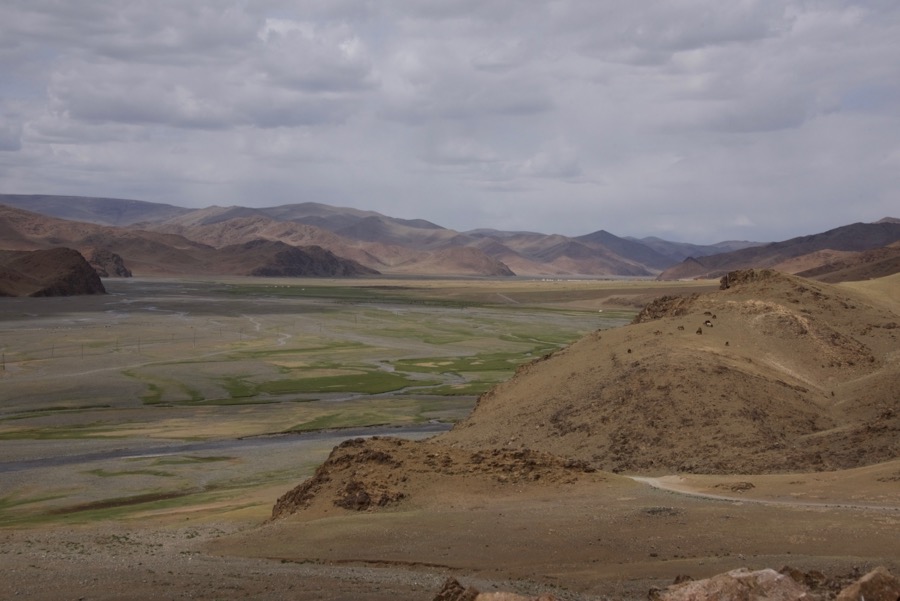
Ikh Bogd Nuruu from the south. Orog Nuur (Lake) is on the other side
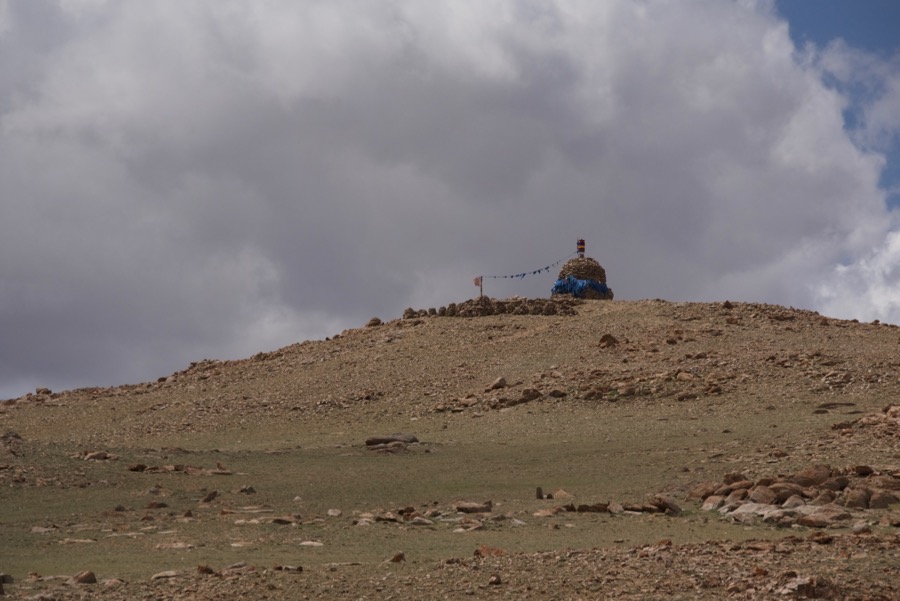
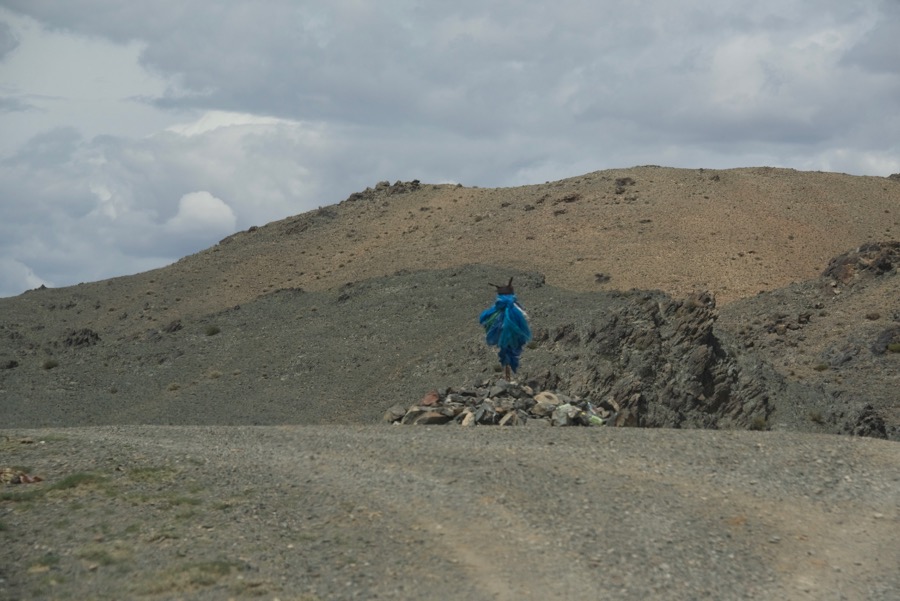
We now drove towards Ikh Bogd Nuruu and worked our way around the south end of the mountain, passing this ovoo on the way
A road sign!
We drove back along the north side of the mountain, passing large herds of animals. The hope had been to camp in the area or by the lake but the presence of many herders and their dogs made that unsafe, so we had to settle for stopping a few times for photos
And what a photo opp!
After working our way through some extremely rough ground, we arrived at an overlook for Orog Nuur. It was a big deal for me to see the lake again since I had camped there on the south shore in 2010 on my very first tent camping trip in Mongolia. It was also the first time I’d traveled with Soyoloo. So it was special for both of us since it’s pretty remote
We continued on and found a sheltered spot not far from a soum center. It was quite windy, as it had been for a lot of the Expedition. The drivers and guide went into town to get gas and buy snacks.
The next morning, not far from the soum center we came upon this flock of eurasian black vultures and I got a lot of really good reference photos
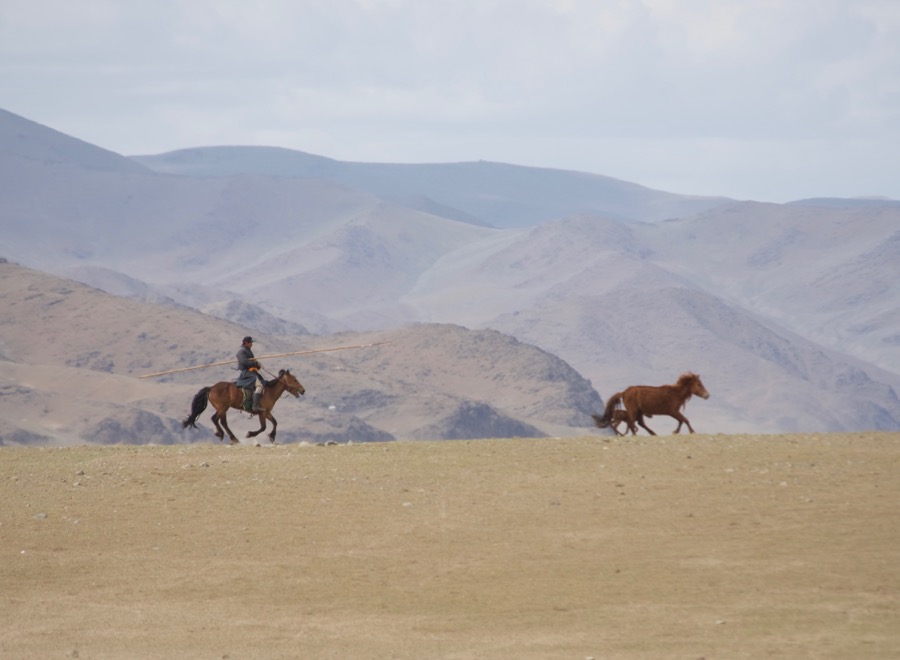
And it’s always nice to see a herd of horses on the way
One mare and her foal had other ideas, though, and the owner was still trying to catch up and turn them back when we went out of sight
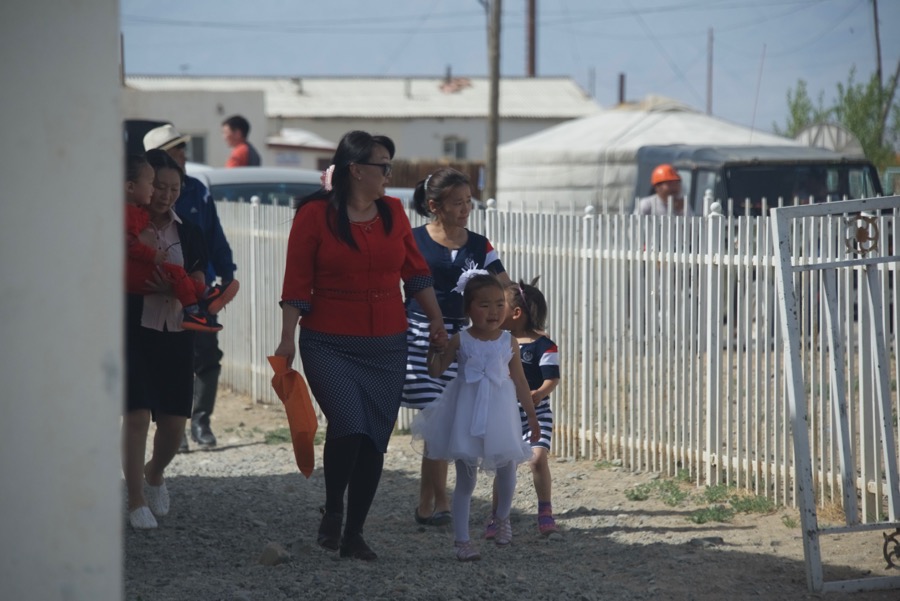
Turned out that it was International Children’s Day, which is a very big deal in Mongolia, with celebrations in every town. Lots of the children are all dressed up and as cute as can be
There was a fenced area that was obviously for community gatherings and this day it was all for the children
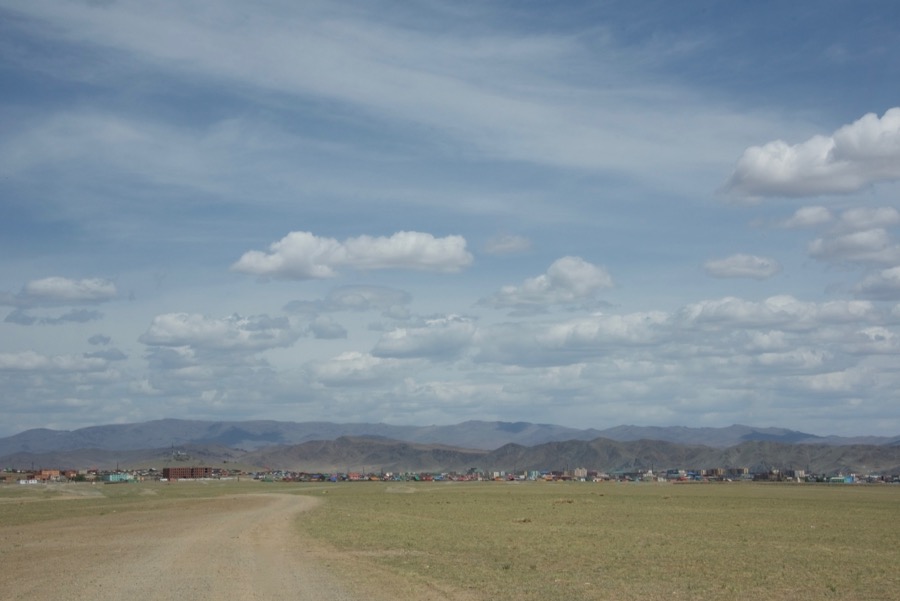
In the far distance were the mountains we were heading for. And, look, a second road sign!
Closing the loop, we arrived back in Bayahongor, which had been our jumping off point for the journey south. We stopped in town and did some final grocery shopping
Then we did what I had originally planned to do when we were there before…travel north up the river valley into the Hangai Mountains to Erdenesogt, which is in the far background
We drove up to a high point with an ovoo and wonderful view of the river valley, then backtracked a short way to a special spot where we set up camp for a few days. And that will be next week’s story.
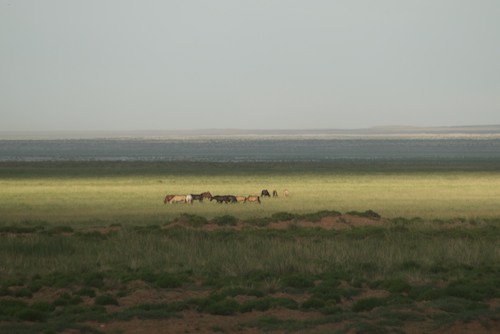
These two Mongol horses were part of a large herd that I saw at Gun-Galuut Nature Reserve in August of 2011. The mosquitos were pretty bad, so they were spending the day standing in a large shallow pond surrounded by a wetland area. Although it is a nature reserve, the local herders are allowed to use the valley as they always have during the times when the ground-nesting cranes aren’t incubating eggs.
Herd of Mongol horses at Gun-Galuut Nature Reserve with the Steppe Nomads eco ger camp in the background. The reserve is only a two-hour drive from Ulaanbaatar
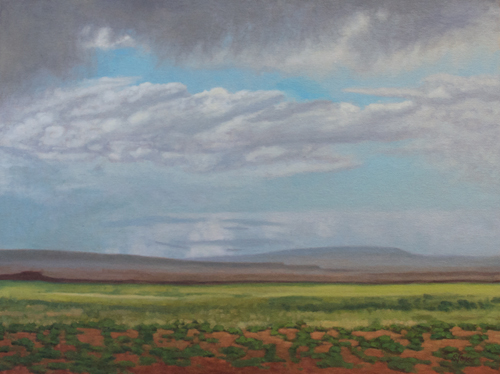
The reference for “Goviin Boroo (Gobi Rain)” was taken in July, 2010 on my amazing two week camping trip. The rains were really good almost everywhere that year and the Gobi, contrary to how most westerners picture it, was green, green, green in many places, including this area near Orog Nuur, a remote Gobi lake where we spent the night.
“Goviin Boroo (Gobi Rain)” 18×24″ oil
I loved the layers of clouds, the streak of sunlight on the grass and the complimentary colors of green and red and knew I’d do a painting of the scene at some point.
You can read about the camping trip by selecting Mongolia 2010 from the drop-down categories menu.
The legendary Gobi….what images it conjures up, some true and some not, as it turns out. A land of contradictions. A desert, but mostly without sand. A byword for dryness and lack of water, but rivers flow through it, there are lakes and it’s known as the source of the sweetest and best vegetables grown in the country.
I grew up in Redwood Country….forests. I’ve always loved forests. My mom loved the desert. Me. Not so much. Until I met this desert.
A view I love…a Mongolian earth road stretching out ahead as far as one can see, Juiy 2010
Time to milk the camels at the only herder’s ger for many miles. Got my first taste of camel’s milk airag, July 2010
It does rain in the Gobi and everything can turn green in a matter of hours, July 2010
My tent on Orog Nuur, a remote Gobi lake, just myself, my guide, the cook, hundreds of birds and gazillions of mosquitos. When camping in Mongolia, you can stop and pitch your tent pretty much wherever you want to, July 2010
Last glow of evening light on The Flaming Cliffs, made famous by Roy Chapman Andrews’ Central Asiatic Expeditions of the 1920s, Sept. 2006
While our original intent had been to spend two nights at Orog Nuur, the combination of heat, mosquitos and there being very few birds around in the morning caused us to decide that we would travel on north instead.
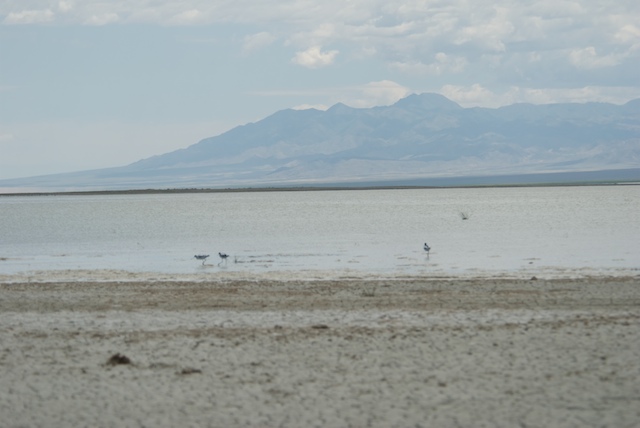
After having lunch on the north side of the lake, where we did see some shorebirds and demoiselle cranes, we worked our way through heavy vegetation on a really rough earth road to get to the main route to Bogd, a soum center, where we re-filled our water containers from the local well.
Shorebirds, Orog Nuur
Demoiselle cranes, Orog Nuur
Then it was up and away from the Gobi toward the Hangai Mountains, another part of Mongolia that I had never seen before.
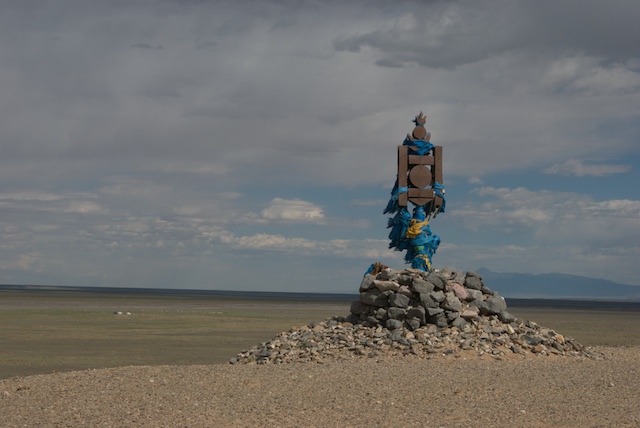
Ovoo with a Soyambu, the National Symbol of Mongolia; very unusual
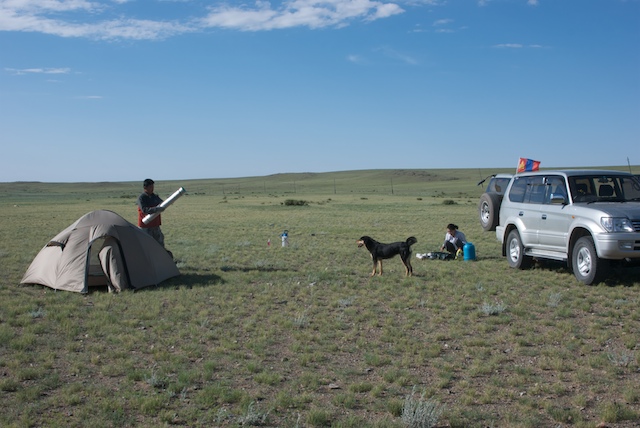
We stopped for the night a short way off the road, after having passed through three changes in vegetation as we went up in elevation. It was cold and windy, quite a change from our previous campsite by the lake, but I slept well.
Upland campsite, with visitor
The next morning we drove into Bayanhongor, an aimag center which was quite a substantial town. We trekked around town buying petrol, eggs, bread and meat. It was an energetic, busy place which had nice tarmac paving in the central area.
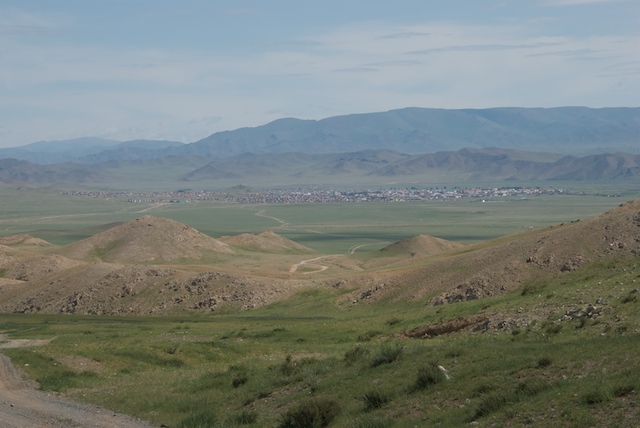
Bayanhongor comes into view, backed by the Hangai Mountains
Horse-drawn water delivery service, Bayanhongor
On the way out of town we found that the road Khatnaa wanted to take was washed out by the recent flooding. Consultations with a number of locals ensued and an alternate route was found. And what a route it was!
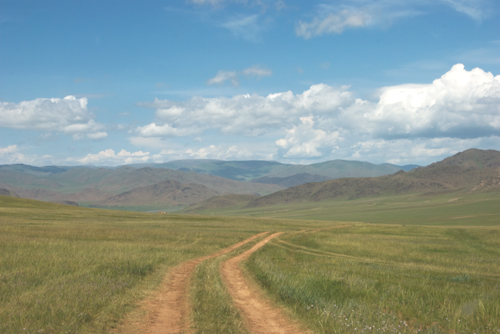
Perfect scene- an earth road leading deep into the Mongolian countryside
Tuy Gol valley
Tuy Gol valley
Yaks, horses and gers; it must be Mongolia!
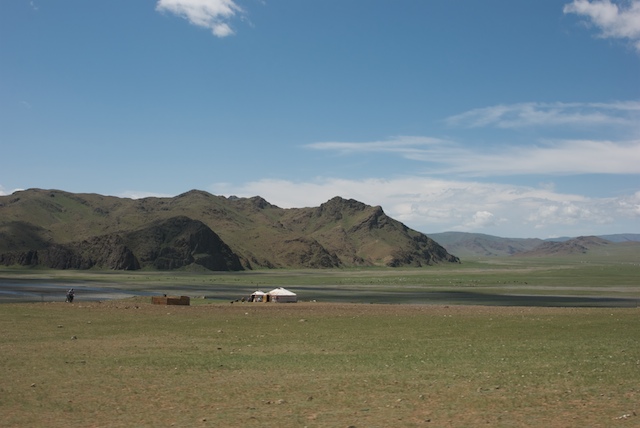
Our destination was the soum center of Erdenetsogt, home to the Gachen Lama Monastery, neither of which I had ever heard of, much less knew anything about. The soum center was typical, except for the lovely setting above the Tuy Gol. The monastery was anything but, as you will see below.
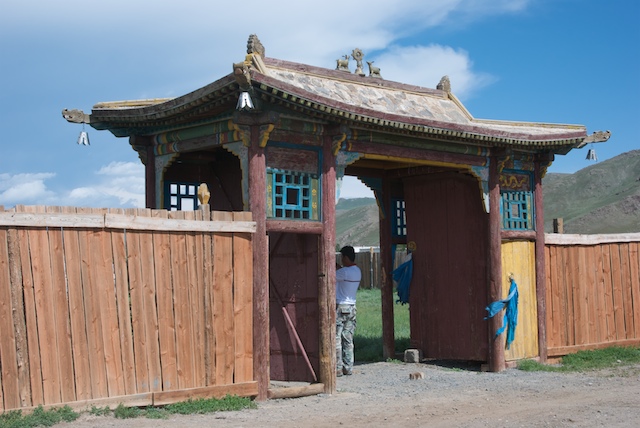
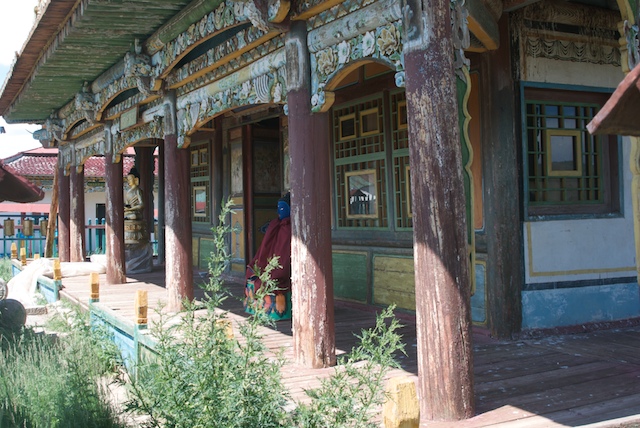
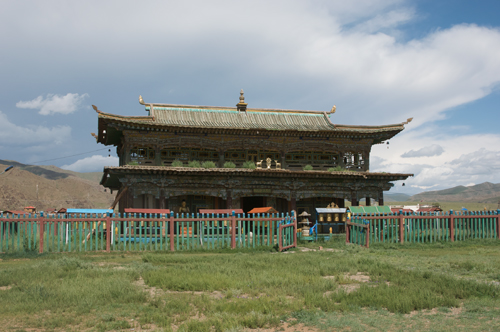
This is one of the most jaw-droppingly beautiful buildings I have ever seen. And what makes it almost unbearably poignant is that it is the sole surviving structure, other than the entry gate, that is left on the site from the destruction of the monasteries that took place in the late 1930s. There were originally ten temples.
The entry gate
Gachen Lama Monastery, old temple
But today the monastery is alive again and it was bustling with activity when we were there in anticipation of a visit the next day by a prominent Tibetan Rimpoche (teacher), who was going to preside over the dedication of two new statues that were to be installed in the new temple next door, which was built in 1990, making it the 20th anniversary celebration.
Temple porch with the two new statues
The old temple was filled with people, many of them elderly women wearing beautiful brocade del. Upon entering, we found that they were preparing hundreds and hundreds of printed Buddhist sutras which were to be placed in the statues. There was a real assembly line going. Some monks were rolling the small strips of paper up very tightly. These were handed to the women who then wrapped them in sewing thread. After a few minutes of watching, Soyoloo reached down, picked up three of the rolled sutras and handed one each to Khatnaa and I, keeping one for herself. Then she got us each of spool of thread. Suddenly we weren’t on-lookers anymore, but participants, truly a gift. We each conscientiously wrapped our sutra and added it to the growing stack. Amazing to think that I’ve left a little bit of me in such a special place.
Preparing for the Rimpoche
One of the two statues
The new temple, just past the row of prayer wheels
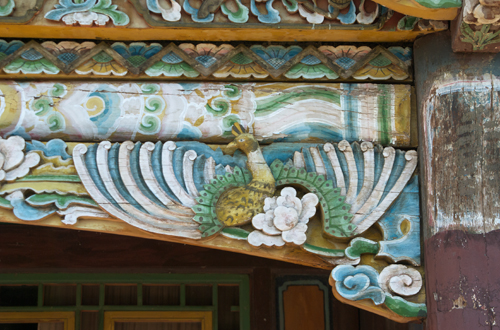
As an artist, the temple was pure eye-candy, being covered with a riot of decorative carvings and paintings on almost every surface. Stylistically it is probably mostly Tibetan, with some Nepalese influence. I’m posting most of the best images I took because when I googled the monastery, I got no hits at all and this place is too special to not share.
Peacock detail,, old temple
Unknown deity or creature, old temple
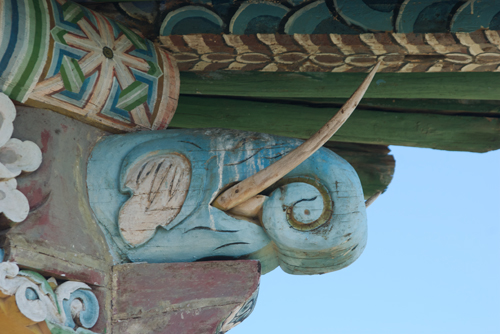
Elephant at corner; for strength- old temple
One corner of old temple; the fretwork gives this large building a delicate, airy feeling
Gachen Lama Monastery; the old temple
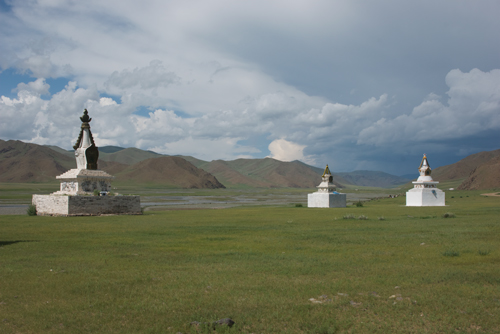
After we left the monastery grounds, we walked toward the river to see the seven stupas which overlook the river valley.
Three of the stupas; cue Jantsannarov’s “White Stupa No. 1”
This seems to be one of the most beloved pieces of music in Mongolia. I love it, too.
We debated whether to stop here for the night in the hope of seeing the Rimpoche the next day. But we really had no idea when he would arrive and were a little uncomfortable being conspicuous as the only non-locals around, so chose to travel on. And that resulted in one of my favorite parts of the entire trip.
I think that in order to communicate with some immediacy one single day that had enough incident for three, I’m going to simply quote my journal entry for July 15, adding images as needed.
“What an amazing day. Went south-west with Orog Nuur as our goal. Khatnaa knew there was the Taatsin Gol to cross, so stopped at a petrol station to ask about it. Also there were two van loads of Mongols from Togrog who were heading west to mine for gold. Usual Mongol socializing and information exchange ensued.
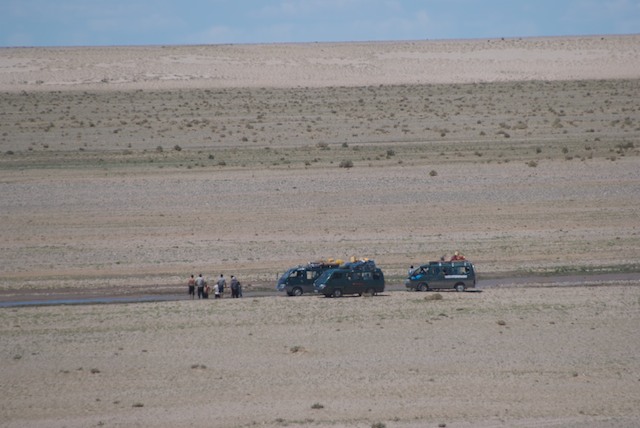
A third van showed up and all headed towards the river, which was flooded due to rains in the Hangai Mountains.
Assessing the situation
We got across one stream, but were stopped by a broad ribbon of streams and mud. The main channel was moving fast and pulsing with even more water.
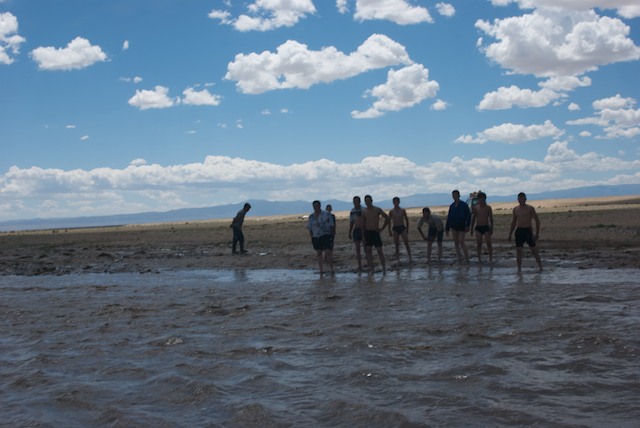
Went back up to the bluff overlooking the river and had lunch, watching the three van loads of Mongols look for a way across and mess around in the water.
Lunchtime for us
Went back down to the river. Khatnaa walked a long way to see if he could find a crossing point, but came back and told us that the last stream of water was the worst of all. So we were faced with going north 100 km to the closest bridge. Such is travel in Mongolia.
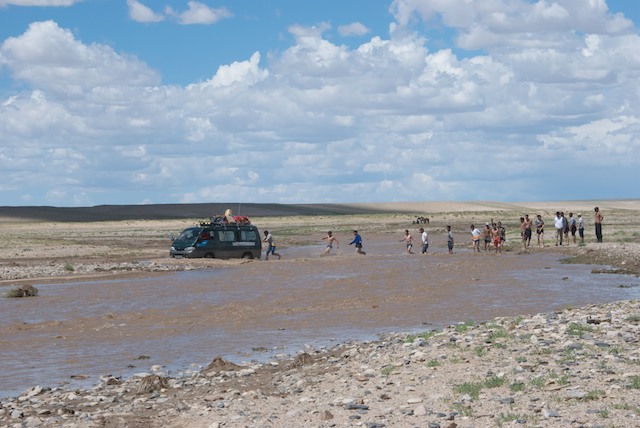
Suddenly, there was action with one of the vans. A bunch of guys had formed a line across one point of the main channel and the van charged into the water, started to stall, but the guys all got behind it and pushed it on through!
First van crosses the river
Well, if a van could make it, our big Land Cruiser certainly could and did, without even needing a push. We did end up with an extra passenger, a little eej (mother) who wasn’t about to miss her chance to ride in our big car.
Our turn. Halfway across.
We got out on the other side and I photographed the other two vans making the crossing. Then said our good-byes.
Third van goes into the river.
We followed one van up a soft sand slope. It promptly got stuck so we rolled back down and went around it and on up the hill.
The entire “adventure” of the river crossing was a perfect example of Mongol practicality, improvisational skills and good humor. No one at any point got angry, showed frustration or swore. When it looked like things had stalled out, the guys took a break and goofed around in the water. Or so it seemed. They were clearly having fun but they were, in retrospect, also searching for a crossing point.
The spot they found was one where the channel wasn’t too wide or deep and where they felt the bottom was solid enough for a vehicle to get across with a minimal chance of getting stuck.
Without winches, cables or even rope, they simply used the same solution they always do – push.”
——
Once across, we were really able to roll for awhile on good earth roads.
At this point we knew that the lake, Orog Nuur, was 2/3 full and that the river flowing into it was impassible due to run-off from the mountains. But we had also been told that there was a road on the opposite side of the lake.
Khatnaa spotted a ger and drove over to it. I usually just stay in the car while he asks directions, but his time he gestured me to get out and said “Let’s visit.”
We ended up spending around two hours with Batsuuri and his family.
When we entered their large, comfortable ger, the first thing I noticed was two boys sitting on the floor watching Star Wars:The Phantom Menace on a small flat screen tv. Batsuuri was sitting on the floor, a couple of older girls were going in and out and Javhlan, his wife, was just starting, I found out later, to make suutai tsai (milk tea). I’ve drunk a fair amount of it by this time, but had never seen it made before.
A bowl of small squares of fried bread and sugar cubes was placed in front of us. The movie ended and the two boys, both Mongol but one had blond hair, started playing with a bunch of nails they had pulled out of a bag. I watched them happily amuse themselves for over half an hour, arranging the nails in various patterns and finally using a closely lined up row of them as a little hammered dulcimer.
At one point a wrestling competition came on the tv and I knew that we were going to be staying for awhile because Khatnaa is a BIG wrestling fan.
Javhlan asked if we would like to try camel milk airag. We all said yes. It was delicious, of course.
As we sat, and Khatnaa and Soyoloo chatted with our hosts (Besides camels, they have about 300 other animals. They lost 10-15 in the zud, nothing, really.), Javhlan made a meal of rice with meat in it and we ended up having dinner with the family.
Then it was time for her to milk the camels. They have 40 camels, seven of which had babies. So I found myself with another amazing photo opportunity.
Javhlan milking one of the camels
I was wearing one of (local Humboldt County artist) Bekki Scotto’s hand-dyed rayon t-shirts and had Khatnaa take some pictures of me standing in front of the camels. I think Bekki will like that.
Soyoloo, our great cook, and I
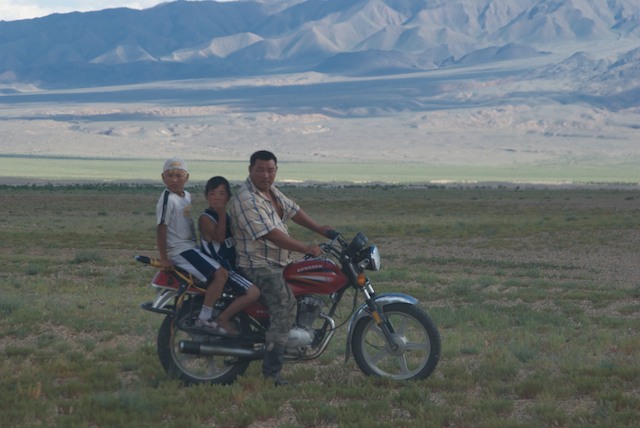
Once the milking was over it was time to leave, but it turned out that there is more than one road around the lake. Batsuuri offered to take us part of the way on his motorbike. Khatnaa provided petrol from a jerry can he had in the car. They had almost finished syphoning when who should pull up but one of the three vans! They had taken the main road to the river, found it flooded and had come back to the only ger for miles to find out if there was an alternate route, so Batsuuri showed them the way also. Once he’d gotten us to the correct road, we waved goodbye and drove on into a large saxaul forest, much of which was in light, almost white, sand. Many stops for pictures. And berries!
Batsuuri shows us the way around the lake
The saxaul forest
Edible berries in the Gobi
Finally we could see the lake, Orog Nuur, in the distance. The passing clouds were creating gorgeous spotlite areas on the mountain range to our left.
Ikh Bogd Uul
Ruddy shelducks, Orog Nuur
We made one more quick stop at a herder’s ger and then found a track down to the lake. We parked, got out, walked down to the shore and Khatnaa announced that we had arrived at “bird heaven”. Indeed. The shoreline had birds from one end to the other. The lake edge had even more mosquitos. I observed that it looked like we had also arrived at “mosquito heaven”, which Khatnaa thought was pretty funny.
But we sure weren’t going to be able to camp there. So we moved away far enough to be out of the worst of it, put on insect repellent that Soyoloo had handy and set up camp.
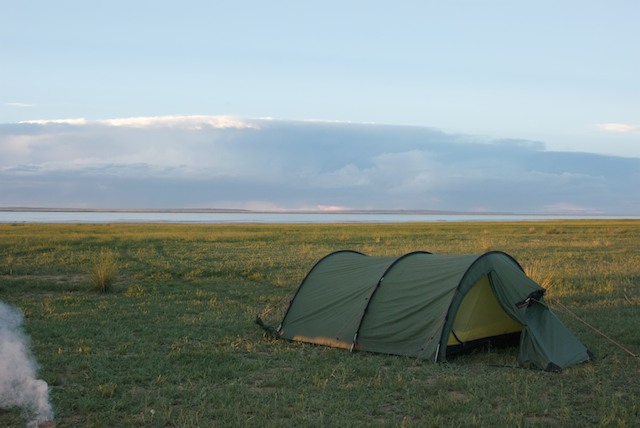
My tent with Orog Nuur in the background
It ended up being cook’s night off since we were all pretty full from the meal at Batsuuri’s. Lunch had been a delicious white fish from Khovsgol Nuur. We all had some leftover fish with rice and a few cookies and we were fine.
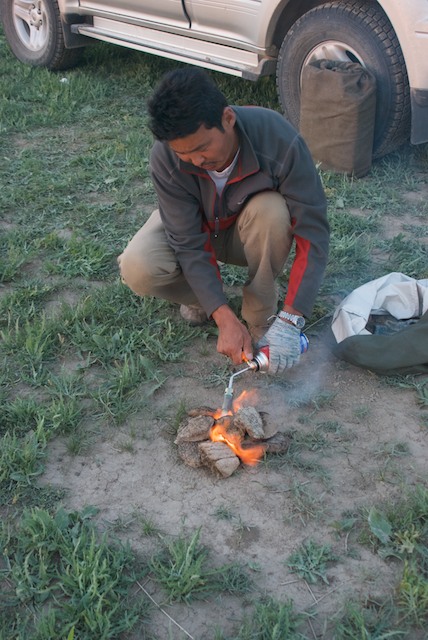
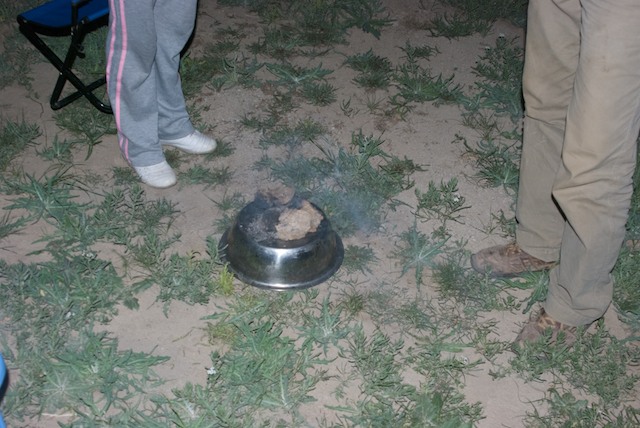
In the meantime, the mosquitos were getting pretty annoying. We had no netting, so , once again, Mongol ingenuity rode to the rescue. Khatnaa went out and gathered a small bag of animal dung which he piled up and set smoking with a small blowtorch. We put our chairs in its path. Problem solved. Until the breeze kept changing direction. Soyoloo came up with a brilliant solution. She turned a metal flat-bottomed bowl upside down and had Khatnaa got a small dung fire burning on it, which meant that instead of moving our chairs to stay in the smoke, we simply moved the smoke. We dubbed it our “nomadic dung fire”.
Setting the dung smoking
The Nomadic Dung Fire
We sat until dark, watching a lightning storm across the lake from us, a spectacular sunset to the north and listening to the Javhlan CD I’d brought from UB, finishing off the last of the bottle of Chinggis Gold vodka and chatting about all kinds of things. A perfect ending to a perfect day.”







































 Susan Fox, American Artist