At last we come to the most important “Snout” of all for Mongolians, the horse. I was told that Mongolians sing about three things: the land, their mothers and their horses. The classic Mongolian musical instrument is the “morin khuur” or horse-headed violin. Here are some that I saw at the Mongolian Artists’ Union gallery in Ulaan Baatar.

Horses have inspired Mongolian art for a very long time. I happened on this delightful modern “horse art” in the courtyard of the Museum of the Chojin Lama in Ulaanbaatar.

And here’s the explanation that was nearby. This was in September of 2006 and I have no idea if they are still there, but the museum is on the list for the upcoming trip, so perhaps we’ll be lucky and get to see them again.

I find that there is often confusion between the, more or less, domestic Mongolian horse and the takhi or Przewalski’s Horse, which is the only surviving species of true wild horse. They are different species. There are domestic horses who have physical traits that indicate a past cross with the takhi, which were extinct in the wild as of 1969. I’ve seen a number of Mongolian horses with some combination of upright, brushy mane, a reddish dorsal stripe, a light eye-ring or muzzle and maybe tarsal and/or carpal stripes on the legs.
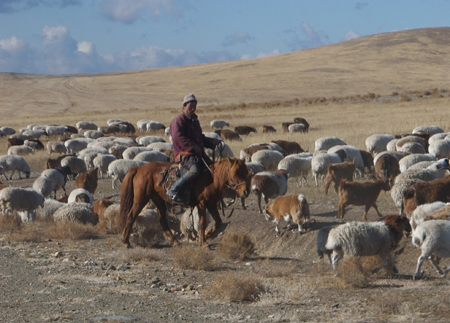
As one travels about the countryside, the herder’s establishments are a blend of old and new. Motorbikes, solar panels and satellite dishes aren’t uncommon, but everywhere there was always at least one horse saddled, bridled, hobbled and ready to ride at a moment’s notice. Mongols are, after all, the original horse culture.
The Mongolian horses are beyond tough. They are left to roam at large most of the year and manage to survive weather, down to -40F in the winter, that would kill most other horses. I have read at least two accounts of western writers who traveled across Mongolia by horse and who described the morning saddle-up as “a rodeo”.
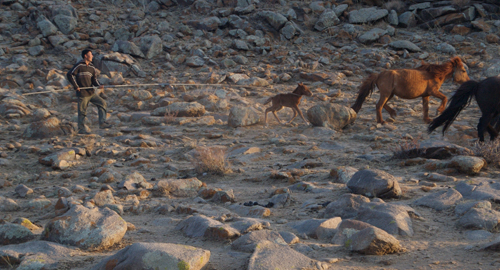
One evening at Ikh Nart, we watched a young Mongolian man capture a foal with an “urga”. Mom was not amused and kept a close eye on things.

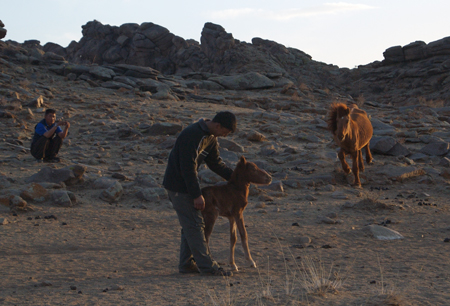
One of the things that amazed me when I saw them for the first time at Ikh Nartiin Chuluu was that even though it was spring (and anyone who has been to Mongolia knows what that means weather-wise: cold, wind, dust storms) and most of the horses were terribly thin, many had long- flowing manes and tails that were gorgeous.
This was one of my favorite pictures from my first trip in the spring of 2005. The young herder was perfectly happy to have his picture taken with me as long as his horse was included. No problem.
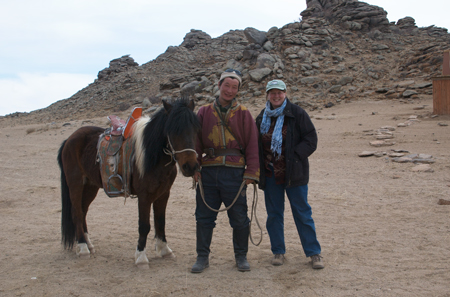
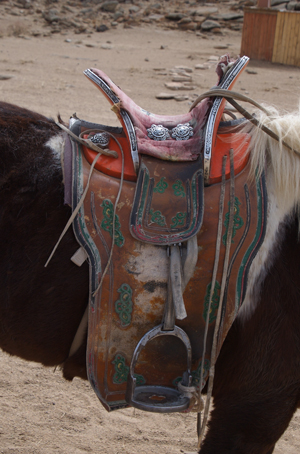
And here a close-up of the saddle. The silver bosses on the side are to “encourage” the rider to ride standing in the saddle.
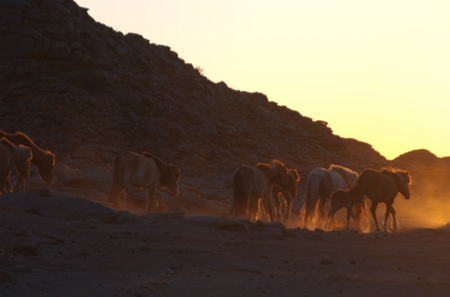
Finally, another one of my favorites; a herd of horses coming down to the stream to drink at Ikh Nartiin Chuluu.
 Susan Fox, American Artist