Today I thought I’d share my record of the progress of a painting that is currently hanging in the Redwood Art Association juried membership show at the Morris Graves Museum of Art in Eureka, California, which is about 20 minutes from where I live. This sequence should give you a pretty good idea of how I work.
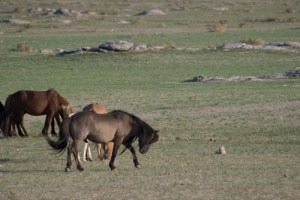 Here’s the reference image that I started with. It was taken in September 2008 at Ikh Nartiin Chuluu Nature Reserve. This group of horses wandered right past the ger camp one evening. I got lots of great pictures. Looking at them when I got home, I was struck by the stallion’s pose as he showed off around the mares. I haven’t done too many domestic horse paintings and I wanted to really focus in on understanding their structure and capturing the sheen of the coat, so I decided to use a fairly large canvas and only paint the horse.
 Here’s how I started. The support is gessoed canvas on hardboard and measures 24″x36″. I did an initial lay-in with a brush. All I cared about at this point was getting the horse where I wanted him on the canvas and indicating the proportions correctly. You can see on the front leg that is lifted where I have started to do the actual drawing.
 This step shows the finished drawing for the head, shoulder and front legs. At this point, I had dragged out all my books on horse anatomy to double check the structure and confirm that I had understood it correctly. Changes are easy to make at the drawing stage, but I’ll wipe out and re-do at any point if I see something that’s wrong. That’s just the way it goes sometimes and I don’t fight it or make excuses to myself anymore. I also have a full-length mirror behind me and I use it constantly to check the drawing for accuracy. I’ve designed the mane and the tail shapes, some of which are planned to go off the edge of the canvas so the horse isn’t floating and looks more like he just happened to be walking through the frame.
I’ve started to lay in the first layer of color on the body and hindquarters and am already varying the values to pick out anatomical structures like the hind leg tendon and to start suggesting the roundness of the torso. Since I’m working from a digital photograph, which flattens form, I’ve schooled myself to compensate by always looking for ways to get back the three dimensional form I know is there.
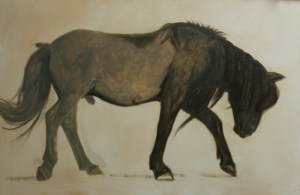 I’ve finished the initial color layers and am starting to paint with the knowledge that the strokes I make now will quite possibly be visible in the finished painting. I’m always refining the drawing as I go. One of the things that interested me about doing this particular piece is that you can’t see his eyes at all, so I wanted to capture his attitude and character from his body language and by painting him big on the canvas. I was also thinking of the design of the positive space -the horse- and the negative space -the background.
I’ve developed a procedure in which I go darker and the opposite color temperature than where I want to end up. When I come in at the last with the final value and temperature, the contrast will create the richness and variety that I really like.
 Most of the basic lay in is done. All my darkest darks and medium tones are in, except for those patchy looking bits that I haven’t gotten to yet. Now the fun starts….all the juicy highlights, modeling and finishing touches that are a reward for the prep work leading up to it.

And here is the finished painting! Since all I cared about was the horse, I kept the background simple and just added some shadows to “ground” him. I wanted a neutral tone that related to his color and then added the soft yellow band to give it a little visual punch. I feel like I have a much better grasp of horse anatomy now and I’m pleased with how it came out.
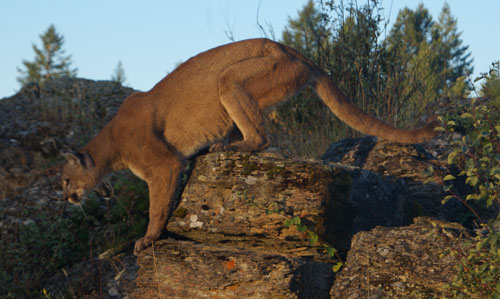
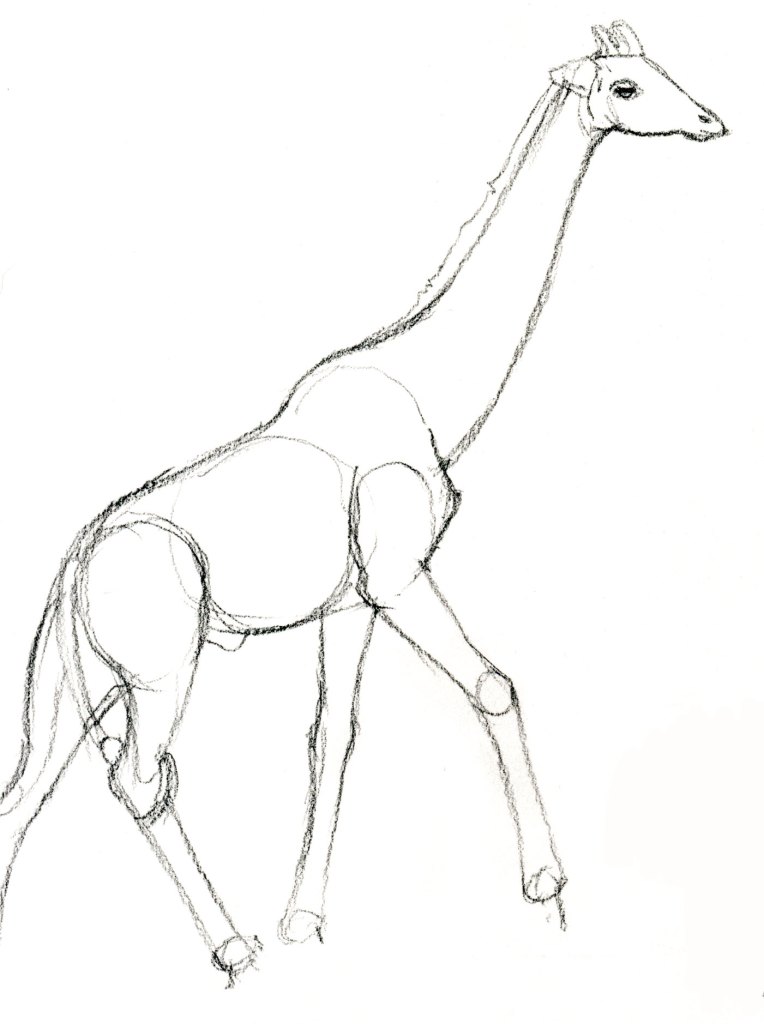
 The only real difference is the position of the head, but the 3/4 view really changes the flow of the top line and actually stops the sense of movement.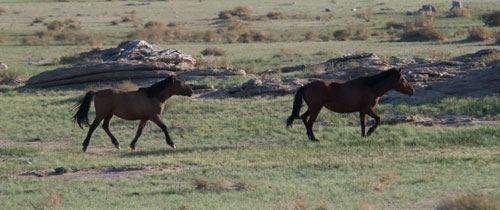



 Susan Fox, American Artist