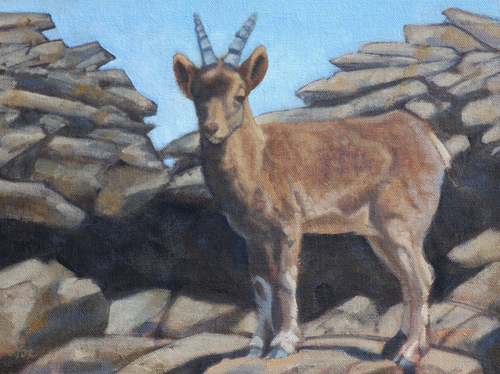
I thought that I would start to share how I put my Mongolia paintings together, starting with a subject from Ikh Nartiin Chuluu Nature Reserve. I had never been to a place anything like it and before I began any finished gallery paintings, I needed to learn to paint the various elements, both the land and the animals. Here are two studies of the rocks, one of a young ibex and a finished 15×30 of two argali-
Since most people are not familiar either with the species or the place, I wanted this first painting to show the kind of landscape that argali like; not just mountains, but upland areas with these rocky outcroppings. You can see the steppe down below and off in the distance. These were two rams who were spending at least part of the day together. It turns out that argali don’t form permanent harems or herds. Animals of all ages and both genders group and re-group throughout the day in numbers, at least from what I saw, from one to twenty or so and everything in between.
Arrived in Ulaanbaatar yesterday afternoon. Managed to get together with a couple of the Mongolian scientists that I met on the Earthwatch project in 2005 and got an update about what is happening at Ikh Nartiin Chuluu.
And….had a hoped-for email from my husband informing me that I have had two paintings accepted in the Society of Animal Artists show “Small Works, Big Impressions”! One is of two young marmots and the other is of a takhi mare and foal. The show will be at The Wildlife Experience in Parker, Colorado, which is just south of Denver. More after I get home.
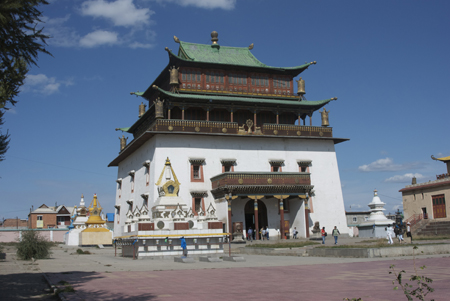
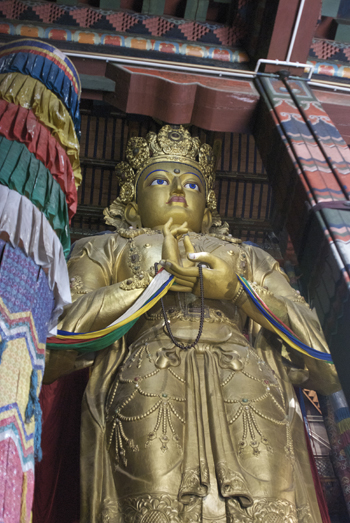
But first, the day before my husband, David, left for home, we walked up to Gandan Monastery and around the downtown. There are more monastery photos on my website but the last time the main temple building was closed. This time we were able to go in and see the gigantic statue of Buddha.
Main temple, Gandan MonasteryBuddha statue, which is almost as tall as the building
David flew home on the afternoon of the 14th after I had left for Ikh Nart. Colleen, the other artist who accompanied us for part of the trip, and I spent the first day trekking around the reserve. We went out with the driver the second and third mornings. The afternoon of Day Two, two busloads of 26 Swedish tourists, who had come from Moscow via the Trans-Siberian Railway, arrived for a couple of nights, so things were very lively. Here’s a selection of images from Ikh Nart, trip 2-
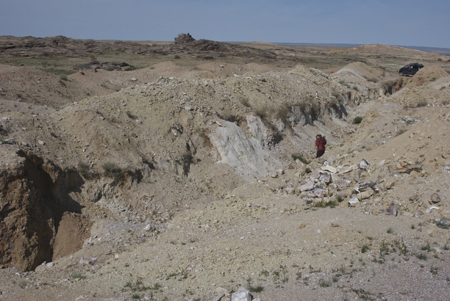
Open pit gem mine
One of the conservation challenges the reserve faces is illegal mining for gems like amethyst. The addition of more rangers has mostly stopped this kind of thing, but the damage remains and will have to be repaired as funding allows. That’s Colleen in the trench for scale.
Rock formations
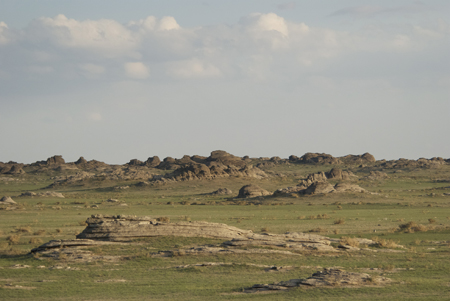
On the other hand, this is the kind of thing, besides the wildlife, that makes Ikh Nart special, the amazing rock formations.
Rock formationView looking south from campArgali sighting
Saw very few argali. They were clearly elsewhere, as were the herder families. The rains didn’t come when they were supposed to, so everybody left. Then it rained like crazy, as described in a previous post, and things greened up. It looked like some families were coming back as we left.
Horses near the ger camp
I thought that that’s what seeing these horse meant, but learned last night that the herders take their sheep, goats and camels, but leave the horses on their own. Looks like they’re doing ok to me.
The reserve faces a number of threats, including overgrazing and climate change, so the challenges exist on a micro and macro level. At one time the grass came up to the bellies of the cows. I hardly saw any grass. It is being replaced by “forbs”, perennial plants, some of which is edible by livestock and some not. I have no idea what the possibility is of reversing this, if it can be done at all. Climate change may trump everyone’s efforts. So, the work then will be to help the country people adjust to the new reality. I don’t know what the prognosis is for the wildlife. The argali seem to be holding their own, so far, which is good.
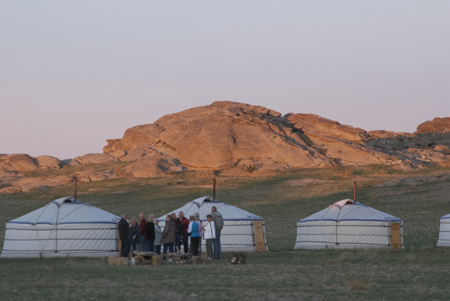
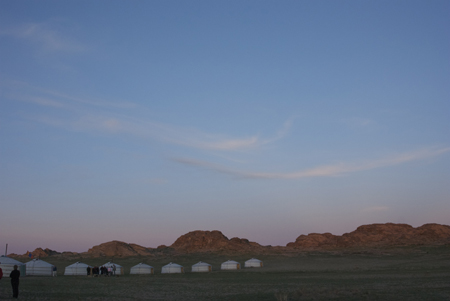
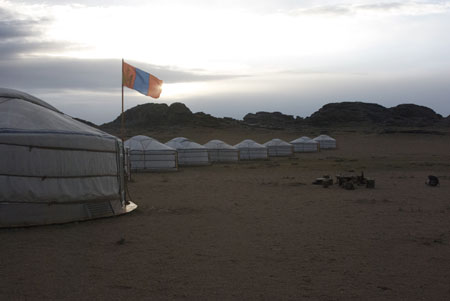
One of the things I love about Ikn Nart are the sunrises and sunsets on the rocks. So, to conclude my Mongolian trip blog, here’s a couple of final images from one of my favorite places in the world.
Sunset with SwedesSunset over the ger camp
Thanks to all of you who followed along and left comments. I had no idea whether this would work or not and I’m glad it did. It’s pretty amazing when you think about it. Not that long ago, just making an international phone call from Mongolia would have been a challenge. Now Mongolia is as connected to the rest of the world as the USA. Most Mongolians can’t afford their own computers yet, but there are lots of internet cafes to provide access
I fly to Beijing tomorrow, stay overnight and then home. Hope to be back at the easel after catching up on mail, petting the cats, kissing my sweetie, etc. Oh, and getting at least the basic cataloging done on the over 2300 images I’ve shot. I can hardly wait to get painting again!
We left the hotel on time, a quick stop by the Nomadic Journeys office, and we were on our way. All the way to the edge of UB, where we pulled into a gas station because….a hose had split. Cell phone call went out to the driver’s son. Two attempts to epoxy it back together. Wouldn’t hold.
Can we fix it?
So we swapped cars with the son, who drove us to Ikn Nart in record time in order to get there before dark. The camp cook who was with us knew the way, which was good, since the dirt track in only had some rocks with rough arrows on them for direction. We arrived to a beautiful warm summer evening. Balmy, in fact.
At around 3:30am, David heard the camp guys outside the ger, pulling the top cover closed because of howling wind and rain. For the next 26 hours, on into the following night, it almost never let up. The toilet was around 50 yards from the ger, so we just changed back into the wet clothes when we needed to go up there. I was still feeling punk from the cold I wasn’t quite over with when we left, so a day of enforced rest wasn’t entirely a bad thing.
It wasn’t particularly cold, but as the day wore on, we saw damp areas start to appear in the cloth covering that faced the wind. Finally some water started to drip in in spots. The gers are covered with what our guide called “Russian canvas” for waterproofing and it mostly worked. Tuya, our guide, came back to the ger to chat after dinner and we could see that it was getting worse and worse. One of the camp guys came in and said that one of the other gers was dry, so we pulled together our stuff in about a minute and moved. A fire was quickly lighted in the stove (wood and dung) and we settled in for the night without any idea of how long the storm would last. For all we knew, we had driven six hours to sit in a ger for three days.
But the next morning was sunny, cold and windy and we went on our first trek after breakfast. Amazingly, we encountered the ranger who I remembered from the Earthwatch project from 2005. He had been out all night in the storm and had lost 10 sheep and 3 goats, which we calculate was about 15% of his animals.
By afternoon, it was warm, sunny and blue skies and the same the next day. Here are some photos from the rest of our stay. We came back to UB yesterday and are at the Bayangol Hotel. It’s now 10:30am Tuesday morning and we are headed out to wander around and museum hop. More this evening (my time). Also, I’ve inserted some photos in the previous posts.
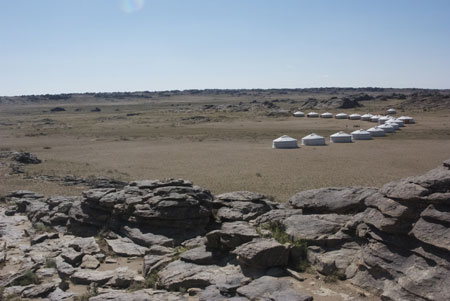
Before the stormRed Rock Ger CampMaikhant helping sheep after stormHorses grazing near ger campArgali, what I came here for mostlyDavid enjoying the sun in front of our gerMe and the cook's kitten
Almost everyone has heard of cashmere. It’s traditionally been associated with other high end luxury goods, like silk and gold jewelry. What isn’t widely known, and I’m hoping this will change, is that the best cashmere in the world comes from Mongolia. Cashmere is superfine angora goat wool. But the goats are pretty special, given that they can tolerate winter temperatures down to -40F.
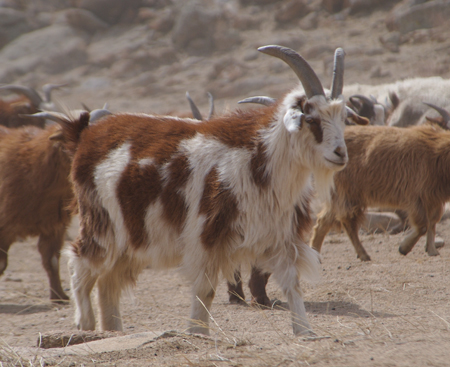
I’ve seen the goats mostly at Ikh Nartiin Chuluu Nature Reserve and found them quirky and fun to watch. As you will see, they come in all shapes, sizes, colors and horn “designs”. But the undercoat is the same on all of them, so the rest doesn’t matter.
While there are businesses in Mongolia that take the raw cashmere and turn it into a finished product, most of the wool is purchased by the Chinese and taken back to China. Our Earthwatch group got to visit Gobi Cashmere in Ulaanbaatar. I brought home a wonderful natural color cashmere neck scarf that is as soft as can be.
But here’s where it starts, with each goat being hand-combed in the spring. Other than the 30 minutes or so they are constrained for combing, they wander free in the countryside, adding a little character and humor to the landscape.
I took this photo on my first visit to a herder’s ger just outside Hustai National Park.
A “pinto” goat at Ikh Nart.
Goats and other livestock being herded through the research camp at Ikh Nart where they had been brought for watering.
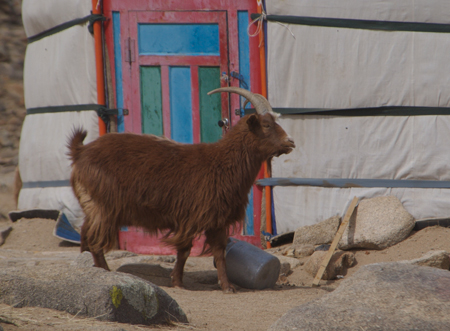
There’s one in every crowd. This one just…had…to…see what was in the can.
These goats are part of a large two ger establishment near the Tuul Gol (river) just outside of Hustai National Park.
Answer to Friday’s question: Roses. Vintage Gardens in Sebastopol, California was having an end of season sale of roses that they might be discontinuing, so I’ve ordered a bunch that looked interesting to help preserve them. Most I’ve never heard of before.
I’ll have to be honest and say that currently I don’t know much about Mongolian sheep. I hope to learn more on the next trip.
I did find a United Nations FAO report that included the following information; Sheep in Mongolia may be grouped into five types. The common native sheep are multipurpose and low in productivity. The other four are used more specifically for their meat (mutton), carpet wool, milk and good-quality lambskins. Grazing is on year-round pastures with no supplementary feeding, even under severe winter and spring conditions. The sheep are well adapted to the unfavourable ecological conditions of steep mountains and poor vegetation.
One distinctive feature of the native coarse wool fat-tailed sheep is noticeable when new grass grows on the pasture: at this time they grow rapidly, are easy to fatten and have a remarkable ability to store 4 to 6 kg of fat around the kidneys, mesentery and the tail bone. This fat is drawn on in winter and spring.
Sheep are reared according to the natural and economic conditions of the different regions in the country. Improvement achieved by crossing exotic, fine and semifine wool sheep breeds has been rapid in Mongolia and the results reasonably good. The average fleece weight of improved (cross-bred) fine and semi-fine wool sheep is two or three times higher than that of the native coarse wool of fat-tailed sheep. Wool quality has also improved.
There are five distinct sheep breeding zones:
· the northern mountain and grassland zone;
· the central steppe zone;
· the southern semi-arid zone;
· the southernmost, semi-desert zone of the Gobi;
· the Altay Mountains in the west.
The northern mountain grassland zone and the central steppe zone are given over to the breeding of fine and semi-fine wool sheep. In the southern semi-arid zone and the northern enclave, Mongolian fat-tailed sheep are purebred. Selection of breeding stock increases the quantity and improves the quality of the carpet wool.
In the extreme south, the semi-desert area of the Gobi has been allocated to Karakul breeding for lambskins. The production of mutton, fat and carpet wool takes place in the western part of the country and includes the Altay Mountains.
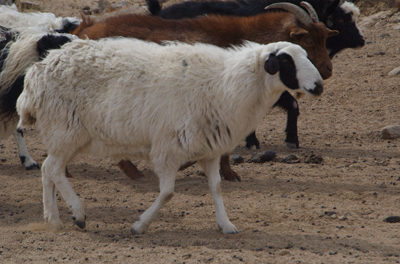
Here are some photos that I’ve taken of sheep.
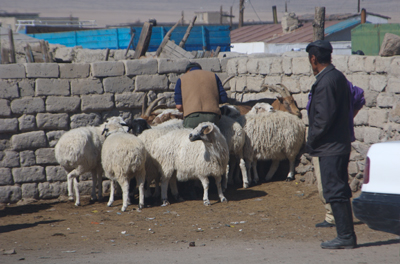
A small flock at the market in Hovd, western Mongolia
“King of the Mountain” at Khar Us Nuur, also western Mongolia. Goats in the foreground, but that’s for next week.
Part of a large group of domestic livestock coming down to the stream to drink at Ikh Nartiin Chuluu Nature Reserve, south of Ulaanbaatar
Finally, for comparison, a wild argali, the world’s largest mountain sheep. This old ram with the amazing horns let me follow him around for almost 20 minutes. As you can see, he is very thin. It was late April and a lot of the animals, wild and domestic were in rough shape from the winter.
One of the main uses of the wool is to make the big pieces of felt which cover the gers. Depending on the weather, there can be one to three layers. I’ve slept in a ger in cold weather with one layer and the next night, one with two layers and the difference was quite noticeable.
One of my most useful souvenirs from Mongolia are my felt slippers. I also got a pair of felt boots. Both are amazingly warm and comfy. I would recommend them to anyone who gets cold feet!
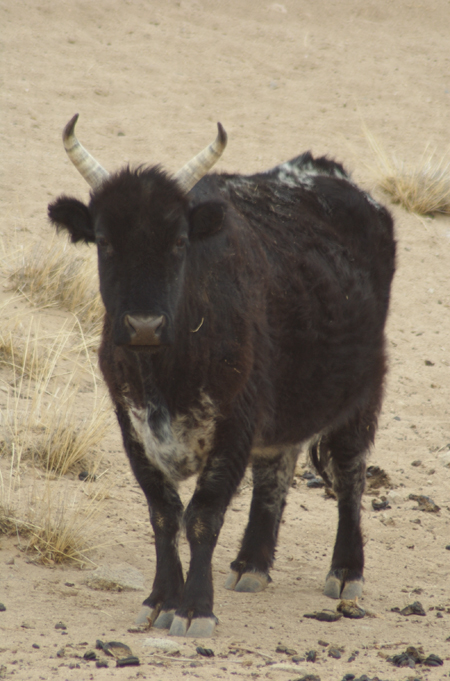
Most of us don’t think of Mongolia as cattle country, but I did see at least a few most places I went. Needless to say, they are as hardy as the other animals the herders keep. There are a number of breeds and they have also been crossed with yaks to create a hybrid the Mongolians call a Hainag. Here are some that I saw when I was at Ikh Nartiin Chuluu Nature Reserve in spring of 2005.
This cow and calf were part of a group that were coming down to the stream for water.
Here’s a black cow who looked me over for a minute.
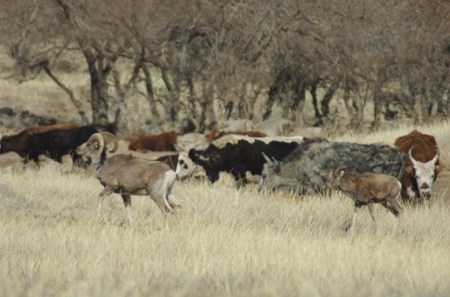
And, of the most interest to me, since it demonstrates the competition wildlife can face from domestic stock, are a couple of argali down at the same stream with the cattle.
When I was in western Mongolia in Sept./Oct. of 2006 we stopped at a ger and I took a number of pictures, including a few of this beautifully dressed woman and her cattle. The man was one of my guides. As it turned out, what I had photographed was him buying milk…for us! When we were back in the van and on our way, I was offered a swig of milk, warm and right out of the cow. It was the best milk I’d ever tasted! It was also the first time this town-raised girl had ever had milk that wasn’t out of a carton. And no, I didn’t “pay” for it later, fortunately.
I love to paint. I love to travel. I love animals. Put it all together with supportive husband who used to stack up the frequent flyer miles, and you get a nature artist who has been lucky enough to go to Kenya twice, Mongolia twice and North American wildlife ground zeros like Yellowstone, the Grand Tetons and Glacier to sketch, observe and photograph a mouthwatering variety of wildlife and their habitats.
The painting above is “Ikh Nartiin Chuluu Argali”, a 15″x30″ oil on canvas. The name translates as “Great Sun Rocks Sheep”. My first trip to Mongolia was in April of 2005 to participate in an Earthwatch Institute project “Mongolian Argali”, which are the world’s largest mountain sheep. A ram can weigh over 400 lbs. and have a horn curl of 65″. In this painting I felt that I was introducing a species that not many people have seen, so I wanted to show them in their environment in the reserve, which is a large area of rocky outcroppings rising up above the steppe, which you can see in the background. “Ikh Nart” is about a five to six hour drive southwest of Ulaanbaatar on a road that largely parallels the railway line to Beijing.
They blend in very well with the rocks and so I designed my composition with the idea that the viewer would see the lead ram first since its head is in high contrast against the background and the second ram, well, second.
For more on my travels, visit my website. For more on the reserve, visit the website listed to the right.


















 Susan Fox, American Artist
