UB to Ikh Nartiin Chuluu

We left the hotel on time, a quick stop by the Nomadic Journeys office, and we were on our way. All the way to the edge of UB, where we pulled into a gas station because….a hose had split. Cell phone call went out to the driver’s son. Two attempts to epoxy it back together. Wouldn’t hold.

Can we fix it?
Can we fix it?

So we swapped cars with the son, who drove us to Ikn Nart in record time in order to get there before dark. The camp cook who was with us knew the way, which was good, since the dirt track in only had some rocks with rough arrows on them for direction. We arrived to a beautiful warm summer evening. Balmy, in fact.

At around 3:30am, David heard the camp guys outside the ger, pulling the top cover closed because of howling wind and rain. For the next 26 hours, on into the following night, it almost never let up. The toilet was around 50 yards from the ger, so we just changed back into the wet clothes when we needed to go up there. I was still feeling punk from the cold I wasn’t quite over with when we left, so a day of enforced rest wasn’t entirely a bad thing.

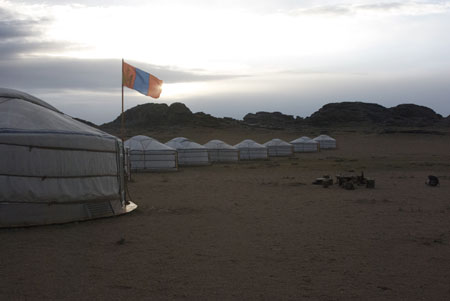
It wasn’t particularly cold, but as the day wore on, we saw damp areas start to appear in the cloth covering that faced the wind. Finally some water started to drip in in spots. The gers are covered with what our guide called “Russian canvas” for waterproofing and it mostly worked. Tuya, our guide, came back to the ger to chat after dinner and we could see that it was getting worse and worse. One of the camp guys came in and said that one of the other gers was dry, so we pulled together our stuff in about a minute and moved. A fire was quickly lighted in the stove (wood and dung) and we settled in for the night without any idea of how long the storm would last. For all we knew, we had driven six hours to sit in a ger for three days.

But the next morning was sunny, cold and windy and we went on our first trek after breakfast. Amazingly, we encountered the ranger who I remembered from the Earthwatch project from 2005. He had been out all night in the storm and had lost 10 sheep and 3 goats, which we calculate was about 15% of his animals.

By afternoon, it was warm, sunny and blue skies and the same the next day. Here are some photos from the rest of our stay. We came back to UB yesterday and are at the Bayangol Hotel. It’s now 10:30am Tuesday morning and we are headed out to wander around and museum hop. More this evening (my time). Also, I’ve inserted some photos in the previous posts.

Before the storm
Before the storm
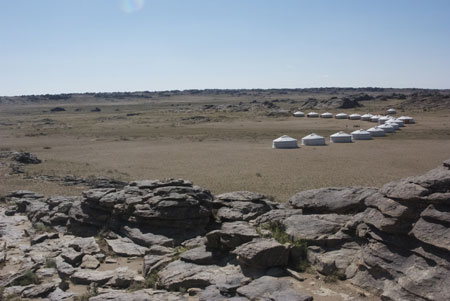
Red Rock Ger Camp
Red Rock Ger Camp
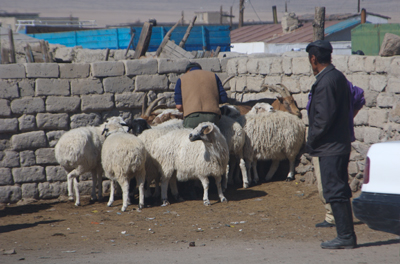
Maikhant helping sheep after storm
Horses grazing near ger camp
Argali, what I came here for mostly
David enjoying the sun in front of our ger
Me and the cook's kitten

Mongolia Monday: The Five Snouts, Part 3

I’ll have to be honest and say that currently I don’t know much about Mongolian sheep. I hope to learn more on the next trip.

I did find a United Nations FAO report that included the following information;
Sheep in Mongolia may be grouped into five types. The common native sheep are multipurpose and low in productivity. The other four are used more specifically for their meat (mutton), carpet wool, milk and good-quality lambskins. Grazing is on year-round pastures with no supplementary feeding, even under severe winter and spring conditions. The sheep are well adapted to the unfavourable ecological conditions of steep mountains and poor vegetation.

One distinctive feature of the native coarse wool fat-tailed sheep is noticeable when new grass grows on the pasture: at this time they grow rapidly, are easy to fatten and have a remarkable ability to store 4 to 6 kg of fat around the kidneys, mesentery and the tail bone. This fat is drawn on in winter and spring.

Sheep are reared according to the natural and economic conditions of the different regions in the country. Improvement achieved by crossing exotic, fine and semifine wool sheep breeds has been rapid in Mongolia and the results reasonably good. The average fleece weight of improved (cross-bred) fine and semi-fine wool sheep is two or three times higher than that of the native coarse wool of fat-tailed sheep. Wool quality has also improved.

There are five distinct sheep breeding zones:

· the northern mountain and grassland zone;
· the central steppe zone;
· the southern semi-arid zone;
· the southernmost, semi-desert zone of the Gobi;
· the Altay Mountains in the west.

The northern mountain grassland zone and the central steppe zone are given over to the breeding of fine and semi-fine wool sheep. In the southern semi-arid zone and the northern enclave, Mongolian fat-tailed sheep are purebred. Selection of breeding stock increases the quantity and improves the quality of the carpet wool.

In the extreme south, the semi-desert area of the Gobi has been allocated to Karakul breeding for lambskins. The production of mutton, fat and carpet wool takes place in the western part of the country and includes the Altay Mountains.

Here are some photos that I’ve taken of sheep.

A small flock at the market in Hovd, western Mongolia

“King of the Mountain” at Khar Us Nuur, also western Mongolia. Goats in the foreground, but that’s for next week.

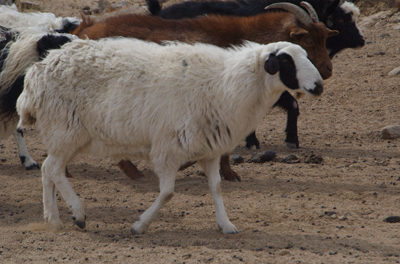
Part of a large group of domestic livestock coming down to the stream to drink at Ikh Nartiin Chuluu Nature Reserve, south of Ulaanbaatar

Finally, for comparison, a wild argali, the world’s largest mountain sheep. This old ram with the amazing horns let me follow him around for almost 20 minutes. As you can see, he is very thin. It was late April and a lot of the animals, wild and domestic were in rough shape from the winter.

One of the main uses of the wool is to make the big pieces of felt which cover the gers. Depending on the weather, there can be one to three layers. I’ve slept in a ger in cold weather with one layer and the next night, one with two layers and the difference was quite noticeable.

One of my most useful souvenirs from Mongolia are my felt slippers. I also got a pair of felt boots. Both are amazingly warm and comfy. I would recommend them to anyone who gets cold feet!

The Elk, part two

ANIMAL STUFF

Went over to the shelter for my usual Wednesday afternoon gig yesterday. Almost didn’t go because I was feeling kind of tired. But working with the animals and getting out on my feet usually energizes me, so off I went.

And was dragooned by a kennel attendant about 10 seconds after I walked in to “help with an animal”. Dog or cat, I asked. Neither, she said. Hummm, I thought. We entered a small outdoor enclosure and there lying on the floor covered up with towels was a jersey bull calf, who had been brought in two hours earlier. He was a newborn, so new that his umbilical cord was still wet when he arrived. He was also pretty scrapped up. They don’t know yet if he was dumped (being a male of a dairy cow breed means you are of very limited use) or fell off a truck, but they needed to get some food in him immediately. So Kathy held the calf, I held the bottle of colostrum and with some sweet talk and stroking, I got him to start sucking at the nipple. Now, mind you, the only reason I ever wanted to go to the fair as a kid was to see the animals, but I’ve hardly ever even petted a cow and here I was getting to help save this (not-so-little) guy’s life. Deep satisfaction doesn’t begin to describe how I felt.

One of the animal control officers has extensive experience with cattle, both dairy and beef and also lives near the shelter, so he has volunteered to take care of him and make sure he eats. The calf also made the front page of the local newspaper this morning. I’ll post updates as I find out more and a photo if I can get one.

ART TALK

So, back to the *#@*!^ elk. Upon further review, something was seriously not right and I spent most of Tuesday and part of Wednesday fixing it. The drawing of the head was out a mile and the neck was too short, plus a few minor, quickly fixed problems with the hind end. I’ve now repainted the head, oh, I don’t know, six or so times. One of the challenges when faced with something like this is to do what needs to be done and still end up with something that doesn’t look labored.

Over at Julie Chapman’s blog, there is a comment thread discussing a common phenomena in art in which the artists who are competent professionals agonize and tear their hair out and artists who aren’t very good always seem to be pleased with what they’ve done, oblivious to the problems in their work and impervious to any criticism. I’m definitely in the “agonize” column. Just ask my husband.

One theory I have is that, as according to Buddhism, people don’t like to be uncomfortable. They move toward pleasurable things and cling to them and away from unpleasant or uncomfortable things. It’s hard to just be with whatever is going on without getting caught up in it one way or another. Really seriously creating art that is good, whatever the media, means living with frustration, mental exhaustion and doubt, none of which is particularly comfortable. Any dedicated artist reading this knows what it feels like when you’ve busted your butt all day and finally your mind just hits the wall and slides down to the floor. Then you know it’s quittin’ time.

But all that can be avoided if one takes the position that everything is fine, just fine. And, if you don’t get into juried shows or organizations, hey, it’s all subjective and they don’t know what they are talking about anyway. Letting go of that means that you have to take responsibility for your art and its shortcomings and, to improve, you have to be willing to do what it takes. And that’s one big thing that separates the amateurs from the professionals. You do what it takes to get it right. No excuses or rationalizations.

I remember when I made the conscious decision to pursue oil painting (and drop illustration, graphic design, etc.) and see just how good I could get. I realized that I had to face the possibility that I would give it everything I had and that, in the end, through an inability to exercise correct choices or judgement, that I would only ever be a mediocre painter. That thought made me sick inside. But I couldn’t turn away, so I accepted the challenge. None of this has ever come easily to me, so one thing I know how to do is hang in there and struggle through. Which brings us back to that bloody elk, part two-
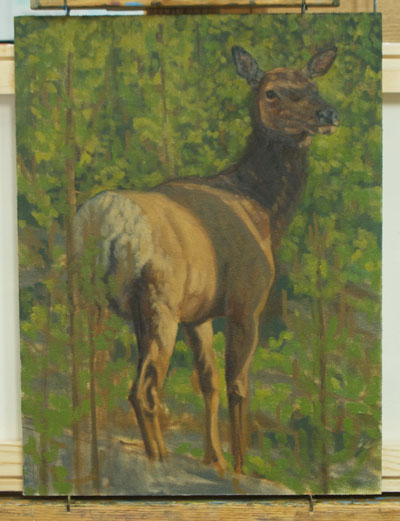
cow-elk2.jpg

There’s still LOTS to do. The modeling of the head needs work to describe the structure. I’ll probably do a pencil drawing to work it out better, so I can lay the paint in with confidence.

And, here’s one of my newest finished paintings, called “Mutual Curiosity”. When I was at Ikh Nartiin Chuluu, I spent two days out in the reserve walking around alone with a GPS, looking for argali so I could do behavioral observations. The trick was that I had to find them, without them seeing me, in order to do the observations. It wasn’t easy. This big old ram spotted me pretty quickly, but he let me follow him around for about twenty minutes. He was very thin, but had a huge, heavy horns. I filled him out a little. It was spring, so he had made it through the winter of 2005. I wondered as I did the painting if he made to 2007.

mutual-curiousity.jpg

I also wanted to show the amazing environment that the argali of Ikh Nart live in. I compressed the scene a little from the photograph, but all those weird formations are within yards of each other.

Happy New Year!

Back in the saddle again for 2008. Lots to look forward to.

All the kittens I fostered have found new homes. I thought that I would start to introduce that permanent animal members of the household. First up- Niki, our four year old tricolor rough collie, self-appointed guardian of all creatures large and small. Here’s picture of him with Tucker and Katie. Niki had laid down by the crate and the two kittens came over and got as close as they could. All of them quickly became fearless of my 75 lb. dog.

niki-tucker-katie.jpg

We finally had our first ducky visitors to our pond, three hooded mergansers. One male, two females. I thought, uh oh, there go the goldfish, since mergansers are diving ducks and, sure enough, while we watched, they caught and ate two big ones. But we have since seen at least eight or nine in their usual hangout, so we didn’t do too badly. Michiko spotted them and instantly became a fan. More about her in the next week or so.

michiko-merganser.jpg

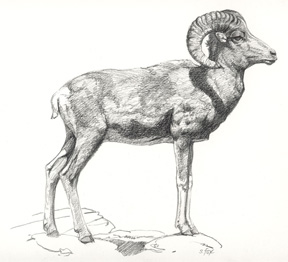
In art news, the latest issue of the newsletter of the Society of Animal Artists features drawings that I have done of Mongolian wildlife. Here’s three of them, an argali ram, an ibex billy and a takhi mare and foal (Przewalski’s Horse). They were done on 2 ply bristol with a Wolff’s carbon pencil.

argali-ram-standing-blog.jpg

ibex-billy.jpg

takhi-mare-and-foal-heads-blog.jpg

Ok, Time For Some Art

I love to paint. I love to travel. I love animals. Put it all together with supportive husband who used to stack up the frequent flyer miles, and you get a nature artist who has been lucky enough to go to Kenya twice, Mongolia twice and North American wildlife ground zeros like Yellowstone, the Grand Tetons and Glacier to sketch, observe and photograph a mouthwatering variety of wildlife and their habitats.

Ikh Nartiin Chuluu Argali

The painting above is “Ikh Nartiin Chuluu Argali”, a 15″x30″ oil on canvas. The name translates as “Great Sun Rocks Sheep”. My first trip to Mongolia was in April of 2005 to participate in an Earthwatch Institute project “Mongolian Argali”, which are the world’s largest mountain sheep. A ram can weigh over 400 lbs. and have a horn curl of 65″. In this painting I felt that I was introducing a species that not many people have seen, so I wanted to show them in their environment in the reserve, which is a large area of rocky outcroppings rising up above the steppe, which you can see in the background. “Ikh Nart” is about a five to six hour drive southwest of Ulaanbaatar on a road that largely parallels the railway line to Beijing.

They blend in very well with the rocks and so I designed my composition with the idea that the viewer would see the lead ram first since its head is in high contrast against the background and the second ram, well, second.

For more on my travels, visit my website. For more on the reserve, visit the website listed to the right.