Mongolia Monday- New Painting Debut!

Last week was pretty intense. I had a painting to finish for submission to an invitational show (which it may or may not be accepted into; we’ll see). It’s by far the most complex and difficult one I’ve taken on so far. The kind where, once you’re well into it and can see what level of effort it’s going to take to pull it off, you wonder if you’re out of your mind. But I felt really driven to paint it, so off I went. I think it took somewhere between 60 and 80 hours, spread over about three weeks, but I wasn’t really counting. I didn’t have time.

I normally post about my painting activities on Fridays, but when you see the reference image that inspired me, I think you’ll agree that it’s right for Mongolia Monday.

I photograph the process when I do “major” paintings, both to have a record and to be able to refer back to previous points while it’s in progress. I thought you might enjoy following how this one developed.

So, to start, here’s the image that said “PAINT ME!” It was taken at a local Nadaam in the town of Erdene, which is about an hour east of Ulaanbaatar, in July of 2009. It was pouring rain when we arrived, just in time to see the finish of the horse race. Fortunately, it stopped and, although it was cloudy and muddy, we had a great time and I got at least three or four more painting ideas from the afternoon.

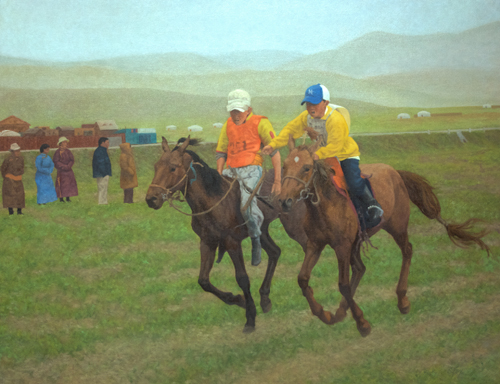
I loved everything about this image: The two horses neck and neck. The fact that one boy is using a traditional Mongol wood saddle and the other is riding bareback in stocking feet and how different it makes their body positions as they ride flat out for the finish line. The way the orange and yellow is repeated in their clothes and the saddle.

The only thing missing was great light. Hum, what to do? I decided that rather than trying to change the light, since July is the rainy season (or at least it’s supposed to be) in Mongolia, which means that at least some of these races happen in wet conditions, I’d just go with it and make the fact that it was a rainy day part of the story.

The  background didn’t do anything for me and since most of the people who will view the final painting won’t be familiar with the setting or situation, I needed to add some context. The first step was to do a pencil drawing that included all the elements to make sure everything would go together even though I used at least six different photos for the final composition.
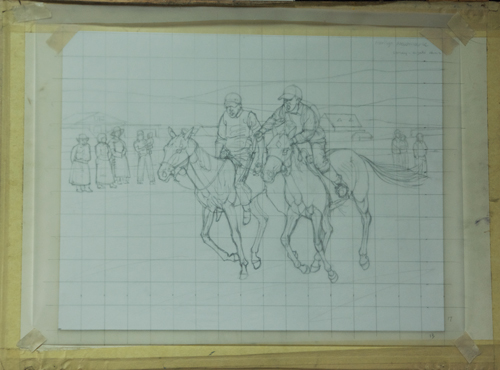
The drawing is done on 19×24″ tracing paper. The finished painting is 28×36″. The grid lines are a traditional (dated back to the Renaissance) method of transferring a drawing to the larger surface. Notice how many spectators there are and where the buildings are. I had already decided to leave out a line of cars that were behind the people.

I have also decided to paint these scenes as I see them. I’m not going to “romanticize” them by substituting traditional hats for the baseball caps or putting the kids in del. While I’m very interested in Mongolian history and might do paintings with historical themes, with historic costumes and armor, if I can get the reference, for the most part I’m interested in Mongolia as it really is right now, in the 21st century.

Once the drawing is transferred to the canvas with a pencil, I re-draw it with a brush, always correcting and refining as I go.
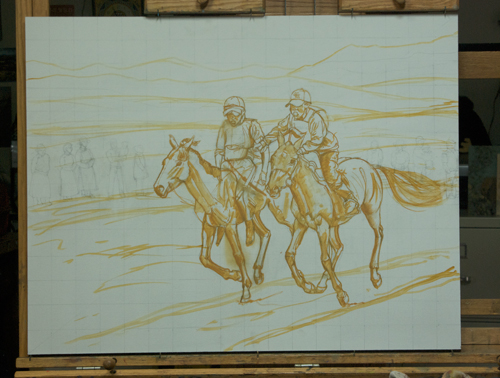
In this case, I decided to start by laying in the background first. I wanted to establish the lightest lights and also the atmospheric perspective of the mountains in the distance. You will also notice that I’ve ditched all the people on the right and cut down the number of people on the left. The buildings are gone, too. I really felt that I needed to simplify things. One of the lessons I’m learning is how what works at one size may not work at a much larger size. It’s what stalled me on the big argali painting.
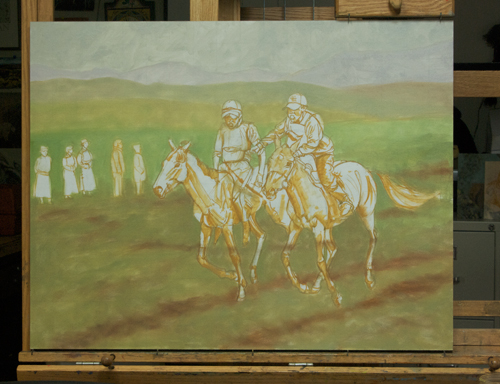
Next, I laid in the first layer of color on the figures, going dark so I could come back in with lighter colors. Everything is in what is called “local color”-the “real” color of an object not affected by a light source. Notice the drawing is pretty much gone, but that’s ok because, I know I can get it back as I go.

Now, I’m past the opening stages. The set-up is done and the constant process of painting, correcting and refining has begun. I’ve laid in the folds on the boy’s clothes and gotten the basic modeling done of the muscles and structure of the horses. Where before, the background had seemed too crowded, now it seems too empty and the people are just standing there, isolated, with no context.

Here you can see how I work. The computer is a 24″ iMac with a glossy monitor, so it’s like painting from very large transparencies. I can easily toggle back and forth between the various images that I’m using. You can see that I’ve added the buildings back in, but now they are behind the spectators, which creates one visual unit instead of two scattered ones. And now there are gers in the background. I’m thinking at this point about the white of the boy’s hats being repeated in the hats of two of the spectators, then repeated again with the gers. So it’s kind of like a bar of music with the white elements as the “notes”.

Here’s a detail of the people and buildings in progress. The good people of Erdene would probably be really confused if they saw this because I’ve used my “artistic license” to move and rearrange the structures to suit me. But I’d like to think that they’d recognize their friends and neighbors. Unfortunately, the pattern on the one woman’s blue del ended up being too visually distracting, so I had to make it just a plain blue. All the colors are intended to relate to each other in a somewhat limited palette and not compete with the jockeys. Oh, and that’s the Mongolian flag at the top of the blue building. Couldn’t leave that out. Notice also that I’ve added the road that runs through the town.  It’s on a diagonal, which is more dynamic than a horizontal. I want it to support and emphasize the main action. That’s also why the lines of dirt at the horses feet are on the diagonal, as you can see in the image above.

Here’s a detail of the jockey’s faces in progress, along with the horse’s heads. They all went through three or four repaints before I got them the way I wanted them. Notice that I haven’t painted any of the tack yet, other than the orange saddle. That’s the final level of detail that I leave for the final orchestration. Also, the paint has to be dry so that if I make a mistake on a stroke I can pull it off without wrecking what I’ve done underneath.
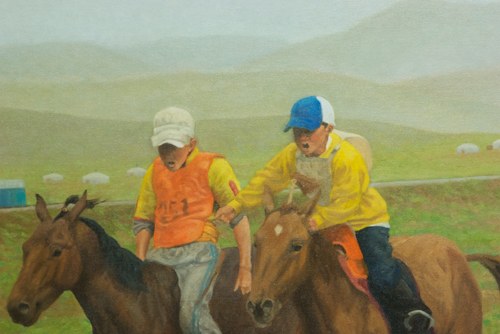
At one point, I stopped, got a piece of paper and a charcoal pencil and did a couple of studies of the boys and the bridle of the horse on the right to make sure that I understood the shapes correctly and could paint only the ones I needed.

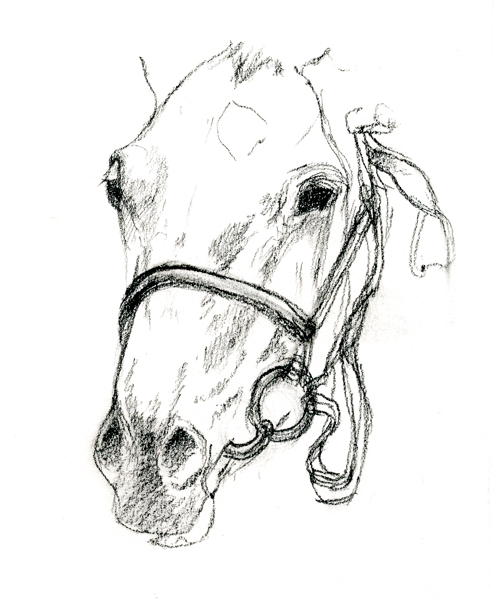
I highly recommend this. Instead of flailing around in paint, hoping to somehow get it right, do a quick drawing to work out the problem. It saves a lot of time, paint and frustration.

One thing I noticed almost at the end was that, as a design decision, I had the right-hand horse’s tail flowing off the canvas. When I was looking at another image for another reason, it hit me and I remembered that the race horse’s tails are bound part-way down. What an awful mistake that would have been. Quick scrap down and repaint.

And here is the finished painting: Rainy Day Finish; Erdene Nadaam, 2009
New Painting! “After The Race; Baga Gazriin Chuluu”

There’s this saying about combat flying- hours of boredom interspersed with moments of stark terror. At a far less dramatic level, painting seems to have a similar rhythm sometimes. We spend days or weeks working on paintings and, suddenly, some get finished, signatures go on, photos are taken and, ta da. we’re ready to move on. I finished this painting a couple of days after the one I posted last Friday.

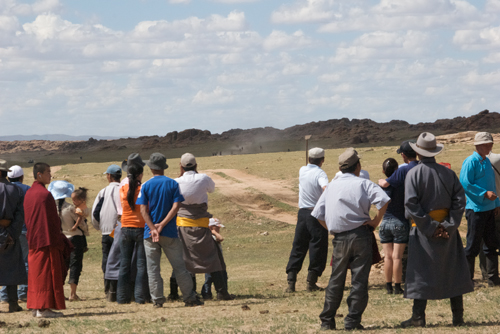
This piece is a scene from the mountain blessing ceremony that I had the good fortune to attend at Baga Gazriin Chuluu. There had already been an anklebone shooting competition, but the horse race was the event that everyone dropped what they were doing for. The Buddhist monks who had been sitting in a tent, chanting, came out and joined their families and friends. For at least a hour before the race, the kids had been warming up the horses by walking them in a big circle, sometimes singing as they rode round and round.

The horses were two-year olds, all stallions. As it turns out the Mongol word for horse, “mor” includes the fact that the horse in an ungelded male. That’s the default. Then there are geldings and mares. Being young colts, the race was a short distance- 7km. (The main national Naadam race for fully adult horses is 56km.) As with all Mongol horse races, after warm-ups the jockeys rode their mounts out to the starting line at a walk or trot, followed by a few vehicles which I assume included the starter and some of the trainers.

Everyone went out of sight behind a large rock formation. We all waited at the finish line, a small pile of rocks which held up a pole that had a colorful red scarf flying from it like a flag.

Horse race with spectators, Baga Gazriin Chuluu, July 2009

Pretty soon the crowd stirred and, looking out, we could see the dust from the horses. In just another minute or two they started to reach the finish line. I got as many pictures as I could.

The trainers checked the horses over and some scrapped the sweat off them, although none were lathered up or even looked particularly tired. Then the jockeys spent most of the next hour circling the wrestling competition, cooling down their mounts. That’s when I got the image I used in this painting.

I’ve also included the reference photos since I think too many animal artists just use whatever setting the animal is in when the picture was taken and don’t consider other options. In this case, the background was pretty boring. But, a short distance away were these really great rock formations.

The young rider:

The background:Put them together and….

After The Race, Baga Gazriin Chuluu 16x20" oil on canvasboard

The rocks were deliberately placed so that the boy would be against the large shadow area. I kept things on a diagonal so that the background would be at a different angle from the main subject and keep the composition from being too static. After going 14km, the rider was still having to pull firmly to keep his mount at a walk. I wanted all the elements of the painting to support that pent-up energy.

Mongolia Monday- New Mongolian Grammar Book

I got an email a month or so ago from one Munkhbayar Barmunkh, with a link to the Amazon page which offered the above book- a new, as of Sept. 2009, Mongolian grammar textbook. He turns out to be the publisher. I ordered it immediately.

The author, Khatantuul Baatarsukh,  has a BA in International Relations and Slavic Studies from the School of Foreign Services at the National University of Mongolia. It was clearly a labor of love. She says in the Preface, “Writing this book was a daring project, for it has many critics. My motivating force was the love and fascination of the art of language. My inspiration comes from life.”

As some of you know, I’m trying to teach myself Mongolian. I’m using: a Transparent Language course ; listening to Mongolian music via both CDs I’ve purchased and TsahimRadio, an internet radio station run by a Mongolian Facebook friend; and asking Mongol friends to translate words and phrases for me. I also have the Lonely Planet phrase book, which is dated in some unfortunate ways, but still very useful; and Mongolian/English and English/Mongolian dictionaries that I brought back in July.

I just bought Bento, the Mac-based consumer datebase app. I’m going to do my own word list since I need a specialized vocabulary of art and craft terms so that I can start to communicate with the felt craft coop ladies.

There doesn’t seem to be much else available that isn’t either really expensive or doesn’t fit my needs. I haven’t diagrammed a sentence since 8th grade (am I dating myself?), but I think this book will be quite helpful.

Mongolian is structured differently than English. The word order is more like German: Subject, object, verb. Verbs are modified by endings, so while I can look up a verb’s root word in the dictionary, I’ve had no idea how to use it correctly in a sentence. One exception is “gui”, which creates a negative. So, “chadakh” means “can” and “chadakhgui” means “cannot”.

The main problem that I have in learning a language is that I have a visual memory. That is, I store and retrieve information in images, for the most part. It makes remembering things like strings of numbers interesting. So, I find it difficult to make sense out of the terms for cases and how to relate them to anything. I’m hoping this grammar will help me sort that out, one way or another. I may just have to learn it by rote, which is ok, too.

All the text is in English and Mongolian cyrillic, which is almost, but not quite, the same as the Russian alphabet. There are lots of practice exercises, with a key at the back.

This book is not for beginning language students. I know just enough to start to beat my way through some of it. It will go with me on my next trip, though.

I invite both the author and publisher to add more information or comments, along with anyone else who has the book or would like to offer ideas/comments about the Mongolian language.

Mongolia Monday- This Week’s EBay Listing 1-4-10; A Takhi From Khomiin Tal SOLD

I thought I’d get a two-fer this week and combine my eBay listing with Mongolia Monday since the painting up for auction is a 8×6″ oil of a takhi (Przewalski’s horse). It’s from a photo that I took at Khomiin Tal, the westernmost of the three takhi reintroduction sites in Mongolia. I visited there in September of 2006. What an adventure that was for me! I flew out to Hovd, met my guide and then went by Russian Fergon van (those of you who have been to Mongolia know what that means…) east over 100 miles on what the Mongols call “earth roads” to the river valley where the horses were. I got to see them in late afternoon and morning light and got a lot of good reference. Here’s a photo of some of the horses grazing-

Takhi grazing at Khomiin Tal, western Mongolia

And here the painting that is currently available at auction here

Takhi 8x6" oil on canvasboard

Memories of Germany A Year After The Wall Came Down

A few people are posting on Facebook about the fall of the Berlin Wall, which happened twenty years ago, so I wrote the following at a Note to post there, but also thought I’d share my memories here of that amazing point in history and our trip to Germany the following year.
——–
I and my husband, who arrived in Berlin (courtesy of the Air Force) six months after The Wall went up, watched it come down on TV 20 years ago. It was something we never thought we’d see in our lifetime. I’ll always regret that I didn’t hop on a plane and get over there to join the party.

We did visit Germany in December of 2000, three months after unification. We flew into Frankfurt, picked up a rental car and headed towards Berlin. I remember crossing the old border between West and East on a country road and coming to an autobahn Kreutz (intersection “cross”) with abandoned guard towers looming over the road in the half-light of a late winter afternoon. It was snowing and very quiet. We took an exit, drove into a village as night was coming on and suddenly found ourselves in the 17th century. Old, old houses and muddy dirt roads. I half-expected to see a horse-drawn cart amble by. The only gasthouse was closed and had obviously been so for many, many years. So we had to scoot back across “the border” to a “west” German town to find a place to stay.

The next morning we crossed the old border again. There were fence posts, but the wire was gone. Tacked to one of the posts was a campaign poster for Helmut Kohl, who had rammed through reunification, knowing it was the right thing to do. I thought the symbolism was very powerful and neatly summed up the dramatic change which had happened the previous year.

We drove on to Berlin through Erfurt. I have ancestors who came from around there and I wanted to see the medieval Cathedral, which has some statues (of Count Erhard and Countess Uta) that I had been struck by when I had seen them in a costume book. As we walked around the city, we drew some stony-faced looks, especially when people saw my camera. We were probably the first western “tourists” they had seen in a long time, if ever. I remember walking past a building that was completely collapsed on the inside and realized that it had probably been bombed during WWII and had never been repaired or replaced.

We found the Kristkindlemarkt in the main square and bought Nuremburger bratwurst and glugwein for lunch. Someone was doing a brisk business selling small, unassuming Christmas trees. There were no merchant booths like we saw in the west German cities. People seemed cautiously happy.

When we got to Berlin, we went down to the Brandenburger Tor or Brandenburg Gate. It was blocked off, but on either side were rows of tables and blankets laid on the ground. Covering both was the flotsam of the end of a country. For sale were East German military coats and hats, ID books, medals, various other documents, East German currency and pieces of the Wall. We bought one big chunk for ourselves and some smaller ones for gifts. I remember that the sellers weren’t speaking German, but a variety of other Eastern European languages.

We then walked all the way around the nearby Reichstag. The walls on all sides had obviously patched bullet holes from the final battle for Berlin.

It’s no longer there, but we also visited the Checkpoint Charlie Museum and saw all the desperately creative ways that people used to try to get from the East to the West, including a small convertible car whose doors had been filled with concrete to stop bullets. It was a convertible because the plan (which worked) was to duck down with the doors for cover and drive right past the guards and under the horizontal gate bars at the border.

Outside we found that Checkpoint Charlie itself, the gates and guard booths, were already gone. As we drove past where it had been, there, on the right hand corner of the first block, was a United Colors of Benneton store. I’ve always wondered how in the world they were able to negotiate a lease and get a store up and running in three months. It was the only western store we saw on that side. I’ve joked over the years that, yes, we got to the old East Germany ahead of McDonald’s. But not Benneton.

We drove around for awhile and then back to the west side of the city past enormous apartment buildings that were the personification of East “bloc” housing.

We went to Templehof airfield (where my husband worked for part of his tour), the sole remaining example of Nazi meglomaniacal architecture, courtesy Albert Speer. The scale of it, even though it was never finished, is almost obscene. But outside is the Berlin Airlift Memorial, which commemorates one of our country’s finest hours and that of the Allies who also participated.

My husband also did part of his tour at a location south of the city. We drove out that way one afternoon and he saw the Berlin skyline from the south for the first time, looking back across what had been no-man’s-land. The farmer’s fields were covered with sparkling frost and a few burned out lime-green Trabant cars lined the road. These quintessential communist-era cars were the subject of many jokes back then, such as “How do you double the value of a Trabant? Fill it with gas.”

Our stay in Berlin at an end, we drove back to Frankfurt via the east-west autobahn that was one of the only ways in and out of Berlin during the Cold War. The East Germans timed travelers. They knew how long it took to get to Berlin and you were asking for serious trouble if you stopped along the way. For us, it was a beautiful drive through the green forests of a Germany that was whole again.

Sketching In New York

I just got back last night from a two-day trip to New York. One day was taken up with the Society of Animal Artists board meeting (of which, more later) and the second day with wandering around Greenwich Village sketching and then hitting some jazz clubs in the evening with fellow artist Guy Combes, who lives across the river in New Jersey as the artist-in-residence at the Hiram Blauvelt Museum of Art.

I hadn’t done any “urban” sketching for quite a long time, but the area of New York that I was in could keep an artist busy for a lifetime. As it was I did the four following sketches in a  5.5×8.5″ Strathmore Series 400 recycled paper sketchbook with a Pentel “Energel” .5 pen.

Nothing fancy here. These are about the process and just having fun.

11-05-NY-1

Notice that I didn’t get into rendering a bunch of leaves on the big shrub. It’s just a shape.

11-05-NY-2

11-05-NY-3

All the little dark marks are what is left of old pier pilings.

11-05-NY-4

I stood on the opposite corner to draw this festive restaurant exterior with the piggy sign.

None of these took more than about twenty minutes.

Mongolia Monday- My Other Mongol Joke

Buuz is one of the most popular foods in Mongolia. They are a small, round steamed “dumpling” with a mutton or beef filling. Mongols make (and eat) zillions of them for their holidays. Just for fun we had a “buuz party” a couple of weeks ago. One of the guests, and the chief buuz maker, was a young Mongol woman, Ganaa, who I met when I advertised for a Mongolian language tutor before my 2006 trip. Her husband is an American who she met when he was teaching English over there in the Peace Corps a few years ago.

I told everyone at the party the Mongol joke that I posted here last week as we scarfed down many buuz and some delicious salads. Ganaa then told us a story about how a family is all sitting around a table eating buuz. There is only one left on the platter when, suddenly, the lights go out. After a short time, the lights come back on and the solitary buuz is gone. Everyone looks at everyone else. Who took the last buuz?

This has apparently been a running joke in Mongolia for many years.

Here’s a photo of the first buuz I ever saw.

buuz1

I was in western Mongolia, on my way back from the Khomiin Tal tahki reintroduction site. We stopped in a soum center (county seat equivalent) for lunch at this little buuz stand. The ladies made them to order and they were delicious! They were also somewhat bemused by my desire to take a picture of something so utterly ordinary (to them, of course). This was the first real Mongolian food I had ever had.

A Trip To The California Academy of Sciences, San Francisco

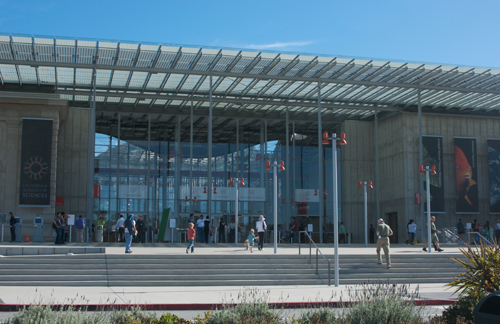
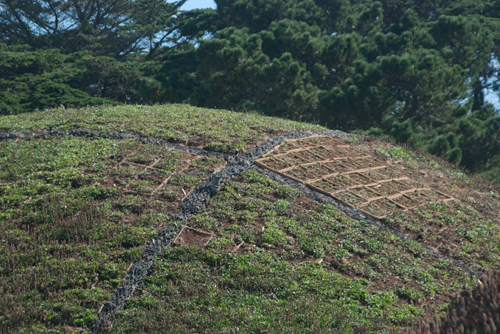
It took a little while to get there after it opened, but we finally visited the California Academy of Sciences in Golden Gate Park this past Sunday. I, like many people, was sorry to see the old building go, but the new one is fantastic. The living roof is worth the price of admission. The Planetarium now is now state of the art with three digital projectors. The original African Hall was preserved, along with this long-time resident….

The albino alligator

Here’s some of my favorite images from the day-

The entrance
The entrance
Looking past the "swamp" to the enclosed food court
Dinosaur
Looking down to the west end of the building
Roof-1
The living roof, covered with California native plants
Roof-2
How the roof started; cocoa fiber planting trays laid out side-by-side

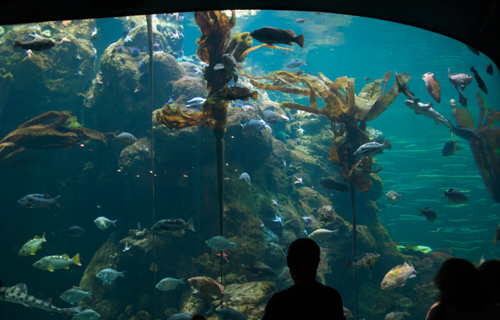
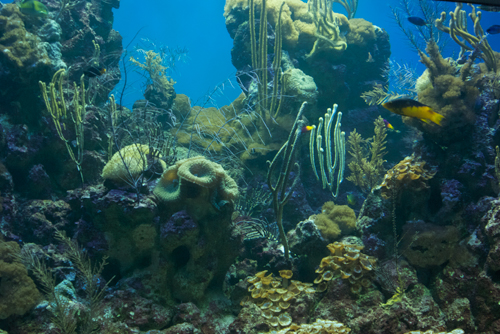
The downstairs is a large and very well-done aquarium.

Calif.-tank
California coast kelp forest fish tank

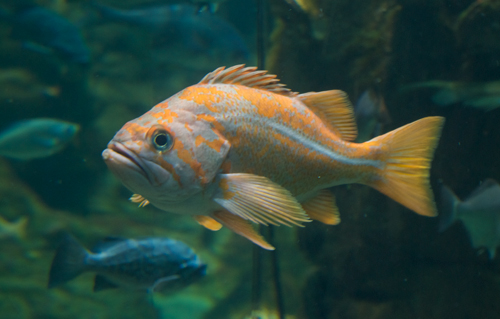
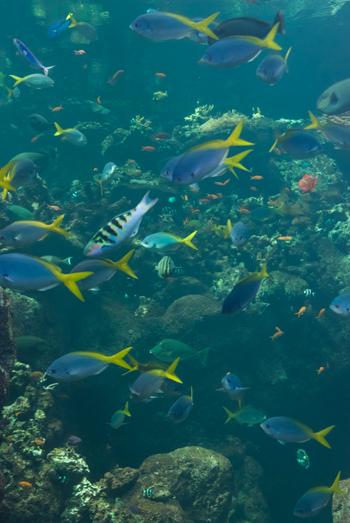
I’m a mammal person and don’t really know my fish that well. I’ve identified the ones I know. You’ll have to use teh googles for the others.

Calif.-fish

Blue-fish
The big salt water tank
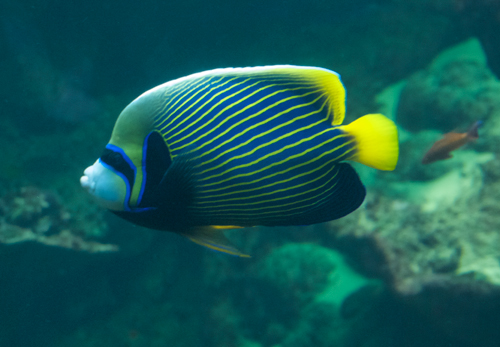
Butterfly-fish
Butterfly fish species
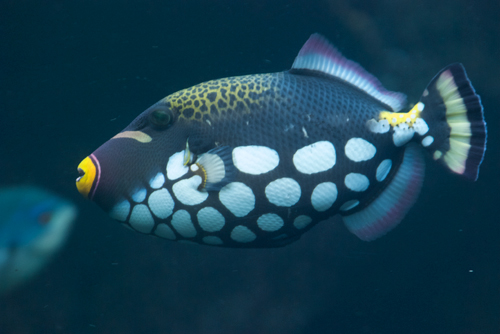
Trigger-fish
Triggerfish species
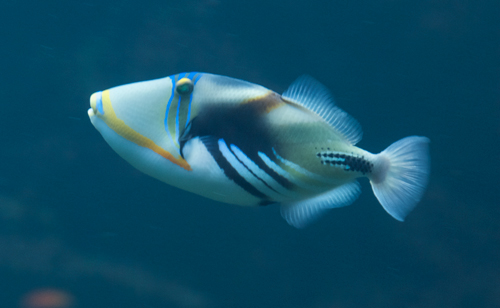
Lagoon-trigger-fish
Lagoon triggerfish
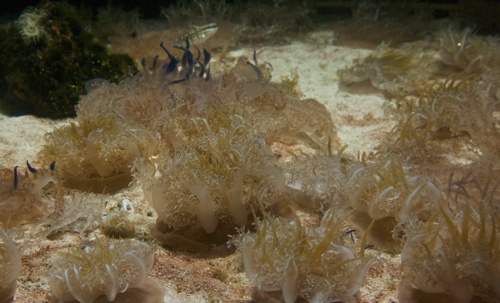
jelly-fish
Upside down jellyfish (no, really, that's their common name)
Small-tank
Small saltwater tank
Moray-eel
Moray eel and fairy shrimp; symbiosis in action

There’s an old Dean Martin song that someone wrote some new words for. It goes like this: “When the eel in the reef has your heel in its teeth, that’s a moray.”

And finally, we walked through the botanical garden across the street before we went to the Academy and “met” this guy:

Squirrel

Become a fan by visiting my public page on Facebook!

Mongolia Monday: Wildflowers, Part 3

This is the final installment of images that I took of wildflowers during my AFC Flag Expedition to Mongolia this past July. As before corrections and identifications of flowers I couldn’t find in the guidebook I used, “Flowers of Hustai National Park”woulo be greatly appreciated.

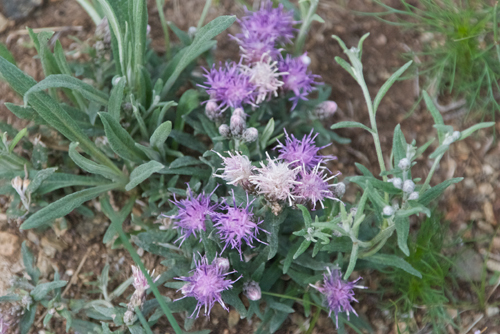
Sawwort, Saussurea amara
Snow-in-Summer, Cerasttium arvense
Thistle species
Thistle species
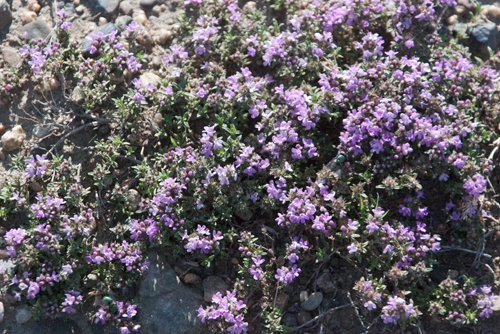
Thyme, Thymus globicus
Unknown; guide said it was not a pasque flower since bloom season for that is earlier
Valerian, Valeriana officinalis
Goniolimon, Goniolimon speciosum
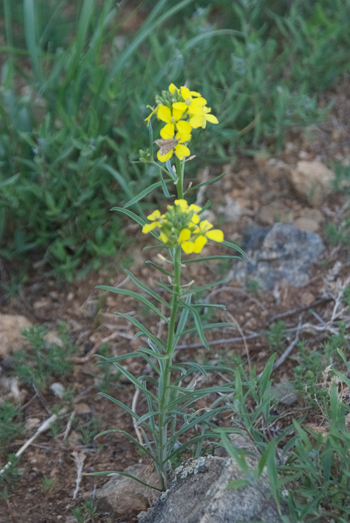
Wallflower, Erysimum flavum
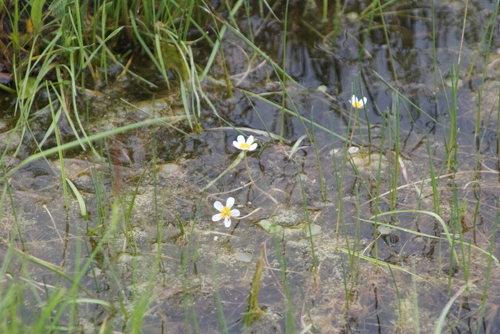
Unknown aquatic flower
Unknown white flower
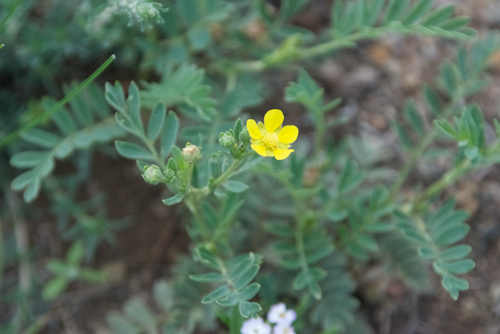
Unknown yellow flower