I keep a journal on all my “interesting” trips, along with a sketchbook, and thought that I would occasionally share some entries. In 2006, I read The Great Railway Bazaar by Paul Theroux on the first part of the trip and was inspired to try my hand at recording something more descriptive, rather than just short “Today I was in western Mongolia, the van broke down and I got food poisoning.” diary-type entries. Here’s what it was like to get clean at a ger camp in the Gobi:
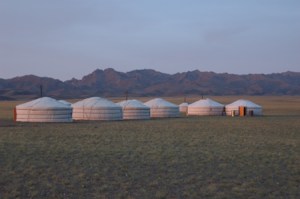
Dungeree Ger Camp, Gobi, 2006 (Gurvansaikhan mountains in background)
October 2, 2006 1:15pm:
Ah, the joys of clean hair and body. Once it was ready, I went to the shower ger. There was a stone path leading to a wood slat platform. A big metal bowl of hot water was sitting on top of the stove, in which there was a roaring fire. A small stand held one pair each lg. and small plastic sandals. There was a hook for ones clothes. The shower was provided by a pump sprayer just like what one would buy at the garden shop or hardware store with a spray head attached. One fills it (although it was already ready for me) with a combination of hot water from the stove and cold water from a can by the wall. Pump up the pressure and voila! a perfectly acceptable hot shower in the middle of the Gobi. It was still a little chilly, so I had a fire ready to go back at my get, so I am now (more or less) clean, dry and warm, a lovely combination much appreciated on this kind of trip.
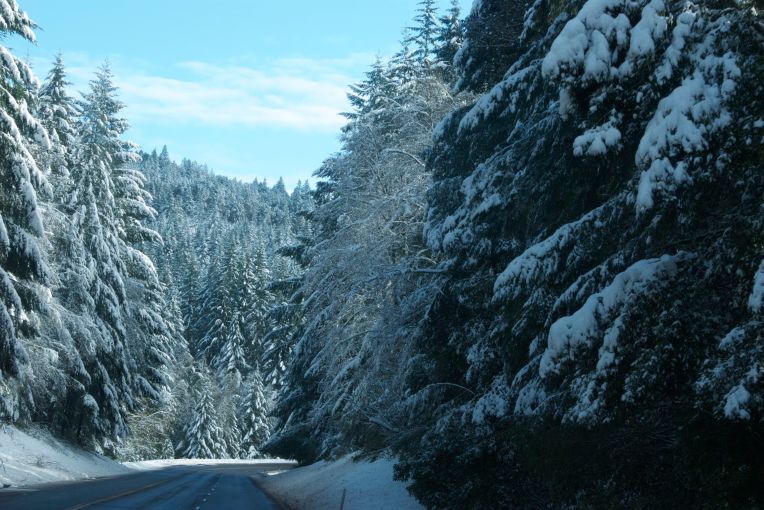
We had a great time with family for Christmas, including a trip up to the snow, which was only about 20 minutes east of us since the level had dropped to 1500 feet, pretty low for coastal California. I may have to try some winter landscapes, not something I’ve painted much due to almost never being around snow.
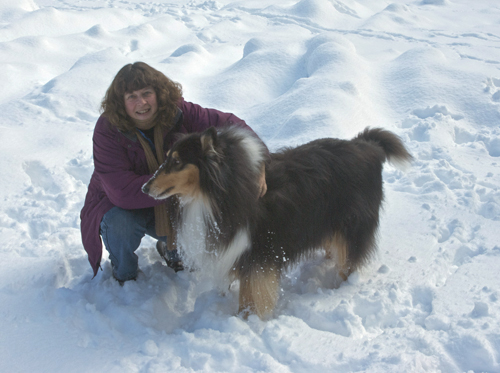
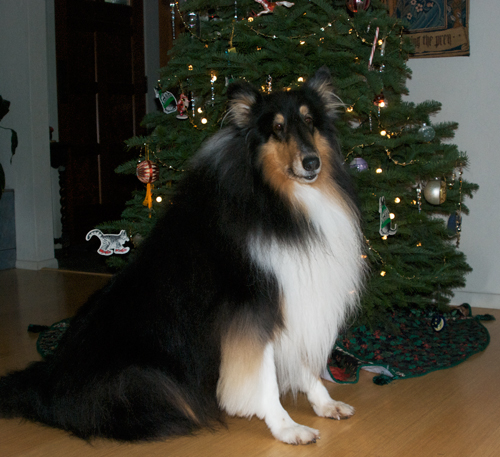
Niki the collie loved it all- being surrounded by people who love him and his first experience of snow. His main interest seemed to be eating as much of it as I’d let him.
Snowy morning on Hwy. 299 at Lord Ellis summitNiki and I in the snowNiki and the Christmas tree; just back from the groomer and lookin' fluffy!Niki with a favorite toy. We 'heart' collies!
Thank you to Julie Chapman, for including me on your list of animal artists/bloggers. I’m in some very nice company. The least I can do is reciprocate and it’s been a fun thing to do on a rainy, REALLY rainy, evening.
Julie offers almost the only workshops with an emphasis on DRAWING animals. Highly recommended.
Here’s the rules:
1. Put a link in your posting about the artist that tagged you. Done.
2. Write 5-7 unusual things about yourself.
3. Tag 5-7 other bloggers and let them know.
__________
Unusual things about me:
1. Sir Winston Churchill is one of my heroes. A few favorite quotes:
“This is the sort of English up with which I will not put.”
“Nothing is so exhilarating as to be shot at without result.” Lady Astor: “Winston, if I were your wife I’d put poison in your coffee,” Churchill: “Nancy, if I were your husband I’d drink it.”
2. I first read the Lord of the Rings in 1968 (8th grade, age 14) and currently have (or am had by, your choice) a cat named Eowyn, which suits her. Pity any Nazgul that come around.
3. I’m planting a collection of striped roses in my garden next year. There’s more of them than you’d think.
4. My favorite client from when I was a freelance graphic designer was the owner of an oriental rug store in Berkeley, California. I created all his advertising for over two years and did many pen and ink drawings of carpets and other asian textiles.
5. I was the one who volunteered to have the boa constrictor wrapped around my neck at an animal park when I was about eight years old.
__________
I’ve been digging around and there don’t seem to be that many animal/wildlife artists blogging and I don’t want to duplicate Julie’s links. So…..
Here are three animal artists not currently on my blogroll whose work I enjoy:
1. Carel Pieter Brest van Kempen – inspiration for those of us who are attracted to “off-beat” subjects. Always fun to see what he’s done now. If you love reptiles……check out his blog.
2. Victoria Wilson-Schultz – a real treat for horse lovers; she blogs on a variety of subjects
3. Val Warner– she lives over in California Gold Country, does interesting compositions of nicely-drawn animals and has painted BIG murals, too.
An enthusiastic plein air painter’s blog:
4. Ed Terpening – whose work reminds me that wildlife artists have to have a handle on landscape, too, and painting plein air is an excellent, maybe the best, way to do that.
And finally, arguably, one of the top three or four wildlife artists of the 20th century (One of the things Julie and I have in common that we have found in him and his work our major inspiration. The difference is that she got to meet him a couple of times. Previous sentence in green):
5. Bob Kuhn – Although he passed away last year, the website is still active and it looks like one can buy prints of his work, along with the most recent book and even some original drawings. He’s the master and forever an inspiration to us all.
To my amazement, this is the one hundredth post that I’ve done since I started to blog last January. It seemed to happen so fast. I guess it really is true that time flies when you’re having fun. Thank you to everyone who reads and comments!
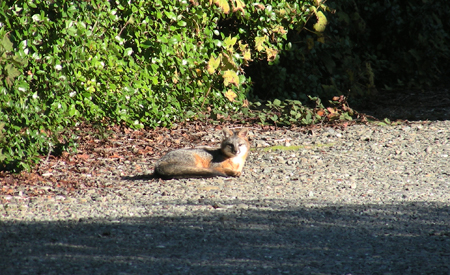
We just got back from a four day trip to San Francisco, which is about six hours south of where we live. We knew that the weather was predicted to be “interesting”. Little did we know. But first, here’s a really special photo my husband took before we left. I was out running errands, he went to get the mail and saw this little grey fox snoozing in the sun right out in the driveway of a house across the street. He got the camera and he/she was still there. This is one of the best shots. Pretty cool.
Grey Fox
As anyone who has cats and dogs knows, they figure out pretty quickly when something is up and the humans are going away. Some get anxious and some, well, don’t.
Persephone
When we left, the ocean looked like this:
Clam Beach near McKinleyville
We speculated on where we might see snow on the mountaintops and maybe even on the road. I figured Rattlesnake Pass between Laytonville and Willits.
Near Confusion Hill, Humboldt County, US101
Wrong. This was almost an hour north in Redwood Country, where we rarely see snow on the coast.
Near Leggett, US101
Mmm, it’s getting heavier and right down to the road.
North of Willits, US101
It’s a….Winter Wonderland!
Oak trees just north of Laytonville, US101
Snow, snow all along the route. Laytonville and Willits were covered with snow. Really beautiful and an unusual treat for us coastal northern Californians where the average temperature in January is 55F.
View from our room
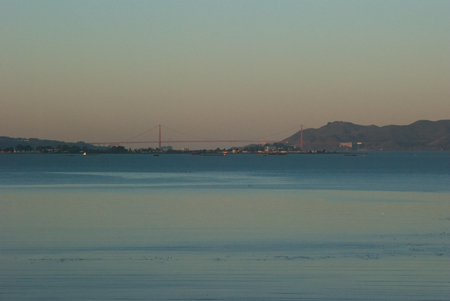
But we got to our room at the Emeryville Courtyard Marriott and had this killer view of San Francisco at sunset. And the Golden Gate Bridge.
The Golden Gate Bridge
Notice the clear skies. So we had nice weather, but cold, for what we came down to do: Family visit, the Yves St. Laurent show “Style”, at the de Young Museum and the Afghani treasures show, “Afghanistan” at the Asian Art Museum. A bonus at the de Young was an absolutely knock-out show of geologic forms, “Systematic Landscapes” in a variety of media by Maya Lin, who designed the Viet Nam War Memorial in Washington D.C.
We got in a stop at IKEA, too.
Of course we took advantage of the culinary richness of the Bay Area, eating Thai (Boran, Solano Ave., Berkeley), Ethiopian (Addis, Telegraph Ave., Oakland), Italian (Pasta Pomodoro, Bay Center, Emeryville) and seafood (Sea Salt, San Pablo Ave.. Berkeley). At the Sea Salt Restaurant, I couldn’t an unexpected opportunity to try the legendary drink Absinthe for the first time. There were three choices and I went for the St. Georges, which is distilled in Alameda, right down the road from Berkeley. It was…..amazing. A little goes a really long way. We found it at a, hate the name, BevMo and indulged in a bottle, which ought to last a couple of years depending on how many artist and other friends care to try it.
And, since David had accidently put his cell phone through the washing machine and our contract was up next spring anyway, we went to an Apple store and got iPhones. Absolutely revolutionary devices. Effortless to use. Intuitive. More stuff than you ever thought you’d want to do. The procrastination possibilities are almost endless. And the phone works just fine, too.
The trip home yesterday was in rain, hard rain and pounding, monsoon-like rain. We were glad to collect the collie boy and kick back for a quiet evening.
I’m going to take next week off and celebrate the holidays with family. Mongolia Monday will return on the 29th. Before we left, I got this photo of Michiko snuggled in her chair amongst some garlands that I’d draped over it.
I tend to start a number of paintings in succession and then finish them in batches. Is it that way for any of you? Or do you have a more even work flow? How do you decide what to do next?
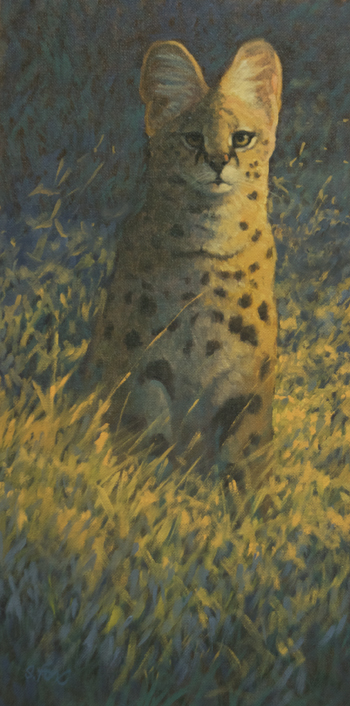
Here’s a new one from reference that I shot in Kenya in 2004. It was after the conclusion of the Simon Combes safari and I had flown back down to the Mara for a few days at Rekero Camp, which is on the Talek River. Fabulous camp, great staff, wonderful food, terrific drivers. I’d love to go there again. It’s apparently one of the places the Big Cat Diary people stay when they are filming and I can see why. It’s a tented camp right in the bush. Buffalo wander through and you can hear the hippos grunting and roaring at night since the tents are mostly right above the river. A real storybook African place.
A couple from Ireland were kind enough to invite me along on their game drives. My first morning with them we saw a serval walking down the road as the sun came up. I loved the color of the first light of the day hitting his or her coat, but most of the shots weren’t particularly paintable. We were so close that my point of view was from above ( I know, I know- boo hoo) or the gesture was awkward, etc. But…..I got some great reference at the Denver Zoo this last May. Nothing special in the Light Department, but wonderful eye-level alert poses. So I put the two together and came up with this. I kept the grass loose and impressionistic so that the focus would be on the cat, who is Up At Dawn.
Up At Dawn oil 16"x 8" (price on request)
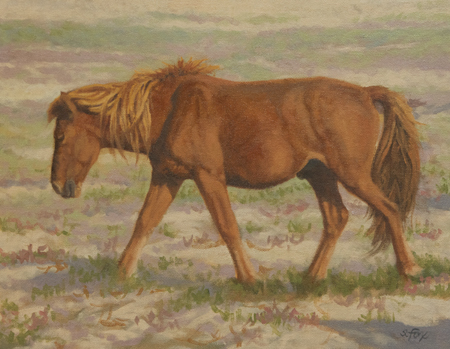
I’ve also just finished my first in a planned series of paintings of Mongolian horses, the ones the Mongolians ride, not the takhi. I got a lot really good shots in great light, but picked this one to start with because I loved the color of his coat.
I’m going to be in a group show with a flower theme at my gallery, starting next week. It’s not something I’ve done a lot of, well, any, but I have some great hummingbird reference that I shot right outside my studio windows so….for something completely different…
Hummin' Along in the Leopard Lilies oil 12"x 9" (price on request)
I went back to an Art Nouveau/Arts and Crafts inspiration from my previous incarnation as an illustrator and used a decorative approach. Flatter light with a plain background. It was fun and I’ll probably do more flower subjects in the future. This one sure got me using my reds more than usual. The bird is a male Rufous hummingbird, just another little rottweiler in a bird costume. Thank goodness they aren’t the size of ravens or none us would be able to go outdoors when they’re around.
STUDIO MUSIC
What do you listen to when you’re working? I can’t write this blog with music going, but otherwise I always have something on. I’ve acquired a taste for celtic-inspired world music and really like listening to Kila, Peatbog Fairies and Shooglenifty (No, really.). When I want to up the energy level, it’s time for some Afro Celt Sound System. I’ve been know to listen to Baka Beyond and Kenyan benga music when working on African subjects and Mongolian music when I’m…. you get the idea. Favorite rock includes anything by John Mayer, Mark Knopfler and Sting. Also still Stuck in the Sixties with Quicksilver Messenger Service (love, love, love John Cippolina, my guitar hero), Jefferson Airplane and of course The Beatles and Rolling Stones. When I come into the studio in the morning and need to ease in slowly, it’s Enya, Clannad or Nightnoise.
ART THOUGHT FOR THE DAY
If anyone, in the beginning of study, will set himself to study the various compositional forms, then experiment and practice with the variations of them, he will find that his instinctive taste is developed; and subjects will in time lend themselves easily to his feeling for unity, and soon he may be able to forget all about them.
It must never be forgotten and let this be most strongly emphasized – that the dominant aim of the student should be to train and equip himself to the point where he can judge unity and all of its contributing factors by “feeling”.
Well, I certainly enjoyed the last two Mongolia Monday posts and hope you did, too. Thanks again, Simon!
Today it’s back to a subject that has become near and dear to my heart- the takhi or Przewalski’s Horse. I always liked horses, even though I was deathly allergic to them as a kid, but have never been, ahem, drawn to them as a subject until I saw takhi for the first time at the Berlin Zoo in October of 2004. I didn’t even know they were there. I just happened on them in the far nether reaches of the zoo. Seven of them, looking like they’d just stepped out of a cave painting.
Takhi group, Berlin Zoo, October 2004
I remember that I plopped down on the nearest bench, probably with an idiot smile of delight on my face, to sketch and photograph them. They were enchanting.
Takhi Stallion, Berlin Zoo, October 2004
I did some research when I got home and found out that they were being reintroduced into Mongolia. So when I signed on for an Earthwatch project there, I arranged a three day trip to the closest site, Hustai National Park. It was spring, which meant cold, windy and and occasional snow, but I saw the horses and got some decent photos. The next step was to get back to Mongolia, which I did in late September-early October of 2006. By then, I’d found out about a third, new release site in western Mongolia, Khomiin Tal, and managed to get out there. There is also a series of three articles I wrote for Horses in Art. One on Hustai National Park, one on Khomiin Tal and one on the domestic Mongolian horses. Look under “Writings” for those.
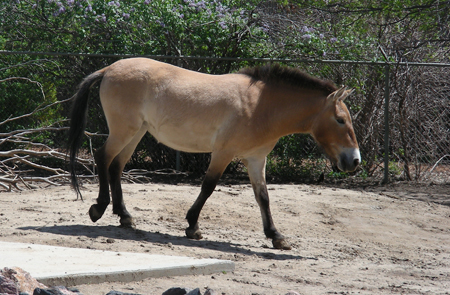
Then, this last May, I was at the Denver Zoo and saw takhi there. They looked much different from the Berlin animals, as you can see. There are a number of reasons for this that have to do with being kept in captive conditions, which can lead to much heavier bone structure and skull defects. The animals for release come from semi-reserves where they can live and eat more normally.
Takhi, Denver Zoo, May 2008
I’ve been drawing and painting them since that first trip to Hustai, but have hardly scratched the surface of the picture possibilities.
Here’s one of the first paintings, which is available as a limited edition giclee. When I showed a photo of it to a Hustai biologist on my second trip there, she immediately recognized the mare by her mane, which reinforced my desire to paint individuals of a species.
Mongolia Morning oil on canvas board 12″x 24″ (price on request)
Followers of this blog know how adamant I am about doing fieldwork. I think this next piece illustrates why. There is no way this painting would have happened if I hadn’t been there at Khomiin Tal to photograph both the horses and the habitat. I’ve seen a few other paintings of takhi and so far none of them really looks to me like it was done from reference shot of reintroduced horses in Mongolia. They are pretty obviously captives in Europe or North America. The light’s not right, the land isn’t right and, mostly, the horses themselves aren’t right. But I sure can understand the compelling desire to paint and draw them anyway!
That’s the Spot! oil on canvas board 18″x 24″ (price on request)
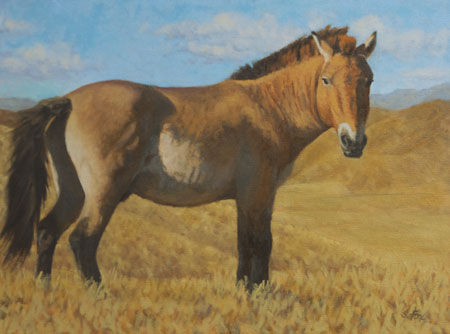
Here’s the most recent painting, a stallion at Hustai. I wanted to really show the valley that is the core habitat of the population of, now, over 200 horses in 15 harems and to try to capture the interesting shape of the shadows on him.
Master of the Valley oil on canvas board 12″x 16″ (price on request)
This 10″x 8″ study is going to be listed for sale on EBay tomorrow or Wednesday. It was amusing to watch the foal work out the motor coordination required to scratch that itch.
Scratch that Itch! 10″x8″ oil on canvasboard
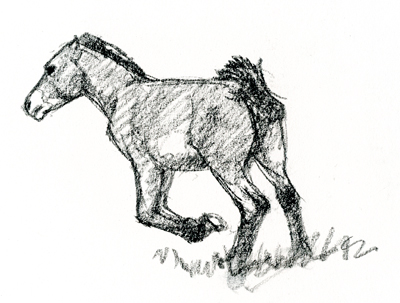
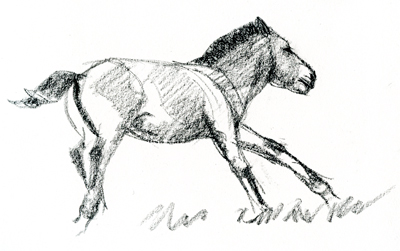
Lastly, I did a batch of drawings a couple of weeks ago and I rather liked the way these came out. The photos were taken at Hustai this past September. It was late afternoon and this one foal was having “crazy fits”. I’m always looking for animals in action and he/she certainly delivered.
Like many artists, I’m trying to figure out what my sales options are given the current economic climate. I’m also interested in seeing if I can sell art directly on the internet. And, a few months ago, I was showing some friends some of the small studies I do to work on various aspects of painting and one encouraged me to try selling them. Taking this all together, I have decided to offer a “new line” of small oils that I am calling “Studio Studies”, because, well, that’s what they are.
As anyone who paints most days a week knows, they do stack up after awhile and I have a few dozen that I’ve decided I’m willing to find new homes for.
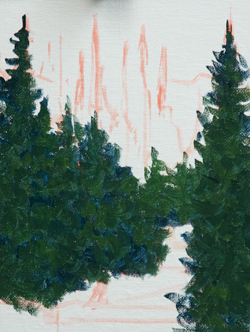
I plan to start offering them a few at a time on EBay, starting next week. Here’s a small preview, starting with one that I photographed in progress, so it’s a short step-by-step demo of how I do these mostly 6″x8″ studies that usually take less than two hours. The idea is to quickly capture a light effect, so detail isn’t relevant. This should look familiar to anyone who has taken Scott Christensen’s Ten Day Plein Air Intensive, because that’s who I learned this approach from and I really like it.
STEP-BY-STEP 8″X 6″ STUDY (from last Friday’s post)-
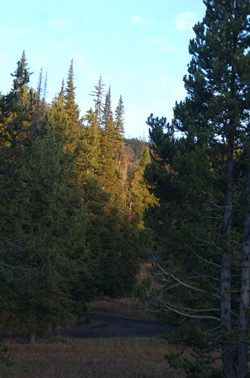
An image I shot up on Dunraven Pass in Yellowstone National Park at first light. What I was working on the was the color temperature shifts from shadow to light.
Photo referenceInitial lay-inStarting with darkest darks and basic shapesAdding light and medium tones; notice brushwork to create treesDawn on Dunraven Pass; 8"x 6"
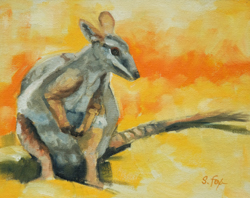
Here’s a couple more. First a demo that I did in about an hour at the Marin Art Festival of a small kangaroo which I photographed at a zoo.
Little Kangaroo- 8"x10"
And a landscape a few minutes from our house looking east from Clam Beach to the bluff. It was summer and the foxgloves were blooming. They’re not a native, but they look like they belong here in Humboldt County.
Clam Beach Bluff; 6"x8"
Finally, since I strongly believe that artists should help and support each other, here, from Alison Stanfield, who runs ArtBizCoach, is some solid advice on “Community”. Thanks, Alison! (Hope it’s readable. Let me know if it’s not.)
ART THOUGHT FOR THE DAY
The artistic mind is one that takes years to develop. Painting never gets easier. Struggle is not something that one goes looking for. It will find you. Just give it time.
I’ve spent a good chunk of this last week or so working on the “light thing”, which, when you get right down to it, is what representational painters are painting. Or, in other words, the effect of light on an object, whether is be a tree, a barn or an apple in a still life. Besides a lack of good drawing skills, failure to accurately perceive, understand and represent light is one of the things one consistently sees in poor or mediocre paintings. Everything tends to be in local color (the “native” color of the object) and the shadows are too dark and lack life. This tends to come from painting from photographs.
Dawn on Dunraven Pass, Yellowstone NP
Capturing the light is one of the major, almost addictive challenges of plein air painting. A given quality of light lasts about two hours at most, sometimes two minutes. It’s an opportunity to experience frustration and exhilaration almost simultaneously. Plein air painting also addresses the problem mentioned above about shadows. When you are in front of the scene, you see how much wonderful color and variation are in shadows that a camera doesn’t pick up, not even the digital ones, although they are much better than film was.
Another important point is that a given hue, value and temperature of a color exists only in relation to the colors around it. No color is dark and cool in and of itself. Not even black (if you mix your own, which you should) or white. It’s always a matter of “warmer than” or “lighter than”. How far one pushes the contrast between color value and temperature is a personal choice the artist makes in order to accurately express their vision and emotional response to their subject.
Along Goodall's Cutoff, Idaho
As primarily an animal artist, I found early on that when I wanted to put an animal in their habitat, I also became, ta da, a landscape artist. And that has proved to be much more difficult for me to get a handle on. I’ve taken at least as many, if not more, landscape painting workshops as wildlife ones.
I’ve done seven small landscape studies over the last few days, mostly just 6″x8″, working on two problems: that classic daybreak and afternoon glow and the wonderful effect of light on trees with dark clouds behind. The small size takes less time and lets me focus on the problem I’m trying to solve.
It’s a juggling act. What order to put the colors down, what values and what temperatures those colors should be. And I still try to do a decent composition and pay attention to the drawing.
Cottonwoods, late afternoon; Dubois, Wyoming
The above paintings took around two hours each and were done on canvas panels with a round brush.
Oh, and I have integrated the Permanent Green Light and Manganese Hue into my palette. Haven’t quite found out what I’ll use the Permanent Magenta for yet.
More Mongolian poetry on Monday!
ART THOUGHT FOR THE DAY
Nature is what you see and what you think about it. Artists change our thoughts about nature, and so, in sense, change nature. A masterpiece does not look like nature, because it is a work of art. The language you want to speak is art, so study art from the masters.
I recently received an email from an art student in Northern Ireland (wonders of the internet!), who is doing a paper about an artist whose work she likes for her “A Levels”. That artist would appear to be me. I liked her questions since they got me thinking some more about what I do, why and how. So I thought I would share it with you:
1.Why did you choose animal art?
As I think about it, it might be more appropriate to say that it chose me. I drew animals more than anything else as a child by far. When I was back in art school at age 35, I tended to think of using animals for my assignments. When I moved to “easel painting”, I started doing animals early on and when I learned about the field of wildlife art, that pretty much sealed the deal. I do enjoy other subjects, but it has always been my animals that have drawn the strongest response from people.
2.How would you gather information for your topic (ie do you study the body movements of animals, go to the zoo etc)
I do fieldwork trips every year to see animals in their own habitats and also visit zoos whenever possible. I have a large reference library that includes a number of books on animal anatomy. I sketch from live animals when I can and take a lot of photos. My digital image library has over 10,000 animal pictures alone, taken since 2004. Plus hundreds of prints from before I went digital.
3.Have you ever been influenced by a person or place?
Yes, I seem to be the kind of artist who is inspired more by what I see in the natural world, as opposed to a more purely internal vision. Taking a master class from John Seerey-Lester in 1997 was probably the greatest single reason I’ve become an animal artist because of his encouraging words about my paintings, which made me believe that I could succeed if I was willing to work hard.
The four places that I find most inspiring are Mongolia, Kenya, the Yellowstone/Wyoming/Montana area and my own home ground of northern California.
4.Is there a particular artist whose work has inspired you?
If I had to name one, it would be Bob Kuhn, a legendary illustrator who became one of the two or three top wildlife artists of the 20th century. I’m inspired by the quality of his draftsmanship, design/composition, his painterly technique, his knowledge of his subjects and his uncompromising willingness to do what it took to get reference he needed. He’s my role model for everything a wildlife/nature artist should be. He passed away last year.
5.What media do you prefer working in and why? Is there a medium you are not comfortable with?
I work in oil. The original impetus was having wanted to paint in oil since I was a child, but now it’s because it’s the medium that most lets me express my vision of a subject. I love everything about it except the fumes, so I pay attention to proper ventilation.
I’m probably least comfortable with something like pastels, for the very pedestrian reason that I don’t like having my hands messy while I work and I don’t want to wear gloves.
6.My favourite piece of your work is ‘Double check’, how did you come up with the idea and how did you gather photographs etc to help you?
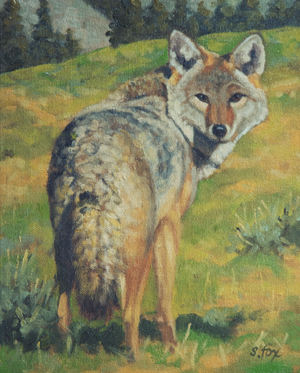
Ah, I just delivered that painting to the buyer. It’s one of my favorites ,too. I hadn’t done a coyote for a long time and I have some great reference of them that I shot over a couple of trips to Yellowstone and the Grand Tetons. I was looking for an image that would work at a small size and had interesting light. I also look for an aspect that represents something authentic about the animal and what they are like, both as a species and as an individual. The painting used two pieces of reference, one of the coyote and one for the background. So I already had the reference for that one.
Double Check oil 10″x8″
7. When did you realise your talent for art and why in your opinion is animal art so effective?
I can’t remember a time when I didn’t draw. I don’t know how much talent I have, but I’ve been willing to work hard for a long time. I’ve been told that my animals have “life” in their eyes and I agree, but that seems to happen without conscious volition on my part, so maybe that’s my “talent”.
Human affinity for animal images goes back to the Stone Age, as can be seen by cave paintings and pictographs. We have literally shared our lives with them for over 10,000 years (in the case of dogs). We share our world with them. Every culture has some relationship to animals, mostly positive, sometimes negative, but a connection nonetheless. We see ourselves reflected in them. We project ourselves and our emotions, ideas about good and bad, and our needs onto them. Images of animals and our liking of them are one facet of that long history.
8. Do you have any future plans for your art?
To continue to grow as an artist and get better. To always look for new ways to more accurately express my vision. To use my art to promote conservation and environmental issues, while making a decent living.
9. What do you think is unique about your art?
My vision and point of view and how I express that stylistically. Which really is, or should be, true for any other artist, no matter what their subject matter or medium.
10. Where do you paint and do you find the environment you work in important?
I have a 450 sq. ft. studio at my home. I have worked in a variety of environments, including a garage, and would have to say, that, yes, it’s important. I need an organized, properly lit space. I need the work space to not get in the way of doing the work.
11. When it comes to doing the fur on the animals, what do you find to be the fastest but most effective way for this?
I don’t personally think that speed, per se, is the goal. First comes the decision about what your vision is and then, what is the most technically appropriate way to accomplish that? Having said that, however, I have no interest in detail for it’s own sake. I would find painting every hair boring to do and usually find it boring to look at. What challenges me is seeing how much I can simplify and leave out and still communicate something like “fur”. So, I don’t literally think “fur” when I’m painting. I’m thinking shape, value, color, color temperature, visual texture, etc., which is a more abstract level. If all those come together then that area will say “fur” even though it’s really just blobs or spots or strokes of paint.
12. Is the background as important as the animal itself?
I would answer that somewhat indirectly by saying that the idea of the painting is the most important and every element present must support that idea, whether it’s the animal or the background. It all has to come together as a coherent whole.
13. What scale would your art normally be and how long would it take you to complete?
The smallest paintings I do are 6″x8″ and, so far, the largest is around 36″x48″, plus a variety of sizes in between. I decide on the subject first and then choose the size and proportion that will best suit the idea I have.
I can finish a small painting to be used as a study in a couple of hours. “How long does it take?” is a question artists get all the time and the answer is usually some variation on “It depends.” It depends on how complex the composition is, how much preliminary work was necessary, how many changes were required along the way, whether one got stuck and had to let the thing sit for a week, a month, a year.
14. Were you hoping to strike any emotions from your audience? if so what?
I think that part of what defines something as “art” is whether or not it elicits an emotional response in the viewer. So, yes, I guess I always hope for that. But I’m really more concerned with recording my emotional response to my subject than trying to project or control that of the viewer.
15. Which is you favourite piece of your own work and why?
Whatever the latest one is that came out the way I’d envisioned it. Currently it’s the Cape Buffalo Head Study. It may be the best painting I’ve done so far and I did it as demo over the course of about six hours at an art festival with constant interruptions. Interesting, in view of my earlier comment about my preferred working environment and that I hadn’t envisioned anything in particular about it except to have something going to draw people into my booth.
16. Is there anything that motivates you whilst painting?
The thought that somewhere, sometime, someone viewing my work might be inspired to become actively involved in working to save our planet. It needs all the help it can get.
May all our interviews be so merry and bright.
NEW COMMISSION
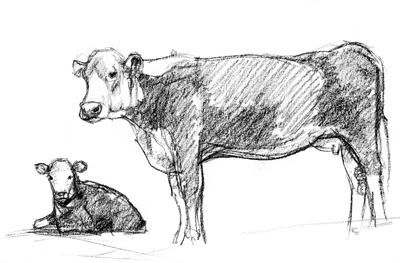
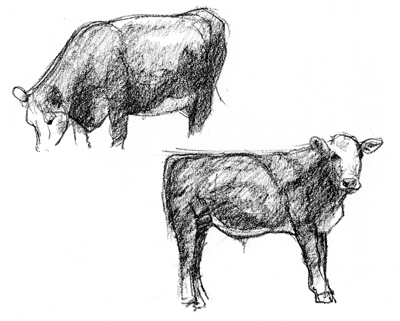
My most faithful collector and I have had a list of paintings that she would like me to do. Since she grew up on a cattle ranch in Southern California, she wants a painting of an oak tree with polled Hereford cattle, plus a few other elements. So this is where my illustration training kicks in. I find this kind of thing fun if, once the content is decided on, I am left to solve the problem and paint it as I see fit. I have now started the sketches. I haven’t drawn cattle much, so that was the first step. Here’s a few that are promising-
Hereford cow and calfYoung Herefords
ART QUOTE OF THE DAY
“You do not have to go very far to find suitable subjects. The cat lounging on your sofa, the horse down the road, yours or your neighbor’s dog; all are proper subjects and all will give knowledge which can later be broadened by trips to the nearest zoo or museum. My old friend and counselor, Paul Bransom, was the man who first urged me to go to the zoo, and to draw, draw, draw, Even the best reference sources don not take the place of real knowledge of animal structure. That can only be gained by putting your time in with the animals.”
















 Susan Fox, American Artist