Mongolia gets very little rain and most of what does fall comes in the summer. After the brutal winter zud (a drought year followed by an extremely cold winter with heavy snowfall) that hammered the country these past months, a year of good rainfall would be a blessing, indeed.
Being a herding culture, the Mongols have always depended on rain to grow the grass they need for their animals. The rainy season is short, so I suspect that as wonderful as a Mongolian summer is, it’s also a time for some anxiety.
In 2008, rain came late, at the end of August. My husband and I were at Ikh Nartiin Chuluu Nature Reserve. We arrived on a beautiful evening. It started to rain at around 3am and didn’t stop for 18 hours (we counted). But we had perfect weather for the rest of the trip.
In 2009, on my Artists for Conservation Flag Expedition, it was definitely the rainy season, even though there wasn’t enough to break the drought.
Here’s a few of my favorite “boroo” photos. (Note: “Boroo” is pronounced more like “baurau”, with a rolled “r”.)
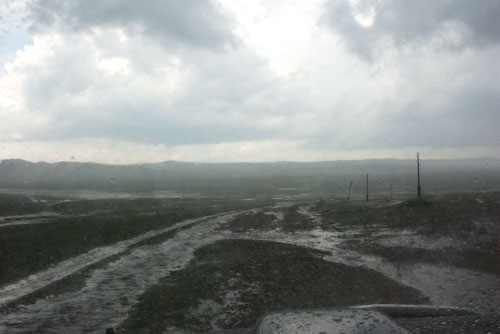
Naadam opening ceremonies, July 2009; the colorful show goes on for everyone, including the Mongolian State National Grand OrchestraHeavy rain/hail en route from Ulaanbaatar to Arburd Sands ger camp, July 2009One of the hailstones; roof of vehicle was dentedOn-coming rainstorm at Ikh Nartiin Chuluu Nature Reserve, July 2009; it rained hard for an hour and a half so I just stayed in the cozy ger; the white rectangle in the background is one of the toilet enclosures. Yes, it was a bit of a walk.
Rain has, so to speak, seeped into the culture to the point where it’s a leitmotif in many of the music videos I’ve watched and clearly has romantic connotations. Sometimes it seems like there has been an informal competition between groups and singers to see who can work the most rain into their video.
Here is one from Javhlan. Imagine this singer with an absolutely glorious voice, standing in the woods singing as the crew poured “rain” onto him. I’ll bet he only needed one take.
And, taking it even further, is A Capella’s “Boroo”. Hope it was a warm evening.
Finally, instead of a set-piece like the previous two, Guys 666, who normally seem to be hard rappers, did this video, also called “Boroo”, that tells a story, albeit not an entirely happy one.
Coming up soon is North Coast Open Studios the weekend of June 12-13 and, the following weekend, June 19-20, the Marin Art Festival. I’ll have framed paintings, prints and cards at both events, plus a variety of small, unframed affordable original oil paintings. I’ve been doing new ones in between working on larger paintings and it’s a nice way to take a break from the more complex pieces.
I generally do these in two sittings, plus maybe one more short one for final tweaking and try to keep them fairly loose and simple.
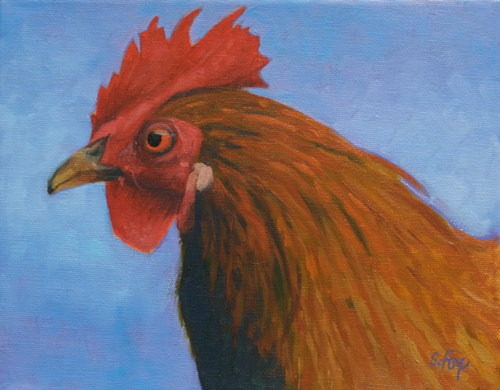
Rooster 8x10" oilChipmunk 5x7" oilThree Tule Elk, Point Reyes 8x10" oil
Coming up: a new on-going series on how to improve your paintings, based on all the mistakes and false starts I’ve made over the fifteen years I’ve been painting in oil. So it will be a looong series. ;0)
The Society of Animal Artists, of which I am a Signature member, has recently started a blog. On it you will find news about the Society, workshop and event listings by the members and a calendar of Society events. Check it out and let me know what you think!
We also now have a fan page on Facebook. You don’t have to join Facebook to visit us. And I invite you to visit our new website, too! It has information about our organization, exhibitions and how to become a member of the premier animal art organization.
Why Did The Elk Cross The Road Dept.
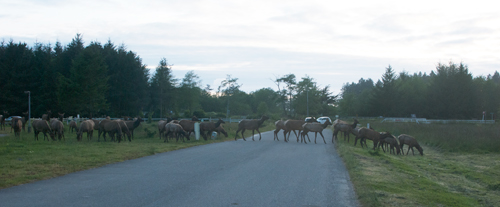
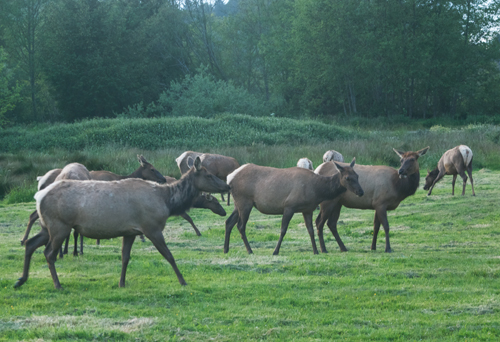
We went for a drive last weekend to find a spot from which to watch the sun set. The clouds rolled in, so that was kind of a bust, but at the Stone Lagoon Schoolhouse campground, which is right off the highway, a large herd of Roosevelt elk were working their way through the almost-empty RV section. We circled around on the campground road and ended up perfectly positioned for me to get some nice elk reference.
Over 30 elk cross the road; looking west towards the oceanFemale Roosevelt elk
This is about twenty minutes north of our house. There are often elk hanging around the campground, sometimes picturesquely situated in front of the old schoolhouse.
Oh, Honey, Look What The Cat Brought In Dept.
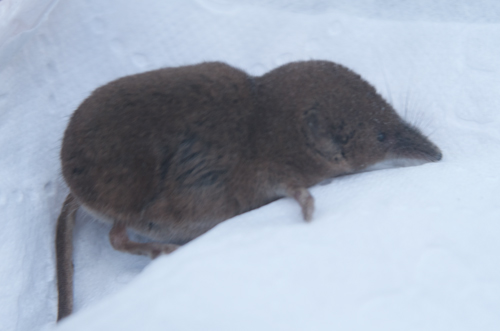
We think of it as semi-regular episodes of Animal Planet. This time, a very alive little shrew was left on an area rug in the living room where we couldn’t miss it. I picked it up in a paper towel and got a couple quick pics before turning it loose outside. Their metabolism runs really fast, so they can’t go long without food and don’t do well under stress.
It’s the last installment of my six part series. This week it’s going to be what I haven’t done yet. Of course, it’s an endless list, even for one country, because there’s always something new crossing one’s radar. But I wrote down the first six thoughts that came to mind and found that I do have a good list of things that I really do want to do or see and that are reasonably achievable.
Not having done them yet, I don’t have images. But I’ll share some which I took on previous trips that are related and also have inspired my list.
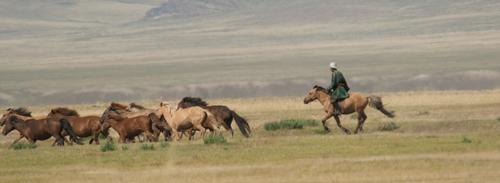
1. Gallop on a horse across the countryside– I am not a rider, but I’ve always wanted to do this (maybe it was all the western movies I watched as a kid). I looked into it once and the riding teacher I spoke with said six weeks of lessons at least to get to that point. Needless to say that didn’t happen. But in Mongolia…..I trust the horses and the horsemen, so maybe it’s possible. We’ll see.
Herder with horses near Hustai National Park, Sept. 2008
2. Attend the Yak Festival– Now really, who could resist that? Not me, that’s for sure. My current understanding is that it was started by a dairy company and is held around the first weekend in August, which means I can probably go this year! According to the Wikipedia entry for “Yak Racing” the activities include “…yak racing and showing, wild stallion and yak rodeo riding, milking contests and other traditional Naadam events of horse racing, wrestling and archery.”
"Ride me? The heck you say." Yaks at Gun-Galuut Nature Reserve, July 2009
3. See Burkhan Khaldun– This is the sacred mountain where Chinggis Khan dedicated himself to Tenger, the Sky, went to pray and, on a few occasions, hide from enemies. It is still an important place in Mongol culture. I don’t know if non-Mongols are allowed or welcome onto the mountain, but I would like to see it.
Tahilgat Hairhan in the distance; en route between Baga Gazriin Chuluu Nature Reserve and Ulaanbaatar, July 2009
4. Take a lesson in writing the ancient Mongol vertical script– Back in the 1970s and 1980s, I worked as a sign painter, graphic designer and calligrapher. I’ve always loved lettering and type. I spent a lot of time learning to letter with a sign painting quill (brush), along with pen and ink. “Oriental” brush lettering never particularly attracted me, however. Then I went to Mongolia and saw the vertical script, which Chinggis Khan adopted from the Uighar people because he realized that he couldn’t run his empire without a writing system. As you can see below, it’s still in use today, 800 years later. And it’s stunningly beautiful.
One of the first times I saw the Mongol script; large banner on building across from my hotel, Ulaanbaatar, Oct. 2006
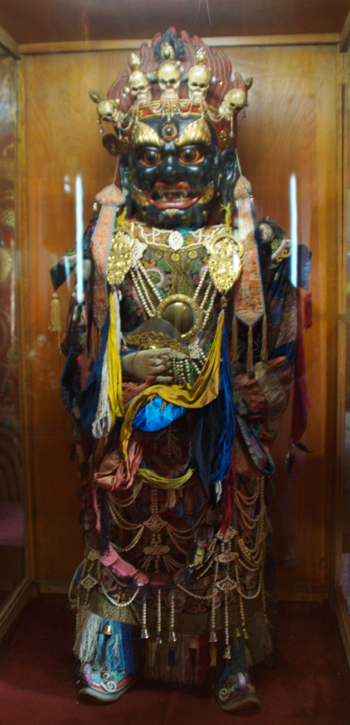
5. See Tsam Dancing– Today it’s a Buddhist ritual of relatively recent (late 18th century) origin, but it has it’s roots in ancient shamanistic beliefs. Basically an exorcism ritual, it has a set “cast of characters”. The fantastic costumes and masks must be seen to be believed. Fortunately, many of them are on display at the Chojin Lama Museum in Ulaanbaatar. When I saw them the first time, I was captivated without having a clue about what they were for. To see them in use would be wonderful. For a fuller explanation, go here.
Tsam dance costume, Chojin Lama Museum, Ulaanbaatar, Sept. 2006
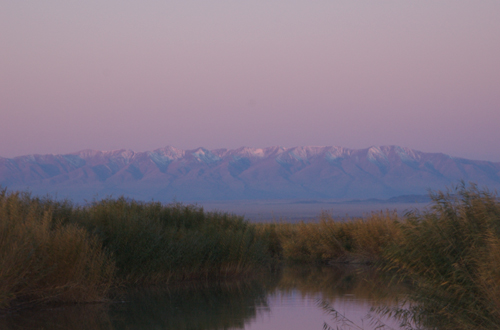
6. Hike in snow leopard habitat-Which is a lot more realistic than saying “see a wild snow leopard”. There are between 500 and 1000 snow leopards in Mongolia, according to the Snow Leopard Trust. Their habitat covers over 100,000 sq. km, so obviously the odds of seeing one are really slim to none. But one can get out into the mountains where they live.
Jargalant mountain, a far eastern spur of the Altai Mountains, Sept. 2006
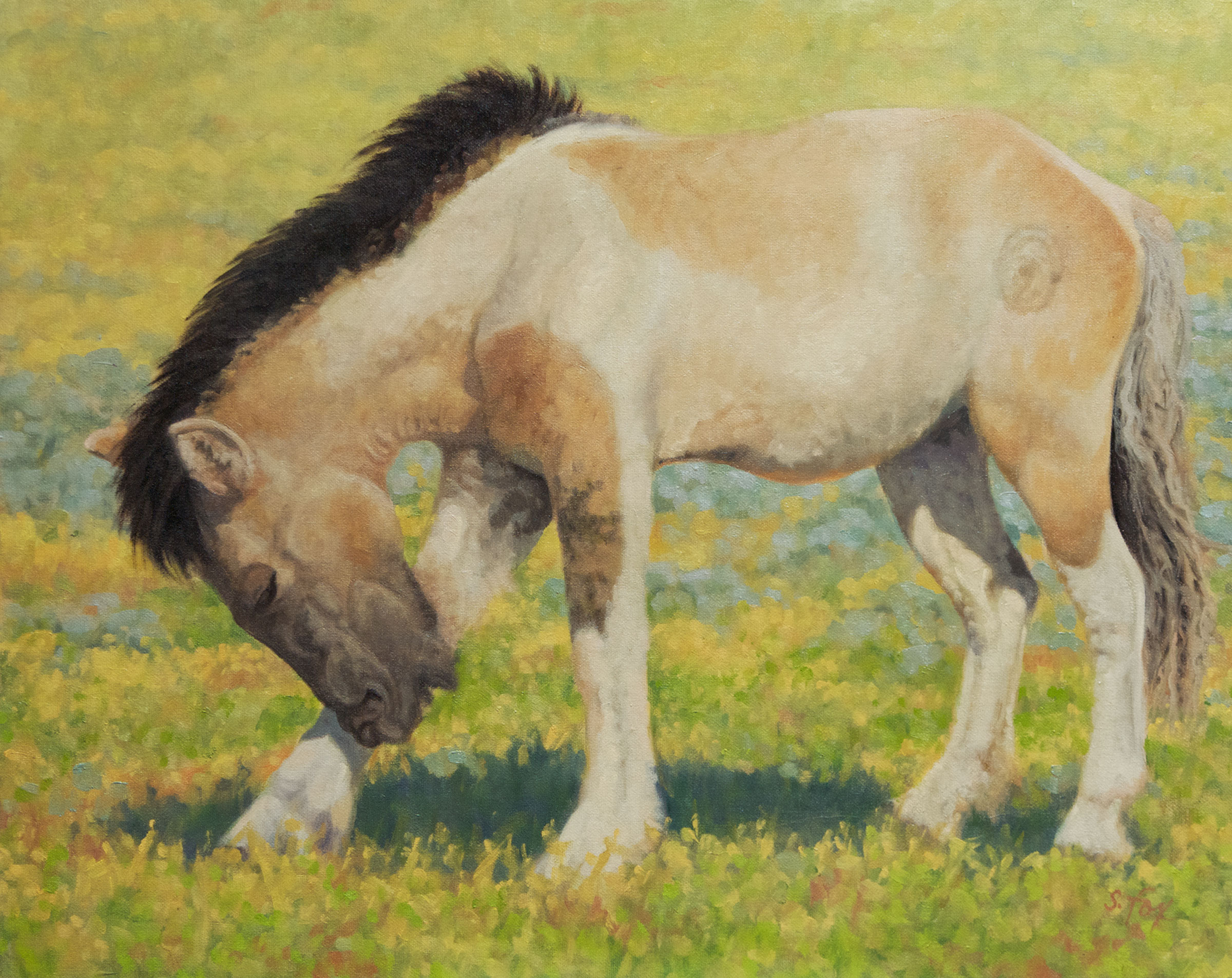
I received word this afternoon that my painting “Mongol Horse #3-Young Stallion” has been accepted into Art and the Animal, the prestigious 50th Annual Exhibition of the Society of Animal Artists. This is the second year in a row I have had work in the show. Last year it was bactrian camels, the detail of which is currently on my masthead.
I’ll be at the opening weekend of the show, which will debut at the San Diego Natural History Museum the first weekend in September. More later….
Mongol Horse #3-Young Stallion 16x20" oil on canvasboard
The only thing many people know about Mongolia is that it is the place from which Chinggis Khan and the Mongol Horde rode forth to conquer the largest land empire in history. The Mongols’ view of him is very different than the one westerners grew up with. Far from being a bloodthirsty “barbarian”, he is considered more as Americans do George Washington, as the father of their country. He united the Mongol tribes in 1206. The last vestiges of his empire lasted until the 18th century, although it had split into many separate parts long before. He was their lawgiver and his pronouncements carry weight and provide some guidance in the country to this day.
Mongolia became the world’s second communist country in 1921. Not long after, the memory and public acknowledgment of Chinggis Khan was, except for a very few brief periods, actively suppressed. This changed, it appears, almost instantly, when Mongolia became a democracy in 1990. He is THE major cultural icon of Mongolia today. In fact, I just realized that I’m writing this wearing my Chinggis Khan t-shirt that I bought when I was there in 2006. There is also Chinggis Khan beer and vodka. Large wall-hangings with his portrait are very popular. You see him on billboards. He and his warriors ride into the National Naadam stadium during the opening ceremonies. There is a pop singer named Chinggis Khan. And, as you will see below, one can put together quite an interesting tour of the country visiting statues, monuments and a variety of locations associated with him.
I’ve been to three of the ones listed here and hope to visit the others at some point. Who knows, maybe this summer!
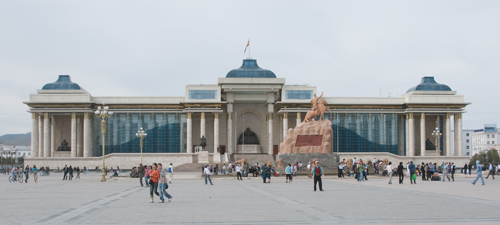
Government House, Sukhbaatar Square, UlaanbaatarChinggis statue
1. Sukhbaatar Square- When I first saw the Government Building in 2005, it was a socialist era plain brown rectangle. The next time, in 2006, it was covered with scaffolding and it looked like a major change in the facade was under way. By the time I saw it again in 2008, the transformation was complete as you can see in the first image. It’s now one of my favorite government buildings ever. And the centerpiece is an enormous statue of Chinggis Khan.
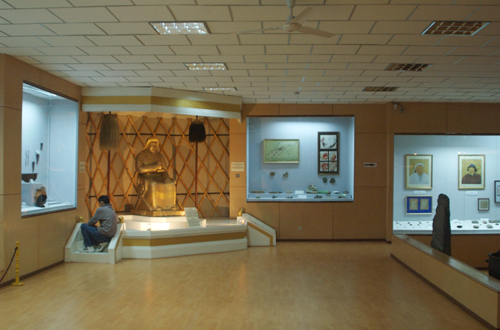
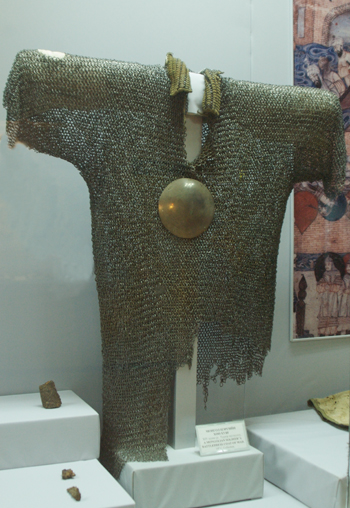
Chinggis Khan room at the National Museum of Mongolian HistoryMongol chain mail hauberk-13th-14th c.
2. National Museum of Mongolian History- There’s a rather large room devoted to Chinggis Khan and the Mongol Empire on the 3rd floor. Lots of interesting artifacts, including the chain mail hauberk show above. There are supposed portraits of Chinggis, Kublai and other Mongol khans, but I believe they are Chinese in origin and created after the lifetimes of the subjects. One unexpected display has an actual letter between one of the later Khans, Guyuk, and the Pope. There was a surprising amount of communication between the Mongols and western Europeans from the 13th century on, although usually at cross-purposes. The Europeans wanted the Mongols to help them beat the Saracens and the Mongols wanted the Europeans to submit to them and become part of the Empire. Needless to say, neither party got what they wanted.
The world's largest equestrian statueThe view looking east as Chinggis would see it
3. The Chinggis Khan Equestrian Statue- It’s 40 meters high and on a 10 meter high base and is covered in aluminum. If you look at the horse’s mane, you can see the people who had taken the elevator up into the horse’s body. There’s a restaurant, gift shop and other facilities in the base. The second image shows what the statue “sees”. Out beyond those mountains is the origin point of the Khalkha Mongol people, who westerners think of as “Mongols”, although there are quite a few other ethnic Mongol groups.
These next three are the places that I haven’t been to yet, so there’s no images.
4. The Onon River– In the mountains near this river’s junction with another, Balj Gols, is where Chinggis Khan is believed to have been born. Although westerners think of the Mongols as a steppe people, they originated in a mountainous area that is part of the southernmost extension of the taiga or boreal forest. This is where the first monument to Chinggis Khan was erected during the socialist era. The people responsible ended up being purged. There is also a stone marker near the village of Dadal, placed in 1990 to commemorate the 750th anniversary of the writing of the Secret History of the Mongols, almost the only primary reference material available about the Mongols during the time of Chinggis Khan, although it survived only as a Chinese transliteration.
5. Avarga- This site on the Kherlen River is supposed to be the location of Chinggis Khan’s “capital”. It is believed to have served as his base from 1197 until the end of his life. I’ve been told that there are two noisy ger camps in the immediate vicinity, so it looks like a day trip or camping out will be the preferred options.
6. Burkhan Khaldun- This mountain, where Chinggis Khan took refuge from enemies before he became Khan of all the Mongols and journeyed at various times in his life to pray to Tenger (the Sky), is located within the Khan Khentii Strictly Protected Area, which the Lonely Planet guide describes as “Chinggis Khan territory”. There is an ovoo on the mountaintop that is visited by the Mongols. I don’t know if it’s ok for non-Mongols to go onto the mountain, but I would at least like to see it.
I’m please to announce that the Letter from Mongolia which I recently wrote for Wildlife Art Journal was posted on their website this morning! It’s illustrated with lots of paintings, drawings and photos, many from my Artists for Conservation Flag Expedition last July. Thank you to Todd Wilkinson and the rest of the staff for providing the only publication (it’s online only, no print version) dedicated to wildlife art!
And yesterday I finished the warthog painting. Here’s the step-by-step from last week. I’m calling it “Gonna Run In 3…2…1”
I’m going to have to once again interrupt my current series to share some news and the accompanying memories-
I got word last week that Choidog, the subject of my painting “Choidog and Black”, which is currently in a national invitational American Academy of Equine Art show in Lexington, Kentucky, passed away in late March. He was about 80 years old and was healthy until the very end. Choidog was one of the legends of Mongolian horse training, having won the national Naadam race three times.
I first encountered him on a fall 2008 trip to Mongolia when my husband and I stayed at Arburd Sands ger camp, which is operated by one of his sons and daughters-in-law. We were invited to his ger by them for the family’s annual foal branding. It was a magical afternoon, which you can read about here. He was every inch the proud Mongol horseman and we knew that we were in the presence of someone special.
At the ger camp, there was a book, “Horse People”, by Mattias Klum. One chapter was about Choidog and his family. I glanced through it, only casually interested, since my focus at the time was almost exclusively on wildlife.
Last July, on my Artists for Conservation Flag Expedition, I had the opportunity to see him again, as his ger happened to be only a kilometer or so from Arburd Sands ger camp, where I was staying for one night on the way to a nature reserve. He didn’t have much to say to me and directed almost all his conversation to my male guide, but that was fine because it let me just sit and quietly watch him as he lay at ease on the bed opposite.
This time, I searched out the “Horse People” book at the ger camp and read, really read, the chapter about Choidog.
Later in the trip, I was visiting a young horse trainer and his wife at Ikh Nartiin Chuluu Nature Reserve. Once again I was in a ger sitting on the floor drinking suutei tsai (milk tea) while a conversation went on around me since I don’t speak much Mongolian yet. I noticed a magazine tucked up between the roof felt and a support pole. There was a photo of a man on the cover and it looked like, even from across the ger, Choidog. I finally had the Mongol scientist I was with ask about it. The young man took it down and handed it to me saying “You have sharp eyes”. It was a much younger Choidog and the magazine, which was for and about Mongol horse trainers, had a feature article on him with photos from the Naadam races he had won in the 1960s.
When I got home, I found a copy of “Horse People” on Alibris. One passage that struck me was Choidog saying that “In Communist times each family could only own 75 horses. The rest went to the state. Now we can own herds of 300-400, if we can manage it. There’s no limit. In communist times it was strange for someone to have his own herd.” This was in about 2002.
I was told, at the time we were there in 2008, that he had between three and four hundred horses. When I mentioned this to the young horse trainer at Ikh Nartiin Chuluu, his eyes got rather wide and he remarked that that was a lot of horses.
The chapter ends with this passage: “He can mount his ‘favorite black’ stallion and thunder off into the unending pastures, just to feed his heart. “To run on horseback in the morning is high exhilaration.” he says, eyes shining. “It is to feel alive, completely awake.” ”
Late last year, a Facebook friend posted something about a new art auction site, to be run by someone called The Brigham Galleries. The short story is that the owners had decided to close their “bricks and mortar” gallery location on Nantucket and instead sell exclusively through online auctions. They saw that there is a price gap between art sales on eBay (generally below $1000) and the big auction houses like Sotheby’s (generally over $500,000). That’s quite a bit of open territory. I went to their site and saw a couple names I recognized on their list of artists and became a fan on their Facebook page.
They announced an opportunity to submit work for the first auction as a “Juror’s Pick” and I decided to submit something. No cost, no risk. Why not give it a whirl? And, the painting above made the cut as a Juror’s Pick!
It’s been a bit of a long road for the women to get it all organized and has taken longer than they expected to get the site up and running. But, as of today, the auctions have begun! The listings are here. Mine is at the bottom of the first page. It’s Lot 35, Lot Item 1102. The auction will be for two weeks.
I’m very pleased with the quality and variety of work that they have for this very first round.
Will I get sales? Who knows? But it’s a new model that I hope will be successful. There is minimal risk to the artist- the work stays in the studio until it sells. And minimum expense- no shipping work back and forth, reasonable listing fees and an extremely reasonable commission upon sales.











 Susan Fox, American Artist