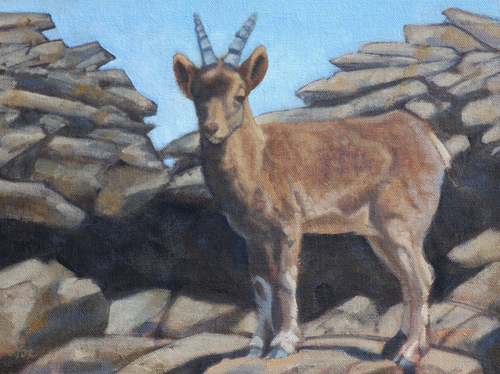
I thought that I would start to share how I put my Mongolia paintings together, starting with a subject from Ikh Nartiin Chuluu Nature Reserve. I had never been to a place anything like it and before I began any finished gallery paintings, I needed to learn to paint the various elements, both the land and the animals. Here are two studies of the rocks, one of a young ibex and a finished 15×30 of two argali-
Since most people are not familiar either with the species or the place, I wanted this first painting to show the kind of landscape that argali like; not just mountains, but upland areas with these rocky outcroppings. You can see the steppe down below and off in the distance. These were two rams who were spending at least part of the day together. It turns out that argali don’t form permanent harems or herds. Animals of all ages and both genders group and re-group throughout the day in numbers, at least from what I saw, from one to twenty or so and everything in between.
IMHO, there is too much animal art out there in which the subject has about as much life as a department store manequin. Why is this? Is it a lingering result of Descartes’ pernicious idea of animals as “mere machines, incapable of thought or feeling” (Pollan, The Omnivore’s Dilemma)? Being so concerned with surface features that the inner life of the animal is ignored? Not doing the fieldwork and observation which would reveal that inner life? I could make a case for any and all of those reasons, but the fact remains that there are an awful lot of “dead” animals on canvas out there.
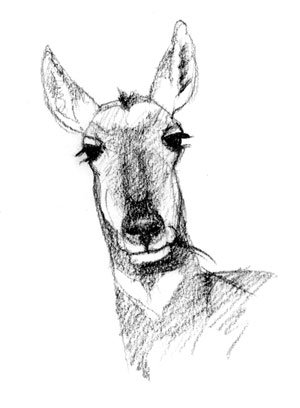
Pronghorn doe
Internationally known wildlife artist John Banovich, who I have been fortunate enough to study with, pointed out in one workshop a few years ago that “you are only as good as your reference”. Since then I’ve realized how true that is. I look back through the print photos that I took before I went digital and it’s so obvious why I couldn’t get my work past a certain level. I didn’t have top-notch reference. I struggled to paint with what I had because I wanted to do it so badly.
African Wild Dog
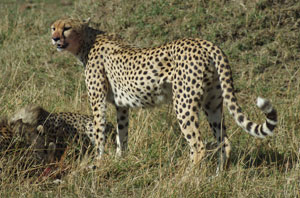
Digital photography has been a godsend since it has always been necessary, as any professional photographer knows, to take 20, 50 or 100 shots to get the keeper. Now there’s no excuse not to fire away and greatly increase the chances that you’ll get the shot that will allow you to do the painting that will be ALIVE. Here’s an example: two images of a cheetah, taken 3 seconds apart. The first is ok, but the second is much, much better. The only difference is a slight turning of the head, but it makes a big difference in the expression.
Cheetah 8:45:11amCheetah 8:45:14
For an painted animal to “be alive”, the artist is required to accept that they are sentient beings, with their own consciousness. Whatever else animals are, they aren’t “dumb”.
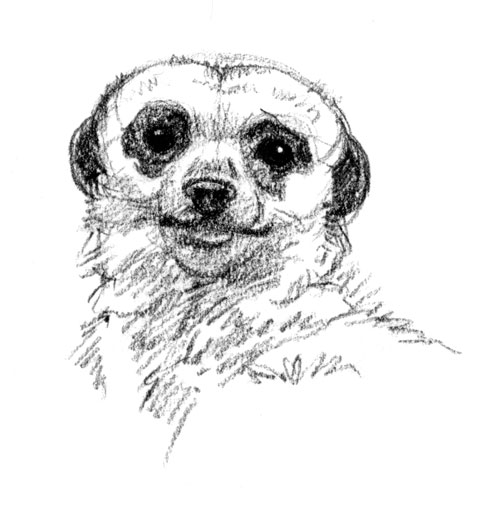
Meercat
For the next few weeks, I’ll be discussing animal features one by one and how they relate to capturing life and expression. The final installment will be how it all comes together to create a whole that is greater than the sum of the parts.
On my first trip to Mongolia in spring of 2005, I managed to get a couple days at Hustai National Park, enough to know that I wanted to go back when the daytime high was more than 32F with howling wind (ah, early May in Mongolia!). Hustai is the most accessible place to see reintroduced takhi, or Przewalski’s horse. For 2006, I arranged to have the use of a car, driver and guide so that I wasn’t dependent on driving around with other, non-artist visitors.
I needed to be in the park at dawn and at the end of the day in order to get what I’d missed before because of cloud cover- takhi in great light. This excerpt is from my first day.
9-27 10:15 am Wed.
Just got back from the morning “game drive”. Left a little after 7:30 am and got to the valley just in time to catch the light about 8 am. Hit the jackpot, Two takhi just on the shadow side and then coming into the sun.
Takhi Mare and Stallion at sunrise, Hustai National Park
Went back up to (the) pass, seeing more takhi and the 2 eco-volunteers from France who I sat with last night. Missed a great shot of a bull marel (a species of elk) because the driver didn’t stop in time. Continued over and down around the backside of what my guide says is called “God Mountain” because all the spire-like piles of rock look like flames of fire. There were takhi at the base of a particularly picturesque part of it and the guide asked me to take her picture. She pointed out another mountain where she said lynx live.
Guide with takhi in front of "God Mountain", Hustai National Park
We continued on into what she says is called “Happy Valley” and it sure was for me. Came upon 2 groups of takhi, one waterhole. I think the issues were who got to drink first and can I steal some of the other guy’s mares. (There are 3 largish songbirds pitty-pattying around on the top of the ger as I write this entry)
Takhi harems at waterhole, Hustai National Park
We entered a part of the valley with trees along one side and it turns out they are saxaul, which I didn’t expect to see until I went south (and it turns out that I hadn’t. Something must have gotten lost in translation, because I found out this last trip that they for sure weren’t saxaul trees). There were also some domestic horses, which the driver got out to shoo away. We circled around out on the grasslands and saw 2 small and 1 large group of gazelle. Final stop was the research center, which was looking pretty sad and almost derelict last time. It’s humming now. Offices for the ec-volunteers, the managers, biologists, ecologists and a kitchen. There’s even curtains on the windows.
So, I’ve gotten my evening light and early morning light. Now it’s just seeing what kind of behavior I can record.
I liked the waterhole setting and plan to eventually do a big painting with both harems that tries to show what I saw that morning. In the meantime, I had this reference from elsewhere in the park of a mare with a beautiful gesture.
One of the things that makes me a little crazy is animal artists who present their subject in an awkward and sometimes even ugly pose. There seem to be a number of reasons for this, among them lack of drawing skill, not knowing the anatomy of the species, getting too caught up in copying a photograph or simply not seeing the inherent grace and rhythm of living things. Just because it “looked that way in the photograph” is NO excuse. Be intentional. Don’t be lazy and settle for what’s in front of you. Now is the time to pull out the old National Geographic or hit Google Images. Not to use someone else’s images, but to fill in the information that is missing in your reference.
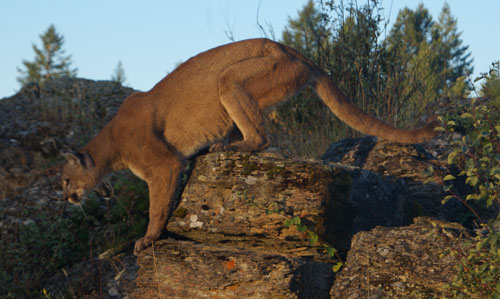
It is a matter of training your eye to evaluate what’s in front of you. Someone once said that drawing is seeing. Exactly right. As an example, here are two images of a cougar. Which pose do you think has the better rhythm?
The only real difference is the position of the head, but the 3/4 view really changes the flow of the top line and actually stops the sense of movement.
Here’s one of two horses I photographed in Mongolia last year. If you saw them separately as paintings on a wall, which one would draw your eye and pull you over to it?
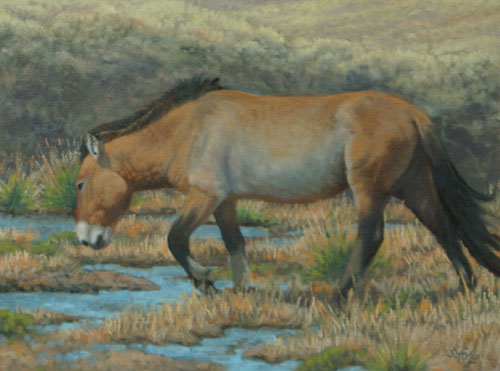
My own eye has been influenced by looking at the work of Alphonse Mucha, the great Art Nouveau graphic artist. Notice how the hair is designed in deliberate, rhythmic shapes.
Think about how that might apply to a horse’s tail or a lion’s mane. It could save you a lot of time, and end with a far more interesting result, by seeing and painting hair and fur as larger shapes instead of individual strands. Fur rendered in excruciating hair by hair detail is definitely another of my pet peeves. There is a better way. Really.
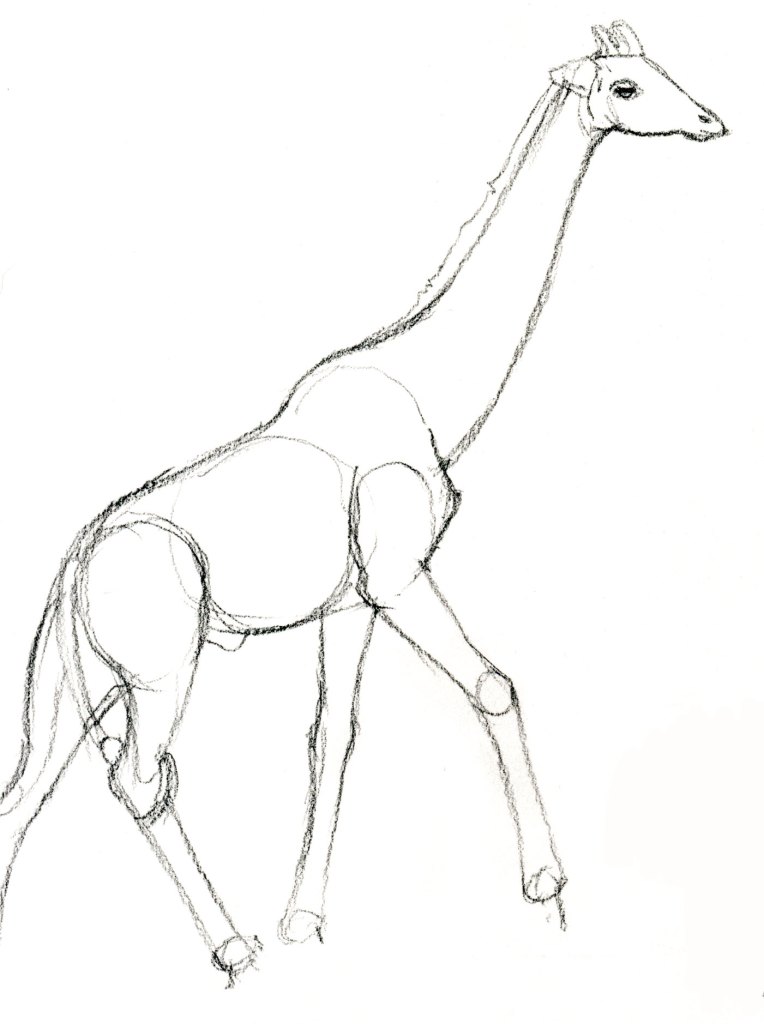
Finally, here are some quick drawings (2 minutes or so) that I did this morning. Notice that I didn’t worry about the spots on the cheetah or the pattern of markings on the giraffe. All I wanted was to catch the gesture and rhythm of the pose. These quick sketches are also a way to find out if a pose “draws well”. Something that looks fine it a photo can look really weird in a drawing. Odd, but true. Why notice it when you’re halfway through painting all those spots?
ART THOUGHT FOR THE DAY
“The true artist does not paint to please the public – but he holds the interest of all who think, for a work of art expresses the mind of its workman. In it are clearly reflected his vices and his weaknesses, as well as his virtues. He may deceive men, perhaps, but not inspiration, which will not be duped by hypocrisy.”
William Wendt (1865-1946) (as recently quoted in the California Art Club newsletter)
Who’s Your Buyer and how do you get your work in front of them? We’re pretty much all going to have to be lean and mean in promoting our art. It’s called “targeted marketing”. Which means knowing who your buyer is.
When I went through the process of creating my marketing plan with a counselor from our local Small Business Development Administration (SBDC) office, the first homework I was given was to pretend that my buyer was sitting in a chair across from me and then describe them. Beyond the general question of who buys original art, who do you think will be interested in YOUR art? In my case, we somewhat humorously pegged my target buyers as “rich celebrity environmentalists”.
More realistically, it’s someone with a certain income level and probable interests in nature, environmental issues, travel and the outdoors. If you request advertising rate cards from a national magazine, they usually include demographic information on who their readers are to demonstrate the kind of eyeballs you can expect to view your ad. You can create the same kind of thing yourself to help decide where it makes the most sense to put your efforts.
I was talking about marketing approaches with an established artist at a wildlife art festival a few years ago. My specific question was where to look for galleries. His advice was to try place my work in locations where there were people “needing” to furnish second and third (!) homes. I’ve got to say, living in a county where the average income is $38,000 a year, that thought truly hadn’t crossed my mind.
Use the Internet- The world’s going digital. The US Postmaster just asked Congress for permission to cut the number of mail delivery days in the future because they are losing so much money. One reason is email and other types of online communication. I know that there are a lot of technophobic artists out there, but you’ve somehow got to suck it up and check it out, if for no other reason that using the internet takes time, but next to no money. At this point everyone pretty much knows that you have to have a website, same as you need a phone.
But when you bring up blogs, Facebook, Twitter, etc. the reaction usually seems to be a cri de coeur that there aren’t enough hours in the day as it is. My objection was that I couldn’t imagine that anyone would care what I had for breakfast (homemade muesli with berries from our garden, usually), so why should I take the time to do a blog. But……..when I evaluated it in terms of my marketing plan and learned how easy they are to do and that, unlike the website, I can update it myself at will in a far more dynamic way, I decided to give it a try. I approached signing on to Facebook the same way. An unexpected fringe benefit is the pleasant, informal contact with artists all over the country and the world.
Twitter I’m not sold on yet, but I monitor it with the idea that it will probably be just the thing at some point.
I encourage you to set aside an evening and check out Google’s Blogspot and also WordPress, which is what I use. Blogspot is probably easier to get started with, WordPress is more sophisticated in how it does things. You can register on both Facebook and Twitter, then just lurk around and see what you think. None of this is permanent. You don’t have to tell anyone. You can register and then cancel if you want. Be aware though that Twitter currently makes it very difficult to sign up again if you close your account.
Let me know if you start a blog or get on Facebook. I’ll be interested to hear what you think.
TWO NEW SMALL PAINTINGS
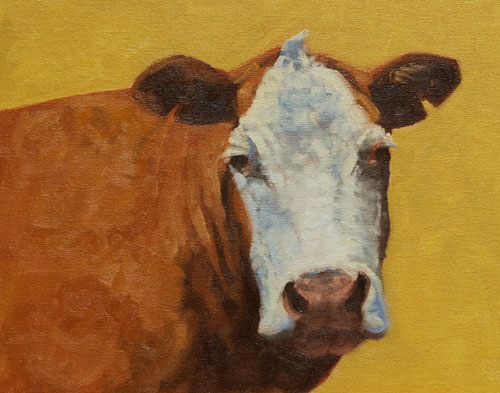
Hereford Study oil 8"x10"
I originally started this as a demo for my painting class and thought it would be fun to finish it. I also have a commission that involves Herefords, so it’s doing double duty.
Afternoon Light, Pismo Beach oil 10"x8"
I did this one yesterday in a couple of hours. Sometimes it’s fun just to smoosh the paint around.
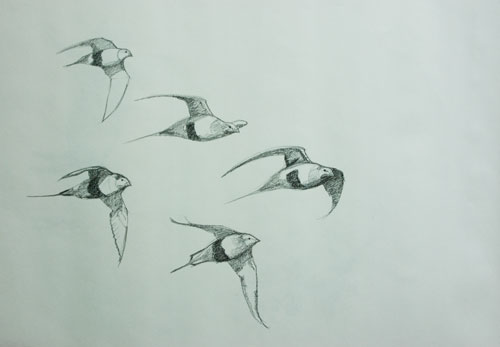
And, finally, a drawing of some grouse that I photographed in Mongolia. Not sure of the species yet.
Sand grouse, Wolff's carbon pencil on drawing paper
I really like the work of Mark Eberhard, who has a background in graphic design and uses it to great effect in his paintings. When I saw the image I shot of what was a good-sized flock, I was struck by the pure design possibilities. To be continued…..
Strength in Numbers! If you think about it, one could say that the ability to be alone and self-motivate are prerequisites for being a working artist. In a sense, painting is a “solitary vice”. So, it may take some conscious effort, in planning the marketing of your work, to consider the multiplier effect of joining with others. This hit me two years ago when I was offered the opportunity to have a solo show at a financial management company. (I should note that where I live there are really no commercial galleries as the term is generally understood. Most spaces, some of which are very nice, are “piggybacked” on another business. However, the community is very supportive of its artists and finding a place to show art publicly is pretty easy. Sales are uncommon, but, boy, do we get fussed over.) I’ve had a few solo shows here and have always gotten a gratifying turnout. But it occurred to me that if I invited some of my animal/nature artist friends, it would not only be more fun, but that then their “fan base” would see my art, too.
I invited four colleagues and they all said “yes”. The reception was packed, I sold two giclees, another artist sold one and a good enough time was had by all that we decided to do it again. Last year we added a couple of new artists and moved to a different venue. We also invited the local wildlife care center folks to attend with a couple of their birds as an added attraction. Once again, a great turnout, both for the reception and during the month that the show was up.
The next show, Wild Visions 3, will be in October and we will have a nationally known wildlife artist as our Special Guest (more later). While, in a sense, it’s “my” show, we all pitch in with ideas (one of the other artists came up with the name) and work the reception. We’re exploring various ideas for “growing” the show.
Should you consider finding a small group to show with whose work is complementary to yours? With the right people it really is “the more, the merrier”.
What’s Your Story? There’s a lot of artists out there. Good ones, too. How do you make your work stand out? One way is your Story. What is it that sets you apart? If you’re going to successfully get local or national editorial coverage (back to last week’s “spend no money”), you have to have a hook to get the attention of a reporter or editor. Not to mention collectors. They are buying your story along with your art.
Now, you can’t just make something up out of whole canvas, so to speak. And you don’t need to. You’re an artist. That gives you a leg up already since people in general are really interested in what artists do and get a kick out of knowing one. Find something particular that you do and why, test drive it and see what the response is.
I like to travel and it’s a necessary part of creating my art. I happen to really like Mongolia, which has a certain cachet as a destination. So, for me, it’s kind of a no-brainer. My story is my travels to Mongolia and the paintings and drawings that are the result.
Filtering how you present yourself and your art this way can simplify your choices, too, since there’s never enough time to do everything you want/need to do.
To be continued…
NEW WORK IN PROGRESS!
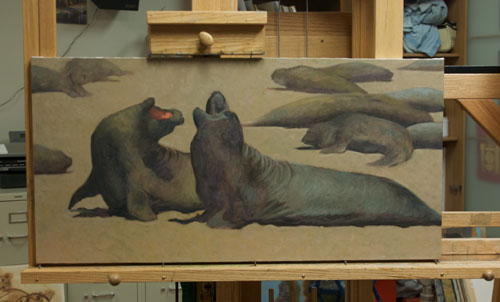
I’ve been fighting off a sinus infection for the past three weeks and haven’t gotten in much easel time, but I have made progress on this new painting from reference that I shot year before last down near Cambria, California. There is a huge elephant seal colony right on the beach next to Highway 1 and they really put on a show. Lots of male posturing.
Young male elephant seals
NEW CAT UPDATE!
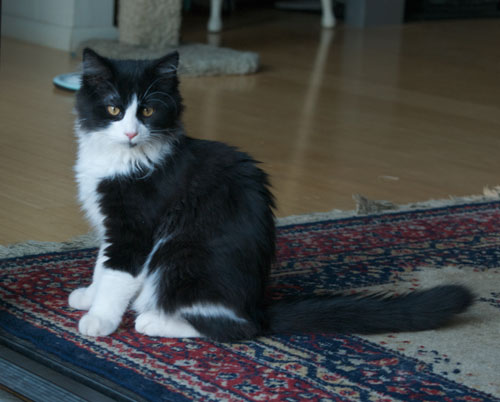
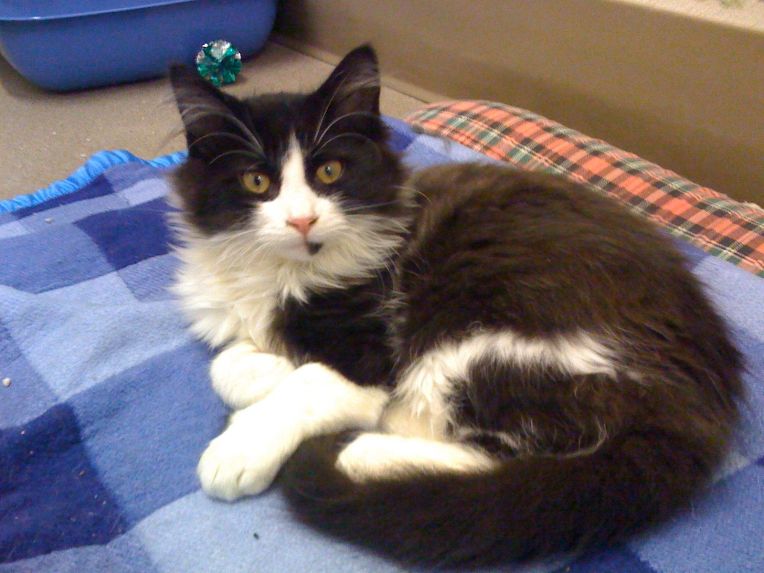
Just for fun, here’s a few photos of Alexander, who’s doing great. He’s gotten nose to nose greetings now from two of the three other cats and one is now willing to play with him.
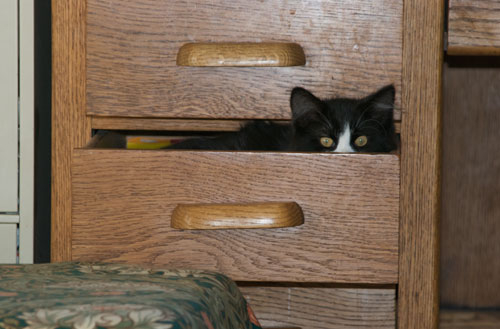
Alexander, first day allowed outsideAlex in one of David's desk drawersAlex in a new favorite place
I was able to take many good pictures of Mongol horses on my trip there in September. This was a stallion who showed up with his harem very near the ger camp at Ikh Nartiin Chuluu late one afternoon. Due to lack of rain, all the herder families had left the area, along with their livestock, but a few groups of horses had been left behind to shift for themselves until their owners returned.
I wanted to really work on understanding horse structure so this is a bigger painting than what I’ve recently been doing – 24″x 36″. The horse is almost 19″ at the withers. I really loved the rhythm of the movement. It was almost like he was showing off. I don’t know horse behavior nearly as well yet as dog or cat, so I’d love to hear from anyone who can interpret what he’s doing and why.
Since the horse was what I cared about , I left the background as a field of mostly warm color with some cool color showing from underneath.
NEWS FROM THE FELINE FRONT
Meet our new family member, Alexander! We brought him home yesterday from the Humboldt County Shelter, where I volunteer. He’s four months old and extremely friendly. He likes other cats (although our three girls aren’t too thrilled at the moment). He’s done a nose touch greeting with Niki the collie. We’ve set him up in a crate in my husband’s office since Alex is supposed to be mainly his cat.
The vet was just here (she does housecalls only; how cool is that?) and she thinks that he may be part rag doll because of how easy he is to handle, kind of like, well, a rag doll. She pronounced him in good health and recommended a bath at the groomer’s to get rid of the whiff of shelter odor and get him all nice and fluffy. We all want to get him the best start on the rest of his life that we can.
FYI: never bring home a new animal, either a cat or a dog, plop them down in the living room and turn them loose. New introductions need to be taken slowly with consideration for everyone. The new animal should be in a crate or behind a baby gate or in a room like the bathroom to ease in gently and avoid conflict. He’ll stay in the office at least until Sunday.
Since, judging from the stats, the subject seemed to be very popular, I thought I would continue today with more on the takhi, specifically how I take the reference I shoot and turn it into a painting. More and more I start with drawings to become familiar with a new species or figure out things about one I’ve painted before.
Here are three drawings from last year, the first two of which were published in the Society of Animal Artists newsletter.
Takhi scratching leg; charcoal pencil on cold-ply bristol paperTakhi mare and foal; charcoal pencil on cold-press bristol paper
Now I’ll show you how I take an animal from one time and place and put her in a setting from another time and place, a challenge that every wildlife artist needs to meet successfully. Here’s the setting:
Main takhi water source; Hustai National Park, Sept. 2006
What a treat! We came around the bend in the dirt track early in the morning and there, right in front of us were two harems at the same time, sorting out who gets to go first.
Watering place close-up; Hustai National Park, Sept. 2006
I always try for a variety of shots; close-ups and the “big picture” for context. I used to come home with great close shots of something like a tree and found that I’d completely forgotten to get the surroundings, which really cut down on my options. Notice that the above photo is kinda fuzzy. But it’s still useable for reference.
Now here is the horse reference. Different part of the park, different year, different season. I’ve included two as an example of what to look for when evaluating images. These are similar, but the second, to me, is clearly superior. I love the rhythm of her gesture.
Takhi mare; Hustai National Park, May 2005Takhi mare 2; Hustai National Park, May 2005
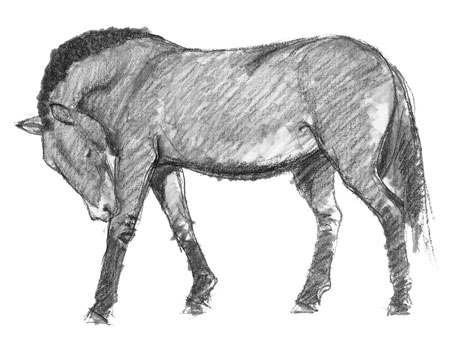
So next I did a drawing to capture that.
Takhi mare walking; charcoal pencil on cold-press bristol paper
And, putting them together, here is the finished painting, completed in 2007. What I hope is that you can’t tell that I “stitched” together the reference from two sources.
Morning Drink oil 12x 16" (price on request)
I also wanted to let you know that two of my takhi images are available as limited edition giclees, framed or unframed. The full information is on my website. Click on “Limited edition giclees” under Fox Studio in the column on the right and it will take you directly to my giclee page.
Takhi Foal; giclee on archival paper
I saw this foal on the same trip as the mare in the painting above. He or she was quite a character.
Mongolia Morning; giclee on archival paper
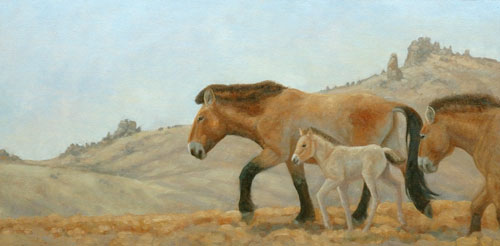
I posted this last week, as the original painting is still available, but have also published it as a giclee. It’s another example of how I took the mare and foal, who were against a grassy hillside and moved them to a ridge that has Hustai’s famous mountain as the background. The third horse was added as a design element.
All my giclees are available for holiday delivery.
ART THOUGHT FOR THE DAY
Let this be plain to all: design, or as it is called by another name, drawing, constitutes the fountain-head and substance of painting and sculpture and architecture and every other kind of painting, and is the root of all sciences. Let him who has attained the possession of this be assured that he possesses a great treasure…:
Well, I certainly enjoyed the last two Mongolia Monday posts and hope you did, too. Thanks again, Simon!
Today it’s back to a subject that has become near and dear to my heart- the takhi or Przewalski’s Horse. I always liked horses, even though I was deathly allergic to them as a kid, but have never been, ahem, drawn to them as a subject until I saw takhi for the first time at the Berlin Zoo in October of 2004. I didn’t even know they were there. I just happened on them in the far nether reaches of the zoo. Seven of them, looking like they’d just stepped out of a cave painting.
Takhi group, Berlin Zoo, October 2004
I remember that I plopped down on the nearest bench, probably with an idiot smile of delight on my face, to sketch and photograph them. They were enchanting.
Takhi Stallion, Berlin Zoo, October 2004
I did some research when I got home and found out that they were being reintroduced into Mongolia. So when I signed on for an Earthwatch project there, I arranged a three day trip to the closest site, Hustai National Park. It was spring, which meant cold, windy and and occasional snow, but I saw the horses and got some decent photos. The next step was to get back to Mongolia, which I did in late September-early October of 2006. By then, I’d found out about a third, new release site in western Mongolia, Khomiin Tal, and managed to get out there. There is also a series of three articles I wrote for Horses in Art. One on Hustai National Park, one on Khomiin Tal and one on the domestic Mongolian horses. Look under “Writings” for those.
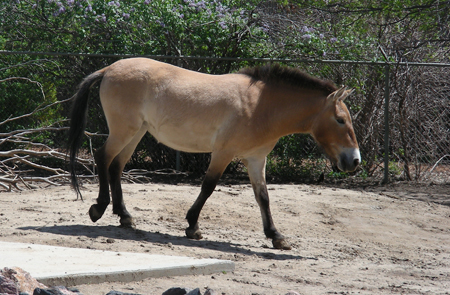
Then, this last May, I was at the Denver Zoo and saw takhi there. They looked much different from the Berlin animals, as you can see. There are a number of reasons for this that have to do with being kept in captive conditions, which can lead to much heavier bone structure and skull defects. The animals for release come from semi-reserves where they can live and eat more normally.
Takhi, Denver Zoo, May 2008
I’ve been drawing and painting them since that first trip to Hustai, but have hardly scratched the surface of the picture possibilities.
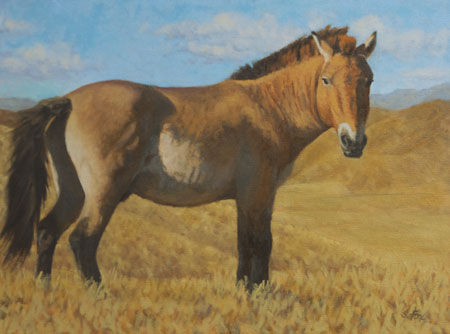
Here’s one of the first paintings, which is available as a limited edition giclee. When I showed a photo of it to a Hustai biologist on my second trip there, she immediately recognized the mare by her mane, which reinforced my desire to paint individuals of a species.
Mongolia Morning oil on canvas board 12″x 24″ (price on request)
Followers of this blog know how adamant I am about doing fieldwork. I think this next piece illustrates why. There is no way this painting would have happened if I hadn’t been there at Khomiin Tal to photograph both the horses and the habitat. I’ve seen a few other paintings of takhi and so far none of them really looks to me like it was done from reference shot of reintroduced horses in Mongolia. They are pretty obviously captives in Europe or North America. The light’s not right, the land isn’t right and, mostly, the horses themselves aren’t right. But I sure can understand the compelling desire to paint and draw them anyway!
That’s the Spot! oil on canvas board 18″x 24″ (price on request)
Here’s the most recent painting, a stallion at Hustai. I wanted to really show the valley that is the core habitat of the population of, now, over 200 horses in 15 harems and to try to capture the interesting shape of the shadows on him.
Master of the Valley oil on canvas board 12″x 16″ (price on request)
This 10″x 8″ study is going to be listed for sale on EBay tomorrow or Wednesday. It was amusing to watch the foal work out the motor coordination required to scratch that itch.
Scratch that Itch! 10″x8″ oil on canvasboard
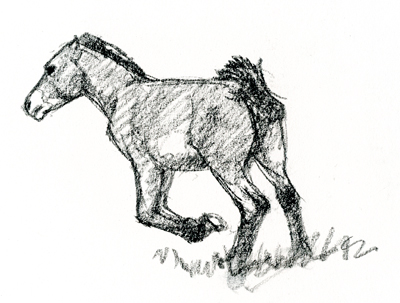
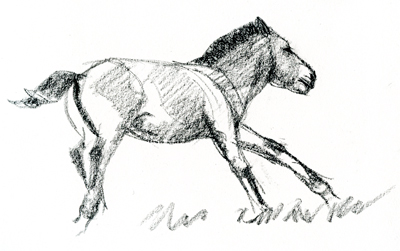
Lastly, I did a batch of drawings a couple of weeks ago and I rather liked the way these came out. The photos were taken at Hustai this past September. It was late afternoon and this one foal was having “crazy fits”. I’m always looking for animals in action and he/she certainly delivered.







 The only real difference is the position of the head, but the 3/4 view really changes the flow of the top line and actually stops the sense of movement.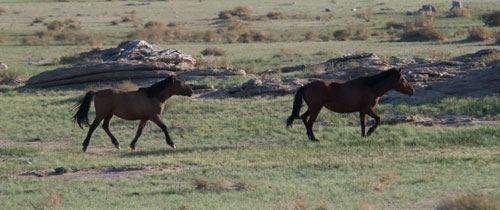















 Susan Fox, American Artist