Mongolia Monday- Talking About Takhi

Well, I certainly enjoyed the last two Mongolia Monday posts and hope you did, too. Thanks again, Simon!

Today it’s back to a subject that has become near and dear to my heart- the takhi or Przewalski’s Horse. I always liked horses, even though I was deathly allergic to them as a kid, but have never been, ahem, drawn to them as a subject until I saw takhi for the first time at the Berlin Zoo in October of 2004. I didn’t even know they were there. I just happened on them in the far nether reaches of the zoo. Seven of them, looking like they’d just stepped out of a cave painting.

Takhi group, Berlin Zoo, October 2004

I remember that I plopped down on the nearest bench, probably with an idiot smile of delight on my face, to sketch and photograph them. They were enchanting.

Takhi Stallion, Berlin Zoo, October 2004

I did some research when I got home and found out that they were being reintroduced into Mongolia. So when I signed on for an Earthwatch project there, I arranged a three day trip to the closest site, Hustai National Park. It was spring, which meant cold, windy and and occasional snow, but I saw the horses and got some decent photos. The next step was to get back to Mongolia, which I did in late September-early October of 2006. By then, I’d found out about a third, new release site in western Mongolia, Khomiin Tal, and managed to get out there. There is also a series of three articles I wrote for Horses in Art. One on Hustai National Park, one on Khomiin Tal and one on the domestic Mongolian horses. Look under “Writings” for those.

Then, this last May, I was at the Denver Zoo and saw takhi there. They looked much different from the Berlin animals, as you can see. There are a number of reasons for this that have to do with being kept in captive conditions, which can lead to much heavier bone structure and skull defects. The animals for release come from semi-reserves where they can live and eat more normally.
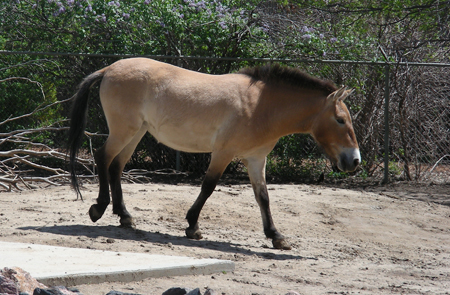
Takhi, Denver Zoo, May 2008

I’ve been drawing and painting them since that first trip to Hustai, but have hardly scratched the surface of the picture possibilities.

Here’s one of the first paintings, which is available as a limited edition giclee. When I showed a photo of it to a Hustai biologist on my second trip there, she immediately recognized the mare by her mane, which reinforced my desire to paint individuals of a species.

Mongolia Morning, oil  12"x 24"
Mongolia Morning       oil on canvas board          12″x 24″ (price on request)

Followers of this blog know how adamant I am about doing fieldwork. I think this next piece illustrates why. There is no way this painting  would have happened if I hadn’t been there at Khomiin Tal to photograph both the horses and the habitat. I’ve seen a few other paintings of takhi and so far none of them really looks to me like it was done from reference shot of reintroduced horses in Mongolia. They are pretty obviously captives in Europe or North America. The light’s not right, the land isn’t right and, mostly, the horses themselves aren’t right. But I sure can understand the compelling desire to paint and draw them anyway!

That's the Spot!  oil  16"x 20"
That’s the Spot!           oil on canvas board        18″x 24″ (price on request)

Here’s the most recent painting, a stallion at Hustai. I wanted to really show the valley that is the core habitat of the population of, now, over 200 horses in 15 harems and to try to capture the interesting shape of the shadows on him.
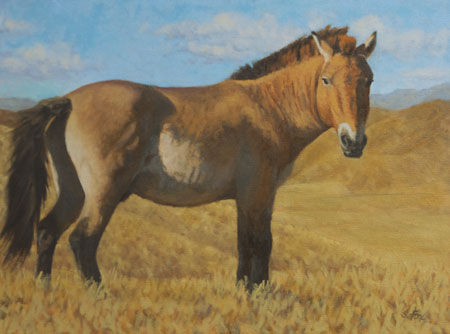
Master of the Valley
Master of the Valley    oil on canvas board    12″x 16″ (price on request)

This 10″x 8″ study is going to be listed for sale on EBay tomorrow or Wednesday. It was amusing to watch the foal work out the motor coordination required to scratch that itch.

Takhi Foal Scratching
Scratch that Itch!   10″x8″    oil on canvasboard

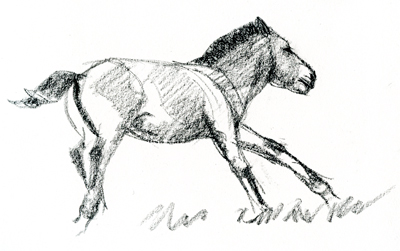
Lastly, I did a batch of drawings a couple of weeks ago and I rather liked the way these came out. The photos were taken at Hustai this past September. It was late afternoon and this one foal was having “crazy fits”. I’m always looking for animals in action and he/she certainly delivered.

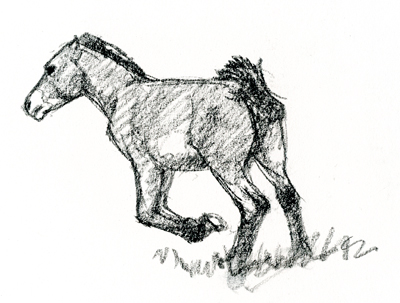
takhi-foal-1takhi-foal3takhi-foal-4

takhi-foal-2

Mongolia Monday- Poetry Special, Part 2

For Part 2 of this special post, here is Simon Wickham-Smith sharing how he became involved in things Mongolian, along with a little information on translating literature from one language into another. His comment about the number of precise words that exist in Mongolian for some parts of their world and culture reminds me of hearing that the Inuit have 37 names for snow, but no generic term as occurs in English.

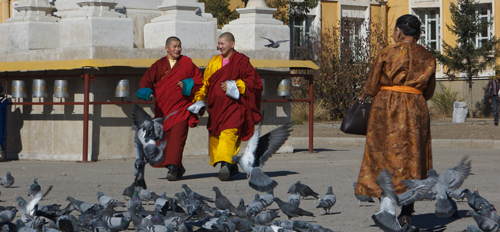
Gandan Monastery, Ulaanbaatar 2006

Simon Wickham-Smith: My own involvement with Mongolian literature started when I was a Tibetan Buddhist monk in Scotland during the 1990s.  I became interested – obsessed might be a better word – with the life and writings of the 6th Dalai Lama and, during my research, came across a reference to Danzanravjaa, a nineteenth century nationalist, scholar, poet and Buddhist monk.

I had already studied Mongolian for some time during the early nineties, and now I started to read and translate Danzanravjaa’s collected works.  When I finally finished this work, in 2005, I felt that, really as a matter of courtesy,  I should write to someone in Mongolia and let them know what I had done.

Thus it was that I came into contact with Gombojavin Mend-Ooyo, one of Mongolia’s most famous literary figures, who invited me to Ulaanbaatar the following year and for whose Mongolian Academy of Poetry and Culture (www.poetry-culture.mn) I have now translated ten books, with at least four more in the pipeline.

The act of translation from any language is a subtle and nuanced negotiation, but when dealing with a source culture which is so very different from the target culture, a number of problems appear.  And so it is with Mongolian.

Painting seen at the Mongolian Artists' Union, Ulaanbaatar 2006
Painting seen at the Mongolian Artists' Union gallery, Ulaanbaatar 2006

The number of words used to describe the natural landscape, animals and animal products, and the movement of the heavens are so detailed and precise as to be effectively untranslatable into English, short of adding phrases or entire sentences to the mix.  This, together with the morphology and structure of the language, means that simply recording what is said in the original becomes a restructuring of thought and a reinterpretation of culture.  Once these concerns are settled, then the literary work can begin, and the rhythm, sound and development of the text finessed.

Over the next five years, the Mongolian Academy of Poetry and Culture intends to publish more translations and to encourage scholarship in both Mongolian and English.  As for me, I am soon to embark upon postgraduate work at the University of Washington’s Jackson School, with an emphasis on Mongolian literature.  Moreover, I am also co-director of the Center for Central Asian Literatures in Translation at UW (www.depts.washington.edu/ccalt), which is hoping to increase the profile of literature from across Central Asia.

I’d like to thank Susan for letting me benignly invade her blog.  I hope that the work that she and I, along with many others, are doing, will encourage people to investigate Mongolian culture and, in particular, its literature.

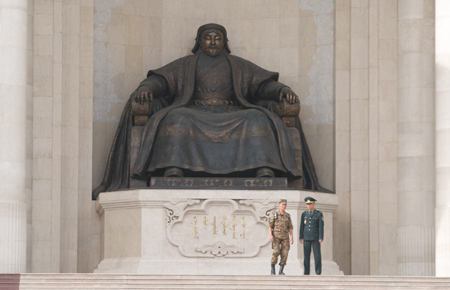
Statue of Chinggis Khan, Government House, Ulaanbaatar 2008

You’re very welcome Simon! It’s a pleasure and a privilege to have you participate here. The following poems are a little on the longer side, but I think that they really show a side of the Mongol people that Westerners, raised on the idea of Chinggis Khan and his Horde cutting a path of destruction across a large chunk of the world, don’t realize exists. If nothing else, it demonstrates our common humanity across time and space. Not a bad thing these days.

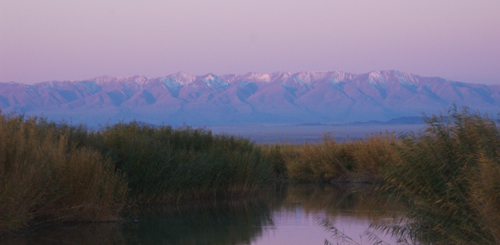
Jargalant at sunrise, Khar Us Nur National Park 2006
Jargalant at sunrise, Khar Us Nuur National Park 2006

A DELUDED ASCENT OF MOUNT CHUN SHAN
Khubilai Khann (1215-1294)
(Yes, that Kublai Khan)

One a day blessed by good fortune,
I climbed up a blue bluff.
I stepped carefully on the ground,
So as not to destroy the landscape.
The flowers glowed red,
Like rainbows.
A beryllium light glistened like mist or smoke or blue haze.
The bamboos along the streams grew green from rain fall and spring water.
The wind blew through the mountain pines with a wonderful fluting melody.
I paid my respects
At the sacred temples,
And returned with the aid of Indra.
And controlled the dragons.

Western Mongolia 2006, "expedition" group shot
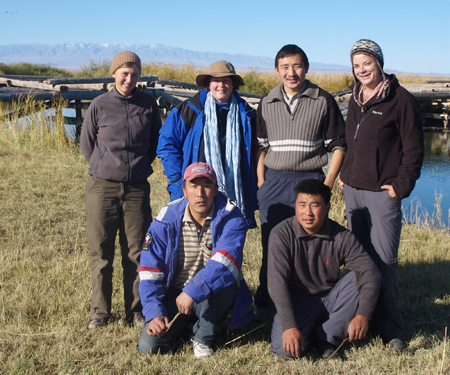
Western Mongolia 2006,"expedition" group shot; two German graduate students, myself, the American, and the Mongolians who made it happen; Jargalant in the background

LOVE ONE ANOTHER, MY PEOPLE

Love one another, my people, while you are alive.
Don’t keep from others whatever you find beautiful.
Don’t wound my heart with heedless barbs, and
don’t push anyone into a dark hole.
Don’t mock someone who has gotten drunk,
think how it could even be your own father.
And, if you manage to become famous,
open the door to happiness to others!
They should also not forget your kindness.
To someone who is lacking a single word of kindness,
you should search for it and speak it out.
Whether outside the sun or at home when it’s mild,
don’t spend one moment at rest.
Don’t use harsh words to complain, you women,
about the young man you remember.
Speak lovingly of those who loved you!
Let them remember you as a good lover.
Our lives are similar,
our words constrict our throats the same way,
our tears drop onto our cheeks the same way-
things are much the same as we go along the road.
Wipe away a halt woman’s tears without a word,
talk your lover up when she’s tripped and fallen!
Today you’re smiling, tomorrow you’ll be crying.
Another day you’re sad, and the next you’ll be singing.
We all pass from the cradle to the grave-
if for no other reason , love one another!
People must not lack love on this wide earth!
I grasp happiness with the fire of my human mind,
the golden shines lovingly upon us all the same, and
so I think that loving others is the path of life,
I understand that to be loved is a great joy.

O Dashbalbar (1957-1999)

Mongolia Monday- Poetry Special, Part 1

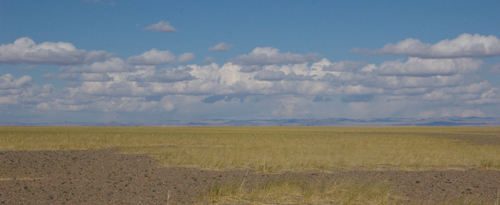
The Steppe, western Mongolia

As promised on Friday, here is Simon Wickham-Smith’s essay-by-request on Mongolian literature. Following are three examples of Mongolian poetry, accompanied by images that I have photographed in Mongolia. Next Monday in Part 2, Simon will talk about how he came to be involved in things Mongolian and some of the challenges that await the translator. I have sent a email to the Mongolian Academy of Poetry and Culture about importing and making available at least two of the books. When I have news, I’ll post it here. So, without further ado:

MONGOLIAN LITERATURE IN TODAY’S MONGOLIA

As with any literature, Mongolian literature is special simply because it is the expression of a society’s experience, values, tradition and culture.  That Mongolia is, as a society, almost totally unknown in the western world, makes their literature even more valuable to us, in that it opens to us a new way of understanding the world.

Over the past century, Mongolia has gone from an almost completely nomadic and herding society, through a period of Soviet-inspired communism, into a contemporary experience in which free-market capitalism dwells at peace within a traditional nomadic culture shaped by a renewed interest in Buddhism and Shamanism.

So this is a true melting-pot, then, full of diverse influences, full of individuals feeling themselves pulled in a number of very different directions at the same time.  And when we look at the literature, we find a similarly vibrant and confused picture.

During the communist period (1924-1990) , of course, writers were strongly discouraged from addressing religious or spiritual topics.  But Mongolians had at their disposal their shamanic tradition of animism, and so writers created a literature which celebrated the land, and which honored the ancestors in the form of the grasses and the hills and the trees.

As for the Buddha – for Vajrayana Buddhism had spread from Tibet to Mongolia during the latter half of the sixteenth century – writers used the word for the sky (tenger), which had traditionally also meant “god,” which in itself meant once more that religion could be discussed by means of the natural world.

Altar in main temple, Museum of the Chojin Lama, Ulaanbaatar

It is interesting to see how the ideas of Buddhism are beginning to come back into the literature.  Young poets such as T Erdenetsogt and Ts Bavuudorj are writing explicitly spiritual works, the former even incorporating Tibetan prayers into his poetry.  Older writers, such as G Mend-Ooyo and D Urianhai, coming from a period of samizdat literature and religious secrecy, approach the subject more indirectly.
Religious writing and writing about the natural world notwithstanding, Mongolian literature has a strong tradition of love poems.  Indeed, the most famous poet of the nineteenth century, the monk Danzanravjaa (1803-1856), combined the three themes of religion, sex and vodka, to create a powerful body of work which even today is still highly influential.

The tradition of love poetry is generally a celebration of young women and their somewhat intangible and transcendent beauty.  The erotic is very subtle, however, and is generally approached from a very oblique viewpoint.  Indeed, one of the criticisms of the novelist and poet G-A Ayurzana’s (by western standards fairly tame) novel The Illusion is that it has too much sex, and this book appeared only in 2003.

To read Mongolian literature, then, is to enter into a world which is similar to ours in very many ways, but whose cultural expression is framed by the cycle of the seasons, by landscape and weather, by gods and Buddhas, by theocracy and by seventy years of political despotism.

And now, three poems:

Horses, Arburd Sands

The story of my people soar with horses,
With wings they reach the golden sun.
The wind riffs through their untrimmed manes,
And, down the skyroad of Khormast,
They return to the lakes like migrating birds,
According to the customs of the golden earth.
The poems of the elders soar with horses,
With wings they reach the vibrant stars.
From the herds of letters formed within the mouth,
We have taken these migrating steeds.
And, from the hitching posts of our poets’ horses,
We have taken off for distant roads.
My horse, fly high, oh my horse.
Fly high, into the worlds of my desire.
From our wise elders’ heights of brilliance,
I offer my song to the spacious earth.
My horse, fly high, oh my horse,
Fly high, into the worlds of my desire.

T. Ochirkhuu (1943-2001)

Proud grandmother, Arburd Sands

ANCIENT SPLENDOR

Indeed,
The ancient splendor
of this land of Mongolia
It has brought us all to birth
In the lineage of Chinggis Khaan

Indeed,
With our destiny like the sky
With our mind in five dimensions
With our peaceful and broadminded decrees
Yes, this is the way of the Sons of Heaven

Yes, it is like moonlight
Among the stars
It is like an ornamented beacon
Among many people

Yes, like high radiation
From the peak of Mount Sumeru
Spreading its glare
May the protective spirit remain firm

Yes, through our savior Chingghis Khaan
We have become the rulers of all Mongolia
Before the banner of the Khaan
May we all bow down in joy

Historians argue that Ancient Splendor, a folk long song sung still widely in today’s Mongolia, was the anthem of the Great Mongol State

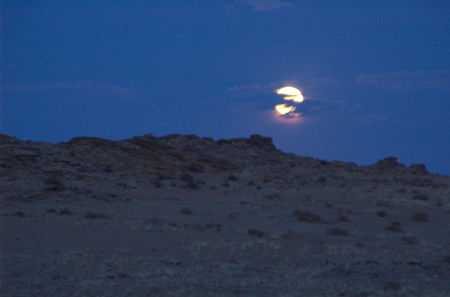
Moonrise, Ikh Nartiin Chuluu

THE HORSES NEIGH AT NIGHT UPON THE STEPPE

The brown steppe is like an ancient story,
There is no sound to be heard.
A traveller, wearied by the distant road,
Spends the night upon the steppe.

In the deep darkness, the objects of the sky
Stretch out white, like a mare’s tethering line,
He feels the nature of the peaceful steppe,
He watches the stars, as though the horse was missing.

The brown steppe is like an ancient story,
There is now sound to be heard.
Like what we sense among the stars,
The horses neigh at night upon the steppe.

D. Nyamaa (1939-)

Something Really Special for Mongolia Monday

When I was in UB, I found and purchased some anthologies of Mongolian poetry translated by one Simon Wickham-Smith. I googled his name and, lo and behold, there was a link to his Facebook page. So I wrote him a short note asking for permission to use some of the poems in my blog and to “be his friend”. Within a couple of hours I got an email back saying “Yes” to both.

I think it would be an understatement to say that Mongolian literature is not well-known in the West and yet I found the poetry that I have read beautiful, evocative and filled with compelling word images about the land and people. I’m hoping to be able to import the books and offer them for sale, but those arrangements have still to be worked out. in the meantime, Simon, at my request, has written two short essays; one on Mongolian literature and one on the story of his involvement in things Mongolian. The first essay will appear this coming Monday and the second on the following.

For more about Simon, visit his website at www.wickhamsmith.net or you can write to him at wickhamsmith@gmx.net

Here is the poem which prompted all this, which I wanted to use for the “bug” post:

Turkic gravestones near Hustai National Park

IN THE WILDS OF AUTUMN by B. Renchin (1905-1977)

Tiring the eyes, the wild steppe ripples
Yellowish and soundless.
Grasshoppers, the world’s voice, keep silent.
In the sky above only the storks are calling.
From the withered, yellow sphere of the sky,
Comes a lively and intriguing scent.
From the foreheads of the stone men in the cemeteries,
The hoarfrost melts into pearls of sweat.

New Painting, New Brushes, New Paint Colors!

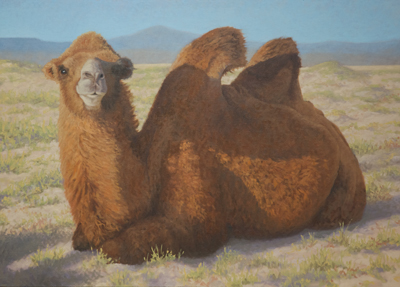
One among many of the great things about our visit to Arburd Sands ger camp in Mongolia was the herd of domestic bactrian camels that lived at the camp. They tended to wander off during the day, but were around in the mornings and late afternoons when the light was at its best (how did they know?) I had fun sketching them and here is my first painting of one.

Bactrian Camel, Arburd Sands, Mongolia

I really enjoyed trying to get the feel of the wooly coat and painting the pattern of light and shadow.

I’m always looking for ways to live more sustainably and responsibly. More and more it involves conscious choices, which means remembering to think about what one is buying or whether or not to buy at all. There is no way to live on the planet without using resources and, currently, the deck is stacked in favor of certain ways of doing things. But it’s been changing and I’ll bet the rate of change is going to increase Real Soon Now.

And, as anyone who has read this blog for awhile knows, I’m very interested in animal welfare issues.

With that in mind, I needed to get some new brushes. I’ve been using Silver Brush Limited Grand Prix Bristles for quite a few years now. Generally speaking, real hog bristle brushes for oil painting are the superior choice. Then I got one of my regular promotional emails from Jerry’s Artarama, who I have ordered art supplies from for twenty years. They were having a sale on Silver Brush brushes and this caught my eye: “How can you save the life of animals and actually help yourself at the same time?”

On offer was a synthetic brush Silver Brush calls “Silverwhite”. And that got me thinking about the use of animal products. I have no idea where the hog bristles in my current brushes come from. Probably China. What kind of conditions are the pigs kept in? No clue. My husband and I already don’t eat meat that we can’t source to a humane producer. What about something like painting brushes?

So, I ordered the synthetics and used a couple for the first time today and I like them a lot. I plan to switch to them. But then the question becomes “What are the Silverwhites made from?” Some kind of petroleum-based material most likely. Sigh. See what I mean? Choices. Synthetic brushes have been around for years, but I’ve never seen them marketed as “animal friendly” and had never thought of it that way before. The idea is kind of “buzzy” in that, assuming the bristles come from hogs raised for meat, it’s not clear how not buying brushes made from their bristles “saves” their lives, but, as I said, I did find it thought provoking.

I’m not going to get doctrinaire about it, but at this point I’m choosing the synthetic. Thoughts, anyone?

On the color front, I want to start pushing more toward a colorist approach. Camille Przewodek is a great contemporary example. She pushes color waaay out there. I looked at the supply list for her workshops (hope to take one sometime when I have the money) and decided to buy these, for me, exciting new colors: Permanent Green Light, Permanent Magenta and Manganese Bue Hue, all Winsor-Newton. Experimentation begins next week.

ART THOUGHTS FOR THE DAY

Everyone has talent at 25. The difficulty is to have it at 50.
Edgar Degas

Every good painter paints who he is.
Jackson Pollock

I realized that all the good ideas I’d ever had came to me while milking a cow. So I went back to Iowa.
Grant Wood

Mongolia Monday- Bizarre to Beautiful “Bugs”

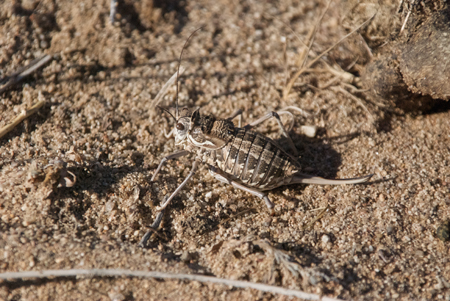
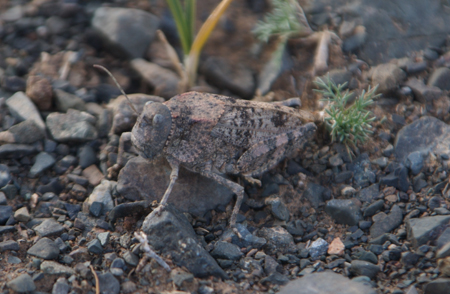
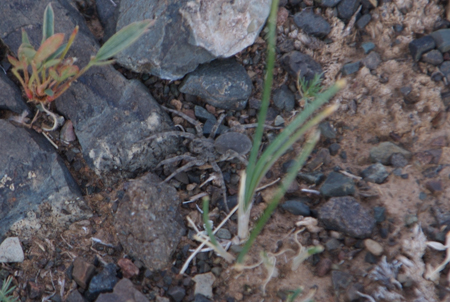
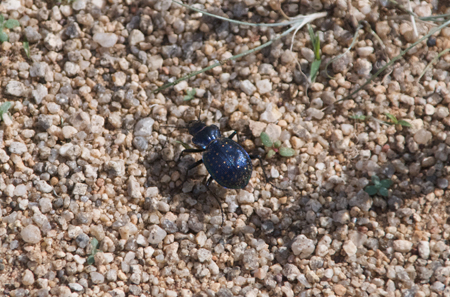
I probably should have run this post last week before Hallowe’en, but, in any case, here’s a variety of the insects that I’ve seen in Mongolia. Not all that many and I don’t know what the species are. Field guides are kind of thin on the ground for Mongolian wildlife. So if anyone can ID these critters, let me know and I’ll update this post.

The photos were shot on my 2006 and 2008 trips. I used a Nikon D70 with a Tamron 28-300mm lens in 2006 and a Nikon D80 with a Promaster (made by Tamron) 28-300 in 2008.

Saw this one in the Gobi. It was big- close to 3″ long.

Saw this one at Ikh Nartiin Chuluu Nature Reserve. There were specimens at the Natural History Museum in UB but, unfortunately, the labels were all in cyrillic Mongolian, which I can’t read. Yet. They are related to grasshoppers, but aren’t. That much I was able to find out.

Grasshopper at the ger camp, Hustai National Park

Another grasshopper photographed at Hustai.

Large, almost 3″ grasshopper photographed near Dungenee Ger Camp, Gobi Desert.

Photographed same location as above. This one really matched the rocks.

Only spider I’ve seen in three trips to Mongolia. Photographed same time as the two grasshoppers above.

Beetle at Ikh Nart. The challenge was waiting until it scurried out into the sun so I could catch the deep blue color.

This was really one of the most dramatic wildlife spectacles I’ve seen in Mongolia. The beetle had pounced on the brownish insect and the battle was on, with the latter trying to escape from the former. The beetle inexorably manuevered the brown one around for what we thought was the death grip in which they were head to head. Then, suddenly, the brown one broke free and got away. It went on for minutes. I took quite a few pictures, but this one seemed to show the situation with the most clarity.

Ikh Nart butterflies.

Mongolia Monday- Planes, Trains and….Camel Carts!

One of the most rewarding parts of travel is finding out how many ways there are to address the everyday challenges of life which are perfectly valid, but really, really different from how one does things at home. If the traveler is open to new experiences with an attitude of neutral curiosity, he or she might find that “difference”, in and of itself, is not threatening. Pity the impervious person who spends fair sums of money and time to travel and comes home utterly unaffected and unchanged. What an opportunity for the enrichment of one’s life wasted.

Mongolia is such a great place to get out of one’s own bubble. Customs and practices that haven’t changed in 1000 years exist happily alongside 20th/21st century technology. So, the country family holds its annual foal branding and a city relative records the occasion with her cell phone camera. Perfect.

(I would also like to note here that I have zero tolerance for those who want to deny more traditional cultures modern equipment, technology or goods because it will somehow “spoil” them. Selfish, romantic nonsense. The thought that a people like the Mongols could somehow be “spoiled” by integrating the modern world into their lives is ridiculous, IMHO. Lack of western technology does not equal stupid. Grant people the right to make up their own minds and choose what makes sense to them.)

Which brings us to today’s theme- how to get around, round, round in Mongolia. We will proceed from western high-tech to (for westerners) the picturesque.

Chinggis Khan International Airport, Ulaanbaatar
Train between Ulaanbaatar and Choir
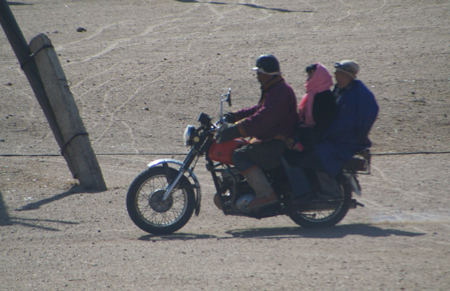
Motorcycle, western Mongolia

Love the seat cover!

A ride home from the train station
Truck with handcrank starter, Hovd, western Mongolia

The Mongolians might be the greatest mechanics in the world. Travel stories by writers who have gone there are filled with accounts of impossible repairs in the middle of nowhere. Lack of money, parts, towing services (Ha!) and the need to find a way has bred an amazing level of ingenuity, which I have personally experienced with awe and respect. But those are stories for future posts.

the fabulous Russian Fergon van

You travel in these to ensure you get there, not because they’re comfortable. Four gear shift levers and counting.

Tractor with hay, Hovd, western Mongolia
Tractor with hay, Hovd
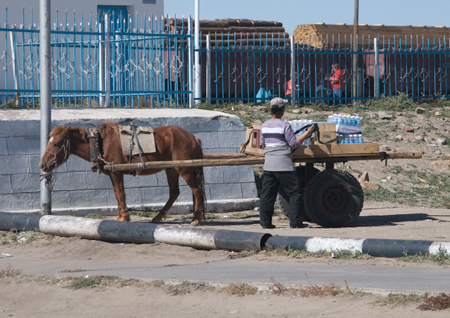
Horse cart with bottled water, Choir
Donkey carts, Hovd
Donkey carts, Hovd
Camel cart, between Ulaanbaatar and Choir
Rubber boat, Khar Us Nur National Park, western Mongolia
Rubber boat, Khar Us Nuur National Park, western Mongolia

My guide had talked about “the boat” (!?) when we were leaving Hovd for Khomiin Tal. Our last night out I found out what he was talking about. He’d purchased this inflatable boat when he was in Germany and this was his first chance to try it out.

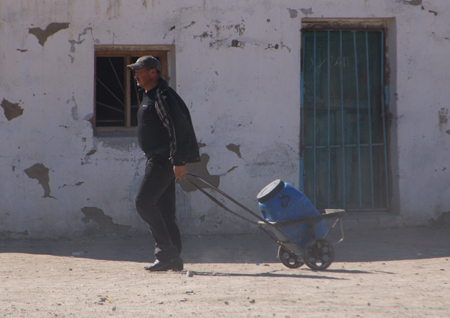
Hauling water in Hovd

There doesn’t seem to be much in the way of running water in the towns I’ve been in, so one sees it being hauled in these carts. It makes you think about your use of water and be more mindful of what it took to provide it.

Moving bricks to the kiln, western Mongolia
Home from shopping, Hovd

Lots of people have to walk to where they need to go, but, of course, the quintessential way to get around in Mongolia has always been on horseback.

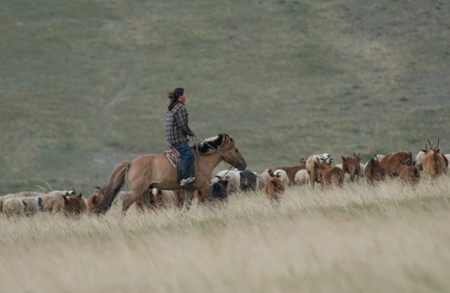
Herding goats near Hustai National Park

I like this picture because you can really see how she is riding standing up in the saddle. The stirrups are tied together under the belly of the horse to keep them in place. Ah, THAT’S the secret.

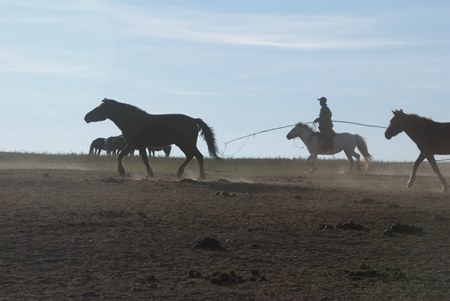
Choidog at the foal branding, Arburd Sands
Timeless
Timeless

Mongolia Monday- Cats and Dogs

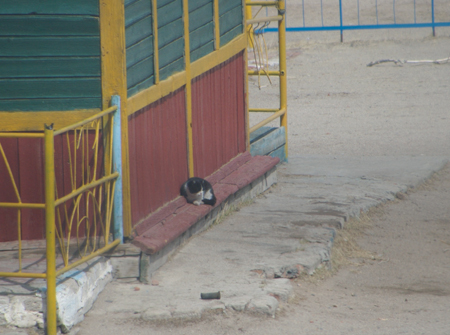
Cat seen from train, 2004

CATS

In three trips to Mongolia I’ve seen exactly….three cats, literally one per trip. In general it appears that Mongolians don’t much like cats. There are a number of beliefs about them, none particularly positive. I was told that the appearance of a cat meant that there would be a death. Two women that I’ve spoken with both said that they didn’t even like the idea of touching a cat, but one allowed as how her attitude was probably based on things older people had said when she was much younger.

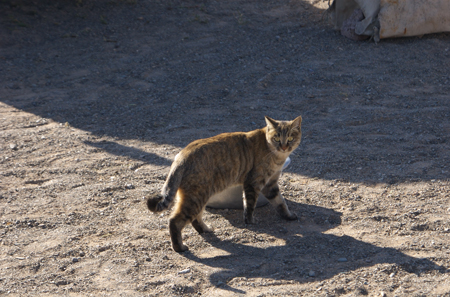
On the other hand, when we stopped at a ger in the Gobi, I watched a woman shoo this cat into the ger while the dogs were clearly meant to stay outside. I remember thinking “It figures.”

Cat at ger near Bayanzag in the Gobi

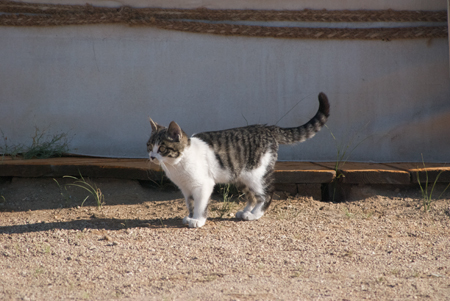
They do seem to be kept around by some families for the age-old purpose of rodent control. This little cat was at the ger camp at Ikh Nart. She was fussed over by the cook, who I was told loves animals. She was very friendly, so David and I were able to get an unexpected “cat fix”. It was apparently impossible to keep her out of the staff ger because she would climb up to the top and come in through the center opening. One night she dropped down onto our guide’s bed, one of the women who was adamant about not liking cats, and proceeded to try to snuggle up near her head. I remember thinking “It figures.”

Young cat at Red Rock Ger Camp, Ikh Nartiin Chuluu Nature Reserve

DOGS

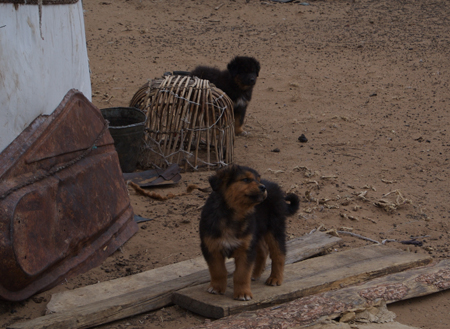
I suspect that Mongols have had dogs for as long as they have had horses and the other “Snouts”. The traditional greeting upon approaching a herder ger is “Hold the dogs!” and they aren’t kidding. The traditional herder’s dog is a Tibetan mastiff, which can take its guard duties very seriously. I was told on this last trip, however, that many herders do keep a dog as a “pet” along with the ones for guarding. I hope to learn more about all this on the next trip.

Tibetan Mastiff-type dog
Mastiff puppies near Hustai National Park

One consistant piece of advice that one runs across when looking into travel to Mongolia is do not, DO NOT, pet, pat, scritch, scratch or otherwise touch any dog. They have not been vaccinated for rabies and getting saliva on your skin, much less a bite, means air evacuation to a hospital for the (painful) series of shots. Foreigners who are working in the countryside get the rabies vaccine, but since nothing is 100%, it’s smart for them not to have contact either.

That said, I have found that most of the dogs I’ve seen don’t exhibit vicious behavior and a lot of them seem to be longing for contact with people. I finally relented once at Arburd Sands when this dog approached me while I was sketching and leaned into me. I decided that it was unlikely that the camp owners would have a dog around that was at all likely to bite the guests. I stayed alert while I gently petted his back and didn’t let his mouth near my hand. He seemed to really like it, but it was still a risk.

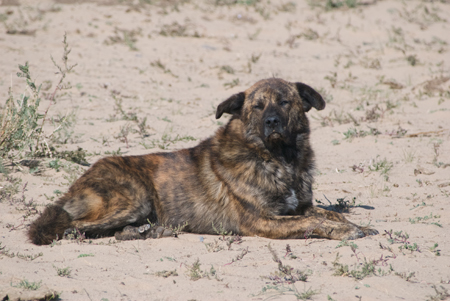
Friendly dog at Arburd Sands

I hadn’t seen brindle dogs like this before this trip. Not sure where that coloration came from, but he has the mastiff head and body type.

I feel like I’m seeing fewer of the pure mastiffs since my first trip. When the Russians pulled out in 1991, I was told that they left their guard dogs, mostly German Shepherds, behind. And I remember seeing a couple of what looked like purebred Shepherds between the airport and UB in 2006. There has obviously been a lot of uncontrolled interbreeding. It looks to me like the dogs are gradually reverting to the basic dog form that travellers see all over the world in the streets, the countryside, at dumps, etc.

Dog seen by side of the road near Gorkhi-Terelj

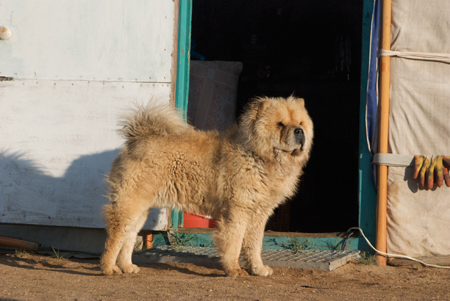
And, for something completely different, at Red Rock Ger Camp, there was this chow chow, the only one I’ve seen in Mongolia. Never found out who he belongs to, but a fairly wide area around the camp seemed to belong to him, judging by his thorough and conscientious marking routine.

Chow chow at Red Rock Ger Camp

RANDOM NOTES

From The Global Village Dept.- twice when I’ve been in the State Department Store, I’ve seen young girls with tiny “fashion accessory” dogs tucked in their arms, a la Paris Hilton. Sigh.

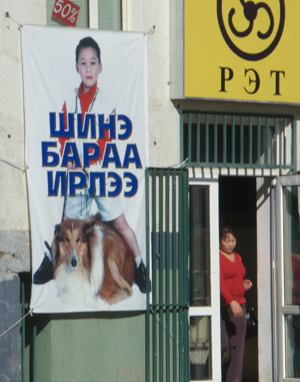
And finally, many of you know that I have a rough collie, named Niki, the same breed as Lassie. Imagine my surprise when I happened upon this banner in Ulaanbaatar:

Pet shop banner, Ulaanbaatar


New Paintings and Equipment Review

I’m just finishing a second productive week in the studio after my return and, boy, does it feel good. As did getting out yesterday afternoon and planting some new roses and spring bulbs.

HEAVY LIES THE HEAD

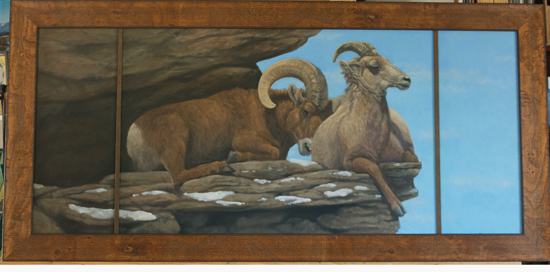
I’ve got a number of pieces in progress, but wanted to share this one that was completed before I left. It was in the Wild Visions 2 show and I hadn’t had a chance to photograph it until a couple of days ago. I’ve never done a three-panel piece and I’m thrilled with the framing. Unfortunately, the framer has gone out of business and there isn’t anyone else around here who can do this kind of custom work. Drat.

Heavy Lies the Head   oil   20"x 46"
Heavy Lies the Head oil 20"x 46"

The animals, bighorn sheep,  were photographed at the Denver Zoo. It was a warm morning and the ram couldn’t keep his eyes open. His head kept, drooping, drooping, until it sank onto the back of the ewe, who never even blinked. The pose was irresistible, but I did check with Laney, a nationally known artist who specializes in bighorns, to ensure that this behavior could have happened in the wild.

Of course they needed a more interesting setting, so I found some nice rock formations that I had shot up on Logan Pass in Glacier National Park, where bighorn sheep are often seen. Laney suggested adding the bits of snow so that the presence of the ram and ewe together would be consistent with the season.

Besides the great pose, I wanted to try to capture the feeling of the environment bighorns live in and how casual they are about heights that would make a lot of people faint with vertigo.

CHEETAH HEAD STUDY

Some animal’s heads are more challenging than others. There are subtleties to the forms that, if they are missed, leave the viewer who knows better feeling that the painting was “close, but no banana”. Cheetahs seem to be one of the difficult ones. I think I’ve seen more badly drawn and painted heads of cheetahs than maybe any other animal, so I’ll hang it out there and offer for your perusal this new head study.

Cheetah Head Study
Cheetah Head Study oil 9"x 12"

EQUIPMENT REVIEWS

All in all, everything worked as it was supposed to.

My husband was very happy with his LL Bean Katahdin 20F sleeping bag. He liked the larger size and the fact that it was rectangular. The Climashield fill kept him comfortable. The only down side was that it didn’t pack down as small as my down bag.

My Katahdin 20F down bag was great, as usual. One of the nice things about the rectangle is that it can double as a comforter. This is handy in a ger, which has regular beds with sheets and blankets. It can get cold at night though, but unzipping the bag and throwing it over the bed worked well. And if the mattress was too hard, as is sometimes the case, I used the bedding as a “pad” and just slept on top of it in the bag.

The LL Bean ripstop cotton pants were absolute winners. We wore ours day after day and they seemed to shed dirt and never felt icky. My husband likes them so much, he now wears them for his everyday pants.

Loved having the New Balance walking shoes for around town and camp as a change from the hiking boots. Hadn’t made space for that before. The LL Bean Cresta Hikers were, once again, comfortable and functional. David bought a pair of Keen hiking boots, which he really likes for their comfort and breathability. What we found, however, during the deluge at Ikh Nart, when we had to walk around 40 yards to the toilet, was that his boots wetted through pretty quickly. Now, he hadn’t waterproofed them, because we hadn’t anticipated such hard, out-of-season rain, but my boots kept my feet dry throughout. They are leather, which I probably wouldn’t buy now unless I could source them to humanely raised cattle, but they really performed.

The Smartwool socks rocked! The Thorlos tended to get sweaty. Next trip I’ll take more Smartwool for the field and a few Thorlo light hikers for around town.

Loved the Patagonia fleece for comfort, but will probably replace it to reduce bulk. It took up a lot of space in my duffle. The Travelsmith jacket was great. Too bad they don’t make it anymore. The only problem was that the patch pocket got caught on something and ripped loose.

I love, love, love my Icebreaker 100% merino wool thermals! The top and bottom together take up less space than one piece of the other brand. I didn’t need them very much, but found them very comfortable when I did wear them.

It’s interesting how things are going full-circle for some outdoor gear. All there used to be was cotton and wool. Then the new, improved synthetics came along and, overall, they were an improvement in weight, performance, etc. But I’m finding that the new cotton and wool products work as well, if not better, and are not made with petroleum by-products.

The MetroSafe 2000 purse was good, as usual. Very functional, practical and unobtrusive.

My old standby neck scarf and hat did the job, also as usual.

Camel ride at Arburd Sands

The luggage came through fine. It was nice to have the lower rigid-side compartment on the bottom of the big one for odd, ends, extras and art purchases. It’s a rolling Sportsman’s gear bag from LL Bean. The small one, which Bean doesn’t make anymore, holds the camera equipment, toiletries bag and the minimum needed to survive a day or two without the big bag.

ART THOUGHT FOR THE DAY

There is a common foundation from which all the arts rise, and that is the need for self-expression on the part of the artist,-expression of his own personal experience, whether it be by words, as with literature; by sound, as with music; by pigment or with plastic shape, as with the graphic arts. But there is a further condition attendant upon this expression of which we do not always take account, namely, that the artist’s personal experience must be emphasized by strong feelings, by enthusiasm, by emotion, or the result is not art.”

Notes on the Art of Picture-Making by C.J. Holmes, Slade Professor of Fine Art, Oxford University, 1909