I’m not sure that this photo, taken by Roy Chapman Andrews, is from Gandan Monastery, but the prayer wheel is certainly close in size and design to the one I saw there.
Large prayer wheel
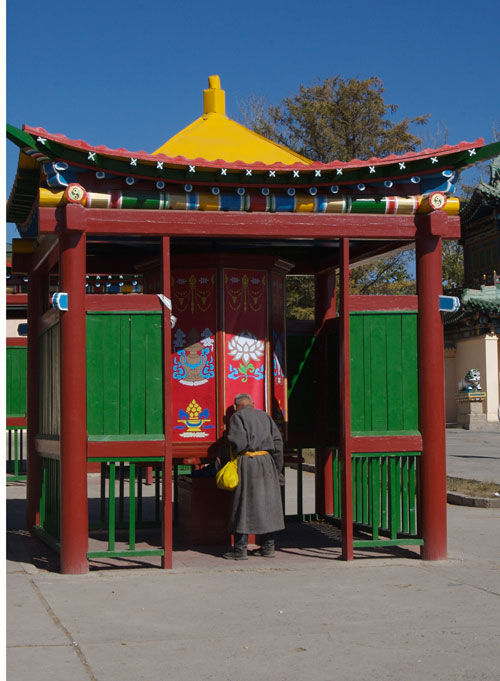
Here is the one I saw.
Large prayer wheel at Gandan Monastery, Sept. 2006
People had written on it with a variety of pens, probably prayers.
I keep a journal on all my “interesting” trips, along with a sketchbook, and thought that I would occasionally share some entries. In 2006, I read The Great Railway Bazaar by Paul Theroux on the first part of the trip and was inspired to try my hand at recording something more descriptive, rather than just short “Today I was in western Mongolia, the van broke down and I got food poisoning.” diary-type entries. Here’s what it was like to get clean at a ger camp in the Gobi:
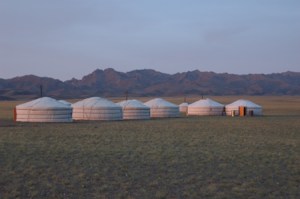
Dungeree Ger Camp, Gobi, 2006 (Gurvansaikhan mountains in background)
October 2, 2006 1:15pm:
Ah, the joys of clean hair and body. Once it was ready, I went to the shower ger. There was a stone path leading to a wood slat platform. A big metal bowl of hot water was sitting on top of the stove, in which there was a roaring fire. A small stand held one pair each lg. and small plastic sandals. There was a hook for ones clothes. The shower was provided by a pump sprayer just like what one would buy at the garden shop or hardware store with a spray head attached. One fills it (although it was already ready for me) with a combination of hot water from the stove and cold water from a can by the wall. Pump up the pressure and voila! a perfectly acceptable hot shower in the middle of the Gobi. It was still a little chilly, so I had a fire ready to go back at my get, so I am now (more or less) clean, dry and warm, a lovely combination much appreciated on this kind of trip.
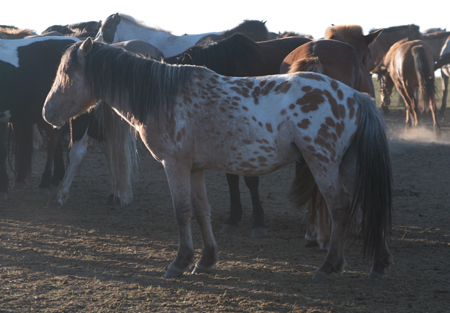
I was able to take many good pictures of Mongol horses on my trip there in September. This was a stallion who showed up with his harem very near the ger camp at Ikh Nartiin Chuluu late one afternoon. Due to lack of rain, all the herder families had left the area, along with their livestock, but a few groups of horses had been left behind to shift for themselves until their owners returned.
I wanted to really work on understanding horse structure so this is a bigger painting than what I’ve recently been doing – 24″x 36″. The horse is almost 19″ at the withers. I really loved the rhythm of the movement. It was almost like he was showing off. I don’t know horse behavior nearly as well yet as dog or cat, so I’d love to hear from anyone who can interpret what he’s doing and why.
Since the horse was what I cared about , I left the background as a field of mostly warm color with some cool color showing from underneath.
NEWS FROM THE FELINE FRONT
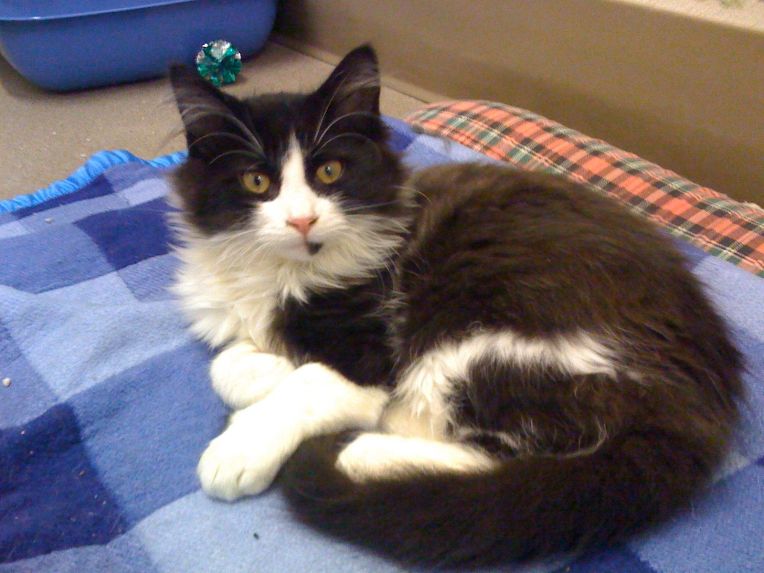
Meet our new family member, Alexander! We brought him home yesterday from the Humboldt County Shelter, where I volunteer. He’s four months old and extremely friendly. He likes other cats (although our three girls aren’t too thrilled at the moment). He’s done a nose touch greeting with Niki the collie. We’ve set him up in a crate in my husband’s office since Alex is supposed to be mainly his cat.
The vet was just here (she does housecalls only; how cool is that?) and she thinks that he may be part rag doll because of how easy he is to handle, kind of like, well, a rag doll. She pronounced him in good health and recommended a bath at the groomer’s to get rid of the whiff of shelter odor and get him all nice and fluffy. We all want to get him the best start on the rest of his life that we can.
FYI: never bring home a new animal, either a cat or a dog, plop them down in the living room and turn them loose. New introductions need to be taken slowly with consideration for everyone. The new animal should be in a crate or behind a baby gate or in a room like the bathroom to ease in gently and avoid conflict. He’ll stay in the office at least until Sunday.
I thought I’d start off the New Year with the subject that’s most near and dear to Mongolians’ hearts – horses.
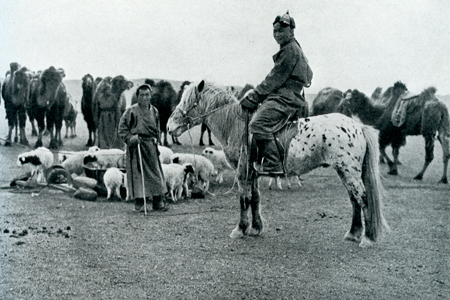
Here’s an old photo from the late 1920’s, taken on one of Roy Chapman Andrews’ Central Asiatic Expeditions:
Mongolian herder, late 1920's
Here’s a horse I saw this past September:
Mongolian horse, Arburd Sands
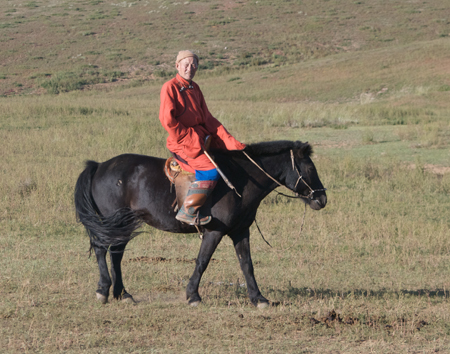
And here’s the herder who owns the horse. Other than the head gear, not much has changed. The long robe or “del” is the perfect garment for the climate and environment. And while I have seen herders wearing the traditional pointed hat, they tend to be mostly the young men. Baseball caps are what one usually sees. The older men often wear snappy-looking fedoras.
Choidog, Arburd Sands
On Friday I’ll be debuting my latest Mongolian horse painting!
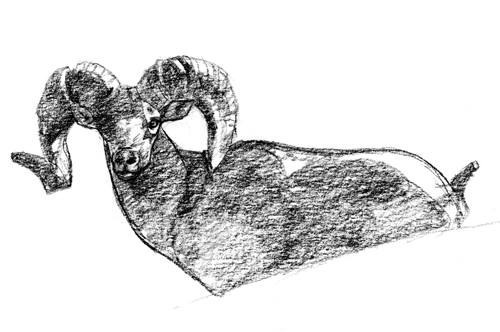
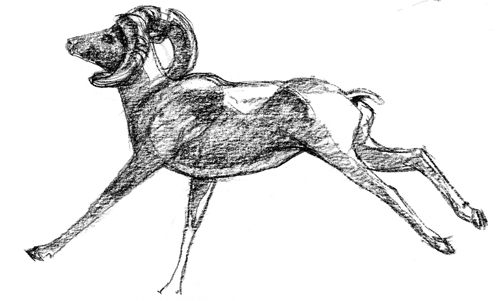
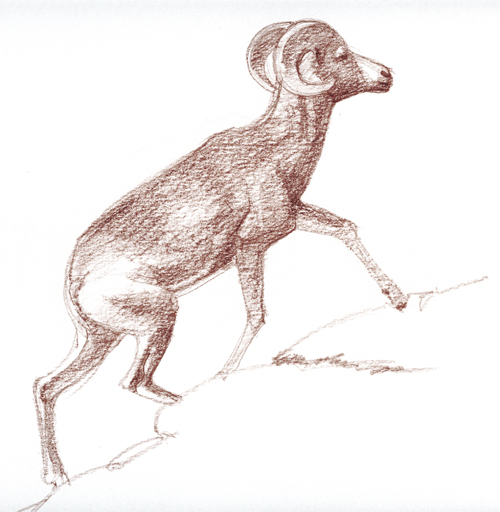
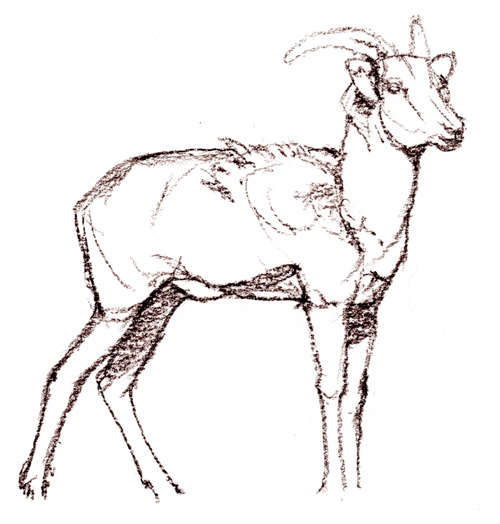
With the New Year come new painting projects. We try to take time off between Solstice and New Year’s Day because that’s when things slow down for my husband, who is the executive director of an information technology consortium, but I can’t stay out of the studio completely. I have a bunch of ideas for paintings with Mongolia subjects and this morning I thought I’d do a few drawings of argali and try different drawing media. All of these are done on 2-ply vellum bristol. None of the four took more than 15-20 minutes. The idea was to limber up after a break without worrying about doing a pretty, finished drawing. I wanted to catch the character of the animal and the rhythm of their body and movement. Please DO try this at home.
Argali Ram, Ikh Nartiin Chuluu, Sept. 2008
This is a try-out to see how he “draws” since I have a painting idea in mind. He’s a big, old ram with battered horns that will be an interesting challenge to paint. I also like the shadow pattern on his head. Drawn with a 6B Wolff’s Carbon pencil.
The gold standard in fieldwork for wildlife artists is the animal Doing Something. Prey animals like argali tend to be running away, so lots of butt shots. But this one took off from stage right to stage left, giving me a perfect chance to record a variety of leg positions. Also drawn with a 6B Wolff’s Carbon pencil.
Young Argali Ram Climbing, Ikh Nartiin Chuluu, Sept. 2008
Another jackpot. He’s going up the rocks parallel to me. Drawn with a Cumberland Derwent Drawing pencil, Venetian Red. These have a fair amount of wax in them, so are more like a fancy crayon. They feel soft on the paper. I don’t think I got very interesting line quality, but did feel that I caught the tension in the hindquarters as he is about to push off.
Argali Ewe Standing, Ikh Nartiin Chuluu, April 2005
This one is from pictures I shot on my first trip to Mongolia in April/May of 2005. The animals still had their winter coats. This ewe was part of a small herd which had come down to a stream for water one morning. I find 3/4 head views challenging, partly because I know that I have to compensate for the flattening effect of the photograph. Drawn with a 2454 Conte crayon. I hadn’t used these in awhile and found I liked the line quality and the way the Conte felt on the paper. This sketch took maybe ten minutes.
So you can see that what you draw with can really change the appearance of your drawing. The only way to know what will work best for you is to experiment with different combinations.
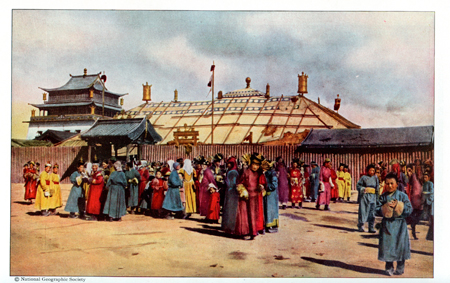
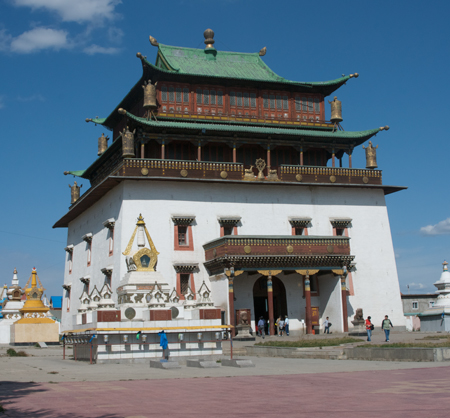
Looking through some of my books about Mongolia and magazines with articles about the country, I had that “I’ve been there” feeling a number of times, partly because not much has changed in some respects from when westerners first visited. So, I thought it would be fun to occasionally juxtapose my photos with the old ones, starting with Gandan Monastery.
Gandan Monastery- photo by Roy Chapman Andrews, late 1920'sGandan Monastery, photo by Roy Chapman Andrews, early 1920'sGandan Monastery, photo by Susan Fox, 2008
Purely coincidental that I took my photo from almost the same position as Andrews.
Then, I was hoping someone could help me here. I really, really, really would like to get one of these tents and have had no luck so far. Can anyone get me a price and supplier? I could probably sell a half dozen or so here in the States. I might be able to pick them up in UB in July, but am open to suggestion.
The holidays are upon us and things are getting busy. The weather here in northern California has been unseasonably warm and sunny, with almost no rain. Very odd. On the other hand, winter has apparently arrived in Mongolia. There’s some nice photos here at AsianGypsy. Below is a picture of a pretty spring day (no wind!) in UB, which brings me to the next topic:
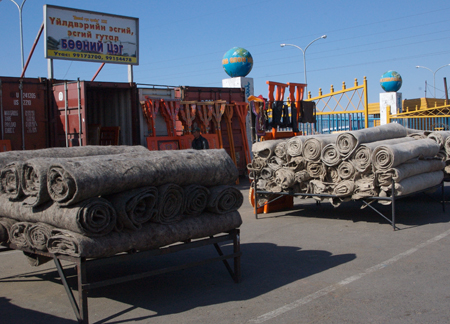
Ger felt at the Narantuul Market, UB 2005
One of the things that I noticed on my first trip to Mongolia was the number of shipping containers around town. I was told that when the economy collapsed, aid poured in and that a lot of it came in shipping containers. Lots of shipping containers. Really, really a lot of containers. Since Mongolia had nothing to send back out, there they have stayed and been put to good use. If you think about it, it makes perfect sense. The Mongols are nothing if not resourceful, there were lots of containers and they are weather and theft-proof. So there is line of crates along one of the main roads where tires are sold, an area of them that house grocery sellers, etc.
Ger supplies, Narantuul Market, UB 2005
These two photos are from the Narantuul (or, as some of you know it, the Black Market) Market in Ulaanbaatar. The containers line the outer edge of the parking lot. Since my interest was gers, my guide took me to the area where everything from complete gers to any and all the parts and furnishings were sold, all out of shipping containers. So, a few weeks ago, I saw this posting on Craig’s List, offering shipping containers for sale. We’ve ended up short on secure, clean storage at our now 3 year old house. I’ve needed somewhere to store extra frames for my paintings, older work, plus all my art festival gear and AirFloat shipping boxes, that is dry and bug-free. David needs to de-clutter the part of the garage he uses for his shop. I also remembered a book I have that discusses how the Japanese traditionally had secure free-standing buildings in which to store their valuables and seasonal items that were not in use (that would be, for us, holiday decorations).
You can see where this is going, right? We’ve almost got the space cleared and the 20’x 8′ shipping container should arrive in a week or so. Mongolians would be shocked at what we are paying for it, but for what it is, on a per-square-foot basis, it’s a deal. It will, however, lack “style points”. I’m going to take a cue from Frank Lloyd Wright, who observed that doctors can bury their mistakes, but architects can only plant vines. We’re going to paint the thing a neutral green, put lattice up along the outboard wall and plant rambling roses and other big vines like a climbing hydranga (canes up to 80′ long). The inboard side will form a wall for a carport on which we can hang our ladders. The door will be the aesthetic challenge, but I’ll think of something. Environmentally it makes sense since we’re re-using something, not using resources for new construction. It may be a marker of where we are in life that both of us are really quite excited about all this. Sufficient storage, The Final Frontier! Thank you to the Mongols for a great inspiration!
MORE POETRY!
On a cultural note, most of what is known about the early history of the Mongolian people is contained in the Secret History of the Mongols, which I plan to blog about in the future once I’ve read it. In the meantime, in Simon Wickham-Smith’s Mongolian poetry anthologies is this, from Chinggis Khan himself:
Statue of Chinggis Khan, Government House, Ulaanbaatar 2008
CHINGGIS’ ADVICE
I don’t worry about my own humble body,
I do worry that my great state may weaken.
I don’t worry about my own constitution,
I do worry that my great country may be distressed.
Should my humble body be exhausted,
Still my great state shall not weaken.
Should my own constitution suffer,
Still my great country shall not be distressed.
Physical strength can see off one alone,
But mental strength can see off many.
One skilled in words becomes wise,
One skilled in swordsmanship becomes a hero.
Head for the mountain pass,
Head for a place to ford the river,
Don’t be overwhelmed by the distance,
Just keep going.
Don’t be overwhelmed by the weight,
You’ll lift it if you make the effort,
Immense river fords,
Don’t be faint-hearted because you’re far away-
If you go along, you will come out on top,
Don’t hesitate believing that is heavy-
If you exert yourself you will lift that up.
Words of Chinggis Khan were noted in decrees and books and called Chinggis’ advice.
I tend to start a number of paintings in succession and then finish them in batches. Is it that way for any of you? Or do you have a more even work flow? How do you decide what to do next?
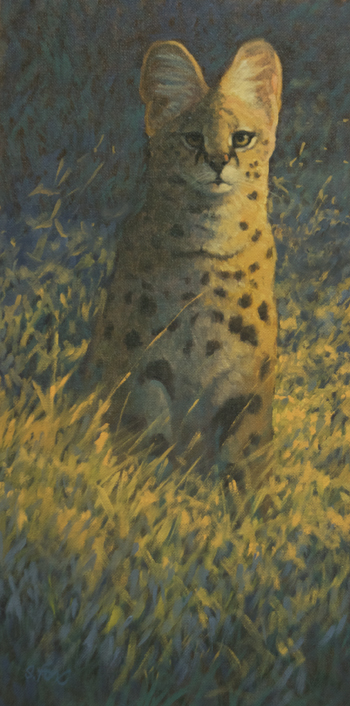
Here’s a new one from reference that I shot in Kenya in 2004. It was after the conclusion of the Simon Combes safari and I had flown back down to the Mara for a few days at Rekero Camp, which is on the Talek River. Fabulous camp, great staff, wonderful food, terrific drivers. I’d love to go there again. It’s apparently one of the places the Big Cat Diary people stay when they are filming and I can see why. It’s a tented camp right in the bush. Buffalo wander through and you can hear the hippos grunting and roaring at night since the tents are mostly right above the river. A real storybook African place.
A couple from Ireland were kind enough to invite me along on their game drives. My first morning with them we saw a serval walking down the road as the sun came up. I loved the color of the first light of the day hitting his or her coat, but most of the shots weren’t particularly paintable. We were so close that my point of view was from above ( I know, I know- boo hoo) or the gesture was awkward, etc. But…..I got some great reference at the Denver Zoo this last May. Nothing special in the Light Department, but wonderful eye-level alert poses. So I put the two together and came up with this. I kept the grass loose and impressionistic so that the focus would be on the cat, who is Up At Dawn.
Up At Dawn oil 16"x 8" (price on request)
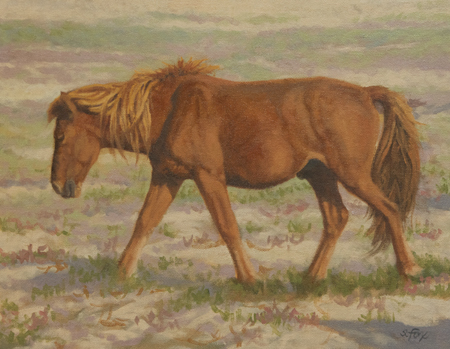
I’ve also just finished my first in a planned series of paintings of Mongolian horses, the ones the Mongolians ride, not the takhi. I got a lot really good shots in great light, but picked this one to start with because I loved the color of his coat.
I’m going to be in a group show with a flower theme at my gallery, starting next week. It’s not something I’ve done a lot of, well, any, but I have some great hummingbird reference that I shot right outside my studio windows so….for something completely different…
Hummin' Along in the Leopard Lilies oil 12"x 9" (price on request)
I went back to an Art Nouveau/Arts and Crafts inspiration from my previous incarnation as an illustrator and used a decorative approach. Flatter light with a plain background. It was fun and I’ll probably do more flower subjects in the future. This one sure got me using my reds more than usual. The bird is a male Rufous hummingbird, just another little rottweiler in a bird costume. Thank goodness they aren’t the size of ravens or none us would be able to go outdoors when they’re around.
STUDIO MUSIC
What do you listen to when you’re working? I can’t write this blog with music going, but otherwise I always have something on. I’ve acquired a taste for celtic-inspired world music and really like listening to Kila, Peatbog Fairies and Shooglenifty (No, really.). When I want to up the energy level, it’s time for some Afro Celt Sound System. I’ve been know to listen to Baka Beyond and Kenyan benga music when working on African subjects and Mongolian music when I’m…. you get the idea. Favorite rock includes anything by John Mayer, Mark Knopfler and Sting. Also still Stuck in the Sixties with Quicksilver Messenger Service (love, love, love John Cippolina, my guitar hero), Jefferson Airplane and of course The Beatles and Rolling Stones. When I come into the studio in the morning and need to ease in slowly, it’s Enya, Clannad or Nightnoise.
ART THOUGHT FOR THE DAY
If anyone, in the beginning of study, will set himself to study the various compositional forms, then experiment and practice with the variations of them, he will find that his instinctive taste is developed; and subjects will in time lend themselves easily to his feeling for unity, and soon he may be able to forget all about them.
It must never be forgotten and let this be most strongly emphasized – that the dominant aim of the student should be to train and equip himself to the point where he can judge unity and all of its contributing factors by “feeling”.
Since, judging from the stats, the subject seemed to be very popular, I thought I would continue today with more on the takhi, specifically how I take the reference I shoot and turn it into a painting. More and more I start with drawings to become familiar with a new species or figure out things about one I’ve painted before.
Here are three drawings from last year, the first two of which were published in the Society of Animal Artists newsletter.
Takhi scratching leg; charcoal pencil on cold-ply bristol paperTakhi mare and foal; charcoal pencil on cold-press bristol paper
Now I’ll show you how I take an animal from one time and place and put her in a setting from another time and place, a challenge that every wildlife artist needs to meet successfully. Here’s the setting:
Main takhi water source; Hustai National Park, Sept. 2006
What a treat! We came around the bend in the dirt track early in the morning and there, right in front of us were two harems at the same time, sorting out who gets to go first.
Watering place close-up; Hustai National Park, Sept. 2006
I always try for a variety of shots; close-ups and the “big picture” for context. I used to come home with great close shots of something like a tree and found that I’d completely forgotten to get the surroundings, which really cut down on my options. Notice that the above photo is kinda fuzzy. But it’s still useable for reference.
Now here is the horse reference. Different part of the park, different year, different season. I’ve included two as an example of what to look for when evaluating images. These are similar, but the second, to me, is clearly superior. I love the rhythm of her gesture.
Takhi mare; Hustai National Park, May 2005Takhi mare 2; Hustai National Park, May 2005
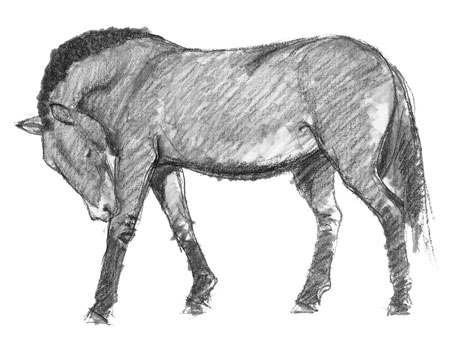
So next I did a drawing to capture that.
Takhi mare walking; charcoal pencil on cold-press bristol paper
And, putting them together, here is the finished painting, completed in 2007. What I hope is that you can’t tell that I “stitched” together the reference from two sources.
Morning Drink oil 12x 16" (price on request)
I also wanted to let you know that two of my takhi images are available as limited edition giclees, framed or unframed. The full information is on my website. Click on “Limited edition giclees” under Fox Studio in the column on the right and it will take you directly to my giclee page.
Takhi Foal; giclee on archival paper
I saw this foal on the same trip as the mare in the painting above. He or she was quite a character.
Mongolia Morning; giclee on archival paper
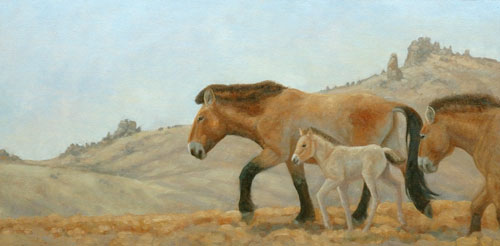
I posted this last week, as the original painting is still available, but have also published it as a giclee. It’s another example of how I took the mare and foal, who were against a grassy hillside and moved them to a ridge that has Hustai’s famous mountain as the background. The third horse was added as a design element.
All my giclees are available for holiday delivery.
ART THOUGHT FOR THE DAY
Let this be plain to all: design, or as it is called by another name, drawing, constitutes the fountain-head and substance of painting and sculpture and architecture and every other kind of painting, and is the root of all sciences. Let him who has attained the possession of this be assured that he possesses a great treasure…:










 Susan Fox, American Artist