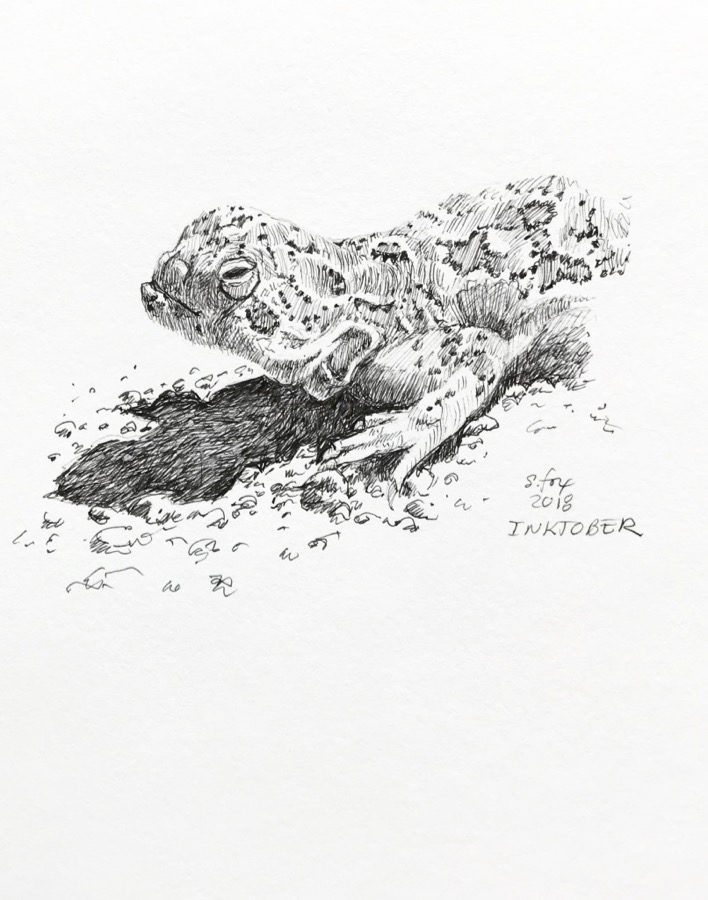
Inktober 7- “Mongolian Agama Lizard” These small reptiles are quite common in the drier parts of Mongolia. I love their funny face with the overshot jaw and their great color pattern. This one “posed” for me for quite a long time. Stillman & Birn Beta series wire bound sketchbook (the very last page) with a Pilot EF fountain pen.
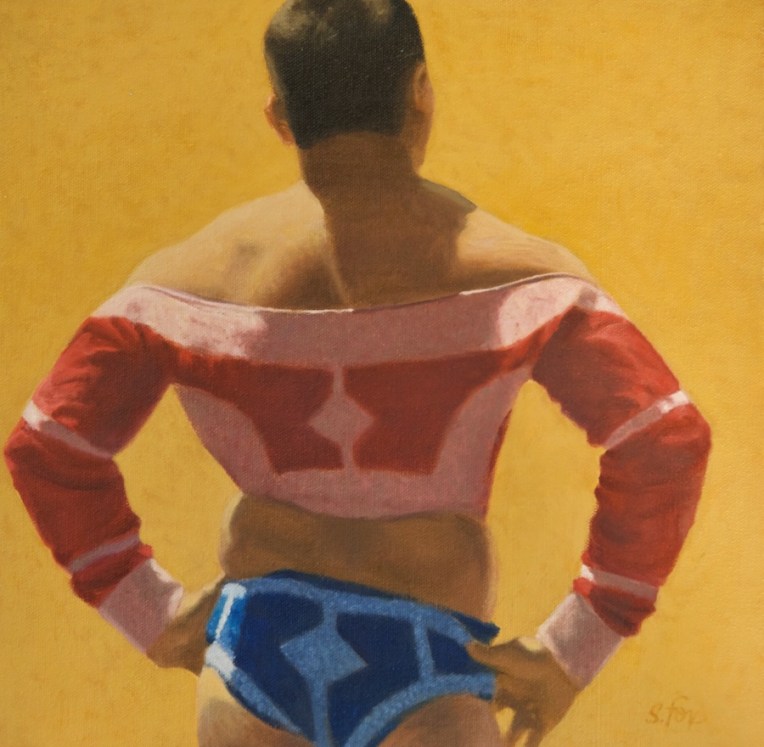
“Mongol Wrestler” oil 12×12″ $950 (Salmagundi Club Summer Exhibition, Certificate of Merit)
I’ve always remembered one of the first things my Illustration II teacher at the Academy of Art told us, which is that “the simpler statement is the stronger statement”. Easy to say, surprisingly hard to do. It’s easy to just accept what’s in front of you and put it in your painting or drawing, whether it’s individual the leaves on a tree or every hair of a coat of fur. It’s much more challenging (and ultimately rewarding) to edit and leave things out. That, however, is a judgement call and the possibility exists that one will make the wrong choice. Scary! Actually, it’s inevitable. But that’s ok as long as one is honest about it and is willing to keep trying. While a good teacher or experienced artist friend can help, ultimately you have to decide what to do based on your vision (you DO have a vision of where you want to end up, right?) of where and how to simplify. In future posts I’ll be discussing a variety of ways to approach simplifying your image.
Example: here’s a 12×12″ oil I did of a Mongolian wrestler. I started by deciding that the painting would be about his pose and the light/shadow pattern. Also the positive shape of the pose and the negative shapes that were then created in the background. I cropped the figure VERY carefully, taking into account the overlap of the frame. When I shot the reference photo kinds of stuff were going on around him on the event field, none of which I needed and which would just get in the way. The gutsy move for me was the golden yellow background. I had to control both color and value so that the subject would still pop out, but keep that sun-drenched feeling. It worked. But if it hadn’t I would have painted over it with something else, most likely still letting a bit of it show through. “Mongol Wrestler” was awarded a Certificate of Merit in the Salmagundi Club’s Members Show in 2017.
–This is one example of what I’m offering on my Patreon site…solid, experience-based information. Please consider becoming one of my valued Patrons! https://www.patreon.com/susanfox/posts
I go to Ikh Nartiin Chuluu (Ikh Nart, for short) Nature Reserve on every trip to Mongolia. It’s where I went on my very first one in April of 2005 to participate in an Earthwatch Institute-sponsored expedition to assist in research that has been carried out there since the mid-1990s. For the two weeks the team of ten of us were there it never got above 32F/0C (not exactly spring weather on the north coast of California where I live), with almost constant wind. Loved every day of it. As of 2016 I bought my own ger with furnishings and have been given permission by the reserve director, who was one of the argali sheep researchers on the Earthwatch project, to set it up in the reserve. So I’ve known him for a long time and am very grateful for being able to “live” in this very special place for a week or more a year. When I’m not there he has the use of the ger for the reserve’s guests.
This year I was allowed to set up at the research camp, which was very convenient since it’s one of the best places to see wildlife. The caretaker, Ulzii, and I have also known each other since that first trip, so I had a trusted back-up just in case I needed it. Which was good because Ikh Nart had gotten no rain to speak of when I got there and then had three corking good storms come through in five days. I got to watch the land go from brown and parched to green with flowers blooming. I also watched the dry streambed turn into quite a “raging” torrent for an hour or so. Many photos and video, so that will be the topic of a future post and a YouTube video.
I did my usual tramping about wildlife watching, also sketching and painting. I still need to scan my journal, which I do a lot of drawing in, but here are my watercolors.
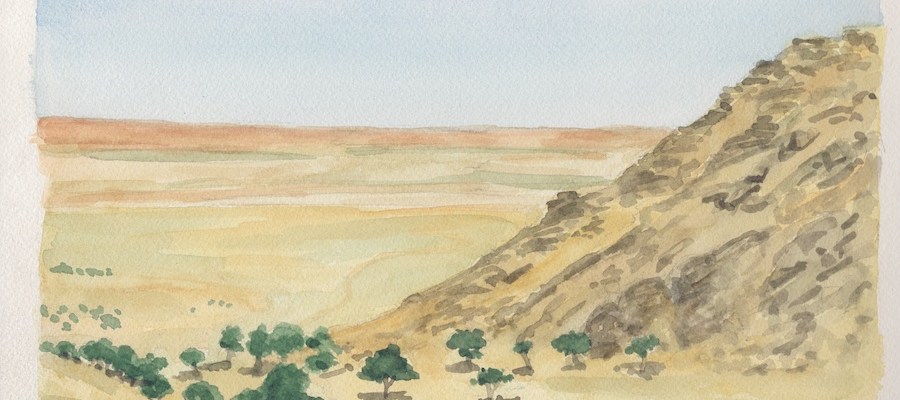
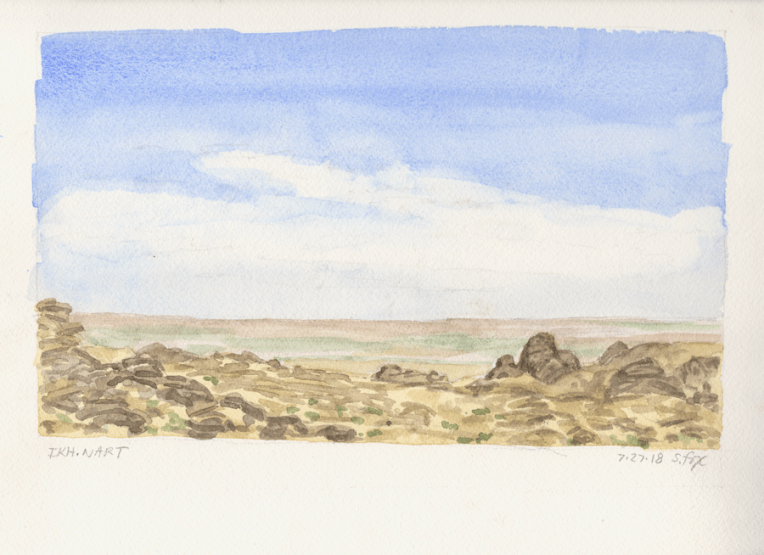
The research camp valley’s west end where it opens out onto the steppe. I’ve always loved this view. Watercolor 9×12″ on Arches 140lb.cold press blockIkh Nart view west to the steppes. Watercolor 9×12″ 140lb. Arches cold press blockIkh Nart rocks. Watercolor 8×8″ Waterford 140lb. cold press
I was out hiking the south edge of the valley and spotted this dramatic overhang. Found some nice flat rocks to sit on and lay out my paints. Looked up and there was an animal standing under it looking at me. Grabbed some quick photos. Then it lay down with just its head showing. Before I finished the painting it left, so I added it from memory. But, when I got back to camp and downloaded the day’s images onto my MacBook Pro I saw that it hadn’t been an ibex, but was instead a female gazelle! Twelve trips to Ikh Nart over the years and this was the first time I’d seen a gazelle in this part of the reserve. But for the painting, an ibex she will remain.
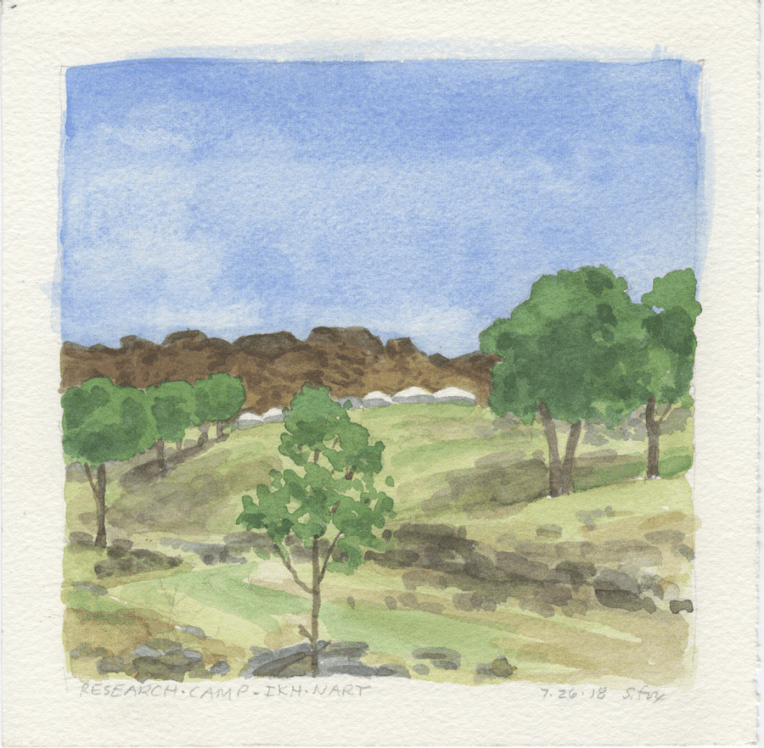
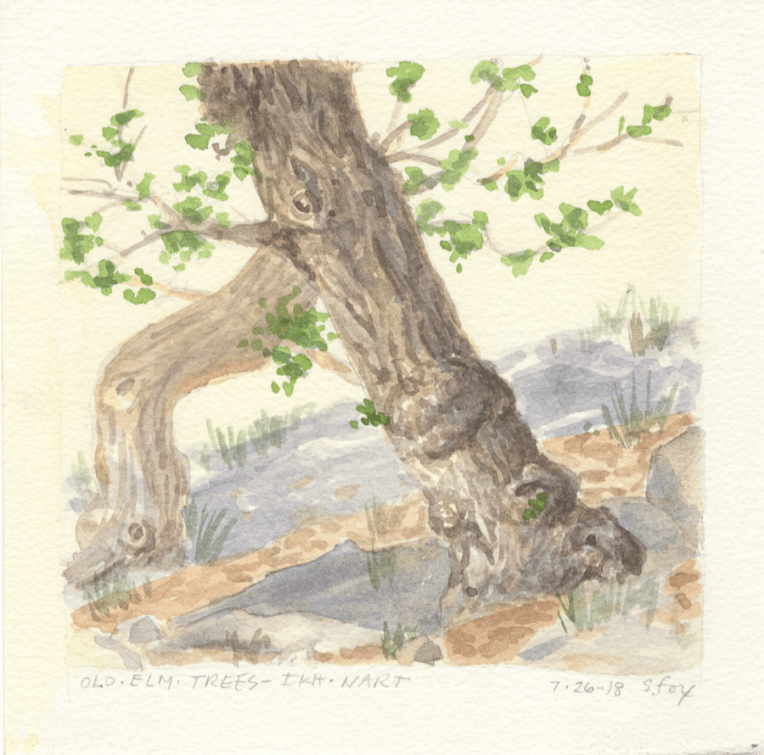
Looking back up the valley to the research camp. Watercolor 8×8″ Waterford 140lb. cold pressElm trees. Watercolor 8×8″ 140lb. Waterford cold press
It was getting hot so I left the top of the valley and went back down into it to look for a location with shade. I found it in a clump of old elm trees and did this study, along with the view towards the research camp. When it hasn’t rained a number of species lose all their leaves and look like they’ve died. But add any amount of rain and they seem to almost instantly leaf out again. I was working away totally focused when I heard a noise behind me. I turned and saw this…
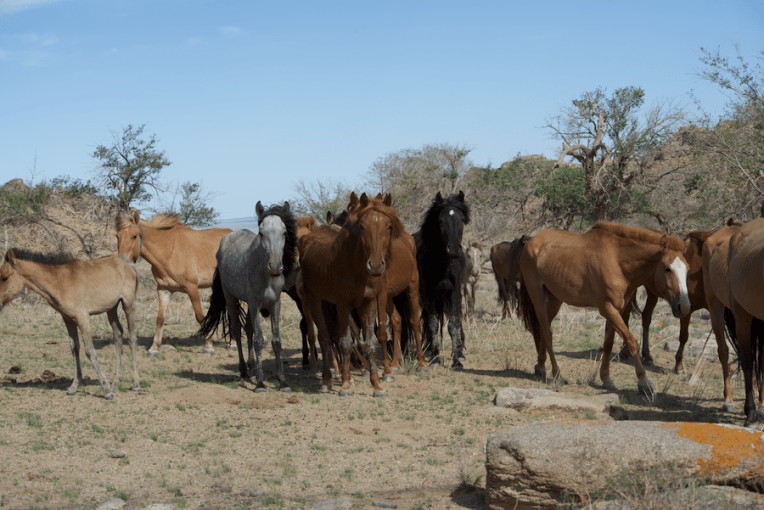
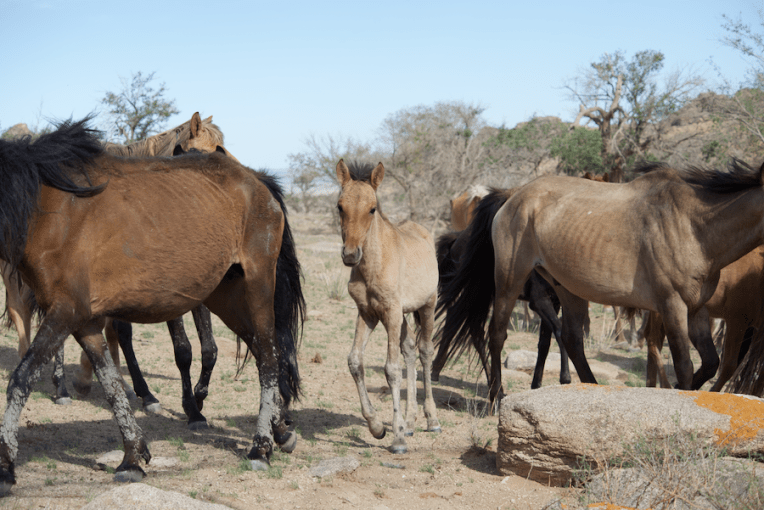
It was a “burrrr” and a snort from this herd of domestic Mongol horses who wanted to get to the spring to drink. And I seemed to be in the way. I looked at them. They looked at me. Then the stallion made his decision.
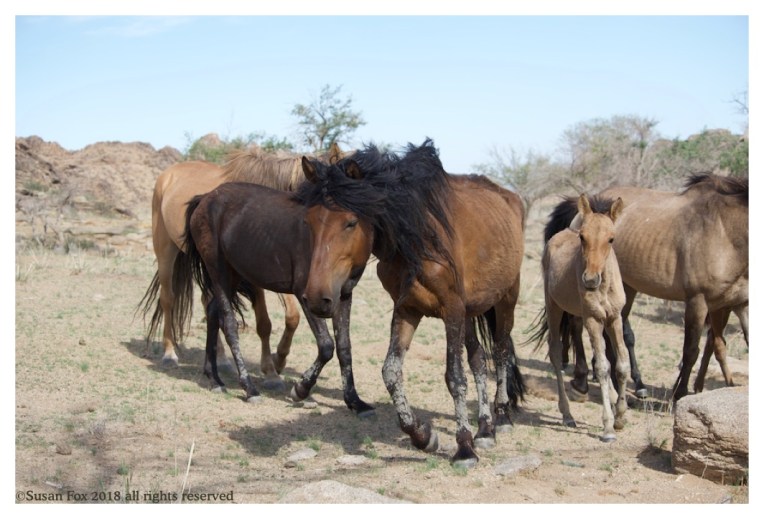
The herd split and went around me on both sides as I madly snapped as many photos as I could.
They rejoined and continued on to the spring. As you can see they were very thin from lack of graze, especially the mares with foals. This was the third dry year in a row. But the storms that came through, I hope, brought enough rain to let them fatten up for the long, very hard Mongolian winter. There are no horses tougher than these, so they’ve got a good chance.
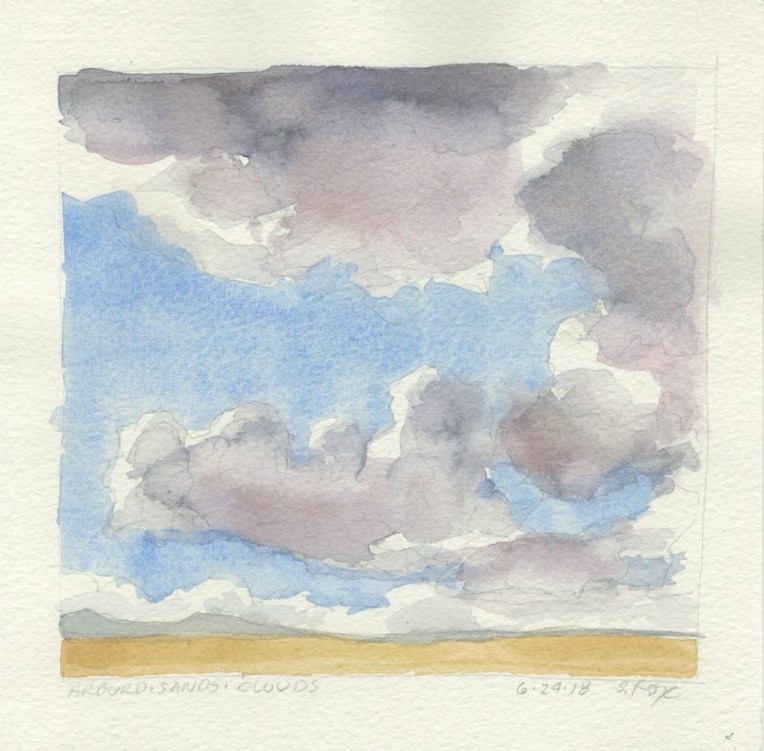
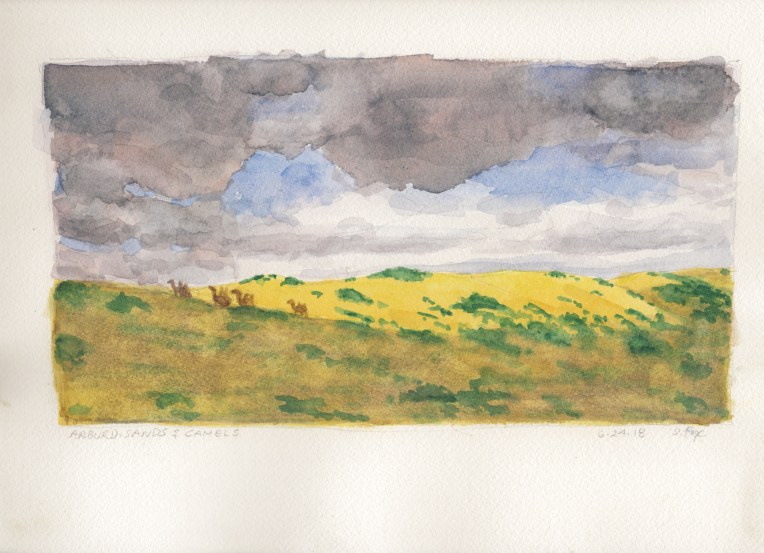
I returned on July 31 from my twelfth trip to Mongolia since 2005. I traveled to a number of places, starting with Arburd Sands ger camp in Bayan-Onjuul Soum, Tov Aimag, about two hours south-west of Ulaanbaatar. The area features a 20km stretch of dunes running east-west, the northernmost extent of the Gobi. I enjoyed capturing the clouds as they drifted by.
Yarka watercolors on Waterford cold press paper
Yarka watercolors on Arches cold press paper
A group of camels was nice enough to move through the scene.
Yarka watercolors on Waterford cold press paper
This was actually the first one I did as a warm-up. A relatively overcast day in a country that gets 250 days of sunshine a year.
When I was working towards a degree in illustration at what was then the Academy of Art Collegs in the late 1980s, the question came up in one class about how far to go trying to make a piece work and, if it’s not, should one start over. The advice the teacher gave us and that I have followed until last year was that past a certain point, well, there was no point. Time to move on to the next piece and not repeat oneself. Made sense to me. Don’t beat the proverbial dead horse.
Fast forward to March of 2016 when I spent two wonderful days visiting and painting with superb landscape painter and friend James Coe at his home near the Hudson River Valley south of Albany, New York. We spent a few hours in his studio talking shop. He pulled out one piece after another, both plein air and studio paintings. And started to talk about how this one or that one had sat for months or years until he figured out what was needed and fixed it. Or how he’d done a small piece of a scene and was planning on doing it again larger. Some he’d painted four or five times from his plein air study. I’d never heard of such a thing! Gobsmacked I was.
Like anyone who has been at the painting game for awhile I have a lot of paintings that I either got stuck on and never finished or didn’t feel were good enough to show anyone except the cat. But now….now! Somehow Jim had given me “permission” to go back to those old pieces and see what I could do with them and it would not be wasting my time or mistreating the horse, which was now alive and well.
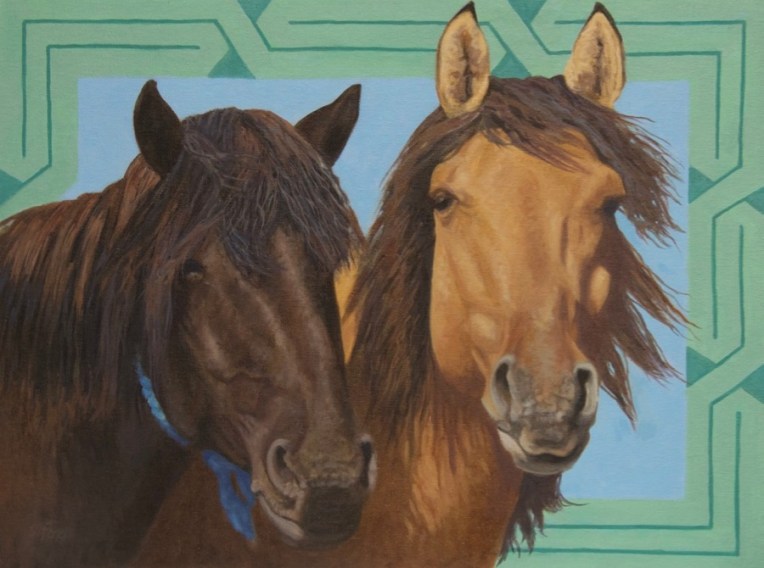
So there’s that. The other thing that has happened is that after toying with the idea for close to three years now, I decided to see how I could integrate my love of pure design, lettering and historic decoration back into my work with my Mongolia subjects. After painting a dozen new pieces for “Wildlife Art: Field to Studio” last year I felt that for the time being I’d had said all I had to say about depicting an animal or animals in a traditionally realistic landscape and it was time to move in what I call to myself my “new direction”. I did a couple of small pieces last fall as tryouts and have a number of larger ones under way, all new. But I’ve also gone back to paintings that just never seemed to work for one reason or another and gave them another look.
I’d also created albums in Photos for images I’ve shot that suggest possibilities for interesting designs and also some for a variety of elements, both natural ones like landscapes with warm, cool or warm and cool colors and human-made like ger or monastery decorative painting. And I found a Mongolian calligrapher who was willing to write words for me and email them as large jpgs, so I can integrate the vertical script, bichig, into my work.
What I’m finding is that adding the decorative elements is not just fun, but makes these old ones visually more interesting so they now work. I’ll be showing more of my “salvage” efforts in the future. In the meantime here’s the painting above as I originally did it in 2012, without the decorative border. I also repainted the horses, tweaking the drawing of them, and generally punching up the color.
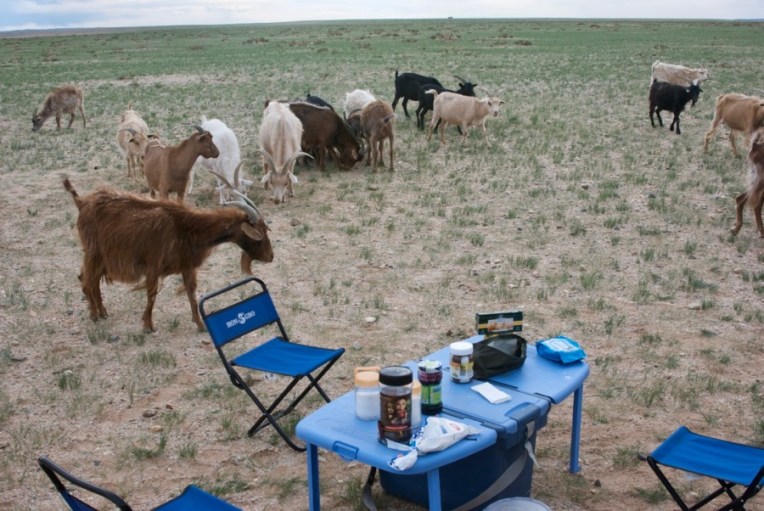
Breakfast, with cashmere goats. Great way to start the day!
In a country where 100km is a good day’s travel on the earth roads that serve most of it, we had just learned from locals at Baruunbayan-Ulaan, a soum center where we had stopped to get petrol, that the heavy log and plank bridge we heading for in order to cross the Taatsyn Gol had been destroyed, a casualty of five days of rain in the Hangai Mountains followed by serious flooding downstream in the Gobi, where I was on a two-week camping trip in July of 2010, traveling in a Land Cruiser with Khatnaa, my driver/guide and Soyoloo, our cook. The closest intact bridge would require almost a two day detour north and then back south, which didn’t appeal to any of us. What to do.
Khatnaa decided that we would drive on west to the river and see what the situation was. Also at the petrol station were two very full Mitsubishi Delicata van’s worth of Mongol men and their families. A little later a third one showed up.
Heading south-east into the Gobi. I love this
In one day that had incident enough to two, here’s my journal entry from July 15, which gives a certain immediacy to what followed (photos after the journal entry):
“What an amazing day. Went south-west with Orog Nuur (Orog Lake) as our goal. Khatnaa knew there was the Taatsyn Gol (Taatsyn River) to cross, so stopped at a petrol station to ask about it. Also there were two van loads of Mongols from Togrog who were heading west to mine for gold. Usual Mongol socializing and information exchange ensued.
A third van showed up and we all headed towards the river, which was flooded due to rains in the Hangai Mountains.
We got across one stream, but were stopped by a broad ribbon of streams and mud. The main channel was moving fast and pulsing with even more water.
Went back up to the bluff overlooking the river and had lunch, watching the three van loads of Mongols look for a way across and mess around in the water.
Went back down to the river. Khatnaa walked a long way to see if he could find a crossing point, but came back and told us that the last stream of water was the worst of all. So we were faced with going north 100 km to the closest bridge. Such is travel in Mongolia.
Suddenly, there was action with one of the vans. A bunch of guys had formed a line across one point of the main channel and the van charged into the water, started to stall, but the guys all got behind it and pushed it on through!
Well, if a van could make it, our big Land Cruiser certainly could and did, without even needing a push. We did end up with an extra passenger, a little eej (mother) who wasn’t about to miss her chance to ride in our big car.
We got out on the other side and I photographed the other two vans making the crossing. Then said our good-byes.
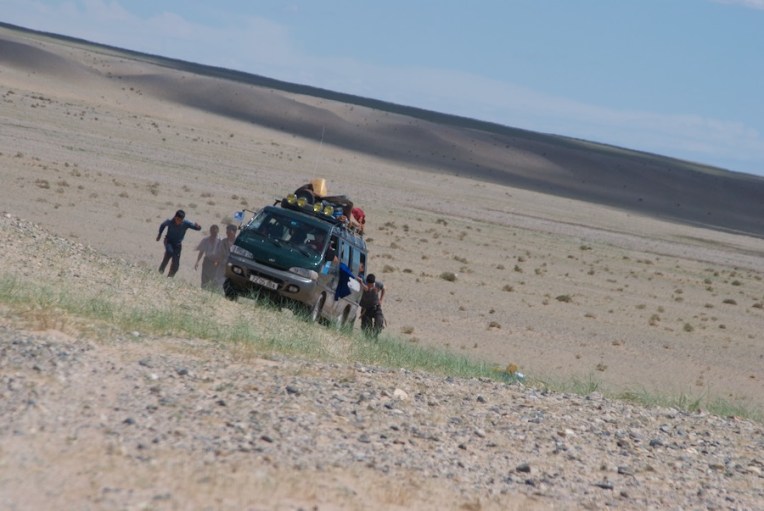
We followed one van up a soft sand slope. It promptly got stuck so we rolled back down and went around it and on up the hill.
The entire “adventure” of the river crossing was a perfect example of Mongol practicality, improvisational skills and good humor. No one at any point got angry, showed frustration or swore. When it looked like things had stalled out, the guys took a break and goofed around in the water. Or so it seemed. They were clearly having fun but they were, in retrospect, also searching for a crossing point.
The spot they found was one where the channel wasn’t too wide or deep and where they felt the bottom was solid enough for a vehicle to get across with a minimal chance of getting stuck.
Without winches, cables or even rope, they simply used the same solution they always do – push.”
Here’s a selection of the photos that I took…
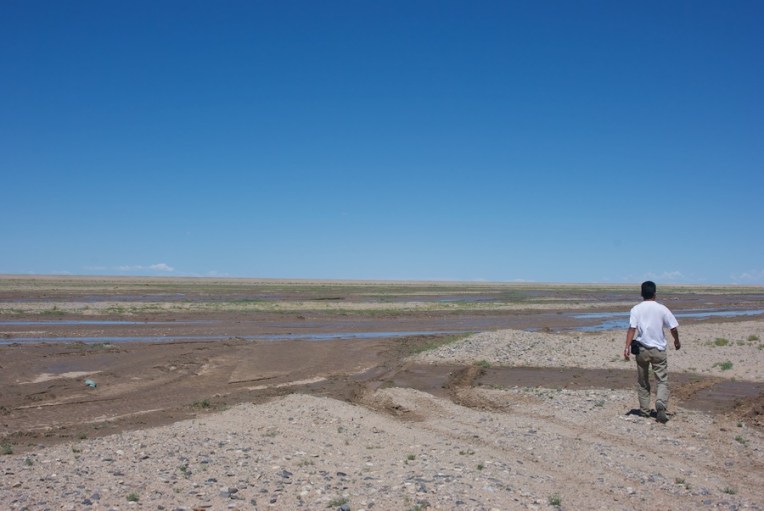
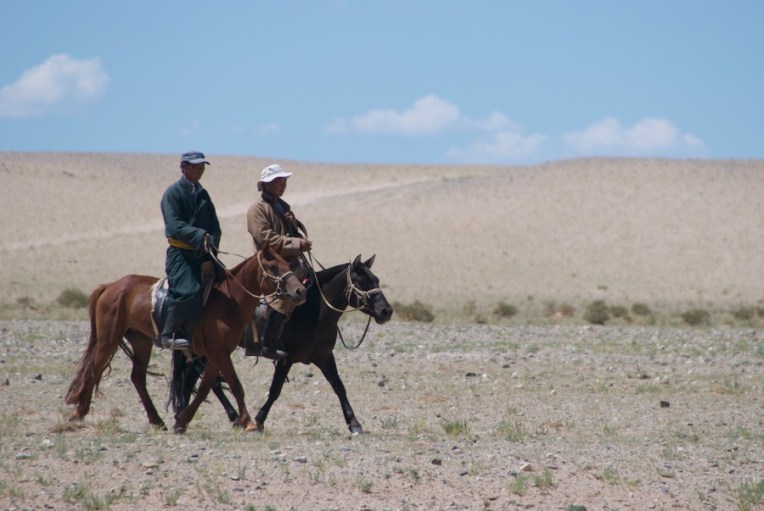
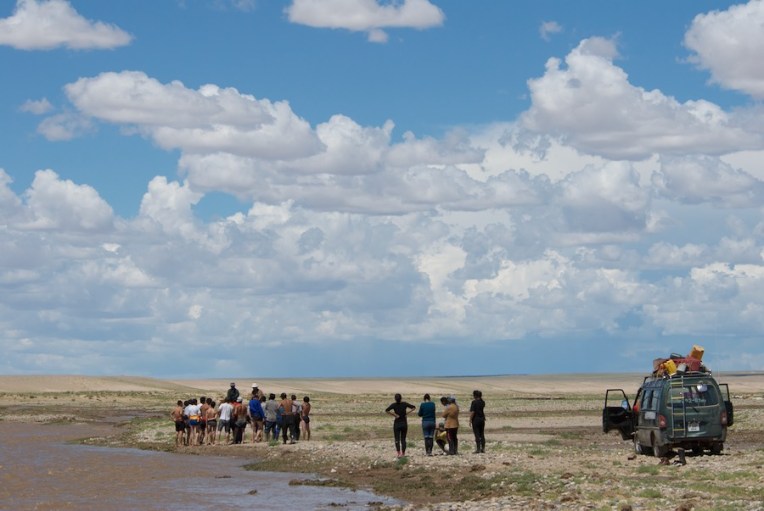
Mongols from the vans looking for a place to cross a channel of the flooded Taatsyn Gol (river)Khatnaa walking out to see if he could find a crossing place as described in the journal entryAfter Khatnaa came back from not finding a way across, he drove up to the top of a bank overlooking the river valley where we had a picnic lunch and watched what was going on down belowWe drove back down and passed these two local herders who were riding over to check out what was happeningYou can see them in the distance on the left. Of course, they just rode across, no problem. Which was pretty funny, actually. It was that kind of dayWould-be miners getting advice from the herders. All this taking place under a spectacular summer sky and crystalline lightWe were waiting at our car and suddenly one of the vans started across. I took this photo just as it started to stall out. The guys behind it immediately rushed up to give it a push and out it came on the other sideThen it was our turn. I took this shot at mid-stream. The water was up past the bumperThen the second van crossed with us looking back the way we’d just comeMeanwhile, the herders enjoyed a little unexpected afternoon entertainment…The third van crossing without incident but some pretty good splashesAll vehicles safely across the guys took a few minutes to goof around in the water.Then they headed back to their vans to continue their journeyWe followed behind and came upon one momentarily stuck in sand on the slope up out of the river valley. We smiled and waved as we went by since we still had a fair distance to go to our next destination, Orog Nuur (lake)And not too long after….camels!
In Mongolia, when traveling in the countryside, even when it seems bad it can be very good. And something cool, interesting or out and out wonderful happens every day.
I sat in the car and took photos through the windshield
I was coming to the end of my first tent camping trip in Mongolia in July of 2010. We had traveled south to a remote Gobi lake, Orog Nuur…myself, my driver/guide and a cook… and back north into the Hangai Mountains to see a variety of sights, including two mineral spring resorts, a Buddhist retreat established by Zanabazar, Mongolia’s finest sculptor, popular Orkhon Falls and the much visited site of the imperial Mongol capital Harkhorin which is adjacent to the famous monastery, Erdene Zuu, partly constructed of stones from the ruined capital which was sacked my the Ming army after they ended the Yuan Dynasty of Khublai Khan and chased the Mongols back to their homeland.
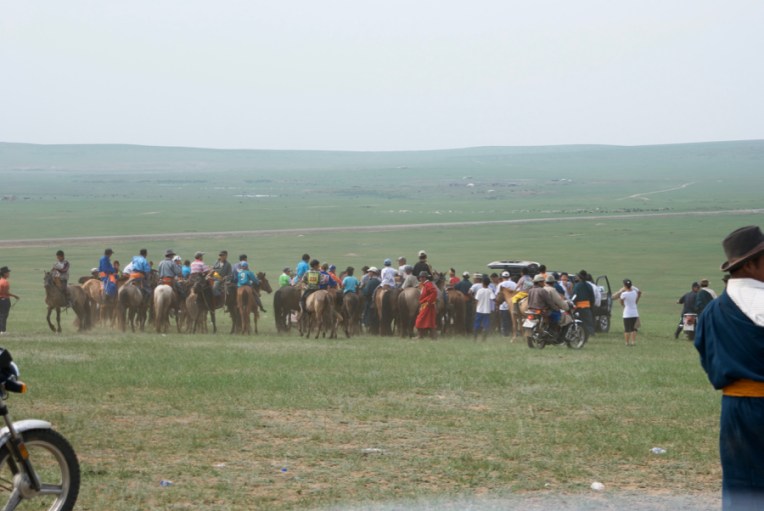
Our route now took us north, down out of the Khangai Mountains, where, for the last night out, we were going to pitch our tents at Ongii Nuur, a lake known for its birds. It was a gloomy, cloudy day. As we were driving along, I noticed a large ger encampment down and off to the left. I almost said something to to my Mongol driver/guide Khatnaa, but let it go. Then he had to slow down because a bunch of men and boys on horses were crossing the road. I told him about the gers. He made a right turn and followed the horsemen up the slope. And at the top found ourselves in the midst of over a hundred Mongols, many dressed to kill in fancy brocade del, sashes and boots.
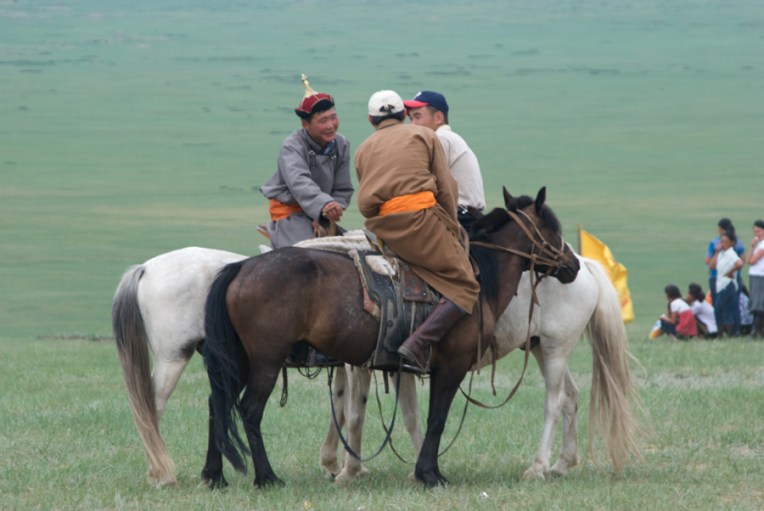
Last instructions, I assume, before the riders and horses go out to the starting p0int
Just about the only thing that I had hoped to encounter on the trip (my fifth to the Land of Blue Skies), but had not, was a local naadam, the festival that always has a variety of traditional competitions and activities, including the Three Manly Sports of horse racing, wrestling and archery (I had gotten to attend my first local naadam at Baga Gazriin Chuluu in 2009 and was instantly hooked). Now it appeared that we had finally stumbled onto one on the last afternoon of the last day of the trip.
We pulled up in an area on the hill where a lot of cars and trucks were parked. There were horses all over the place. Khatnaa got out, spoke with someone and came back with the news that the event was a family reunion. Stay or go? We’d inadvertently crashed a private party. I told Khatnaa that it was up to him to do what he thought best. He thought for a moment while I held my breath and then pulled into the middle of a long line of cars, where we tried to be as inconspicuous as possible. Over the next two to three hours I sat in the big silver Land Cruiser and took around five hundred photos of whatever crossed my field of vision. Our arrival had coincided with the run-up to the horse race and we had gotten there just in time to watch all the preparations for it.
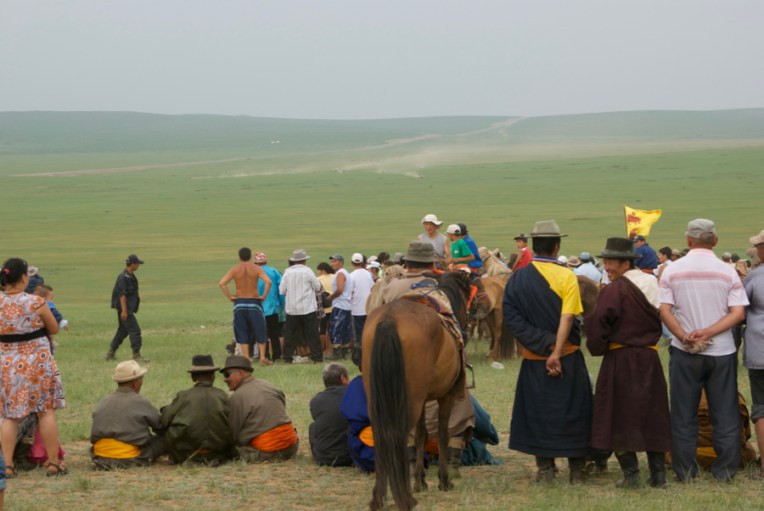
I wasn’t sure what to watch for, but then saw the characteristic cloud of dust with a chase car in front and the riders and other cars behind
It seemed like over half the men and boys were on horseback, warming up the racehorses, chatting and just riding around the area the same way the rest of us would walk. The trainers stood out with their fancy del, sashes, hats and boots, along with their sweat scrapers tucked in to the back of their sashes. Older men sat on the ground exchanging snuff bottles in the traditional greeting. Kids were happily running and riding all over the place. Everyone was clearly having a great time, as was I getting to watch it all.
Our “cover” was blown when a young couple on a motorbike drove up and offered us fresh, hot khuushuur (fried mutton turnovers). No way we were going to pass on those. I stayed in the car until the first horses were approaching the finish line and then got out and joined the happy crowd.
I never found out for sure, but it looked like it was a tie for first place. What counts is to be in the first five to cross the finish line
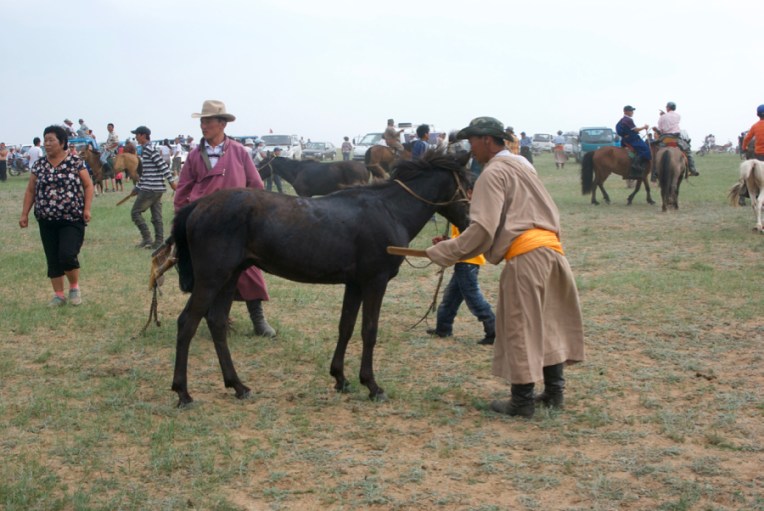
Afterwards, shortly before we left, I was photographing a lovely black race horse who was being scraped down, as the sweat from the winning horses is thought to be very lucky and auspicious. A woman came up to me, took my arm, led me over to the horse and made a gesture for me to lay my palm on the sweat, which suddenly turned me from spectator to participant. It was a very kind and thoughtful thing for her to do since I was very obviously not a member of this very big family. I was never so glad that I knew how to say “thank you” in Mongolian.
The black horse. This was a race for two-year olds so the horses haven’t reached their full size yet.
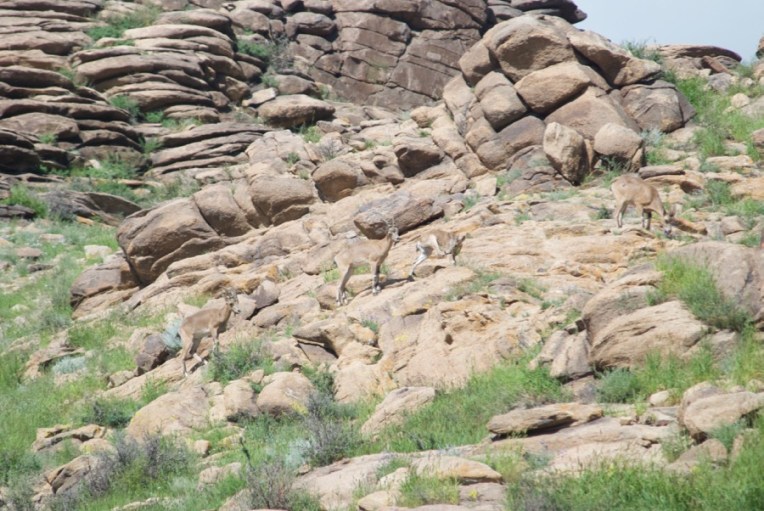
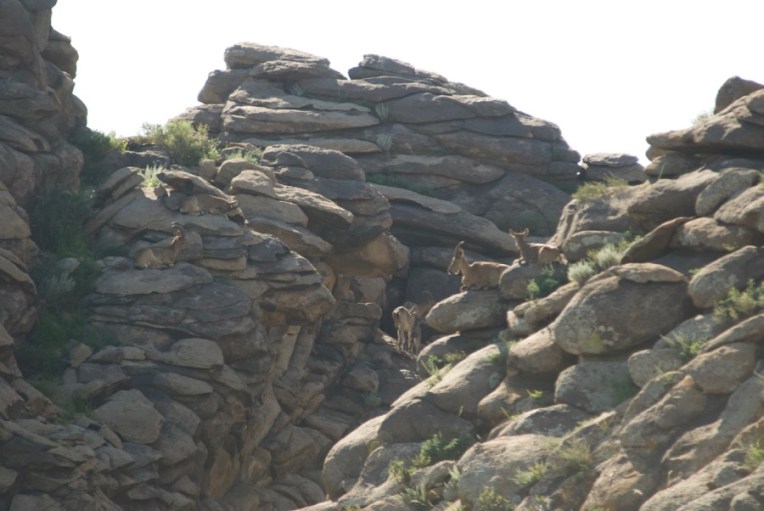
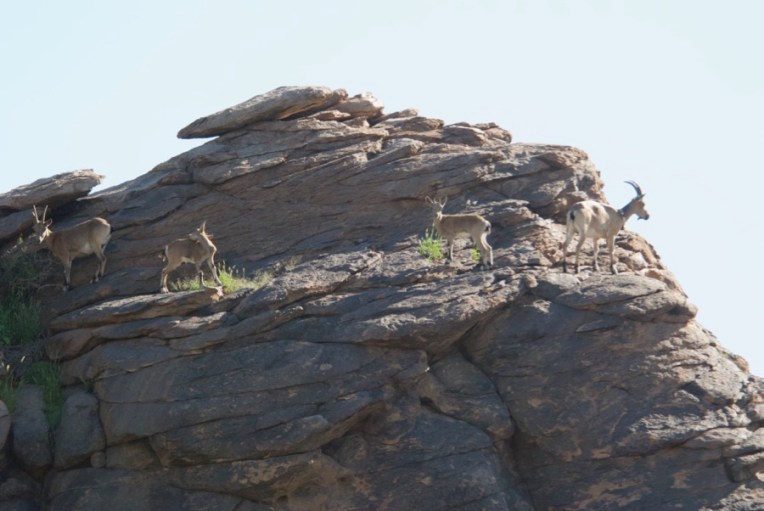
I spent over an hour watching this group of ibex nannies and kids, six or seven in all; I’m working on a painting of them is this great setting of rocks and green grass
I was staying at the research camp at Ikh Nartiin Chuluu Nature Reserve in September of 2012. It’s one of the best places in Mongolia to see argali mountain sheep (Ovis ammon) and Siberian ibex (Capra siberica).
I went out walking one morning for a day of hiking around and it quickly turned into One of Those Days that wildlife watchers and artists dream of…nine separate sightings and three times spending an hour or more with an entire group.
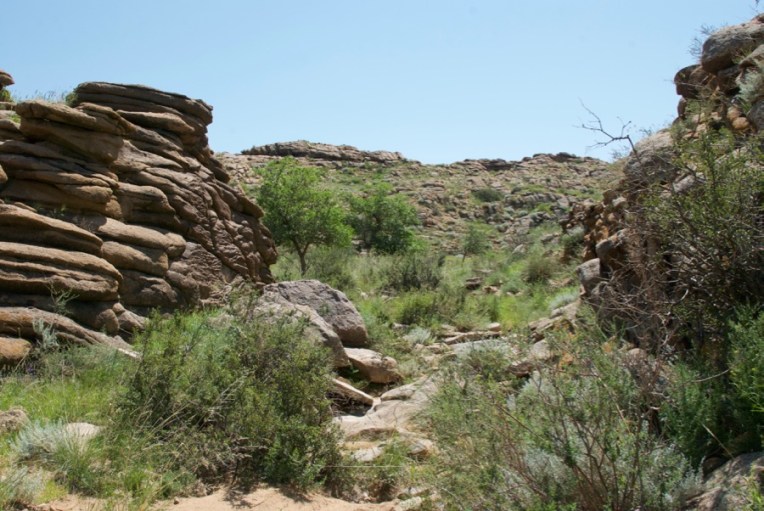
About halfway through the morning I’d come along the top of the valley and was now walking down a draw towards the valley, intent on heading towards the western end rock formations and following a very narrow path left by various animals, both wild and domestic. I was maybe ten yards from where the draw joined up with a larger one which would drop down to the valley when, with no sound or warning, two ibex nannies came running at full speed around the corner of a rock straight at me! They pulled up fast, gave me a look and turned. One bolted back up the way she’d come and the other, which I now saw had a kid, ran off down the direction I intended to go. Everyone involved was equally surprised. Needless to say I didn’t get any photos of the actual encounter, but I can see it in my mind’s eye. all of us standing there for an instant looking at each other. No idea, of course, why they were running so hard and fast.
At the fork of the “y” where we all came together. I’d come in from the left, the ibex had come barreling around those rocks that are also on the left. I’m standing with my back to the draw I was heading for.
And, as you can imagine, my heart was pounding. They could have easily run right over me. But everyone was fine, they were gone, so I continued on down the draw. And, believe it not, there was the nanny and kid…
The nanny was straight ahead of me
Amazingly, the ibex had stopped running, had gone up on a rock formation and was just standing there.
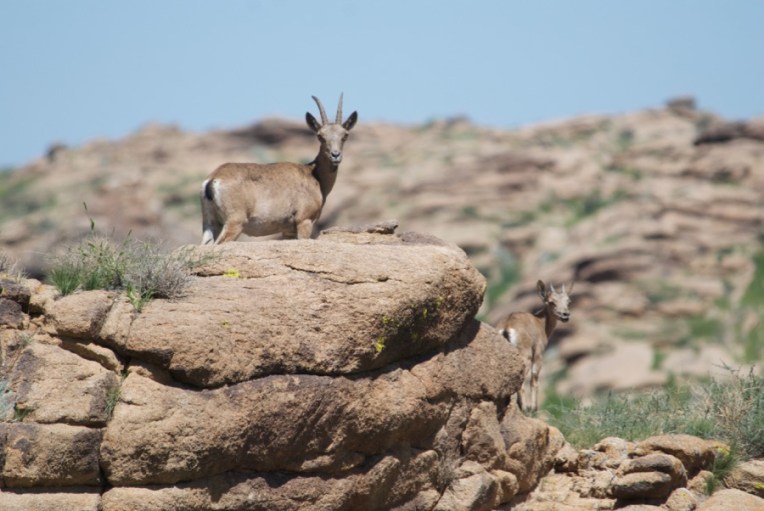
Siberian ibex nanny and kid
I walked forward a slow step at a time and got close enough for a few shots and her youngster. The photo above is not cropped. It was taken with my Nikon D750 and Nikon Nikkor 80-400 lens. She looked around a bit then she and her baby vanished on down the valley. I waited a bit to let them get ahead of me and be able to go where they wanted to go. I think she’d seen enough of me for one day.
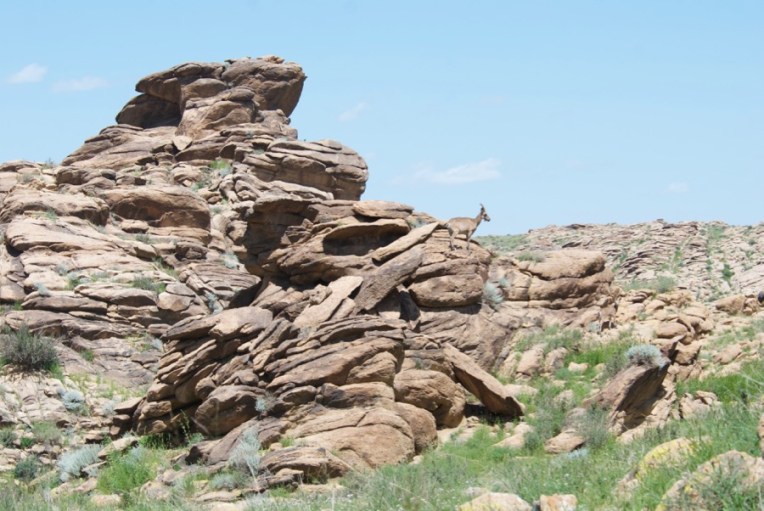
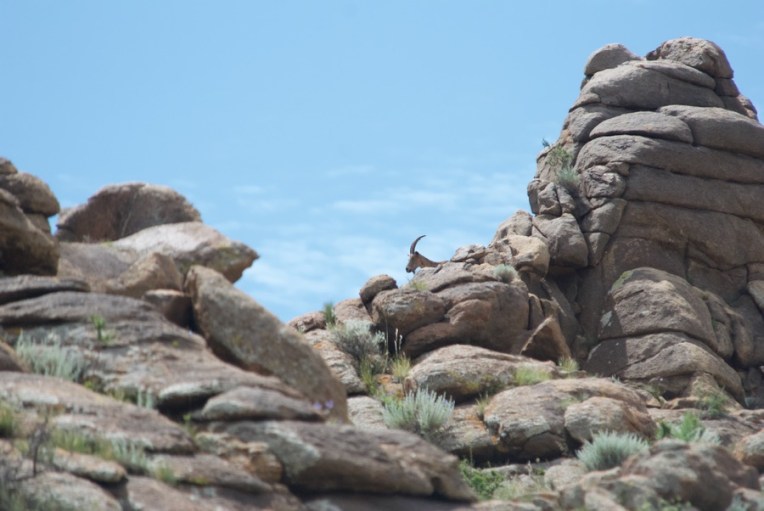
Here is a far more common way of seeing ibex. One learns to spot them from quite a long distance because the pattern of head and horns doesn’t match the rocks.
This was the first sighting of the day, very typical, just a head above the rocks.
And here are some more photos of other sightings that day. I finally got down to the rocks on the south side of the western end of the valley and found a large group of nannies and kids, who I hung around with for over an hour.
There are seven ibex in this photo
Farther down the valley there was yet another group. A couple were wearing radio collars. Once they settled down I sat in plain view, photographing and sketching them.
There were a number of kids who were playing and jumping around on the rocks, which was great fun to watch
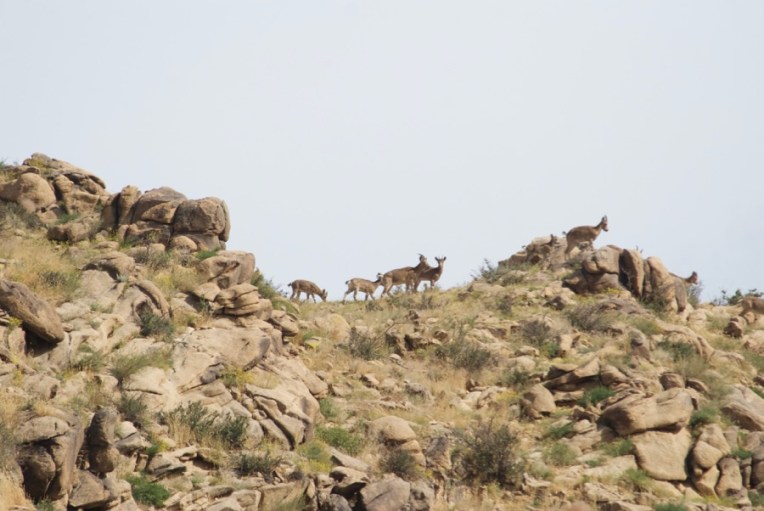
They finally moved off out of sight, but I’ve learned to hang around and wait. This time I was rewarded by having the whole group reappear and cross in a long line along the ridgetop, finally disappearing out of sight for good.
Ibex nanny group against the sky
There were a couple more long distance sightings of one or two ibex on my way back to camp, but they were either too far away or in the shade for photos anything other than “I saw them” shots, which I always take as a memory jog, if nothing else.
And that’s the tale of my “Ibex Day” which I will long remember.















 Susan Fox, American Artist