Mongolia Monday: The Best Camping Trip Ever, Part 8 – Khuisiin Naiman Nuur National Park

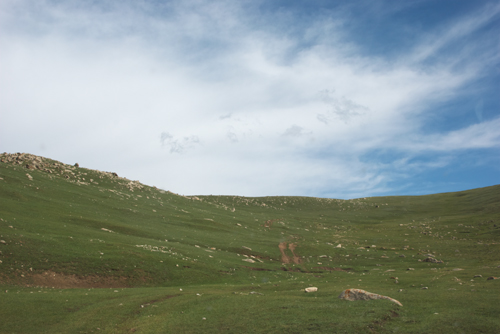
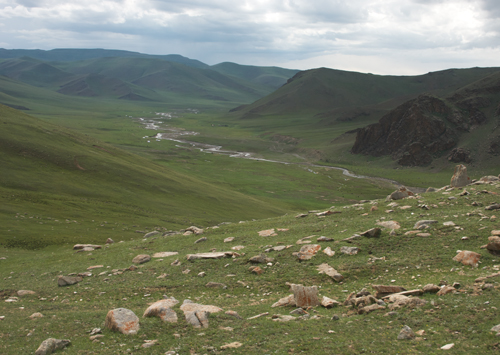
One of the places I most want to go back to and spend a week camping, painting and sketching is this place. For me, the “Valley of the Yaks” is the whole package. Green mountains, beautiful small rivers, herders, their gers and their animals, raptors like black kites and absolutely no visitor infrastructure at all.

 

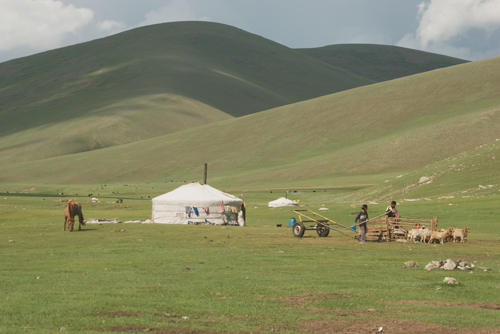
Gers in the valley


First yaks we saw


We drove more or less to the end of the road, which was at the top of a steep slope. There was, of course, an ovoo. Getting out and looking over the top, I noticed two things right away: A drop dead gorgeous mountain lake, one of eight in the park (“naim” means “eight” in Mongolian”) and that the road continued down, and I do mean down, the other side at about a 45 degree angle. Needless to say, almost no one is crazy enough to drive it even though it is the only road in the park that provides access by car to any of the lakes. The only other way to get to them is to walk or ride a horse. We climbed up the slope, joining quite a few Mongol day-trippers. Even though nothing in particular was going on, there was a festive feeling in the air.

 

One of the lakes of Naiman Nuur National Park; road to right, after it's leveled out some


Wildflowers


I took my lake photos and also got some more good wildflower images, then it was time to drive back down the hill and find a campsite. We passed some Mongol guys who were sitting and chatting by the side of the road. As we went by, one of them, who had obviously noticed that I was a westerner, yelled out “I love you!” Almost without thinking, I yelled back “Bi mongol dortei!”, “I like Mongolia!”. For some reason, Khatnaa and Soyoloo thought this was hilarious, burst out laughing and high-fived me. Khatnaa then decided that I had to learn another Mongol sentence: “Bi argaliin udad dortei” which means “I like dung smoke.”, a reference to our stay at Orog Nuur in the Gobi. I think I ended up having to repeat it at every ger we visited after that. All in good fun, of course.

The time had now come to find a spot to camp for the night. I was looking a little longingly at a place right down next to the river, certainly a prime spot that one would gravitate to in America. But up on higher ground was a dirt ring where someone had set up a ger. That’s the spot that Khatnaa picked and when it started to rain pretty hard later on, it was obvious that he had made the right choice and my choice might have gotten us quite wet if the river level had gone up very much.


Campsite after the tents had been taken down; what a view!


As I sat enjoying the late afternoon light, suddenly I had to grab my camera body with the long lens. A herder had come down the other side of the river and was rounding up his yaks. I reeled off about 170 images from the comfort of my camp chair.


Local yak herder


After dinner, we all sat and chatted until suddenly the wind kicked up and then it started to rain. Bedtime.

The next morning was beautiful and I got some more long range shots of the same herder milking some of his yaks. Soyoloo and I took turns washing each other’s hair down by the river.

I hated to leave, but promised myself that I would return and have more time.
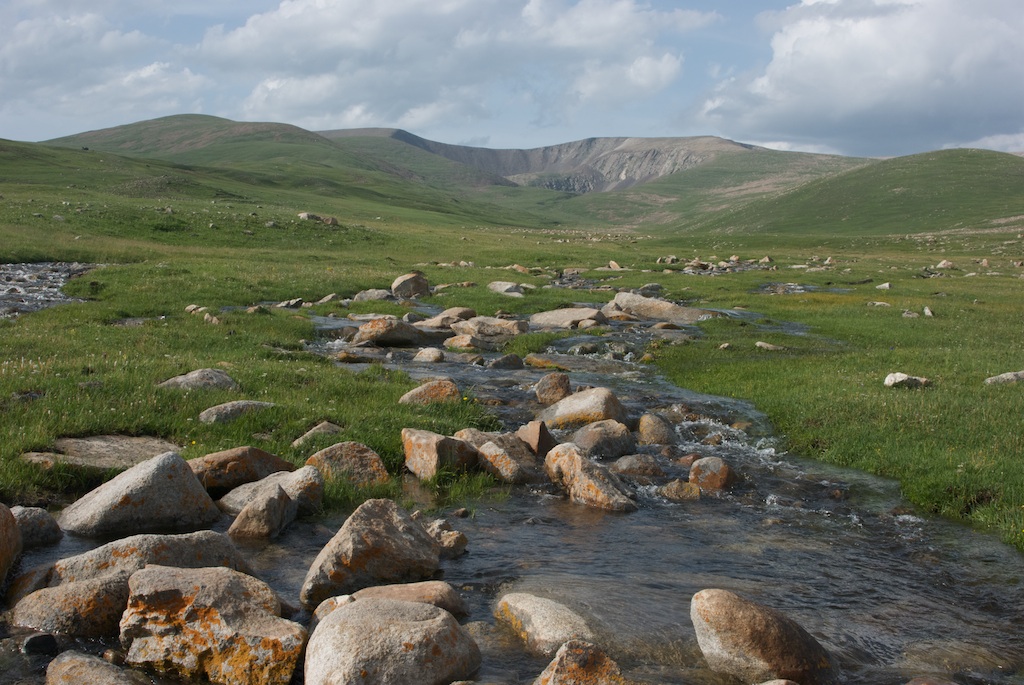
 

One of the rivers


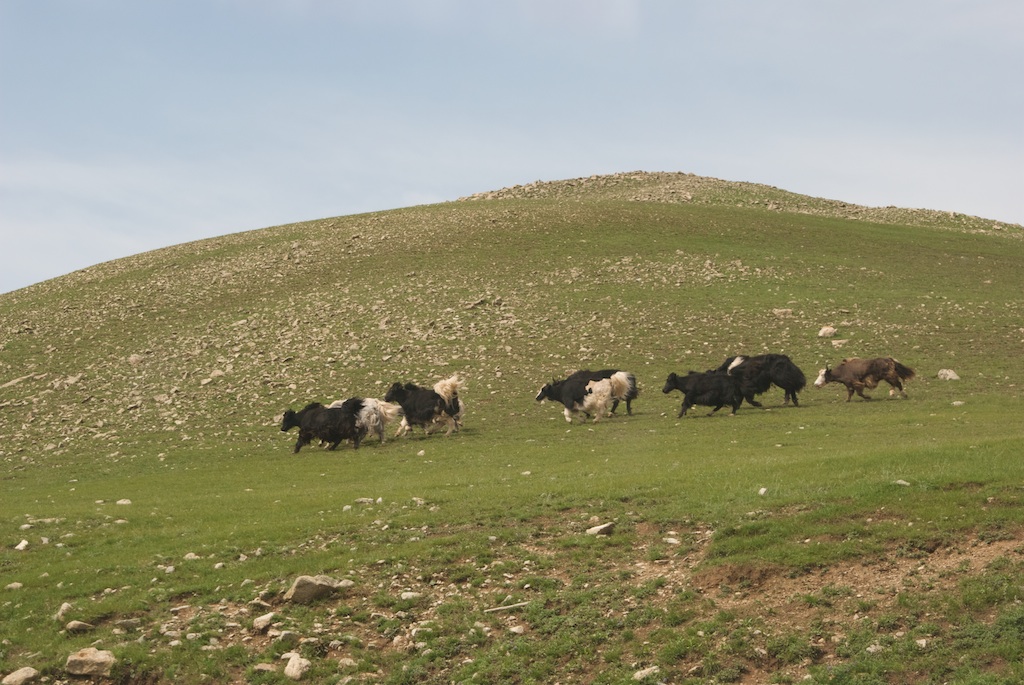
We re-traced our route back down the valley. On the way, we stopped for more yak photos. I had, not unreasonably, thought that the bigger ones with horns were the bulls. Then I saw an actual bull. He was absolutely huge and had no horns. The herders remove them because, armed with what are essentially two long, sharp spikes, a bull yak would be a very dangerous animal to have around.


Bull yak on right


Yaks, gers, windmill, car


The gelded yaks, like the ones above, are called “shar”, Mongolian for “yellow”. It seems to be the term applied to any gelded livestock. I don’t know why yet.

We also passed a number of herds of horses. It looked like the airag supply was good.


Horses


Back out of the valley, we passed this little riverside drama, but didn’t stay to see what happened next.


Someone made a poor decision


We drove past a family who was setting up housekeeping. I thought this was a good photo of a ger without the felt covering, plus, what a lovely spot to live!
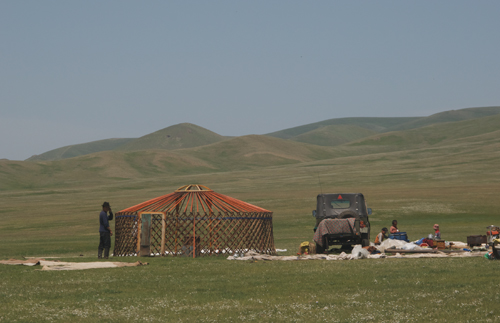
 

Soon to be home, sweet home


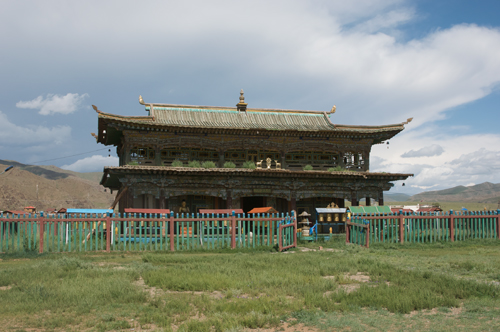
We also went by this small monastery, located outside of a soum center.


Small monastery, with stupas


Continuing on, we were soon going up in elevation and I started to see forests for the first time. We stopped for lunch on a hillside covered with wildflowers.
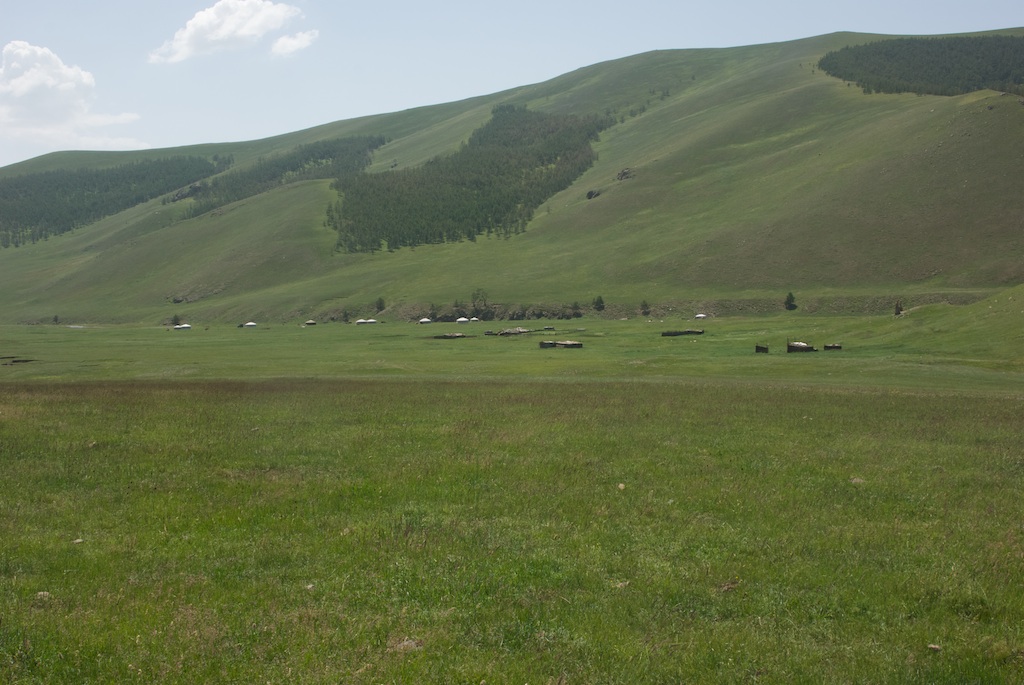
 

Lunchtime view


Next week: wildflower heaven and a famous waterfall.
Mongolia Monday: The Best Camping Trip Ever, Part 7 – A Quieter Day, But One With Its Own Rewards

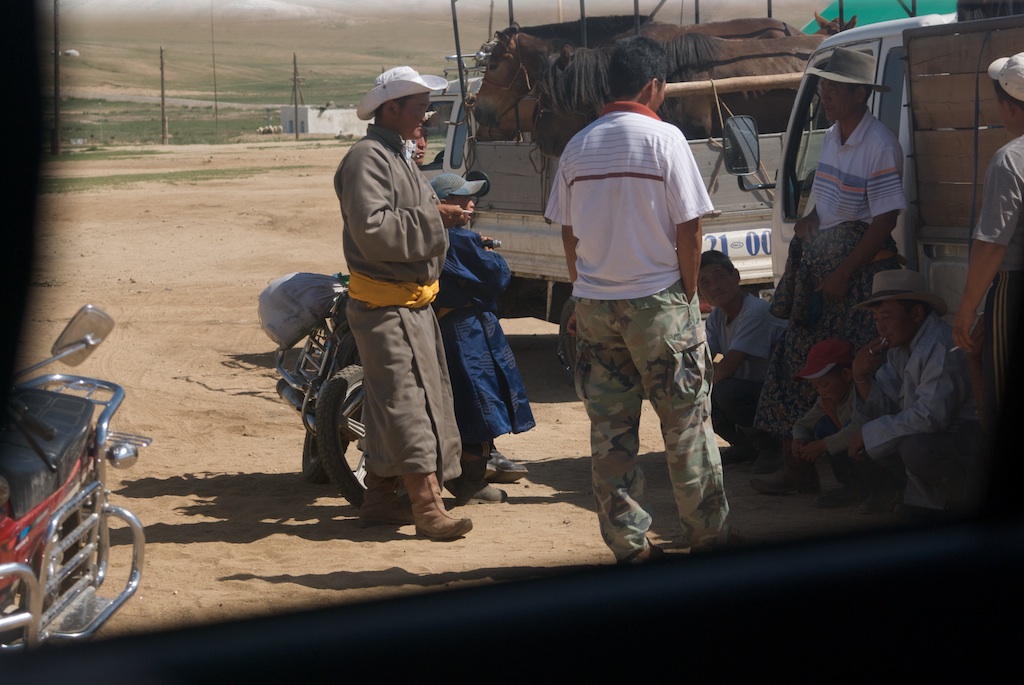
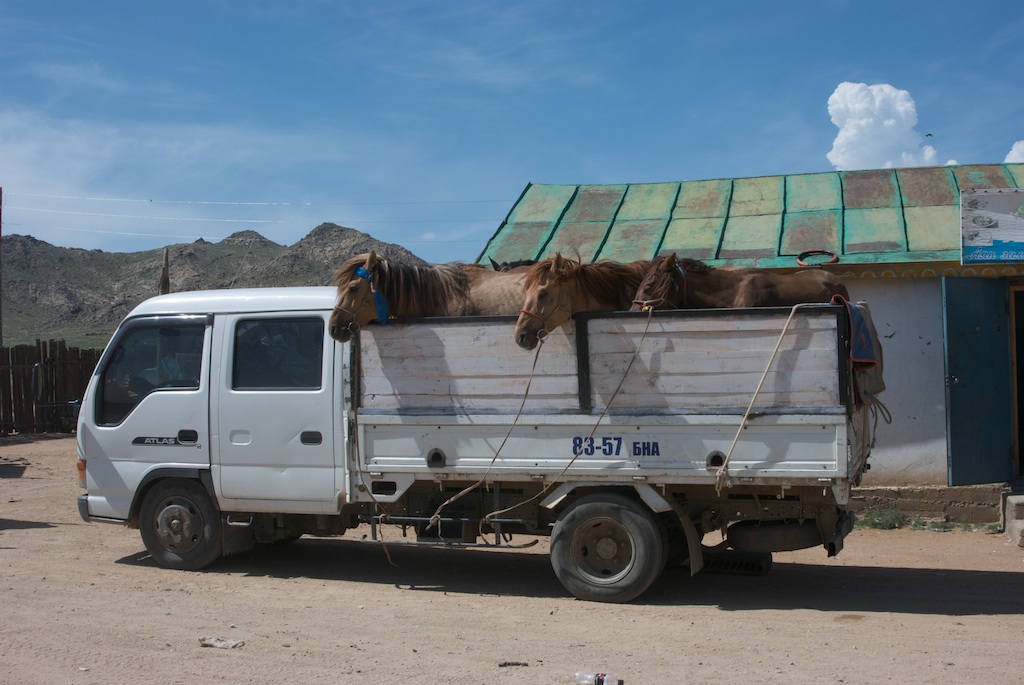
We came south down out of the mountains and into a small soum center, stopping at a petrol station. There was a truckload of horses parked near us and Khatnaa spent some time chatting with the men while I snuck a few photos from inside the car.

Horse transport, Mongol-style
Khatnaa chatting with the herders

Our next stop was in front of a fenced compound, which turned out to be the home of Khatnaa’s cousin and his family. We spent a few hours visiting them, being fed a feast of airag, buuz and other goodies. Since this was a very special social stop, I left the camera in the car. Not only did it seem inappropriate to even ask to take pictures, but I’ve found that sometimes I simply want to fully be a part of whatever is going on and using a camera creates a barrier that makes me an observer instead.

We finally went on our way, richer by a container of fresh, delicious airag.

It was fairly late in the afternoon by the time we left, going north back into the mountains. We crossed over a pass and on through a valley, finally stopping for the night on an open slope. The next morning we were visited by a young local herder, who was obviously nervous, but unwilling to pass up a chance to meet us. He did seem to have a quiet, confident way about him and I asked Khatnaa to ask him if he had been a jockey in naadam races. And the answer, as I expected, was “yes”.

View from our campsite, with yaks

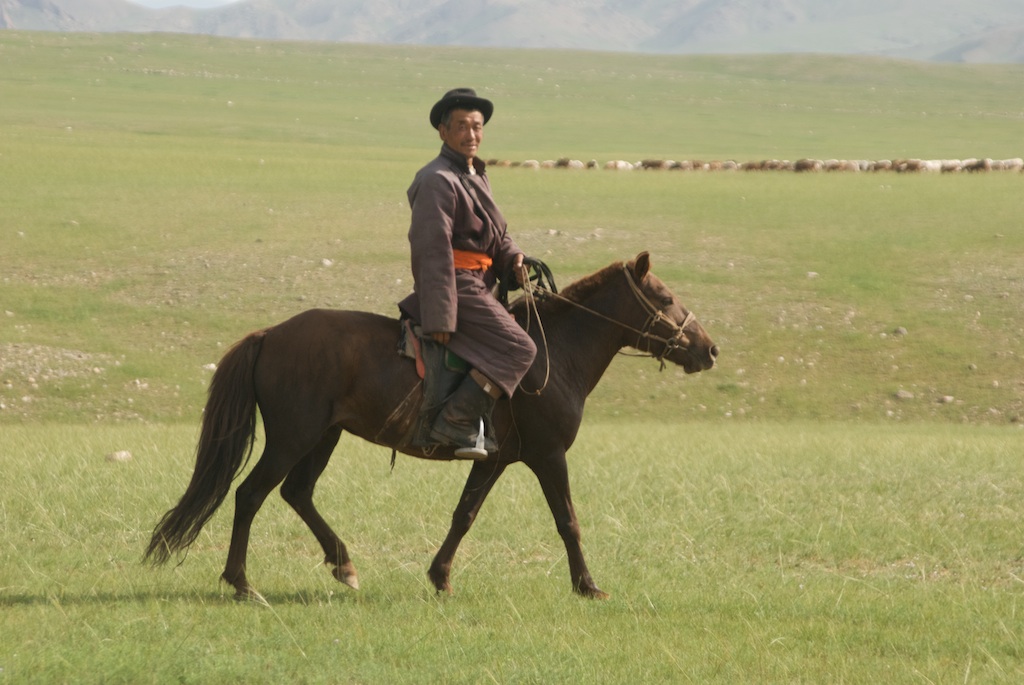
There were small groups of horses and yaks around, so I got some good photos just sitting in our camp. Then a well-dressed older gentleman rode over to us and stopped for a chat. He really was the quintessential Mongol herder.

Local herder

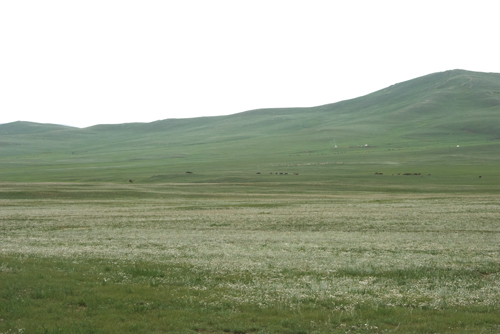
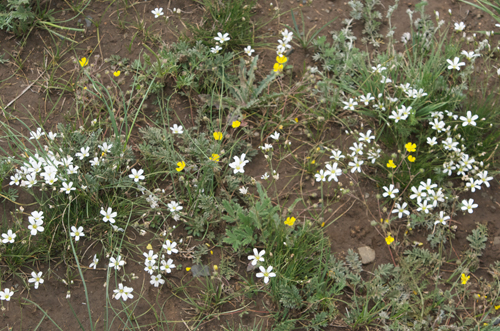
We finally got all packed up and on the road, crossing a river as we drove up a beautiful green valley. But suddenly, the green turned white. Khatnaa stopped the car immediately and I saw that the ground on either side of the car was carpeted with tiny white flowers. We got out and took in the beauty of the scene. Khatnaa spoke with Soyoloo and then said to me in English that it looked like the very first light snow in October and one didn’t see this large an area of the flowers very often. Even though it was cloudy, the fields had an airy, delicate quality which was quite magical.

Carpet of white flowers
Close-up of flowers; don't know the species

Our next stop was at a small temple which stood on the outskirts of a soum center. The statue and offerings on the inside were quite extraordinary, at least to me.

Temple on outskirts of soum center
The occupant of the interior of the temple, with offerings

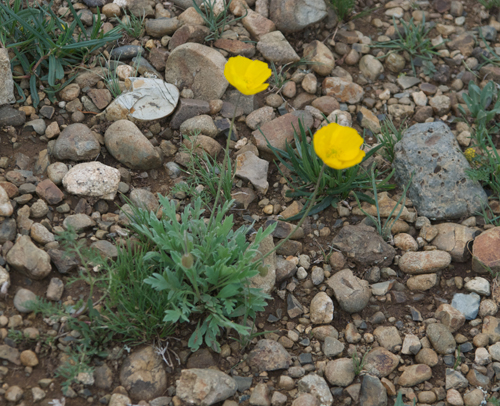
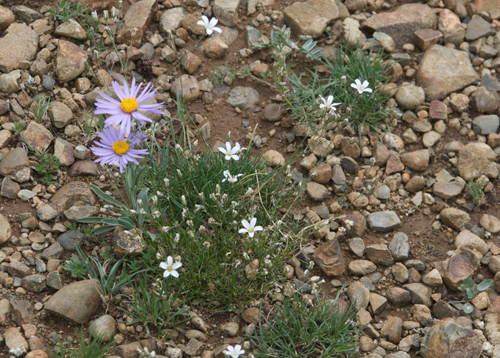
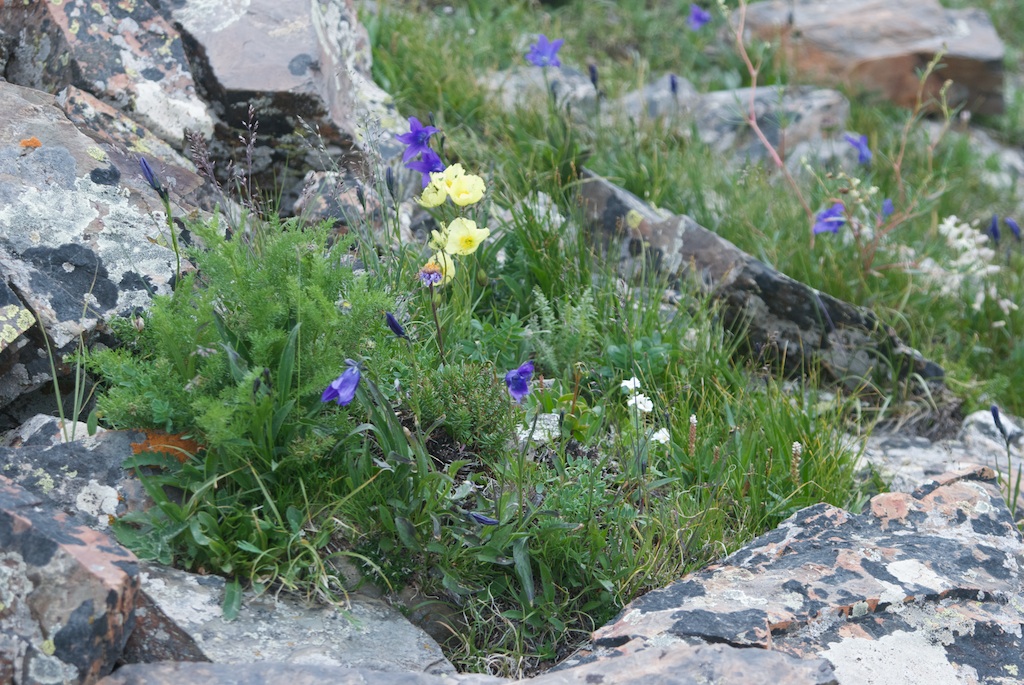
Driving on, we were soon going up in elevation again, stopping for lunch at a turnout in the road that, at first, looked good simply for its lovely view. But once out of the car and walking around, I found that we were in the middle of an alpine rock garden, filled with delicate flowers, like yellow poppies, which were delightful miniatures of the kind one finds in western gardens.

Lunchtime view
"Rock garden"
Miniature yellow poppies
Asters and unknown white flower

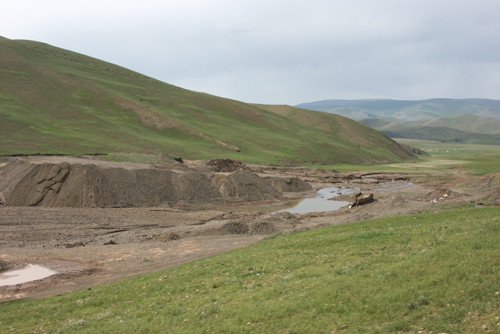
Coming back down into a valley filled with gers and livestock, we passed the remains of one of the illegal “ninja gold mines” that are disfiguring the Hangai Mountains. These mines have also affected the run-off which fills lakes like Orog Nuur, causing them to be dry now, more often than not. Very sad in a country that has traditionally had such a strong land ethic. But understandable when there are not enough jobs and people have families to support.

Illegal gold mine

As we continued on, we saw two young men on horses riding in our direction. We stopped and Khatnaa got out to chat with them while I took photos from the car (do you see a pattern here? :0) . I don’t know where they were going, but they were all dressed up and looking good.

Local lads

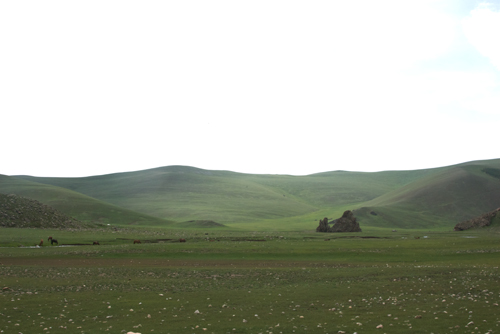
We continued on into the valley and a huge freestanding rock came into view.

Another river to cross
As we came around the bend...

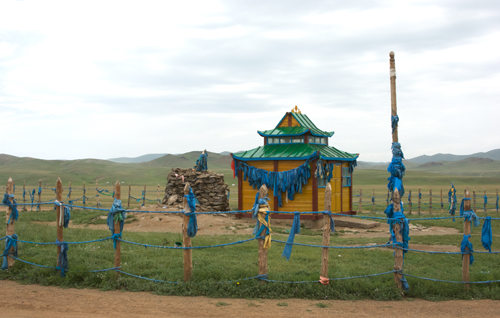
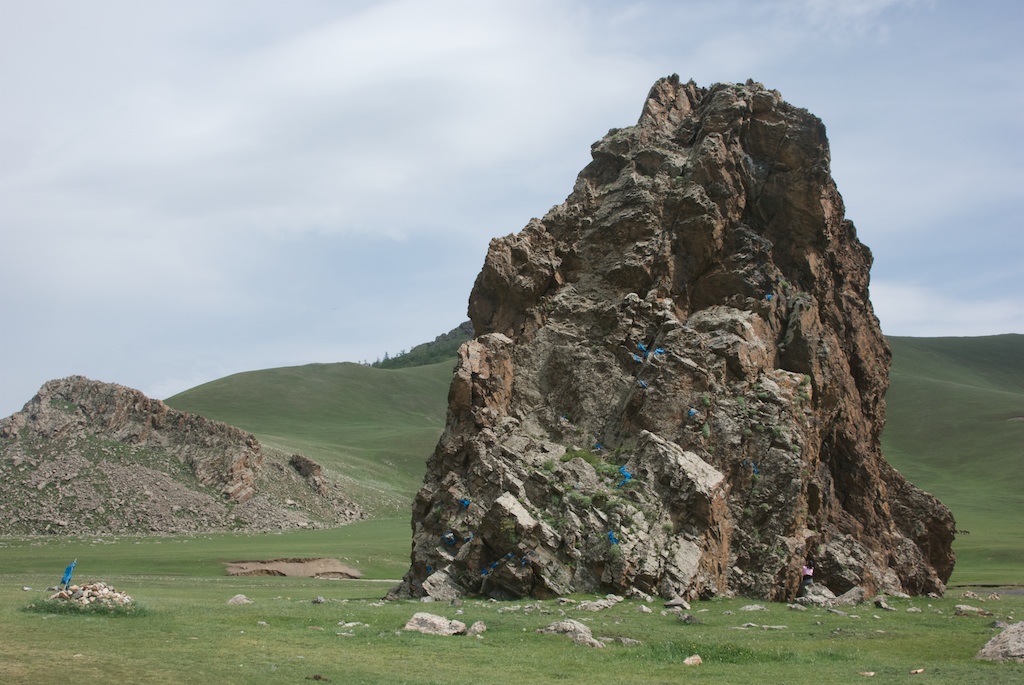
Driving up to it, I could see that it was festooned with khadak, the ceremonial blue scarves. We stopped for a short time, walking around it.

Sacred rock (I didn't get its name)

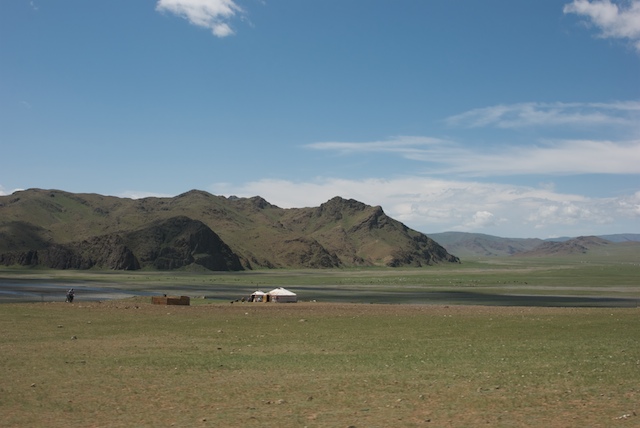
As it turned out, just past this local sacred landmark was what I will always think of as the “Valley of the Yaks” and which I think is one of the most beautiful places I saw on my trip.

Mongolia Monday:The Best Camping Trip Ever, Part 6 – A “Very Local Road” To The Shargaljuut Mineral Springs Resort

As I wrote last week, we had decided to leave the Ganchen Lama Monastery at Erdenesogt and go on to the Shargaljuut Mineral Springs Resort. Our route took us up a beautiful valley of green hills, gers and…yaks!

Domestic Mongolian yak

Mostly they were just wandering around grazing in small groups, but we also happened upon a young boy carrying out his herding duties.

Yak herding

The herder’s gers were scattered along the river which wound through the valley. We were, by now, well off the usual tourist routes, traveling on what Khatnaa said were “local roads”. Indeed. We were almost the only moving vehicle I’d seen all day.

Setting up housekeeping, Mongol-style

Khatnaa stopped at a number of gers as we moved up the valley, including the one below, to ask directions. The situation we’d found ourselves in was that the recent storms, which caused the flooding of the rivers down south in the Gobi, had also washed out a number of bridges in the mountains and therefore, to get to our next destination, we would have to retrace a lot of our previous route back south down the valley, then do a 70km loop to the north where the resort was located. Since one can often only travel a distance of around 100km in a day, this was a long detour. He had been told at one point, however, that there was an alternate, more direct route. We pulled up to what turned out to be one last ger and Khatnaa got out and spoke with the herders.

Ger we stopped at before the fun began

He got back in the car, turned to me, smiled and said something I’ll remember for as long as I have two brain cells to rub together, “Now we will go on very local roads”. He turned the car to the east and headed up a slope that looked no different than any of the others that we had passed.

Looking up at the "very local road"

We went higher and higher, leaving the river valley far below. There was definitely an earth road, more like an earth trail actually, but it sure didn’t look like it got much use. Was I having fun yet? You bet!

Tuy Gol valley, looking back toward the direction from which we came

Up and up we went, passing interesting rock formations, until we reached Hujirt Pass which, of course, had a ovoo.

Ovoo on Hujirt Pass

We now started going down, down, down, surrounded by wonderful scenery. There had been storm clouds to the west and north most of the day, but the weather was fine along our route. No problem, right? Well…..

Coming down out of the mountains, looking north

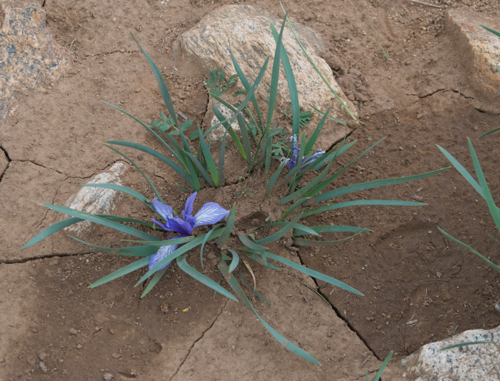
We reached the river valley and I could see the road we hadn’t taken on the other side. Then I spotted something I’d never seen in Mongolia…wild iris. I asked Khatnaa to stop and jumped out to take some photos.

Wild iris

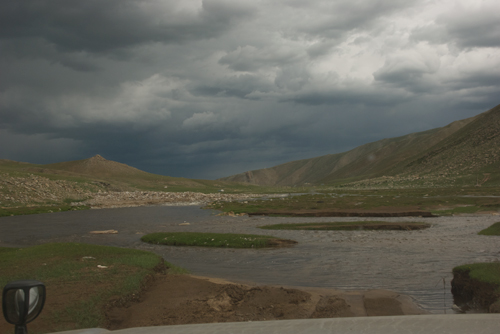
In less than a minute, he leaned out and told me that I must get back into the car and when I had, explained that the rain we saw in the distance could cause the river to rise very quickly and that we had to get across it. Now.

When there's no bridge available....

And, as it turned out, there wasn’t just one channel to cross, but three or four. I kind of lost count.

The final water crossing. Our destination is in the distance. Notice the grey Russian fergon van on the road, middle right

Picking his spot, Khatnaa got the Land Cruiser up onto the road and we continued on to the mineral resort as it got darker and the wind started to kick up.

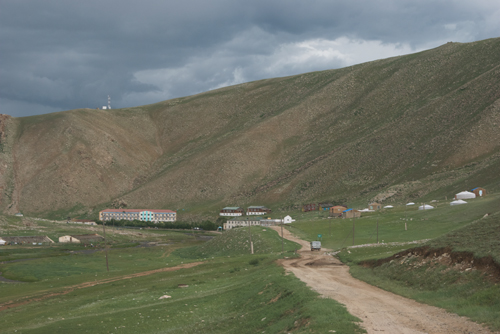
Shargaljuut Mineral Springs resort; well-known in Mongolia

Although this was a camping trip, Khatnaa decided that, for this night at least, we would see if we could stay in the ger camp. He was concerned about the storm and how high the water might get. No argument from me, that was for sure.

We were able to get two gers, one for me to stay in and one for Khatnaa and Soyoloo that also doubled as our “kitchen” and “dining room”. It was a pretty wild and rainy night, but the next morning was fine. And, to our amusement, we found that the Rimpoche we had decided not to worry about seeing at the Gachen Lama Museum was staying at the resort!

View from the ger camp, looking up the valley; thermal springs are on the left side of the river, reachable by a foot bridge

We still never got to see him since it turned out that he skipped breakfast and left early for the monastery, but I did end up having a nice chat with a Mongol man who had called out to me in perfect California English “Where are you from?” when I stepped out of my ger with a cup of coffee. It turned out that he was a famous wrestler who had retired with the rating of Garuda and was now a businessman living in the San Francisco Bay Area. Khatnaa knew who he was and, of course, we had to have our picture taken with him. He was on vacation, he said, and was volunteering as a driver for the Rimpoche and his entourage.

The next great thing that happened was that we got to take our first showers since we were at the Onglyn valley in the Gobi. We had to wait our turn in the very busy sanitarium, but it was worth it. If there were any other Westerners anywhere around, I never saw them. Just the way I like it.

Before we left, we walked across the bridge and explored the thermal area. The different springs have different mineral content and are used to treat specific ailments, some physical, some mental. One consults a doctor before beginning treatment.

Thermal area

Our departure from Shargaljuut was much less eventful than our arrival. A short way down the road, though, we came across evidence of how powerful the storm run-off from the mountains can be. Just to the left is the “detour” across the now dry riverbed.

Badly damaged bridge; other pieces were strewn around nearby

Here is what it would have looked like before the flood. All but a couple of the bridges I’ve crossed in my travels have been built this way, out of logs and lumber.

Intact bridge

Where were we going next? I had no idea, but I knew it would be worth the trip, so I simply kicked back and enjoyed the scenery.

On the (Earth) Road Again

Mongolia Monday: The Best Camping Trip Ever, Part 5 – North To The Hangai Mountains, Bayanhongor, Gachen Lama Monastery

While our original intent had been to spend two nights at Orog Nuur, the combination of heat, mosquitos and there being very few birds around in the morning caused us to decide that we would travel on north instead.

After having lunch on the north side of the lake, where we did see some shorebirds and demoiselle cranes, we worked our way through heavy vegetation on a really rough earth road to get to the main route to Bogd, a soum center, where we re-filled our water containers from the local well.

Shorebirds, Orog Nuur
Demoiselle cranes, Orog Nuur

Then it was up and away from the Gobi toward the Hangai Mountains, another part of Mongolia that I had never seen before.

Ovoo with a Soyambu, the National Symbol of Mongolia; very unusual

We stopped for the night a short way off the road, after having passed through three changes in vegetation as we went up in elevation. It was cold and windy, quite a change from our previous campsite by the lake, but I slept well.

Upland campsite, with visitor

The next morning we drove into Bayanhongor, an aimag center which was quite a substantial town. We trekked around town buying petrol, eggs, bread and meat. It was an energetic, busy place which had nice tarmac paving in the central area.

Bayanhongor comes into view, backed by the Hangai Mountains
Horse-drawn water delivery service, Bayanhongor

On the way out of town we found that the road Khatnaa wanted to take was washed out by the recent flooding. Consultations with a number of locals ensued and an alternate route was found. And what a route it was!

Perfect scene- an earth road leading deep into the Mongolian countryside
Tuy Gol valley
Tuy Gol valley
Yaks, horses and gers; it must be Mongolia!

Our destination was the soum center of Erdenetsogt, home to the Gachen Lama Monastery, neither of which I had ever heard of, much less knew anything about.  The soum center was typical, except for the lovely setting above the Tuy Gol. The monastery was anything but, as you will see below.

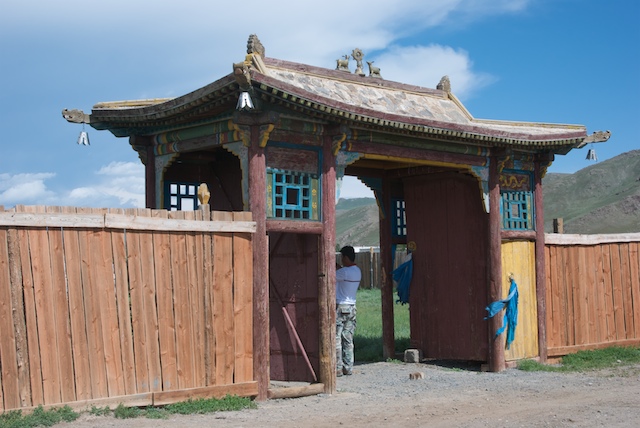
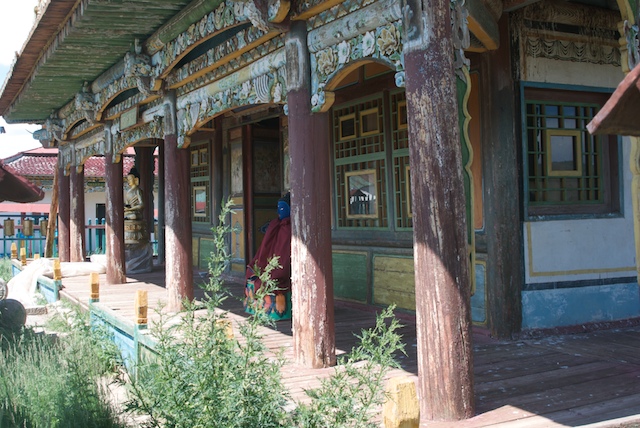
This is one of the most jaw-droppingly beautiful buildings I have ever seen. And what makes it almost unbearably poignant is that it is the sole surviving structure, other than the entry gate, that is left on the site from the destruction of the monasteries that took place in the late 1930s. There were originally ten temples.

The entry gate
Gachen Lama Monastery, old temple

But today the monastery is alive again and it was bustling with activity when we were there in anticipation of a visit the next day by a prominent Tibetan Rimpoche (teacher), who was going to preside over the dedication of two new statues that were to be installed in the new temple next door, which was built in 1990, making it the 20th anniversary celebration.

Temple porch with the two new statues

The old temple was filled with people, many of them elderly women wearing beautiful brocade del. Upon entering, we found that they were preparing hundreds and hundreds of printed Buddhist sutras which were to be placed in the statues. There was a real assembly line going. Some monks were rolling the small strips of paper up very tightly. These were handed to the women who then wrapped them in sewing thread. After a few minutes of watching, Soyoloo reached down, picked up three of the rolled sutras and handed one each to Khatnaa and I, keeping one for herself. Then she got us each of spool of thread. Suddenly we weren’t on-lookers anymore, but participants, truly a gift. We each conscientiously wrapped our sutra and added it to the growing stack. Amazing to think that I’ve left a little bit of me in such a special place.

Preparing for the Rimpoche
One of the two statues
The new temple, just past the row of prayer wheels

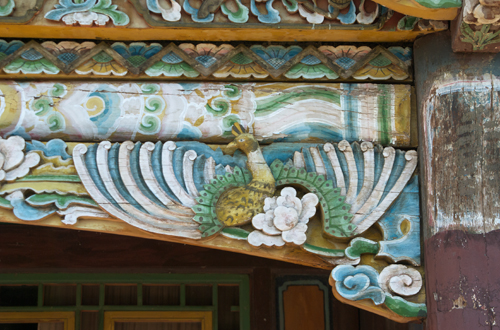
As an artist, the temple was pure eye-candy, being covered with a riot of decorative carvings and paintings on almost every surface. Stylistically it is probably mostly Tibetan, with some Nepalese influence. I’m posting most of the best images I took because when I googled the monastery, I got no hits at all and this place is too special to not share.

Peacock detail,, old temple
Unknown deity or creature, old temple
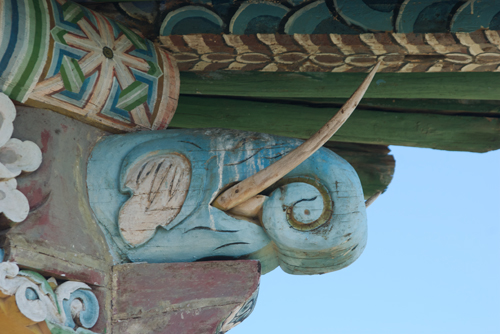
Elephant at corner; for strength- old temple
One corner of old temple; the fretwork gives this large building a delicate, airy feeling
Gachen Lama Monastery; the old temple

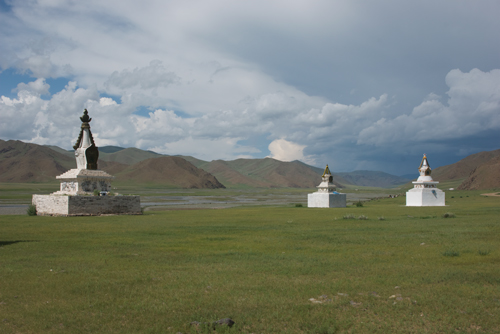
After we left the monastery grounds, we walked toward the river to see the seven stupas which overlook the river valley.

Three of the stupas; cue Jantsannarov’s “White Stupa No. 1”

This seems to be one of the most beloved pieces of music in Mongolia. I love it, too.

We debated whether to stop here for the night in the hope of seeing the Rimpoche the next day. But we really had no idea when he would arrive and were a little uncomfortable being conspicuous as the only non-locals around, so chose to travel on. And that resulted in one of my favorite parts of the entire trip.

Mongolia Monday: The Best Camping Trip Ever, Part 4 – Crossing A Flooded River, Visiting A Camel Herder’s Ger, Arriving At A Remote Lake In The Gobi

I think that in order to communicate with some immediacy one single day that had enough incident for three, I’m going to simply quote my journal entry for July 15, adding images as needed.

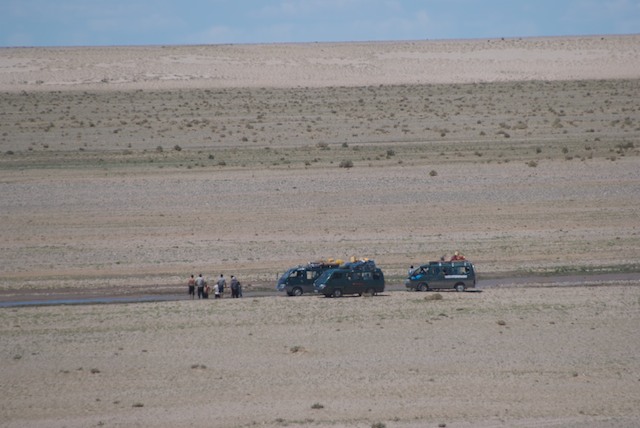
“What an amazing day. Went south-west with Orog Nuur as our goal. Khatnaa knew there was the Taatsin Gol to cross, so stopped at a petrol station to ask about it. Also there were two van loads of Mongols from Togrog who were heading west to mine for gold. Usual Mongol socializing and information exchange ensued.

A third van showed up and all headed towards the river, which was flooded due to rains in the Hangai Mountains.

Assessing the situation

We got across one stream, but were stopped by a broad ribbon of streams and mud. The main channel was moving fast and pulsing with even more water.

Went back up to the bluff overlooking the river and had lunch, watching the three van loads of Mongols look for a way across and mess around in the water.

Lunchtime for us

Went back down to the river. Khatnaa walked a long way to see if he could find a crossing point, but came back and told us that the last stream of water was the worst of all. So we were faced with going north 100 km to the closest bridge. Such is travel in Mongolia.

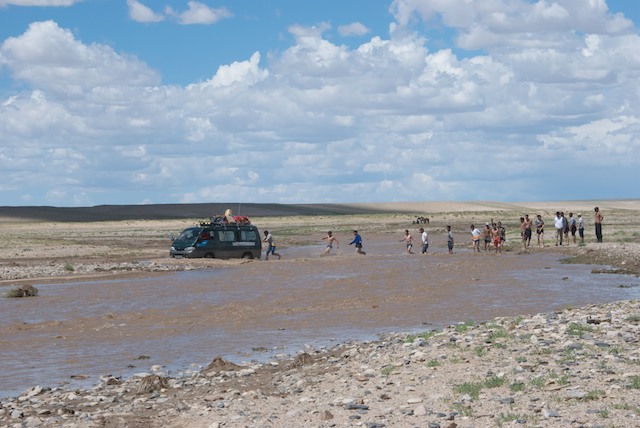
Suddenly, there was action with one of the vans. A bunch of guys had formed a line across one point of the main channel and the van charged into the water, started to stall, but the guys all got behind it and pushed it on through!

First van crosses the river

Well, if a van could make it, our big Land Cruiser certainly could and did, without even needing a push. We did end up with an extra passenger, a little eej (mother) who wasn’t about to miss her chance to ride in our big car.

Our turn. Halfway across.

We got out on the other side and I photographed the other two vans making the crossing. Then said our good-byes.

Third van goes into the river.

We followed one van up a soft sand slope. It promptly got stuck so we rolled back down and went around it and on up the hill.
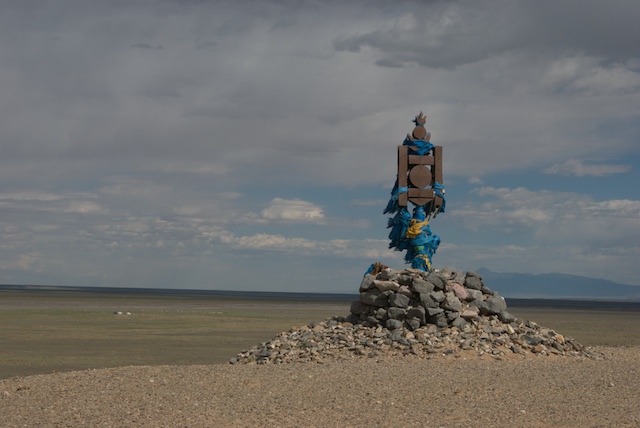
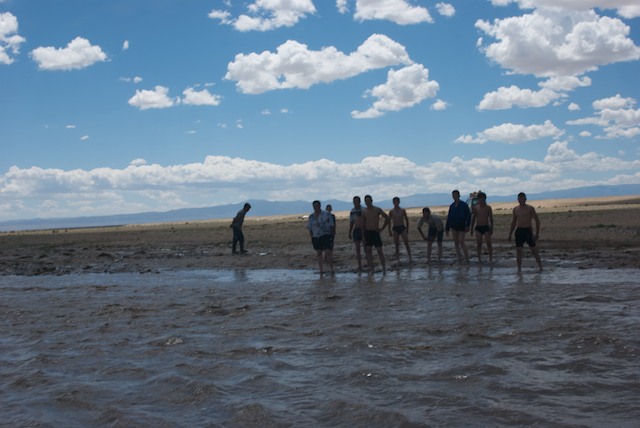
The entire “adventure” of the river crossing was a perfect example of Mongol practicality, improvisational skills and good humor. No one at any point got angry, showed frustration or swore. When it looked like things had stalled out, the guys took a break and goofed around in the water. Or so it seemed. They were clearly having fun but they were, in retrospect, also searching for a crossing point.

The spot they found was one where the channel wasn’t too wide or deep and where they felt the bottom was solid enough for a vehicle to get across with a minimal chance of getting stuck.

Without winches, cables or even rope, they simply used the same solution they always do – push.”

——

Once across, we were really able to roll for awhile on good earth roads.

At this point we knew that the lake, Orog Nuur, was 2/3 full and that the river flowing into it was impassible due to run-off from the mountains. But we had also been told that there was a road on the opposite side of the lake.

Khatnaa spotted a ger and drove over to it. I usually just stay in the car while he asks directions, but his time he gestured me to get out and said “Let’s visit.”

We ended up spending around two hours with Batsuuri and his family.

When we entered their large, comfortable ger, the first thing I noticed was two boys sitting on the floor watching Star Wars:The Phantom Menace on a small flat screen tv. Batsuuri was sitting on the floor, a couple of older girls were going in and out and Javhlan, his wife, was just starting, I found out later, to make suutai tsai (milk tea). I’ve drunk a fair amount of it by this time, but had never seen it made before.

A bowl of small squares of fried bread and sugar cubes was placed in front of us. The movie ended and the two boys, both Mongol but one had blond hair, started playing with a bunch of nails they had pulled out of a bag. I watched them happily amuse themselves for over half an hour, arranging the nails in various patterns and finally using a closely lined up row of them as a little hammered dulcimer.

At one point a wrestling competition came on the tv and I knew that we were going to be staying for awhile because Khatnaa is a BIG wrestling fan.

Javhlan asked if we would like to try camel milk airag. We all said yes. It was delicious, of course.

As we sat, and Khatnaa and Soyoloo chatted with our hosts (Besides camels, they have about 300 other animals. They lost 10-15 in the zud, nothing, really.), Javhlan made a meal of rice with meat in it and we ended up having dinner with the family.

Then it was time for her to milk the camels. They have 40 camels, seven of which had babies. So I found myself with another amazing photo opportunity.

Javhlan milking one of the camels

I was wearing one of (local Humboldt County artist) Bekki Scotto’s hand-dyed rayon t-shirts and had Khatnaa take some pictures of me standing in front of the camels. I think Bekki will like that.

Soyoloo, our great cook, and I

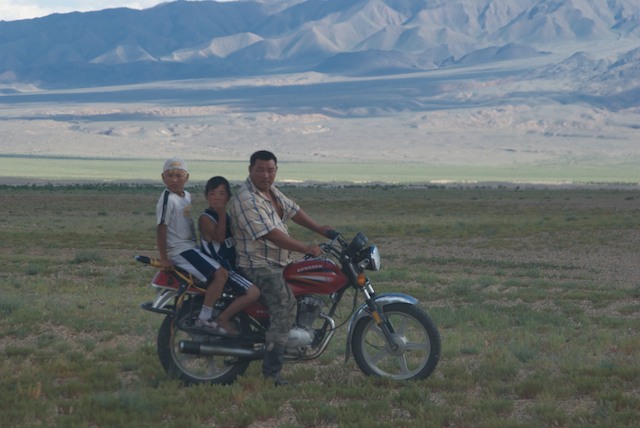
Once the milking was over it was time to leave, but it turned out that there is more than one road around the lake. Batsuuri offered to take us part of the way on his motorbike. Khatnaa provided petrol from a jerry can he had in the car. They had almost finished syphoning when who should pull up but one of the three vans! They had taken the main road to the river, found it flooded and had come back to the only ger for miles to find out if there was an alternate route, so Batsuuri showed them the way also. Once he’d gotten us to the correct road, we waved goodbye and drove on into a large saxaul forest, much of which was in light, almost white, sand. Many stops for pictures. And berries!

Batsuuri shows us the way around the lake
The saxaul forest
Edible berries in the Gobi

Finally we could see the lake, Orog Nuur, in the distance. The passing clouds were creating gorgeous spotlite areas on the mountain range to our left.

Ikh Bogd Uul
Ruddy shelducks, Orog Nuur

We made one more quick stop at a herder’s ger and then found a track down to the lake. We parked, got out, walked down to the shore and Khatnaa announced that we had arrived at “bird heaven”. Indeed.  The shoreline had birds from one end to the other. The lake edge had even more mosquitos. I observed that it looked like we had also arrived at “mosquito heaven”, which Khatnaa thought was pretty funny.

But we sure weren’t going to be able to camp there. So we moved away far enough to be out of the worst of it, put on insect repellent that Soyoloo had handy and set up camp.

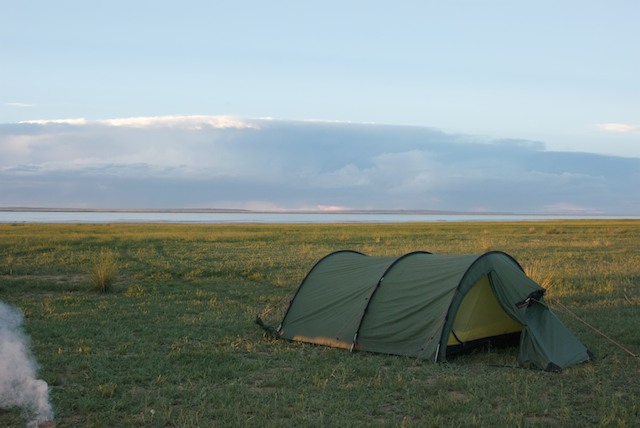
My tent with Orog Nuur in the background

It ended up being cook’s night off since we were all pretty full from the meal at Batsuuri’s. Lunch had been a delicious white fish from Khovsgol Nuur. We all had some leftover fish with rice and a few cookies and we were fine.

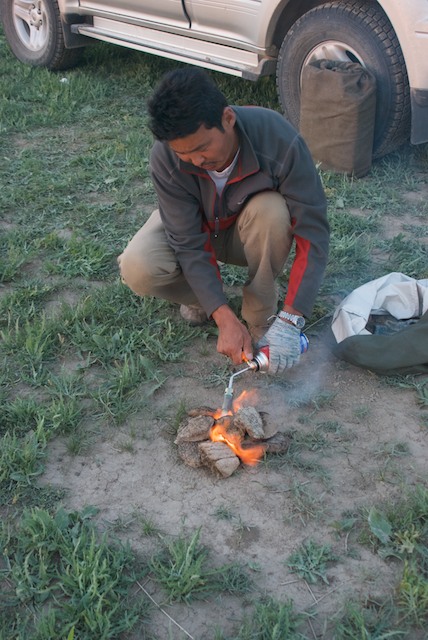
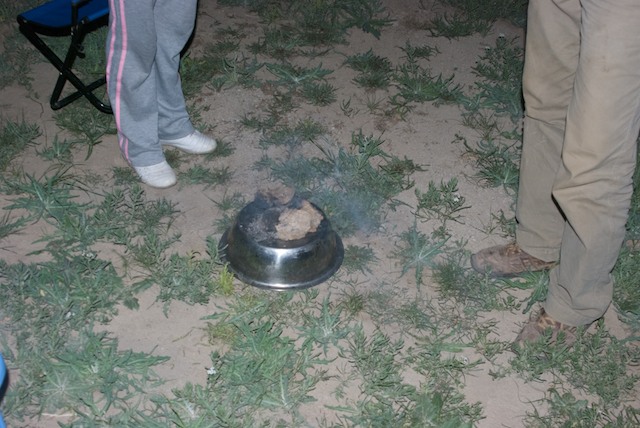
In the meantime, the mosquitos were getting pretty annoying. We had no netting, so , once again, Mongol ingenuity rode to the rescue. Khatnaa went out and gathered a small bag of animal dung which he piled up and set smoking with a small blowtorch. We put our chairs in its path. Problem solved. Until the breeze kept changing direction. Soyoloo came up with a brilliant solution. She turned a metal flat-bottomed bowl upside down and had Khatnaa got a small dung fire burning on it, which meant that instead of moving our chairs to stay in the smoke, we simply moved the smoke. We dubbed it our “nomadic dung fire”.

Setting the dung smoking
The Nomadic Dung Fire

We sat until dark, watching a lightning storm across the lake from us, a spectacular sunset to the north and listening to the Javhlan CD I’d brought from UB, finishing off the last of the bottle of Chinggis Gold vodka and chatting about all kinds of things. A perfect ending to a perfect day.”

Sunset at Orog Nuur, the Gobi

Location Sketching In Ulaanbaatar, Mongolia

This time I finally did something I’ve been wanting to do in Ulaanbaatar for my last couple of trips to Mongolia – sketch on location.

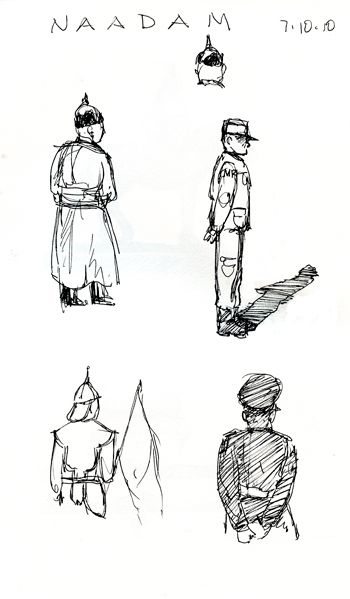
I got started right away since I had a couple of hours before I left for the countryside on July 10, having arrived on July 8. The Naadam celebrations had begun at Sukhbaatar Square, so I walked over from my hotel and did this page of quick studies.

Naadam 2010, Sukhbaatar Square

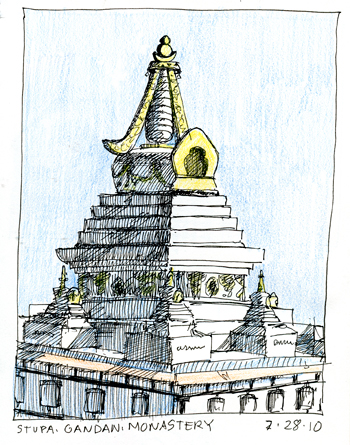
Back in UB after the camping trip, I met up with a new Mongol friend I had originally connected with on Facebook and we spent part of a morning at Gandan Monastery. It was fun to have a sketching buddy. He hadn’t drawn since high school, but must have still remembered something, because he immediately turned out some nice work.

I got an interesting comment on the stupa drawing. An older man came by, looked at what I was doing and told me, through my friend, that there HAD to be nine smaller stupa shapes below the main one. I couldn’t really explain that I simply couldn’t see them from the angle at which I was sitting, so just had to let him walk off in a minor huff.

Stupa, Gandan Monastery

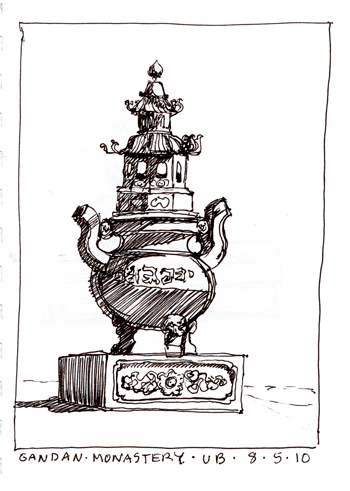
There are a number of these big (close to 8′ high) incense burners around the Monastery grounds. Visitors circle them while trailing a hand along the surface.

Large bronze incense vessel, Gandan Monastery

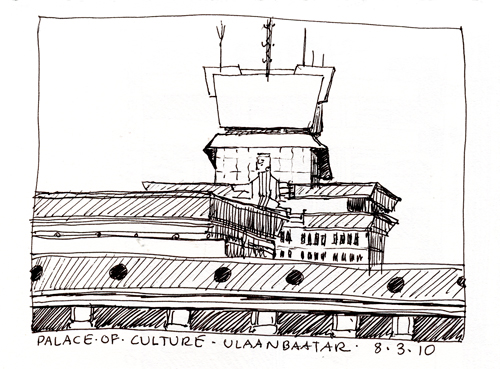
After I returned from the countryside, I went back to Sukhbaatar Square and sketched some of the buildings. The Palace of Culture is one of my favorites. The top of the tower is metallic gold and sparkles beautifully in the sunshine.

The Palace of Culture
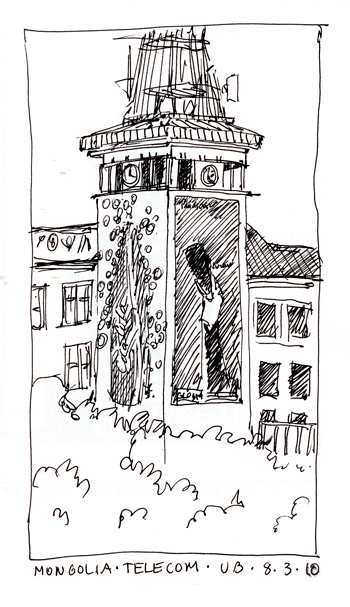
Mongolia Telecom

I started to draw some attention at this point, particularly from a nice young man who wanted to practice his English, and had to give it up. Yes, that’s a giant Coke bottle on the left hand side of the building.

I also went back to Gandan Monastery for another morning of sketching. This time I tried adding some color with my water-soluble colored pencils.

Gandan Monastery

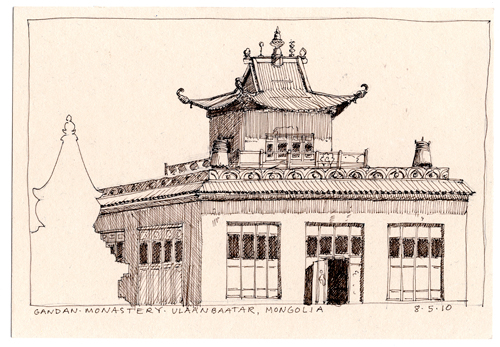
The preceeding sketches were all done in a small Strathmore premium recycled sketchbook. But I also wanted to experiment with working on location on toned paper. These were done during the second stint at Gandan Monastery and also at the Museum of the Chojin Lama. I never do architecture, really, so it was a challenge to try to keep things in reasonably decent perspective. On the other hand, unlike animals, the buildings, at least, don’t move.

Gandan Monastery temple
Museum of the Chojin Lama temple gate

Next Friday, I’ll post more drawings, this time from the journal that I kept during the trip. Dogs, dinosaurs, the desert and…..

Mongolia Monday: The Best Camping Trip Ever, Part 3- The Gobi, Gempilarjaalin and Onglyn Monasteries

Leaving Baga Gazriin Chuluu meant that I was now traveling south into a part of Mongolia that I had never been to and really knew very little about. Perfect.

Our first stop was in the soum center of Erdenedalay, home of the Gempildarjaalin Monastery, which was built in 1910. The main temple survived the destruction of the late 1930s and there are now ten monks in residence.

Gempildarjaalin Monastery
Gempildarjaalin Monastery interior

Our road then continued out across the Gobi. The landscape was rolling and surprisingly green. We could see a storm front with rain off to our right.

Earth road in the Gobi

Our final destination for the day was the river valley of the Onglyn Nuur (River), which is also home to the ruins of Onglyn Monastery.

Onglyn Nuur valley

Khatnaa and I went for a birding walk in the early evening and saw some hoopoes, one of the most elusive birds to get close-up photos of.

Hoopoe

The next morning we walked the short distance to the monastery ruins, which were actually two separate establishments, one founded by a prominent lama in the 1760 and the other by one of his students in 1800.

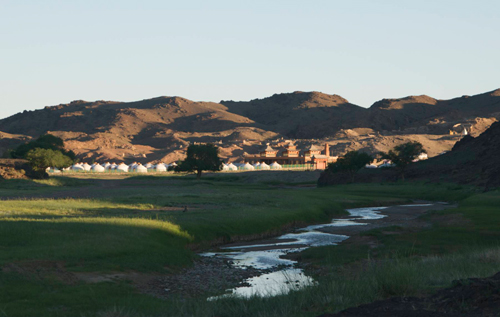
Tourist ger camp with ruins behind it on the hillside

They were two of the largest monasteries in Mongolia, capable of housing up to 1000 monks. All the buildings were destroyed in 1937. Two hundred monks were killed. Many were put to work for the communist government. Some escaped by becoming farmers.

Ruins with sacred spring

A new, small temple has been built and there are now some monks in residence at the site again. There are also ambitious plans to re-build a major temple.

Small temple interior
The main altar

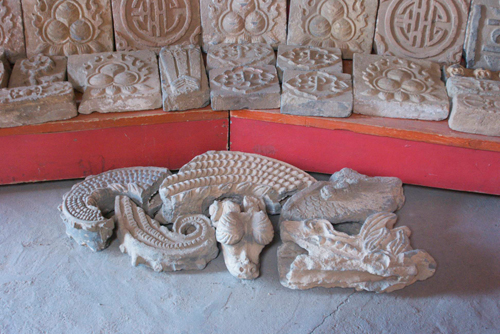
Not far from the temple is a ger which houses a small museum of artifacts that have been recovered from the ruins. I found it very poignant. So much beauty, wantonly destroyed.

Decorative stone work recovered from ruins
Wood beam with raised decoration
Khatnaa speaking with the museum host

On a happier note, we stopped in at the Secret of Onglyn ger camp and Khatnaa arranged for us to take real showers! It being the morning and the water being heated via a solar system, they were going to be cool, not hot, but it really felt good to remove a few layers and get my hair washed.

Back on the road, the green had disappeared and become the almost bare, gravelly ground that the Gobi is known for. We also drove up and over rock formations that reminded me a little of those at Ikh Nartiin Chuluu.

Rocky upland area

In the late afternoon, we stopped at a town called Guichin Us to re-fill our water containers from the well. This became a regular feature of the trip, stopping at a local well for water, which Soyoloo then boiled so that we could use it for drinking.
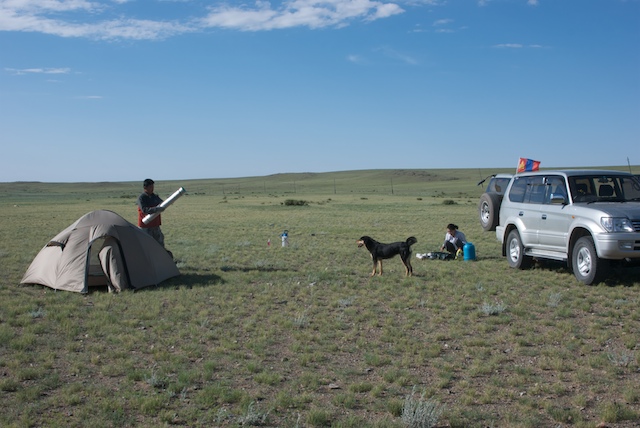
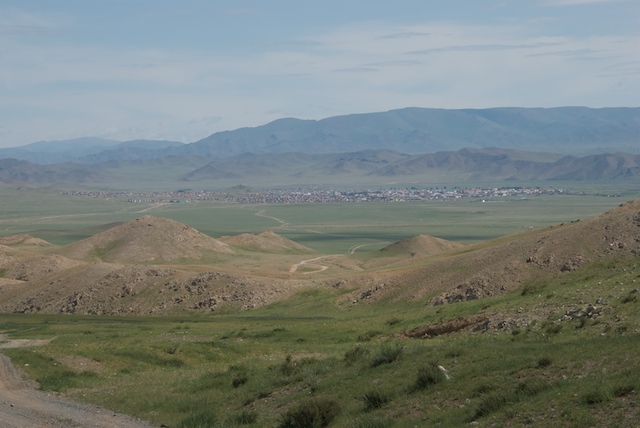
Water refill from a town well

We drove a few kilometers out of town, onto the open plain and stopped for the night. One of the remarkable things to me was the spots that Khatnaa often chose for campsites. He almost never sought out a sheltered spot of any kind. What seemed to matter was having a slight slope so that if it rained, the water wouldn’t gather under the tents. So here’s my tent out in the “middle of the Gobi”, complete with my drying laundry. It was really, really quiet and we sat after dinner watching a distant thunderstorm, hoping that it was dropping badly needed rain on the land beneath.

My tent (with clean socks)

Next up:  crossing a flooded Gobi river, bactrian camels and “mosquito heaven”.


Mongolia Monday- “Ikh Nart Is Our Future” Update

I’ll get back to The Camping Trip, but I really want to share the news on the women’s felt crafts collective. Notice the change from “cooperative”. There are a number of words used in Mongolia for legally constituted groups, each of which has different requirements. I need final confirmation from him, but my scientist friend Amgaa, who has been instrumental in helping me help the ladies, believes that this is the correct term, which is almost surely a holdover from socialist times.

Stuffed toy camel in progress

I spent a fun and productive week at Ikh Nartiin Chuluu Nature Reserve. There will be more about my argali and ibex sightings in a future post, but for the moment I’ll just say that I finally, after five trips there, got the reference photos I’ve really wanted – both species in great light and close enough for me to really capture details like head structure. Paintings to follow.

I’ve been so anxious to see Boloroo, the collective director, the other women and to find out how things are going for them.

Boloroo and Tuvshin

I’ll quote from my journal:

Tuesday, August 10-
Great reunion with Boloroo and some of the other ladies. Learned that what started last year with 14 ladies from one Bag (the smallest administrative unit in Mongolia; “bag” means “small” in Mongolian) has now expanded to 30 members in four of the five bags in the soum (the equivalent of a county). Some of the new members came along and it was fun to meet them.

Tuvshin (Boloroo’s son, my little buddy from last year) is now a sturdy almost 2 year old. One lady who was pregnant last year came with her baby and husband, who brought a nice little ibex carving to sell. (I’ve got a probable donor for good quality steel carving knife blanks. I’d like to encourage the men, too.)
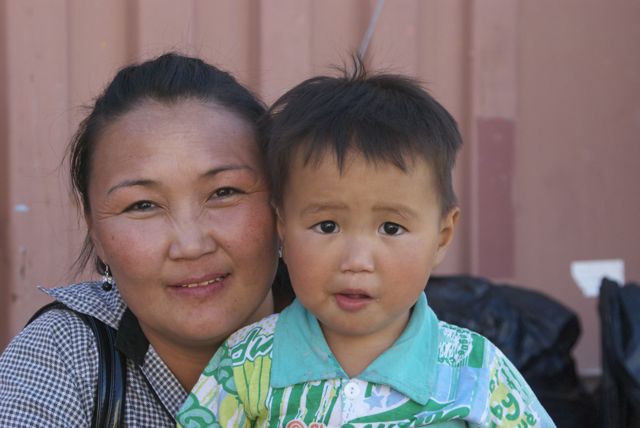
Two folding tables were set up and covered with lots of merchandise. The collective has expanded beyond felt crafts, too. One lady now has a knitting machine and brought a variety of tops and sweaters to sell.

Crafts

Selenge (the research camp manager and my translator) had me explain it all to the Earthwatch volunteers. By close of business, close to half of what had been brought had been sold.

A wonderful follow-up in every way to last year’s launch.

And customers

I was also able to have a private meeting with Boloroo, Selenge translating, about ideas for the kinds of things I think would sell in the US and some possibilities I’m working on for sales outlets. Many of the women will be perfectly happy to make slippers, stuffed toys and small, simple items to sell to visitors who come to Ikh Nart. But I’ve seen a level of talent and creativity in some of the women that I want to encourage. They can take their work, with practice, to a very high level of fine craft and therefore command much higher prices.

I watched Boloroo switch from visiting mode to business mode and am really impressed by how thorough and professional she is. I am so very fortunate to have gotten involved with a group that has her as the leader.

One of the new members and her family

I had also brought over a stack of sketchbooks, plus pens and pencils, so that young local artists would have the materials they need to create designs for things like purses. I believe this is better  than having a westerner like me do them, although I’ll be happy to help if asked.

Office interior

The following afternoon, I visited the soum center, Dalanjarglan, for the first time. Boloroo was there and we got to spend three hours together. She showed us the collective “headquarters”, a small free-standing building which used to be a gas station. It turns out that she bought the building herself. Amgaa had a banner sign made and donated some large informational posters from a past presentation about Ikh Nart. These have been hung on the interior walls. I saw the felt presses and they are clearly getting used regularly.

The felt presses

I had also paid for training earlier in the year in UB for Boloroo and one other lady, Lhagvadelger, the Bag Governor’s wife. Boloroo is now doing training herself. I also learned that there are four more levels of training available, so I will be looking for funding to cover that in the future.

Boloroo and I in front of the "Ikh Nart Is Our Future" office building

In UB a couple of weeks ago, I paid a visit to Tsagaan Alt, a store run by the Mongolian NGO from whom we got the felt presses and training. Everything they offer is of very high, consistent quality. Eventually, the collective will be able to sell their work there.

Selenge is going to try to keep up with what is going on with the collective and send me occasional reports.  Stay tuned. The ladies are clearly just getting started.

Mongolia Monday: The Best Camping Trip Ever, Part 2 – Baga Gazriin Chuluu Nature Reserve, Delgeriin Choiriin Khid

Even though I only spent two days there last year, Baga Gazriin Chuluu was a place that I really looked forward to visiting again.

A harem of local horses near our camp

One of the best experiences was visiting the ger of Yanjmaa, who had made boortz soup from scratch for us and served me a bowl of the best yogurt I’d ever had. Would she still be around? Although she had relocated her ger, the answer was “yes” and we had another lovely visit, but also learned something disturbing about the wildlife of the reserve.

There was a zud in Mongolia this past winter, which is a combination of a dry summer and a very severe winter. It was a national disaster that was occurring the same time as the quake in Haiti, so there was very little media coverage until early in 2010. The last estimate I read said that around 10 million head of livestock died.

Yanjmaa told us that no argali or ibex had been seen in Baga Gazriin Chuluu since February.  Before then, she had gone out one morning, and to her surprise, found a large ibex billy in with her domestic goats. He was very weak, so she managed to get him into her ger and onto her bed, hobbling him when he started to thrash around.

Having been a vet before she retired, she tried to treat him by offering him cold water and a medicinal plant, shavag, which contains lots of vitamins. Finally, she moved him back out to the goat enclosure, where he died.

Our first thought was that the argali and ibex had all died, like the ibex, but later on that day, it occurred to me that wild animals sense what is going on in their world and that it was more likely they had all simply left as the weather became extremely severe. In some parts of Mongolia, the temperatures dropped to -50F.

Talking with the reserve ranger, Batsaikhan, the next day, we confirmed that the ibex and argali were gone, around 160 animals total. Khatnaa had told me that he had seen 10+ argali about 20 km east of Arburd Sands, which is about a four hour drive north of Baga Gazriin Chuluu, on July 5, a week earlier. This was outside their normal, known range and preferred habitat.

That evening, Batsaikhan came by our camp to give us really good news. A group of visitors had reported seeing a group of argali just within the reserve! Perhaps they and the ibex will all, or mostly, come back to Baga Gazriin Chuluu now that the weather is good. I hope so.

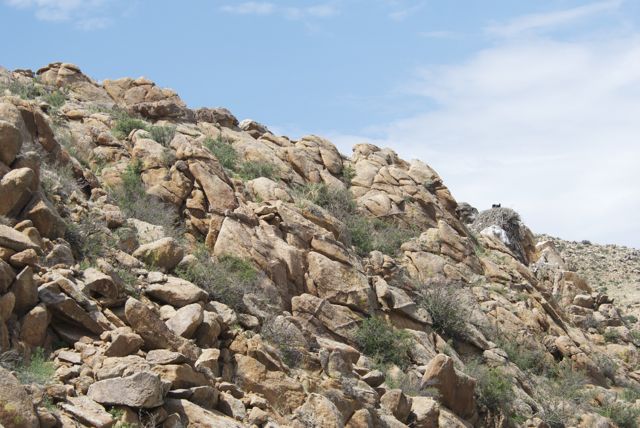
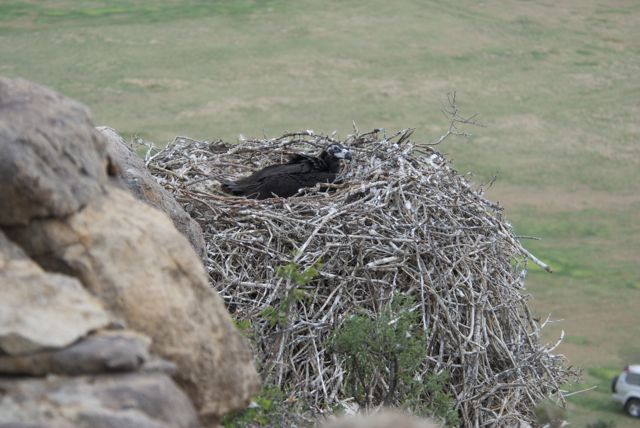
On our way to find Yanjmaa, we had passed through an area that had a number of vulture nests, one of which was on a cliff near the road with a fledgling cinereous vulture in it. I got some good photos from down below, but Khatnaa climbed up behind the nest and came back with some amazing images. We went back the next day and this time I climbed up with him and found myself just slightly above the nest, about 8 meters away. What a photo op!

Cinereous vulture nest from below

He/she knew we were there, but never showed any stress. The adult had taken off as soon as we got out of the car, so I felt comfortable staying for awhile and taking almost 100 photos.

The young occupant

Later that afternoon, we took a side trip out of the reserve to visit a local monastery, Delgeriin Choiriin Khiid. It was one of the many, many monasteries destroyed in the late 1930s, but is now being rebuilt. There are 15 lamas in residence. I was allowed to take photos in the interior of one temple, which is in a large ger.

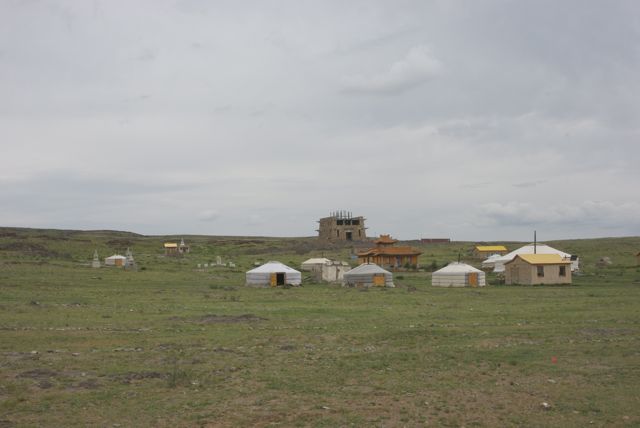
Monastery grounds
Interior of ger temple

The next morning we departed for the fabled Gobi.