UPDATE 9:30 AM THURSDAY: Well, well, what a surprise….went to my GoDaddy account about an hour ago and had no problem accessing my old website there, just “coincidentally” after the end of the 24 hour SOPA strike. I had last checked it around 9 pm last night and was still locked out. GoDaddy is in the news today because they have FINALLY come out against SOPA/PIPA. But my experience tells another story. Wonder what they’ll pull the next time. I won’t be around to find out because my new Sandvox-built, Namecheap-hosted site went live yesterday afternoon. This morning I stripped the old site bare. Yesterday I deleted the clunky, visually cluttered “albums”. The whole GoDaddy website-building operation is a kludge, badly implemented, and I’m so glad to be done with it, even without the last little gotcha, not to mention their inane sexist advertising and their elephant-killing SOB of a CEO. And no, I did not return the call from Mr. Director of Network Abuse (WTF?) because I have no reason to believe anything he might have said.
And why, you might reasonably ask, did I ever use them in the first place if they were so awful? Because, at the time, they were the least objectionable of the very few options available for artists who want to build their own sites and I have another artist colleague who had managed to put together a quite decent-looking site using them. What was not obvious is what a mess the interface is, to the point of being a terrible timesuck. I didn’t know about Sandvox and it may not have existed. At least it never showed up in my Google searches. I’ll be reviewing Sandvox in a future post.
UPDATE 5:20 PM: Just listened to a phone message from 10 am that I missed because I was otherwise occupied from a guy at GoDaddy who described himself as the “Director of Network Abuse” calling to say that it “had come to his attention” that I had posted about “issues I was having with my account” on my Blogspot blog (my blog is on WordPress). Would I please call him so he can see what he can do to “help”? Yo, Mr. Director, how about if you’d called to tell me that I can now get to my site and, oh gee, we’re really sorry you had a problem. But no, I just went there and I still cannot access it. But it doesn’t really matter because my new site went live about two hours ago. Check it out! www.foxstudio.biz
Want to know what the world will be like if SOPA passes? I just found out. After posting on my website’s home page yesterday that I would be blacking it out today in support of the Strike Against SOPA. I went to my account this morning to do so and found that I cannot launch my site, which is how one accesses it to make changes. Which means that I cannot black it out or make any other changes.
I also have two other domains registered, but that do not have live sites. My access to those has been blocked also.
I moved my domains and my web hosting to Namecheap when it became known that GoDaddy was supporting SOPA. They publicly backed off, but I doubt that anyone really believes that they had changed their mind.
Yesterday I could access my site to make changes. This morning, the day of the strike, I cannot. Coincidence? Highly unlikely.
However….I had already rebuilt my site using Sandvox. We just haven’t had time to do the conversion. We’re in progress on that right now. As soon as the new site is live and I have access to the old GoDaddy version again, if I ever do, I’ll be striping all the content from it and also deleting my albums, which contain images of my work and travels. I had already redone those in Picasa.
So. F— you, GoDaddy. I’m posting about what you have done to me in every place and comment thread I can find.
UPDATE!- 5pm- Aperture came up this morning and then the connection to the Library hard drive dropped again. This time David swapped out the power supply, which made no difference. Then, because the next step was drastic, re-building the entire Vault, and with no reason to believe it would make a difference, he put the original Library drive back on. And it worked. All day without a hiccup. At this point he thinks that somehow a read-write error got onto the hard drive, but somehow it’s not there now. Go figure. The good news is that I got a good afternoon’s work in at the easel. The Vault drive will be re-built over the weekend. Just in case.
We were almost certain that the problem was due to something in Lion since the problem showed up the first time I used Aperture after the upgrade and because of what happened when I installed it on my MacBook (see below). And it might be, but no idea what it would be. Thus once again demonstrating why correlation is not necessarily causation.
Original post from 10am this morning:
We’re still in the midst of dealing with this “situation”, but it’s ugly. The first morning I came into the studio to get to work after the holidays seemed to go fine. Until toward the end of the day I clicked on an image in Aperture to change the view mode and suddenly things went crazy. One image was half blues and magentas. Some had vanished. Uh oh. Call Tech Support, which happens to be my husband, who has been in IT (Information Technology) since 1964. Without Aperture, I literally cannot do my work. Did I say this was ugly?
That was two weeks ago. Despite changing out the external hard drive which has my Aperture Library on it (he had a third drive on hand just in case; four+ hours to copy the Library to it), multiple calls to the hard drive company (good support and helpful) and swapping out the Firewire cables for USB cables, just to hit the highlights, yesterday afternoon the Library simply vanished from the Desktop after successfully, we thought, addressing the problem. And work was done for the day and until we can get this fixed. Stay tuned.
Fortunately, all my images are backed up to a duplicate hard drive and also to an external Vault drive, which is kept in the detached garage. So I’m not hyperventilating with stress and terror that I’m going to somehow lose over 60,000 images that I absolutely depend on for my work. But this sucks, big time.
We did everything right. We thought. David recommended holding off on upgrading to Lion when it came out because there’s always something and he knows how mission-critical Aperture is for me. So we waited some months.
Finally, we agreed that I should go ahead and install Lion on my MacBook, which I did. And it was fine, except that the MacBook now could not see the Terastation server drives. Just. Great. And expensive. There were no workarounds, though he was given some to try by various colleagues. So we now have new server drives. And all was rainbows and unicorns.
We let another couple of months go by. I checked all the forums I could find and didn’t see anything that suggested people were running into problems with Aperture after upgrading to Lion. So David finally said to go ahead. It went fine, Aperture came up and functioned correctly. Right up until it didn’t.
So, having exhausted the other possibilities, we are left thinking that the problem is something that has happened because of Lion, but we don’t know what yet. The IMac seems much slower to come up now than before and it takes a long time for it to see the Wacom tablet and the mouse upon start-up.
First Summer, Takhi Foal 18x24" oil hot off the easel
1. Suck it up and accept the fact that you are an entrepreneur and that you are running a business. Artists can handle business stuff. We are not, by definition, airy, fairy flakes. Get organized, get Quicken for financial recordkeeping, Evernote for keeping track of everything and make the commitment to nurture your career. No one else will do it for you or as well.
2. Create a marketing plan or you won’t have a clue about what to do. Without a context and the bigger picture, how can you know whether or not doing a particular show makes sense or if you should do prints or sign with that gallery? Not having a plan is throwing spaghetti against the wall and hoping something (like money) sticks. Find your local Small Business Development Corporation office and take advantage of their free and low-cost services. I did and it’s really paid off. Literally.
Ready for North Coast Open Studios, June 11, 2011
3. Make social media work for you. Yeah, I know “but I already spend too much time on the computer (whine)”. Like it or not, online career-building is where it’s at now and has the major advantage is that it’s often free, unlike traditional advertising and promotion. These days you must have: a website that you can update yourself (I use Go Daddy. There are others that are probably simpler to set up but don’t offer the design flexibility; google “artists websites” to see what’s out there); a blog (This is a WordPress blog. Blogger works fine also, but the backend isn’t as sophisticated); a Facebook public page (easy to set up); a Twitter account (you’ll need to experiment to see how well it works for you); a newsletter (Constant Contact is the way to go); a LinkedIn profile (lots of artists there these days) and whatever else you find out there that can help get the word out about your work. It’s the synergy between all this that is what counts. There is no “one place to be”. The question is “how many places can I be?”
4. Always do the very best work you can that reflects your passion and point of view, NOT what you think the market wants. That way lies imitative, mediocre art that is always going to be two steps behind. Be the best YOU can be and then back it up with numbers 1 and 2.
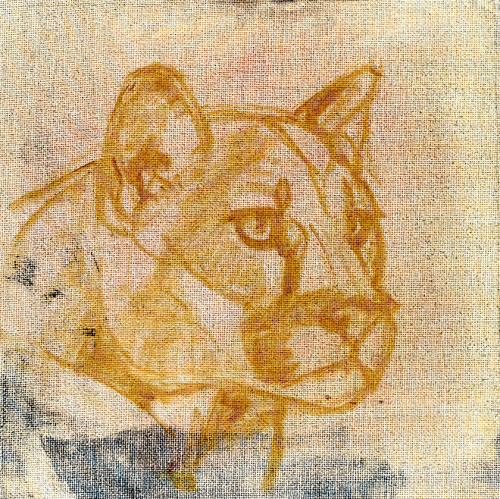
Work in progress
5. Buy Alyson Stanfield’s book“I’d Rather Be In The Studio: the artist’s no-excuse guide to self-promotion” and check out her website and blog. She’s the best resource out there for ideas, advice and encouragement for building an art career. One of the things she emphasizes over and over is how critical your mailing list is because these are the people who are interested enough in what you do to let you contact them with news of what you’re up to.
Notice all the links? That’s no accident. Part of the purpose of this post and the links is to drive traffic to this blog.
Feel free to add any further thoughts and ideas in the comments!
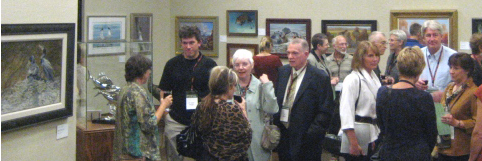
SAA members and guests at the opening weekend of the 49th Art and the Animal; Rolling Hills Wildlife Experience
This post was originally written for the Society’s Facebook public page and blog, but I wanted to share it here since I think what I have to say relates not just to what my thoughts are about applying to join the SAA, but also lays out in general some of my beliefs about what makes good animal art. It’s illustrated with images of various members of the Society, who I am proud to call my colleagues and friends.
The deadline for the next round of consideration is coming up in mid-April. I thought that, having participated in three membership juries now as a member of the Executive Board of the Society, I would offer some observations and tips that might be helpful to those of you who aspire to membership in the SAA.
A couple of notes before we start- First, I’m a painter and that’s what I know best. What I’m going to say applies to most other media, but creating a successful painting will be my main focus. Second, this article represents my personal views and is not an official statement by the SAA, any of its officers or the other board members. If you have any comments or questions, please direct them to me.
Now, to begin: I recommend that you do this exercise. Go to the Society’s website, visit the virtual museum and the individual websites of any member’s work that catches your eye. Then get out at least eight or ten of your own pieces. Line them up. Look at them objectively. This is not easy. We tend to be either too hard or too easy on ourselves. Do your best to be honest since that is when opportunities for growth happen.
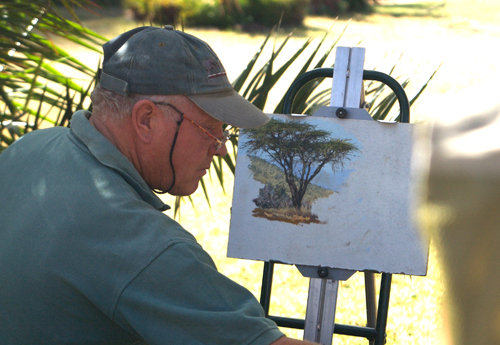
The late Simon Combes giving a demonstration; Lewa Downs Wildlife Conservancy, 2004
Representational painting in general, and animal art in particular, have well-established criteria for what constitutes a “good” painting. These principles have evolved over a number of centuries. They are not “subjective”.
You are not in competition for a limited number of spots as would be true with a juried show. We usually have between two and three dozen applications to consider. We can accept all of them. Or none of them. Each applicant’s work is judged on its own merits.
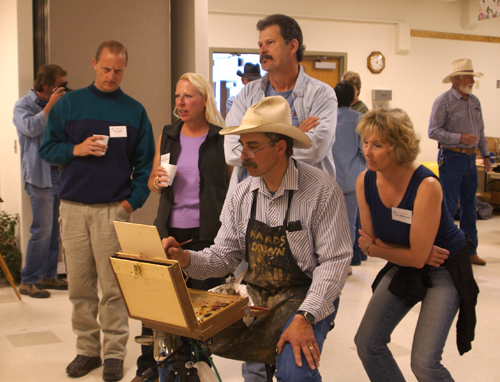
Greg Beecham at the Quick Draw; Susan K. Black Foundation art conference, 2005 (Suzie Seerey-Lester to left)
Pick one piece that you honestly believe is at or is close to the level of the work of the artists who are already members.
You now need four more at or near that level, because one of the things that will sink an application fast is one or two good pieces followed by the jury seeing the next three or four go off the cliff. You will be judged by your weakest pieces. Consistency is very important.
Kent Ullberg gets inspired at the SAA 50th Anniversary event; San Diego Safari Park, 2010
Consistent in what? Glad you asked…
1. DRAWING: Animals have a physiological and behavioral reality that a competent animal artist has to understand and demonstrate to the jury. In other words, you need to be able to draw them with accuracy and understanding if you are a traditional representational artist and clear understanding if you are going to handle them in a more personally expressive way. You are hoping to join the ranks of animal artists who have been doing this, in some cases, for decades. They know if the drawing is correct or not. Which way a leg can bend, how a wing moves in flight or what the pattern of spots are on a leopard are not really subject to debate, however open they are to informed interpretation.
Karryl sculpts on location at the 50th Anniversary event; Rolling Hills Wildlife Experience, 2010
2. CRAFT: We want to see a solid understanding of your chosen media, whatever it is. If you decide to submit work in more than one media, then all of them need to be at an equal level of competence. Don’t submit a little of this and a little of that, hoping that something will stick, like spaghetti on a wall.
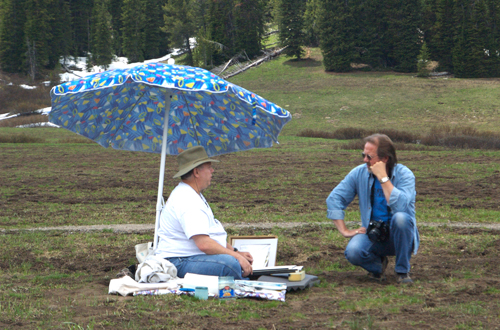
David Rankin on location, ready for anything at Torrey Lake: Susan K. Black Foundation art conference, 2005
3. DESIGN AND COMPOSITION: Do you have a solid grasp of design and composition? Have you made a conscious decision about every element of your piece? For instance, are the subjects in the majority of your submissions plopped automatically into the middle of the canvas or thoughtfully placed to carry out your central idea?
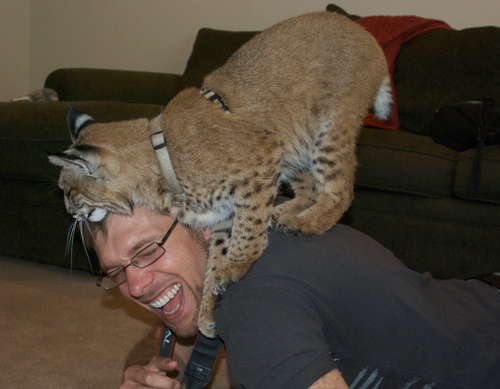
Andrew Denman gets worked over by an affectionate bobcat; he, Guy Combes and I visited the Sierra Endangered Big Cat Haven last year
4. PERSONAL VISION: Are you creating art based on a personal vision or simply copying photographs? (It is well-known that photographic images flatten and distort three-dimensional subjects like animals, so the artist must learn how to compensate for that if their goal is a realistic representation.) What do YOU have to say about lions and elk, butterflies and buzzards? Let your opinion, point of view and passion come through. HAVE an opinion, point of view and passion about your subjects.
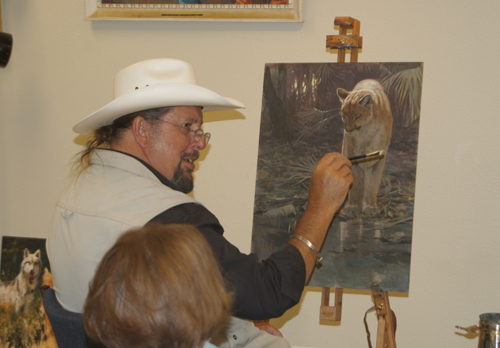
John Seerey-Lester paints a mountain lion; Susan K. Black Foundation art conference, 2005
5. KNOWLEDGE: Do you understand basic animal anatomy? Do you understand the habitat of the species you are representing? Have you learned about their behavior as an inspiration for your work? Or is everyone just standing around? If you put an animal in a realistic setting, you are now a landscape painter too. Are both your animals and any habitat shown depicted at the same level? Or does one lag behind the other?
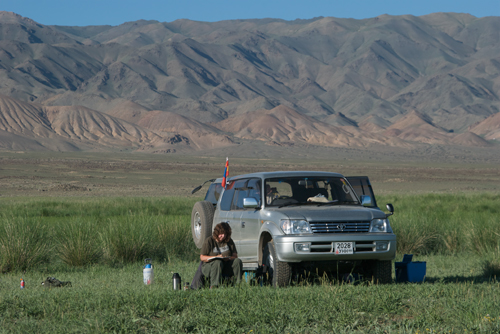
Yours truly hard at work in the Gobi, Mongolia 2010
Animals are specialized subject matter that require study and the accumulation of knowledge over time to represent successfully. There are no shortcuts.
We are looking for artists who have mastered their art and craft at a consistent level and who present us with a body of five works which all reflect that level.
Well, I’m back in the saddle after a great vacation in Hawaii with my husband. First order of business in the studio is to finish some drawings that I have promised to do for the people at the Sierra Endangered Cat Haven to thank them for their warm welcome (and fixing my broken van). I did this study of their clouded leopard yesterday, truly one of the most beautiful of the cats.
It’s been fun to get back to this kind of finished graphite drawing. If you like good drawing and good commentary, check out Terry Miller’s blog, Pencil Shavings. Very inspirational.
I’ve admired Ron Kingswood’s work for years, since I first saw it and met him at the Southeastern Wildlife Exhibition. His work has changed since then and he has gone far beyond what is conventionally considered representational art, much less what most people think of as wildlife art. And that’s ok. Too many artists reach a certain developmental point and stop learning or they gain a satisfying level of success in the marketplace and are then trapped by the expectations of their galleries and collectors.
Now, he’s contributed an essay, “Is Animal Painting Dead?” to the online publication Wildlife Art Journal. Not too many comments there yet, but it’s buzzing on the magazine’s Facebook page. Here are links to the editor’s introduction, the essay itself and the Journal’s Facebook page.
If The Conversation About Art Isn’t Real, What Good Is It?And by the way, Wildlife Art Journal is the only source for what’s happening in the animal are world. They deserve support and currently have a special subscription offer going of $8 a year.
Late last year, a Facebook friend posted something about a new art auction site, to be run by someone called The Brigham Galleries. The short story is that the owners had decided to close their “bricks and mortar” gallery location on Nantucket and instead sell exclusively through online auctions. They saw that there is a price gap between art sales on eBay (generally below $1000) and the big auction houses like Sotheby’s (generally over $500,000). That’s quite a bit of open territory. I went to their site and saw a couple names I recognized on their list of artists and became a fan on their Facebook page.
They announced an opportunity to submit work for the first auction as a “Juror’s Pick” and I decided to submit something. No cost, no risk. Why not give it a whirl? And, the painting above made the cut as a Juror’s Pick!
It’s been a bit of a long road for the women to get it all organized and has taken longer than they expected to get the site up and running. But, as of today, the auctions have begun! The listings are here. Mine is at the bottom of the first page. It’s Lot 35, Lot Item 1102. The auction will be for two weeks.
I’m very pleased with the quality and variety of work that they have for this very first round.
Will I get sales? Who knows? But it’s a new model that I hope will be successful. There is minimal risk to the artist- the work stays in the studio until it sells. And minimum expense- no shipping work back and forth, reasonable listing fees and an extremely reasonable commission upon sales.
This article was in Andrew’s latest newsletter. I don’t have a lot of experience with commissions, having only done a few dogs and one horse portrait over the years. When I read this article, I saw that it had a lot of good information that would be of interest not only to the artists among you, but anyone who has thought about commissioning a piece of art but wasn’t sure how to go about it. I think that if everybody follows their respective “tips”, the odds are that it will be a happy experience all around.
By way of introduction: Andrew has gained national attention through his involvement with the Society of Animal Artists, feature coverage in such publications as Southwest Art, American Artist, Wildlife Art, and The Artist’s Magazine, among others. and has held three highly successful one-man shows at Pacific Wildlife Art Galleries. He has also participated in exhibits at the Bedford and Hearst Galleries, and the Oakland Museum. His work has toured nationally with Birds in Art and the Society of Animal Artists, which has honored Andrew’s work with Awards of Excellence for two consecutive years. Andrew’s work can be found in the National Museum of Wildlife Art in Jackson, Wyoming, the Leigh Yawkey Woodson Art Museum, Wisconsin, and numerous private collections across the country. He is currently represented by the venerable Trailside Galleries in Jackson Hole, Wyoming. You can see more of his work here.
"A Very Wyer Winter" acrylic on board, 24 x 21" 2009
So, without further ado, here’s Andrew Denman on “The Delicate Art of Commissions:
As long as there have been artists committed to earning a living with their work, there have been collectors and patrons eager to commission art that speaks directly to their own tastes and preferences. Many artists have a love- hate relationship with commissions; they certainly offer the comfort and convenience of a “sure sale,” but may artists feel an uncomfortable sense of restriction, of guidelines outside one’s own whims and fancies bogging down the creative process. It’s unfortunate, because commissions (like the one above) can be among the most rewarding and profitable experiences an artist can have. The following are tips for both artists and patrons on how to successfully pursue a commission.
TIPS FOR ARTISTS:
1. Only take commissions that interest you. The primary fear of many artists who refuse commissions altogether is that taking a commission necessarily means painting whatever a client demands and “selling out.” This is hardly an issue if you only take the jobs that speak to you as an artist. Moreover, remember that just because it didn’t start out as “your idea” doesn’t mean a commission can’t become a painting that fully represents you as an artist. Remember the Sistine Chapel was a commission too!
2. Spend time with the client, carefully assessing likes, dislikes and project requirements. Presumably, if a collector has sought you out, he has seen and enjoyed previous work. Take note of the client’s favorite pieces, and be sure you understand specifically what he likes about them. Be certain to learn the deal breakers. If you know the two or three things you have to avoid or must include (say the client wants a painting of a barn swallow, hates the color blue, especially loves your attention to fine detail, and wants to make sure the painting will look good in a driftwood frame) then you can exercise your creativity in all other areas.
3. Be certain to have the commissioner approve of a sketch or study before you begin work on the final piece. If some small element needs adjusting, this is the time to do it. I only ask for a deposit after this stage so the client doesn’t feel any obligation until he knows exactly what he’s getting. If the client is dissatisfied, I still have a nice study ready to use for other purposes.
4. Do take a deposit before you begin painting. One of the benefits of commissions is that you have some money coming in while you are working, not just after completion. Be prepared, however, to return the deposit if the client is dissatisfied. It may never happen to you (and it probably won’t) but a happy client might still buy from you in the future. A disappointed client stuck with a painting he doesn’t like certainly won’t and will never send any referrals your way.
5. Agree on a deadline. Many artists hate working under pressure and many of us have show schedules to consider and galleries to supply, so commission deadlines of a year or more are not uncommon. The key is to let your collector know exactly what to expect. If a hard deadline is one of the project requirements (such as for a birthday or anniversary gift) be honest about your ability to meet the deadline. It’s better to turn down a job than to take on more work than you can handle and sacrifice the quality of your art.
6. If you are still uncomfortable with commissions, consider a “First Right of Refusal” arrangement. Unlike commissions, first rights of refusal involve no deposits and no deadlines. A client who is interested in a painting of a bison, for instance, will simply have “first dibs” on your next bison painting, which you may finish next week or two years down the road. The client feels no obligation and you have total creative control, but you’ve given a collector special treatment that is unlikely to be forgotten, whether he buys the specific piece you offer him or not. Keep a running list of such requests and follow through.
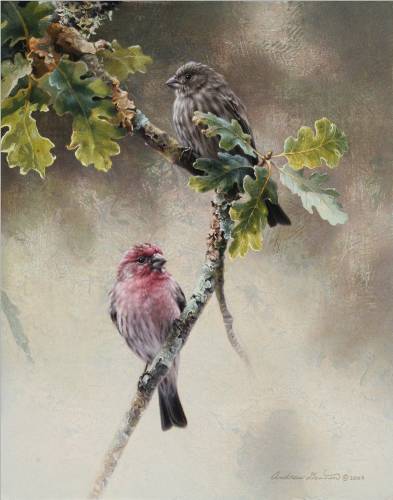
"The Hawthorne Pair" acrylic on board, 12 x 9 1/2" 2009
TIPS FOR COLLECTORS:
1. Be selective about the artists you approach with your ideas. Entering into a commission is entering into a relationship with an artist that could last months or years. Make sure that you and the artist can communicate effectively and amicably from the start. Any artist should be flattered that you thought of him to create that special piece, but make sure your project speaks to the artist’s interests and personality before making your approach.
2. When you tell the artist your idea, don’t rattle off a laundry list of requirements. Be very clear about what’s really important to you and leave the nitty gritty details to the artist’s imagination. Start by sharing with the artist your favorite pieces and clearly describe what speaks to your sensibilities. It’s challenging enough for an artist to take the image in his own head and translate it to the canvas; it’s nearly impossible for him to take the image in your head and bring it to life. Commissioning a fine art piece isn’t about finding someone to paint that idea you’ve always had in your head; it’s about providing the seed of inspiration that inspires an artist to create something that belongs to him as much as it does to you.
3. Honesty combined with tact goes a long way. Ask to see a study up front and be frank about your impressions. Artists can be touchy about criticism, but this is your ball game, so don’t apologize for your input. Simply avoid vague criticisms, broad generalities, and major changes from the idea you originally discussed. As long as you clearly state any concerns and offer your suggestions in a respectful manner, remembering to defer to the artist’s professional judgements (except where deal breakers are concerned), no reasonable artist should take offense. If your suggestions are met with annoyance or hostility, this is the time to part ways. Either the artist is unreasonable or the two of you simply aren’t communicating effectively, in which case neither of you are likely to be pleased with the final result.
A Final Note:
Collectors, when all is said and done, make sure the artist knows how pleased you are with the final piece. Creating a work of art requires hard work and a very special talent, which is why you’re contracting it out in the first place, and a piece of original art that truly meets or surpasses your expectations is to be cherished, as is the artist who created it.
Artists, remember that a collector who admires your work, seeks you out, and wants to be a part of your creative process is a great gift, not to mention an invaluable testament to your abilities as an artist. When you find a commissioner who is a pleasure to work with, be sure to express your appreciation too, and take care to nurture the relationship in the years ahead.
———
Susan here:
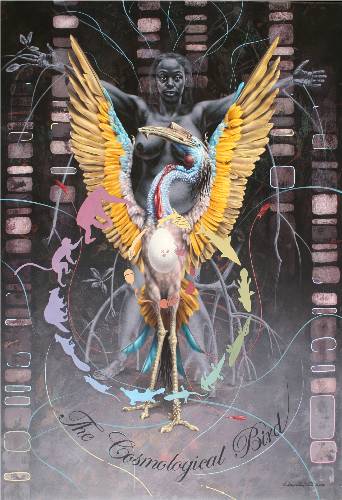
I’ve seen a lot of Andrew’s work. He does what is needed to say what he wants to say and doesn’t give a fig about stylistic consistency. But this last piece is really, well, different than anything else I’ve seen him do. Maybe I’ll have him back to tell us the story of this commission.
"The Cosmological Bird" acrylic on board, 34 1/2 x 24" 2008
We had a heck of a series of winter storms last week here in California. And this week a large chunk of the rest of the country is getting wacked. It’s stay indoors season. Not a great time to paint outdoors, unless you’re one of those seriously hardcore plein air folk, or do fieldwork if you are an animal artist. Snow is one thing, but driving rain and hail, high winds or ice storms are something else. What to do (drums fingers on table)? Here’s some ideas:
1. Ask yourself- What are you really bad at?- Trees? Water? Fur? Eyes? Be honest. We all have our strengths and weaknesses. I remember my artist sister-in-law telling me about a classmate at art school whose use of color was, apparently, pretty awful. He made a commitment to improve and is now a nationally known artist and illustrator known for, among other things, his incredible use of color. What I learned from this story is that, with hard work and a willingness to struggle and learn, a weakness can be turned into a major strength.
There's probably at least six exercises that one could do from this photo. What are they?Cinereous vulture, Bronx Zoo; opportunity to show depth and form in an eye study; the photo flattens the image; what do you have to do to compensate?
Exercise: Set aside some time each week to work on something that’s hard or that you feel is a weak point in your work. Do little studies that should only take a hour or two. Don’t bit off a big chunk like “water”. Break it down into smaller problems like reflections or what pebbles look like through water. Robert Bateman says that he used to sit and watch water for hours to learn what the pattern was. You could throw stones in a big mud puddle to study ripples.
2. Take a look at your old work- Creating art can be very discouraging. Sometimes it seems like we’re just spinning our wheels. Progress in gaining any skill is usually incremental. Someone who hadn’t seen my work for awhile was visiting my studio recently and commented that my work had taken a great leap since they’d last seen it. I found that very gratifying, but also interesting. I do occasionally paint something in which it all comes together and there is a big move forward, but that’s the exception.
old reference 4x6" photo (cropped) from 1996Painting (cringe) from 1997; it looked ok to me at the time; I could write an entire post now about what's wrong with itBrush drawing from a couple of weeks ago for an 8x8" painting; the difference should be obvious
Exercise: Get some of your favorite beverage, pull out your old work and set it up next to your latest pieces. What do you think? I hope you see steady improvement over time, which should give you some well-deserved encouragement. If you don’t, then see if you can figure out why. Be honest. I know some artists who seem to think that amount of years spent painting equals good work. Not true at all. Twenty-five years of doing the same subjects in the same way with the same technical problems still means mediocre paintings.
3. Evaluate your photo reference- a famous wildlife artist who I was lucky enough to study with a couple of times told us that “you’re only as good as your reference”. I have found that to be absolutely true. Every time I’ve been able to upgrade my camera equipment or how I view my reference, my paintings have shown immediate improvement. You can’t put in what’s not there unless you know the subject extremely well. Trust me on this. The biggest leap for me was going from film to digital, which let me move from prints to the equivalent of big transparencies. I’m slowly purging my photo print reference of all the kinda-sorta images that I know aren’t good enough.
Impala painting from photos shot during my 1999 trip to Kenya; flat as a piece of paper with everything in local color my main reference photo; notice the absolute lack of any perceivable light sourceThompson's Gazelle; no hint of a background, but you know there's light because of that cast shadow on the neck
Exercise: Go through your reference, in whatever format, with a fresh eye. Ask yourself- How much work will it take to make this into something? Does it really represent what it was that caused me to take the picture in the first place? Is it blurry? (I tend to keep those because there still might be a hoof or other information that I can use, but I don’t use blurry images for primary reference. Or let’s just say that every time I’ve done it, I’ve regretted it.) Is it under- or over-exposed? How about the lighting? Is it interesting? Or is it flat?
4. Start a sketchbook- You know you “should”. One of my teachers in art school did a lot of storyboard work for major San Francisco ad agencies. High pay, super short deadlines, no time to shoot reference. He did a drawing a day besides whatever work he had. While I was in his class, we all did a drawing a day. I had fun using my favorite felt tip pens and also Berol color sticks, which were new for me. So it was a chance to try different media, too.
Table and chair; not easy to get the perspective rightBut no one says it has to be literally realisticI tend to do this kind of drawing with carbon or charcoal pencils in the studio, but still use felt pens on location
Exercise:For one week, do a drawing a day. Of anything. You can set up a still life, draw furniture, work from magazine photos. With any media. But draw. Then add a second week. See what happens. Send me a 500 pixel jpg of your favorite and I’ll post them here.
5. Dream your dreams- Blue sky time. If resources, monetary and otherwise, were not a factor, what would you be doing as an artist? Some of us want to paint full-time, which I am fortunate enough to be able to do. Others want a special place in their home where they can do their art or want to go to a workshop or travel to Italy or…..the possibilities are as endless as the ways artists express themselves.
Dream big, but don't miss the stuff that might be close by
Exercise: Set aside an evening and make a list. Try to be specific. Instead of just “workshop”, how about “I want to study plein air painting with…..”? Or not just “I want to travel”, but “I want to go to Kenya and see wild lions”. Then think about what steps you can take to achieve one or more of your dreams. Get on the internet and see what you can learn about how other artists have achieved their dreams, both for inspiration or ideas.
So, there you have it. Five ideas and look! It’s April already!
A Facebook artist friend posted a link to a web page which said a survey showed that 96% of Americans value art in their communities, but only 27% value artists. What’s up with that?
That page is part of the site of United States Artists, whose mission is to provide direct support to artists by means of substantial grants. Really substantial grants. Like $50,000 each for 50 artists EVERY YEAR. Before you start hyperventilating with anticipation, artists have to be nominated. You can’t just apply. Anyway, check out the site. And feel warm and fuzzy about the fact that someone has finally figured out that most of us work really hard at our art, but don’t make a lot of money at it and that the money has generally gone to cultural institutions, not the people who do the actual creative work.
Needless to say, I wish United States Artists every success.










 Susan Fox, American Artist