When I made the decision to specialize in animal subjects, I also took a deep breath and made a personal commitment to reach the highest level of excellence that I was capable of (still chugging away). Then I researched the approach and working methods of the best current and past wildlife artists, figuring the odds were that they knew a few things that would be useful to me.
And guess what, not a single one of them, (including Bob Kuhn, Carl Rungius, Wilhelm Kuhnert, all unfortunately deceased) like Robert Bateman, Guy Coholeach, Ken Carlson, Dino Paravano, Lindsay Scott, Julie Chapman or Laney, to name some of my favorites, rely on other people’s photos except to supplement their own for specific elements, only go to zoos or game ranches or work exclusively from photos to the exclusion of anything else. They GET OFF THEIR BUTTS, pick up their sketchbooks along with their cameras and hit the road to where the animals are.
This is not a field for the lazy. Even if your passion is the songbirds and squirrels that you can see in your own backyard, you still need to do fieldwork. Believe me, it shows in the work to those who know.
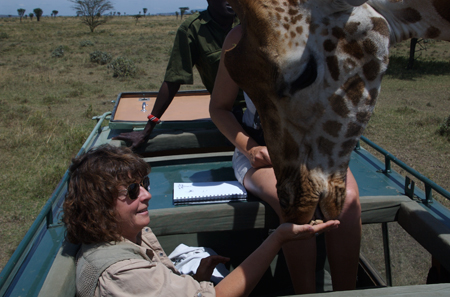
(Endangered Rothschild’s Giraffe and I at the Kigio Nature Conservancy, Kenya or Why I Like Fieldwork.)
There is no substitute for seeing an animal in its own habitat. This was brought home to me when I went to Kenya and saw lions, elephants and warthogs “in context” for the first time. The warthogs in the Masai Mara were the same color as a lot of the rocks. Thirty elephants emerged from trees lining a river bank. They had been invisible. The only evidence of their presence was that the tops of the trees were moving. We were at most 50′ away. The lions are very similar in color to the dried grass.
The prey species like wildebeest and zebra had a vibe that is totally lacking in the ones I’ve seen in zoos. In the wild they have to Pay Attention and work to survive. The zoo animals don’t have to do either and it shows in their body language.
You need:
A good digital SLR: Point and shoot won’t do it. Too slow to catch movement and you can’t change out lenses if necessary
The sketchbook of your choice: you may have to try some different ones to find a combination of paper and pen/pencil that works for you
Pens/pencils: So many possibilities. I use fine point gel pens for the most part because they don’t smear and I can’t fuzt around and erase.
Patience: In ten years, I have found that, on average, a given animal will do something at least mildly interesting or worth recording within about twenty minutes, but you have to be willing to sit and watch and watch and watch and……., even in zoos
Curiosity: Which translates into a willingness to learn about your subjects, not just settle for superficial appearance
Imagination: I’ve been in the field with other artists who seemed to be trying to capture “The Pose” that they would then faithfully reproduce on canvas. I often seemed to be the only one whose shutter was firing. Why? Because I’ve learned that you can never know in advance what you will find useful and when you’ve spent hundreds or thousands of dollars to get to a place, it’s crazy to stint on reference collection, especially with digital cameras and the ever dropping price of memory cards.
The Payoff? Great, unique reference (how many cougar paintings have you seen recently that were obviously from the same captive animal shot in the same locations? Yawn.), your memories of what it was like to be there which will somehow seep into your work, stories to accompany the paintings that will interest collectors and the possibility of seeing things very few people are privileged to.
Here’s a few examples of shots taken on the off-chance they might come in handy sometime. Not necessarily interesting to anyone but me.
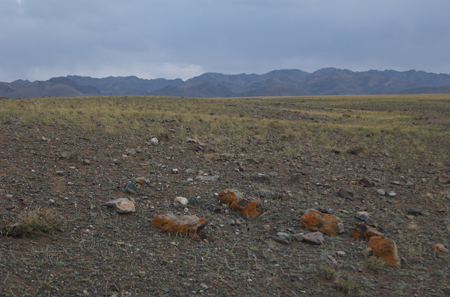
The Gobi Desert near my ger camp. Useful elements: cloudy sky, distant mountains, September grass, lay of the land, gravely surface, rocks with red lichen.

Grab shot from Lewa Downs Conservancy, Kenya. It’s a little blurry, but turns out to be the only tree that I’ve seen with that trunk color. It will be the perfect element for something, sometime.
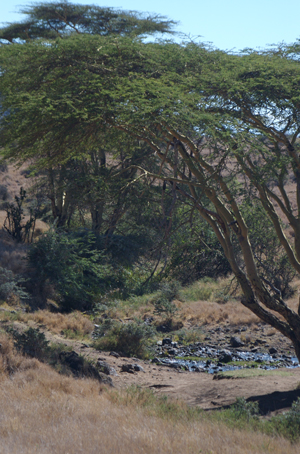
Photographing the animals is a no-brainer, but don’t forget their habitat. I know what animals live in the Conservancy where I took this picture, so I know who could be found in this neat waterhole setting.
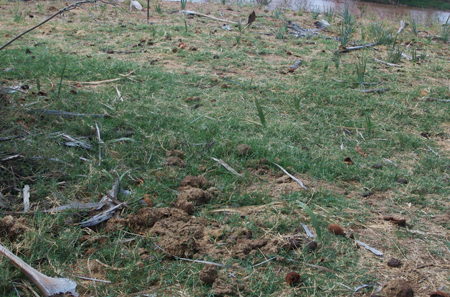
On the banks of the Ewaso Ngiro river in the Samburu, northern Kenya. We have: a little of the water for context (where did I take that picture?), grass, some kind of spiky leaved plant just coming up (needs to be identified), doum palm nuts and frond droppings and…..elephant dung. This was taken right in camp.
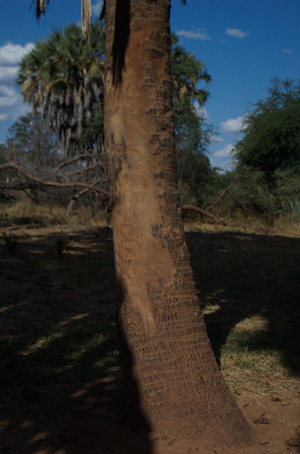
And, nearby, is a doum palm that has been partly rubbed smooth by elephants.
And here are some elephants. Nothing spectacular by itself (well, other than the fact that I’m seeing them in Kenya, of course!). But the preceeding photos provide context and additional elements that could be used with the photo below to create something more interesting and memorable.

I realize that these are exotic locations that many artists can’t get to or aren’t interested in, but the principle applies no matter where you are. Get out into the field and see as much as you can of everything around you. Filter that through your interests and passions as an artist and it will shine through in your work.
ART THOUGHT FOR THE DAY
“Now the light was fading fast. We had to hurry to reach the gate before 7 pm, but just as we were leaving the plains, Dave said urgently, ‘Stop! Stop!’ Thirty yards from the road, a lion and lioness stood silhouetted by the setting sun. She moved against him, rubbing her body on his great shaggy main, and twitched her tail high in the air. Then, blatantly sensual, she crouched on the ground and the big male mounted her. The coupling was brief and ended with a climax of impressive snarls before she rolled onto her back in evident satisfaction.”
Simon Combes, from Great Cats: Stories and Art from a World Traveler
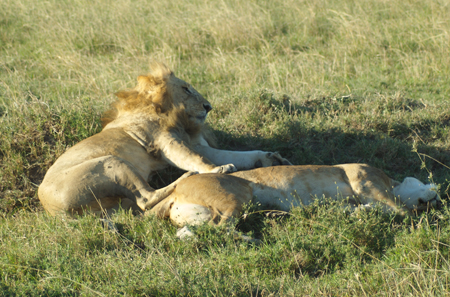
Thanks, Simon. (Photo from Oct. 2004 art workshop/safari led by Simon Combes two months before he was tragically killed by a cape buffalo. More images from the safari and a memorial page to Simon on my website)





 Susan Fox, American Artist