Seeing the Light

I’ve spent a good chunk of this last week or so working on the “light thing”, which, when you get right down to it, is what representational painters are painting. Or, in other words, the effect of light on an object, whether is be a tree, a barn or an apple in a still life. Besides a lack of good drawing skills, failure to accurately perceive, understand and represent light is one of the things one consistently sees in poor or mediocre paintings. Everything tends to be in local color (the “native” color of the object) and the shadows are too dark and lack life. This tends to come from painting from photographs.

Dawn on Dunraven Pass, Yellowstone NP

Capturing the light is one of the major, almost addictive challenges of plein air painting. A given quality of light lasts about two hours at most, sometimes two minutes. It’s an opportunity to experience frustration and exhilaration almost simultaneously. Plein air painting also addresses the problem mentioned above about shadows. When you are in front of the scene, you see how much wonderful color and variation are in shadows that a camera doesn’t pick up, not even the digital ones, although they are much better than film was.

Another important point is that a given hue, value and temperature of a color exists only in relation to the colors around it. No color is dark and cool in and of itself. Not even black (if you mix your own, which you should) or white. It’s always a matter of “warmer than” or “lighter than”. How far one pushes the contrast between color value and temperature is a personal choice the artist makes in order to accurately express their vision and emotional response to their subject.

Along Goodall's Cutoff, Idaho

As primarily an animal artist, I found early on that when I wanted to put an animal in their habitat, I also became, ta da, a landscape artist. And that has proved to be much more difficult for me to get a handle on. I’ve taken at least as many, if not more, landscape painting workshops as wildlife ones.

I’ve done seven small landscape studies over the last few days, mostly just 6″x8″, working on two problems: that classic daybreak and afternoon glow and the wonderful effect of light on trees with dark clouds behind. The small size takes less time and lets me focus on the problem I’m trying to solve.

It’s a juggling act. What order to put the colors down, what values and what temperatures those colors should be. And I still try to do a decent composition and pay attention to the drawing.

Cottonwoods, late afternoon; Dubois, Wyoming

The above paintings took around two hours each and were done on canvas panels with a round brush.

Oh, and I have integrated the Permanent Green Light and Manganese Hue into my palette. Haven’t quite found out what I’ll use the Permanent Magenta for yet.

More Mongolian poetry on Monday!

ART THOUGHT FOR THE DAY

Nature is what you see and what you think about it. Artists change our thoughts about nature, and so, in sense, change nature. A masterpiece does not look like nature, because it is a work of art. The language you want to speak is art, so study art from the masters.

John Sloan
Friday Features- I’m Invited!

This will be the last one until probably October since we are approaching the final countdown to departure for Mongolia on the 24th.

However, I’ve just gotten a letter informing me that I am invited to participate in the 2009 Marin Art Festival and bypass the jurying process! The answer is “Yes!”, so my first festival of 2009 is on the calendar.

PLANET SAVER TIP OF THE DAY (all photos copyright Susan Fox)

Quotes that I find inspiring, thought-provoking and worthwhile to consider-

What is the good of having a nice house without a decent planet to put it on?
Henry David Thoreau

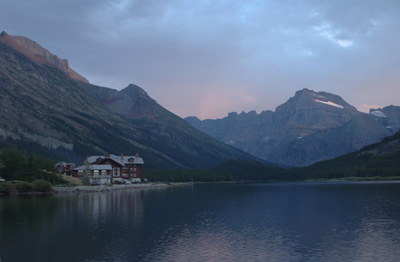
Many Glacier Lodge, Glacier National Park, USA

“I went to the woods because I wished to live deliberately, to front only the essential facts of life, and see if I could not learn what it had to teach, and not, when I came to die, discover that I had not lived.”
– Henry David Thoreau

“It’s hard for the modern generation to understand Thoreau, who lived beside a pond but didn’t own water-skis or a snorkel.”
– Bill Vaughan

“We do need a ‘new economy,’ but one that is founded on thrift and care, on saving and conserving, not on excess and waste.  An economy based on waste is inherently and hopelessly violent, and war is its inevitable by-product.  We need a peaceable economy.”
– Wendell Berry, Thoughts in the Presence of Fear.

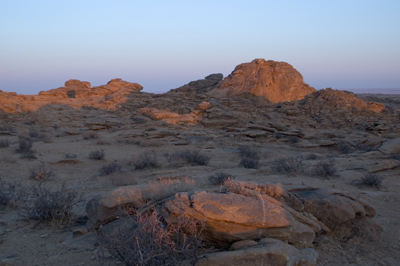
Sunrise at Ikh Nartiin Chuluu Nature Reserve, Mongolia

“The more clearly we can focus our attention on the wonders and realities of the universe, the less taste we shall have for destruction.”
– Rachel Carson

Watering place, Kenya

“The purpose of conservation: The greatest good to the greatest number of people for the longest time.”
– Gifford Pinchot, first Director of the U.S. Forest Service

” When we try to pick out anything by itself, we find it hitched to everything else in the Universe.”
– John Muir

Sundown, Masai Mara, Kenya

Friday Features

BACKYARD BIRD LIST

Six or so red crossbills are still showing up most days. There was a group of fox sparrows last weekend. Our hummingbird-friendly plants are really starting to bloom. I was sitting here at my desk and look who showed up outside my french doors? I was able to grab the camera and get some shots through the glass. Sometimes lucky is better than good. Looks like a male Allen’s hummingbird to me.

Speaking of hummer plants, here’s my 50 cent, 4″ pot white verbascum that I rescued off an end-of-season sale table the year before last. Is that a happy plant or what? I’m going to have to move the poor little heather underneath it before it’s completely smothered. Or I may move the verbascum to a more spacious location. I didn’t think it would get quite this big.

ART TALK

I finished the bighorn painting and took it to the framer only a little wet in a few areas. When it was laying on the counter, I saw a spot in the sky I missed, which I’ll fix when I get it back. But it reminded me of one of my favorite artist stories:

Every year the Royal Academy in London has its Summer Exhibition. We were lucky to be in England and able to attend some years ago. The galleries looked like in old photos you see: work stacked from the floor to the very high ceilings. Those whose paintings ended up in “nosebleed” country called it “being skied”.

William Mallord Turner (b. 1755 d. 1851) was a regular participant, although his work mystified many of his comtemporaries and the general public. “Varnishing Days” were the three to five days before the exhibition opened when the artists could come in and put on a final varnish or touch up their paintings. Turner became somewhat famous for this and is said to have deliberately brought in unfinished paintings so that he could show off his technique. Imagine any of us doing that today? It would be like Robert Bateman showing up at the opening of his current retrospective, palette, brushes and paint in hand to add a few more snowflakes to his famous snow leopard painting. Turner showed up dressed for town and S.W. Parrott was inspired to create this permanent record, which is reproduced here in black and white. How do you dress when you’re in the studio?

PLANET SAVER TIP FOR THE DAY

Speaking of Robert Bateman, besides creating a lot of the best wildlife art of this or any other century, he is a tenacious advocate for the environment. You can read what he has to say at www.batemanideas.com

ART THOUGHT FOR THE DAY

If a man does not keep pace with his companions, perhaps it is because he hears a different drummer. Let him step to the music which he hears, however measured or far away.

Thoreau

Drawings from live animals and new painting

From the stats it looks like the post of my pet sketches was one of my most popular so far, so here’s more. These are done the way I usually work, with a fine tip gel pen. They’re done fast. Under five minutes, sometimes under two.

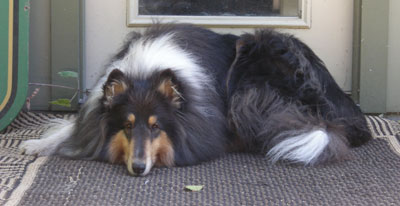
Niki, our tri-color rough collie

From the San Francisco Zoo. He really did hold still long enough for this head study.

These were ultra-quick, a minute or less, but I caught the gesture. Also San Francisco Zoo.

And, looking through my old sketchbooks, I came across the studies I did at Julie Chapman’s workshop in 2005. These are of Daisy, the badger, who alas, is no longer with us. Notice that I didn’t worry about eyes. I was trying to capture “badgerness”.

If you decide to try this, and I hope you do, keep in mind that every animal is an individual and look for what makes them them. If you like what I do, I think that’s a big part of it.

I’ll end with the bobcat painting, now called “Stepping Lightly”. I’m thinking of punching up the highlights on grass and maybe futzing (that’s the technical term, of course) with the logs some more, but that’s about it.

PLANET SAVER TIP OF THE DAY

This one’s easy. Start to become aware of how you use energy. You can save money and help slow down climate change by using less and using it more wisely. Just little stuff to start- turn lights off when you leave a room, don’t leave the tv on if no one is watching, turn your thermostat down a couple of degrees or up, depending on the temperature where you are.

Now, you must know that this kind of thing, while necessary and desirable, is the “low hanging fruit”. It requires simple changes of habit, not real sacrifice. If you’re already doing the above and are ready and able to take the next steps, consider updating your older appliances to new, energy-efficient models. Change your incandescent light bulbs to compact flourescents or LEDs.

For more information and actions you can take, check out www.motherearthnews.com and www.builditsolar.com

What ideas would you like to pass on to me and my readers? We’re all in this together, after all.

Friday Features

IN OUR OWN BACKYARD

Last night my husband and I were sitting in our spa at dusk and what should we see ambling along the edge of one of the flower borders but a mom skunk with one baby. Niki the collie, who got thoroughly skunked a month or so ago, immediately went to the other side of the spa and gazed with great interest toward the pond. Good dog.

The skunks went right onto the patio and then under the engawa (Japanese style veranda), at which point we called it a night.

BACKYARD BIRD LIST

Same as last week, except one of the first hummingbirds, an Allen’s I think, found the verbascum and lavender, which are starting to bloom. There was an article in the news today here about the songbird die-off. Pretty depressing. The only local bird named that we have seen here is the Rufous Hummingbird. Time to plant more hummingbird friendly plants.

ON A LIGHTER NOTE

You think you know your pets, but sometimes………..

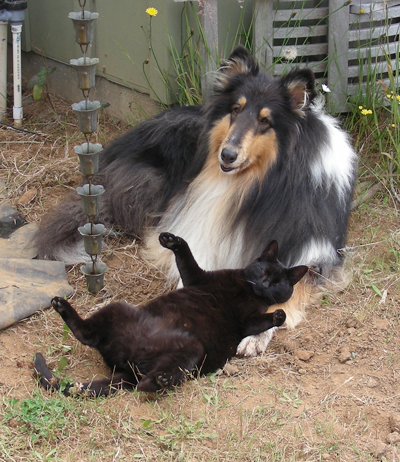
Niki and Eowyn, en flagrante something or other. Got another one that I’m going to upload to www.icanhascheezburger.com. If you haven’t been there and you have a sense of the ridiculous, highly recommended.

ART THOUGHT(S) FOR THE DAY

Two Views on Art:

Artists can color the sky red because they know it’s blue. Those of us who aren’t artists must color things the way they really are or people might think we’re stupid.

Jules Pfeiffer, famous artist

Anyone who sees and paints the sky green and pastures blue ought to be sterilized.

Adolf Hitler, failed artist

Friday Features

Think I’ll start a couple of quick Friday Features:

OUR OWN BACKYARD BIRD SIGHTINGS:

Current regulars: American Goldfinches, Least Goldfinches, Steller’s jays, ravens, crows, house sparrows

Semi-regular visitors: one pair Black-headed grosbeaks, an osprey (!), a great blue heron (we have a large pond), a red-shouldered hawk, barn swallows, violet-green swallows

The Very First for our yard: this morning, one male western bluebird

PLANET SAVER TIP OF THE DAY:

Honey bees are in crisis. Without them, kiss fruits, nuts and berries good-bye. Visit this link http://www.sfgate.com/cgi-bin/article.cgi?f=/c/a/2008/06/26/MNLA11FN5B.DTL, which was in today’s San Francisco Chronicle for more information.

What you can do: Set aside, say, a six to ten foot square or so in your yard and plant it with bee-friendly plants like lavender, coriopsis, sunflower, thyme and coneflower. Your local nursery should be able to point you to bee-friendly plants for your area. If enough people do this, it could make a real difference. Even better, replace some or all of your lawn. Just think, no more mowing, dethatching, fertilizing, weeding and you’ll save water, plus have flowers for your home.

BONUS

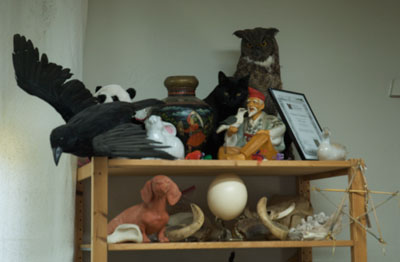
Find the live cat in this picture:


To Finish Yesterday’s Post….

I ran into serious problems posting the images of the kittens yesterday and finally gave it up and wrote to tech support. Turns out, doesn’t it figure, that it was something I had done with a setting that I shouldn’t have. But the reason I bring it up is to pass on how quick and great the tech support was! Three Cheers for WordPress!

So, since it’s the next day, here’s a new ART THOUGHT FOR THE DAY, one of my all-time favorites for truth and pithiness, from Edgar Degas, who knew a thing or two about painting:

“Painting is easy when you don’t know how, but very difficult when you do.”

NORTH COAST OPEN STUDIOS

Had a good turnout this year. Lots of nice people, many of them first time visitors. Here’s a photo of the studio ready to go, with Niki also ready to help with hosting. He appointed himself Official Escort To And From The Cars, much to the amusement of the attendees.

HOT OFF THE EASEL

Just finished this one yesterday. The reference was a print photo that I had been meaning to paint for ages. It’s important to see the warm tones in the snow leopard’s coat, which is similiar to polar bears. It’s an oil on canvas on board and is 24″x18″, so the head is life-sized or maybe a little larger. If you are interested in snow leopard conservation, check out the Snow Leopard Trust at www.snowleopard.org.

Ok, Time For Some Art

I love to paint. I love to travel. I love animals. Put it all together with supportive husband who used to stack up the frequent flyer miles, and you get a nature artist who has been lucky enough to go to Kenya twice, Mongolia twice and North American wildlife ground zeros like Yellowstone, the Grand Tetons and Glacier to sketch, observe and photograph a mouthwatering variety of wildlife and their habitats.

Ikh Nartiin Chuluu Argali

The painting above is “Ikh Nartiin Chuluu Argali”, a 15″x30″ oil on canvas. The name translates as “Great Sun Rocks Sheep”. My first trip to Mongolia was in April of 2005 to participate in an Earthwatch Institute project “Mongolian Argali”, which are the world’s largest mountain sheep. A ram can weigh over 400 lbs. and have a horn curl of 65″. In this painting I felt that I was introducing a species that not many people have seen, so I wanted to show them in their environment in the reserve, which is a large area of rocky outcroppings rising up above the steppe, which you can see in the background. “Ikh Nart” is about a five to six hour drive southwest of Ulaanbaatar on a road that largely parallels the railway line to Beijing.

They blend in very well with the rocks and so I designed my composition with the idea that the viewer would see the lead ram first since its head is in high contrast against the background and the second ram, well, second.

For more on my travels, visit my website. For more on the reserve, visit the website listed to the right.

Pond Visitors

It’s been interesting over the last year seeing who shows up at our pond. Photos will be forthcoming as soon as I get over a particularly persistent cold which is going around our area. Today we spotted a red-shouldered hawk for about the fourth time, so we may have our first winter raptor regular. The west end of the property (1 acre total) is being allowed to revert to native forest, but right now it’s shrubby grass. He’s perching up in a big Douglas fir next door, then flying over to some dead cascara buckthorn trunks and carefully inspecting the ground. Not sure what he’ll find. Mice, voles and shrews most likely. Maybe a frog or two.

Other avian garden visitors these days are juncos, robins, goldfinches and Steller’s jays.

The pond has also drawn a great blue heron (apparently a neighborhood regular named “Bill”), a great egret,  male and female belted kingfishers and, to our surprise, a double-crested cormorant. In the spring, to our utter amazement and delight, a movement caught our eye and we looked out from the living room just in time to see a juvenile osprey lifting off! No ducks yet, which I find kind of ironic, since that is was I thought we would get this fall. A friend gave us some teal decoys for a joke, but even they haven’t worked yet.

Turkey vultures occasionally circle over and there are resident ravens and crows.

I keep my camera handy so I can shoot reference as the opportunity presents itself. Missed the osprey and cormorant, but have gotten the hawk, heron and egret.

Just finished Prodigal Summer by Barbara Kingsolver. Highly recommended to anyone with an interest in nature! She is an amazing writer.

On the animal welfare front, I highly recommend Nathan Winograd’s new book Redemption, which presents a whole new way of looking at animal sheltering in this country.