Who’s Your Buyer and how do you get your work in front of them? We’re pretty much all going to have to be lean and mean in promoting our art. It’s called “targeted marketing”. Which means knowing who your buyer is.
When I went through the process of creating my marketing plan with a counselor from our local Small Business Development Administration (SBDC) office, the first homework I was given was to pretend that my buyer was sitting in a chair across from me and then describe them. Beyond the general question of who buys original art, who do you think will be interested in YOUR art? In my case, we somewhat humorously pegged my target buyers as “rich celebrity environmentalists”.
More realistically, it’s someone with a certain income level and probable interests in nature, environmental issues, travel and the outdoors. If you request advertising rate cards from a national magazine, they usually include demographic information on who their readers are to demonstrate the kind of eyeballs you can expect to view your ad. You can create the same kind of thing yourself to help decide where it makes the most sense to put your efforts.
I was talking about marketing approaches with an established artist at a wildlife art festival a few years ago. My specific question was where to look for galleries. His advice was to try place my work in locations where there were people “needing” to furnish second and third (!) homes. I’ve got to say, living in a county where the average income is $38,000 a year, that thought truly hadn’t crossed my mind.
Use the Internet- The world’s going digital. The US Postmaster just asked Congress for permission to cut the number of mail delivery days in the future because they are losing so much money. One reason is email and other types of online communication. I know that there are a lot of technophobic artists out there, but you’ve somehow got to suck it up and check it out, if for no other reason that using the internet takes time, but next to no money. At this point everyone pretty much knows that you have to have a website, same as you need a phone.
But when you bring up blogs, Facebook, Twitter, etc. the reaction usually seems to be a cri de coeur that there aren’t enough hours in the day as it is. My objection was that I couldn’t imagine that anyone would care what I had for breakfast (homemade muesli with berries from our garden, usually), so why should I take the time to do a blog. But……..when I evaluated it in terms of my marketing plan and learned how easy they are to do and that, unlike the website, I can update it myself at will in a far more dynamic way, I decided to give it a try. I approached signing on to Facebook the same way. An unexpected fringe benefit is the pleasant, informal contact with artists all over the country and the world.
Twitter I’m not sold on yet, but I monitor it with the idea that it will probably be just the thing at some point.
I encourage you to set aside an evening and check out Google’s Blogspot and also WordPress, which is what I use. Blogspot is probably easier to get started with, WordPress is more sophisticated in how it does things. You can register on both Facebook and Twitter, then just lurk around and see what you think. None of this is permanent. You don’t have to tell anyone. You can register and then cancel if you want. Be aware though that Twitter currently makes it very difficult to sign up again if you close your account.
Let me know if you start a blog or get on Facebook. I’ll be interested to hear what you think.
TWO NEW SMALL PAINTINGS
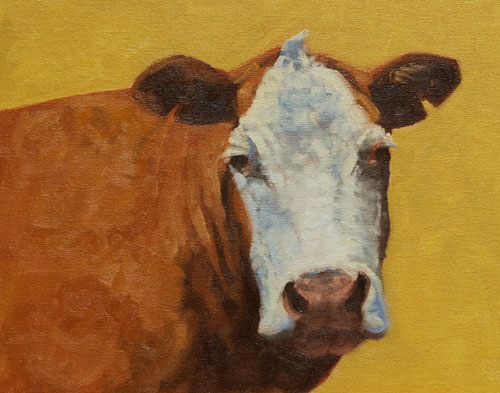
Hereford Study oil 8"x10"
I originally started this as a demo for my painting class and thought it would be fun to finish it. I also have a commission that involves Herefords, so it’s doing double duty.
Afternoon Light, Pismo Beach oil 10"x8"
I did this one yesterday in a couple of hours. Sometimes it’s fun just to smoosh the paint around.
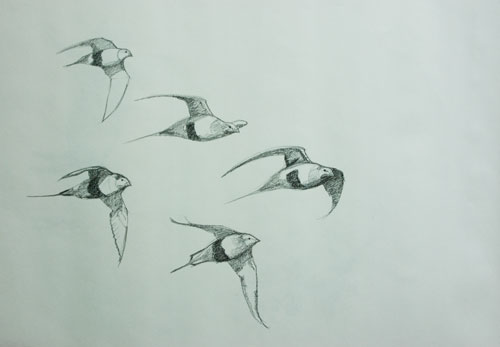
And, finally, a drawing of some grouse that I photographed in Mongolia. Not sure of the species yet.
Sand grouse, Wolff's carbon pencil on drawing paper
I really like the work of Mark Eberhard, who has a background in graphic design and uses it to great effect in his paintings. When I saw the image I shot of what was a good-sized flock, I was struck by the pure design possibilities. To be continued…..
Here’s a few bactrian camel drawings I did in about an hour this morning. They were done on vellum bristol with a Wolff’s carbon pencil. The head drawing is a little more finished. The full body study was really just to capture the pose and lay in the shadow areas. You can see how I corrected one of the hind legs. The small hind leg study was to learn more about the structure. So, one subject, three different goals. As usual, do try this at home.
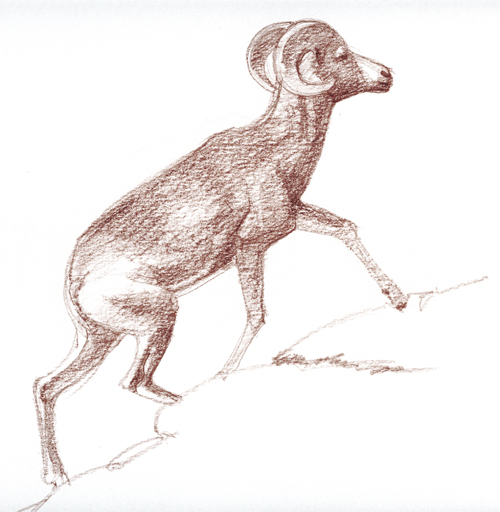
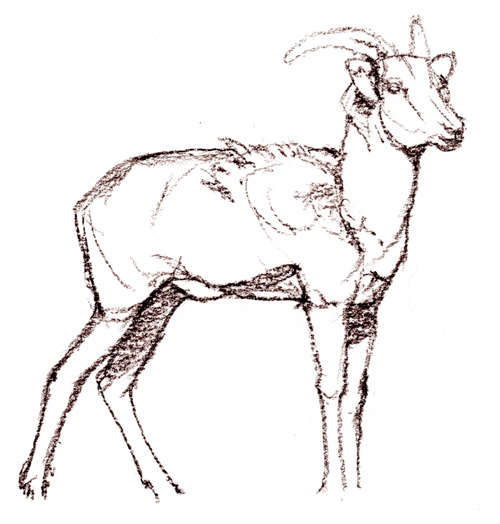
With the New Year come new painting projects. We try to take time off between Solstice and New Year’s Day because that’s when things slow down for my husband, who is the executive director of an information technology consortium, but I can’t stay out of the studio completely. I have a bunch of ideas for paintings with Mongolia subjects and this morning I thought I’d do a few drawings of argali and try different drawing media. All of these are done on 2-ply vellum bristol. None of the four took more than 15-20 minutes. The idea was to limber up after a break without worrying about doing a pretty, finished drawing. I wanted to catch the character of the animal and the rhythm of their body and movement. Please DO try this at home.
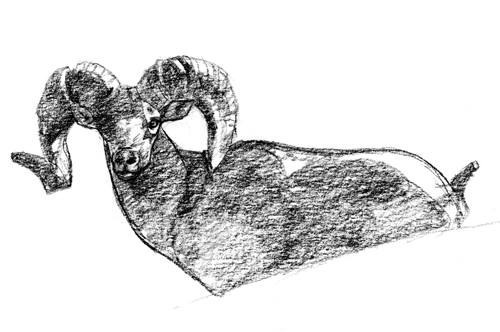
Argali Ram, Ikh Nartiin Chuluu, Sept. 2008
This is a try-out to see how he “draws” since I have a painting idea in mind. He’s a big, old ram with battered horns that will be an interesting challenge to paint. I also like the shadow pattern on his head. Drawn with a 6B Wolff’s Carbon pencil.
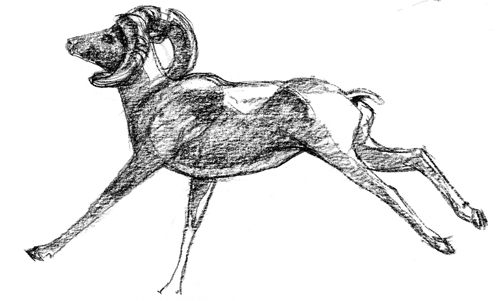
The gold standard in fieldwork for wildlife artists is the animal Doing Something. Prey animals like argali tend to be running away, so lots of butt shots. But this one took off from stage right to stage left, giving me a perfect chance to record a variety of leg positions. Also drawn with a 6B Wolff’s Carbon pencil.
Young Argali Ram Climbing, Ikh Nartiin Chuluu, Sept. 2008
Another jackpot. He’s going up the rocks parallel to me. Drawn with a Cumberland Derwent Drawing pencil, Venetian Red. These have a fair amount of wax in them, so are more like a fancy crayon. They feel soft on the paper. I don’t think I got very interesting line quality, but did feel that I caught the tension in the hindquarters as he is about to push off.
Argali Ewe Standing, Ikh Nartiin Chuluu, April 2005
This one is from pictures I shot on my first trip to Mongolia in April/May of 2005. The animals still had their winter coats. This ewe was part of a small herd which had come down to a stream for water one morning. I find 3/4 head views challenging, partly because I know that I have to compensate for the flattening effect of the photograph. Drawn with a 2454 Conte crayon. I hadn’t used these in awhile and found I liked the line quality and the way the Conte felt on the paper. This sketch took maybe ten minutes.
So you can see that what you draw with can really change the appearance of your drawing. The only way to know what will work best for you is to experiment with different combinations.
Since, judging from the stats, the subject seemed to be very popular, I thought I would continue today with more on the takhi, specifically how I take the reference I shoot and turn it into a painting. More and more I start with drawings to become familiar with a new species or figure out things about one I’ve painted before.
Here are three drawings from last year, the first two of which were published in the Society of Animal Artists newsletter.
Takhi scratching leg; charcoal pencil on cold-ply bristol paperTakhi mare and foal; charcoal pencil on cold-press bristol paper
Now I’ll show you how I take an animal from one time and place and put her in a setting from another time and place, a challenge that every wildlife artist needs to meet successfully. Here’s the setting:
Main takhi water source; Hustai National Park, Sept. 2006
What a treat! We came around the bend in the dirt track early in the morning and there, right in front of us were two harems at the same time, sorting out who gets to go first.
Watering place close-up; Hustai National Park, Sept. 2006
I always try for a variety of shots; close-ups and the “big picture” for context. I used to come home with great close shots of something like a tree and found that I’d completely forgotten to get the surroundings, which really cut down on my options. Notice that the above photo is kinda fuzzy. But it’s still useable for reference.
Now here is the horse reference. Different part of the park, different year, different season. I’ve included two as an example of what to look for when evaluating images. These are similar, but the second, to me, is clearly superior. I love the rhythm of her gesture.
Takhi mare; Hustai National Park, May 2005Takhi mare 2; Hustai National Park, May 2005
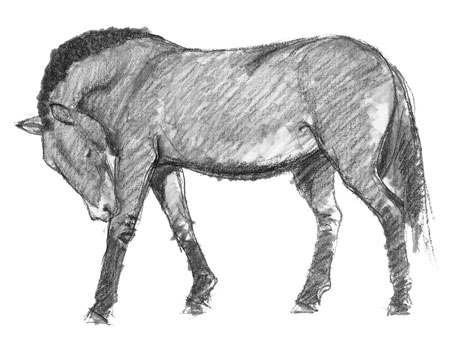
So next I did a drawing to capture that.
Takhi mare walking; charcoal pencil on cold-press bristol paper
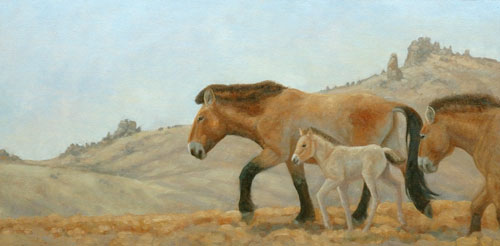
And, putting them together, here is the finished painting, completed in 2007. What I hope is that you can’t tell that I “stitched” together the reference from two sources.
Morning Drink oil 12x 16" (price on request)
I also wanted to let you know that two of my takhi images are available as limited edition giclees, framed or unframed. The full information is on my website. Click on “Limited edition giclees” under Fox Studio in the column on the right and it will take you directly to my giclee page.
Takhi Foal; giclee on archival paper
I saw this foal on the same trip as the mare in the painting above. He or she was quite a character.
Mongolia Morning; giclee on archival paper
I posted this last week, as the original painting is still available, but have also published it as a giclee. It’s another example of how I took the mare and foal, who were against a grassy hillside and moved them to a ridge that has Hustai’s famous mountain as the background. The third horse was added as a design element.
All my giclees are available for holiday delivery.
ART THOUGHT FOR THE DAY
Let this be plain to all: design, or as it is called by another name, drawing, constitutes the fountain-head and substance of painting and sculpture and architecture and every other kind of painting, and is the root of all sciences. Let him who has attained the possession of this be assured that he possesses a great treasure…:
I recently received an email from an art student in Northern Ireland (wonders of the internet!), who is doing a paper about an artist whose work she likes for her “A Levels”. That artist would appear to be me. I liked her questions since they got me thinking some more about what I do, why and how. So I thought I would share it with you:
1.Why did you choose animal art?
As I think about it, it might be more appropriate to say that it chose me. I drew animals more than anything else as a child by far. When I was back in art school at age 35, I tended to think of using animals for my assignments. When I moved to “easel painting”, I started doing animals early on and when I learned about the field of wildlife art, that pretty much sealed the deal. I do enjoy other subjects, but it has always been my animals that have drawn the strongest response from people.
2.How would you gather information for your topic (ie do you study the body movements of animals, go to the zoo etc)
I do fieldwork trips every year to see animals in their own habitats and also visit zoos whenever possible. I have a large reference library that includes a number of books on animal anatomy. I sketch from live animals when I can and take a lot of photos. My digital image library has over 10,000 animal pictures alone, taken since 2004. Plus hundreds of prints from before I went digital.
3.Have you ever been influenced by a person or place?
Yes, I seem to be the kind of artist who is inspired more by what I see in the natural world, as opposed to a more purely internal vision. Taking a master class from John Seerey-Lester in 1997 was probably the greatest single reason I’ve become an animal artist because of his encouraging words about my paintings, which made me believe that I could succeed if I was willing to work hard.
The four places that I find most inspiring are Mongolia, Kenya, the Yellowstone/Wyoming/Montana area and my own home ground of northern California.
4.Is there a particular artist whose work has inspired you?
If I had to name one, it would be Bob Kuhn, a legendary illustrator who became one of the two or three top wildlife artists of the 20th century. I’m inspired by the quality of his draftsmanship, design/composition, his painterly technique, his knowledge of his subjects and his uncompromising willingness to do what it took to get reference he needed. He’s my role model for everything a wildlife/nature artist should be. He passed away last year.
5.What media do you prefer working in and why? Is there a medium you are not comfortable with?
I work in oil. The original impetus was having wanted to paint in oil since I was a child, but now it’s because it’s the medium that most lets me express my vision of a subject. I love everything about it except the fumes, so I pay attention to proper ventilation.
I’m probably least comfortable with something like pastels, for the very pedestrian reason that I don’t like having my hands messy while I work and I don’t want to wear gloves.
6.My favourite piece of your work is ‘Double check’, how did you come up with the idea and how did you gather photographs etc to help you?
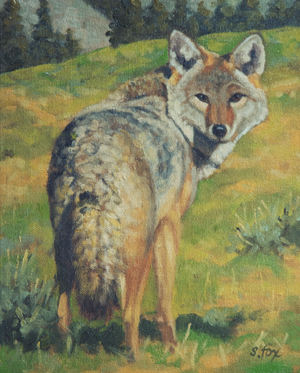
Ah, I just delivered that painting to the buyer. It’s one of my favorites ,too. I hadn’t done a coyote for a long time and I have some great reference of them that I shot over a couple of trips to Yellowstone and the Grand Tetons. I was looking for an image that would work at a small size and had interesting light. I also look for an aspect that represents something authentic about the animal and what they are like, both as a species and as an individual. The painting used two pieces of reference, one of the coyote and one for the background. So I already had the reference for that one.
Double Check oil 10″x8″
7. When did you realise your talent for art and why in your opinion is animal art so effective?
I can’t remember a time when I didn’t draw. I don’t know how much talent I have, but I’ve been willing to work hard for a long time. I’ve been told that my animals have “life” in their eyes and I agree, but that seems to happen without conscious volition on my part, so maybe that’s my “talent”.
Human affinity for animal images goes back to the Stone Age, as can be seen by cave paintings and pictographs. We have literally shared our lives with them for over 10,000 years (in the case of dogs). We share our world with them. Every culture has some relationship to animals, mostly positive, sometimes negative, but a connection nonetheless. We see ourselves reflected in them. We project ourselves and our emotions, ideas about good and bad, and our needs onto them. Images of animals and our liking of them are one facet of that long history.
8. Do you have any future plans for your art?
To continue to grow as an artist and get better. To always look for new ways to more accurately express my vision. To use my art to promote conservation and environmental issues, while making a decent living.
9. What do you think is unique about your art?
My vision and point of view and how I express that stylistically. Which really is, or should be, true for any other artist, no matter what their subject matter or medium.
10. Where do you paint and do you find the environment you work in important?
I have a 450 sq. ft. studio at my home. I have worked in a variety of environments, including a garage, and would have to say, that, yes, it’s important. I need an organized, properly lit space. I need the work space to not get in the way of doing the work.
11. When it comes to doing the fur on the animals, what do you find to be the fastest but most effective way for this?
I don’t personally think that speed, per se, is the goal. First comes the decision about what your vision is and then, what is the most technically appropriate way to accomplish that? Having said that, however, I have no interest in detail for it’s own sake. I would find painting every hair boring to do and usually find it boring to look at. What challenges me is seeing how much I can simplify and leave out and still communicate something like “fur”. So, I don’t literally think “fur” when I’m painting. I’m thinking shape, value, color, color temperature, visual texture, etc., which is a more abstract level. If all those come together then that area will say “fur” even though it’s really just blobs or spots or strokes of paint.
12. Is the background as important as the animal itself?
I would answer that somewhat indirectly by saying that the idea of the painting is the most important and every element present must support that idea, whether it’s the animal or the background. It all has to come together as a coherent whole.
13. What scale would your art normally be and how long would it take you to complete?
The smallest paintings I do are 6″x8″ and, so far, the largest is around 36″x48″, plus a variety of sizes in between. I decide on the subject first and then choose the size and proportion that will best suit the idea I have.
I can finish a small painting to be used as a study in a couple of hours. “How long does it take?” is a question artists get all the time and the answer is usually some variation on “It depends.” It depends on how complex the composition is, how much preliminary work was necessary, how many changes were required along the way, whether one got stuck and had to let the thing sit for a week, a month, a year.
14. Were you hoping to strike any emotions from your audience? if so what?
I think that part of what defines something as “art” is whether or not it elicits an emotional response in the viewer. So, yes, I guess I always hope for that. But I’m really more concerned with recording my emotional response to my subject than trying to project or control that of the viewer.
15. Which is you favourite piece of your own work and why?
Whatever the latest one is that came out the way I’d envisioned it. Currently it’s the Cape Buffalo Head Study. It may be the best painting I’ve done so far and I did it as demo over the course of about six hours at an art festival with constant interruptions. Interesting, in view of my earlier comment about my preferred working environment and that I hadn’t envisioned anything in particular about it except to have something going to draw people into my booth.
16. Is there anything that motivates you whilst painting?
The thought that somewhere, sometime, someone viewing my work might be inspired to become actively involved in working to save our planet. It needs all the help it can get.
May all our interviews be so merry and bright.
NEW COMMISSION
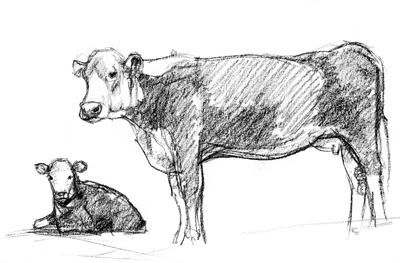
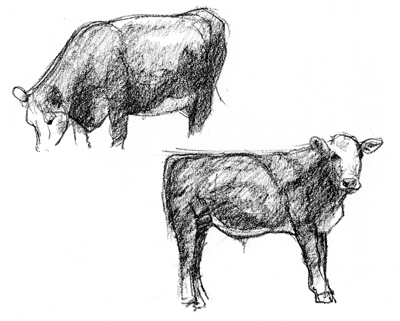
My most faithful collector and I have had a list of paintings that she would like me to do. Since she grew up on a cattle ranch in Southern California, she wants a painting of an oak tree with polled Hereford cattle, plus a few other elements. So this is where my illustration training kicks in. I find this kind of thing fun if, once the content is decided on, I am left to solve the problem and paint it as I see fit. I have now started the sketches. I haven’t drawn cattle much, so that was the first step. Here’s a few that are promising-
Hereford cow and calfYoung Herefords
ART QUOTE OF THE DAY
“You do not have to go very far to find suitable subjects. The cat lounging on your sofa, the horse down the road, yours or your neighbor’s dog; all are proper subjects and all will give knowledge which can later be broadened by trips to the nearest zoo or museum. My old friend and counselor, Paul Bransom, was the man who first urged me to go to the zoo, and to draw, draw, draw, Even the best reference sources don not take the place of real knowledge of animal structure. That can only be gained by putting your time in with the animals.”
I don’t know about other artists, but after a long trip it takes a little internal shove for me to get going again. I need to shake the rust off, get in the groove, just….start…..working.
I also spent some time thinking about my work procedures. I love to paint and tend to dive in, flail around and pull it together, or not. I’ve got some ideas about what I want my work to look like and have come to conclusion that I need to spend more time on the preliminaries, especially for larger works. That means drawing, drawing, drawing. Plus value and color studies as needed.
Winter is when I try to push my work to the next level and experiment and, since the first winter storm of the year arrived yesterday, I guess it’s time.
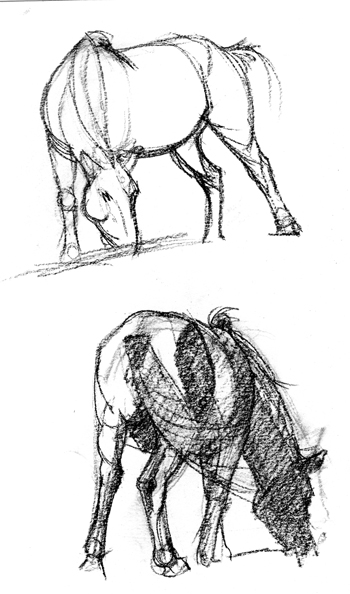
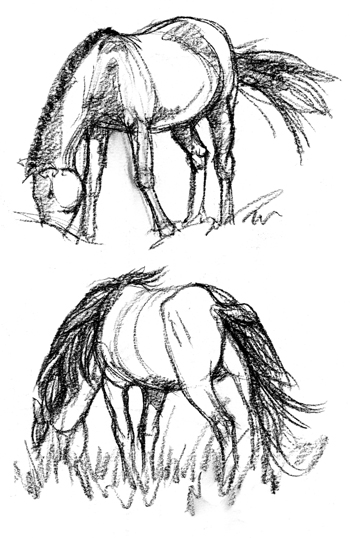
This week I’ve done a pile of charcoal drawings of the Mongolian horses, which I got fantastic reference photos of. I’ve always struggled for some reason with poses where the horses have their heads down, grazing, so I decided to get a handle on that once and for all. What worked was doing the body first and then adding the head. I’d been doing it the other way around, to my eternal frustration.
Here’s a selection of some I feel came out ok. They are done with a 6B extra soft General Charcoal pencil on 2 ply Strathmore Vellum Bristol and are unretouched. I’m always looking for what will add to the illusion of three dimensional structure and a body in space and what will help me get a handle on the anatomy.
These took 15-20 minutes each.
I also want to get some action into my work, so here’s a couple of running horses.
No idea if any of these will find their way into paintings, but I enjoyed doing them.
ART THOUGHT FOR THE DAY
“Artistic growth is, more than anything else, a refining of the sense of truthfulness. The stupid believe that to be truthful is easy: only the great artist knows how difficult it is.”
From the stats it looks like the post of my pet sketches was one of my most popular so far, so here’s more. These are done the way I usually work, with a fine tip gel pen. They’re done fast. Under five minutes, sometimes under two.
Niki, our tri-color rough collie
From the San Francisco Zoo. He really did hold still long enough for this head study.
These were ultra-quick, a minute or less, but I caught the gesture. Also San Francisco Zoo.
And, looking through my old sketchbooks, I came across the studies I did at Julie Chapman’s workshop in 2005. These are of Daisy, the badger, who alas, is no longer with us. Notice that I didn’t worry about eyes. I was trying to capture “badgerness”.
If you decide to try this, and I hope you do, keep in mind that every animal is an individual and look for what makes them them. If you like what I do, I think that’s a big part of it.
I’ll end with the bobcat painting, now called “Stepping Lightly”. I’m thinking of punching up the highlights on grass and maybe futzing (that’s the technical term, of course) with the logs some more, but that’s about it.
PLANET SAVER TIP OF THE DAY
This one’s easy. Start to become aware of how you use energy. You can save money and help slow down climate change by using less and using it more wisely. Just little stuff to start- turn lights off when you leave a room, don’t leave the tv on if no one is watching, turn your thermostat down a couple of degrees or up, depending on the temperature where you are.
Now, you must know that this kind of thing, while necessary and desirable, is the “low hanging fruit”. It requires simple changes of habit, not real sacrifice. If you’re already doing the above and are ready and able to take the next steps, consider updating your older appliances to new, energy-efficient models. Change your incandescent light bulbs to compact flourescents or LEDs.
Julie Chapman recently posted a couple of sketches of her dog on her blog (no, we won’t go there). A series of comments followed about the value of drawing.
You can read my comments here: http://julietchapman.com/blog/?p=59#comments . They’re #5 of 6. She just finished doing her summer animal drawing workshop outside of Kalispell, Montana at the Triple D Game Ranch. I attended a few years ago and found it very worthwhile.
So, she challenged the readers of her blog to get out the charcoal and draw along. I accepted. It took a few more days than I’d hoped, but here’s the best of what I came up with over about an hour this morning. One challenge was drawing kittens that are black and fluffy. A little hard to see the structure. I also found that they would get up and come running to the front of the crate every time they saw me watching them. The trick is to ignore all that and go for the gesture. These took maybe 15 seconds.
Then I went into the house and there was Persephone, aka The Princess, taking her morning princess nap on the bed. She then sat up and I got a quick start on a head study. Didn’t get all the stripes in, though.
Finally, next to the window on the floor, Niki the collie was zonked out. This one is mostly coat (he’s got a big one!), but the curves were nice.
I used a 4B Wolff’s Carbon pencil for all the sketches and a Canson Universal Recycled Sketchbook. The paper has a good amount of tooth for the pencil.
ART THOUGHT FOR THE DAY
Today’s thought is from Edgar Payne’s seminal book, Composition of Outdoor Painting, which every artist who paints outdoors or anywhere else, for that matter, should have. It’s expensive and might be hard to find, but it is as good a presentation of the traditional craft of oil painting as you will find.
“While talent or genius must exist, at best they are merely embryonic factors and no one can guide these into productive artistry without the initiative, perseverance and determination of the student. To say that the artist is born and not made, is only partly true. Actually, while it is an important qualification, there is no proof of real worth in talent until it has been developed and expanded by a tremendous amount of serious study and hard work.” (Bold added by me)
I had a terrific time doing North Coast Open Studios this year, not the least because I sold the coyote painting shown below in my June 3 post. The title is now “Double Check”
Lots of nice people, most of whom had not been to my studio before. On Saturday afternoon, one couple stopped by who had driven all the way from Ukiah just for the event. She had researched the artists and chosen the ones they wanted to visit, since, with over 100, there wasn’t time to see them all. I was very flattered to make the cut!
I’m now in prep mode for the Marin Art Festival and will head south on Friday. Really looking forward to it. Temperatures are supposed to be in the 80’s, though. I paid an extra $25 for electricity, so the portable fan goes with me. I ain’t suffering for my art if I can help it.
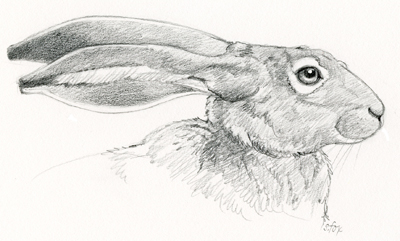
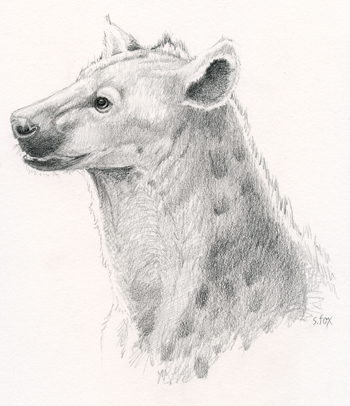
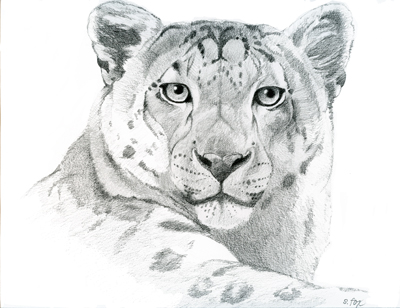
Today I’ve been scanning drawings for new notecards. Here’s three of them, a jackrabbit, spotted hyena and a snow leopard:
The next big event for me locally will be Wild Visions 2, a group show consisting of myself, Paula Golightly, John Wesa, Linda Parkinson, Shawn Gould. This time we are showing with Meridian Fine Art at the Umpqua Bank Community Gallery. There will be a reception the second Friday in August, so save the date! More as it gets closer.







 Susan Fox, American Artist