I was down in the San Francisco Bay Area this past weekend and got a chance to spend a couple of hours at the Oakland Zoo with family. This was my first chance to use the iPad for drawing live, wild animals. It was sunny and warm. In fact, I believe San Francisco hit a new record high, 80F.
The only drawback I found to using the iPad is that I still just have a basic folder cover, so it wasn’t very secure. And I found it a distraction to have to worry about it falling into the tiger enclosure or being jostled and dropping it. I’ve got some ideas about what kind of carrier would solve those problems, though.
In the meantime, here’s the results. I really liked being able to quickly change colors, line width, etc. without fumbling around in my pockets. These were all done very quickly, one to three minutes or so. The granddaughters were along, so I needed to be ready to move on. Good practice.
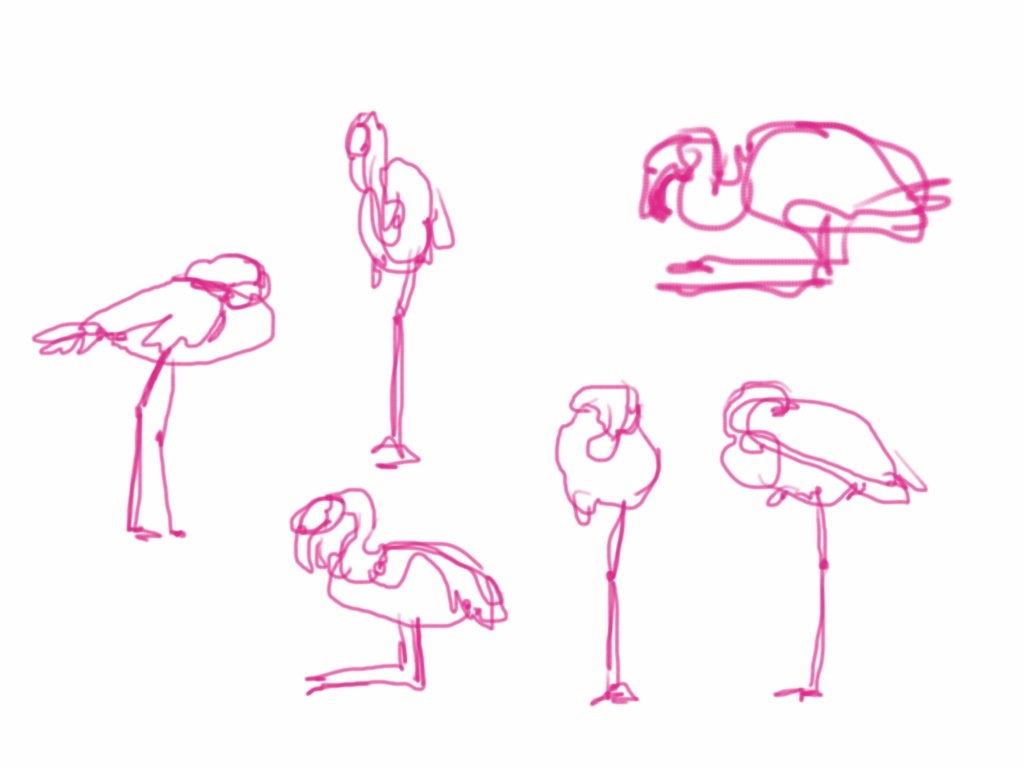
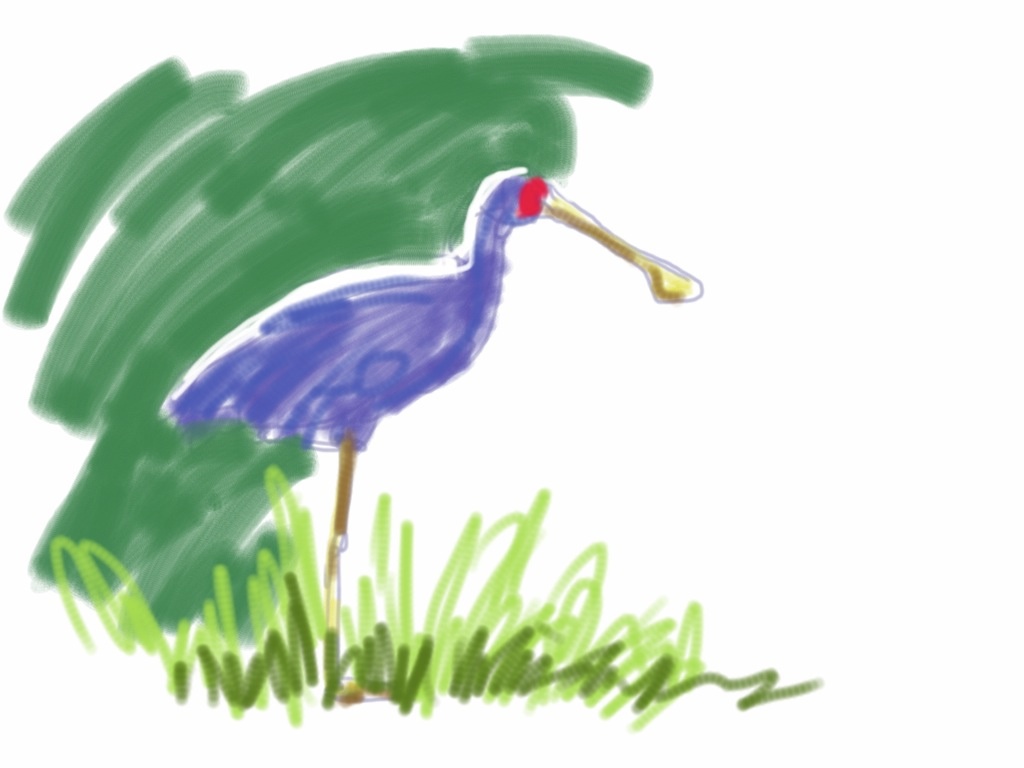
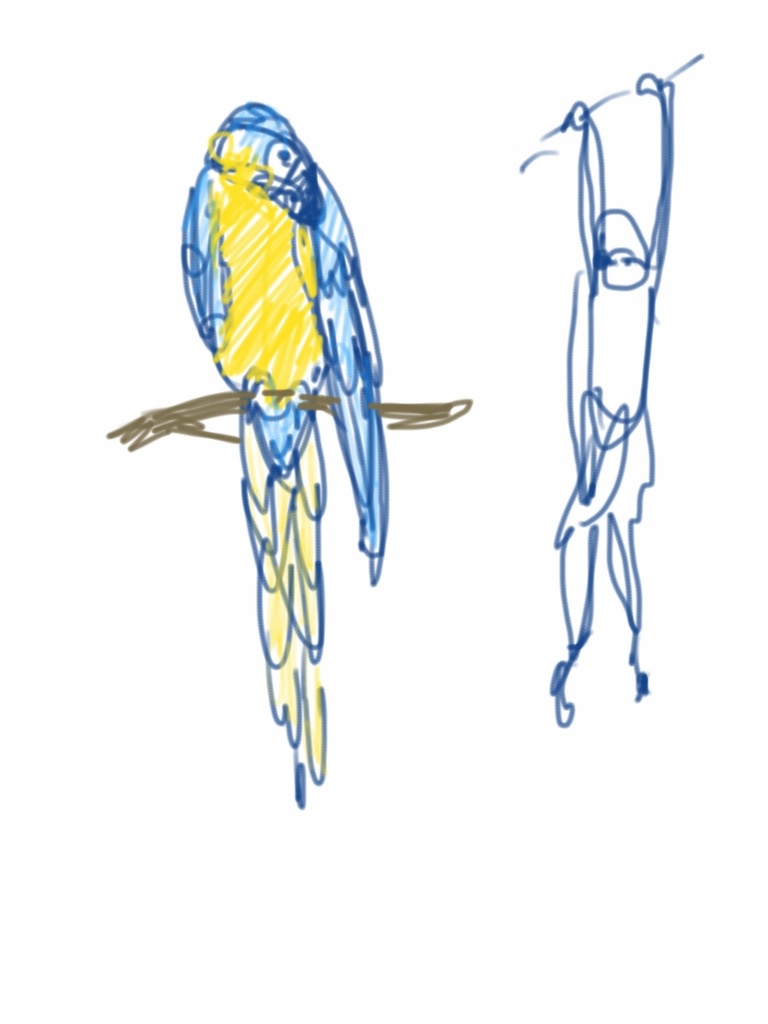
I started with the flamingos because they weren't moving muchThere were also a couple of spoonbillsIt was fun doing them in pinkThought I'd try to capture the bird in shadow with rim light against the dark backgroundMacaw and gibbon apeAmerican alligator; when there was time, I added a second colorI love bats! It was such a treat to sketch themJust hangin' aroundI had about 30 seconds to have a go at this pot-bellied pig
I used the Ten Design Pogo Sketch stylus for all the drawings. It worked fine, but the foam is starting to fray a little. Definitely will be experimenting with DIY options.
I’ve had my iPad for about three weeks and am already wondering how I got along without it.
It’s easy for me to read on it and I’ve downloaded my first book, Isaac Asimov’s Memoirs, if you must know.
I’ve played to the end of Graffiti Ball. I’ve got Solitaire, Cro-Mag Race and Paper Toss. David and I have found that we like playing Scrabble with it.
I’ve downloaded the iPad version of the Monglian language app that I have on the iPhone and also found a English-Mongolian dictionary.
Google Earth looks really good.
I plan to use Keynote for a virtual portfolio of my work and a presentation about the women’s crafts collective that I work with in Mongolia.
The battery life is terrific. The glossy screen is lovely. The keyboard, well, it’s functional, but will take some getting used to. I wouldn’t write the Great American Novel with it, but would certainly do short blog posts or longish emails.
But, I wondered, having bought Autodesk’s Sketchbook for the iPhone, could I use the iPad as a real, functional, I just need to get some work done, sketchbook? I bought Sketchbook Pro first thing. With some caveats, which I will cover at the end, the answer is a resounding “YES!!!” I had to force myself to stop drawing and get this post done.
The iPad should be viewed as simply another way to create images. A different media, if you will. And one that takes the same kind of futzing around, experimenting and practice that would be required to get the hang of any new way of working. Except that it’s a whole bunch of ways in one app that can be endlessly combined.
I’ve barely scratched the surface as this point, but thought that I would share some of what I’ve drawn and “painted” over the last week or so.
I first had to decide what tool to draw with and what color. I decided to see if I could replicate David Rankin’s fast sketching technique because, if I could, then the iPad would be all I would need for field sketching at zoos and such. Here’s some experiments, the ones I considered reasonably successful. The others have gone to the big wastebasket in teh interwebs.
Gobi Monastery gate, from July 2010 trip to Mongolia; this was the first keeperHerder's dog; started to see how to add color
These next ones are all done really fast. Maybe a minute or so.
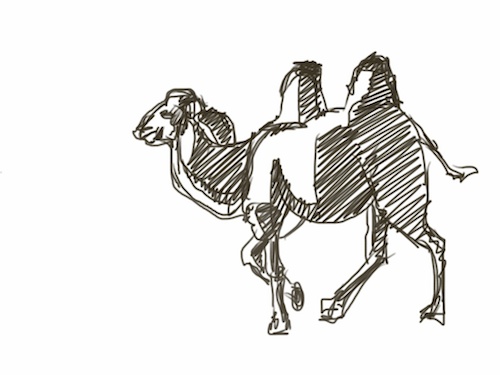
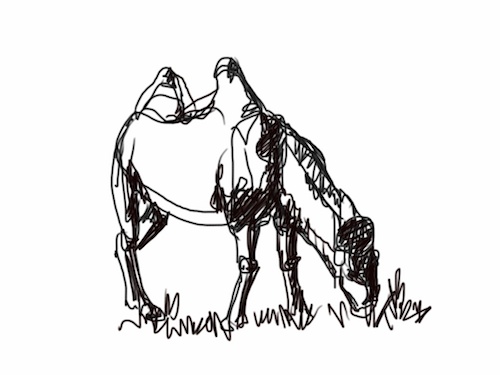
Bactrian camel; trying different tool and valueAnother experimentI like this one. Used a chisel point for thick and thin lines.My thought here was to see if I could do a prelimary quick sketch for a painting. Two guys riding a yak.
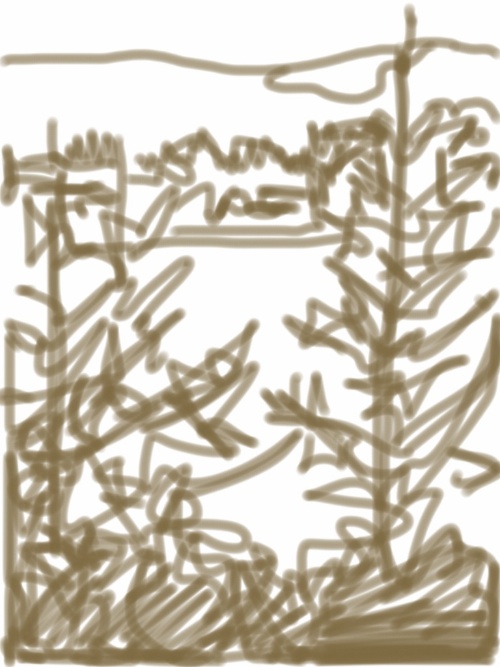
Then we went to the Humboldt Bay National Wildlife Refuge and I took the iPad with me. I realized that I didn’t know it well enough to do much, but I did do this one sketch that turned out ok. It’s from up on Table Bluff looking east across the bay.
First location sketch
When we got home I decided to try something finished in full color from a photo I’d taken that day. I beat this thing to death adding layer after layer and, you know what, it didn’t matter. I could just keep going as long as I wanted to.
Trees at the refuge
So I had a scribbling good time on that one. But how about a “real” drawing of an animal. A couple of false starts, I did the lemur and realized that this app was for real. It probably took me somewhat over an hour because of picking my way through all the choices of tool and colors. At this point, I also started to really use the “Radius” setting, which is the diameter of the tool and “Opacity” which is how solid the color is. And that function is what really makes this go for me more than anything else, I think.
Lemur, Bronx Zoo
I started an argali drawing, got it almost done, leaned forward, accidentally pushed the button at the bottom of the iPad, which closed the app, unfortunately having not saved about an hour’s worth of work. All gone. Oops. Lesson learned. But here’s the starting drawing, which is pretty much the same as what I do with a brush or pencil.
Start of argali drawing; and the end, as it turned out.
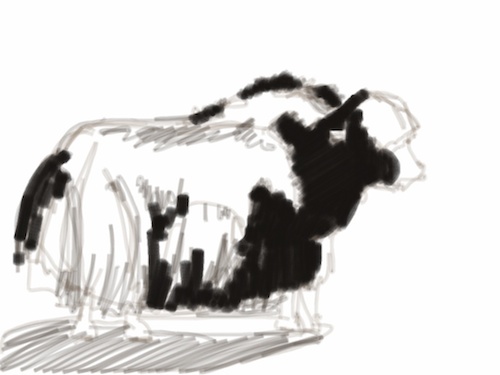
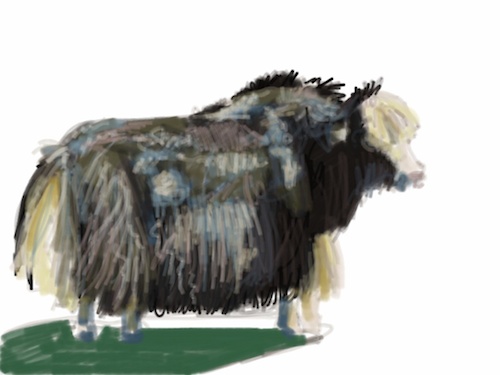
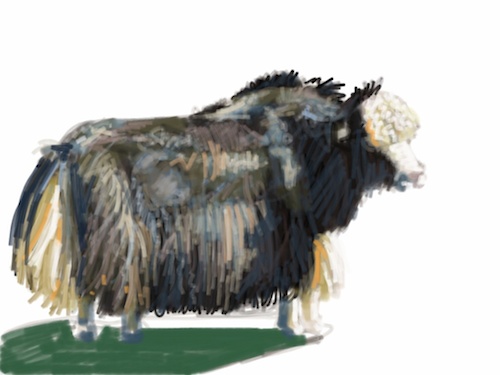
This morning I did the following drawing of a yak, wanting to have something more finished to go with the lemur. I did my saves this time, so I can show you the whole sequence from start to finish. It took about an hour and a half. I used the same procedure as usual.
DrawingShapes of shadowsLaying in the darkest darksPutting in a layer of color all overThe process of refining shape, values, drawing beginsMore layers of colorThought I was done and, anyway, it was lunchtime.But came back and realized that the highlights on the hide were too bright.
I could keep going on this guy, smoothing the transitions between areas and doing more with the ground, but I’ve gotten all I need from this one, so time to move on. It was fun though, especially adding the squiggles on the head.
Now, the caveats:
The first eight drawings, up to the lemur, were done with my finger. I was surprised at what a decent result I got, but I needed something with finer control and which was a wee bit thinner because said finger blocked my view of what I was working on. We went by the local Apple affiliate store and I bought a Ten One Design Pogo Sketch because….it was the only stylus they had. As it turned out, it works pretty well. But I would still like something with a smaller tip. There doesn’t seem to be anything out there at the moment. The stylus tips have to be a special kind of foam that will conduct electricity, which is how the touch screens work. There is some DIY info. on the web that shows you how to make your own and I’m thinking I might try that.
Moving the foam tip around on the screen doesn’t have a great tactile quality. It’s kind of smooshy and draggy. And I wonder how long the foam will hold up with the kind of use I intend to give it. I still need to put a removable clear film on the screen, so maybe I can find something that is slicker. Someone needs to make a special clear film for artists that has the right amount of friction.
Overall the functionality of Sketchbook Pro is really good and pretty intuitive. I’ve read the documentation and don’t recall seeing any of these addressed: I would like to have a side bar, like in Photoshop, that let’s me keep the tools and color selector in view. Having to toggle back and forth can get a little old. But it does give one the maximum real estate for drawing. I’d like an auto-save option (imagine that) that can be set to a choice of intervals. I want an eraser. Right now, I have to change colors and select white to erase.
I’d like to be able to directly import all or a selection of drawings into Aperture without having to export them to Photos on the iPad first. But the whole process was easy and worked well, except for the part where every image was re-named “Susan on the camel.jpg” (a previous project) when I exported them to my blog folder instead of the names I took the time to give each drawing in Sketchbook. Aperture also insisted on creating a new Project for the images instead of letting me import them into the album I had created for them. The two apps need to learn to communicate better.
I’d like the images to be in a format other than jpg so that I can process them in Photoshop if I want to without losing image quality.
I would like to be able to access the user manual in one click.
In conclusion:
The combination of the iPad and Sketchbook Pro is very close to being a serious product for serious working fine artists. I absolutely recommend it.
Well, I’m back in the saddle after a great vacation in Hawaii with my husband. First order of business in the studio is to finish some drawings that I have promised to do for the people at the Sierra Endangered Cat Haven to thank them for their warm welcome (and fixing my broken van). I did this study of their clouded leopard yesterday, truly one of the most beautiful of the cats.
It’s been fun to get back to this kind of finished graphite drawing. If you like good drawing and good commentary, check out Terry Miller’s blog, Pencil Shavings. Very inspirational.
I’ve admired Ron Kingswood’s work for years, since I first saw it and met him at the Southeastern Wildlife Exhibition. His work has changed since then and he has gone far beyond what is conventionally considered representational art, much less what most people think of as wildlife art. And that’s ok. Too many artists reach a certain developmental point and stop learning or they gain a satisfying level of success in the marketplace and are then trapped by the expectations of their galleries and collectors.
Now, he’s contributed an essay, “Is Animal Painting Dead?” to the online publication Wildlife Art Journal. Not too many comments there yet, but it’s buzzing on the magazine’s Facebook page. Here are links to the editor’s introduction, the essay itself and the Journal’s Facebook page.
If The Conversation About Art Isn’t Real, What Good Is It?And by the way, Wildlife Art Journal is the only source for what’s happening in the animal are world. They deserve support and currently have a special subscription offer going of $8 a year.
I spent a day last week at the Ornithology Department of the American Museum of Natural History (AMNH) in New York City, doing research for a painting that I have been asked to do. I’ll write more about this project as it goes along, but this was a necessary first step.
Readers of this blog know how uncompromising I am about seeing my subjects in the wild and how much doing fieldwork feeds into an animal artist’s paintings. In this case, however, no matter how much money I was willing to spend or how far I traveled, I wasn’t going to see this species in its native habitat for the simple fact that it has been extinct for almost 100 years.
The Carolina parakeet was the only member of the parrot family native to North America. Although the passenger pigeon is better known, this very colorful bird also originally was seen in enormous flocks in a range that covered most of the eastern United States from the Atlantic to Florida to Ohio and west to Kansas. They were shot for their feathers, meat and because they were considered a pest, as they liked grain fields and orchards.
And now, except for specimens in museums they’re gone, all gone. Forever.
So my only option was to do my fieldwork at one of those museums. I was going to be in New York for a Society of Animal Artists board meeting and was able to secure access to the rare and extinct bird collection at the AMNH. The room is locked and every drawer in it is locked. After all, there won’t be any more specimens collected of any of those species. I spent all day with two drawers of fifty skins, plus a number of mounts, measuring, photographing and sketching them. And marveling at how beautiful they were.
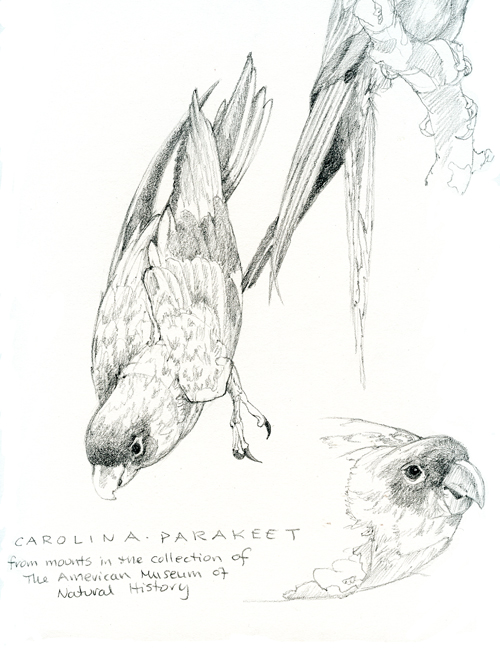
Now back at home, I’ve started to do drawings in graphite to learn what the birds look like. I will have to rely on the understanding, accuracy and competence of the taxidermists of the AMNH who prepared, preserved and mounted them. I hope to get permission at some point to post some of my photos, but for the time being what I can share is the art that I’m creating from them.
Carolina parakeet studies from taxidermy mountsCarolina parakeet studies from taxidermy mounts
I will be working with a few colleagues who specialize in painting birds to ensure that I get their structure and body positions as correct as possible. I will also be consulting videos of a couple of similar species to see how they move and behave. This is a challenging commission, but one that I know will be very rewarding.
But first, here’s the link to the blog of fellow Society of Animal Artist member and great sculptor, Simon Gudgeon, who resides in the UK. His latest post is an excellent discussion of wildlife art and its place in the larger world of “fine art”. Here’s one bit that I particularly like: “…too many artists use photographs rather than their minds and let the photograph dictate the finished artwork. An artist should observe their subject and decide how they want to portray it, or take a theme or emotion and work out how they can use a wildlife subject matter to illustrate it.” Truer words….
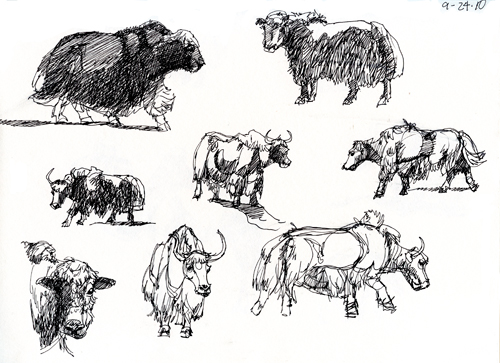
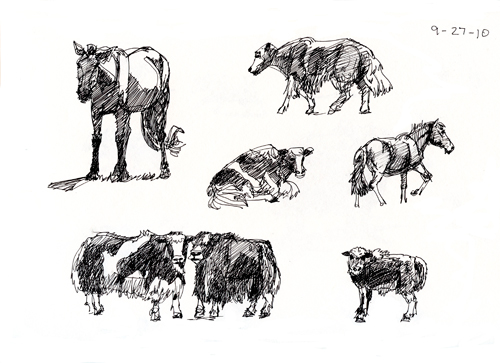
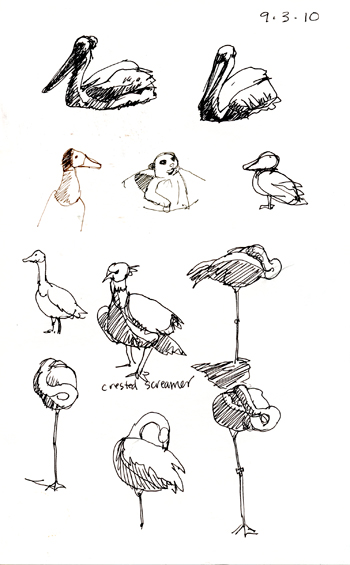
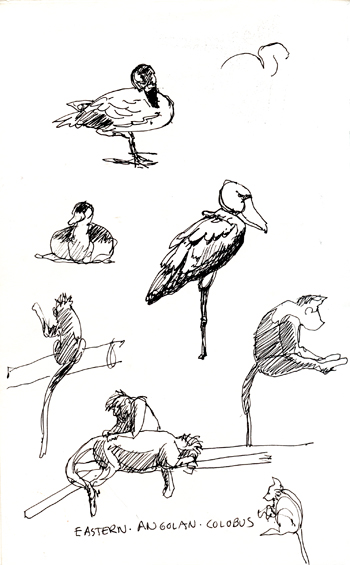
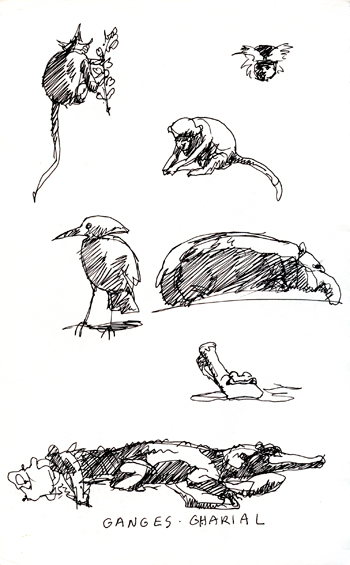
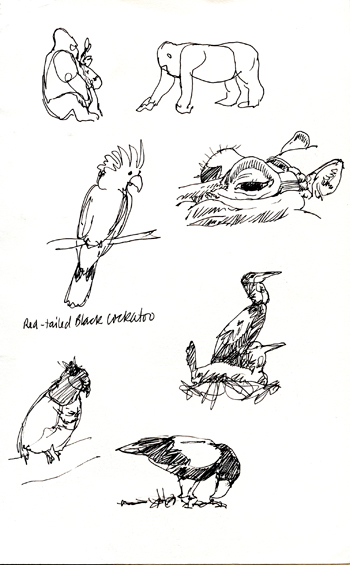
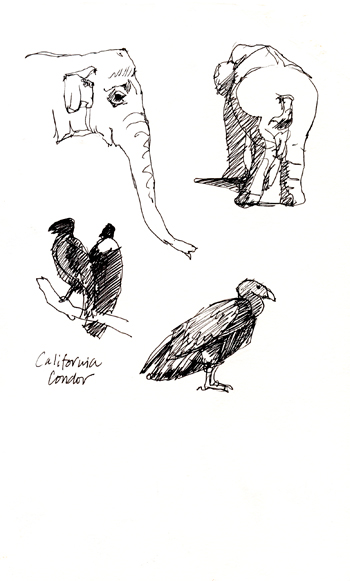
In the meantime, I’m having fun in the evenings, while we watch the San Francisco Giants possibly close in on their first Division pennant since 2003 (tonight might be the night!), doing more quick sketches with a gel tip pen in a Strathmore Universal Recycled sketchbook. Once again, these don’t take more than a few minutes each.
If you decide to try this at home, and I hope you do, look for photos of animals with distinct light and shadow sides, using that to emphasize form and structure where possible. I think you can see below that the most successful sketches have interesting shadow shapes. I also keep each most of the sketches to two values, light side/shadow side. There’s a couple where I added a third, intermediate value because it was a black animal or a black and white animal and I wanted to show the black part in light and shadow. The all-white yaks were actually….black yaks, in flat light.
Domestic Mongol yaksYaks, horses and a domestic bactrian camelHorses and yaksYaks, horses and common shelducks
A few months ago I blogged about a terrific book by nationally-known artist David Rankin called “Fast Sketching Techniques – Capture the Fundamental Essence of Elusive Subjects”. You can read about it here.
While I was at the Society of Animal Artists 50th Anniversary Exhibition, the pre-show opening activities included full days at both the San Diego Zoo Wild Animal Park (since re-named the San Diego Zoo Safari Park) and the San Diego Zoo. I had already planned to do more sketching than photographing, so had what I needed. What I hadn’t planned on was getting to spend part of one day and almost all of the next sketching with…David Rankin! What a difference it made to watch how he does his fast sketching. And once I got the hang of it, I was hooked. I did around three times the sketches that I would have done before. And they were better, too.
Another point that David made that really, really helped me was his observation that every media or drawing tool can be compared to a musical instrument. Each one has to be learned and mastered on its own. As he said, a piano is different than a violin.Watercolor is different than gouache. Charcoal pencils are different than Conte crayons.
I have always assumed that drawing is drawing and that I should be able to pick up any pen or pencil and get a good result because the fundamentals of good drawing exist separately from what one draws with. Not so, it turns out. Not only do I now have an explanation for why I’ve had trouble with results when I change media or tools, but it got me off a hook I didn’t even know I was on and gave me a real confidence boost.
There was one other minor benefit….my perception of my subjects, both live and in photographs, was fundamentally altered. I find that I am seeing the simple shapes better and more quickly. I’ve always felt a little lost doing 3/4 views of heads and have struggled trying to understand the structure of an argali’s horn curl. I’m seeing both of those much better now.
All that said, here’s the art. None of these took more than a couple of minutes at most:
Pre-fast sketching; not bad, but....Preliminary try-out from photos get the basic hang of itFirst attempts from live animals; still too much fussing at the top; the flamingos are much betterStarting to get in the groove, simplify shapes and speed upThe hammerkop (bird in middle left) is exactly what I'm going forI'm really having fun nowAdding back in some details and shading
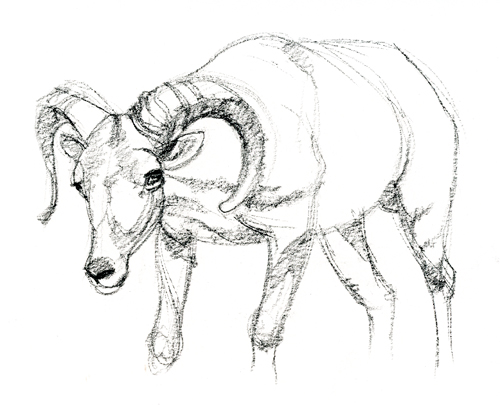
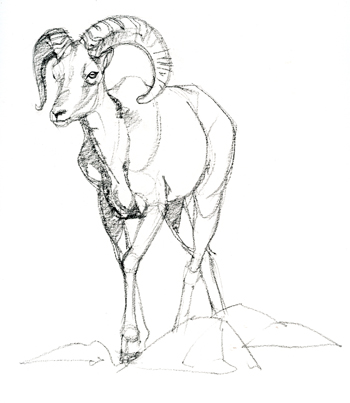
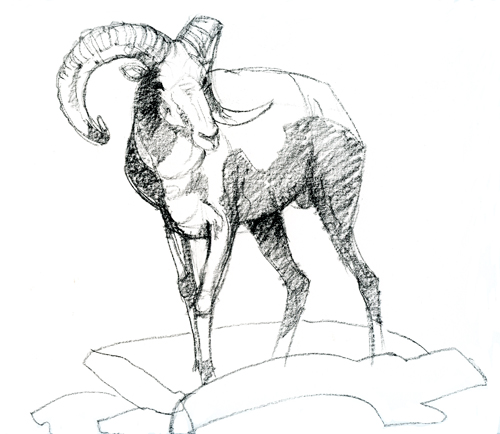
And here are three argali drawings done in the studio from reference I shot at Ikh Nartiin Chuluu Nature Reserve in August. Drawn with a 6B Wolff’s Carbon pencil on Strathmore Vellum Bristol.
This time I finally did something I’ve been wanting to do in Ulaanbaatar for my last couple of trips to Mongolia – sketch on location.
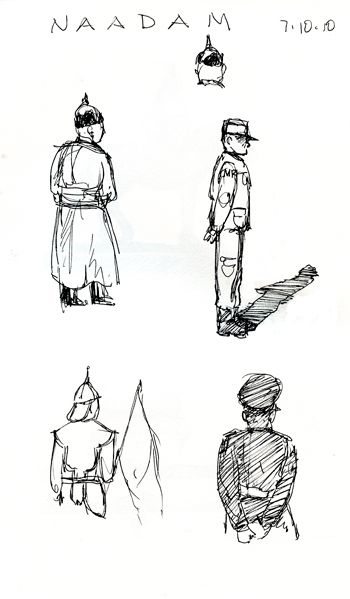
I got started right away since I had a couple of hours before I left for the countryside on July 10, having arrived on July 8. The Naadam celebrations had begun at Sukhbaatar Square, so I walked over from my hotel and did this page of quick studies.
Naadam 2010, Sukhbaatar Square
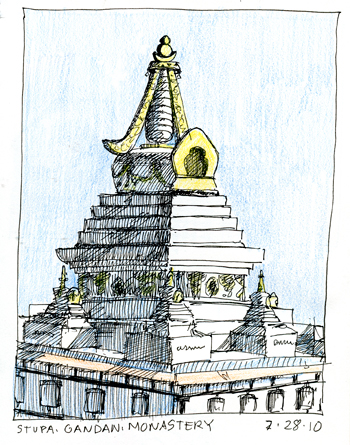
Back in UB after the camping trip, I met up with a new Mongol friend I had originally connected with on Facebook and we spent part of a morning at Gandan Monastery. It was fun to have a sketching buddy. He hadn’t drawn since high school, but must have still remembered something, because he immediately turned out some nice work.
I got an interesting comment on the stupa drawing. An older man came by, looked at what I was doing and told me, through my friend, that there HAD to be nine smaller stupa shapes below the main one. I couldn’t really explain that I simply couldn’t see them from the angle at which I was sitting, so just had to let him walk off in a minor huff.
Stupa, Gandan Monastery
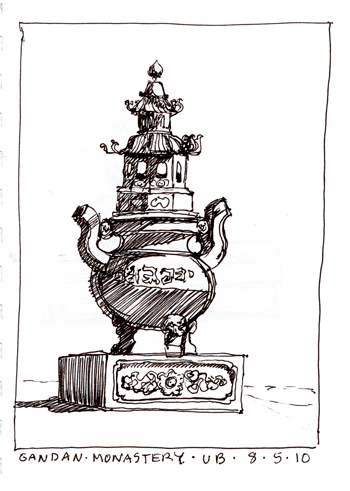
There are a number of these big (close to 8′ high) incense burners around the Monastery grounds. Visitors circle them while trailing a hand along the surface.
Large bronze incense vessel, Gandan Monastery
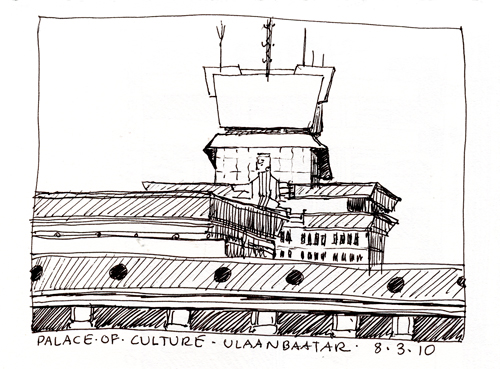
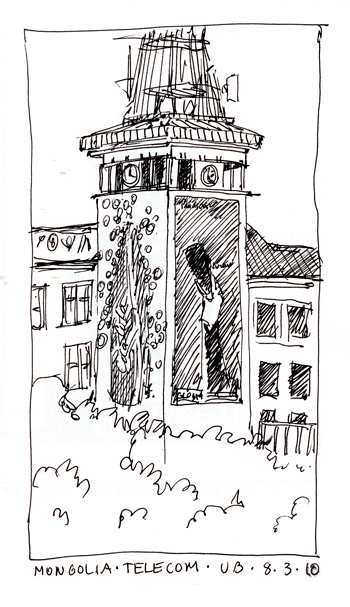
After I returned from the countryside, I went back to Sukhbaatar Square and sketched some of the buildings. The Palace of Culture is one of my favorites. The top of the tower is metallic gold and sparkles beautifully in the sunshine.
The Palace of CultureMongolia Telecom
I started to draw some attention at this point, particularly from a nice young man who wanted to practice his English, and had to give it up. Yes, that’s a giant Coke bottle on the left hand side of the building.
I also went back to Gandan Monastery for another morning of sketching. This time I tried adding some color with my water-soluble colored pencils.
Gandan Monastery
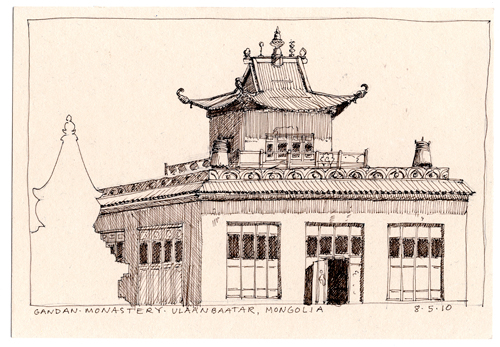
The preceeding sketches were all done in a small Strathmore premium recycled sketchbook. But I also wanted to experiment with working on location on toned paper. These were done during the second stint at Gandan Monastery and also at the Museum of the Chojin Lama. I never do architecture, really, so it was a challenge to try to keep things in reasonably decent perspective. On the other hand, unlike animals, the buildings, at least, don’t move.
Gandan Monastery templeMuseum of the Chojin Lama temple gate
Next Friday, I’ll post more drawings, this time from the journal that I kept during the trip. Dogs, dinosaurs, the desert and…..
If you’re watching the Olympics you know that it sometimes seems more like ads interspersed with some sporting events than the other way around. I’ve also realized that I don’t know how argali sheep are put together as well as I need to, especially the legs, and I’ve got a major takhi painting coming up
Put the two together and I’m getting some good sketching time in. I’ve got all my images from my last two trips to Mongolia on my MacBook Pro, sitting in iPhoto, which happens to have a great enlargement function. I’ve set the laptop on a small folding table (are they still called “tv trays”?) and am using a 9×12″ sketchbook.
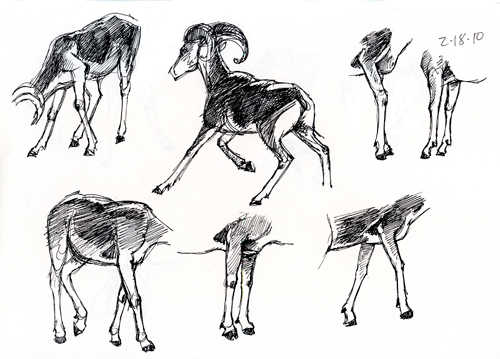
These are drawn with a fine felt tip pen with no preliminary pencil work. I either get it or I don’t. None take more than about five minutes, so there isn’t a lot of time invested. The purpose is to hone in on areas that I don’t understand as well as I should. Purely process, not result. Plus, I keep in mind that photos flatten objects, so I need to compensate for that when drawing three dimensional animals.
I started with a page of takhi, plus a cow I saw at Hustai.
Then I moved on to argali. One of the challenges is to keep the legs and body in proper proportion since the legs are really skinny and long. There isn’t a lot of muscle definition to play with, like with horses, so one has to nail the overall shape.
I’m struggling with the horns, too. They move back and around in space and I’m suspicious of how the camera might distort them. What I really need is to draw from the live animals. But there are none in zoos that I know of and in the wild you’re lucky to watch them from 600 meters (over 600 yds.)
Ideally, I’d have my Leica Televid spotting scope, which would solve the problem, except that it is entirely impractical to haul it around in the terrain where the argali are, at least for me. So it’s photographs and a pair of domestic ram’s horns that I brought back from England some years ago. I don’t have access to taxidermy mounted argali, but the problems there would whether or not the horns are typical, how good the quality of the mount is and is it a Mongolian argali. Notice that I started on the left with only basic shapes and didn’t worry about modeling or “color”.
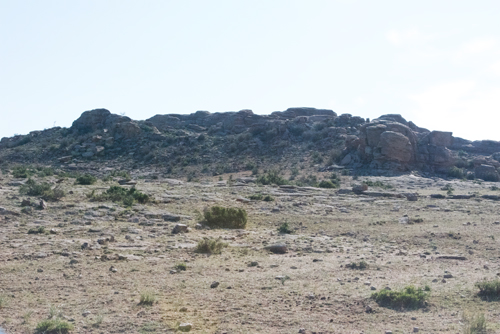
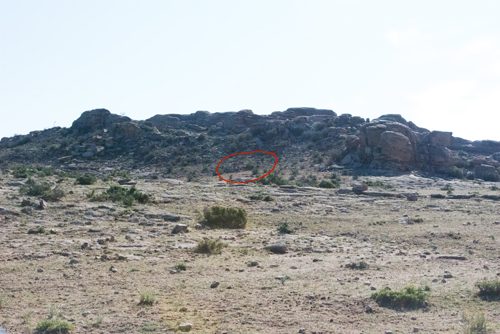
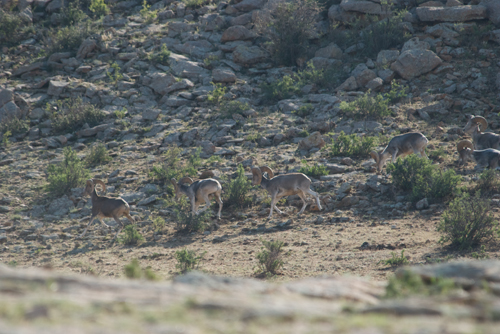
The best images I have of argali so far are a group of six rams at Baga Gazriin Chuluu Nature Reserve. They were considerate enough to have parked themselves in the open within sight of the main road through the reserve in great morning light. I would have been lucky to have spotted them, but the local man living in the reserve who my guide hired to go out with us both mornings that I was there saw them right away. Here’s a long shot from where we stopped. They’re right back against the rocks, in the middle.
I’ve circled them in red.
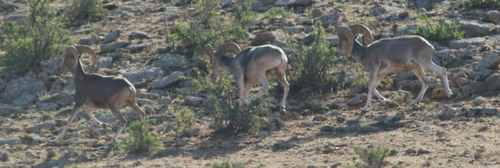
Piece of cake, right? Here’s what I got when I zoomed in with my Nikon Nikkor VR 80-400 lens. These are 10mg files, so they can take quite a bit of enlargement and stay sharp. I’ve got about 84 images total to work with. There’s something useful in all of them. Love these guys.
Here’s a close-up of the three rams in front. A perfect Exhibit A of the subject of a previous post about why you have to get out there and do the fieldwork. There’s no other way to get this kind of reference (Buying it from someone else doesn’t count). Game ranch animals won’t do it either. They’re out of context and, unless you’ve observed the species in the wild, you have no idea whether or not any behavior that you see is “real”.
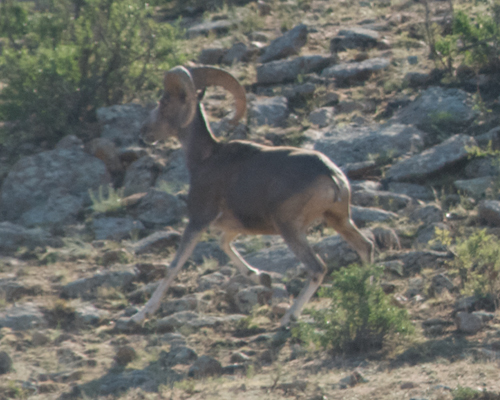
And closer yet of one I drew last night. Everyone was fat and sassy and in great condition. Notice that the younger ram is much browner than the older ones. His behavior was different, too. He was a little more skittish, kept more space between himself and the others than they did between each other and was last in line when they all finally moved up into the rocks.
Great stuff! Action, a terrific pose, rim light. Here’s the page of sketches that include this ram.
Give it a try! It’s a great way to keep training your eye.
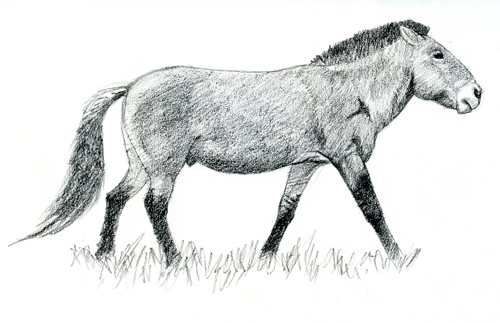
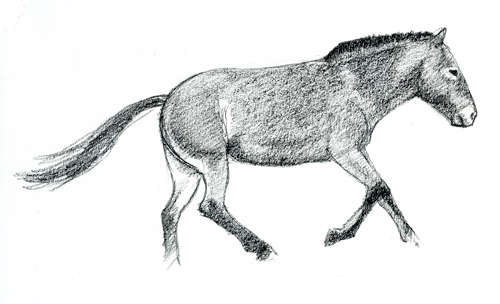
I’m in the middle of a rather large painting (no, not the argali one; a subject for another post; short, short version: got stuck, needed to let it sit for awhile), so I thought I would post a few drawings that I’ve done recently and then get back to the easel. It’s juried show painting season, so I’m trying out different reference images to see if I think they’ll make a painting. These were all done with Wolff’s carbon pencils on Canson Universal Recycled Sketch paper, which turns out to be quite a nice combination.
Ibex billy; from Baga Gazriin Chuluu, July 2009Bactrian camel, Arburd Sands, Sept. 2008Bactrian camel, Arburd Sands, Sept. 2009Takhi stallion "Temujin", Hustai National Park, Sept. 2008Takhi mare, Hustai National Park, Sept. 2008Takhi foal, Hustai National Park, Sept. 2008





















 Susan Fox, American Artist