I recently received an email from an art student in Northern Ireland (wonders of the internet!), who is doing a paper about an artist whose work she likes for her “A Levels”. That artist would appear to be me. I liked her questions since they got me thinking some more about what I do, why and how. So I thought I would share it with you:
1.Why did you choose animal art?
As I think about it, it might be more appropriate to say that it chose me. I drew animals more than anything else as a child by far. When I was back in art school at age 35, I tended to think of using animals for my assignments. When I moved to “easel painting”, I started doing animals early on and when I learned about the field of wildlife art, that pretty much sealed the deal. I do enjoy other subjects, but it has always been my animals that have drawn the strongest response from people.
2.How would you gather information for your topic (ie do you study the body movements of animals, go to the zoo etc)
I do fieldwork trips every year to see animals in their own habitats and also visit zoos whenever possible. I have a large reference library that includes a number of books on animal anatomy. I sketch from live animals when I can and take a lot of photos. My digital image library has over 10,000 animal pictures alone, taken since 2004. Plus hundreds of prints from before I went digital.
3.Have you ever been influenced by a person or place?
Yes, I seem to be the kind of artist who is inspired more by what I see in the natural world, as opposed to a more purely internal vision. Taking a master class from John Seerey-Lester in 1997 was probably the greatest single reason I’ve become an animal artist because of his encouraging words about my paintings, which made me believe that I could succeed if I was willing to work hard.
The four places that I find most inspiring are Mongolia, Kenya, the Yellowstone/Wyoming/Montana area and my own home ground of northern California.
4.Is there a particular artist whose work has inspired you?
If I had to name one, it would be Bob Kuhn, a legendary illustrator who became one of the two or three top wildlife artists of the 20th century. I’m inspired by the quality of his draftsmanship, design/composition, his painterly technique, his knowledge of his subjects and his uncompromising willingness to do what it took to get reference he needed. He’s my role model for everything a wildlife/nature artist should be. He passed away last year.
5.What media do you prefer working in and why? Is there a medium you are not comfortable with?
I work in oil. The original impetus was having wanted to paint in oil since I was a child, but now it’s because it’s the medium that most lets me express my vision of a subject. I love everything about it except the fumes, so I pay attention to proper ventilation.
I’m probably least comfortable with something like pastels, for the very pedestrian reason that I don’t like having my hands messy while I work and I don’t want to wear gloves.
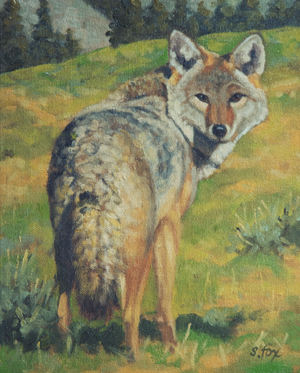
6.My favourite piece of your work is ‘Double check’, how did you come up with the idea and how did you gather photographs etc to help you?
Ah, I just delivered that painting to the buyer. It’s one of my favorites ,too. I hadn’t done a coyote for a long time and I have some great reference of them that I shot over a couple of trips to Yellowstone and the Grand Tetons. I was looking for an image that would work at a small size and had interesting light. I also look for an aspect that represents something authentic about the animal and what they are like, both as a species and as an individual. The painting used two pieces of reference, one of the coyote and one for the background. So I already had the reference for that one.
Double Check oil 10″x8″
7. When did you realise your talent for art and why in your opinion is animal art so effective?
I can’t remember a time when I didn’t draw. I don’t know how much talent I have, but I’ve been willing to work hard for a long time. I’ve been told that my animals have “life” in their eyes and I agree, but that seems to happen without conscious volition on my part, so maybe that’s my “talent”.
Human affinity for animal images goes back to the Stone Age, as can be seen by cave paintings and pictographs. We have literally shared our lives with them for over 10,000 years (in the case of dogs). We share our world with them. Every culture has some relationship to animals, mostly positive, sometimes negative, but a connection nonetheless. We see ourselves reflected in them. We project ourselves and our emotions, ideas about good and bad, and our needs onto them. Images of animals and our liking of them are one facet of that long history.
8. Do you have any future plans for your art?
To continue to grow as an artist and get better. To always look for new ways to more accurately express my vision. To use my art to promote conservation and environmental issues, while making a decent living.
9. What do you think is unique about your art?
My vision and point of view and how I express that stylistically. Which really is, or should be, true for any other artist, no matter what their subject matter or medium.
10. Where do you paint and do you find the environment you work in important?
I have a 450 sq. ft. studio at my home. I have worked in a variety of environments, including a garage, and would have to say, that, yes, it’s important. I need an organized, properly lit space. I need the work space to not get in the way of doing the work.
11. When it comes to doing the fur on the animals, what do you find to be the fastest but most effective way for this?
I don’t personally think that speed, per se, is the goal. First comes the decision about what your vision is and then, what is the most technically appropriate way to accomplish that? Having said that, however, I have no interest in detail for it’s own sake. I would find painting every hair boring to do and usually find it boring to look at. What challenges me is seeing how much I can simplify and leave out and still communicate something like “fur”. So, I don’t literally think “fur” when I’m painting. I’m thinking shape, value, color, color temperature, visual texture, etc., which is a more abstract level. If all those come together then that area will say “fur” even though it’s really just blobs or spots or strokes of paint.
12. Is the background as important as the animal itself?
I would answer that somewhat indirectly by saying that the idea of the painting is the most important and every element present must support that idea, whether it’s the animal or the background. It all has to come together as a coherent whole.
13. What scale would your art normally be and how long would it take you to complete?
The smallest paintings I do are 6″x8″ and, so far, the largest is around 36″x48″, plus a variety of sizes in between. I decide on the subject first and then choose the size and proportion that will best suit the idea I have.
I can finish a small painting to be used as a study in a couple of hours. “How long does it take?” is a question artists get all the time and the answer is usually some variation on “It depends.” It depends on how complex the composition is, how much preliminary work was necessary, how many changes were required along the way, whether one got stuck and had to let the thing sit for a week, a month, a year.
14. Were you hoping to strike any emotions from your audience? if so what?
I think that part of what defines something as “art” is whether or not it elicits an emotional response in the viewer. So, yes, I guess I always hope for that. But I’m really more concerned with recording my emotional response to my subject than trying to project or control that of the viewer.
15. Which is you favourite piece of your own work and why?
Whatever the latest one is that came out the way I’d envisioned it. Currently it’s the Cape Buffalo Head Study. It may be the best painting I’ve done so far and I did it as demo over the course of about six hours at an art festival with constant interruptions. Interesting, in view of my earlier comment about my preferred working environment and that I hadn’t envisioned anything in particular about it except to have something going to draw people into my booth.
16. Is there anything that motivates you whilst painting?
The thought that somewhere, sometime, someone viewing my work might be inspired to become actively involved in working to save our planet. It needs all the help it can get.
May all our interviews be so merry and bright.
NEW COMMISSION
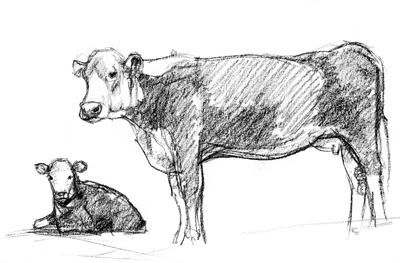
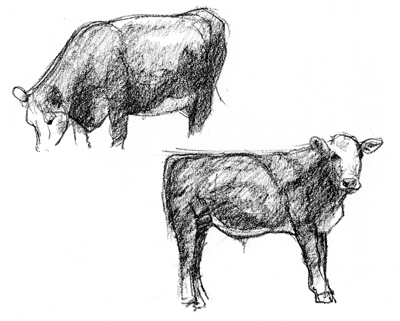
My most faithful collector and I have had a list of paintings that she would like me to do. Since she grew up on a cattle ranch in Southern California, she wants a painting of an oak tree with polled Hereford cattle, plus a few other elements. So this is where my illustration training kicks in. I find this kind of thing fun if, once the content is decided on, I am left to solve the problem and paint it as I see fit. I have now started the sketches. I haven’t drawn cattle much, so that was the first step. Here’s a few that are promising-
Hereford cow and calfYoung Herefords
ART QUOTE OF THE DAY
“You do not have to go very far to find suitable subjects. The cat lounging on your sofa, the horse down the road, yours or your neighbor’s dog; all are proper subjects and all will give knowledge which can later be broadened by trips to the nearest zoo or museum. My old friend and counselor, Paul Bransom, was the man who first urged me to go to the zoo, and to draw, draw, draw, Even the best reference sources don not take the place of real knowledge of animal structure. That can only be gained by putting your time in with the animals.”
To conclude my postings about fieldwork, here’s a partial list of the gear that I’m taking to Mongolia next week. Everything has to meet certain requirements of function, weight and cost. This isn’t extreme travel (read anything by Tim Cahill for that), but we will need to be self-sufficient and ready for dramatic swings in weather since Mongolia is landlocked with no marine influence. Rain shouldn’t be an issue, but cold nights and wind are likely based on my limited past experience. Days should be nice, even hot, at least early on.
My fond hope is that this and the previous posts will de-mystify getting out into the field by providing specific information on one way to do it.
Most of the following has gone with me before, but there are a few new things, which I’ll start with:
Thermals- Icebreaker 260 100% merino wool long-sleeved top and leggings. Not cheap, but half the bulk of what I used to have.
Pants- LL Bean Pathfinder Ripstop Cotton; less bulky than jeans; my husband loves the pair we bought him so much, he’s getting two more, so I decided to try them, too.
Shoes- New Balance 644 “sneakers” (645 follow-on); for around camp and town
And, going with me again:
Boots- LL Bean Gortex Cresta Hikers; they say you can wear them out of the box and I found that to be absolutely true. These are great boots!
Socks- Thorlo Light Hikers, daytime warm; Smartwool for cold and at night as needed; they don’t itch, so I don’t have to take silk liner socks anymore
Layers- Patagonia fleece pullover, purchased used at Wilderness Experience consignment shop, Berkeley. Black, lined jacket (see photo at top) from TravelSmith; purchased for first trip to Kenya in 1999, so no longer available, but still going strong; have only had to mend torn corner of front patch pocket.
Purse-MetroSafe200; has a steel cable in the shoulder strap and all the zippers close forward so no one can slip it open; it goes into my daypack, which is one of my two carry-ons; Peace of mind in unfamiliar cities in any country.
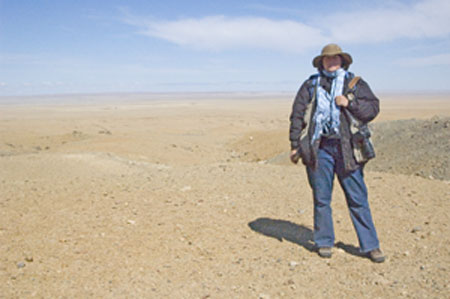
Neck- a long blue kaffiyeh-print scarf that I picked up somewhere; more versatile than a bandana; muffler when cold; face or camera protection from dust; wet rag or washcloth; style points in photos, like above
Hat- canvas, foldable, 360 brim from The Australian Outback Collection; took a few tries to find the right one; also gets style points (see photo above); and a baseball hat to get my hair up and out of the way in camp when showers are unavailable
So, why care about “style points”? Because part of being a working artist who intends to make a living is marketing and one’s “story”. Part of mine is the trips I take, which my friends, fans and buyers get to share. Pictures of me are part of it and I don’t want to look like a dork.
the Sleeping Bag- I can’t begin to tell you how much I hate mummy bags. It affects my sleep and I never seem to really adjust since I’m a curl-up-on-my-side sleeper. Bless their hearts, LL Bean makes one of the very few rectangular down bags for my kind of field use. It’s rated to 20F.
I do have a couple of different Thermarest pads, but the tour company provides one, so mine stay home this time.
Luggage- I have a pair of LL Bean rolling duffles that have clamshell top openings. I love them, but they aren’t available anymore. My big bag, their Sportsman’s Extra-Large Drop Bottom Rolling Gear Bag, however, is. I got it because even the larger of the two clamshell duffles won’t hold the Thermarest pad. Not long enough. The smaller one is carry-on size. It gets the camera equipment and just-in-case basics. The daypack has the laptop, documents, book, food, etc. and my purse.
Last post until I manage to get on-line in Mongolia.
Cheers!
ART TIP OF THE DAY
“I don’t mind hard work. You’ve got to work hard to generate something. I don’t think there’s any secret to success if you show up in the right place, at the right time and you put in a lot of time and effort and energy – you’re going to get something out of it. It’s not brain surgery.”
Ryan Seacrest, ex-actor, now host of American Idol and Dick Clark’s heir apparent as “America’s Host”
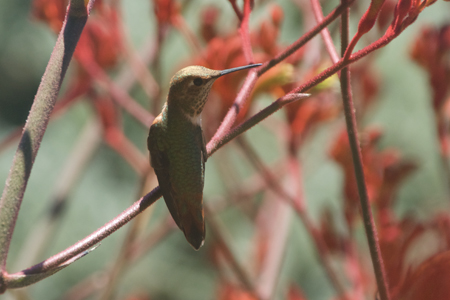
Hot hummingbird action the last few days. Two Allen’s hummers competing for control of the plants outside my studio window. I have now found an absolutely reliable way for animal artists, or anyone else for that matter, to procrastinate. Plant hummingbird-friendly plants right outside the window next to your desk. Wait for that “humming” sound, stop work and watch. Perfect.
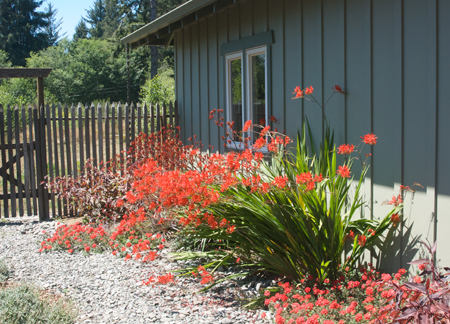
Outside my studio window is what I call “the tropical garden”. South-facing and it’s where I’m putting all the hot color combinations; red, orange, yellow, lavender, etc. Front to back is red verbena, crocosmia ‘Lucifer’, kangaroo paw and red dragon persicaria.
One of the little gladiators. I sometimes think that they are really Rottweilers in bird costumes.
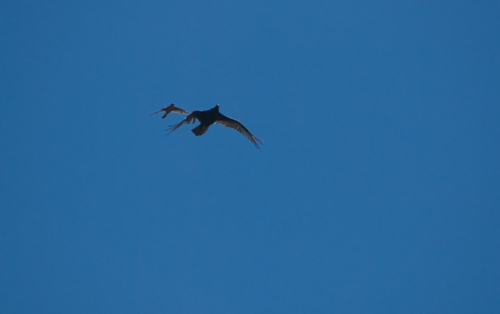
Looked up a few days ago when I was outside and saw what looks like a northern goshawk escorting a turkey vulture, probably away from the nest. I got about six photos. This one reminds me of some I’ve seen in my husband’s aviation books of comparatively tiny American fighter jets “escorting” truly huge Soviet “Bear” bombers.
ART TALK
So, to follow up on the source of the Wednesday post title “Pot of Paint”. James McNeil Whistler (of “Whistler’s Mother” fame) had utterly buffaloed the art community in London with what he called his “nocturnes”, impressionistic paintings of night scenes which he showed at a time when the eyes of the public and art critics were conditioned to seeing a high level of detail and what was called “finish”.
The leading art reviewer and taste-maker of the Victorian era was John Ruskin, the first prominent critic to champion the Pre-Raphaelites, who never let the vein of a leaf go unpainted if they could help it.
In his review of Whistler’s show at the Grosvenor Gallery, then known for showing “advanced” work, Ruskin wrote that he “he never expected to hear a coxcomb ask two hundred guineas for flinging a pot of paint in the public’s face.” So there.
Whistler sued for libel. What followed was one of the most celebrated lawsuits of the time. What makes it fascinating and relevant even today is that it turned into a monumental struggle between two very different philosophies concerning the creation of art. Ruskin represented the establishment view that art had a duty to be beautiful, uplifting and moral. Whistler adamantly insisted that Art had no duty outside itself, in other words, “Art for Art’s Sake”.
The trial lasted for eight hours. The jury deliberated for two and, in the end, returned the verdict for Whistler, but only awarded him only one farthing, approximately a quarter of a penny, in damages. Whistler mounted it on his watch fob. The good news was that the verdict saved him from having to pay Ruskin’s court costs, but it left him in debt, albeit with a moral victory.
If you would like to know all the delicious, gory details, buy, what else, A Pot of Paint- Aesthetics on Trial in Whistler vs. Ruskin, by Linda Merrill.
The debate goes on today, although without the level of consciousness that existed in the Victorian art arena. There has been more than one art show here in Humboldt County through the years that had a painting in it that someone found objectionable. The reason is usually some variation of the un-thought out idea that art is supposed to be beautiful, pretty and not make the viewer uncomfortable. Poppycock. Art has no responsibility other than to express the creativity of the maker. No one has the right to pre-censor what an artist creates or shows. No one has to buy what is produced, but they don’t have the right to demand its removal either.
ART FOR ART’S SAKE!
ART QUOTE FOR THE DAY
It is this sense of persistent life force back of things which makes the eye see and the hand move in ways that result in true masterpieces. Techniques are thus created as a need.
It is thus necessary to work very continuously and very valiantly, and never apologetically. In fact, to be ever on the job so that we may find ourselves there, brush in hand, when the great moment does arrive.
Six or so red crossbills are still showing up most days. There was a group of fox sparrows last weekend. Our hummingbird-friendly plants are really starting to bloom. I was sitting here at my desk and look who showed up outside my french doors? I was able to grab the camera and get some shots through the glass. Sometimes lucky is better than good. Looks like a male Allen’s hummingbird to me.
Speaking of hummer plants, here’s my 50 cent, 4″ pot white verbascum that I rescued off an end-of-season sale table the year before last. Is that a happy plant or what? I’m going to have to move the poor little heather underneath it before it’s completely smothered. Or I may move the verbascum to a more spacious location. I didn’t think it would get quite this big.
ART TALK
I finished the bighorn painting and took it to the framer only a little wet in a few areas. When it was laying on the counter, I saw a spot in the sky I missed, which I’ll fix when I get it back. But it reminded me of one of my favorite artist stories:
Every year the Royal Academy in London has its Summer Exhibition. We were lucky to be in England and able to attend some years ago. The galleries looked like in old photos you see: work stacked from the floor to the very high ceilings. Those whose paintings ended up in “nosebleed” country called it “being skied”.
William Mallord Turner (b. 1755 d. 1851) was a regular participant, although his work mystified many of his comtemporaries and the general public. “Varnishing Days” were the three to five days before the exhibition opened when the artists could come in and put on a final varnish or touch up their paintings. Turner became somewhat famous for this and is said to have deliberately brought in unfinished paintings so that he could show off his technique. Imagine any of us doing that today? It would be like Robert Bateman showing up at the opening of his current retrospective, palette, brushes and paint in hand to add a few more snowflakes to his famous snow leopard painting. Turner showed up dressed for town and S.W. Parrott was inspired to create this permanent record, which is reproduced here in black and white. How do you dress when you’re in the studio?
PLANET SAVER TIP FOR THE DAY
Speaking of Robert Bateman, besides creating a lot of the best wildlife art of this or any other century, he is a tenacious advocate for the environment. You can read what he has to say at www.batemanideas.com
ART THOUGHT FOR THE DAY
If a man does not keep pace with his companions, perhaps it is because he hears a different drummer. Let him step to the music which he hears, however measured or far away.
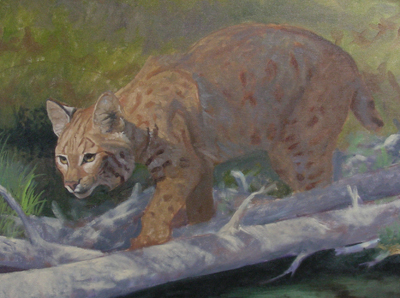
The bobcat painting is done. I’ve called it “Stepping Lightly”. It will make it’s debut at Wild Visions2, the group show with five other Humboldt County artists next month. The opening reception will be August 9 from 6-9pm. More later about the show and the other artists.
“Stepping Lightly” oil 18″x24″
Now, a cautionary tale about reference and using captive animals as models.
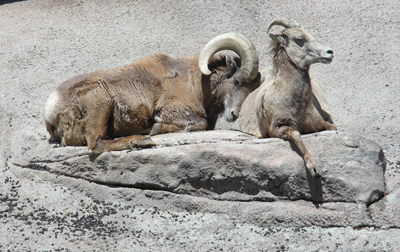
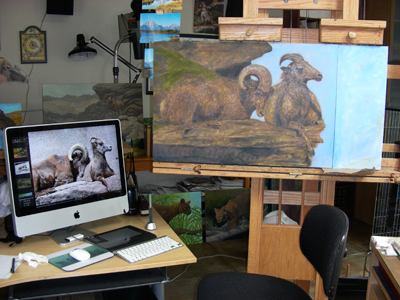
I’m doing a painting that is a first for me, three panels. Here’s the reference I’m using. The animals were photographed at the Denver Zoo and the landscape is from up on Logan Pass in Glacier National Park.
Is that a great pose or what? It was morning, warm and sunny, and the ram was getting sleepier and sleepier and finally his head gently dropped onto the ewe’s back. She never even twitched. Click. Gotta paint it. But where to put them? I chose this rocky outcropping in Glacier because I liked the shapes and knew that bighorns were often seen in the area. I did a preliminary drawing of the animals with the idea of showing them on a shelf of rocks. I wanted to communicate how comfortable bighorns are in an environment that we would find “challenging”. Here’s an in-progress shot that shows my setup with my iMac.
It’s great because Aperture lets me zoom in and out as needed very easily.
Another in-progress shot with the side panels propped on either side. At this point, I sent a jpeg to wildlife artist Laney, who has said nice things about my work the couple of times I have met her. She specializes in bighorns and I wanted her to eyeball the animals for drawing or any other problems. She replied very promptly and said that overall it looked good, but that the ewe’s hoof was in the wrong position compared to the rest of the leg and that the ram’s muzzle was too thin.
I went back to my reference and compared what I had with an absolutely wonderful book, Mountain Royalty, by famous Alaska artist Doug Lindstrand. As you can see from my photo, the ram in particular is shedding out, so it was a little hard to see the structure. Doug’s photos solved that problem and there was even a picture of a ram in a similiar position.
What I ultimately found was that while I had accurately drawn what was in my reference, it wasn’t “right”. The ewe’s hoof was at that funny angle, but that didn’t mean I should paint it that way, so I fixed it. When I compared my reference ram’s head with the ones in the book, I found that his head was really quite odd. Longer, thinner and with a roman nose that was much more exaggerated than the wild sheep. So I fixed his muzzle and re-proportioned his head as needed.
The other question I had for Laney was whether or not this behavior might be observed in the wild. She replied that the rams were only with the ewes in winter, so maybe I’d like to add some snow. Ah, well. In the zoo, of course, the animals are pretty much together all year around. In the wild when I shot my reference at the beginning of May, it was unlikely. Cue the snow reference. And, what I found was that it was the frosting on the cake since it brought the cool of the sky into the rock area and helped pull the whole thing together. Thanks Laney!
The moral of this story is that you can’t have too much reference, don’t assume that zoo or captive animals look the same as wild ones, do your fieldwork and learn about your subjects and finally, it is tremendously helpful to have a knowledgeable eye like Laney’s to look over what you’ve done and to it keep on track.
I finish the painting today and it goes in for framing tomorrow. I’ll post an image of it once it’s on the wall at the show.
ART THOUGHT FOR THE DAY
Experience enables you to recognize a mistake when you make it again.
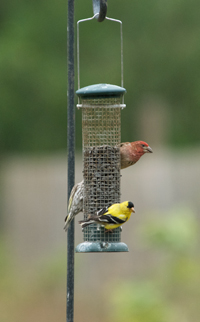
Red Crossbills showed up at the sunflower seed feeder yesterday and made a serious dent in it. A group came through last fall, but moved on after a couple of days. We’ll see how long these stay.
The goldfinches and sparrows are emptying out two thistle seed bags in less than 48 hours. They’re back within seconds of the refill. We live but to serve. We must have the fattest finches in the neighborhood.
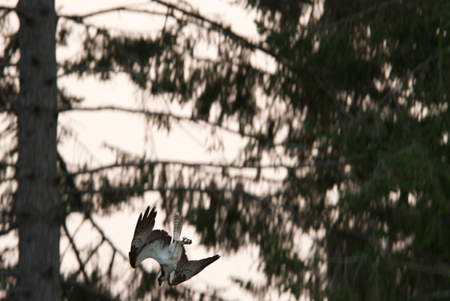
Bonus photo with my new lens- an osprey diving toward the pond, at what we’re not sure since the goldfish pretty much stay under the branches we’ve laid around part of the edge.
All photos taken with my new Nikon D80 with the equally new AF-VR-Nikkor 80-400. I’m stoked, to say the least.
PLANET SAVER TIP OF THE DAY
Anyone with even a small yard can make it bird-friendly. Food, water and shelter are the requirements. We have the big pond, feeders, food plants, trees and brush piles. But a town backyard could have a bird bath (be sure to keep it clean), bird feeders and some small shrubs. If you can stand it and feel you have room, let a corner go “wild”. And consider not obsessively cleaning up in the fall. Leave some seed heads on the flowers and grass. Then sit back and see who shows up.
ART THOUGHT FOR THE DAY
“There’ll be moments when you get a spark, a gleam of light and BOOM!, you’re gone. It seems easy. But then it goes away, and it gets so incredibly hard. It’s like having sex in a wind tunnel.”
From the stats it looks like the post of my pet sketches was one of my most popular so far, so here’s more. These are done the way I usually work, with a fine tip gel pen. They’re done fast. Under five minutes, sometimes under two.
Niki, our tri-color rough collie
From the San Francisco Zoo. He really did hold still long enough for this head study.
These were ultra-quick, a minute or less, but I caught the gesture. Also San Francisco Zoo.
And, looking through my old sketchbooks, I came across the studies I did at Julie Chapman’s workshop in 2005. These are of Daisy, the badger, who alas, is no longer with us. Notice that I didn’t worry about eyes. I was trying to capture “badgerness”.
If you decide to try this, and I hope you do, keep in mind that every animal is an individual and look for what makes them them. If you like what I do, I think that’s a big part of it.
I’ll end with the bobcat painting, now called “Stepping Lightly”. I’m thinking of punching up the highlights on grass and maybe futzing (that’s the technical term, of course) with the logs some more, but that’s about it.
PLANET SAVER TIP OF THE DAY
This one’s easy. Start to become aware of how you use energy. You can save money and help slow down climate change by using less and using it more wisely. Just little stuff to start- turn lights off when you leave a room, don’t leave the tv on if no one is watching, turn your thermostat down a couple of degrees or up, depending on the temperature where you are.
Now, you must know that this kind of thing, while necessary and desirable, is the “low hanging fruit”. It requires simple changes of habit, not real sacrifice. If you’re already doing the above and are ready and able to take the next steps, consider updating your older appliances to new, energy-efficient models. Change your incandescent light bulbs to compact flourescents or LEDs.
Last night my husband and I were sitting in our spa at dusk and what should we see ambling along the edge of one of the flower borders but a mom skunk with one baby. Niki the collie, who got thoroughly skunked a month or so ago, immediately went to the other side of the spa and gazed with great interest toward the pond. Good dog.
The skunks went right onto the patio and then under the engawa (Japanese style veranda), at which point we called it a night.
BACKYARD BIRD LIST
Same as last week, except one of the first hummingbirds, an Allen’s I think, found the verbascum and lavender, which are starting to bloom. There was an article in the news today here about the songbird die-off. Pretty depressing. The only local bird named that we have seen here is the Rufous Hummingbird. Time to plant more hummingbird friendly plants.
ON A LIGHTER NOTE
You think you know your pets, but sometimes………..
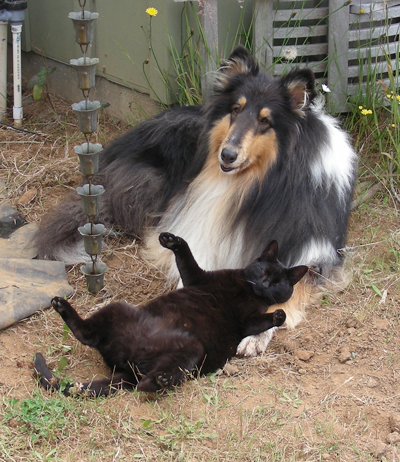
Niki and Eowyn, en flagrante something or other. Got another one that I’m going to upload to www.icanhascheezburger.com. If you haven’t been there and you have a sense of the ridiculous, highly recommended.
ART THOUGHT(S) FOR THE DAY
Two Views on Art:
Artists can color the sky red because they know it’s blue. Those of us who aren’t artists must color things the way they really are or people might think we’re stupid.
Jules Pfeiffer, famous artist
Anyone who sees and paints the sky green and pastures blue ought to be sterilized.
A few of you may remember that I was posting images of an elk painting in progress. I’m sure the suspense has been killing you. As it happens, it was a bust. Too many problems with the drawing of the elk that I saw after I’d let it sit awhile. Win some, lose some.
But here are two that are well on the way-
First is a bobcat I photographed at the Triple D Game Ranch and transferred to a more interesting setting that I shot on the Firehole River in Yellowstone. The trick, of course, is to make the light match when the reference is from two different locations, like Montana vs. Wyoming. However, both are morning light.
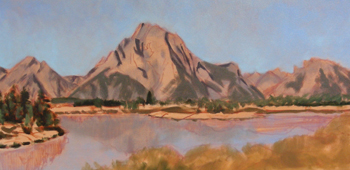
The second is Mt. Moran at Grand Tetons National Park with the famous Oxbow of the Snake River in the foreground. I’ve got three pieces of reference up for this one. One is overexposed for the mountains, but has the compositional angle I want and great reflections. The other two have rich color and show more detail of the mountain. For this subject, as I learned from a workshop I took a few years ago with Jim Wilcox, one has to introduce some atmospheric perspective in order for the painting to “read” correctly. The air is soooo clear that the Tetons look to be a few hundred yards away, but actually they are around 10-12 miles from the major vantage points along the road. So, getting the value relationships right is critical. And so is being decisive and accurate in the drawing of the mountain. It’s really a portrait in rock. Stay tuned.
ART THOUGHT FOR THE DAY
I see a flower. It gives me the sensation of the beautiful. I wish to paint it. And as soon as I wish to paint it I see the whole subject-flower-changed. It is now an art problem to resolve.
 Double Check oil 10″x8″







 Susan Fox, American Artist