
See the listing here
See the listing here
Happy bidding!
Since, judging from the stats, the subject seemed to be very popular, I thought I would continue today with more on the takhi, specifically how I take the reference I shoot and turn it into a painting. More and more I start with drawings to become familiar with a new species or figure out things about one I’ve painted before.
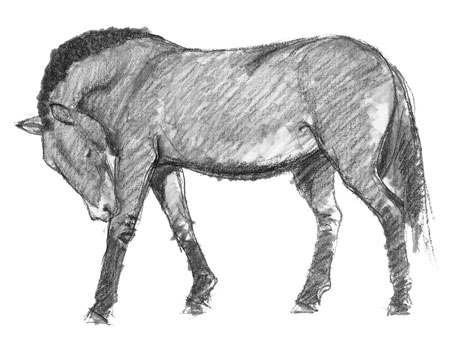
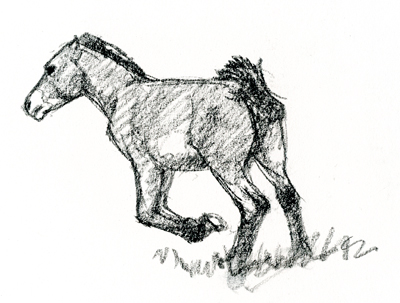
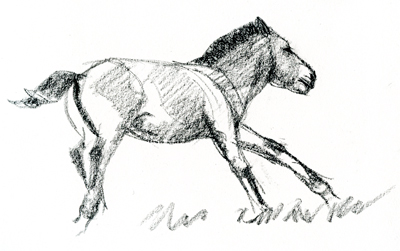
Here are three drawings from last year, the first two of which were published in the Society of Animal Artists newsletter.

Now I’ll show you how I take an animal from one time and place and put her in a setting from another time and place, a challenge that every wildlife artist needs to meet successfully. Here’s the setting:

What a treat! We came around the bend in the dirt track early in the morning and there, right in front of us were two harems at the same time, sorting out who gets to go first.

I always try for a variety of shots; close-ups and the “big picture” for context. I used to come home with great close shots of something like a tree and found that I’d completely forgotten to get the surroundings, which really cut down on my options. Notice that the above photo is kinda fuzzy. But it’s still useable for reference.
Now here is the horse reference. Different part of the park, different year, different season. I’ve included two as an example of what to look for when evaluating images. These are similar, but the second, to me, is clearly superior. I love the rhythm of her gesture.


So next I did a drawing to capture that.

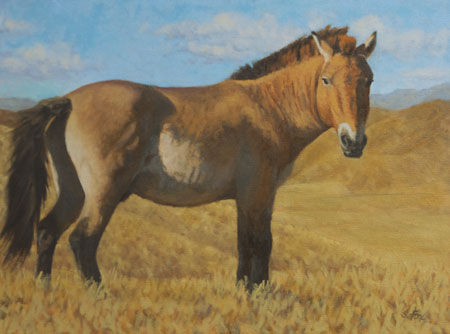
And, putting them together, here is the finished painting, completed in 2007. What I hope is that you can’t tell that I “stitched” together the reference from two sources.

I also wanted to let you know that two of my takhi images are available as limited edition giclees, framed or unframed. The full information is on my website. Click on “Limited edition giclees” under Fox Studio in the column on the right and it will take you directly to my giclee page.

I saw this foal on the same trip as the mare in the painting above. He or she was quite a character.
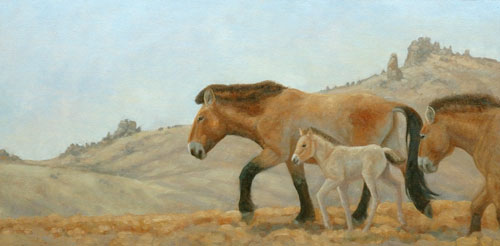
I posted this last week, as the original painting is still available, but have also published it as a giclee. It’s another example of how I took the mare and foal, who were against a grassy hillside and moved them to a ridge that has Hustai’s famous mountain as the background. The third horse was added as a design element.
All my giclees are available for holiday delivery.
ART THOUGHT FOR THE DAY
Let this be plain to all: design, or as it is called by another name, drawing, constitutes the fountain-head and substance of painting and sculpture and architecture and every other kind of painting, and is the root of all sciences. Let him who has attained the possession of this be assured that he possesses a great treasure…:
Michaelangelo (who ought to know)

Just listed on EBay. Seven day auction. Starting bid- $40. Buy it now- $60. Free shipping. Return in 14 days for any reason.
“Scratch That Itch” is a 10″x8″ original oil painting on canvas board. It is unframed.
The subject is a takhi foal I photographed at Hustai National Park in May of 2005. One of the rarest animals in the world (there are only around 2000), takhi are the only surviving species of true wild horse and are being reintroduced to three locations in Mongolia. I’ve been lucky enough to visit two of them.
You can view the listing here
Happy bidding!
Well, I certainly enjoyed the last two Mongolia Monday posts and hope you did, too. Thanks again, Simon!
Today it’s back to a subject that has become near and dear to my heart- the takhi or Przewalski’s Horse. I always liked horses, even though I was deathly allergic to them as a kid, but have never been, ahem, drawn to them as a subject until I saw takhi for the first time at the Berlin Zoo in October of 2004. I didn’t even know they were there. I just happened on them in the far nether reaches of the zoo. Seven of them, looking like they’d just stepped out of a cave painting.

I remember that I plopped down on the nearest bench, probably with an idiot smile of delight on my face, to sketch and photograph them. They were enchanting.

I did some research when I got home and found out that they were being reintroduced into Mongolia. So when I signed on for an Earthwatch project there, I arranged a three day trip to the closest site, Hustai National Park. It was spring, which meant cold, windy and and occasional snow, but I saw the horses and got some decent photos. The next step was to get back to Mongolia, which I did in late September-early October of 2006. By then, I’d found out about a third, new release site in western Mongolia, Khomiin Tal, and managed to get out there. There is also a series of three articles I wrote for Horses in Art. One on Hustai National Park, one on Khomiin Tal and one on the domestic Mongolian horses. Look under “Writings” for those.
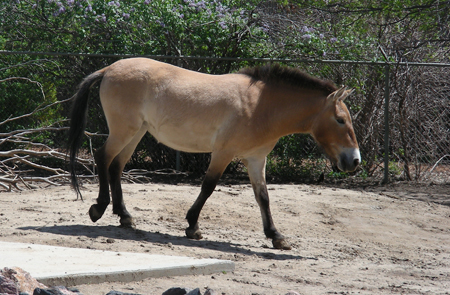
Then, this last May, I was at the Denver Zoo and saw takhi there. They looked much different from the Berlin animals, as you can see. There are a number of reasons for this that have to do with being kept in captive conditions, which can lead to much heavier bone structure and skull defects. The animals for release come from semi-reserves where they can live and eat more normally.
I’ve been drawing and painting them since that first trip to Hustai, but have hardly scratched the surface of the picture possibilities.
Here’s one of the first paintings, which is available as a limited edition giclee. When I showed a photo of it to a Hustai biologist on my second trip there, she immediately recognized the mare by her mane, which reinforced my desire to paint individuals of a species.

Followers of this blog know how adamant I am about doing fieldwork. I think this next piece illustrates why. There is no way this painting would have happened if I hadn’t been there at Khomiin Tal to photograph both the horses and the habitat. I’ve seen a few other paintings of takhi and so far none of them really looks to me like it was done from reference shot of reintroduced horses in Mongolia. They are pretty obviously captives in Europe or North America. The light’s not right, the land isn’t right and, mostly, the horses themselves aren’t right. But I sure can understand the compelling desire to paint and draw them anyway!

Here’s the most recent painting, a stallion at Hustai. I wanted to really show the valley that is the core habitat of the population of, now, over 200 horses in 15 harems and to try to capture the interesting shape of the shadows on him.
This 10″x 8″ study is going to be listed for sale on EBay tomorrow or Wednesday. It was amusing to watch the foal work out the motor coordination required to scratch that itch.
Lastly, I did a batch of drawings a couple of weeks ago and I rather liked the way these came out. The photos were taken at Hustai this past September. It was late afternoon and this one foal was having “crazy fits”. I’m always looking for animals in action and he/she certainly delivered.


Like many artists, I’m trying to figure out what my sales options are given the current economic climate. I’m also interested in seeing if I can sell art directly on the internet. And, a few months ago, I was showing some friends some of the small studies I do to work on various aspects of painting and one encouraged me to try selling them. Taking this all together, I have decided to offer a “new line” of small oils that I am calling “Studio Studies”, because, well, that’s what they are.
As anyone who paints most days a week knows, they do stack up after awhile and I have a few dozen that I’ve decided I’m willing to find new homes for.
I plan to start offering them a few at a time on EBay, starting next week. Here’s a small preview, starting with one that I photographed in progress, so it’s a short step-by-step demo of how I do these mostly 6″x8″ studies that usually take less than two hours. The idea is to quickly capture a light effect, so detail isn’t relevant. This should look familiar to anyone who has taken Scott Christensen’s Ten Day Plein Air Intensive, because that’s who I learned this approach from and I really like it.
STEP-BY-STEP 8″X 6″ STUDY (from last Friday’s post)-
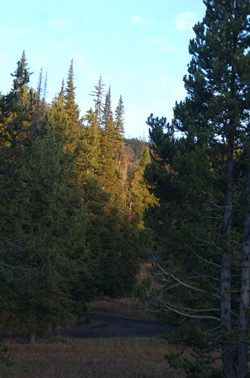
An image I shot up on Dunraven Pass in Yellowstone National Park at first light. What I was working on the was the color temperature shifts from shadow to light.

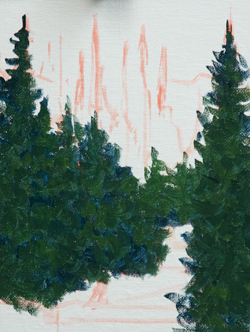


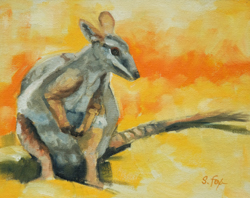
Here’s a couple more. First a demo that I did in about an hour at the Marin Art Festival of a small kangaroo which I photographed at a zoo.
And a landscape a few minutes from our house looking east from Clam Beach to the bluff. It was summer and the foxgloves were blooming. They’re not a native, but they look like they belong here in Humboldt County.
Finally, since I strongly believe that artists should help and support each other, here, from Alison Stanfield, who runs ArtBizCoach, is some solid advice on “Community”. Thanks, Alison! (Hope it’s readable. Let me know if it’s not.)

ART THOUGHT FOR THE DAY
The artistic mind is one that takes years to develop. Painting never gets easier. Struggle is not something that one goes looking for. It will find you. Just give it time.
Scott Christensen, The Nature of Light
For Part 2 of this special post, here is Simon Wickham-Smith sharing how he became involved in things Mongolian, along with a little information on translating literature from one language into another. His comment about the number of precise words that exist in Mongolian for some parts of their world and culture reminds me of hearing that the Inuit have 37 names for snow, but no generic term as occurs in English.
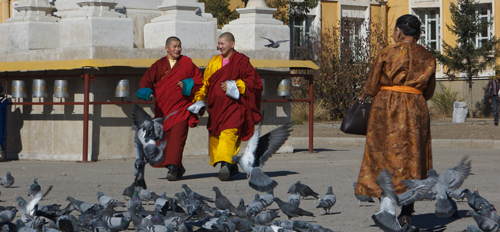
Simon Wickham-Smith: My own involvement with Mongolian literature started when I was a Tibetan Buddhist monk in Scotland during the 1990s. I became interested – obsessed might be a better word – with the life and writings of the 6th Dalai Lama and, during my research, came across a reference to Danzanravjaa, a nineteenth century nationalist, scholar, poet and Buddhist monk.
I had already studied Mongolian for some time during the early nineties, and now I started to read and translate Danzanravjaa’s collected works. When I finally finished this work, in 2005, I felt that, really as a matter of courtesy, I should write to someone in Mongolia and let them know what I had done.
Thus it was that I came into contact with Gombojavin Mend-Ooyo, one of Mongolia’s most famous literary figures, who invited me to Ulaanbaatar the following year and for whose Mongolian Academy of Poetry and Culture (www.poetry-culture.mn) I have now translated ten books, with at least four more in the pipeline.
The act of translation from any language is a subtle and nuanced negotiation, but when dealing with a source culture which is so very different from the target culture, a number of problems appear. And so it is with Mongolian.

The number of words used to describe the natural landscape, animals and animal products, and the movement of the heavens are so detailed and precise as to be effectively untranslatable into English, short of adding phrases or entire sentences to the mix. This, together with the morphology and structure of the language, means that simply recording what is said in the original becomes a restructuring of thought and a reinterpretation of culture. Once these concerns are settled, then the literary work can begin, and the rhythm, sound and development of the text finessed.
Over the next five years, the Mongolian Academy of Poetry and Culture intends to publish more translations and to encourage scholarship in both Mongolian and English. As for me, I am soon to embark upon postgraduate work at the University of Washington’s Jackson School, with an emphasis on Mongolian literature. Moreover, I am also co-director of the Center for Central Asian Literatures in Translation at UW (www.depts.washington.edu/ccalt), which is hoping to increase the profile of literature from across Central Asia.
I’d like to thank Susan for letting me benignly invade her blog. I hope that the work that she and I, along with many others, are doing, will encourage people to investigate Mongolian culture and, in particular, its literature.
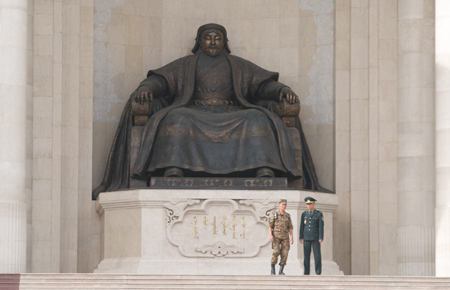
You’re very welcome Simon! It’s a pleasure and a privilege to have you participate here. The following poems are a little on the longer side, but I think that they really show a side of the Mongol people that Westerners, raised on the idea of Chinggis Khan and his Horde cutting a path of destruction across a large chunk of the world, don’t realize exists. If nothing else, it demonstrates our common humanity across time and space. Not a bad thing these days.
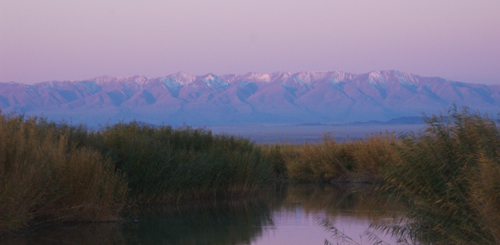
A DELUDED ASCENT OF MOUNT CHUN SHAN
Khubilai Khann (1215-1294) (Yes, that Kublai Khan)
One a day blessed by good fortune,
I climbed up a blue bluff.
I stepped carefully on the ground,
So as not to destroy the landscape.
The flowers glowed red,
Like rainbows.
A beryllium light glistened like mist or smoke or blue haze.
The bamboos along the streams grew green from rain fall and spring water.
The wind blew through the mountain pines with a wonderful fluting melody.
I paid my respects
At the sacred temples,
And returned with the aid of Indra.
And controlled the dragons.
LOVE ONE ANOTHER, MY PEOPLE
Love one another, my people, while you are alive.
Don’t keep from others whatever you find beautiful.
Don’t wound my heart with heedless barbs, and
don’t push anyone into a dark hole.
Don’t mock someone who has gotten drunk,
think how it could even be your own father.
And, if you manage to become famous,
open the door to happiness to others!
They should also not forget your kindness.
To someone who is lacking a single word of kindness,
you should search for it and speak it out.
Whether outside the sun or at home when it’s mild,
don’t spend one moment at rest.
Don’t use harsh words to complain, you women,
about the young man you remember.
Speak lovingly of those who loved you!
Let them remember you as a good lover.
Our lives are similar,
our words constrict our throats the same way,
our tears drop onto our cheeks the same way-
things are much the same as we go along the road.
Wipe away a halt woman’s tears without a word,
talk your lover up when she’s tripped and fallen!
Today you’re smiling, tomorrow you’ll be crying.
Another day you’re sad, and the next you’ll be singing.
We all pass from the cradle to the grave-
if for no other reason , love one another!
People must not lack love on this wide earth!
I grasp happiness with the fire of my human mind,
the golden shines lovingly upon us all the same, and
so I think that loving others is the path of life,
I understand that to be loved is a great joy.
O Dashbalbar (1957-1999)
I’ve spent a good chunk of this last week or so working on the “light thing”, which, when you get right down to it, is what representational painters are painting. Or, in other words, the effect of light on an object, whether is be a tree, a barn or an apple in a still life. Besides a lack of good drawing skills, failure to accurately perceive, understand and represent light is one of the things one consistently sees in poor or mediocre paintings. Everything tends to be in local color (the “native” color of the object) and the shadows are too dark and lack life. This tends to come from painting from photographs.

Capturing the light is one of the major, almost addictive challenges of plein air painting. A given quality of light lasts about two hours at most, sometimes two minutes. It’s an opportunity to experience frustration and exhilaration almost simultaneously. Plein air painting also addresses the problem mentioned above about shadows. When you are in front of the scene, you see how much wonderful color and variation are in shadows that a camera doesn’t pick up, not even the digital ones, although they are much better than film was.
Another important point is that a given hue, value and temperature of a color exists only in relation to the colors around it. No color is dark and cool in and of itself. Not even black (if you mix your own, which you should) or white. It’s always a matter of “warmer than” or “lighter than”. How far one pushes the contrast between color value and temperature is a personal choice the artist makes in order to accurately express their vision and emotional response to their subject.

As primarily an animal artist, I found early on that when I wanted to put an animal in their habitat, I also became, ta da, a landscape artist. And that has proved to be much more difficult for me to get a handle on. I’ve taken at least as many, if not more, landscape painting workshops as wildlife ones.
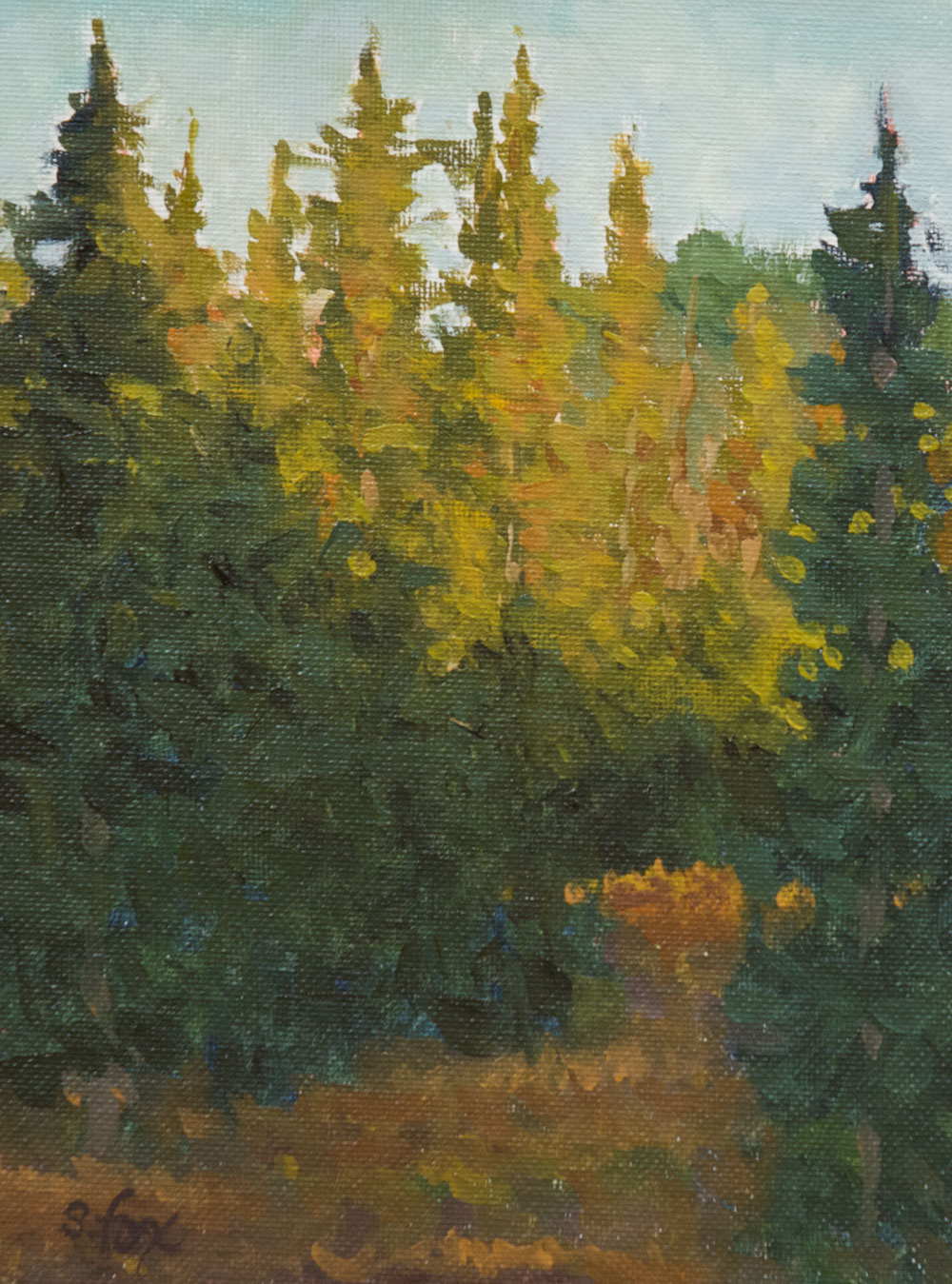
I’ve done seven small landscape studies over the last few days, mostly just 6″x8″, working on two problems: that classic daybreak and afternoon glow and the wonderful effect of light on trees with dark clouds behind. The small size takes less time and lets me focus on the problem I’m trying to solve.
It’s a juggling act. What order to put the colors down, what values and what temperatures those colors should be. And I still try to do a decent composition and pay attention to the drawing.

The above paintings took around two hours each and were done on canvas panels with a round brush.
Oh, and I have integrated the Permanent Green Light and Manganese Hue into my palette. Haven’t quite found out what I’ll use the Permanent Magenta for yet.
More Mongolian poetry on Monday!
ART THOUGHT FOR THE DAY
Nature is what you see and what you think about it. Artists change our thoughts about nature, and so, in sense, change nature. A masterpiece does not look like nature, because it is a work of art. The language you want to speak is art, so study art from the masters.
John Sloan
There is a terrific earth dog blog called Terrierman’s Daily Dose. I sent him a jpeg of the Jack Russell terrier painting that appeared in the post “Dog Day Friday”. He liked it well enough that I’m a “guest” on his blog today!
He doesn’t just write about dogs, but also politics and whatever else catches his fancy, which seems to cover quite a lot of territory. Always entertaining, often incisive, usually educational.
Check it out at http://terriermandotcom.blogspot.com/

 Susan Fox, American Artist