Mongolia Monday- “Required” Reading, Part 3

For the final installment of my list of “must” reads for anyone interested in Mongolia, I offer three books: One about a place and two about people.
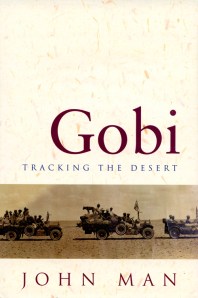
gobi-john-manThe word “Gobi” is a byword for dry/arid/trackless/endless desert. In fact, there is a saying, “Dry as the Gobi”, to describe an extreme lack of moisture. Would it surprise you to know that the best, sweetest vegetables grown in Mongolia come from the Gobi? Or that snow leopards live there? Or that there is a forest with trees that have wood so dense that a piece of it sinks when thrown in water? Author John Man realized his dream of traveling to the Gobi (which is the word for “desert” in Mongolian) and then wrote this excellent book, Gobi, published in 1997, about his journey there, along with lots of excellent information on the human history, natural history, geology and paleontology of this remote and fascinating part of the world.

“We stopped to confer, and I unfolded the map on the bonnet. The Flaming Cliffs were definitely west, they had to be…..In the distance, a ger appeared, standing out of the desert as clear as a mushroom on the moon….Inside, the woman of the ger was distilling camel’s milk, boiling it in an immense pot, capturing the essence as it condensed, drop by drop. We received tokens of hospitality: camel’s curd, hard and sharp as parmesan, and a dish of distilled camel’s milk. It was a nectar of transparent purity, like vodka to look at, but with its alcohol content disguised bya smooth and subtle texture.”

This was one of the first books I read after my first trip to Mongolia in 2005 and it was, in part, the inspiration for my own trip to the Gobi in 2006. Re-acquainting myself with it for this review, I saw in the Acknowledgements two familiar names: wildlife artist Simon Combes, who Man encountered in the Altai Mountains when Combes was there gathering snow leopard information for his Great Cats series of paintings and Dr. Richard Reading, who was the scientist in charge of the Earthwatch project, Mongolian Argali, that was my means of getting to Mongolia the first time in spring of 2005. You’ll be hearing more about Dr. Reading in the not-to-distant future.

Gobi by John Man, Weidenfeld & Nicolson 1997

dragon-hunterEvery Westerner who goes to the Gobi is, to some extent, traveling in the footsteps of Roy Chapman Andrews, who organized and carried out his series of five Central Asiatic Expeditions from 1922 to 1930. Andrews was about as close to a real life Indiana Jones as one is likely to find. Dragon Hunter, by Charles Gallenkamp, tells the story of Andrews’ life and his amazing adventures. He made his reputation at The Flaming Cliffs in the Gobi, where he and his fellow scientists found some of the most important fossils in the history of paleontology. Which was ironic, because Andrews was in Mongolia on a mission laid out by his boss at the American Museum of Natural History in New York to find evidence that man had originated in Asia, not Africa; a goal tinged with more than a bit of racism.

“It was agreed by everyone that the primary objective of the 1923 expedition should be The Flaming Cliffs. Shackelford’s unidentified dinosaur skull, the egg-like fragment found by Granger, and prolific array of bleached bones littering the ground and eroding out of the sculptured formations offered an irresistable lure.”

You can see my photo of The Flaming Cliffs at sunset and Mongolian dinosaur fossils on my website under “Mongolia/Mongolia 2006 photos/items 4 and 1

Dragon Hunter by Charles Gallenkamp, Viking 2001
women-of-mongolia

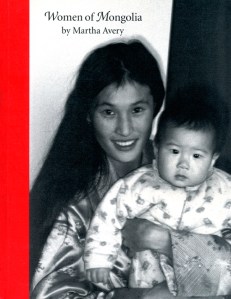
Women of Mongolia is a truly wonderful collection of first person narratives that introduce us to women from every part of Mongolian society: city and countryside, professionals and laborers. I was struck by their strength, practicality and resourcefulness, all of which were necessary for them and their families to survive the transition from socialism to a market economy. The photos in the book may make them seem distant and exotic, but once you start reading, you realize how much we have in common even though the details of their lives are very different from the average American.

A herder woman: “What do I do all day? There’s plenty to do! First I get up at around six o’clock in the morning to milk the cows. My daughter helps me. We have nineteen cows to milk, so it takes around one hour. After that I do various other jobs. I go to bed around ten or eleven in evening. We make everything here. Yes, the wheels of the carts outside are an example. My husband makes them, out of wood. We use the carts to move the ger and our belongings. They are pulled by oxen. I make all the ropes out of horsehair – you can see them on the outside of the ger, holding down the felt.”

An anthropologist: “I recently founded a new Department at the University, so right now I am rather busy. I’m head of the Department of Anthropology and Archaeology at the Academy of Sciences, and also head of the new Department of Anthropology at the National University…The focus of my own work has been craniological study…..How did I get started in this work? I graduated from the Moscow State University in anthropology because that is what the government told me to study.”

Women of Mongolia by Martha Avery, Asian Art and Archaeology/University of Washington Press 1996

——-

And, on a different note: join Lonely Planet Mongolia author Michael Kohn as he takes the train from Ulaanbaatar to Beijing and beyond.
Animal Expression, Part 3- Noses And….A Contest!

Saving the eyes for last, I’m going to skip “down” to noses. This is a case where access to zoo animals is really handy. Even though you will still want to compare them to the wild version, being able to learn how a given animal’s nose structure works by seeing it really close up is very valuable.

Something that one of my art school teachers emphasized again and again was to not be “evasive” in our drawings, but to make a decision, put it down and then either make corrections, realize what needs to be changed for next time, or celebrate that you got it right. What was not ok was aimless noodling around trying to find the form. It shows.

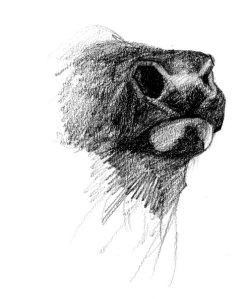
I spent 4-5 hours on these six drawings of noses. This time I used a Sanford Draughting pencil, but on the same vellum bristol as last time. I kept erasures to a minimum and draw as directly as possible.

So here’s the deal: the first person who emails me with the correct identification (common name) of all six species gets a packet of six of my notecards (with images from original drawings). The deadline is midnight PST Wednesday, March 25. Your hint- they are all from North America.

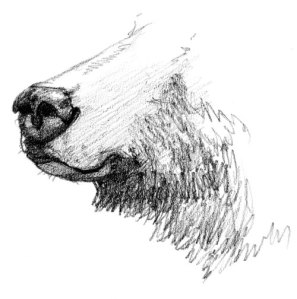
grizzly-noseI’ve personally found the 3/4 view difficult, at least partly because I know that the camera flattens and distorts the form. This is a case where I draw what I know rather than what I see in the image.
bison-nose

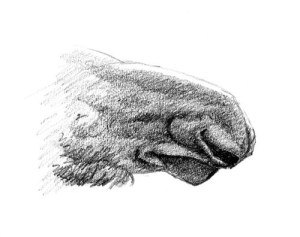
Face-on is a good way to start. Look for reference with a good light side and shadow side, which will show more detail and structure.

moose-nose1Profile is good, also. Then you can see how the nose fits into the rest of the head without worrying about perspective. Pick what you want to emphasize and downplay the rest.

vulture-noseBird’s beaks are really hard to see close up in the field, generally because they’re small and the owners don’t tend to hold still for long. A captive bird may be your best bet because you don’t want to get caught faking it. But beware captive raptors whose beak tips won’t show the wear that the wild ones will.

cougar-nose1Cat noses are fairly similar in form. Variations on a theme, more or less. So drawing your house cat’s nose can be good practice for the big, wild guys.
elk-noseIt’s always great to get good reference of unusual angles, like this one looking up. It helps to see how the lower jaw fits with the upper jaw. Note how I have created a sense of three dimensional form by “wrapping” the right hand upper lip around the lower jaw.

AND A VERY HAPPY FIRST DAY OF SPRING!

Here’s a photo from the garden:

tulips2009-03-191

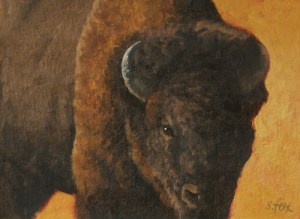
Ebay Listing- 3-16-09; American Bison

American Bison  oil on canvasboard 6x8
American Bison oil on canvasboard 6x8

Click to bid here

Mongolia Monday- “Required” Reading, Part 2

Last week, we started with personal accounts by people who had lived in Mongolia as journalists or as a teacher. This week, it’s three selections from one of my favorite genres- travel writing. I’ve had some fun and “interesting” times on my travels and folks back home here in northern California think I’m very brave and adventurous. That’s as may be, but let me tell you, these books will put my travels into perspective in a hurry.

The first two, written about ten years apart, are the result of actually doing what a fair number of adventure travelers have probably considered or wish they had done: follow in the “hoofsteps” of Chinggis Khan’s Horde and travel across Mongolia by horse.

First up. Tim Severin:

severinTim Severin has made a name for himself re-creating famous journeys of the past and then writing compelling, informative and sometimes humorous  books about what happened. I first found some of them on a remainder table in an English bookstore and have since read as many as I can get my hands on. A few examples: his first foray was to cross the Atlantic in the same kind of small leather boat that St. Brendan used when he supposedly made the same trip (The Brendan Voyage). Another was to have a traditional wooden Arabic ship called a “dhow” constructed so he could retrace the voyages of Sinbad (The Sinbad Voyage). He has also traced the route of the Crusaders from Bouillon in France to Jerusalem. In 1987-88. On horseback. By which time there were somewhat different obstacles to overcome than the ones the original Crusaders faced.

Severin’s journey across Mongolia took place in 1991, when the country was in dire economic straits from the withdrawal of the Soviets and was beginning to create a new government and civil society from ground zero after 70 years of socialism. He had been asked to help a group of Mongols travel the route of the Mongol Empire’s amazing overland communication system that made it possible for messages to cross 2/3s of the known world, from Mongolia to the Danube in about two weeks. The grand plan for this journey involved riding, in stages, a distance equivalent to that between Hong Kong and London, around 6,000 miles. He jumped at the chance because “Here was the most wonderful opportunity for me to travel freely inside Mongolia, not just as an outsider following his own program, but in the company of Mongols who were committed to rediscovering their own history. It was an opening no Westerner had ever been offered before.”

After trip preparations that became a small saga in themselves, the expedition was on its way. “At first the ride was exciting and spectacular. There was the constant rumble of 100 sets of hooves, the shouts of the herdsmen, the mob of horses surging forward….and the sheer exhilaration of riding at a fast pace across unspoiled countryside…..Sure enough, after three or four hours, the well-remembered riding aches and pains set in…The hammering, jarring flat run of the Mongol horses was as excruciating as ever….I understood why the Mongol dispatch riders had found it necessary to strap up their bodies in tight bandages…..”

The account of the trip then moves forward, interspersed with lots of information about Mongolian history and culture. Obviously, highly recommended, as are the next two.

In Search of Genghis Khan, Cooper Square Press, 2003

in-the-empire

Stanley Stewart caught the Mongolia bug and nurtured the idea of going there for 25 years. In his 2002 book, In the Empire of Genghis Khan, Stewart, having made his way from Istanbul through Kazakhstan, finally finds himself being served dinner in a ger near the town of Bayan-Olgii in far western Mongolia. “Sated with sheep guts, we settled into after-dinner chat. Bold explained that I intended to ride across Mongolia to Qaraqorum, the ancient capital, then beyond to Dadal, the birthplace of Genghis Khan. Batur looked for me a long time without speaking. The plan was obviously too outlandish to merit comment…Batur saw no reason to try to dissuade me. Events would soon take care of that.”

As you might imagine, I really liked this description of the horses: “The relationship of Mongolian horses to the wild Przhevalsky’s horse of these regions has yet to be conclusively established (it has since been demonstrated that the domestic and wild horses diverged about 500,000 years ago) but presumably they share the same parole officer. They looked like the outlaws of the equine world….What they lacked in stature they made up for with attitude. They had carried the hordes of Genghis Khan to the gates of Vienna….Now they milled about on the slope below the ger, snorting and pawing the ground, a rabble looking for excitement and hostages. ”

Interestingly, both Severin and Stewart describe the morning process of saddling the horses as “a rodeo”.

Aided by a succession of patient interpreters, who changed out at each stage of the trip, Stewart makes his way across the vast empty interior of Mongolia. Well, not quite. “In Outer Mongolia, my social calendar was packed. Lunch invitations, drinks parties and dinner engagements came thick and fast. There were times when crossing the Mongolian steppe felt like a royal tour of which I was the unlikely focus.” All to say that, after a thousand years, the traditional customs of Mongolian hospitality are alive and well. I can personally vouch for that.

In The Empire of Genghis Khan, The Lyons Press, 2002, 2000

long-way-round

In their 2004 book, Long Way Round, Ewan McGregor (yes, that Ewan McGregor) and his good friend Charley Boorman decide that their lives will not be complete unless they ride their motorcyles from London to New York – by way of Europe and Central Asia. A four month jaunt of 20,000 miles, as it turned out. The reason I include their book on this list is that not only did they travel through Mongolia, but that out of all the countries they visited it was the one that grabbed McGregor and hung on.

Having finally made it to and through a border crossing in the far west that was normally only open to Russian and Mongolian goods vehicles “we rode into Mongolia, turned a corner and ran straight into a herd of yaks….” And a few minutes later, “We pulled into a clearing, where our local fixer, Karina, had been waiting for four days. She was very excited to see us and tied blue ribbons (actually blue scarves called “khadak”) to our bikes, a Mongolian shaman tradition used to bestow good luck on babies and vehicles”.

The book is largely excerpts from the diaries they both kept and, as many of you know, they were also accompanied by a small film crew. Ewan and Charley quickly find out that in most of Mongolia the word “road” doesn’t mean the same thing as it does in the west. Mongolia is not a country where you fly in, grab a rental car and head off into the countryside. Unless you have a GPS and are willing to spend a lot of time trying to puzzle out which of the endless braid of dirt tracks is the one you want, because there are no road signs. None. Not that you are all alone out there on the steppe. “At the top of the first pass, we came across a nomad on horseback with three camels and a couple of dogs. He was a stunning man, fine-featured and handsome, proudly sitting bolt upright on his horse. In the traditional garb of pointed leather herdsman’s boots, a Mongolian hat and several layers of heavy woolen clothing, he was grazing his camels at the top of the mountain. He looked so perfect and so at home in his surroundings that it could have been a hallucination.”

They do, of course, make their way to Ulaanbaatar, where they had made arrangements with UNICEF to visit some of the street children and also a center that has been set up to help them. “The conditions in which these children lived, even in a proper centre, hit me like a sledgehammer. A four-year-old girl was lying on the floor with her head against the wall. Her legs were withered and weak and she was trembling. It broke my heart to see her in such distress, so in need of love and attention, but so alone. I spent quite a lot of time with her, stroking her hair, touching her face and playing peek-a-boo with her. And then we had to leave. I hugged as many of them as I could, said goodbye and got into a car”. (Spoiler alert: I believe that after the trip, McGregor went back to Mongolia, adopted the girl and took her home to England with him, may great blessings be upon him.)

Finally, their journey took them north out of Mongolia and into Russia and Charley observed, “…I’d come to love Mongolia. It had been hell at times (Did I say that this isn’t the easiest place to travel?), but some part of me had actually relished the misery. I’d enjoyed meeting people along the road and I’d been blown away by the helpfulness of complete strangers. We couldn’t have done it without them.”

McGregor noted that “Riding across Mongolia had been incredibly demanding, but it had offered everything I’d been looking for on the trip, a pastoral paradise full of curious, open-hearted people who welcomed me into their homes because I was a passing traveler, not because I was Obi-Wan Kenobi on a bike…It had been like riding through the pages of National Geographic.”

Long Way Round, Atria Books, 2004

———-

If you are interested in learning more about the street children and how they are being helped, visit the website of the Christina Noble Children’s Foundation at www.cncf.org.

——

Next week: More books about the land and people of Mongolia.

Animal Expression- Part 2: Ears

Starting at the top, so to speak, this week we’ll look at ears.

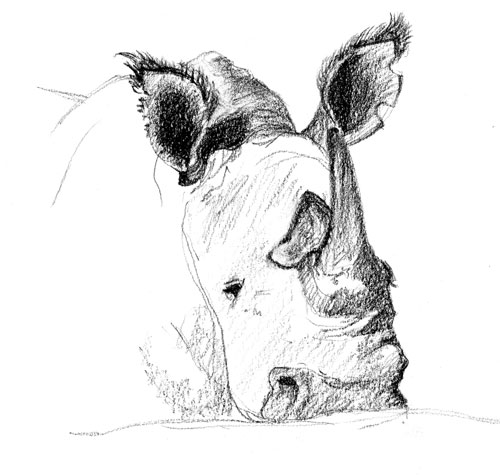
It’s important to not only look at the ear itself, but where it inserts onto the skull. These drawing were done in less than three hours with a Wolff’s Carbon pencil on vellum bristol paper. All the animals are native to Africa.

Bat-eared Fox, Kenya 2004
Bat-eared Fox, Masai Mara, Kenya 2004

Sometimes the ears occupy most of the top of the skull. They are the defining feature of this fox species, which is nocturnal. This one and its mate, however, were out and about near their den at mid-morning.

White Rhino, Lewa Downs Conservancy, Kenya 2004

Ears can also be set high and perched almost at the corners of the skull. Notice how the fringe of hair makes them much more interesting and expressive than they would be without it. Also: Note that I didn’t “finish” the drawing, but concentrated on the parts of interest. Something to remember that might solve a problem sometime.

Cheetah, Masai Mara, Kenya 2004

Notice that the cheetah’s ears are set low on the its head. They are down when the animal is relaxed and only come up when something has caught its attention. Ear set and skull shape are critical for getting  a cheetah head to look right.

Lioness, Denver Zoo 2008

I just happened to find this image of a lioness which has almost the same angle to the head as the cheetah. You can see that while her ears are in a similar position on her skull, they are much bigger in proportion to her head size. They are carried more erect and have a black stripe on the back that is apparently used as a signaling system when hunting with other lions.

The first three drawings were animals that I photographed in the wild. The lioness and the next two are zoo residents. While remembering that wild animals show wear and tear that captives do not, it is still very useful to do these kinds of studies to learn how to draw details like ears.

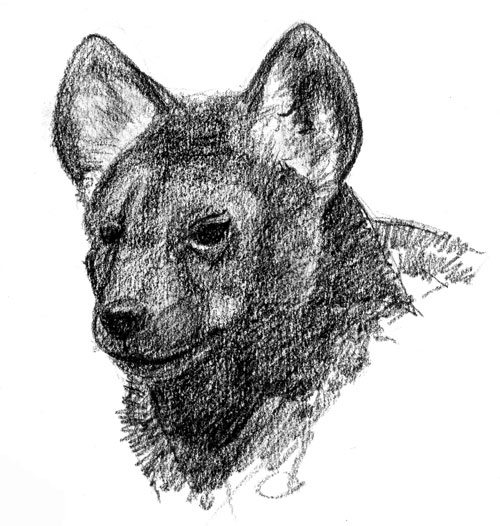
Hyena cub, Denver Zoo 2008

The outward curve of the ear inserts smoothly at its base into the skull. Hyena cubs are dark chocolate brown. For comparison, here is an adult (the mother).

Hyena female, Denver Zoo 2008

As the head grows, the ears appear to move back on the skull. Unlike the cheetah, the hyena’s ears are carried upright. Hyenas always seem to look ready for anything.

Look at your own pets, whether it’s a cat, dog or hamster and see what you can observe about the ears. Then try drawing them!

EBay Auctions: 3-9-09- Still Available

Goose Lake Afternoon 8x10 oil on canvasboard

Go to Lost Coast Daily Painters to Buy It Now

Big Lagoon Morning 8x10 oil on canvasboard; plein air

Go to Lost Coast Daily Painters to Buy It Now

Animal Expression, Part 1

IMHO, there is too much animal art out there in which the subject has about as much life as a department store manequin. Why is this? Is it a lingering result of Descartes’ pernicious idea of animals as “mere machines, incapable of thought or feeling” (Pollan, The Omnivore’s Dilemma)? Being so concerned with surface features that the inner life of the animal is ignored? Not doing the fieldwork and observation which would reveal that inner life? I could make a case for any and all of those reasons, but the fact remains that there are an awful lot of “dead” animals on canvas out there.

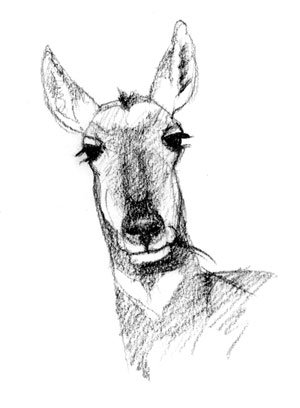
Pronghorn doe
Pronghorn doe

Internationally known wildlife artist John Banovich, who I have been fortunate enough to study with, pointed out in one workshop a few years ago that “you are only as good as your reference”. Since then I’ve realized how true that is. I look back through the print photos that I took before I went digital and it’s so obvious why I couldn’t get my work past a certain level. I didn’t have top-notch reference. I struggled to paint with what I had because I wanted to do it so badly.

African Wild Dog
African Wild Dog

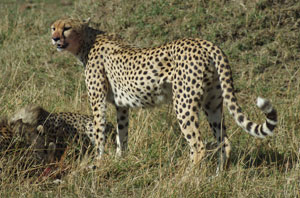
Digital photography has been a godsend since it has always been necessary, as any professional photographer knows, to take 20, 50 or 100 shots to get the keeper. Now there’s no excuse not to fire away and greatly increase the chances that you’ll get the shot that will allow you to do the painting that will be ALIVE. Here’s an example: two images of a cheetah, taken 3 seconds apart. The first is ok, but the second is much, much better. The only difference is a slight turning of the head, but it makes a big difference in the expression.

Cheetah 8:45:11am
Cheetah 8:45:11am
Cheetah 8:45:14
Cheetah 8:45:14

For an painted animal to “be alive”, the artist is required to accept that they are sentient beings, with their own consciousness. Whatever else animals are, they aren’t “dumb”.

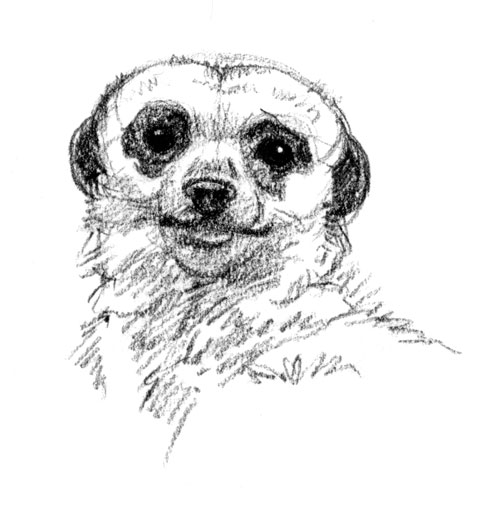
Meercat
Meercat

For the next few weeks, I’ll be discussing animal features one by one and how they relate to capturing life and expression. The final installment will be how it all comes together to create a whole that is greater than the sum of the parts.

Lion yawning
Lion yawning

Hope you find it interesting!

eBay Auctions- 3-2-09, Border Collie; 3-9-09 Coast Range-SOLD

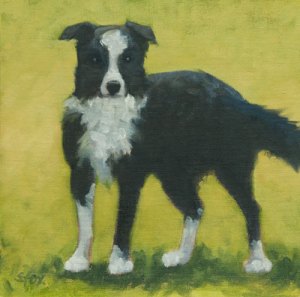
Border Collie  oil on canvasboard 8x8
Border Collie oil on canvasboard 8x8

Available through Buy It Now at www.lostcoastdailypainters.blogspot.com

Coast Range, Humboldt County  oil on canvasboard 8x10
Coast Range, Humboldt County oil on canvasboard 8x10

SOLD