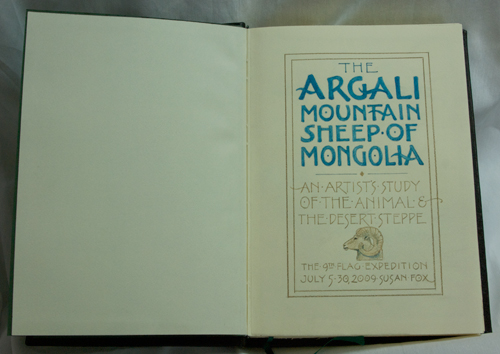
I may add embelishments as the fancy or inspiration strikes me. But I’m tolerably pleased with how it came out.
My Flag Expedition page is up and running here over at Artists for Conservation. I’ll also be blogging and posting photos there.
I may add embelishments as the fancy or inspiration strikes me. But I’m tolerably pleased with how it came out.
My Flag Expedition page is up and running here over at Artists for Conservation. I’ll also be blogging and posting photos there.
Let’s see….my Flag Expedition page should be live soon over at Artists for Conservation. I have confirmed that the weather is likely to be hot, hot, hot. Unless it rains, in which case it could be cold enough that I’ll want my down bag.
I spent three hours on the phone last night with Gana Wingard, the scientist with whom I am working on the women’s craft cooperative. She sent me a great email this morning entitled “The Grand Plan” and then noted that, of course, it’s all subject to change. But we now have hashed out a way forward and know what we need to do, who we need to talk to over there and when and in what order it will probably happen.
It reminds me of one of my favorite exchanges towards the end of one of my all-time favorite movies “The Wind and the Lion”. The Raisuli and his men are on their way to a small village, returning Mrs. Pedicaris and her two children to a contingent of American marines and, after hearing their destination described, along with the myriad dangers likely to be lurking there and the possibility that he could be killed, The Raisuli says “It is good”. His right hand man says “What is good?’. The Raisuli answers “It is good to know where we are going.”
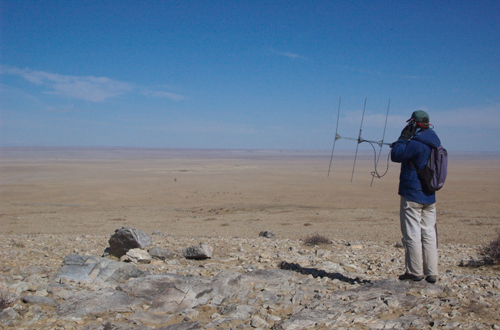
It turns out that Gana will be bringing radio telemetry equipment because she needs to find all the radio-collared argali or as many as possible before the next Earthwatch team arrives on August 2. There are plans to try a new population survey method since, at this point, it’s not really known how many animals are in the reserve. This is great news for me, since I will now be able to go out looking for sheep with someone who knows the reserve really well and is as motivated as I am to spot the animals.
Here are a couple of photos that I took on previous trips of the scientists using radio telemetry equipment. The research project now has some GPS collars, which send in the data via satellite, but those are relatively expensive, so there are still animals that need to be tracked the old fashioned way.

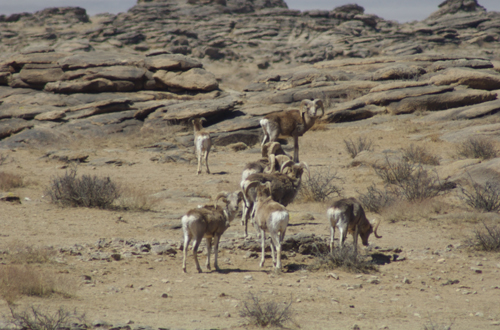
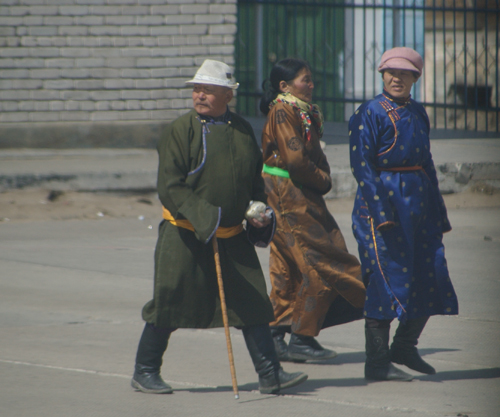
Our plan is to “game drive” in the mornings and evenings, when it’s relatively cooler (Gana said that temperatures went over 100F last July. Okaaay.). During the day we will have our meetings with the women, for which the groundwork is being laid by another of the scientists, Amgalanbaatar (which means “peace hero” in Mongolian; see above photo), who we all call “Amgaa”. He is now at the reserve and is passing the word about the meeting and the hoped-for dates. Everything is tentative because summer is when the women have the most work do to, milking animals, making aruul and airag and also felt. We don’t know how many will come, but we know that they are interested. They will need to arrange to have someone watch the children and will want to be home in time to make dinner. Gana expects that they will arrive both on horses and motorbikes.
There are about 100 families living in and around the reserve, depending on their livestock for their living. The women all know how to sew and, in fact, the country women are the repository of the skills needed to make garments like del (the long robes). The younger women who have been brought up in town don’t learn to sew anymore. The material to make a del, outer fabric, liner fabric and trim costs about $30. Some of the women also do embroidery and since that’s something I’ve done on and off for many years, I’m really looking forward to seeing their work.
After talking with Gana, we’ve scheduled a third day for me to get together with any of the kids who are interested in art. I’m taking some sketchpads, pens and pencils. Should be a fun way to pass a hot afternoon.
We plan to go to Ikh Nart on the 23rd and return to UB on the morning of the 28th. That will give me a day and a half to tie up loose ends. Five days and counting………..
Christopher Gervais and Wildlife Art Shows are out of business, citing “the global economic crisis and cost analysis of upcoming events.” I guess he forgot about the criminal investigations and the fact that the wildlife art world is on to his rip-off business practices. If you are signed up for one of his shows, I hope you can get your money back. If not, report it to the Pennsylvania Attorney General’s office.
This showed up on his website in the last day or so, I guess. I got an email from another artist giving me the heads-up. Pass the word.
Note that while the Snow Leopard Trust’s logo still appears on the page they withdrew from any association with him at least a month ago. They are in no way involved in his “activities” and are worthy of your support.
I’ve gone back and forth over whether to add some way of shooting video on the upcoming trip to Mongolia. I looked at “real” camcorders and finally decided that another $600 and hauling a third thing that is bigger than a Nikon just wasn’t in the cards. But I was very skeptical of the little Flip camcorders. Many times it’s better to skip something rather than settle for the minimum and then just be frustrated.
But I’ve watched a couple of people use them and saw how compact and light they are. Hummm. I went to Amazon over the weekend and poked around. The second generation of Flips are out and the price was too good to pass up, so, for $129 I got a Flip UltraHD and I have to say, I’m really impressed. Here’s my first ever video that I shot last night, all nine seconds of it:
I’ve already learned one thing and that is to let the subject go all the way out of the frame before stopping the shot.
This Flip will shoot 120 minutes of video and has 8gb of built in memory. It has a flip-out USB port that plugs into your computer. I also got the rechargeable battery pack and the padded case. The case was returned today. It was a $15 rip-off. Cheesy and no way to even get the camera in it since it was effectively sewn shut.
I have no idea what kind of wildlife footage I’ll get since there’s really no zoom to speak of, but for the national Nadaam events, especially the horse-racing, and domestic animals like the horses and camels, it will be interesting to have images of moving animals to work from when I get home instead of only stills. It’ll all be a big experiment and a fun one.
Spent a good chunk of Friday finally coming to grips with The Journal. I need a title page and a page with a map of Mongolia on it. The backstory on all this is that from 1976, when I was mumblety years old, until 1988, I was a freelance sign painter, graphic designer, calligrapher and generally a lettering and type nut. All that was peeled away as I decided to concentrate on illustration and then easel painting. But I have always kept my lettering and type books and also the late 19th-early 20th century illustrated storybooks and historic decoration books that I had accumulated way back then, always kind of thinking and hoping that maybe some day….
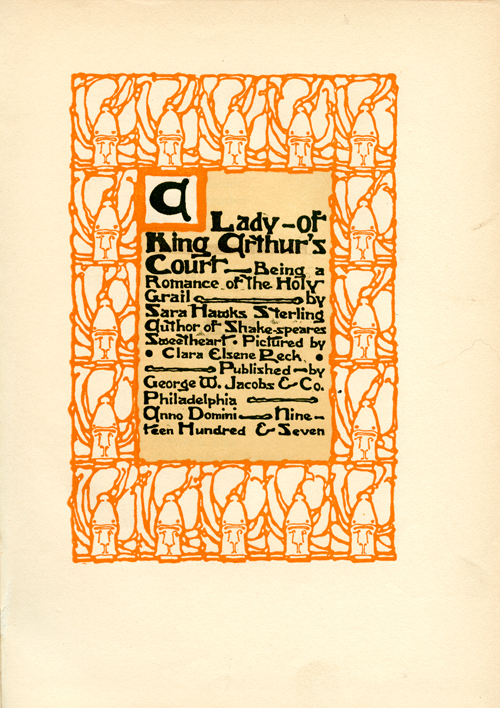
Well, some day is here. I was blanking out on how to approach the journal when I realized that it was time to do what I know- the lettering and stylistic approach of the Art Nouveau and Edwardian eras. I got out a stack of books for inspiration and to jog my memory. Here’s motifs from a couple of them, which helped get the juices going:


Then I needed to look at some lettering samples, once again to jog my memory. I have a number of old commercial handlettering handbooks. The sign painter I worked for and who taught me brush lettering used the same kind of letterforms for the basis of his sign designs:
 The name of my Flag Expedition is rather long and when I came upon these pages, I realized that I could use that to my advantage:
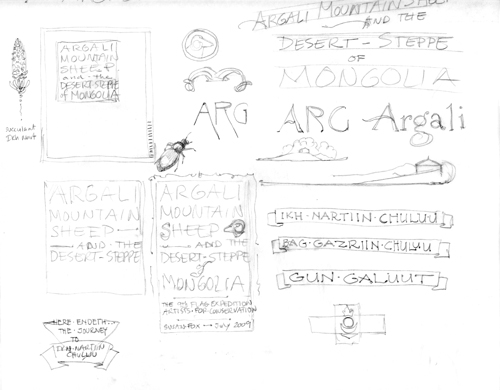
I got out the tracing paper and started to scribble any ideas that occurred to me- thinking with a pencil. I liked the block in the lower middle of the page with the sheep’s head and decided to develop that further to see how it worked. This is half the sheet:
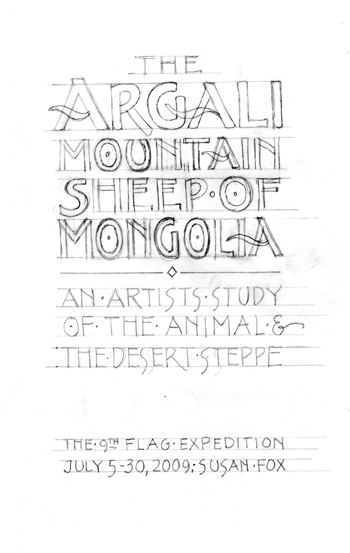
I did a rough layout next:

I needed to leave a space for the sheep’s head and also started to refine and design the lettering.
This is the final layout from which I’ll do a graphite transfer onto the Journal page.
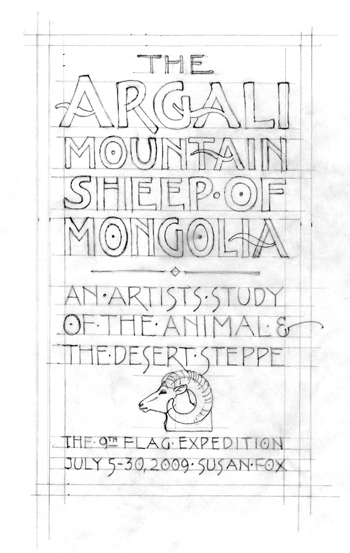
I based the letters on the kind of thing I always liked and have done a lot of. I let the forms vary without worrying about consistency. I don’t want to and don’t have time to agonize over this for weeks, so decided to take it to the next step and refine the letterforms.
I settled on a more rounded small serif, used the curved cross stroke for the “A” and added the little dots in the centers of the “o”s, kind of a tribute to my old sign painter boss, since it was one of the things that made his signs instantly recognizable as being done in his shop. I’ll post the finished page as soon as it is done.
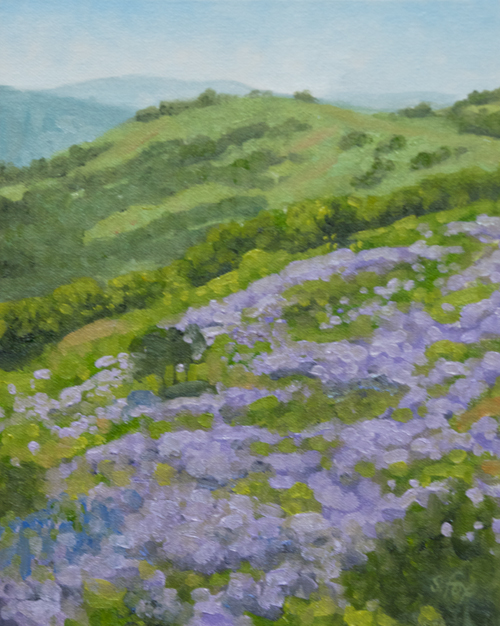
This is a scene from a once-in-fifty-years mass bloom of lupine up on Bald Hills Road in Redwood National Park. I was fighting a cold, but my husband drove me up there late one afternoon so that I could see it and get pictures. The location is about an hour from our house. Click to buy it here
Here’s the deal. Mongolia is a land-locked country where there is no/none/zero marine influence to moderate the weather. I am from a coastal Mediterranean climate (the north coast of California) where the average temperature swing is from an average of 55F in January all the way up to 65F in August. Are we weather weenies here? Yes, we are.
I got on Weather Underground and checked the current six day forecast for Ulaanbaatar. The daytime highs and nightime lows read like this: 80, 30, 50, 32, 59, 33, 66, 42, 69, 37, 89, 44 with chances of rain every day. Not sure what it will like when I’m there, this being the first trip in the summer, but I’m going to be ready for heat, cold and rain. Thank goodness it looks like it cools down at night. I don’t sleep well when it stays warm. We pretty much always have a window open at least a little here at home.
—————-
I’m now three and a half weeks from departure and I’ve dragged out the luggage and a lot of the stuff I’m taking. I’ve printed out my packing list. An extra camera battery and two additional memory cards are on their way. The failing MacBookPro’s battery has been replaced. New light hiking boots have arrived, along with a lightweight rain poncho. I have new, sturdy walking shoes. I’ll probably take the Teva sandals and a pair of nice shoes for when I’m in town.
David, my husband, and I went over everything that needs power this evening. The gear falls into two categories: stuff that needs juice to re-charge and stuff that runs on batteries only. I plan to do my re-charging either when I’m somewhere that has electricity or by way of an adapter that plugs into a car cigarette lighter. That will cover the MacBookPro, the iPhone and the Wolverine external hard drive, which will be my backup image storage. The iPhone can also be charged by way of the MacBook when it’s plugged in. The charger for the camera batteries and also the one for the Wolverine can be plugged in to a wall socket or the lighter adapter.
The immersion heater will only work when I can plug it in. If there’s no electricity, then I’ll use the little “stove”, which I also need to test run. A friend said that I’ll need to get a lighter, so that’s been added to the list.
I’ll also have a GPS, Tikka headlamp and a travel alarm which are battery only. I’ll carry one set of extra batteries for each.
This sounds like a lot of hassle, but once I’m on the road and organized, I have a routine that involves always charging things whenever I have the chance while I read or am at dinner or overnight.
——–
I dress in layers. No jeans. Too bulky. Instead I’ll have a couple of pairs of LL Bean ripstop cotton pants, plus a pair of loose pull-ons for on the plane. For town, I may take a sleeveless dress I got some years ago at Hilo Hattie’s in Hawaii in case it’s really hot and a pair of “town” pants. I have a Patagonia fleece pullover that I found at a outdoor equipment consignment shop in Berkeley for about $30. That, a jacket and a set of smart wool thermals will keep me warm. I’ll take two pairs of heavy smart wool socks, too, just in case.
Otherwise, a couple of field t-shirts, a couple of town t-shirts, my denim shirt, which can be a light jacket, a turtleneck and a couple of tank tops. I’ve really pared down the clothes over the years. I just want to have something clean to change into if I get hot and sweaty and while I’m washing the dirty stuff. The humidity is really low in Mongolia, but the insides of the buildings in UB can be sweatboxes.
I’m debating whether or not to take my grey Mongolian del, the traditional item of clothing. It’s kind of bulky, but it makes a great robe/lounge around/throw-on-to-run-to-the-toilet garment. I’ll probably try to squeeze it in.
——
Still sorting out art equipment. More on that later.
My name came up on Julie Chapman’s blog about the article by Thomas Mangelsen in Wildlife Art Journal. In addressing the post and comments there, I ended up adding to my thinking about the issue. The post is here. Here’s my comment.
I guess since my name has come up, I ought to show up and comment here, although I suspect that my comments on the Wildlife Art Journal article make my feelings about the subject pretty clear. I have thought a lot about game ranches since my two experiences at them and have come to feel that they are not a place that I choose to go, for the reasons that I and Mangelsen enumerate.
So, FWIW:
I don’t believe that for him, and I agree, the issue is being a purist, but of being honest about how and where one collects images of genetically wild animals. If the photo is not labeled “captive”, then people are free to assume, as most do, that the image was taken in the wild, as Larry, and I at one time, believed. Truth in advertising, I guess. That’s not at all the game ranch’s fault or responsibility.
Painters don’t have the same issue of attribution that a photographer has, since a good artist generally uses multiple reference, or brings a unique point of view, for a painting and doesn’t simply copy a single photograph, theirs or anyone else’s.
I think as we live our lives we all end up in the position of having friends, sometimes quite good friends, who do things or have beliefs that we don’t agree with. The choice is either to accept that or end the friendship. Mangelsen chose to stay friends with Bob Kuhn.
By “old school”, I think that he may have been referring more to a way of thinking about animals that has changed dramatically in the last twenty years. We have gone from Descartes’ view that they are “machines”, driven by instinct, feeling no pain and having no souls to a recognition that we share the world with many sentient species. Year by year, the definition of what separates homo sapiens from animals has to be modified. Oh, they use tools. Oh, they recognize themselves in a mirror. Oh, they have culture. Oh, they have a sense of fairness. Oh, they lie and cheat. And the list goes on.
I have found that in order to reconcile, and be personally ethically consistent with, what I have learned over the years about animals and from my involvement in animal welfare (definitely not PETA-type animal rights, a whole different deal) and dog and cat rescue, I can’t justify going to game ranches.
I can, with reluctance, accept zoos that are heavily involved with education, conservation and the preservation of endangered species. I’ve pretty much reached the point where I choose not to support activities in which animals are used for human entertainment where there is a significant risk of abuse, either physical, emotional or psychological. I await the day when animals are no longer needed in any kind of research because computer models are superior.
My thinking is constantly evolving in this area as I add to my knowledge. My husband and I decided last year to no longer eat meat that we cannot source and that we do not know to have come from animals who have been treated humanely. This includes eggs. We refuse to support industrial animal agriculture, with its battery cages, feedlots and cruel confinement.
I wish to emphasize that these are all personal choices. I have no wish to dictate what other artists, photographers or people, in general, choose to do.
I think you can see that my decision about game ranches is just one part of a larger question that I’ve been thinking about for years- What is the appropriate relationship between humans and the fellow creatures we share this planet with?
PS, Larry- Barry Bonds- Being a Giants fan, I watched the whole thing play out. My opinion, and it is just my opinion, is that he probably used something in the 1980s at a time when many players did, so maybe the playing field was effectively re-leveled during The Steroid Era. Maybe he should be prosecuted (he’s charged with perjury, not substance use per se), but then there’s quite a few other ball players who used stuff and lied about it. How come they’re not on trial? His biggest problem has maybe been his attitude, which alienated the sports media, who often seem to feel an amazing sense of entitlement in what they feel they are owed by pro athletes. I’m not pro or anti Barry, by the way. It is what it is. Giants fans have moved on.
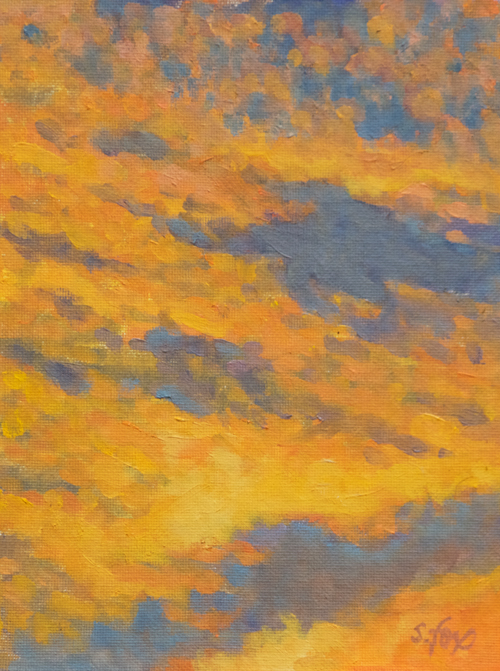
Click to Buy It Now here
 Susan Fox, American Artist