“A Republic If You Can Keep It”

This blog is primarily about my art and adventures in Mongolia. But I’m also an American and I’m very concerned about what is going on in our country. Not just economically, but the “body politic”. Who will have time for art if we lose what fundamentally ties us together as a people? I have no intention of changing the focus of my blog, but it also doesn’t exist in a vacuum. Civilization and a civil society are required for culture to flourish. Our society, thanks to a vocal few, has become anything but civil. We have lost our ability to have honest disagreements and work them out. The shrillest and most extreme voices are prevailing. And it needs to stop. Now.

“All that is required for evil to triumph is for good men to do nothing. “ Edmund Burke.

How many of us stood by for the eight years until President Obama’s election while the Constitution was dragged through the mud? I’d have to raise my hand. How many of us stood by while, at the very highest levels of government, fear was used to control people and keep them from seeing that we were engaging in a war of choice, that alleged enemies were tortured and that the civil rights upon which we all depend were deliberately, consciously and with malice aforethought eroded?

Andrew Sullivan, who blogs over at the Atlantic Monthly, posted something very important today. The title of this post is taken from his. It is a quote from John Adams. It is the best explanation yet of the situation that America now finds itself in. Whither goest our grand experiment in self-governance? Please click through and read it. Thank you.
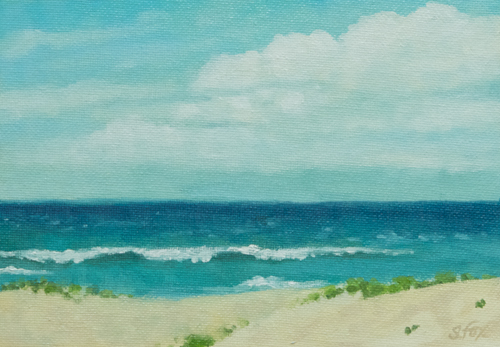
EBay Auction, 1-25-10; Polihali Beach, Kauai SOLD

Polihali Beach, Kauai 5x7" oil on canvasboard

The guidebook stated in no uncertain terms that if you took your rental car off the road at this famous beach and got stuck, well, it was a long walk back. We left the car in the parking lot and spent part of one afternoon on our last trip to Hawaii enjoying the gorgeous colors of the water, sand and sky. A little spot of summer for you in the middle of winter. Click to bid here

Mongolia Monday- An Extremely Hard Winter In Mongolia

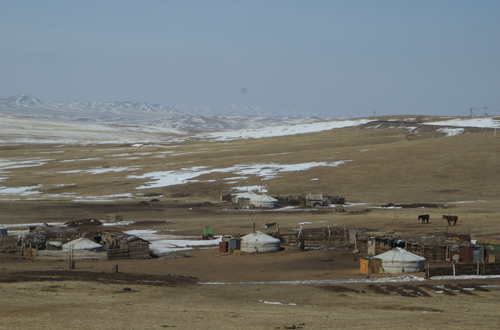
Gers in "winter quarters", late April 2005

I was going to do a book review on “Genghis Khan and the Making of the Modern World” this morning, but in the modern world of Mongolia, the country people are suffering through a very severe winter. A Facebook page that I follow “Mongolian Business and Economy News” posted a link to this AP story “United Nations Warns Extreme Cold, Heavy Snow in Mongolia Threatens Lives”, from which there are a few quotes below.

The page administrator asks “Will anyone hear our plea when the whole world is focused on providing aid to Haiti. I guess most of the help and aid should come from domestic sources, but most people barely have enough money to support themselves, let alone helping herders.” He or she is looking into setting up a fund.

I’ll post more about this as it unfolds. I have herder friends, the women who have joined the felt crafts cooperative at Ikh Nartiin Chuluu, who I am concerned about. I have no idea how they are doing, but am going to try to find out.

—————-

“…..extreme winter weather that has killed more than 1 million livestock in Mongolia is likely to harm the country’s food supply and worsen poverty.

Nineteen of Mongolia’s 21 provinces have been hit by heavy winter snow and temperatures that have plunged below minus 40 degrees (minus 40 degrees Celsius)…….

……..particularly concerned about pregnant women cut off from medical facilities by the heavy snow – three have reportedly died in childbirth so far…….”

—————-

New Painting! “After The Race; Baga Gazriin Chuluu”

There’s this saying about combat flying- hours of boredom interspersed with moments of stark terror. At a far less dramatic level, painting seems to have a similar rhythm sometimes. We spend days or weeks working on paintings and, suddenly, some get finished, signatures go on, photos are taken and, ta da. we’re ready to move on. I finished this painting a couple of days after the one I posted last Friday.

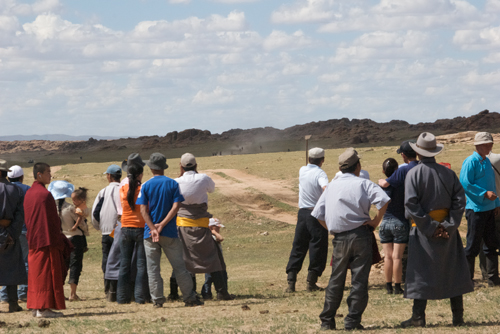
This piece is a scene from the mountain blessing ceremony that I had the good fortune to attend at Baga Gazriin Chuluu. There had already been an anklebone shooting competition, but the horse race was the event that everyone dropped what they were doing for. The Buddhist monks who had been sitting in a tent, chanting, came out and joined their families and friends. For at least a hour before the race, the kids had been warming up the horses by walking them in a big circle, sometimes singing as they rode round and round.

The horses were two-year olds, all stallions. As it turns out the Mongol word for horse, “mor” includes the fact that the horse in an ungelded male. That’s the default. Then there are geldings and mares. Being young colts, the race was a short distance- 7km. (The main national Naadam race for fully adult horses is 56km.) As with all Mongol horse races, after warm-ups the jockeys rode their mounts out to the starting line at a walk or trot, followed by a few vehicles which I assume included the starter and some of the trainers.

Everyone went out of sight behind a large rock formation. We all waited at the finish line, a small pile of rocks which held up a pole that had a colorful red scarf flying from it like a flag.

Horse race with spectators, Baga Gazriin Chuluu, July 2009

Pretty soon the crowd stirred and, looking out, we could see the dust from the horses. In just another minute or two they started to reach the finish line. I got as many pictures as I could.

The trainers checked the horses over and some scrapped the sweat off them, although none were lathered up or even looked particularly tired. Then the jockeys spent most of the next hour circling the wrestling competition, cooling down their mounts. That’s when I got the image I used in this painting.

I’ve also included the reference photos since I think too many animal artists just use whatever setting the animal is in when the picture was taken and don’t consider other options. In this case, the background was pretty boring. But, a short distance away were these really great rock formations.

The young rider:

The background:Put them together and….

After The Race, Baga Gazriin Chuluu 16x20" oil on canvasboard

The rocks were deliberately placed so that the boy would be against the large shadow area. I kept things on a diagonal so that the background would be at a different angle from the main subject and keep the composition from being too static. After going 14km, the rider was still having to pull firmly to keep his mount at a walk. I wanted all the elements of the painting to support that pent-up energy.

Mongolia Monday- New Mongolian Grammar Book

I got an email a month or so ago from one Munkhbayar Barmunkh, with a link to the Amazon page which offered the above book- a new, as of Sept. 2009, Mongolian grammar textbook. He turns out to be the publisher. I ordered it immediately.

The author, Khatantuul Baatarsukh,  has a BA in International Relations and Slavic Studies from the School of Foreign Services at the National University of Mongolia. It was clearly a labor of love. She says in the Preface, “Writing this book was a daring project, for it has many critics. My motivating force was the love and fascination of the art of language. My inspiration comes from life.”

As some of you know, I’m trying to teach myself Mongolian. I’m using: a Transparent Language course ; listening to Mongolian music via both CDs I’ve purchased and TsahimRadio, an internet radio station run by a Mongolian Facebook friend; and asking Mongol friends to translate words and phrases for me. I also have the Lonely Planet phrase book, which is dated in some unfortunate ways, but still very useful; and Mongolian/English and English/Mongolian dictionaries that I brought back in July.

I just bought Bento, the Mac-based consumer datebase app. I’m going to do my own word list since I need a specialized vocabulary of art and craft terms so that I can start to communicate with the felt craft coop ladies.

There doesn’t seem to be much else available that isn’t either really expensive or doesn’t fit my needs. I haven’t diagrammed a sentence since 8th grade (am I dating myself?), but I think this book will be quite helpful.

Mongolian is structured differently than English. The word order is more like German: Subject, object, verb. Verbs are modified by endings, so while I can look up a verb’s root word in the dictionary, I’ve had no idea how to use it correctly in a sentence. One exception is “gui”, which creates a negative. So, “chadakh” means “can” and “chadakhgui” means “cannot”.

The main problem that I have in learning a language is that I have a visual memory. That is, I store and retrieve information in images, for the most part. It makes remembering things like strings of numbers interesting. So, I find it difficult to make sense out of the terms for cases and how to relate them to anything. I’m hoping this grammar will help me sort that out, one way or another. I may just have to learn it by rote, which is ok, too.

All the text is in English and Mongolian cyrillic, which is almost, but not quite, the same as the Russian alphabet. There are lots of practice exercises, with a key at the back.

This book is not for beginning language students. I know just enough to start to beat my way through some of it. It will go with me on my next trip, though.

I invite both the author and publisher to add more information or comments, along with anyone else who has the book or would like to offer ideas/comments about the Mongolian language.

EBay Listing, 1-18-10 – Takhi Yearling

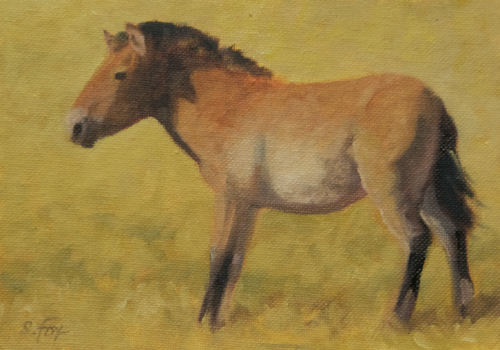
Takhi Yearling 6x8" oil on canvasboard

“Takhi Yearling” is a painting of a takhi that I saw at Hustai National Park in Mongolia in Sept. 2006. Takhi are the only surviving species of true wild horse. It’s a thrill and a privilege to see them in their native habitat. I’ve now visited two of the three places in Mongolia where they have been reintroduced after going extinct in the wild in the late 1960s. Click to bid here

New Painting Debut! “Choidog and Black”

In September of 2008, my husband and I went together to Mongolia. One of the places we stayed at was Arburds Sands ger camp. It turned into one of the most memorable experiences that I’ve had in Mongolia because we were invited to a foal branding. The post on that is here.

I got a lot of great pictures, including some of the family patriarch, Choidog. He is a famous horse trainer who won the national Naadam horse race three times in the 1960s. During socialist times, he and the other herdsmen were only allowed to have 75 horses. Twenty years after the changeover to a parliamentary democracy, he has between 300 and 400. I suspect he thinks that’s just about right, but even by horse-loving Mongol standards, it’s a lot.

I decided recently that I wanted to start painting not just the Mongol horses, but their riders, too. And where better to start than with a man who is now 80 years old, who still rides every day and whose life has been dedicated to horses?

Choidog and Black 18x24" oil on canvasboard

As much as they love their horses, Mongols do not sentimentalize them and don’t give them what we would call “real” names. Choidog is riding his current favorite horse, who is simply called “Khar” or “Black”. Black could take his master 140 km to Ulaanbaatar if necessary, probably without breaking a sweat.

In this painting, Choidog is circling and looking over the horse herd that has been gathered in. Most of the foals are already tied to a picket line, but some of the men are out lassoing the others with urga, a long pole with a loop on the end.

We were told afterward, while sitting in the ger drinking airag with the family and friends, that Choidog had made his boots himself over the previous winter. The toes are upturned, not because it looks cool, but so that when walking (which people like Choidog never do if they can ride), the wearer won’t scuff the earth and damage it. The Mongols learned over a thousand years ago that they had to live with and respect the land in order to survive. Hum….

Mongolia Monday (More from “Among the Mongols”)- Hospitality

Ger near Arburd Sands, Sept. 2008

One of the interesting and, to a lot of Westerners, amazing things about traveling in Mongolia is that the thousand-plus year old traditions of hospitality out in the countryside are still practiced. It feels very odd to walk up to someone’s ger (assuming there are no dogs in sight), open the door and walk right in without knocking. After four trips, I still get a twinge doing it.

I found myself very intimidated the first time. There are no windows in a ger and the door is solid wood so, even with a guide, you are walking into someone’s home without any idea of what to expect. Fortunately, the Mongols are patient and understanding, like my first time, when I turned to the right instead of the left and circumnavigated the ger to get to the stool that I was to sit on.

At least I remembered not to step on the threshold or walk between the upright supports.

The older gentleman approved of the fact that I was wearing Mongol boots. He said to me, through my guide “I see Mongol boots and I look up and see… a western face”. It was spring, which means really cold and windy, and they were the warmest footwear I had with me, having purchased them at the State Department Store in UB. They worked, of course. I asked if he would be willing to have his picture taken with a westerner wearing Mongol boots and he immediately sat up, buttoned his del and made room for me to sit beside him on the bed.

First-ever ger visit; ok, I'm hooked; near Hustai National Park, May 2005

Those thermoses keep water hot, hot, hot for over 24 hours. I want one. I just have to figure out how to carry it home.

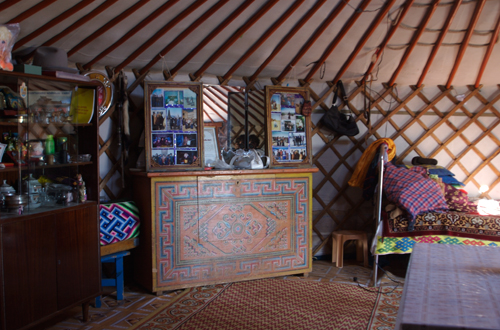
Ger interior; the Gobi near Bayanzag, Sept. 2006

Now ger visits are one of the things I MOST look forward to when I go to Mongolia. A ger, maybe because of the quality of space that the round shape creates, is one of the most pleasant and peaceful places that I’ve ever been in. I just happily sit sipping milk tea or airag and nibbling aruul as conversations that I don’t understand a word of go back and forth between my guide and our hosts.

Mutton almost ready; my driver really tucked in; I passed; western Mongolia, Sept. 2006
Boortz soup; Yum!! Mutton I can believe in (and eat safely); Baga Gazriin Chuluu, July 2009;
Aruul; an acquired taste that I had acquired after about three (careful, 'cause it was rock hard) bites; western Mongolia, Sept. 2006
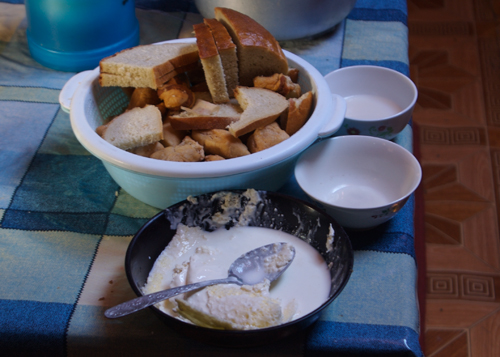
Mongol-style clotted cream; to die for- near Hustai National Park, Sept. 2006

Gilmour seems to have relished ger visits also and provided a good description of the customs:

“As for entering tents on the plain, there need be no bashfullness. Any traveler is at perfect liberty to alight at any village he may wish and demand admittance; and any Mongol who refuses admittance, or gives a cold welcome even, is at once stigmatised not a man but a dog. Any host who did not offer tea, without money and without price, would soon earn the same reputation, the reason being, I suppose, that Mongolia has no inn, and all travelers are dependent on private houses for shelter and refreshment. At first sight it seems rather exacting to leap off your horse at the door of a perfect stranger, and expect to find tea prepared and offered to you free; but probably the master of the tent where you refresh yourself is at the same time sitting likewise refreshing himself in some other man’s tent some hundred miles away; and thus the thing balances itself. The hospitality received by Mongols in travelling compensates for the hospitality shown to travelers.”

Young hostess; near Hustai National Park, Sept. 2009 (the ger with the CREAM)

EBay Listing, 1-11-10- Daruma #1

Daruma #1 8x8" oil on canvasboard

“Daruma #1” is a painting of a little paper-mache daruma doll that I bought on a trip to Japan in 1968 when I was 14 years old, so he’s been with me for a long time. I never wished on either of the eyes and now I wouldn’t because they represent possibility to me instead of simply wishes that were or weren’t granted. Click to bid here