EBay Listing, 2-15-10: Wine Country Scene

Wine Country Scene 8x6" oil on canvasboard

“Wine Country Scene” is a study of lovely fall colors that I saw in the Napa Valley some years ago. I really liked the contrast of the upright landscape trees, the intense warm colors of the grape leaves and the spot of pink lavender. Click to bid here

Mongolia Monday- New Painting Debut!

Last week was pretty intense. I had a painting to finish for submission to an invitational show (which it may or may not be accepted into; we’ll see). It’s by far the most complex and difficult one I’ve taken on so far. The kind where, once you’re well into it and can see what level of effort it’s going to take to pull it off, you wonder if you’re out of your mind. But I felt really driven to paint it, so off I went. I think it took somewhere between 60 and 80 hours, spread over about three weeks, but I wasn’t really counting. I didn’t have time.

I normally post about my painting activities on Fridays, but when you see the reference image that inspired me, I think you’ll agree that it’s right for Mongolia Monday.

I photograph the process when I do “major” paintings, both to have a record and to be able to refer back to previous points while it’s in progress. I thought you might enjoy following how this one developed.

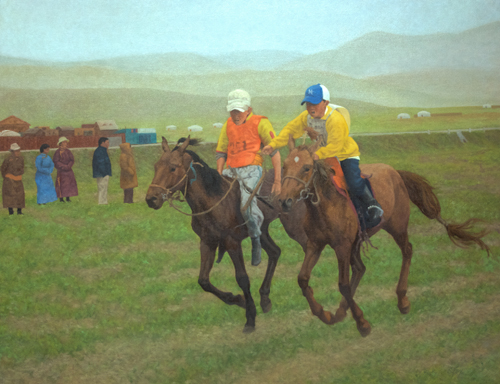
So, to start, here’s the image that said “PAINT ME!” It was taken at a local Nadaam in the town of Erdene, which is about an hour east of Ulaanbaatar, in July of 2009. It was pouring rain when we arrived, just in time to see the finish of the horse race. Fortunately, it stopped and, although it was cloudy and muddy, we had a great time and I got at least three or four more painting ideas from the afternoon.

I loved everything about this image: The two horses neck and neck. The fact that one boy is using a traditional Mongol wood saddle and the other is riding bareback in stocking feet and how different it makes their body positions as they ride flat out for the finish line. The way the orange and yellow is repeated in their clothes and the saddle.

The only thing missing was great light. Hum, what to do? I decided that rather than trying to change the light, since July is the rainy season (or at least it’s supposed to be) in Mongolia, which means that at least some of these races happen in wet conditions, I’d just go with it and make the fact that it was a rainy day part of the story.

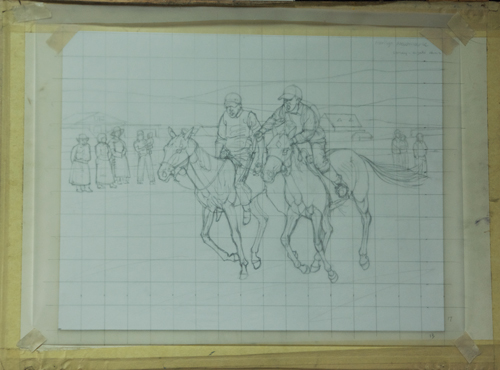
The  background didn’t do anything for me and since most of the people who will view the final painting won’t be familiar with the setting or situation, I needed to add some context. The first step was to do a pencil drawing that included all the elements to make sure everything would go together even though I used at least six different photos for the final composition.

The drawing is done on 19×24″ tracing paper. The finished painting is 28×36″. The grid lines are a traditional (dated back to the Renaissance) method of transferring a drawing to the larger surface. Notice how many spectators there are and where the buildings are. I had already decided to leave out a line of cars that were behind the people.

I have also decided to paint these scenes as I see them. I’m not going to “romanticize” them by substituting traditional hats for the baseball caps or putting the kids in del. While I’m very interested in Mongolian history and might do paintings with historical themes, with historic costumes and armor, if I can get the reference, for the most part I’m interested in Mongolia as it really is right now, in the 21st century.

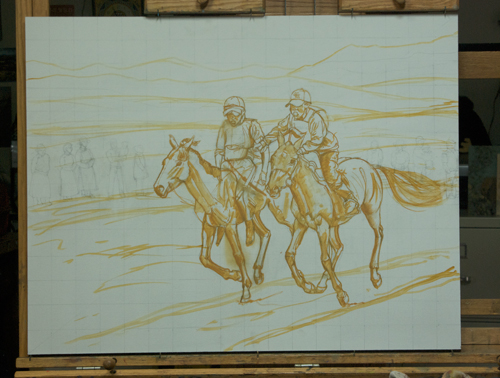
Once the drawing is transferred to the canvas with a pencil, I re-draw it with a brush, always correcting and refining as I go.

In this case, I decided to start by laying in the background first. I wanted to establish the lightest lights and also the atmospheric perspective of the mountains in the distance. You will also notice that I’ve ditched all the people on the right and cut down the number of people on the left. The buildings are gone, too. I really felt that I needed to simplify things. One of the lessons I’m learning is how what works at one size may not work at a much larger size. It’s what stalled me on the big argali painting.

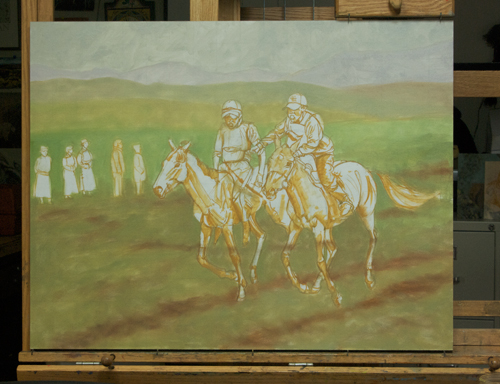
Next, I laid in the first layer of color on the figures, going dark so I could come back in with lighter colors. Everything is in what is called “local color”-the “real” color of an object not affected by a light source. Notice the drawing is pretty much gone, but that’s ok because, I know I can get it back as I go.

Now, I’m past the opening stages. The set-up is done and the constant process of painting, correcting and refining has begun. I’ve laid in the folds on the boy’s clothes and gotten the basic modeling done of the muscles and structure of the horses. Where before, the background had seemed too crowded, now it seems too empty and the people are just standing there, isolated, with no context.

Here you can see how I work. The computer is a 24″ iMac with a glossy monitor, so it’s like painting from very large transparencies. I can easily toggle back and forth between the various images that I’m using. You can see that I’ve added the buildings back in, but now they are behind the spectators, which creates one visual unit instead of two scattered ones. And now there are gers in the background. I’m thinking at this point about the white of the boy’s hats being repeated in the hats of two of the spectators, then repeated again with the gers. So it’s kind of like a bar of music with the white elements as the “notes”.

Here’s a detail of the people and buildings in progress. The good people of Erdene would probably be really confused if they saw this because I’ve used my “artistic license” to move and rearrange the structures to suit me. But I’d like to think that they’d recognize their friends and neighbors. Unfortunately, the pattern on the one woman’s blue del ended up being too visually distracting, so I had to make it just a plain blue. All the colors are intended to relate to each other in a somewhat limited palette and not compete with the jockeys. Oh, and that’s the Mongolian flag at the top of the blue building. Couldn’t leave that out. Notice also that I’ve added the road that runs through the town.  It’s on a diagonal, which is more dynamic than a horizontal. I want it to support and emphasize the main action. That’s also why the lines of dirt at the horses feet are on the diagonal, as you can see in the image above.

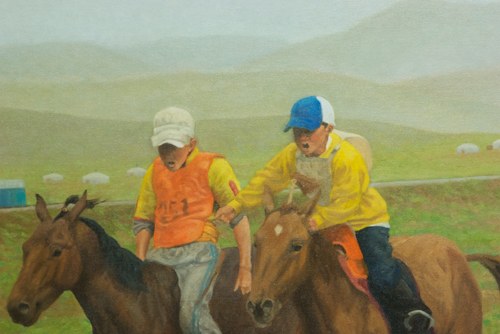
Here’s a detail of the jockey’s faces in progress, along with the horse’s heads. They all went through three or four repaints before I got them the way I wanted them. Notice that I haven’t painted any of the tack yet, other than the orange saddle. That’s the final level of detail that I leave for the final orchestration. Also, the paint has to be dry so that if I make a mistake on a stroke I can pull it off without wrecking what I’ve done underneath.

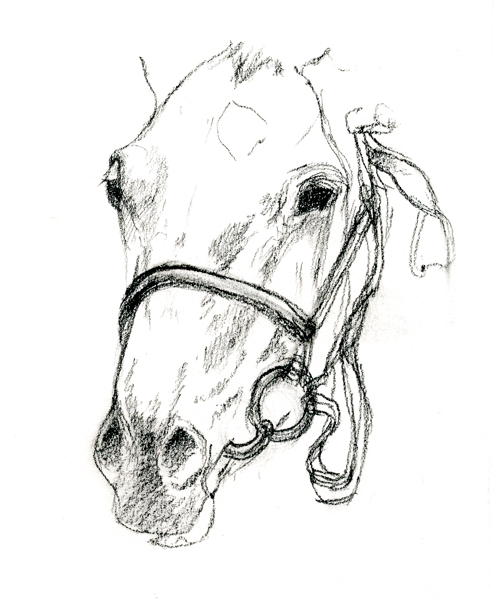
At one point, I stopped, got a piece of paper and a charcoal pencil and did a couple of studies of the boys and the bridle of the horse on the right to make sure that I understood the shapes correctly and could paint only the ones I needed.

I highly recommend this. Instead of flailing around in paint, hoping to somehow get it right, do a quick drawing to work out the problem. It saves a lot of time, paint and frustration.

One thing I noticed almost at the end was that, as a design decision, I had the right-hand horse’s tail flowing off the canvas. When I was looking at another image for another reason, it hit me and I remembered that the race horse’s tails are bound part-way down. What an awful mistake that would have been. Quick scrap down and repaint.

And here is the finished painting: Rainy Day Finish; Erdene Nadaam, 2009

Guest Post: Artist Andrew Denman On “The Delicate Art of Commissions”

This article was in Andrew’s latest newsletter. I don’t have a lot of experience with commissions, having only done a few dogs and one horse portrait over the years. When I read this article, I saw that it had a lot of good information that would be of interest not only to the artists among you, but anyone who has thought about commissioning a piece of art but wasn’t sure how to go about it. I think that if everybody follows their respective “tips”, the odds are that it will be a happy experience all around.

By way of introduction: Andrew has gained national attention through his involvement with the Society of Animal Artists, feature coverage in such publications as Southwest Art, American Artist, Wildlife Art, and The Artist’s Magazine, among others. and has held three highly successful one-man shows at Pacific Wildlife Art Galleries. He has also participated in exhibits at the Bedford and Hearst Galleries, and the Oakland Museum. His work has toured nationally with Birds in Art and the Society of Animal Artists, which has honored Andrew’s work with Awards of Excellence for two consecutive years. Andrew’s work can be found in the National Museum of Wildlife Art in Jackson, Wyoming, the Leigh Yawkey Woodson Art Museum, Wisconsin, and numerous private collections across the country. He is currently represented by the venerable Trailside Galleries in Jackson Hole, Wyoming. You can see more of his work here.

"A Very Wyer Winter" acrylic on board, 24 x 21" 2009

So, without further ado, here’s Andrew Denman on “The Delicate Art of Commissions:

As long as there have been artists committed to earning a living with their work, there have been collectors and patrons eager to commission art that speaks directly to their own tastes and preferences.  Many artists have a love- hate relationship with commissions; they certainly offer the comfort and convenience of a “sure sale,” but may artists feel an uncomfortable sense of restriction, of guidelines outside one’s own whims and fancies bogging down the creative process.  It’s unfortunate, because commissions (like the one above) can be among the most rewarding and profitable experiences an artist can have.  The following are tips for both artists and patrons on how to successfully pursue a commission.

TIPS FOR ARTISTS:

1.  Only take commissions that interest you.  The primary fear of many artists who refuse commissions altogether is that taking a commission necessarily means painting whatever a client demands and “selling out.”  This is hardly an issue if you only take the jobs that speak to you as an artist.  Moreover, remember that just because it didn’t start out as “your idea” doesn’t mean a commission can’t become a painting that fully represents you as an artist.  Remember the Sistine Chapel was a commission too!

2.  Spend time with the client, carefully assessing likes, dislikes and project requirements.  Presumably, if a collector has sought you out, he has seen and enjoyed previous work.  Take note of the client’s favorite pieces, and be sure you understand specifically what he likes about them.  Be certain to learn the deal breakers.  If you know the two or three things you have to avoid or must include (say the client wants a painting of a barn swallow, hates the color blue, especially loves your attention to fine detail, and wants to make sure the painting will look good in a driftwood frame) then you can exercise your creativity in all other areas.

3.  Be certain to have the commissioner approve of a sketch or study before you begin work on the final piece.  If some small element needs adjusting, this is the time to do it.  I only ask for a deposit after this stage so the client doesn’t feel any obligation until he knows exactly what he’s getting.  If the client is dissatisfied, I still have a nice study ready to use for other purposes.

4.  Do take a deposit before you begin painting.  One of the benefits of commissions is that you have some money coming in while you are working, not just after completion.  Be prepared, however, to return the deposit if the client is dissatisfied.  It may never happen to you (and it probably won’t) but a happy client might still buy from you in the future.  A disappointed client stuck with a painting he doesn’t like certainly won’t and will never send any referrals your way.

5.  Agree on a deadline.  Many artists hate working under pressure and many of us have show schedules to consider and galleries to supply, so commission deadlines of a year or more are not uncommon.  The key is to let your collector know exactly what to expect.  If a hard deadline is one of the project requirements (such as for a birthday or anniversary gift) be honest about your ability to meet the deadline. It’s better to turn down a job than to take on more work than you can handle and sacrifice the quality of your art.

6.  If you are still uncomfortable with commissions, consider a “First Right of Refusal” arrangement.  Unlike commissions, first rights of refusal involve no deposits and no deadlines.  A client who is interested in a painting of a bison, for instance, will simply have “first dibs” on your next bison painting, which you may finish next week or two years down the road.  The client feels no obligation and you have total creative control,  but you’ve given a collector special treatment that is unlikely to be forgotten, whether he buys the specific piece you offer him or not.  Keep a running list of such requests and follow through.

"The Hawthorne Pair" acrylic on board, 12 x 9 1/2" 2009

TIPS FOR COLLECTORS:

1.  Be selective about the artists you approach with your ideas.  Entering into a commission is entering into a relationship with an artist that could last months or years.  Make sure that you and the artist can communicate effectively and amicably from the start.  Any artist should be flattered that you thought of him to create that special piece, but make sure your project speaks to the artist’s interests and personality before making your approach.

2.  When you tell the artist your idea, don’t rattle off a laundry list of requirements.  Be very clear about what’s really important to you and leave the nitty gritty details to the artist’s imagination.  Start by sharing with the artist your favorite pieces and clearly describe what speaks to your sensibilities.  It’s challenging enough for an artist to take the image in his own head and translate it to the canvas; it’s nearly impossible for him to take the image in your head and bring it to life.  Commissioning a fine art piece isn’t about finding someone to paint that idea you’ve always had in your head; it’s about providing the seed of inspiration that inspires an artist to create something that belongs to him as much as it does to you.

3.  Honesty combined with tact goes a long way.  Ask to see a study up front and be frank about your impressions.  Artists can be touchy about criticism, but this is your ball game, so don’t apologize for your input.  Simply avoid vague criticisms, broad generalities, and major changes from the idea you originally discussed.  As long as you clearly state any concerns and offer your suggestions in a respectful manner, remembering to defer to the artist’s professional judgements (except where deal breakers are concerned), no reasonable artist should take offense.  If your suggestions are met with annoyance or hostility, this is the time to part ways.  Either the artist is unreasonable or the two of you simply aren’t communicating effectively, in which case neither of you are likely to be pleased with the final result.

A Final Note:

Collectors, when all is said and done, make sure the artist knows how pleased you are with the final piece.  Creating a work of art requires hard work and a very special talent, which is why you’re contracting it out in the first place, and a piece of original art that truly meets or surpasses your expectations is to be cherished, as is the artist who created it.

Artists, remember that a collector who admires your work, seeks you out, and wants to be a part of your creative process is a great gift, not to mention an invaluable testament to your abilities as an artist.  When you find a commissioner who is a pleasure to work with, be sure to express your appreciation too, and take care to nurture the relationship in the years ahead.

———

Susan here:

I’ve seen a lot of  Andrew’s work. He does what is needed to say what he wants to say and doesn’t give a fig about stylistic consistency. But this last piece is really, well, different than anything else I’ve seen him do. Maybe I’ll have him back to tell us the story of this commission.

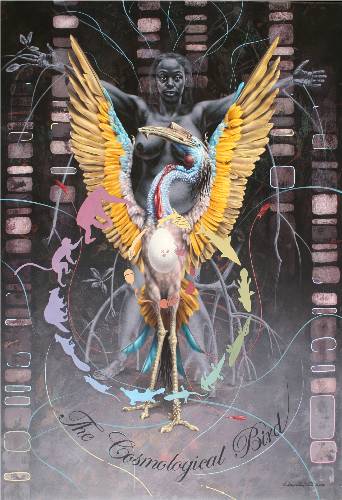
"The Cosmological Bird" acrylic on board, 34 1/2 x 24" 2008

EBay Auction, 2-8-10-Wait For Me! (Baby African Elephant) SOLD

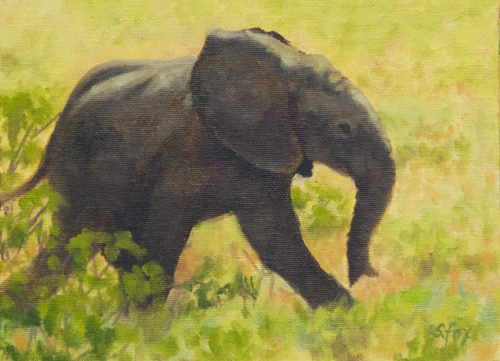
Wait For Me! 6x8" oil on canvasboard

Wait for Me! is a study of a baby elephant I saw in the Samburu in Kenya when on an art workshop/safari in October of 2004. The herd had crossed the river right in front of us and a couple of the “little” ones were hurrying to catch up with the adults, who were engaging in a morning dust bath. Click to bid here

Mongolia Monday- Book Review: Genghis Khan And The Making Of The Modern World

F

This book is on my short list of “must reads” for anyone interested in Mongolia. It’s not simply a history of the Mongols and their empire, but what they did that still influences us today in ways that you might find quite surprising. Weatherford effectively demonstrates how the way of life dictated by the vicissitudes of living on the steppes of Central Asia formed Mongol society and, indeed, Genghis (hereinafter called by the more accurate rendition, “Chinggis”) Khan himself.

After reading “Genghis Khan and the Making of the Modern World”, I was left almost wishing that the Mongols had been able to keep going to the Atlantic and beyond. So much of what people know about them was, unusually, written by the “losers”, historians and chroniclers in the countries that the Mongols conquered. Not surprisingly, the emphasis is often on the destruction and disruption that they caused wherever their armies appeared. The only surviving source of information on Mongol history by the Mongols themselves that is available in English is “The Secret History of the Mongols”, a book that will deserve its own post once I’ve acquired the latest translation, which, with luck, will be this summer.

Chinggis Khan was not a man to take “no” for an answer and he and his sons and grandsons had the warriors and tactics to back it up. Being practical people, they went with what worked. Not reveling in, or particularly liking, bloodshed, their campaigns were designed to minimize it, at least for themselves. Against other armies, they used the same methods as when they hunted game on the steppes back home. Retreating to draw the opposing army onto favorable ground was a common tactic that seems to have worked every time. Against cities, they used Chinese-designed siege engines, re-routed at least one river and, in another siege, when the inhabitants had barricaded themselves within their city walls, built an entire second wall around the perimeter to demonstrate who was really in charge.

When the Mongol army arrived at a city, it was given the opportunity to surrender and if it did, then everyone, except leaders who could foment revolt, was pretty much allowed go on peaceably about their business, but under a Mongol administration. Defiance was met with total destruction, hence their reputation for violence and ruthlessness in the West.

The boundaries of the empire expanded until they were defeated by the Mameluke army of Egypt in the west, failed twice to conquer Japan in the east and were more or less defeated by the hot, humid climate to the south. Kublai Khan, Chinggis’ grandson, over the course of twenty years, defeated the Sung dynasty of China and founded the Yuan dynasty, which ruled for over 100 years until overthrown by rebels who established the Ming Dynasty. The other parts of the empire more or less faded away over time and the Mongols were assimilated into the local populations.

For most Westerners, that’s the end of the story. But as dramatic as it is, it’s what happened during the existence of the Mongol Empire that I found fascinating and which is the heart of this book.

The Mongols, over three generations and thirty years, created the largest land empire the world has ever seen. They created countries, Russia is one example, that hadn’t previously existed. Within that empire the Pax Mongolica reigned. It turns out that Chinggis Khan wanted peace for himself and his people. The irony, of course, is that he waged war for most of his life to achieve it.

So, how does any of this relate to the modern world? Well, here are a few highlights from the book…..

-Chinggis Khan established the supremacy of the rule of law, which he applied to himself the same as to the poorest herder. It’s known as The Great Law and was based, not on divine revelation or the codes of settled lands, but the customs and traditions of the nomadic steppe people. This at a time, the 13th century, when in Western Europe kings ruled by divine right, no rules need apply.

-Given that within his empire, virtually every religion, including Christianity, Islam and Buddhism, was represented, Chinggis Khan decreed total religious freedom for everyone, though he himself worshiped the traditional Mongol spirits and always had a shaman in attendance in his camps.

-The Mongols had no written language. Once they found themselves administering an empire that was almost 6000 miles from east to west, that had to change. Since the Uighers are closely related to the Mongols (Xinjiang in China in their homeland) and already had a perfectly serviceable writing system, Chinggis Khan simply adopted it. That, plus the addition of professional administrators from China and other countries like Persia, and bureaucratic paperwork, Mongol-style, was born.

-Most Americans have heard of the fabled Pony Express, which operated for a short time in the 19th century American West. The Mongols had the “arrow messengers”, a system of fast riders. The stations were about twenty miles apart and staffed by about twenty-five families. The system survived from the 13th to 18th centuries, when it had sixty-four stations. Chinggis Khan knew that efficient, reliable communication was essential for administering the empire.

-Under Khubilai Khan in China (the empire had split into four parts by that time), the Mongols: “guaranteed landowners their property rights, reduced taxes and improved roads and communication”. They reduced by almost half the number of capital offenses that had existed under their predecessors, substituted fines for physical punishment and moved to limit the use of torture (evidence had to be gathered first; physical compulsion was a last resort) at the same time European authorities, both church and state, were expanding it through, among other things, the creation of institutions like the Inquisition, no evidence sought or used.

-Khubilai Khan greatly expanded the use of paper money, which Marco Polo remarked on, creating opportunities for both credit and bankruptcy. No one could declare bankruptcy to avoid debts more than twice. A third time could lead to execution. The money was made from mulberry bark, cut into various sized rectangles, marked and stamped.

-Unlike the Romans and their enthusiasm for blood sports, the Mongols had a cultural abhorrence, mentioned earlier, of bloodshed. They had no interest in pitting animals against each other for entertainment. Execution of criminals was not a public spectacle as was so prevalent in Europe.

-What made Chinggis Khan’s, and his descendant’s, empire tick was trade, on a massive scale. Under the Pax Mongolica, the Silk Road flourished like never before or since. The quantity and quality of goods that flowed between east and west was incredible. A partial list of what the author mentions includes: silk (of course, and in massive amounts), bronze knives, wooden puppets, iron kettles, board games, perfume and makeup, musk, indigo, jewelry, wine, honey, cinnabar and sandalwood. It was the closest thing to a global economy until relatively recently.

The author, Jack Weatherford, has produced a compelling, compulsively readable account of how one man, starting from nothing, even being kept a slave for some period of time, rose to become the ruler of the world’s largest empire and, in doing so, laid much of the groundwork for the world we know today.

And…. he has a new book coming out on Feb. 16, The Secret History of the Mongol Queens: How the Daughters of Genghis Khan Rescued his Empire.

Genghis Khan and the Making of the Modern World by Jack Weatherford, Three Rivers Press, New York, 2004

Some Of My Latest Drawings

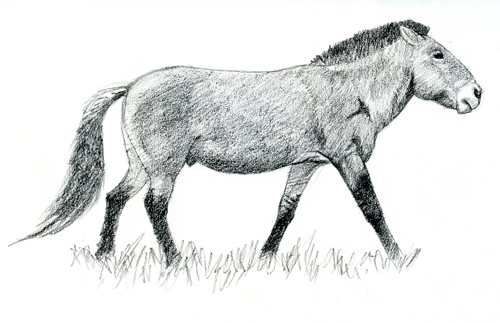
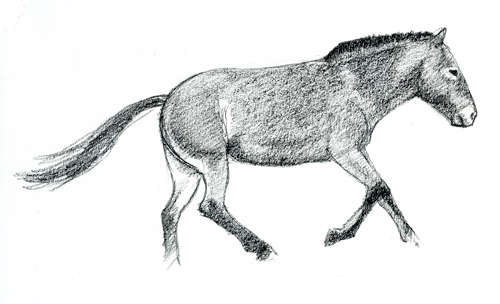
I’m in the middle of a rather large painting (no, not the argali one; a subject for another post; short, short version: got stuck, needed to let it sit for awhile), so I thought I would post a few drawings that I’ve done recently and then get back to the easel. It’s juried show painting season, so I’m trying out different reference images to see if I think they’ll make a painting. These were all done with Wolff’s carbon pencils on Canson Universal Recycled Sketch paper, which turns out to be quite a nice combination.

Ibex billy; from Baga Gazriin Chuluu, July 2009
Bactrian camel, Arburd Sands, Sept. 2008
Bactrian camel, Arburd Sands, Sept. 2009
Takhi stallion "Temujin", Hustai National Park, Sept. 2008
Takhi mare, Hustai National Park, Sept. 2008
Takhi foal, Hustai National Park, Sept. 2008


Mongolia Monday- The Saga Of The Scissors

When I went to Mongolia last July on my AFC Flag Expedition, I knew that arrangements had been made to meet with some unknown number of women at the Ikh Nartiin Chuluu Nature Reserve research camp to talk about helping them set up a felt crafts cooperative. I sorted through all my sewing stuff and came up with a pretty good-sized bag of needles, thread, notions and one extra pair of very good sewing scissors to donate to the cause. You can read about the meeting and see photos of the four intense days I spent with the women here.

The scissors, I found out late on the third day, were very, very, did I say very, popular. I was asked during a last meeting of everyone, if I could get more scissors. Sure, I said, how many pair? One for everyone, so 20 pair. I knew I could figure out some way to do this, so I said yes.

Then a burly man in a del, clearly one of the herders who had spent most of his life out of doors and who had quietly come in and was sitting by the door, raised his hand. Through my translator, he shyly asked if it would be possible to get 21 pair. His wife hadn’t been able to come to the meeting, but he would like to give a pair to her because it would make her happy. Yes, of course. I still choke up a little when I remember him sitting there in a ger full of women (Mongol women can be formidable), summoning up the courage to ask a total stranger for something for his wife.

My gift scissors being used to cut out the fabric for a del for my husband. The women made two, one for each of us, in three days. Notice that there is no paper pattern. The skill to make these traditional Mongol garments is either passed down or there are classes where it is taught.

Then, during a series of “competitions” that celebrated the end of the meetings, everyone divided up into teams to do skits. One team did theirs on where the scissors were because everyone was wanting to use them.

I think what is being said is something like "I need to cut this. Where are the scissors?"

Fast forward and I’m back at home. My husband generously offered to donate the money to purchase the scissors through his company. I got on the internet and in touch with one of the staff people at the Denver Zoo Foundation. It turned out that a fabric store chain had 8″ Gingher sewing scissors on sale at a very good price. Sewers know that Ginghers are about the best you can get and that’s what I wanted the ladies to have.  So they were ordered and delivered to my contact person at the Zoo.

Next was how to get them to Mongolia. We’d hoped to send them over with someone, but no one was going in the near future, the scissors weighed a fair amount and, with security being what it is, we felt like it was a lot to ask for someone to take them on a plane, even in checked luggage.

The Director of the Conservation Biology Department, which is who I work through, said that the only reliable way to make sure they got to where they needed to go was via FedEx, so that’s what we did. That cost over $400. My husband had included $100 for shipping in his original donation and the Zoo picked up the rest. So far so good.

The scissors arrived at the airport and then it got complicated with customs paperwork that none of us knew had to be done ahead of time. More fees, which my husband covered. But the scissors were in UB and in the possession of the right person, who would make sure they got to where they needed to go.

All along I’d had this vision of the scissors arriving in the winter when the women didn’t have as much work to do, so would have time to make felt items to sell this summer. And it would be cold and things would be difficult, but maybe this would be a nice mid-winter surprise. And I would be announcing that this endeavor of my Art Partnerships for Mongolian Conservation had been successfully concluded.

Unfortunately, this winter has turned out to be what the Mongols call a “Zud”, heavy snow and extreme cold, as in below -40F, which is a “normal” winter low. Haiti has the world’s attention, deservedly, but for those of us who care about Mongolia, there is a crisis happening there, too. I wrote to the scientist who goes to Ikh Nart every month and who is going to deliver the scissors, asking how my friends are. His reply was that he hasn’t been able to contact anyone, but will let me know when he does. I suspect that he can’t even get to the area right now. Conditions may not improve until April. I know that the Mongols are resourceful people and they’ll help each other through this, but I am concerned. I’ll be very glad when I hear that everyone is ok.

I’ll post as soon as I have news. In the meantime, I’m making my plane reservations for the next trip in July/August.

EBay Listing, 2-1-10; Back Country Summer SOLD

Back Country Summer, Humboldt County 8x10" oil on canvasboard

Back Country Summer, Humboldt County” is a typical late summer scene in southern Humboldt County, California on the road between Petrolia and Honeydew. Although world-renowned for its coast redwoods, the inland areas have rolling hills and prairies with native oaks and often eucalyptus trees planted by early settlers. I wanted to capture a sense of the stillness of hot summer day and the contrast of the rich greens of the trees with the golden grass. Click to bid here

Five Things Artists Can Do While Waiting For Spring

We had a heck of a series of winter storms last week here in California. And this week a large chunk of the rest of the country is getting wacked. It’s stay indoors season. Not a great time to paint outdoors, unless you’re one of those seriously hardcore plein air folk, or do fieldwork if you are an animal artist. Snow is one thing, but driving rain and hail, high winds or ice storms are something else. What to do (drums fingers on table)? Here’s some ideas:

1. Ask yourself- What are you really bad at?- Trees? Water? Fur? Eyes? Be honest. We all have our strengths and weaknesses. I remember my artist sister-in-law telling me about a classmate at art school whose use of color was, apparently, pretty awful. He made a commitment to improve and is now a nationally known artist and illustrator known for, among other things, his incredible use of color. What I learned from this story is that, with hard work and a willingness to struggle and learn, a weakness can be turned into a major strength.

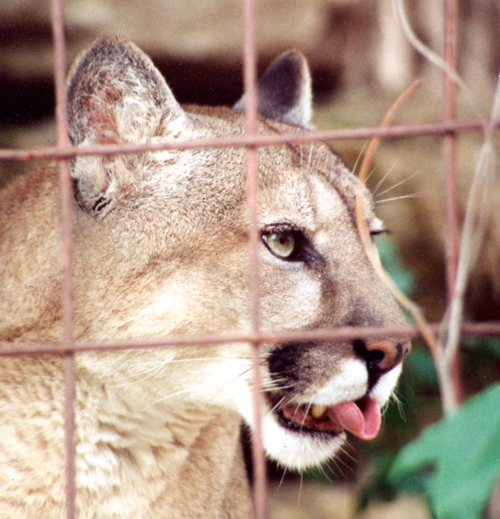
There's probably at least six exercises that one could do from this photo. What are they?
Cinereous vulture, Bronx Zoo; opportunity to show depth and form in an eye study; the photo flattens the image; what do you have to do to compensate?

Exercise: Set aside some time each week to work on something that’s hard or that you feel is a weak point in your work. Do little studies that should only take a hour or two. Don’t bit off a big chunk like “water”. Break it down into smaller problems like reflections or what pebbles look like through water. Robert Bateman says that he used to sit and watch water for hours to learn what the pattern was. You could throw stones in a big mud puddle to study ripples.

2. Take a look at your old work- Creating art can be very discouraging. Sometimes it seems like we’re just spinning our wheels. Progress in gaining any skill is usually incremental. Someone who hadn’t seen my work for awhile was visiting my studio recently and commented that my work had taken a great leap since they’d last seen it. I found that very gratifying, but also interesting. I do occasionally paint something in which it all comes together and there is a big move forward, but that’s the exception.

old reference 4x6" photo (cropped) from 1996
Painting (cringe) from 1997; it looked ok to me at the time; I could write an entire post now about what's wrong with it
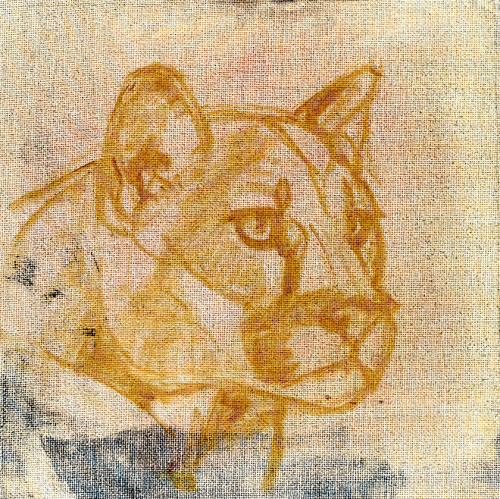
Brush drawing from a couple of weeks ago for an 8x8" painting; the difference should be obvious

Exercise: Get some of your favorite beverage, pull out your old work and set it up next to your latest pieces. What do you think? I hope you see steady improvement over time, which should give you some well-deserved encouragement. If you don’t, then see if you can figure out why. Be honest. I know some artists who seem to think that amount of years spent painting equals good work. Not true at all. Twenty-five years of doing the same subjects in the same way with the same technical problems still means mediocre paintings.

3. Evaluate your photo reference- a famous wildlife artist who I was lucky enough to study with a couple of times told us that “you’re only as good as your reference”. I have found that to be absolutely true. Every time I’ve been able to upgrade my camera equipment or how I view my reference, my paintings have shown immediate improvement. You can’t put in what’s not there unless you know the subject extremely well. Trust me on this. The biggest leap for me was going from film to digital, which let me move from prints to the equivalent of big transparencies. I’m slowly purging my photo print reference of all the kinda-sorta images that I know aren’t good enough.

Impala painting from photos shot during my 1999 trip to Kenya; flat as a piece of paper with everything in local color
my main reference photo; notice the absolute lack of any perceivable light source
Thompson's Gazelle; no hint of a background, but you know there's light because of that cast shadow on the neck

Exercise: Go through your reference, in whatever format, with a fresh eye. Ask yourself- How much work will it take to make this into something? Does it really represent what it was that caused me to take the picture in the first place? Is it blurry? (I tend to keep those because there still might be a hoof or other information that I can use, but I don’t use blurry images for primary reference. Or let’s just say that every time I’ve done it, I’ve regretted it.) Is it under- or over-exposed? How about the lighting? Is it interesting? Or is it flat?

4. Start a sketchbook- You know you “should”. One of my teachers in art school did a lot of storyboard work for major San Francisco ad agencies. High pay, super short deadlines, no time to shoot reference. He did a drawing a day besides whatever work he had. While I was in his class, we all did a drawing a day. I had fun using my favorite felt tip pens and also Berol color sticks, which were new for me. So it was a chance to try different media, too.

Table and chair; not easy to get the perspective right
But no one says it has to be literally realistic
I tend to do this kind of drawing with carbon or charcoal pencils in the studio, but still use felt pens on location

Exercise: For one week, do a drawing a day. Of anything. You can set up a still life, draw furniture, work from magazine photos. With any media. But draw. Then add a second week. See what happens. Send me a 500 pixel jpg of your favorite and I’ll post them here.

5. Dream your dreams- Blue sky time. If resources, monetary and otherwise, were not a factor, what would you be doing as an artist? Some of us want to paint full-time, which I am fortunate enough to be able to do. Others want a special place in their home where they can do their art or want to go to a workshop or travel to Italy or…..the possibilities are as endless as the ways artists express themselves.

Dream big, but don't miss the stuff that might be close by

Exercise: Set aside an evening and make a list. Try to be specific. Instead of just “workshop”, how about “I want to study plein air painting with…..”? Or not just “I want to travel”, but “I want to go to Kenya and see wild lions”. Then think about what steps you can take to achieve one or more of your dreams. Get on the internet and see what you can learn about how other artists have achieved their dreams, both for inspiration or ideas.

So, there you have it. Five ideas and look! It’s April already!