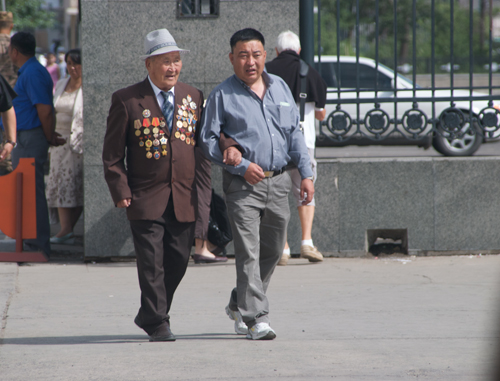
Honored elder at Naadam opening ceremony, Ulaanbaatar
Before I left on my July/August trip to Mongolia, I bought some new stuff and posted about it here and here. It included a new camera pack, jacket, hard drive for image back-up and memory cards. I also bought a couple of pairs of L.L. Bean tropic weight pants.
The KATA digital rucksack was a WIN. My camera equipment was well-protected and easy to access. The straps had a good ergonomic design that made the pack very easy to wear while hiking.
My new REI Windbreak Thermal jacket was also a WIN. It was all I needed for summer travel in Mongolia and it really did stop the wind and resist light rain.
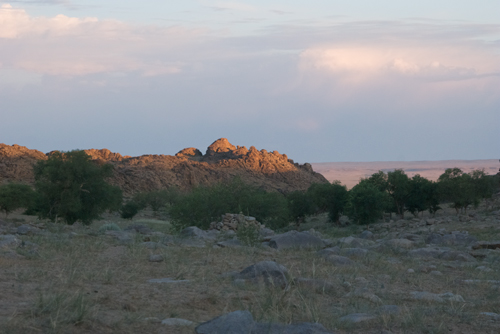
Sunrise, Ikh Nartiin Chuluu Nature Reserve
The Toshiba 500GB hard drive, which I used to back up images that I had downloaded to my MacBook Pro did the job. I liked not having another battery to keep charged, as was true with the Wolverine drive it replaced. Another WIN.
The Sandisk Extreme 8GB cards were indispensible. I was filling one in a little more than a day at times. I’ll keep the 4GB ones for back-up for now, but will probably get two more 8GB cards for the trip to Kenya/India in January. Definite WIN.
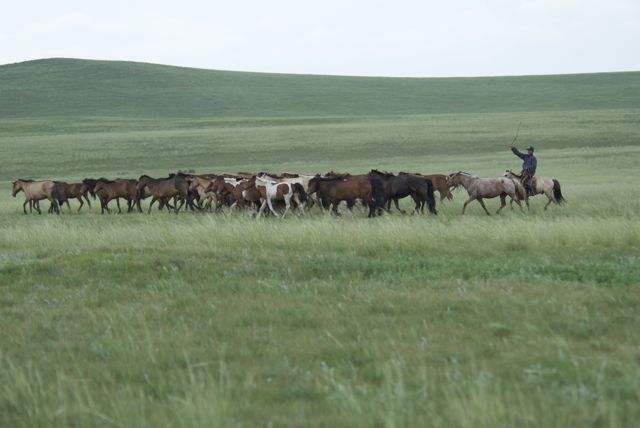
Horses near Hustai National Park
The only FAIL were the L.L.Bean “tropic weight” cargo pants. I have no idea what they were thinking when they named these. I wasn’t in the tropics, but the weather was often humid, sometimes VERY humid. The pant fabric didn’t breathe at all. If anything, they acted like a moisture trap when my legs started to sweat. Very uncomfortable. Needless to say, they aren’t going to India with me, but they’re fine for wearing here in Humboldt County.
I spent a day last week at the Ornithology Department of the American Museum of Natural History (AMNH) in New York City, doing research for a painting that I have been asked to do. I’ll write more about this project as it goes along, but this was a necessary first step.
Readers of this blog know how uncompromising I am about seeing my subjects in the wild and how much doing fieldwork feeds into an animal artist’s paintings. In this case, however, no matter how much money I was willing to spend or how far I traveled, I wasn’t going to see this species in its native habitat for the simple fact that it has been extinct for almost 100 years.
The Carolina parakeet was the only member of the parrot family native to North America. Although the passenger pigeon is better known, this very colorful bird also originally was seen in enormous flocks in a range that covered most of the eastern United States from the Atlantic to Florida to Ohio and west to Kansas. They were shot for their feathers, meat and because they were considered a pest, as they liked grain fields and orchards.
And now, except for specimens in museums they’re gone, all gone. Forever.
So my only option was to do my fieldwork at one of those museums. I was going to be in New York for a Society of Animal Artists board meeting and was able to secure access to the rare and extinct bird collection at the AMNH. The room is locked and every drawer in it is locked. After all, there won’t be any more specimens collected of any of those species. I spent all day with two drawers of fifty skins, plus a number of mounts, measuring, photographing and sketching them. And marveling at how beautiful they were.
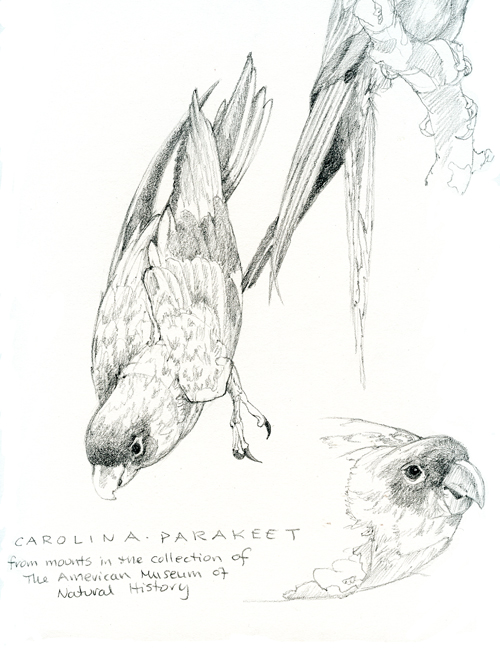
Now back at home, I’ve started to do drawings in graphite to learn what the birds look like. I will have to rely on the understanding, accuracy and competence of the taxidermists of the AMNH who prepared, preserved and mounted them. I hope to get permission at some point to post some of my photos, but for the time being what I can share is the art that I’m creating from them.
Carolina parakeet studies from taxidermy mountsCarolina parakeet studies from taxidermy mounts
I will be working with a few colleagues who specialize in painting birds to ensure that I get their structure and body positions as correct as possible. I will also be consulting videos of a couple of similar species to see how they move and behave. This is a challenging commission, but one that I know will be very rewarding.
After the dramatic trip down the mountain and then arriving at our campsite just before dark, it was lovely to wake up to sunshine the next morning on a grassy hillside. Even better was the parade of horses and yaks that came right by where I was sitting as I was having morning coffee. Lazy animal watching and reference shooting again.
Our beautiful campsite near Tsenkher Mineral Springs
I found out over breakfast that we were camped near Tsenkher, another mineral spring resort. We drove to one of the ger camps, where the manager treated us to tea and snacks, arranged for us to take showers and for me to do a last small round of laundry.
The hot spring, with ovoo
We then drove north out of the mountains to the large town of Tsetserleg, where we visited a hillside temple in front of which was a very tall, new statue of the Buddha. I had been wanting a new del, so we searched around the container market, but didn’t find one that was what I was looking for. Getting to poke around a town a little was fun, though.
View of Tsetserleg with new Buddha statue
I thought our next stop was the famous monastery of Erdene Zuu, but Soyoloo’s cell phone rang and, the next thing I knew, we were back at her sister’s home. We were invited to join them and share a meal that is dear to the hearts of many, many Mongols….bodog or marmot BBQ. We arrived just as they were ready to begin stuffing the carcass with hot rocks and meat. Once the marmot was ready, we all piled into cars and went to a lovely spot on a nearby river for a picnic dinner.
The entire process was a pretty involved affair and I took around 150 images. I’m just going to show a couple here and do a separate post later on, which the status of marmots in Mongol culture certainly justifies.
Yes, the fur really is removed with a portable blowtorchDinner is served!
I was honored with the liquid that was poured out of the body cavity, which I drank and found quite good, then the tongue, which I ate and found quite good, and the first cut of meat, which I ate and….found quite good. We all washed down the feast with vodka (all together now), which was quite good.
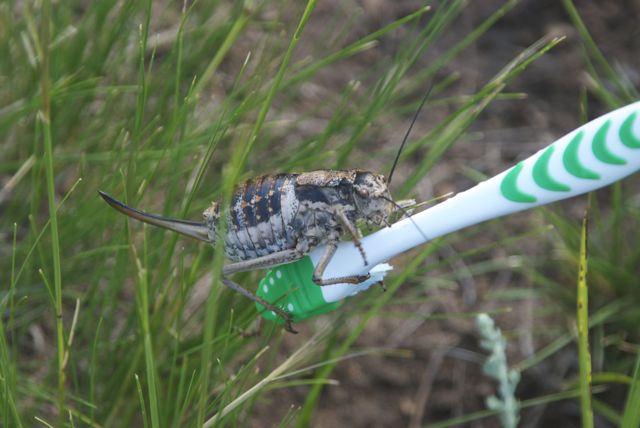
It was late afternoon by the time we said our good-byes and were on our way. We camped on a hillside along the road to Erdene Zuu. It was warm and humid. There were lots of mosquitos, so we lit a dung fire again. I use earplugs, so I slept ok, but Khatnaa and Soyoloo were kept awake by loud and numerous grasshoppers.
species of grasshopper on a toothbrush
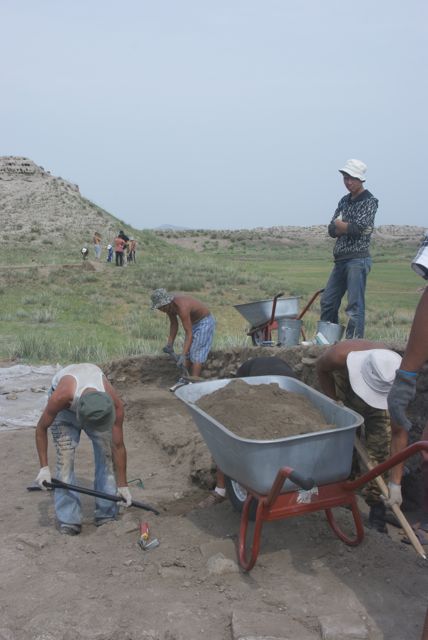
Our first stop after breaking camp were the ruins of an old Uigher city, Har Balgas. As it happened, there was an archaeological dig going on, which was interesting to watch and I got to chat with the archaeologist in charge.
Rampart ruins of Har BalgasDig in progress
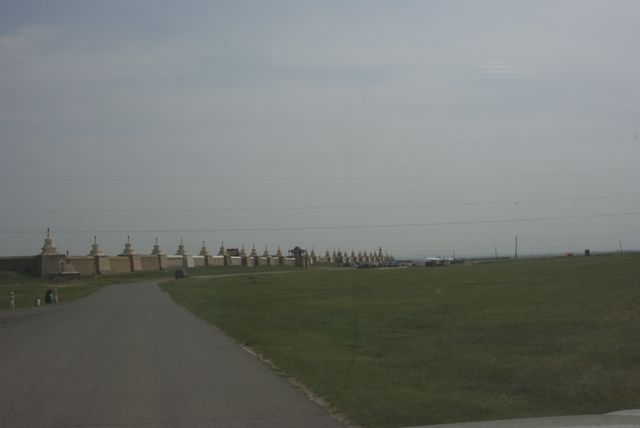
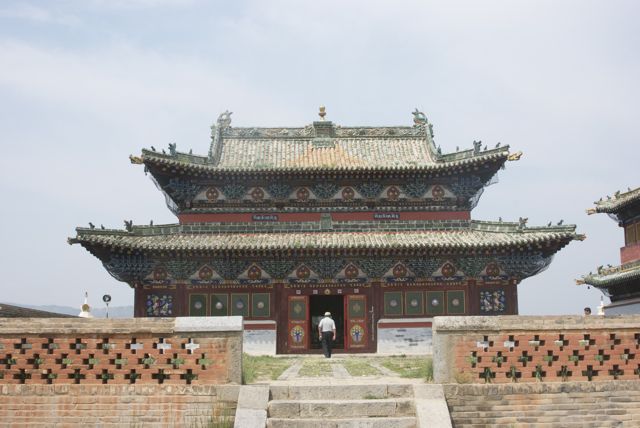
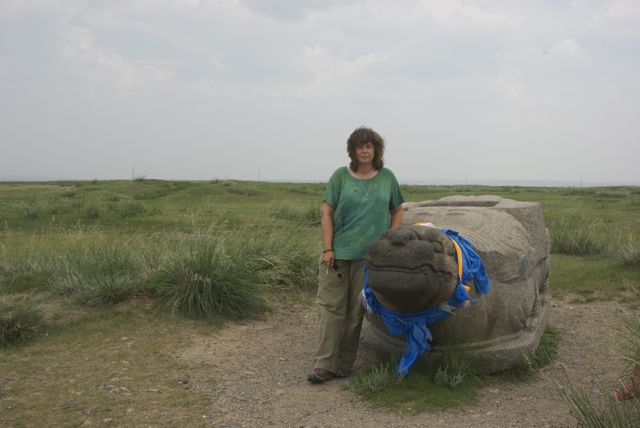
Not too much farther on, the stupa-lined walls of Erdene Zuu Monastery came into view. Not only is it adjacent to the site of the ancient Mongol capital, Kharkhorin, but it was built using stones from the old city, which was destroyed by a Ming Chinese army after the fall of the Yuan Dynasty, which had been founded over one hundred years earlier by Chinggis Khan’s grandson, Kublai Khan. A stone turtle is the only artifact left where the city had stood.
The wall around the monasteryOne of the main templesLarge stupa complexCeramic roof detailPosing with the turtle
I had gotten careless and went into the complex with no hat, sunscreen or water, so by the time this photo was taken, I wasn’t feeling very well. It was extremely humid and hot. I was ok once we were back at the car and I drank a lot of water, but this was probably the closest I’ve ever come to heat exhaustion or worse. Very foolish. But Erdene Zuu lived up to its reputation as the top tourist site in Mongolia. The temples are magnificent and I was sorry that no photography was allowed inside them.
Our route now took us north, where, for our last night out, we were going to camp at a lake known for its birds. As we were driving along, I noticed a large ger encampment to the left. I almost said something to Khatnaa, but let it go. Then he had to slow down because a bunch of men and boys on horses were crossing the road. I told him about the gers. We followed the horsemen.
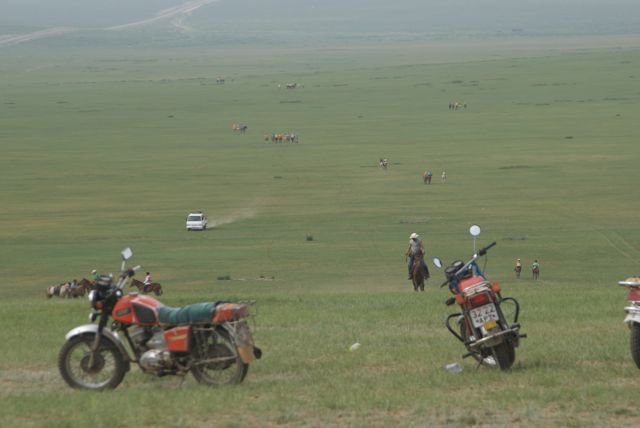
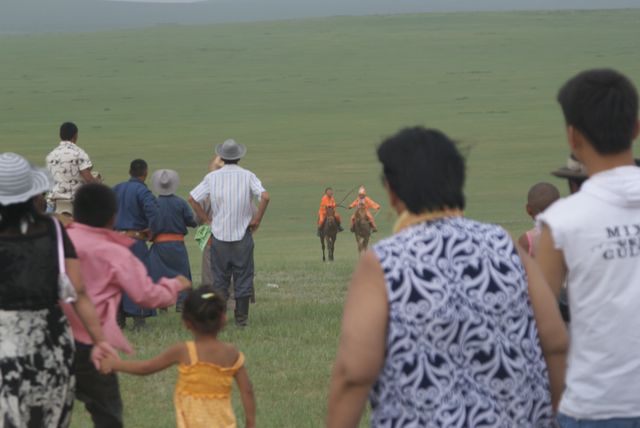
The one thing that I had hoped for on the trip, but had not been able to find, was a local Naadam. Now it appeared that we had stumbled onto one the last day of the trip. We pulled up into an area on a rise where a lot of cars and trucks were parked. There were horses all over the place. Khatnaa got out, spoke with someone and came back with the news that the event was essentially a family reunion. Stay or go? We’d inadvertently crashed a private party. I told Khatnaa that it was up to him to do what he thought best. We stayed. And tried to be as inconspicuous as possible. Over the next few hours I sat in the car and took around 500 photos. Our arrival had coincided with the horse race and we had gotten there in time to watch all the preparations for it.
Some of the horsemenLots of socializing on horseback; the men in fancy del and traditional hats all seemed to be the trainers
Our “cover” was blown when a young couple on a motorbike drove up and offered us fresh, hot khuushuur (fried mutton turnovers). No way we were going to pass on that. I stayed in the car until the first horses were approaching the finish line and then got out and joined the crowd.
Jockeys taking their mounts out to the starting lineNeck and neck to the finish line; the winners crossed the line at the same time
Afterwards, I was photographing a lovely black race horse who was being scraped down. A woman came up to me, took my arm, led me over to the horse and made a gesture for me to lay my palm on the sweat, which is lucky and auspicious. It was a very kind and thoughtful thing for her to do since I obviously was not one of this very big family. I was never so glad that I knew how to say “thank you” in Mongolian.
All day it had been cloudy and humid, with some squalls of rain. By the time we were on the road down to Ogii Nuur, it had gotten really windy. Khatnaa and Soyoloo managed to wrap a tarp around a picnic structure to provide shelter from the wind to cook our dinner. At dusk, it died down enough to set up camp on the lakeshore. We were all pretty tired.
The weather was much better the next morning and we got in some good birdwatching. Khatnaa had gone up to one of the ger camps along the lake the previous evening and made arrangements for Soyoloo to use their kitchen to prepare our breakfast, which was very kind of them. The owner of the camp was there and turned out to be a retired Mongol army officer, who still needed something to do, so he had started a couple of ger camps. We had a nice chat with him and his wife and then left for the final leg of the trip.
Soon we were on tarmac, leaving the earth roads I love behind. There were a few more sights to see, like a dune complex where local herders were offering camel rides and our lunch spot next to the road where I got one last round of good horse and herder photos.
Lunchtime reference opportunity
By mid-afternoon we were in Ulaanbaatar, pulling into the hotel parking lot. I had left UB on July 10. It was now July 25. I still had trips to Hustai National Park to see the takhi and to Ikh Nartiin Chuluu and, as much as I looked forward to going to both places, I was sorry to have my camping trip come to an end. It was one of the best experiences of my life. My goal was to simply go into the countryside without a set itinerary and let Mongolia come to me. It did, in ways I would literally never have dreamed of. Bayarlala!
I had the opportunity to spend yesterday morning and early afternoon at the Metropolitan Museum of Art in New York City before my evening flight home. (I was there for a Society of Animal Artists board meeting and added a little time for other things). My main purpose was to see the Kublai Khan exhibition. He was the grandson of Chinggis Khan, which I hadn’t realized until I started to learn about Mongol history. That will be a Mongolia Monday post at some point.
Afterwards, I wandered through the 19th Century European painting galleries and was reminded once again that there is no substitute for seeing masterpieces in the original. I also noticed quite a few paintings with animal subjects. I didn’t have my Nikon, just my iPhone. So the following images aren’t great, but they will serve to share my favorites.
I didn’t remember to photograph the labels for all of them, I’m sorry to say, but did track down titles and artist for all except one. But it really doesn’t matter who did them. The takeaway is to see and appreciate the great lineage of animal art that those of us who have chosen our fellow creatures as subjects are part of.
Tiger and Cubs- Gerome
Animal art has a long and honorable history in European painting and was not dismissed with the snobbery so many of us encounter today.
detail of horse painting- Bonheur
It is instructive to see how artists of the period, who had tremendous ability as painters in a variety of subject matter, could also do a specialized subject like animals extremely well. That is often not the case today.
Detail, camel
There was one entire room dedicated to European artists who painted North African subjects. Many also traveled to the Middle East. The collective term for them is Orientalists. I should do a post on them sometime since their approach and reaction to what they saw is interesting for any artist who, like myself, is also fortunate enough to journey to distant places.
Before the Audience- Gerome
What IS that black cat doing there? A spy, perhaps?
Friedland detail- Messonier
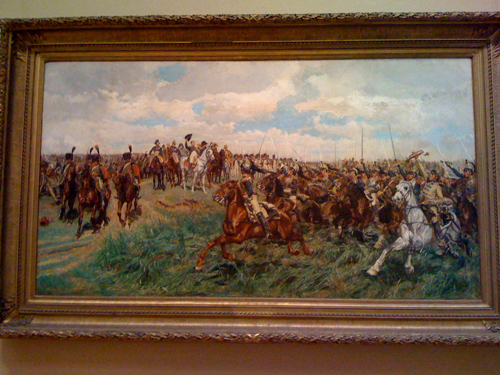
This is a detail from a massive painting of one of Napoleon’s greatest victories, with a cast of dozens. This horse is around 5″ from top of head to bottom of hoof. Stunning description of action and anatomy. Here’s the whole thing:
Friedland- Meissonier
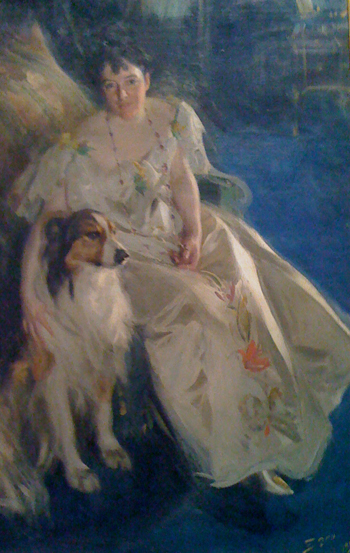
Since we have a rough collie in the family, I naturally had to have a photo of this one, which has a more old-fashioned shape to the head:
Mrs. Walter Rathbone Bacon- Zorn
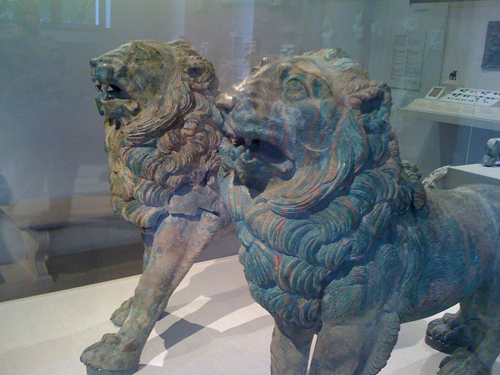
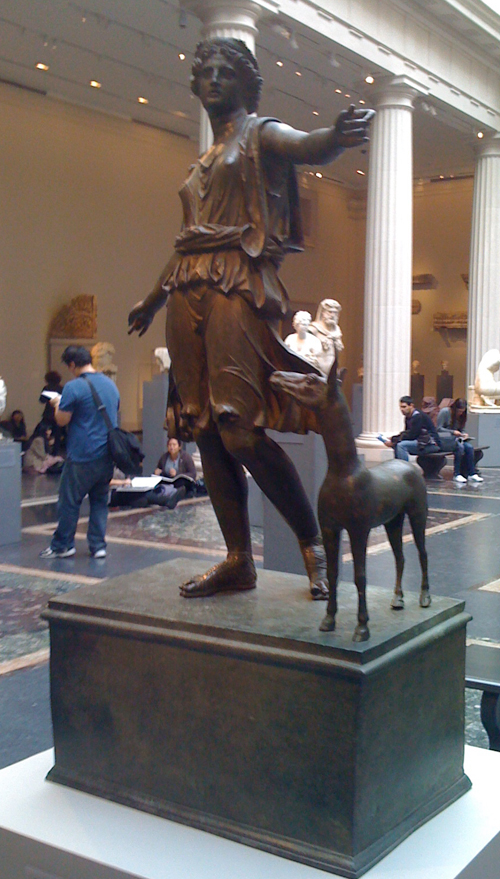
The Met also has a phenomenal collection of Greek and Roman sculpture. The main hall was filled with schoolkids drawing from the marble and bronze figures.
Bronze lions, ancient Greece
If you have access to a museum with animal sculpture, you have a great rainy day opportunity to go sketch animals that will hold still.
Statue of Artemis/Diana
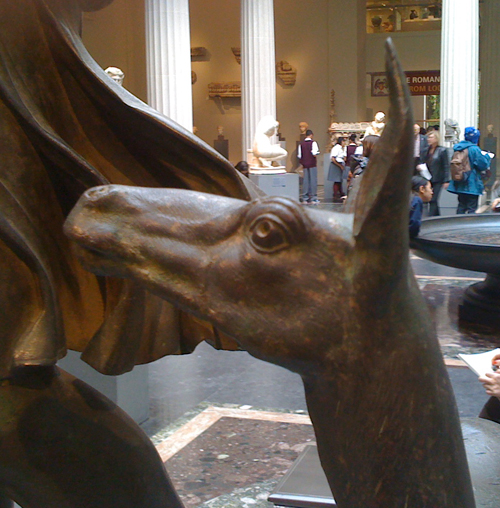
It’s interesting to note how artists interpreted something like the head structure of a deer over 2,000 years ago.
detail of deer's head
I also want to strongly make the point that there is no substitute for seeing great art “live”. Reproductions in books and posters are, at best, rough approximations. The color is probably not accurate. The size certainly isn’t. And size matters. The visual impact of a painting like “Friedland” is due in no small part to its large dimensions: 53.5″ high and 95.5″ wide.
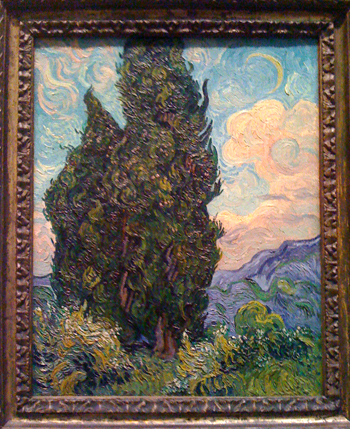
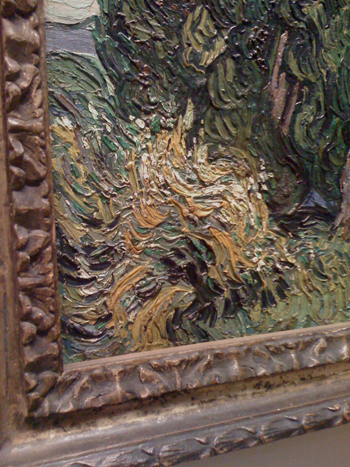
But what I think is missing almost the most is that a painting has a visual texture, sometimes subtle, sometimes not. Printing an image of a painting on a flat piece of paper eliminates that aspect completely. As an admittedly dramatic example, here is a Van Gogh. First the whole work. Then a detail shot at an angle that shows how the paint was applied. When he put it on this thickly, the painting almost becomes a live thing.
van Goghdetail
A painting like this is about more than the image. It’s also about paint as paint.
But there is a Mongolia connection with all three.
When It Rains It Pours Department: The first two announcements are somewhat related since they both involve very special invitations to travel to “interesting” locations and work with fellow artists.
Update Jan. 2011: Guy and I both bailed on this one when it became clear that it wasn’t very well organized, but who knows, I may still make it to India sometime.
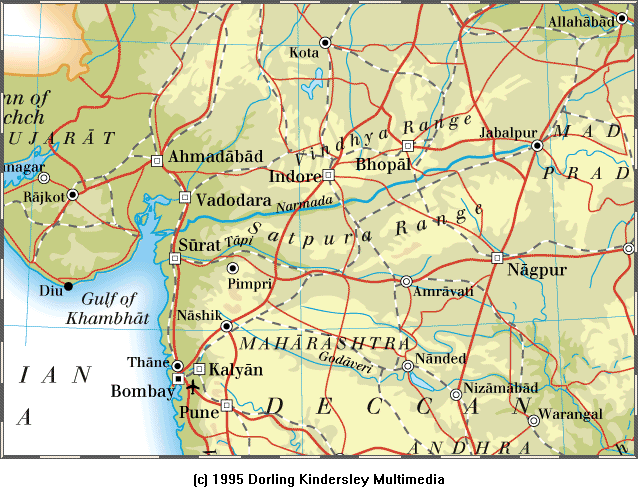
The first invitation has been extended to me thanks to my good friend and colleague, Guy Combes. Even though I’ve bought the plane tickets, I’m still pinching myself about this incredible opportunity. I’ll be departing on January 18, 2011 for Nairobi, from where Guy and I will fly to…..India! We will be part of an international group of artists from the UK, Sri Lanka, Pakistan, India, Nepal, Peru, the USA and Australia who have been invited to the Kanha Tiger Reserve for an Artist’s Week. We will be exploring the park, shooting reference and sketching in order to be able to produce art for a show which will tour internationally and then be auctioned to raise funds for tiger conservation. All expenses except airfare are being covered by our hosts, who own the luxurious lodge where we will be staying.
This is the place that inspired Rudyard Kipling’s Jungle Book stories. It is home to 22 mammal species and over 200 species of birds and is one of the remaining strongholds of the Bengal tiger.
And the Mongolia Connection? Babar, who conquered part of India, was a descendant of Tammerlane, who claimed descent from Chinggis Khan. Maybe or maybe not. But he did come from Central Asia and the part of India that Babar ruled became known as “Mughulistan” or “Land of the Mongols”. We know it as the Mughal Empire, which lasted from the 1500s until the British took over India in the 1800s. The most famous artifact of the Mughals is the Taj Mahal, built by Mughal Emperor Shah Jahan.
Kanha Tiger Reserve is near Nagpur
After our week in India, we’ll go back to Kenya, where I will stay, visiting and animal watching until I come home on the February 15.
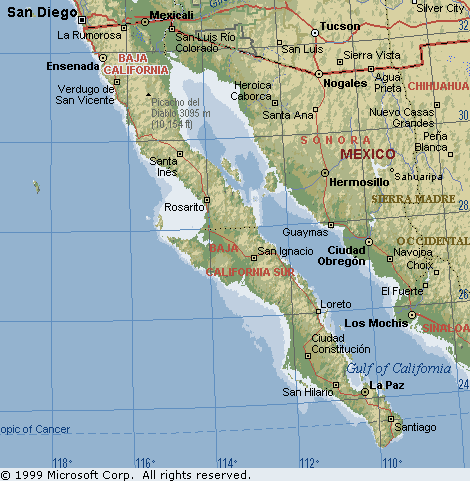
The second invitation came via an email from Dr. David Wagner, who specializes in curating shows of animal art, including the Society of Animal Artists annual exhibtion “Art and the Animal”. He has invited me to join him and a number of my colleagues on the Sea of Cortez at the end of March, 2011. We will be accompanied by a scientist familiar with the Sonoran desert and Sea of Cortez ecosystems. Our mission is to learn about them, shoot reference, sketch and paint, hang out on the beach and eat great Mexican food while talking art shop. The end result will be a show at the Arizona-Sonora Desert Museum in 2013. More details and who else will be going soon.
The Mongolia connection? I will be able to compare the Gobi with the Sonoran Desert ecosystem to see what the similarities and differences are of climate, plant and animal life. I already know that the far-western edge of the Sonoran Desert extends to Anza-Borrego Desert State Park, where there are desert bighorns and that there are argali sheep in mountain areas of the Gobi.
We will be based outside of Guaymas
Last but not least, I am pleased to announce that Plaza Design, with stores in Eureka, Arcata and McKinleyville, is now offering a large selection of my small, original oil paintings! There’s a little bit of everything, including landscapes and American wildlife. They will be offering a selection of my greeting cards, too.
The Mongolia Connection? There are currently a couple of takhi (Przewalski’s horse) paintings available, with more Mongolia subjects to come.
Here’s a look at the display in the Arcata store:
Next week I’ll wrap up The Best Camping Trip Ever.
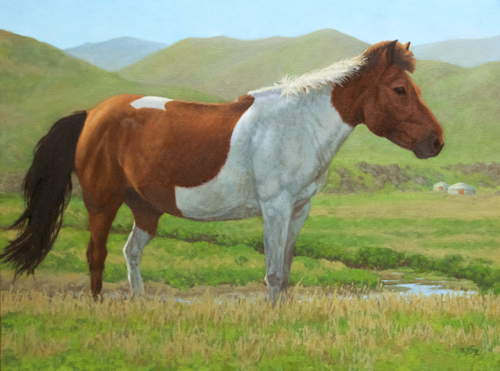
Mongol Horse #7-Getting Warmed Up 18x24" oil on canvas
This was the first painting I started after the long travel layoff. I wanted to keep it simple, so I chose this beautiful paint horse standing with his back to the morning sun. In my reference he was standing with a hill behind him, which wasn’t very interesting, so I “moved” him to a background that let me do a landscape, too. The setting is the Hangai Mountains of central Mongolia, a lush and scenic part of the country that isn’t anything like the vision most people have of the Land of Blue Skies.
After leaving the falls, our route took us along and across the Orkhon Gol until we started to climb back into the mountains.
Along the Orkhon GolBridge over the river
Once again, we were in wildflower heaven.
Up into the mountains once moreMountain wildlflowers
We were on our way up to Tovhon Monastery, a famous remote mountain retreat founded by Zanabazar, the first Bogd Khan of Mongolia and the greatest artist the country has produced. He is particularly known for his exquisite bronze sculptures of Buddhist incarnations and deities.
As we drove farther up, the earth road turned into a very badly rutted mud road, due to the recent rains. We came very close to getting stuck and Khatnaa backed down onto a flat area and said that we would walk the rest of the way, about a kilometer. That was fine with me since I had wanted to do at least a little hiking in the Hangai Mountains. What I hadn’t realized was how hot and humid it would be. But I just put one foot in front of the other and pretty soon these green prayer flags came into view.
Our destination proved to be worth every step and drop of sweat. In fact, it really felt like walking the last part had absolutely been the right thing to do.
Green prayer flags near path to monastery
We emerged out of the trees onto an open area with some gers and local guys trying to get their horses lined up for a photograph.
Local herders with horses for hire
Then it was time to make a final walk up the slope to the monastery itself. Once we were on the grounds, the view across the mountains was breathtaking.
View from Tovhon Monastery, Hangai Mountains
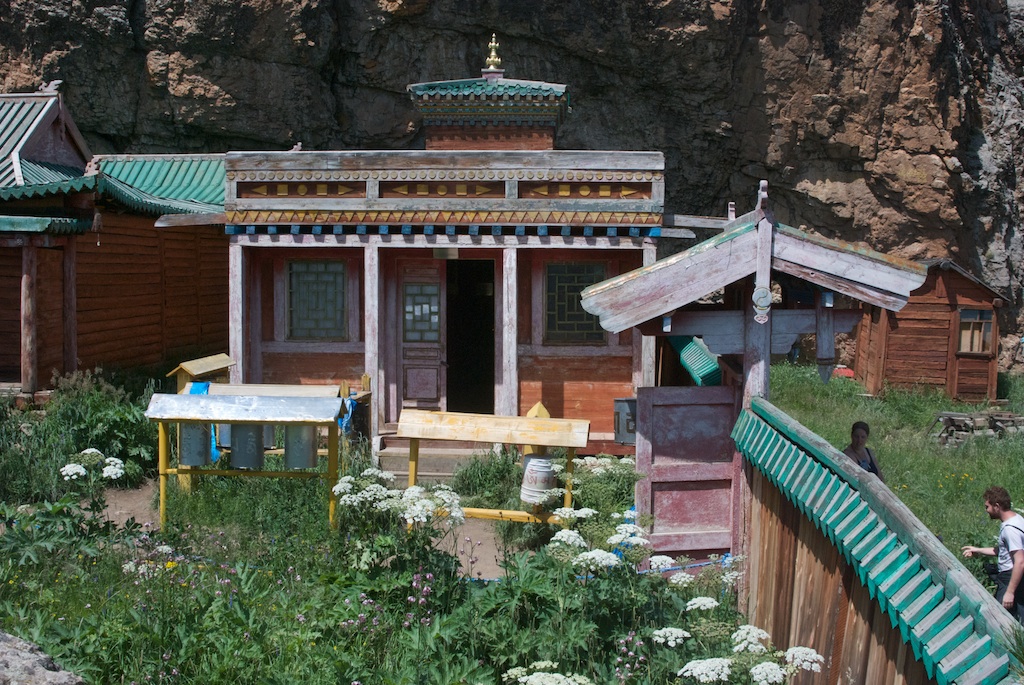
The buildings are of Tibetan/Nepalese style. Zanabazar ran afoul of the authorities more than once and this was one place where he took refuge. There are a number of small structures and stupas, but one of the main reasons people come here is to climb up the cliff that backs the monastery to pass through a “womb cave”. Doing so symbolizes death and rebirth. Men can then continue onto the top. Women are not allowed. Right or wrong, that’s simply the way it is. I was too wrung out from the hike, so I stayed below, took photos and enjoyed just sitting and being in a very special place.
Temple with prayer wheels
In the background of the above photo, you can see people beginning the climb to the top. It was very steep, really right up the cliff face. Not anything that would be allowed in the USA.
Temple building with fence and gate
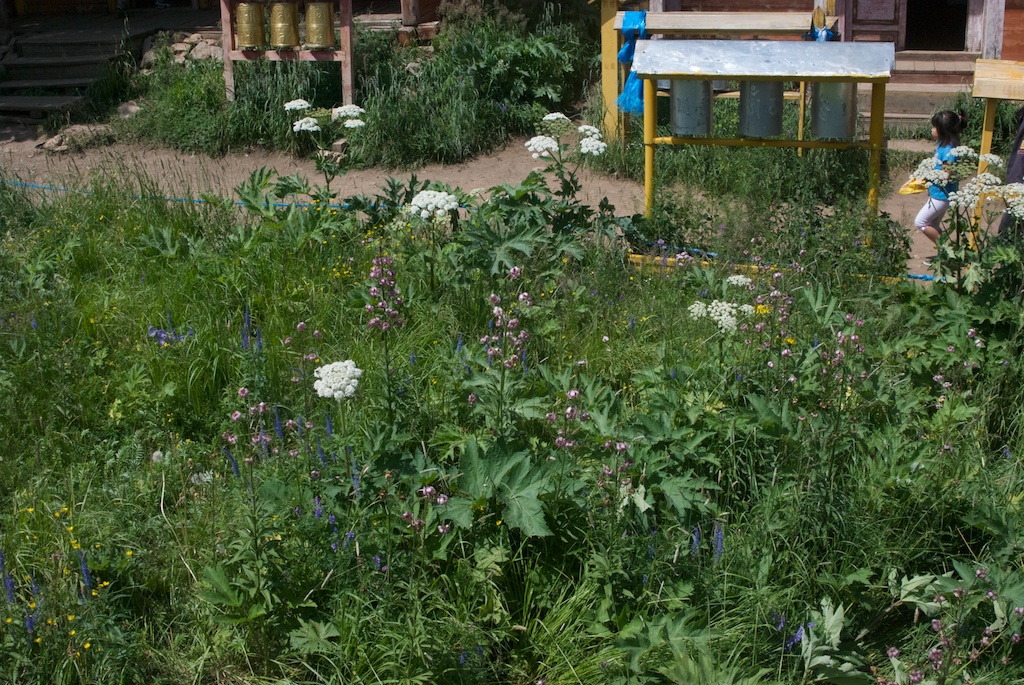
There was also a small garden. Once again, there were native plants that have been introduced into America. But what was really special were these lilies, the only time I’ve seen them in all my trips to Mongolia.]
LiliesMonastery garden with cow parsley, veronica, larkspur, hardy geraniums and the lilies
Finally it was time to take our leave and start back down. I took this last photo from down below. You can just see the top of the temple roofs.
View of monastery setting
The hike back to the car was easier, even with the ups and downs. We drove down the hill to a huge swath of wildflowers. Other tour groups had set up long tables and were having lunch. Khatnaa pulled right out into the middle of the flowers and we also had our lunch surrounded by them.
Lunchtime view
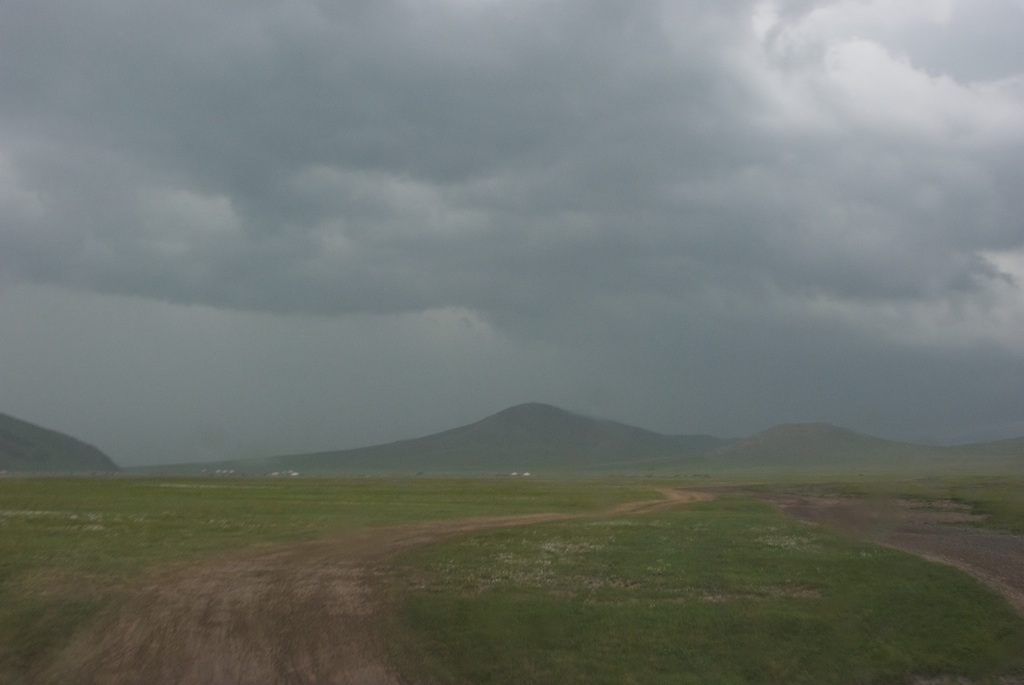
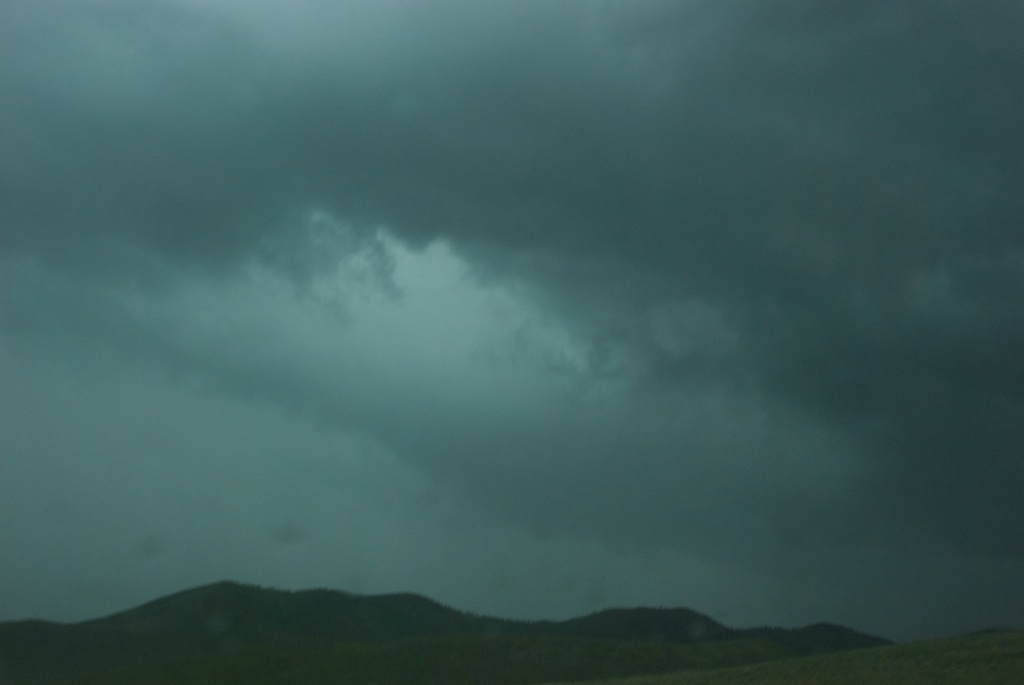
Just as we were finishing up, it started to sprinkle. Time to leave. The sun had vanished over the past hour and as we drove on, I realized that we were driving more or less straight towards some very dark and heavy clouds.
We started to see big bolts of lightning to the right and left. Then in front. We reached an elevation where we were almost up in the clouds. Diffused flashes of bright light went off directly in front of us with almost simultaneous cracks of thunder. Then it started to rain. Hard.
Storm clouds, but no rain yet; taken through windshield
At this point, I stopped taking pictures for awhile because I didn’t want to distract the driver. The storm had become very intense. Eventually, we came down into a high valley.
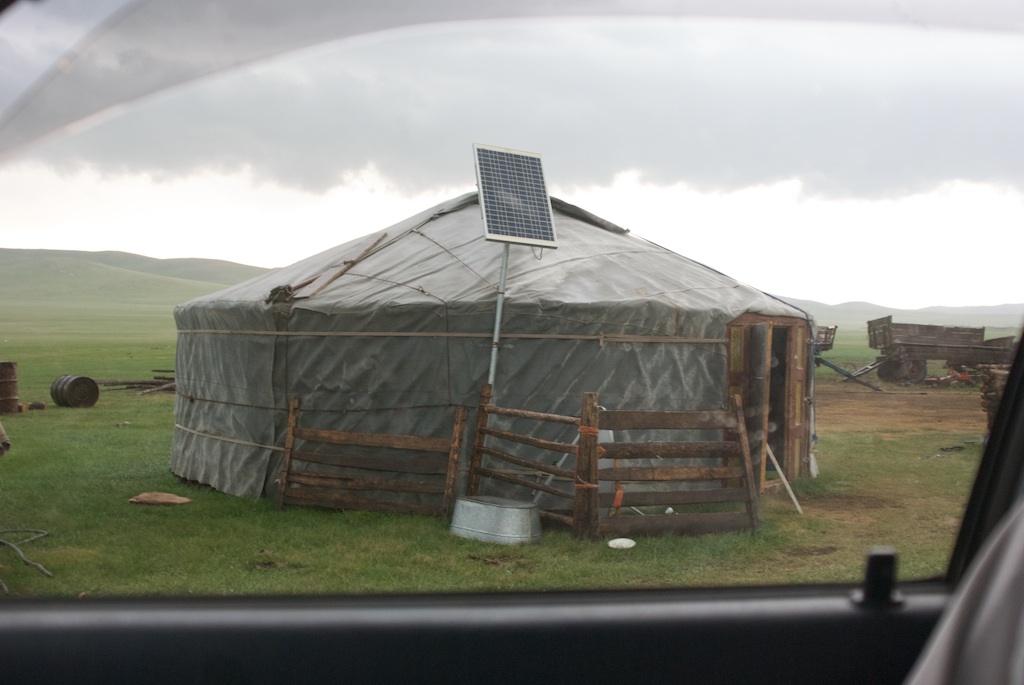
Rain in the distance; the direction we were goingA ger we made a quick stop at
And then went back up in elevation again in driving rain.
Serious storm cloudsRoad back up into the mountains
We reached the pass. The rain had let up enough for us to circle this ovoo.
Ovoo up on the passDown into another valley
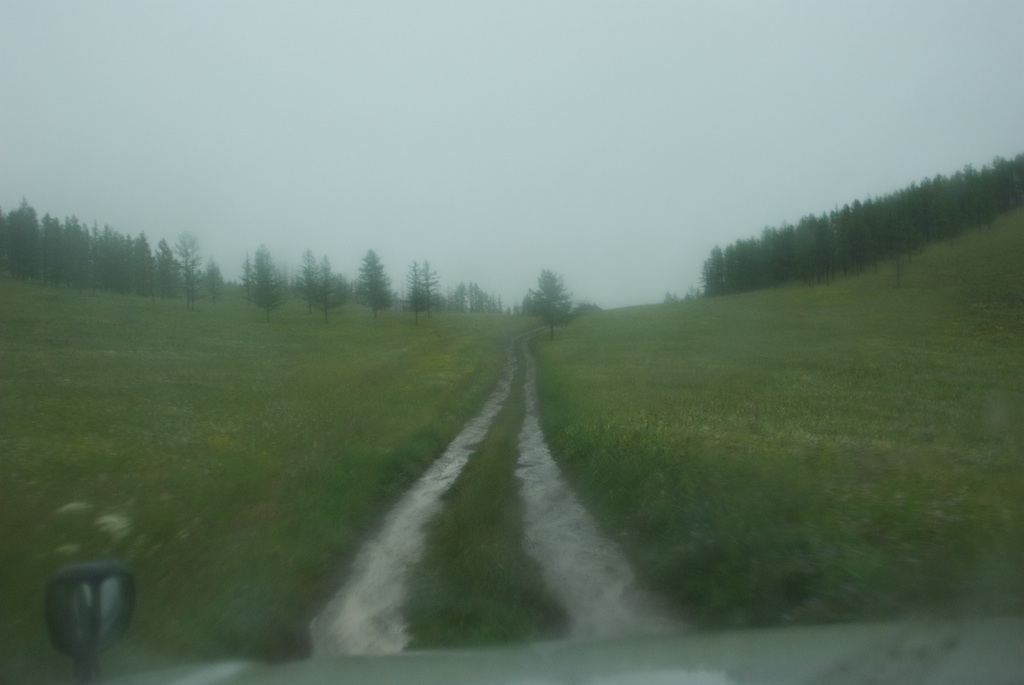
Once we came down into this valley and saw all the gers and animals, I thought to myself “Whew, we’re through it.” Wrong. We were driving toward where it had been raining, so there was an increasing water build-up on the earth roads which soon turned them to mud.
Coming down out of the mountains
The road got more and more treacherous. Once again I mostly stopped taking pictures to avoid causing any distraction. To quote from my journal:
“It had been raining heavily in the direction we were going and the roads were running with water and very slick in spots. As I sat in the passenger seat, I saw how deep the Mongol bag of tricks is for driving on in what were really impossible conditions.
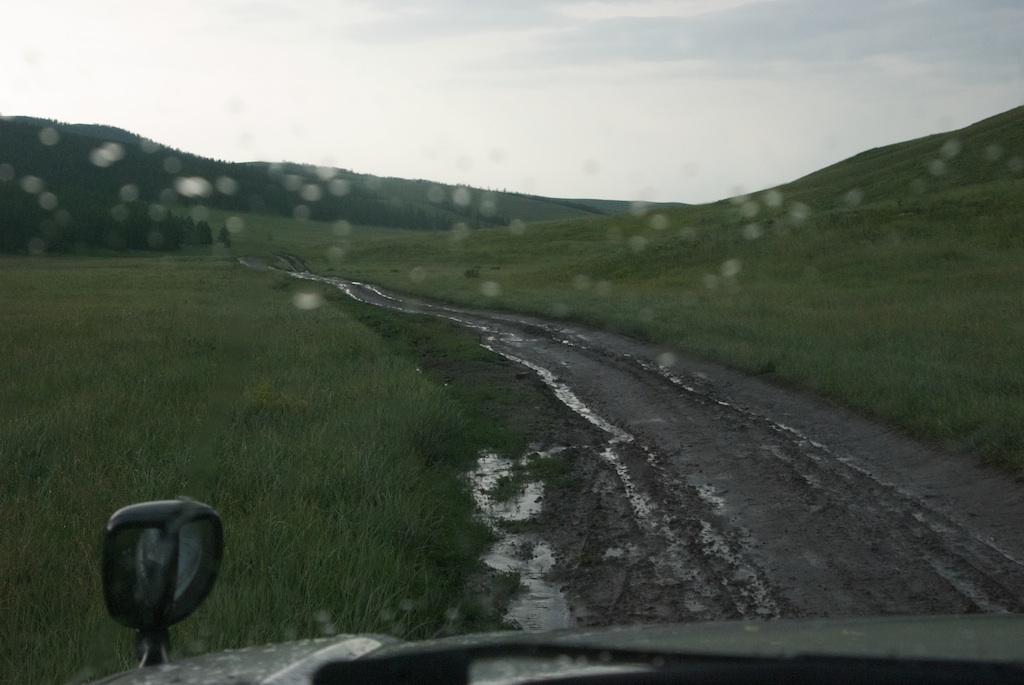
“The tire treads got so caked with mud at one point we lost traction completely and slid to the side of the road. Khatnaa, somehow, by turning the wheel back and forth quickly, got us facing in the right direction and then deliberately drove down a rut (see image below) at the side of the road that had water in it to clean off the treads on one side.
“He also kept the treads clear by driving on faint paths in the grass, off the road.
“We were still at high elevation and hadn’t seen a ger since the climb to the pass, so if we got stuck, I’m not sure what our options would have been. Calling AAA certainly wasn’t one of them.”
"Mud" road; deliberately driving into this ditch seemed really counterintuitive, but it worked
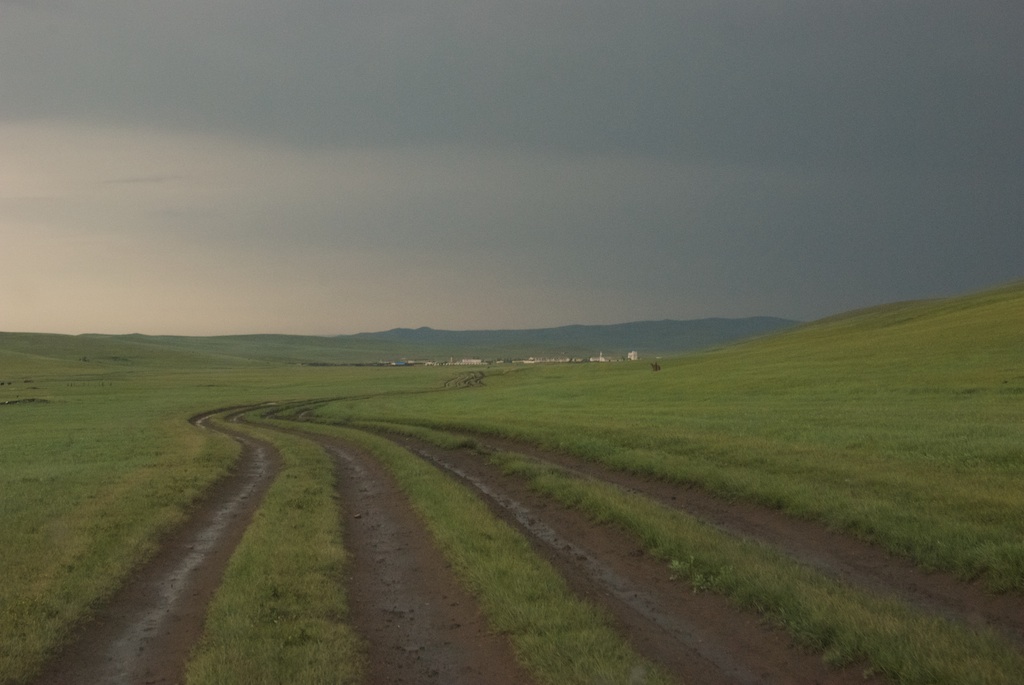
Finally we really were down out of the mountains, crossing a grassy steppe lit up in beautiful storm light.
Level, almost dry earth road at lastStorm light; grab shot from car windowSoft light on the steppeSoum center houses
All this had really used up the day and, to my eternal delight, we ended up at Soyoloo’s sister’s home for dinner. And what a dinner! First, of course, was good, hot suutai tsai (milk tea), followed by airag, followed by nermal arkhi, accompanied by a big platter of aruul. Then we were served mantuu (steamed bread) roe deer venison, lenok (a kind of fish) broth and a big serving of buuz.
We also learned that, not surprisingly, the rivers were either high or flooded at most of the fording spots. Our hosts led us to a safe crossing point as an almost-full moon lit our way. We arrived at our campsite around 9:30pm and set up the tents. I don’t believe any of us had trouble falling asleep that night.
A beautiful Mongolian night
Next time: A trip into Tsetserleg, plus Uigher ruins and Mongolia’s most famous visitor destination- Erdene Zuu.
I unexpectedly got some very good reference this past July for ruddy shelducks, a species that I hadn’t seen much of before this trip. Some of the best photos are of a mother duck and her ducklings, swimming around in a stream surrounded by yaks. And I will certainly do a painting of that.
But, first things first. I need to do a couple of studies of the adult and ducklings to learn “what they look like” and how I want to handle painting the feathers. I have no interest in rendering every feather, so I need to use the process of painting to analyze the pattern and see what I can leave out while still making it clear that I have observed shelduck feathers correctly. I’ll probably also go to Google Images before I start a larger, more complex painting so that I can get a feel for what is typical and what is unusual or where my reference might be deceiving me.
In the meantime, I did this simple 12×12″ study of a shelduck in nice light.
"Ruddy Shelduck, Mongolia" 12x12" oil on canvasboard
After lunch at the lovely spot that ended the previous post, we drove higher into the mountains, up where there were forests of larch trees.
Typical beautiful scenery
Two boys we passed; what a great place to be kid on a horse!
Many of them were a reddish color, which indicated that they were dead or dying of a beetle infestation. Very sad.
We came over a pass that had a very impressive ovoo.
Ovoo made of wood, with khadak
As we came up into the trees, we found ourselves in a wonderland of wildflowers. To my surprise and delight, one of the most common was very familiar – fireweed. It is an introduced plant in the United States and I see it in bloom in many places near our house and along the roadside. Little did I know that there is a little bit of Mongolia in the neighborhood.
Up into the mountains; fireweed by roadside
Large colony of fireweed
It was clearly the perfect time of year to see mountain wildflowers. I grabbed a lot of photos as we went by, but we also stopped a couple of times to get close-ups.
Wildflowers
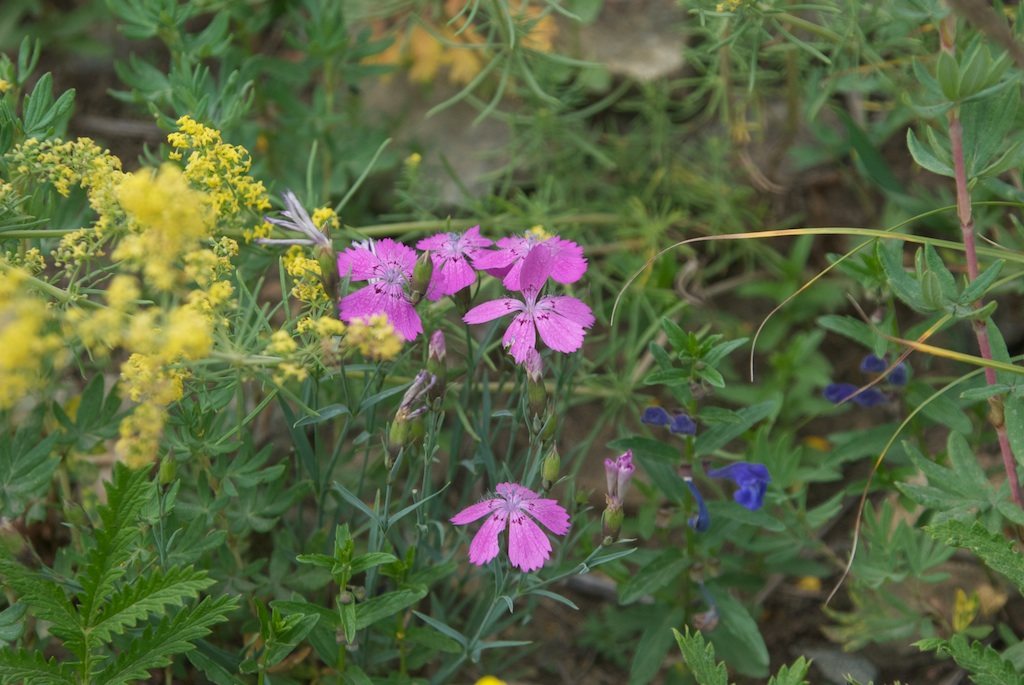
Dianthus
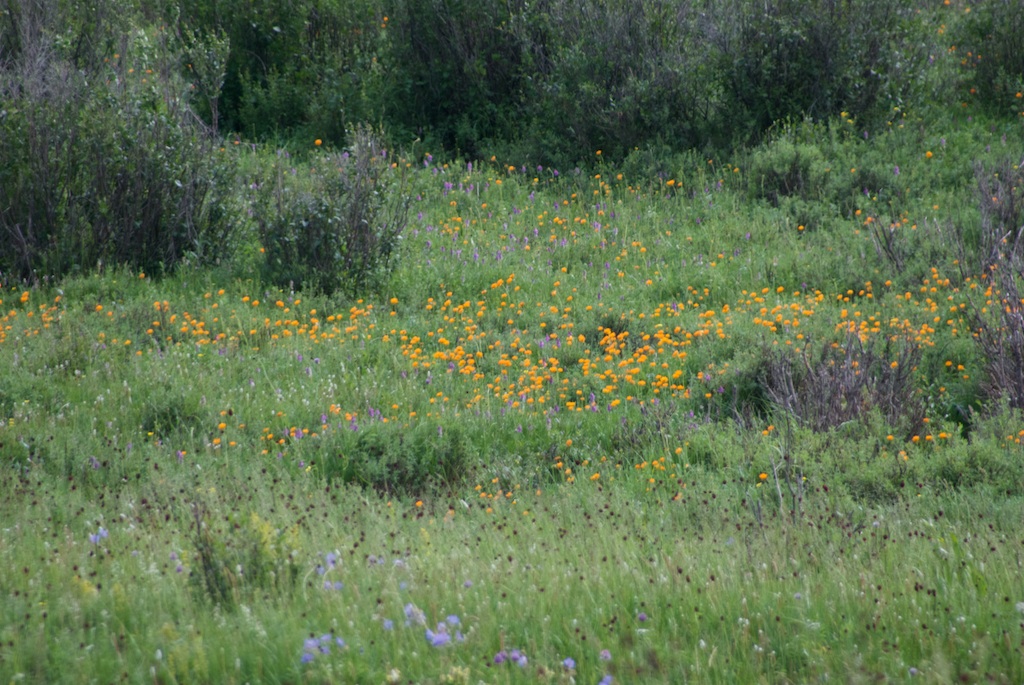
Colony of troilus (orange flowers)
Bedstraw, larkspur. burnet, geranium
The flowers tapered off as we came down in elevation, where we passed this herd of horses.
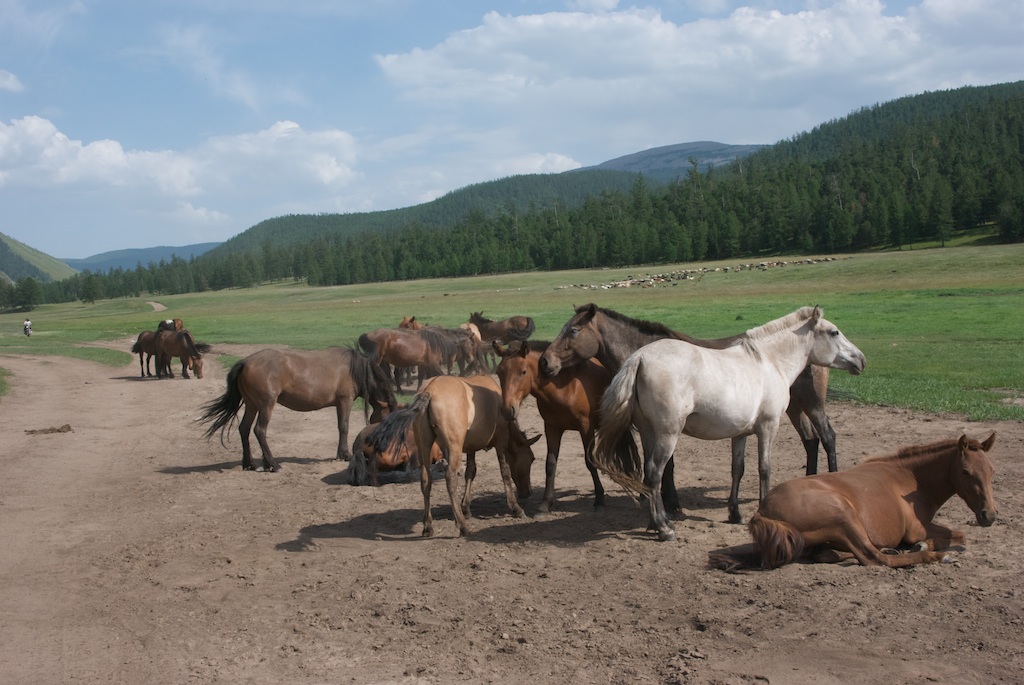
Horses
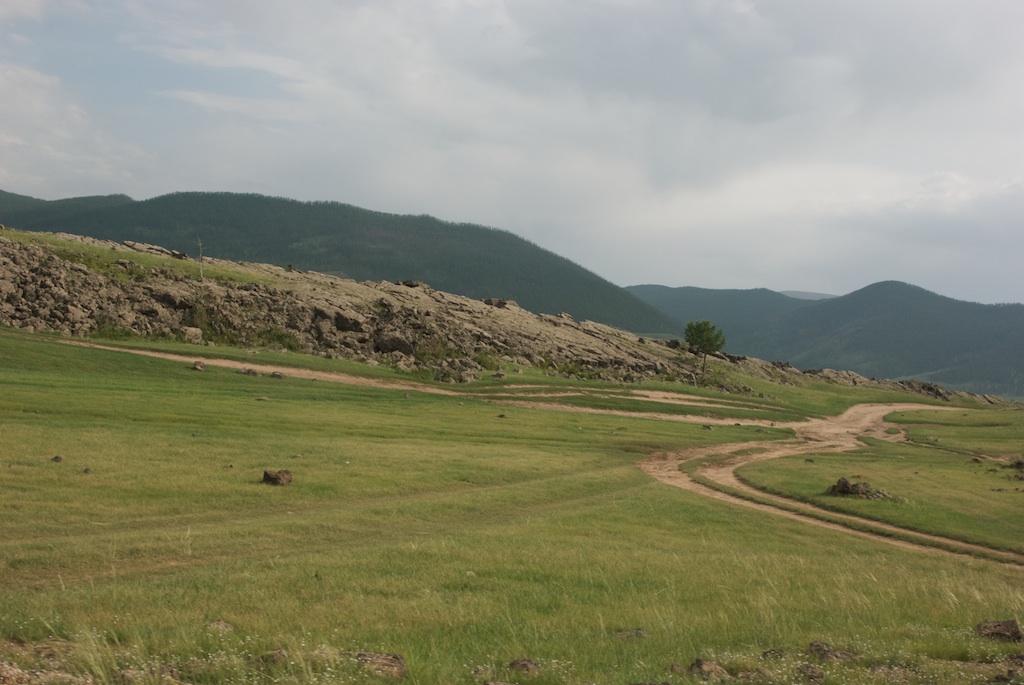
Soon we were driving across a very large valley with a lot of rock outcroppings. Upon looking at them closely, I realized that I had seen something similar in Hawaii and Idaho- lava flows. It looked as if the entire valley had been filled to some unknown depth from an ancient volcanic eruption.
Orkhon Valley
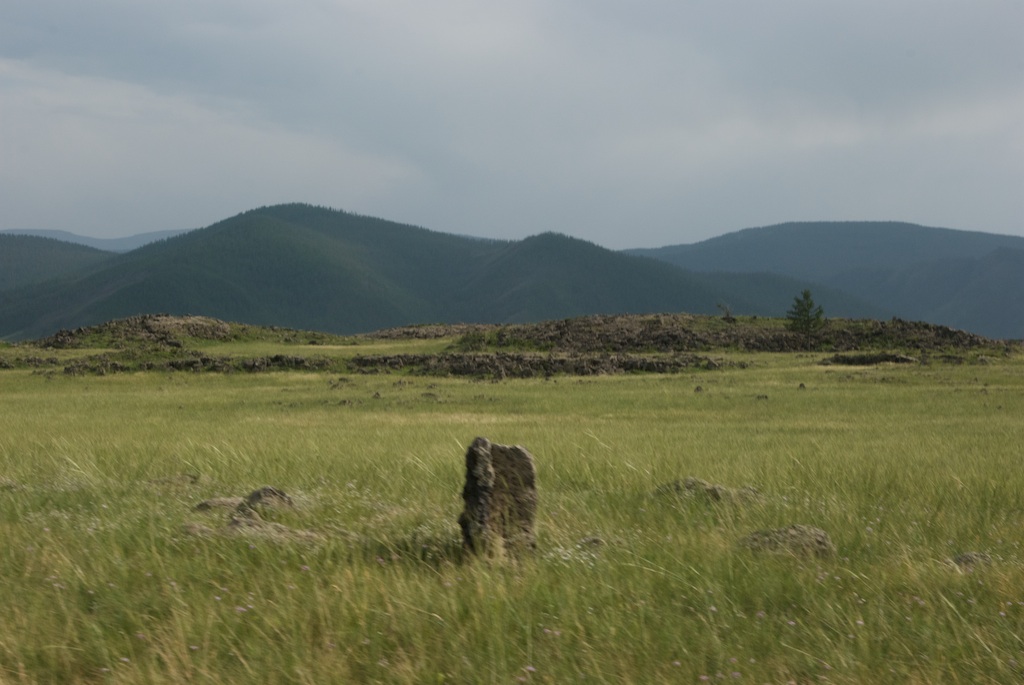
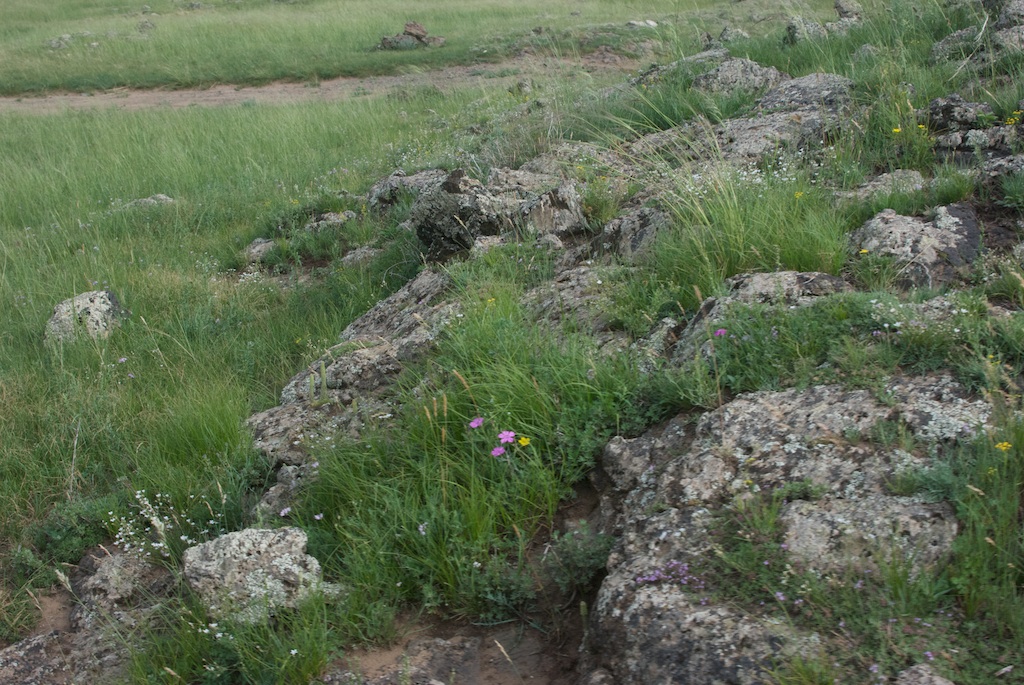
Wildflowers growing in lava formations
Edge of massive lava flow
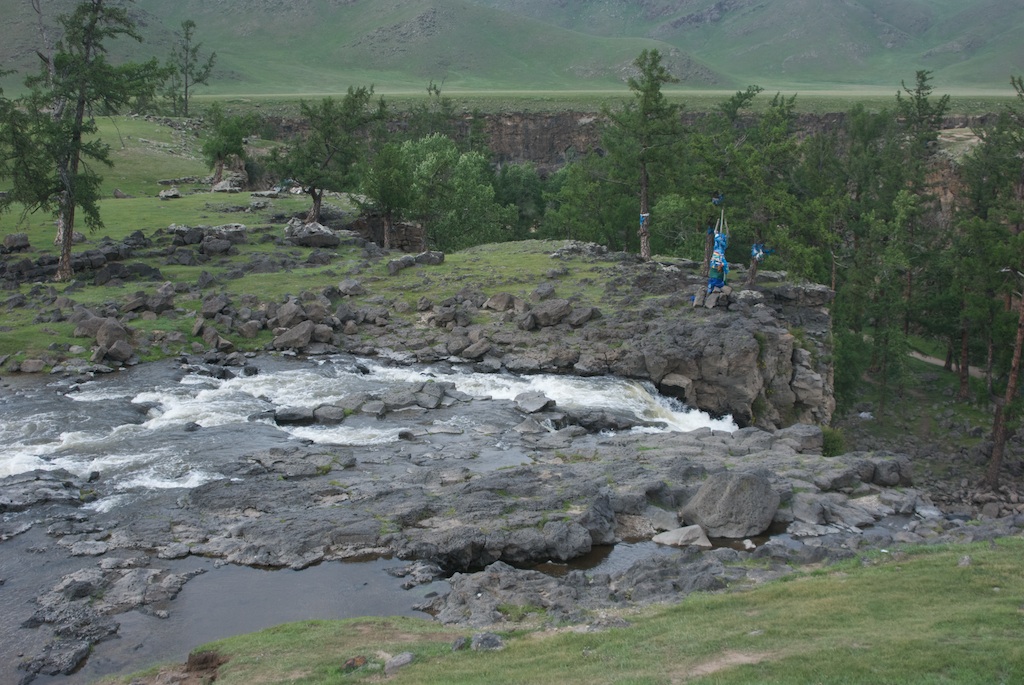
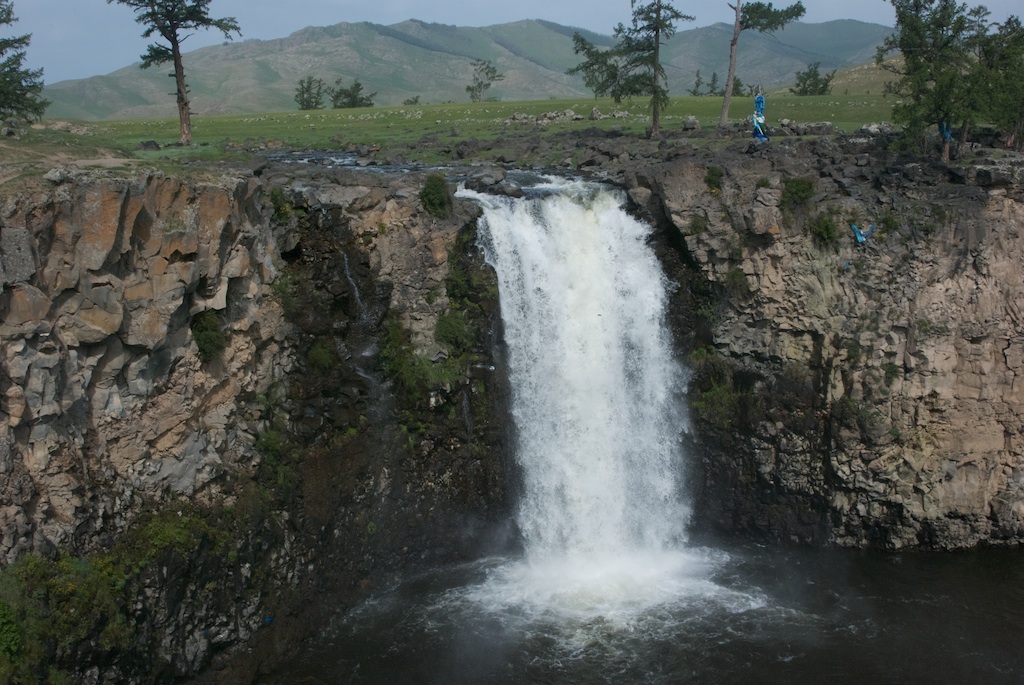
We finally approached the site of something that Mongolia isn’t particularly known for… a waterfall. The amount of water going over the edge is dependent on rainfall. Many people apparently go to the Orkhon Falls and are disappointed in how little water there is to see. We weren’t. One consequence of the rainfall that has been a part of this story from the time we were in the Gobi is that the falls were full and beautiful. It was pretty overcast, so we took a look and some photos and left to find a campsite.
At the edge
At Orkhon Falls
Once again, good yak viewing from the comfort of our camp.
My tent, with yaks
A couple of local herders came by to gather up their animals.
Local herder
The next morning was bright and sunny, so we went back to the falls before departure and I got some lovely photos.
Khatnaa, me and Soyoloo; the kid who Khatnaa handed my camera to did a nice job!
One can now see how deep the lava deposit is.
Orkhon Falls
Ovoo at edge of falls
Orkhon Gol (river)
By an interesting coincidence, another Humboldt County artist friend was not only in Mongolia at the same time as me, but she and some other folks were on a canoe trip. On the Orkhon Gol. They were far downriver from where I was, to the north. The Orkhon Gol orginates in the Hangai Mountains and flows north, where it joins the Selenge Gol, which flows into Lake Baikal.
On our way out of the area of the falls, we saw two black kites sitting on fence posts.
Black kites
Little did I know that this morning was the beginning of one of the most interesting, eventful and unexpected days of the entire trip.
































 Susan Fox, American Artist